
中考英语语法动词及时态 2PPT讲稿思维导图知识点归纳总结[PPT白板课件]
词 有人称和数的变化。
will
情态动词表示能力、义务、必要、
情 猜测等,表示说话人的语气或情态。
态 动
情态动词只能和动词原形一起构成 can,could,may,might,must, 谓语动词,没有人称和数的变化。 need , shall , should , will ,
would
词
动词短语 常见以下六种类型: 1. 动词+介词,宾语位于介词后。例如: look for; listen to; talk about/with; think about 2. 动词+副词,代词作宾语时须用“动词+代词+副词”形式; 名词作宾语可以在副词前,也可在副词后。例如: turn on/off/ up/down; pick up; call up; take out 3. 动词+副词+介词,宾语位于介词后。例如: come up with; run out of; get on/along with
用法
例句
表示习惯性、经常性的动作或存在 的状态,常与always,often, sometimes, every day等频率副词 或时间状语连用
①I often go to school at seven. 我经常在 七点钟去上学。
②We visit Uncle Liu every month. 我们每月都去看望刘叔叔。
现在完成时 主语+have/has+过去分词+其他
中学阶段见到的其他时态
时态
构成
过去完成时 主语+had+过去分词+其他
过去将来时
现在完成 进行时
主语+would+动词原形+其他 主语+was/were going to+动词原形
主语+have/has+been+现在分词+其他
ห้องสมุดไป่ตู้
二、时态的应用及动词变化形式 1. 一般现在时 (1)一般现在时的用法
用法 表示客观事实或普遍真理
例句
The sun rises in the east. 太阳在东方升起。
在时间、条件或让步状语从句 If it doesn’t rain tomorrow, I will leave. 如果
中,表示将要发生的动作
明天不下雨我将离开。
g动 安o排,词好c常o的m用e将,一要l般e发a现ve生,在的a时r动ri表v作e示等计瞬划间、T的h火e t车rai5n:
(2)动词第三人称单数形式的变化规则
规则
举例
一般情况下直接加-s
read—reads write—writes run—runs swim—swims
以-ch, -sh, -s, -x或-o结尾的词加- teach—teaches wash—washes
es
go—goes
以“辅音字母+y”结尾的词变y try—tries
I met him in the street yesterday. 昨天我在街上遇到他了。
②表示过去某一段时间内经常或反复发生的动作。 通常与often, usually, seldom等表示频度的副词连用,但这种用 法是以一个过去时间为前提的。例如: He often went to school by bus last term. 上学期他经常乘公共汽车去上学。 ③在时间、条件状语从句中,常用一般过去时代替过去将来时。 例如: He said he would not go if it rained. 他说如果下雨他就不去了。
4. 动词+名词+介词,宾语在介词后;名词前可以加形容词限定。 例如: take (good) care of; take pride in; pay (more) attention to 5. 动词+名词(后无宾语)。例如: take place; lose heart 6. be+形容词+介词,形容词前可加程度副词。如very等。例如: be proud of; be angry with; be interested in
grow,feel,appear,turn
词
分类
定义
例词
本身没有词义,不能单独作谓语,
只能和别的动词一起构成谓语动词,
助 表示时态、语态、语气等特征。帮 be(am, is, are) , do(does, did,
动 助构成否定、疑问、强调、省略等。done),have(has, had),shall,
为i再加-es,但“元音字母+y”则 study—studies
直接加-s
play—plays
carry—carries stay—stays say—says
2. 一般过去时 (1)一般过去时的用法 ①表示过去某个特定时间发生的动作或存在的状态。通常与 yesterday, last year, in 1976, a few months ago等表示过去的时 间状语连用。例如:
总有一款PPT 适合您
【最新出品\精心整理\倾情奉献\敬请珍惜】
考点一 动词的分类
分类
定义
例词
实 义
及物 borrow, enjoy, put, forget, 实义动词是指具有完整意义,可 动词 worry, love, guess, use 以单独作谓语的动词,主要表示
动 主语的动作、状态和品质。根据
for Beijing 30离开。
leaves
at
5:
30.
开往北京
元贝驾考网 / 元贝驾考科目四 科目一 科目三 仿真试题
【巧学妙记】学习一般现在时,基本用法要熟悉。 表示动作常发生,特征性格和能力。 存在状态和习惯,客观事实与真理。 如果主语是单三,谓语就要变一变。
词 能否带宾语,又分为及物动词和 不及 arrive , come , go , run ,
不及物动词。
物动 walk , cry , swim , fall ,
词 happen
连
系
动
连接主语和表示主语身份、性质、be , seem , look , become , get ,
状态的动词称为连系动词。
考点二 动词的时态
一、时态构成
时态
构成
一般现在时 主语+动词原形+其他 主语(第三人称单数)+动词的单数形式+其他
一般过去时 一般将来时 现在进行时 过去进行时
主语+动词过去式+其他 主语+will/shall+动词原形+其他 主语+be going to+动词原形+其他 主语+am/is/are+v. -ing+其他 主语+was/were+v. -ing+其他
中考英语动词时态讲解 PPT资料共46页.ppt

[解题技巧] 以此立意的试题考查考生能否通过“过去 动作对现在的影响”这一含义判断出动词 用现在完成时态。
本题中“从去年至今我都没有见过我的老 师了”,对现在的影响是“我想念老师”, 强调了“没有看”这一动作对现在的影响, 选C。
11. “经历”所采用的现在完成时态。
—Would you like to see the film with me?
4.现在进行时的用法
1) 现在进行时表示说话时或近阶段正在进 行的动作,由“be十现在分词”构 成.例如: Look! The students are reading. (说话 时正在进行的动作)
We’re all working for the 2019 Olympics.(近阶段正在进行的动作)
he _______.
A. returned C. will return
B. returns (成都)
[解题技巧] 以此立意的试题考查考生是否掌握了when, until, as soon as等引导的时间状语从句和if 引导的条件状语从句中的一般现在时态。
本题中的主句是一个一般将来时态,as soon as引导的从句用一般现在时态与之呼 应,选B。
My friend will come tomorrow. Mr Green will teach us English next term. 注:Will you do…? 还可表示一种请求的 语气。
如: I can’t carry the box, will you help me? 2) “ to be going to十动词原形”,表示即将
David had a good time yesterday. I usually got up early when I was young. 2)表示过去经常发生的动作,也可用 “used to+do”表示。例如: My father used to smoke. Grandma used to be a history teacher 注意;used to表示过去常发生而现在不 再发生的动作或存在的状态。
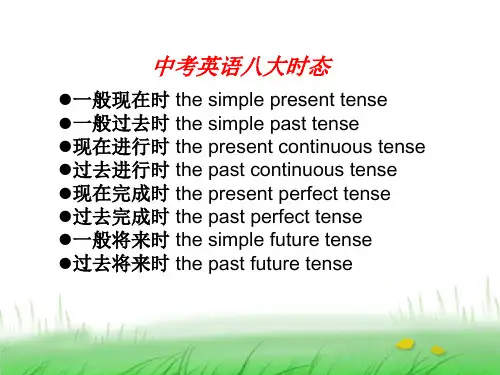
中考英语动词时态课件(38张PPT)
planned
get got take took go went swim swam eat ate drink drank are were have had do did come came cut cut put put say said see saw
1.The twins ___w_a__sh__e_d__(wash) the
Lily
Lucy
What a fine day today! Look....
过去进行时: Past Progressive 概念: 表示过去某一时刻或某一个时间段内 发生的动作 结构: be (was,were) + doing 标志语:at 8:00 yesterday 、 at that moment 、 when 、 while、…
一般过去时: Past Simple 概念: 表示过去经常或反复发生的动作 结构: did, was/were(过去时)
例句:I went to the park yesterday. I was happy yesterday.
标志语:yesterday、... ago、just now in 1992、 last week/month…
结构: have done/ been/gone(过去分词)
标志语:already、yet for 、since
get got gotten
go went gone
eat ate eaten
are were been
do did done
cut cut
cut
say said said
night
பைடு நூலகம்
went… visited…
初中英语语法动词时态详解 PPT课件 图文

中考模拟:
--Mike, who____football in the yard?
--Let me go and see. (2004顺义)
A.has played
B.will play
C.was playing
D.is playing
1.Look!What___the children___ over there? A.are;do B.are;doing C.is;do D.is doing 2.Those workers____here these months.
初中英语语法(1)
动词的时态
动词的时态结构歌谣
一 一般现在时,动词用原型; 般 单数三人称,动词加“s” 。 时 一般过去时,动词加“ed”。
I work. He works. I worked.
现在进行时,
进 am,is,are,-ing。
行 时
过去进行时, was,were,-ing。
例句:I am working.
10.I borrowed the book a week ago.I_h_a_v_e _k_e_p_t_the book for a week.
11.I bought the car a year ago. I_h_a_v_e _h_a_d_the car since a year ago.
1.--What a nice bike! How long____you____it?
--Just two weeks.(2004北京市中考)
A.will;buy B.did;buy C.are;having D.have;had
2.--How long have you____here? --Since 1997.
动词的时态和语态-PPT课件

9. The boys __w_e_r_e_p_l_a_y_in_g___ (play) basketball from 5:00 to 6:00 yesterday.Βιβλιοθήκη .19练习
.
20
用所给动词的正确形式填空: 1. She _l_e_ft__ (leave) the office two
hours ago. 2. As son as she arrived home, the girl
discovered that she _h_a_d__t_a_k_e_n__ (take) her friends book by mistake. 3. Who _c_o_m__e_s__ (come) to school earliest in your class every morning? 4. Great changes _h_a_v_e_t_a_k_e_n_p__la_c_e__ (take place) in this city since 1979. 5. By the time he was twelve, Edison _h_a_d__b_e_g_u_n_ (begin.) to sell newspape21rs.
I’ll go to see you when I have time. I’ll go to see you if I have time tomorrow. 2. 某些动词,如:stand, continue, wish, love, like, hate, feel, find, think等常用一般现在时态
中考专题复习---动词的时态和语态ppt课件

times a day , etc
.
6
一般现在时用法
习惯活动 I get up at six every morning.
现在情况
They are very busy. He needs help.
客观事实 主将从现
The moon moves around the earth.
We’ll go there if it doesn’t rain. He’ll call you when he arrives. -
概念:表示将来某个时间要发生的动 作或存在的状态
构成形式 :1. will/shall+do
2. am/is/are going to+do
3. am/is/are + doing
常用时间状语 :
tomorrow, in three days,this…,
next…, soon, etc. .
18
一般将来时用法 将来状态 There will be rain tomorrow. 将来活动 What are you going to do next
weekend?
主将从现 I will call you as soon as I get
there tomorrow morning.
现进表将 The bus is coming.
.
19
一般将来时的注意点:
Look at the dark clouds, it _is__g_o_in_g__to_rain. Tomorrow ___w_i_ll__ be April Fool’s Day.
C. wrote D. was writing
2. _W__h_il_e_Jim was making a paper plane ,
第十章动词的时态(思维导图+知识梳理+好题精炼)2022-2023初中英语中考语法归纳
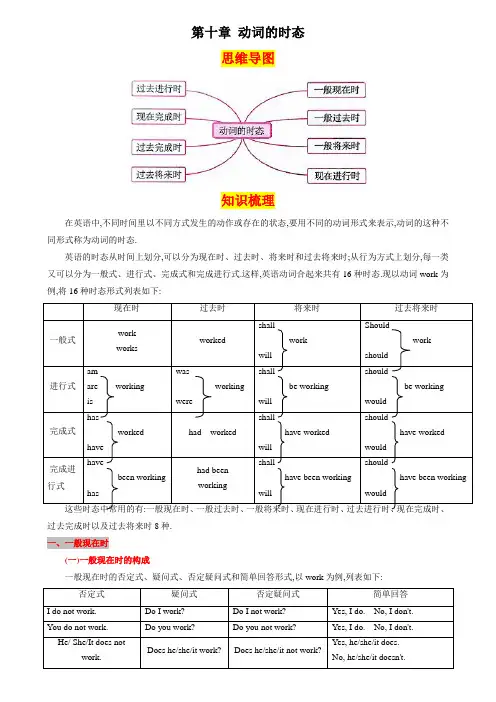
第十章动词的时态思维导图知识梳理在英语中,不同时间里以不同方式发生的动作或存在的状态,要用不同的动词形式来表示,动词的这种不同形式称为动词的时态.英语的时态从时间上划分,可以分为现在时、过去时、将来时和过去将来时;从行为方式上划分,每一类又可以分为一般式、进行式、完成式和完成进行式.这样,英语动词合起来共有16种时态.现以动词work为例,将16种时态形式列表如下:现在时过去时将来时过去将来时一般式workworksworkedshallworkwillShouldworkshould进行式amare workingiswasworkingwereshallbe workingwillshouldbe workingwould完成式hasworkedhavehad workedshallhave workedwillshouldhave workedwould完成进行式havebeen workinghashad beenworkingshallhave been workingwillshouldhave been workingwould这些时态中常用的有:一般现在时、一般过去时、一般将来时、现在进行时、过去进行时、现在完成时、过去完成时以及过去将来时8种.一、一般现在时(一)一般现在时的构成一般现在时的否定式、疑问式、否定疑问式和简单回答形式,以work为例,列表如下: 否定式疑问式否定疑问式简单回答I do not work. Do I work? Do I not work? Yes, I do. No, I don't.You do not work. Do you work? Do you not work? Yes, I do. No, I don't.He/ She/It does notwork. Does he/she/it work? Does he/she/it not work?Yes, he/she/it does.No, he/she/it doesn't.We do not work. Do we work? Do we not work? Yes, you do. No, you don't. You do not work. Do you work? Do you not work? Yes, we do. No, we don't. They do not work. Do they work? Do they not work? Yes, they do. No, they don't.当主语是第三人称单数时,谓语动词需加-s或-es(见下表):规则动词原形第三人称单数形式一般在词尾加-s playworkleaveswimplaysworksleavesswims以字母s, x, ch, sh, o结尾的词加-es passfixteachwishdopassesfixesteacheswishesdoes以辅音字母加y结尾的词,先变y为i,再加-es studycarryflycrystudiescarriesfliescries(三)动词第三人称单数加s或es后的读音1.在清辅音/p/, /k/, /t, /f/后读/s/stops/stɒps/ jumps/dʒʌ mps/ likes/laɪks/ picks/pɪks/ visits/vɪzɪts/ laughs/lɑːfs/coughs/kɒfs/ posts/pəʊsts/2.在/s/, /z/, /ʃ /, /tʃ /, /dʒ /之后读/ɪz/passes/pɑːsɪz/guesses/gesɪz/ rises/raɪzɪz/ refuses/rɪfju:zɪz/ wishes/wɪʃɪz/ washes/wɒʃɪz/ teaches/ti:tʃɪz/ watches/wɒtʃɪz/ changes/tʃeɪndʒɪz/ manages/mænɪdʒɪz/3.除以上两种读音外,其余的均读/z/(四)一般现在时的用法1.表示经常的或习惯性的动作常与often, always, sometimes, every day, on Sundays/Mondays等表示频度的时间状语连用.My father often gets up early in the morning.我父亲早晨经常早起.He has breakfast at 7:00 every morning.他每天早晨七点吃早饭.2.表示现在的状态My father is at work. He is very busy.我父亲在工作,他很忙.The boy is twelve.这个男孩儿12岁.3.表示主语具备的性格、能力和特征I like to listen to music.我喜欢听音乐.They speak English very well.他们英语说得非常好.This taxi driver knows the city of Beijing like the back of his hand.这位出租车司机对北京城了如指掌.4.表示客观事实和普遍真理Two plus two is four.2加2等于4.The sun rises in the east and sets in the west.太阳从东方升起,从西方落下.5.表示计划安排好的将来动作,也可用一般现在时,只限于: go, come, leave, start, begin, arrive, be等动The plane takes off at 11 a.m.飞机上午11点起飞.We leave Beijing next month.下月我们离开北京.He comes back tonight.他今晚回来.6.在时间、条件状语从句中,用一般现在时代替一般将来时I'll write to you as soon as I get to Shanghai.我一到上海就给你写信.Turn off the lights before you leave.走前关灯.If it doesn't rain tomorrow, we'll go to the park.如果明天不下雨,我们就去公园.If it rains tomorrow, we won't go to the park.如果明天下雨,我们就不去公园.7.表示(书、信、报纸、通知、牌示、广播等)“说”“报导”,用一般现在时,主要是动词sayThe notice says,“ No Parkin g.”通知说:“不准停放车辆.”The radio says heavy rain in the afternoon.广播预报下午有大雨.8.叙述历史,常用一般现在时,以使其生动Jeanne is sitting in the park. Mathilde walks towards her, and she stops and speaks to Jeanne.珍妮在公园里坐着.玛蒂尔德向她走来,停下来和珍妮谈话.二、一般过去时(一)一般过去时的构成(以动词work为例)否定式疑问式否定疑问式简单回答I did not work. Did I work? Did I not work?Yes, I did. No, I didn't.You did not work. Did you work? Did you not work?Yes, I did. No, I didn't.He/ She/ It did not work. Did he/she/it work? Did he/she/it not work?Yes, he/she/it did. No, he/she/it didn't.We did not work. Did we work? Did we not work?Yes, you did. No, you didn't.You did not work. Did you work? Did you not work?Yes, we did. No, we didn't.They did not work. Did they work? Did they not work?Yes, they did. No, they didn't.构成规则原形过去式-般在动词末尾加-ed workplantplayworkedplantedplayed结尾是e的动词在末尾加-dlikelivechangelikedlivedchanged末尾只有一个辅音字母的重读闭音节词,先双写这个辅音字母,再加-ed planstopdropplannedstoppeddropped以辅音字母加y结尾的,先变y为i再加-ed carrystudycrycarriedstudiedcried(1)prefer的过去式要先双写末尾辅音字母r再加-ed: preferred.(2)travel的过去式可双写1再加-ed; travelled(英式英语);也可以直接加-ed; traveled(美式英语).(三)动词过去式与过去分词的读音1.清辅音后面的-ed读/t/音stopped/stɒpt/停止laughed/lɑːft/笑asked/ɑːskt/提问hoped/həʊpt/希望dressed/drest/穿衣marched/mɑːtʃt/行军watched/wɒtʃt/看pushed/pʊʃt/推2.浊辅音及元音后面的-ed读/d/音rubbed/rʌbd/擦tried/traɪd/试图,努力lived/lɪvd/生活begged/begd/请求named/neɪmd/取名agreed/əgri:d/同意rained/reɪnd/下雨moved/mu:vd/移动3.t,d后面加-ed读/d/音united/ju:naɪtɪd/联合heated/hi:tɪd/加热ended/endɪd/结束needed/ni:dɪd/需要wanted/wɒntɪd/想要guided/'gaɪdɪd/指引4.以-ed结尾的过去分词作形容词用时读/ɪd /音aged/eɪdʒɪd/年老的learned/1ɜːnɪd/有学问的wicked/wɪkɪd/罪恶的interested/ɪntrəstɪd/感兴趣的(四)不规则动词的过去式和过去分词原形过去式过去分词词义Cost Cut Hit Hurt Let Put Read costcuthithurtletputreadcostcuthithurtletputread花费削、砍打击伤害、使受伤让放读Become Come Run becamecameranbecomecomerun成为来跑Bring Buy Fight Think Catch Teach broughtboughtfoughtthoughtcaughttaughtbroughtboughtfoughtthoughtcaughttaught带来买打架想抓住教Build Lend Send Spend Lose Smellbuiltlentsentspentlostsmelt/smelledbuiltlentsentspentlostsmelt/smelled建筑借给送,寄花(钱、时间)丢失闻Feel Keep Sleep Sweep Leave Meetfeltkeptsleptsweptleftmetfeltkeptsleptsweptleftmet感觉保持睡觉扫离开遇见Burn Learn Mean burnt/burnedlearnt/learnedmeantburnt/burnedlearnt/learnedmeant燃烧学会意思是Sell Tell soldtoldsoldtold卖告诉Hold held held 抓住、握住ShineWinGetStand UnderstandDigHang have(has)hearmakepay shone/shinedwongotstoodunderstooddughung/hangedhadheardmadepaidshone/shinedwongotstoodunderstooddughung/hangedhadheardmadepaid照耀,使光亮赢得到站理解、懂得挖挂/绞死有听见制造付(钱)say sit findsaidsatfoundsaidsatfound说坐发现am, is are do go wear lie see wasweredidwentworelaysawbeenbeendonegonewornlainseen是是做去穿着躺看见begin drink ring sing swim begandrankrangsangswambegundrunkrungsungswum开始喝打电话,(铃)响唱游泳drive rise ride write droveroserodewrotedrivenrisenriddenwritten驾驶升起骑(马、自行车)写blow grow know throw fly blewgrewknewthrewflewblowngrownknownthrownflown吹生长知道投掷飞draw showdrewshoweddrawnshown画、拉出示break speak choose take mistake wakebrokespokechosetookmistookwaked/wokebrokenspokenchosentakenmistakenwaked/woken打断,打破讲选择拿走弄错唤醒beat eat fall give forgetbeatatefellgaveforgotbeateneatenfallengivenforgotten打吃落下给忘记1.表示过去某个特定时间发生的动作或存在的状态这时常与yesterday, last week, a moment ago, in 1949等表示过去时间的状语连用.What did you have for breakfast this morning?今天早饭吃的什么?I had two eggs and a glass of milk.早饭吃了两个鸡蛋和一杯牛奶.The police stopped him on his way home last night.昨晚在回家的路上警察拦住了他.My sister passed her examination because she studied very hard.我妹妹通过了考试,因为她学习非常努力.2.表示过去某一段时间内经常或反复发生的动作,这时常和表示频度的状语连用Last term we often did experiments.上学期我们经常做试验.He always went to work by bus.他过去总是乘车去上班.She gave her teacher presents every Christmas.她每年都给她的老师送圣诞礼物.点拨used to do的否定式和疑问式有两种构成法.(1)借助did,即:didn't use to doHe didn't use to do it, did he?他过去不经常这么做,是吗?Did you use to play football?你过去经常踢足球吗?(2)不用did,即:usedn't to doShe usedn't to make those mistakes.她以前并不经常出那些错的.Used you to play football?你过去经常踢足球吗?3.在时间、条件状语从句中,常用一般过去时代替过去将来时He said he would not go if it rained.他说如果天下雨就不去了.They told us that they would not leave until she came back.他们告诉我们直到她回来他们才会离开.4.常用“would+do”表示过去经常反复发生的动作I would ask you to think carefully before you spoke.我劝你在讲话之前要认真考虑一下.We would turn to him for help when we were in trouble.我们一遇麻烦,就向他请求帮助.三、一般将来时(一)一般将来时的构成一般将来时的否定式、疑问式、否定疑问句式和简单回答形式,以study为例:否定式疑问式否定疑问句式简单回答I shall/will not study. Shall I study? Shall I not study?(Shan't I study?)Yes, you will.No, you won't.You will not study. Will you not study?Will you study?(Won't you study?)Yes, I shall/will.No, I shan't/won't.He/ She/It will not study. Will he/she/it notstudy?Will he/she/it study?(Won't he/she/it study?)Yes, he/she/it will.No, he/she/it won't.We shall/will not study. Shall we study? Shall we not study?(Shan't we study?)Yes, you will.No, you won't.You will not study Will you study? Will you not study?(Won't you study?)Yes, we shall/will.No, we shan't/won't.They will not study. Will they study? Will they not study?(Won't they study?)Yes, they will.No, they won't.在口语中,will常缩写为’ll与主语连写在一起.如:I'll, you'll, he'11和she'll we’ll, they'll, shall not 常缩写为shan't, will not常缩写为won't.在疑问中,主语为第一人称(I和We)时,常用助动词shall.(二)一般将来时的用法1.一般将来时表示在将来某个时间将要发生的动作或存在的状态.常与表示将来的时间状语如tomorrow, next week/month/year等连用I'll come to pick you up at 6:00 on Wednesday evening.我星期三晚上6点来接您.I'll have a party next Saturday. I hope you can come.下周六我要举行聚会,希望你能来.If it doesn't rain tomorrow, we are going to the Summer Palace.如果明天不下雨,我们就去颐和园.My daughter will be twenty years old next year.我女儿明年就20岁了.He will be here in ten minutes.他10分钟后在这儿.2.表示将来经常或反复发生的动作I'll come and see you every Sunday next year.明年我将每个星期天来看你.We shall come and work in this factory every year.我们将每年到这个工厂来劳动.3.表示揣测This will be the dictionary you're looking for.这大概是你要找的那本词典吧.The game will be finished by now.球赛大概已经结束了.4.“be going to+动词原形”结构表示现在打算在最近或将来要做的事,或表示说话人根据已有的迹象认为很可能要发生的事情.如: We are going to have a new subject this year.今年我们将学一门新学科.It's going to rain this afternoon.今天下午天要下雨.I'm not going to write letters.我不打算写信.5.“be+动词不定式”结构表示按计划要发生的事,或用来征求对方意见Where are we to stay tonight?今晚我们在哪儿过夜?What is to do?怎么办?6.“be about+动词不定式”结构表示即将做某事I haven't gone yet, I'm about to.我还没走,正要走呢.The Sports Meeting is about to start now.运动会即将开始.点拨有些表示位置转移的动词,如come, go, leave, start, arrive, fly等的现在进行时可表示按计划或安排将要发生的动作,常与表示将来的时间状语连用.He is leaving for Shanghai tomorrow.他明天动身去上海.They are arriving tomorrow afternoon.他们明天下午到达.(三)需注意的几点1.在回答Shall I...问句时,应该说:Yes, please./Please do.或No, please don't./Please don't.不可说:Y es, you shall.或No, you shall not.2.在回答Shall we...问句时,应该说:Yes, let's... 或No, I don't think we shall./No, let's not.(四)will和be going to的比较1.will和be going to 都可表示某种意愿但其含义和用法有所不同.be going to往往表示经过考虑的打算,而will多表示意愿、决心.We are going to watch the football game.我们打算观看这场足球赛.I will tell you all about it.我将把全部情况告诉你.2.will可用于条件从句表示将来的意愿,而be going to用于条件从句,只是表示单纯的将来,试比较Miss Gao will tell you the answer if you ask her.如果你去问高老师,她会告诉你答案的.If you are going to attend the meeting, you'd better leave now.如果你要参加会议,最好现在就走.四、现在进行时(一)现在进行时的构成现在进行时由“am/is/are+动词现在分词”构成.现在进行时的肯定式、否定式和疑问式及简单回答形式:(以动词work为例)肯定式I am/'m working.He (She, It)is/isn't working. We(You, They) are/'re working.否定式I am not/'m not working.He(She, It)is not/isn't working.We(You, They) are not/aren't working.疑问式Am I working...?Is he(she, it)working...?Are you(we, they)working...?简单回答Yes, you are. No, you aren't.Yes, I am. No, I'm not. Yes, he(she it) is. No, he(she ,it)isn't. Yes, we(you, they) are. No, we(you, they) aren't.1.一般在动词原形末尾加-ingstay-staying/'steɪɪŋ /do-doing/'du:ɪŋ/listen-listening/'lɪsnɪŋ/suffer-suffering/'sʌfərɪŋ/work-working/'wɜːkɪŋ/spend-spending/'spendɪŋ/look-looking/'lʊkɪŋ/2.以不发音的字母e结尾的动词,先去掉e,再加-ingmake-making/'meɪkɪŋ/take-taking/'teɪkɪŋ/give-giving/'gɪvɪŋ/ride-riding/'raɪdɪŋ/please-pleasing/'pli:zɪŋ/refuse-refusing/'rɪ'fju:zɪŋ/close-closing/'kləʊzɪŋ/operate-operating/'ɒpəreɪtɪŋ/3.以一个辅音字母结尾的重读闭音节词,先双写这个辅音字母,再加-ingput-putting/'pʊtɪŋ/sit-sitting/'sɪtɪŋ/run-running/'rʌnɪŋ/win-winning/'wɪnɪŋ/begin-beginning/bɪ'gɪnɪŋ/4.以ie结尾的动词,先去掉e,把i变为y,再加-inglie-lying/'laɪɪŋ/tie-tying/'taɪɪŋ/die-dying/'daɪɪŋ/5.以re结尾的动词,先去掉e,再加-ingprepare-preparing/prɪ'peərɪŋ/interfere-interfering/ɪntə'fɪərɪg/tire-tiring/'taɪərɪŋ/bore-boring/'bɔ:rɪŋ/cure-curing/kjʊərɪŋ/6.以er结尾的动词,如果是重读音节结尾,先双写r,再加-ing;如果不是重读音节结尾,就直接加-ing prefer-preferring water(浇水)-watering(三)现在进行时的用法1.表示说话时正在进行或发生的动作这时可以不用时间状语,也可以和now, at present, at the moment等时间状语连用.有时用一个动词.如look(看),listen(听).What are you reading now?你在读什么?His mother is watching TV at the present.此刻,他的妈妈正在看电视.I'm writing a novel at present.眼下我正在写一部小说.Look! The bus is crossing the bridge.看!这辆公共汽车在过桥.Listen! Someone is singing in the classroom.听!有人在教室里唱歌.2.表示当前一段时期内的活动或现阶段正在进行的动作(说话时动作不一定正在进行),常与表示一段时间的状语these days, this week等连用They are working in a factory these days.他们这几天正在工厂劳动.More and more people are giving up smoking.越来越多的人在戒烟.They are working in a factory these days.他们这几天在工厂劳动.They're visiting Beijing this week.这周他们在北京观光.3.现在进行时常与always, continually, constantly, forever等表示频度的副词连用,表示经常、反复发生的动作,常表示厌烦、不满、赞扬等情感He is always thinking of his work.他总是想着他的工作.They're forever quarrelling about something.他们老是为某件事争吵不休.(不满)4.现在进行时有时也用来代替一般现在时,表示一个经常性的动作或状态,或是为了表示一种感情(如赞叹、厌烦等)或是为了强调情况的暂时性How are you feeling today?你今天觉得怎么样?(亲切)Linda is doing fine work at school.琳达在学校学习挺不错.(赞美之意)5.有些动词:如come, go, leave, arrive, begin, start, stay等的现在进行时可表示将要发生的动作,一般跟时间状语,表明动作发生的时间The train is arriving soon.火车要到了.We are leaving on Saturday.我们星期六动身.Are you going anywhere tomorrow?明天你到哪儿去吗?(四)有的动词不能用于现在进行时这些词通常是表示感觉、感情、存在、从属、思维等的动词.表示感觉的动词:see, hear, smell, taste, feel, notice, look, seem, appear表示感情的动词:hate, love, fear, like, want, wish, prefer, refuse, forgive(原谅)表示存在状况:be, exist(存在), remain(保持), stay, obtain(获得)表示从属或占用:have, possess(拥有), own(拥有), contain(包含), belong(属于),consist of(由······组成), form(形成)表示思考、理解:understand ,know, believe, think, doubt, forget, remember五、过去进行时(一)过去进行时的构成过去进行时由“was/were+现在分词”构成.过去进行时的肯定式,否定式和疑问式及简单回答.(以动词work为例)肯定式I(He, She, It)was working. We(You, They)were working.否定式I(He, She, It)was not working We(You, They)were not working.疑问式Was I(he, she, it)working..? Were we(you, they)working...?简单回答Yes, you were. No, you were not.Yes, I was No, I was notYes, he(she, it) was. No, he(she, it) was not.Yes, you(we, they)were. No, you(we, they) were not.1.过去进行时表示过去某一个时刻或某一段时间内正在进行或发生的动作.通常与表示过去的时间状语连用.then, at this/that time, yesterday, at nine, last night等At 8:00 o'clock yesterday evening I was having dinner with some friends.昨天晚上八点,我在和几位朋友一起吃饭.The doorbell rang while my mother was cooking the dinner.在妈妈做饭时,门铃响了.Mary fell asleep while she was watching TV.玛丽看着电视睡着了.My son was learning English in Australia last autumn.去年秋天我儿子在澳大利亚学习英语.I was reading an interesting book last month.上个月我在看一本有趣的书.2.表示移动的动词.如:come, start, stay, leave, fly等词的过去进行时,可以表示过去将要发生的动作He was leaving the following day.他第二天将要离开.She asked when I was starting.她问我何时动身.3.过去进行时动词常与always, forever, continually, constantly, frequently等副词连用,代替一般过去时,强调过去经常性或习惯性动作,表现出说话人的赞美、厌烦等情绪He was forever complaining about something.他老是怨这怨那.He was constantly asking questions.他老是没完没了地提问题.4.在含有时间状语从句的复合句中,延续时间较长的动作用过去进行时,另一个动作用一般过去时.若表示两个延续动作在过去某一时刻同时发生,则主句和从句的谓语动词都用过去进行时What was Jim doing when the teacher came in?老师进来的时候吉姆在做什么?He read a piece of newspaper while he was waiting for the bus.他一边等车,一边看报.The students were reading while the teacher was grading their homework.学生们在看书,而老师在批改他们的家庭作业.点拨(1)静态动词如be, have, seem, depend on(依靠)等一般不能用于进行时态.(2)表示知觉、认识或情感的动词如see, hear, believe, know, like, love, want, wish等一般也没有进行时态.(三)一般过去时与过去进行时的用法比较一般过去时表示在过去某个时间发生的动作或存在的状态;而过去进行时则表示在过去某个特定时间正在进行的动作.Mary wrote a letter to her friend last night.玛丽昨晚给她朋友写了封信.(信已写完)Mary was writing a letter to her friend at 8:00 o'clock last night.昨晚八点钟玛丽在给她的朋友写信.(信不一定写完,只说明了动作的延续)It was raining this time yesterday.昨天这个时间在下雨.(动作延续)It rained yesterday.昨天下过雨.(动作完成)六、现在完成时(一)现在完成时的构成现在完成时由“have/has+过去分词”构成.现在完成时的肯定式、否定式和疑问式及简单回答.(以动词work为例)肯定式I(You) have worked.He(She, It) has worked.We(You, They) have worked.否定式I(You) have not/haven't worked.He(She, It) has not/hasn't worked.We(You, They) have not/haven't worked.疑问式Have I(you) worked...?Has he(she, it) worked...? Have we(you, they) worked...?简单回答Yes, you(I) have. No, you(I) have not/haven't. Yes, he(she, it) has. No, he(she, it) has not/hasn't. Yes, you(we, they) have. No, you(we, they) have not/haven't.②have not常缩略为haven't, has not常缩略为hasn't.(二)现在完成时的词尾变化现在完成时由“助动词have/has+过去分词”构成.规则变化的过去分词与动词过去式的变化一样,在动词词尾加-ed;不规则变化的过去分词见“一般过去时”一节的不规则动词表.(三)现在完成时的用法1.表示过去已经开始,持续到现在(也许还会继续进行下去)的动作或状态;常和表示一段时间的状语,如:today, these days, since, for, this month, now等连用I'm hungry. I haven't eaten anything since breakfast.我饿了,早饭以来我还什么东西都没吃.I have worked at this school for 20 years.我在这所学校工作20年了.They have lived in Beijing since 1972.他们从1972年以来就住在北京.He has drunk four cups of coffee today.他今天喝了4杯咖啡了.It's nice to see you again. We haven't seen each other for a long time.再次见到你很高兴,我们有很长时间没见面了.2.表示过去发生或已经完成的某一动作对现在造成的影响或结果I have just posted a letter.我刚把信邮寄了.She has lost her watch.她把表丢了.Someone has broken the window.有人把窗户打碎了.We have lived in Beijing.我们一直住在北京.I understand what she has said to me.我理解她对我说的话.We know that he has passed the English exam.我们知道他英语考试及格了.(四)现在完成时需注意的问题1.表示短暂性的动词不能与表示一段时间的状语连用这类动词常见的有:appear, begin, borrow, buy,close, come, die, fall, find, finish, join, kill, leave, lend, sell, start, stop等.2.现在完成时不能和明确指出过去时间的状语连用,但可以和不明确指出时间的状语连用,也可以和包括现在在内的时间状语连用明确指出过去的时间状语:如yesterday, last week, in 1999,two days ago, just now, when I came in不明确指出时间的状语:如already, yet, sometimes, always, often, just, before,never, ever, lately, once包括现在在内的时间状语:如this morning, today, this week, this year(五)have(has) been和have(has)gone的区别表示“曾到过某地”要用“have(has)been”;表示“已经去某地”要用“have(has)gone”.试比较:Where has he been?他刚才到哪儿去了?(他已回来)Where has he gone?他上哪儿去了?(他现在不在这里)They have been to Beijing.他们到过北京.(现在已不在北京了)They have gone to Beijing.他们到北京去了.(他们可能在去北京的路上,或者已到北京)(六)现在完成时与一般过去时在意义上的区别现在完成时表示过去发生的某一动作对现在造成的影响或结果,强调的是现在的情况.因此,它不能和表示过去的时间状语连用,如:yesterday, last night,three weeks ago, in 2000等.而一般过去时只表示过去的动作或状态,和现在不发生关系,它可以和表示过去的时间状语连用.试比较:I have seen him.我已见过他了.(我了解他的情况)I saw him yesterday.我昨天看到他的.(只说明昨天我看到他,并不涉及现在的情况)I have been ill for a week.我已病了一周了.(现在还在生病)I was ill for a week.我病了一周.(过去病了一周)(七)延续性动词与非延续性动词的用法1.现在完成时表示动作从过去某个时候开始一直持续到现在,与一段时间连用时应注意句中的谓语动词应是延续性动词,非延续性动词在肯定句中不可和一段时间连用我离开这所学校已经八年了.误:I've left this school for eight years.正:I've been away from this school for eight years.他借用我的词典已两天了.误:He has borrowed my dictionary for two days.正:He has kept my dictionary for two days.不过,在否定句中非延续性动词可与一段时间连用.I haven't gone to see him for several months.我已经好几个月没去看他了.2.非延续性动词与一段时间连用时可采用下列两种方法(1)将非延续性动词转化为延续性动词.bu y→ have borrow→ keepopen→ be open close→ be closedbegin/start→ be on come→ be herego→ be there finish→ be overdie→ be dead catch a cold→ have a coldput on→ wear get up→ be upwake up→ be awake fall asleep→ be asleeplose→ not have join→ be in/be a member ofleave→ be away arrive/reach→ bemarry/get married→ be married(2)用句型“Iris+一段时间+since从句(从句中的谓语动词用非延续性动词的过去式)”表示.It is two years since the old man died.这个老人去世两年了.七、过完成时(一)过去完成时的构成过去完成时由“助动词had+过去分词”构成.所有人称和数都用“had+过去分词”,其否定式had not 常缩写为hadn't.过去完成时的肯定式和疑问式及简单回答形式:(以动词work为例)I(You)肯定式I(You)He(She, It) had worked. We(You, They)否定式I(you)He(She, It) had not/hadn't worked. We(You, They)疑问式I(you)Had he(she, it) worked...?we(you, they)简单回答I(you) I(you)Yes, he(she, it) had No, he(she, it) had not/hadn’d we(you, they) we(you, they)(二)过去完成时的用法1.表示在过去某一时间之前(也称为“过去的过去”)已经发生或完成的动作.常与“by/before+过去的时间”构成的短语连用How many English songs had you learned by the end of last term?到上学期末,你们学了几首英文歌?By the end of last year, we had planted 10,000 trees.到去年年底,我们一共栽种了1万棵树了.I had never seen such a wonderful match before that day.那天之前我从未看到过那么精彩的比赛.The boys had got to school before 7:00 in the morning.这些男孩儿7点以前就到校了.2.用于以连词when, as soon as, as... as, before, until, now that引导的状语从句中或一些宾语从句中以表示动作发生的时间早于主句所表示的动作,可表示原因、动作先后等关系I saw Li Ping yesterday. We had not seen each other since I left Beijing.我昨天见到了李平.自我离开北京以来,我们就没见过面.He went out after he had put on his coat and hat.他穿上大衣、戴上帽子后,便出去了.The train had just left when they got to the station.当他们到达火车站时,火车刚刚开走.How long had Mr. Li taught in the south before he came here?李先生在来这儿之前,在南方教了几年书?Mr. and Mrs. Brown had lived in Boston before they moved to Washington.布朗夫妇在搬到华盛顿之前,在波士顿居住.3.某些表示意愿、意图等的动词,如:think, hope, want, intend, plan, mean等,其过去完成时常表示本来打算做而没有做的事I had meant to buy, but I brought no money.我本想买,但身上没带钱.He had intended to speak, but time did not permit.他本想发言,可是时间不允许.I had thought that they all knew about it.我还以为他们都知道这件事呢.(实际上他们并不知道)I had hoped that you would come, but you didn't.我本希望你能来,可你没有来.4.在No sooner...than...;Hardly(scarcely)...when...的结构中,前面的动词多用过去完成时No sooner had he arrived home than he was asked to start on another journey.他刚到家就被要求做另一次旅行.Hardly had we got into the country when it began to rain.我们刚到乡间就下雨了.5.用于表示与过去事实相反的虚拟条件从句If he had seen you yesterday, he would have asked you about it.假如他昨天看到你,他就会问你这件事了.I should have called you if I had known your telephone number.要是我知道你的电话号码,我就给你打电话了.(三)用一般过去时代替过去完成时的情况1.含有动作已经完成意义的动词,如arrive, enter, open等,当主句和从句的两个动作紧紧相连时,两个动作都可以用一般过去时When I arrived at the station, I learnt the train had already left.我一到车站,就听说火车已经离开了.When he entered the office, he heard the telephone ringing.他一进入办公室,就听到电话铃响了.2.由连词before, after, as soon as等引导的从句,由于连词本身意义已经说明主句和从句两个动作先后发生的关系,因此,两个动作都可以用一般过去时After he dosed(=had closed) the door, he left the house.他关好门后离开房子.I telephoned you as soon as I got home.我一到家,就给你打了电话.八、过去将来时(一)过去将来时的构成1.过去将来时由“助动词would+动词原形”构成.助动词would常简写为“’d”.例如:“I'd"“you'd”“he'd”等;would not 常简写为”wouldn't"2.过去将来时还可以用“was(were)+going to+动词原形”来表示(二)过去将来时的用法1.表示从过去某一时间看将要发生的动作或存在的状态过去将来时在宾语从句里最常见.I wondered why he wouldn't go with us.我想知道,他为什么不和我们一起去.They asked how they would go to Paris.他们问他们将怎么去巴黎.He asked when the meeting would end.他问会议将在什么时候结束.I wondered if our team would win.我想知道,我们队是否会赢.He said there would be a concert this evening.他说今晚有一场音乐会.2.过去将来时也可用“was/were going to+动词原形”构成,表示曾经打算或准备要做的动作I thought it was going to rain soon.我认为很快就会下雨.。
中考复习专题6.动词的时态.语态PPT教学课件
间:如:yesterday,last year,two days ago等;在 时间条件从句中,用一般过去时表示过去将来时。
2021/01/21
6
➢ 考点揭密
⑤现在完成时:表示过去发生但与现在有联系的动作或状态,强
2021/01/21
2
➢ 考点揭密
3.
①一般现在时:表示现在经常反复发生的动作、存在的
状态或习惯性的动作。动词写原形或第三人称单数形式,
即主语为第三人称单数时,动词一般要加-s/es,与名词 复数规则构成类似。如果动词为行为动词,构成问句、
否定句需加助动词/do/does;一般现在时的时间标志词 有:often,always,sometimes,usually,every day,on Sundays等;另外表示主语具有的性格、能力、特征, 表客观事实和普遍真理,表现在发生的具体动作等也用
2021/01/21
8
➢ 考点揭密
⑦过去将来时:表示过去看来将要发生的动作或存在 的状态。过去将来时动词的构成为: would/should+do,也可用was/were going to+do; 过去将来时一般用在从句中;一些表示位置移动的 动词如:go,come,leave等可用过去进行时表示过 去将来时。
2021/01/21
4
➢ 考点揭密
③一般将来时:表示将来要发生的动作或存在的状态。 动词do的一般将来时结构为will+do,主语为第一人称 时可用shall+do,be going to do 结构也可表示将 来时,可以和will互换,但有些情况不可互换,带有 意愿色彩,常用will;表邀请或命令时,用will;在时间 和条件从句中,主句将来时常用will;有迹象表示某 事将要发生或打算,计划决定要做某事,一般用be going to do 结构;一般将来时的时间为表示将来的 时间:如tomorrow,next week等。