
2021年牛津译林版八年级英语下册Unit 4 Grammar导学案.doc
优质资料Unit 4 Grammar导学案课前参与一、预习书本P54-56,完成书本上的练习。
二、重难点解析:1.我们可以用“疑问词+动词不定式”结构作动词的宾语。
疑问词有:what, which , who, how, when, where .常和这一结构连用的动词有:know, learn, see, hear, ask, tell, advise, decide, explain, find out, forget, remember, think, understand, wonder等.I don’t know _______ _______ __________ next.我不知道接下来说什么.I can’t decide ________ ________ _________ _______.我不能决定选哪个.有些动词,如:advise, ask, show, teach, tell可以接双宾语.Please tell________ _______ _______ ________there. 请告诉我怎么去那儿。
有些疑问词,如:what, which , whose, how many, how much可以先接一个名词,再接动词不定式。
She wondered _______ ________ _________ _______ ________. 她不知道选哪几门学科。
2.must表示主观的义务和必要,主要用于肯定句和疑问句,意思是“必须,得,要”。
否定形式mustn’t表示禁止,意思是“不能,不许”。
如:你今天必须完成作业。
You _______ _______your homework today.你不能在这里抽烟.You _______ _________ here. have to表示一种客观的需要,意思是“不得不”。
have to 有人称和数的变化。
否定形式是don’t have to。
天快黑了。
他现在得回家了。
It’s getting dark.. He ______ ______ _______ home now.他们目前没必要买电脑。
They _______ _______ _______ _______ a computer now..课中参与一、根据句意及首字母或汉语提示完成单词1. Much __________________ (advise) has been given to teenagers.2. Our _______________(stomach) can be worse if we don’t have healthy diets.3. In the _______________(begin), he thought he would never remember all the words.4. She wanted to c___________ working after she got married.5. Please put the piano there, a____________ the wall.6. You should read some r_____________ about the book before _______________(write).7.____________(递,交)in your homework as soon as possible.8.Lucy hasn’t finished reading the book, so she wants to __________(续借)it.9._____________(无论如何),I know who to ask for help with maths homework.10.Peter is _______________ (想知道)where to borrow a book.11.Do your classmates like reading _________________ (小说)?12. Most _____________(Germany) are very honest and serious.二、单项填空( )1.Our maths teacher seldom drives to work, ______________?A. doesn’t heB.isn’t heC. does heD. is he( )2.This book __________ Lucy’s. Look, her name is on the book.A. must beB. may beC.can’t beD.mustn’t be( )3.—Must I finish the work this afternoon? –No, you ________.A. mustn’tB. needn’tC.can’tD.may not( )4.It was __________ that she went out for a swim.A.so a fine weatherB. so fine weatherC. such a fine weatherD. such fine weather ( )5.--_________ the flowers when I’m away. –OK, I will.A. Forget to waterB.Forget wateringC.Remember to waterD. Remember watering ( )6.—With 3G mobile phones, people can even see each other as they talk.优质资料---Really? Would you show me _______________it, please?A.how to useB. when to useC. where to useD.what to use( )7.Peter showed great __________ in these places of ___________.A.interest, interestB.interest , interestingC.interested ,interestingD.interesting, interesting ( )8.Gulliver __________ to get away from the small house , but failed.A. managed B continued C shouted D. crashed( )9.When I saw Peter, he was standing _______ the wall, reading a book.A. withB. beforeC.againstD. on( )10.The twins couldn’t stop ________ the TV as soon as they got home. The basketball match was still ________.A. to turn on, playingB. turning on , playingC. to open , havingD. turning on, on三、动词填空1. The microphone can make your voice __________ (sound) louder.2. Mr Brown likes children very much, he ______________ (write) a children’s book these days.3. It’s every student’s job ___________ (work) hard for our country.4. It’s 6:30. Look! The sun ______________ (rise).5. My father _____________ (go) to Japan. He__________ (be) there for another month.6. Kitty is wondering where ___________ (ask) for help.7. She _______ (have ) _____________ (look) after her daughter every day.8. The rain continued ___________ (rain ) all the afternoon.9. How did he manage ___________ (get) there?10 .I didn’t know what ____________ (say) to the student.四、根据汉语意思完成句子1.他们得记住什么时候应该交作业。
They have ________ ________ ________ ______ _______ _______ their homework.2.你清楚向谁征求意见吗?Are you _______ who ________ ask ________ ________?3.你可以问父母你能带多少钱。
You can ask your parents ______ ______ ________ _______ ________ _____you .4.我直到父母亲下班回来才睡觉。
I __________ _________ to bed ________ my parents _________back ________ work.5.每次来图书馆时,你得带上你的图书证。
You ______ ______ _______ your library card ________ ________ you come to the library. 6.你的鞋和我的一样大小。
Your shoes are _________ _________ _________ ________ __________.五、句型转换1.I want to know how I can work out the problem.(同意句)I want to know _______ _______ ________ ________ the problem.2.I can’t decide when I should do homework and when I can spend time on hobbies. (同意句)I can’t decide _______ ______ _____homework and ______ ______ ______time on hobbies.3 How we should do it was discussed last night.(同意句)_______ ________ ________ ________ was discussed last night.4.He found he could not lift his hands(同意句)He ________ __________ __________ ________ ________ his hands.。
(完整版)牛津译林版英语八年级上册Unit4Grammar教学设计
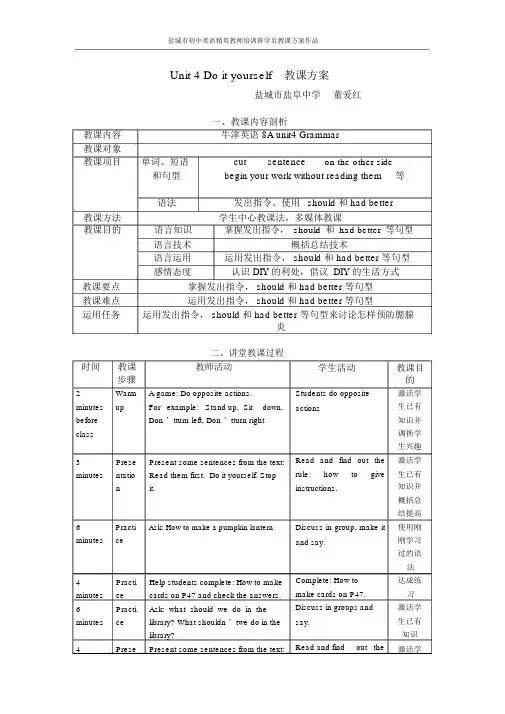
盐城市初中英语精英教师培训班学员教课方案作品Unit 4 Do it yourself教课方案盐城市盐阜中学董爱红一、教课内容剖析教课内容牛津英语 8A unit4 Grammar教课对象教课项目单词、短语cut sentence on the other side和句型begin your work without reading them等语法发出指令、使用should 和 had better教课方法学生中心教课法,多媒体教课教课目的语言知识掌握发出指令,should和had better等句型语言技术概括总结技术语言运用运用发出指令, should 和 had better 等句型感情态度认识 DIY 的利处,倡议 DIY 的生活方式教课要点掌握发出指令, should 和 had better 等句型教课难点运用发出指令, should 和 had better 等句型运用任务运用发出指令, should 和 had better 等句型来讨论怎样预防腮腺炎二、讲堂教课过程时间教课教师活动步骤2Warm A game: Do opposite actions. minutes up For example: Stand up, Sit down, before Don ’tturn left, Don ’tturn right class3Prese Present some sentences from the text: minutes ntatio Read them first. Do it yourself. Stop n it.6Practi Ask: How to make a pumpkin lantern minutes ce4Practi Help students complete: How to make minutes ce cards on P47 and check the answers. 6Practi Ask: what should we do in the minutes ce library? What shouldn ’twe do in thelibrary?4Prese Present some sentences from the text:学生活动Students do oppositeactionsRead and find out therule: how to give instructions.Discuss in group, make itand say.Complete: How tomake cards on P47.Discuss in groups andsay.Read and find out the教课目的激活学生已有知识并调换学生兴趣激活学生已有知识并概括总结提高使用刚刚学习过的语法达成练习激活学生已有知识激活学盐城市初中英语精英教师培训班学员教课方案作品minutes ntatio What should we do? You ’d better get rule: how to use should n some tools.and had better.6Prese Ask: How to be a good student?Discuss in groups and minutes ntatio sayn4Practi Help students complete: DIY advice Complete : DIY advice minutes ce and check the answers.6Prese Ask:How to prevent Mumps( 腮腺Discuss in groups and minutes ntatio炎 )sayn5Exerci Help the students complete the Complete the exercise. minutes se exercise and check the answers.English people like DIY . A lot ofpeople spend their holiday makingtheir homes more b______1______.If there is anything that needsrepairing or decorating around theirhomes, such as p_____2_____thewalls or putting in a new shower, theywill do the jobs themselves. Theys_____3______ DIY experience withtheir friends. More and more peopleshow an i______4_____ in DIY .Sometimes people also DIY in orderto s_____5_____ money. They aretrying to find ways to make theirhouse better when they can’t affordthe c______6_____. So,it ’s notsurprising that DIY is very popular.DIY can be different.People oftenfind it more e______7______ to builda piece of furniture because they can ’tunderstand the instructions well.Sometimes the instructions are simpleand clear,but the furniturei______8_____ is difficult to build.DIY can also be d______9_____.People should learn much about DIYwork before doing it.U______10_____, many people don ’tcare about that. So they may be in 生已有知识并概括总结提高使用刚刚学习过的语法达成练习拓展思维当堂检测盐城市初中英语精英教师培训班学员教课方案作品danger.1Home Say: Finish some exercises.minute work三、教课反省教课反省。
+Unit+4+Agood+read+Grammar教案 牛津译林版八年级英语下册
课题译林版八下英语Unit 4 A good read - Grammar 教案课型新授时间课时 1 主备人I.Teaching objectives1. Knowledge goalsStudents can understand the basic concepts and usage of the simple past and present perfect tense.Students are able to master the common time adverbial of the simple past tense and the present perfect tense.Students can correctly use the simple past tense and present perfect tense to express themselves.2. Ability goalsThrough practice, improve students' ability to correctly use the two tenses in context.Cultivate students' language comprehensive use ability and logical thinking ability.3. Emotional goalsStimulate students' interest in learning English grammar and enhance their confidence in learning.Cultivate students' sensitivity and observation ability to the English language.II. Teaching key and difficult points1. Teaching focusConcconcept, structure and usage of simple past and present perfect tense.Distingudistinguish between simple past tense and present perfect tense.2. Teaching difficultiesUnderstanding the persistence of action in present perfect tense and the impact on the present.Accurately use the simple past tense and the present perfect tense in a practical context.III. teaching method1. Teaching method: explain the grammar rules and usage of simple past tense and present perfect tense.2. Practice method: consolidate the knowledge learned through practice and improve students' language use ability.3. Discussion method: Organize students to discuss relevant grammar points to deepen their understanding of knowledge.4. Induction method: guide the students to summarize the characteristics and differences of the two tenses.IV teaching process(1) Lead in (5 minutes)1. Show pictures or videos about events in the past and things that continue to the present, such as "a person went to the park yesterday" and "a person has lived in the city for five years now."2. Ask the students how to describe these situations in English, and guide them to think about different tense expressions.(2) Knowledge explanation (10 minutes)1. Simple past timeConcept: An action or state of existence at a certain time in the past.Structure: subject + verb past formula + other.Time adverbial: yesterday, the other day,last...,...ago et al.For example: I visited the Palace Museum with my grandparents the other day.2. Now is in the perfect tenseConcept: represents the effect or result of past actions on the present, or the action or state that continues from the past to the present.Structure: Subject + has / has + the past participle of the verb + other.Timbial language: already, ever, trust, recently, not yet, so far, up to now, until / till now, etc.For example: Daniel has lived in Beijing for two years.(Iii) Comparative analysis (15 minutes)1. Organize students to compare the usage and time symptoms of simple past tense and present completion tense, and complete the form:Ttense usage time adverbialAction or presence in a simple past state yesterday, the other day,last...,...ago et al Present perfect tense Impact or consequences of past actions on the present; actions or states continuing from the past to the present already, ever, trust, recently, not yet, so far, up to now, until / till now, etc2. Let the students discuss the difference between the two tenses, and the teacher will summarize and supplement them.(4) Practice and consolidation (10 minutes)1. Complete the exercises in the textbook, such as Simon is showing Millie some pictures. Complete his sentences with the correct forms of the words in brackets., etc.2. Give some sentences, let the students judge whether the simple past or the present, and explain why.For example: I saw the film yesterday. (simple past, because there is a clear past time "yesterday")He has finished his homework. (Now finish time, emphasize the impact on the present "work is completed")(V) Expand the application (5 minutes)1. Create a situation for students to have a dialogue between the simple past tense and the present completion tense.For example: A: Have you ever been to5. Teaching reflectionIn this teaching, through the introduction of pictures and videos has stimulated the students' interest in learning, so that the students can quickly enter the learning state. In the link of knowledge explanation, the method of comparative analysis is used to let the students clearly understand the difference and usage of simple past time and present perfect tense. Practice consolidation link, through various forms ofpractice, such as filling in the blanks, judgment, dialogue, etc., to help students to deepen the understanding and mastery of knowledge. Expand the application link, let the students use the knowledge learned in the actual situation, improve the students' comprehensive use of language ability.However, there are also some shortcomings in the teaching process. Some students do not have a thorough understanding of the continuous movements in present perfect tense, and they are easy to make mistakes when using them. In the future teaching, we should strengthen the practice and explanation of this aspect, and give some more vivid examples to help students understand. At the same time, in the design of teaching activities, can be more diversified, increase the group competition and other forms, improve the students' participation and enthusiasm.。
新牛津译林版八年级英语下册Unit 4 Grammar导学案

Unit 4 Grammar导学案课前参与一、预习书本P54-56,完成书本上的练习。
二、重难点解析:1.我们可以用“疑问词+动词不定式”结构作动词的宾语。
疑问词有:what, which , who, how, when, where .常和这一结构连用的动词有:know, learn, see, hear, ask, tell, advise, decide, explain, find out, forget, remember, think, understand, wonder等.I don’t know _______ _______ __________ next.我不知道接下来说什么.I can’t decide ________ ________ _________ _______.我不能决定选哪个.有些动词,如:advise, ask, show, teach, tell可以接双宾语.Please tell________ _______ _______ ________there. 请告诉我怎么去那儿。
有些疑问词,如:what, which , whose, how many, how much可以先接一个名词,再接动词不定式。
She wondered _______ ________ _________ _______ ________. 她不知道选哪几门学科。
2.must表示主观的义务和必要,主要用于肯定句和疑问句,意思是“必须,得,要”。
否定形式mustn’t表示禁止,意思是“不能,不许”。
如:你今天必须完成作业。
You _______ _______your homework today.你不能在这里抽烟.You _______ _________ here. have to表示一种客观的需要,意思是“不得不”。
have to 有人称和数的变化。
否定形式是don’t have to。
Unit+4+Agood+read++Reading导学案 牛津译林版八年级英语下册
课题译林版八下英语Unit 4 A good read - Reading导学案课型新授时间课时 1 主备人一、学习目标1. Students can understand and master the key words and phrases in the text, such as: against, tired out, tie, tiny, continue, manage, etc.2. Students can understand Gulliver's wonderful experience in Lilliput through reading.3. Cultivate students' reading comprehension ability and language expression ability.二、学习重难点1. 重点Master the key words and sentence patterns in the text.Understand how Gulliver met at Lilliput and the details.2. 难点Be able to describe Gulliver experiences in your own language.Understanding of the complex sentence structure in the text.三、学习方法1. Independent reading: Students should read the text independently in the preview stage and have a preliminary understanding of the story content.2. Group discussion: To discuss the problems and difficulties in the text in the group and solve them together.3. Teacher's explanation: Teachers will explain and answer the key knowledge and students' questions.四、学习过程(一)预习导入(5 分钟)1. 让学生在预习的基础上,尝试回答以下问题:Have you ever read Gulliver's Travels?What do you know about this book?2. 引导学生思考:If you were Gulliver, what would you do in such a strange situation?(二)词汇学习(10 分钟)1. 展示单词:against, tired out, tie, tiny, continue, manage 等。
牛津译林版英语八年级下册课时练习 Unit 4 Period 4 Grammar
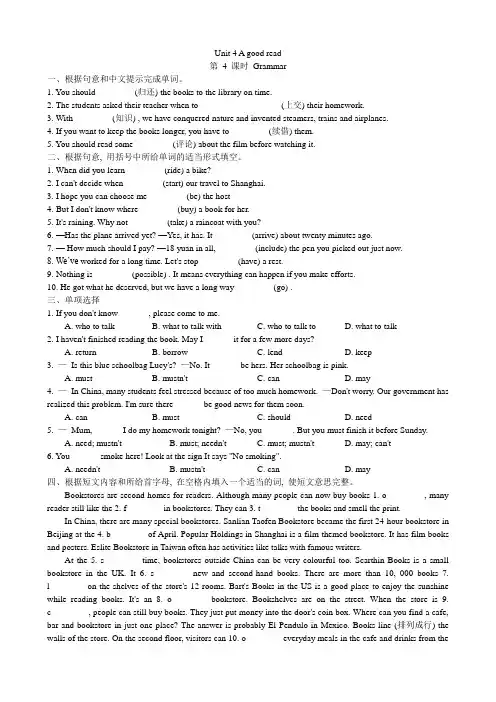
Unit 4 A good read第 4 课时Grammar一、根据句意和中文提示完成单词。
1. You should ________ (归还) the books to the library on time.2. The students asked their teacher when to ________ ________ (上交) their homework.3. With ________ (知识) , we have conquered nature and invented steamers, trains and airplanes.4. If you want to keep the books longer, you have to ________ (续借) them.5. You should read some ________ (评论) about the film before watching it.二、根据句意, 用括号中所给单词的适当形式填空。
1. When did you learn ________ (ride) a bike?2. I can't decide when ________ (start) our travel to Shanghai.3. I hope you can choose me ________ (be) the host4. But I don't know where ________ (buy) a book for her.5. It's raining. Why not ________ (take) a raincoat with you?6. —Has the plane arrived yet? —Yes, it has. It ________ (arrive) about twenty minutes ago.7. — How much should I pay? —18 yuan in all, ________ (include) the pen you picked out just now.8. We’ve worked for a long time. Let's stop ________ (have) a rest.9. Nothing is ________ (possible) . It means everything can happen if you make efforts.10. He got what he deserved, but we have a long way ________ (go) .三、单项选择1. If you don't know ______ , please come to me.A. who to talkB. what to talk withC. who to talk toD. what to talk2. I haven't finished reading the book. May I ______ it for a few more days?A. returnB. borrowC. lendD. keep3. —Is this blue schoolbag Lucy's? —No. It ______ be hers. Her schoolbag is pink.A. mustB. mustn'tC. canD. may4. —In China, many students feel stressed because of too much homework. —Don't worry. Our government has realized this problem. I'm sure there ______ be good news for them soon.A. canB. mustC. shouldD. need5. —Mum, ______ I do my homework tonight? —No, you ______ . But you must finish it before Sunday.A. need; mustn'tB. must; needn'tC. must; mustn'tD. may; can't6. You ______ smoke here! Look at the sign It says "No smoking".A. needn'tB. mustn'tC. canD. may四、根据短文内容和所给首字母, 在空格内填入一个适当的词, 使短文意思完整。
八年级英语下册_Unit 4 Grammar 课时练习
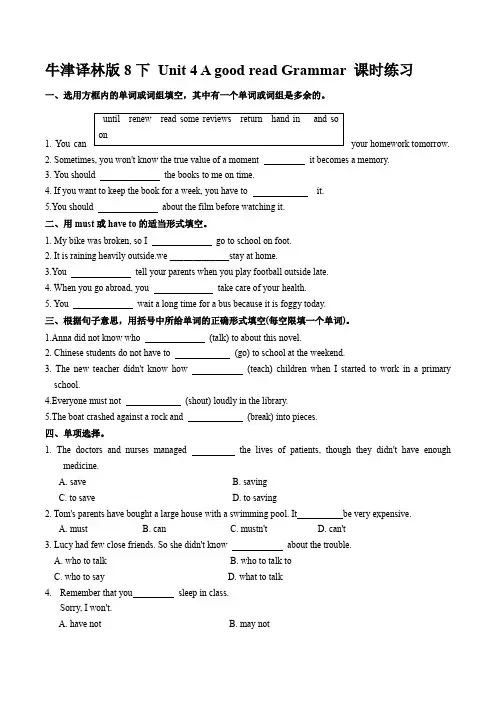
牛津译林版8下Unit 4 A good read Grammar 课时练习一、选用方框内的单词或词组填空,其中有一个单词或词组是多余的。
1. You canyour homework tomorrow.2. Sometimes, you won't know the true value of a moment it becomes a memory.3. You should the books to me on time.4. If you want to keep the book for a week, you have to it.5.You should about the film before watching it.二、用must或have to的适当形式填空。
1. My bike was broken, so I go to school on foot.2. It is raining heavily outside.we _____________stay at home.3.You tell your parents when you play football outside late.4. When you go abroad, you take care of your health.5. You wait a long time for a bus because it is foggy today.三、根据句子意思,用括号中所给单词的正确形式填空(每空限填一个单词)。
1.Anna did not know who (talk) to about this novel.2. Chinese students do not have to (go) to school at the weekend.3. The new teacher didn't know how (teach) children when I started to work in a primary school.4.Everyone must not (shout) loudly in the library.5.The boat crashed against a rock and (break) into pieces.四、单项选择。
初中英语八年级下册(牛津译林版)Unit4Grammar教学设计
-学生分享自己在本节课的学习收获,提高他们的反思能力。
2.语法规则总结:
-教师通过提问方式,引导学生总结一般将来时的语法规则。
-学生用自己的话复述语法规则,加深对知识点的理解。
3.课后任务布置:
-布置与未来相关的写作任务,要求学生运用一般将来时。
2.学生英语水平:经过前两年的英语学习,学生已具备一定的英语基础,掌握了一般现在时、一般过去时等基本时态。但在实际运用中,对一般将来时的掌握程度仍有待提高。
3.学生学习习惯:部分学生习惯于被动接受知识,缺乏自主学习能力。在教学过程中,教师需关注学生的学习方法,引导他们养成良好的学习习惯,提高学习效率。
-分享在学习本章节过程中的心得体会,包括对一般将来时理解上的突破和学习方法的改进。
作业布置时,教师应提醒学生注意以下事项:
-完成作业时,要注重语言表达的准确性和流畅性。
-主动发现并纠正自己在语法运用上的错误,提高自我纠错能力。
-养成良好的学习习惯,按时提交作业,培养责任感和自律性。
-在作业批改中,关注学生对一般将来时的掌握程度,给予有针对性的反馈。
7.拓展与延伸:
-鼓励学生课后阅读与未来相关的英语文章、书籍,提高他们的阅读兴趣和水平。
-组织英语角活动,让学生在实际交流中运用一般将来时,提高他们的口语表达能力。
四、教学内容与过程
(一)导入新课
1.教学活动设计:
-利用多媒体展示一组关于未来科技的图片,如自动驾驶汽车、智能家居等,引发学生对未来的思考。
-设计有针对性的练习题,包括填空、选择、改错等,帮助学生巩固所学知识。
5.作业布置:
-布置与未来相关的写作任务,如写一篇关于未来职业规划的文章,要求学生运用一般将来时。
Unit4Grammar教案牛津译林版英语八年级下册
A. on timeB. in timeC. at timesGrammar考点1 疑问词+动词不定式一“疑问词+动词不定式”可在句中用作宾语、主语和表语。
eg:Can you tell me how to spell the word?你能告诉我怎么拼写这个单词吗?How to go there is a question.如何去那里是个问题。
二【重点】疑问词+动词不定式"作宾语是初中阶段的重点。
在"疑问词+动词不定式”结构中,只有疑问词why不能与不定式连用。
有些疑问词,其后可先接名词再接动词不定式。
作宾语时,此结构常用于know, learn, see, hear, ask, tell,advise, decide, explain, find out, forget, remember, think, understand, wonder 等动词或动词短语中。
也可用于sure,clear等形容词之后。
eg:The teacher is telling the students what to do.老师正告诉学生们要做什么。
Have you found out what time to start?你査淸楚什么时间开始了吗?I am not sure which way to take.我不确定走哪条路。
【测一测】—I’ll have a tenday holiday. But I don’t know一How about Paris?A. what to doB. where to goC. when to go考向三:“疑问词+动词不定式”结构可以改写为该疑问词引导的从句。
eg:We do not know what to do. = We do not know what we should do.我们不知道该做什么。
考点二must和have to一【重点】:must的用法must为情态动词,后接动词原形。
牛津译林版英语八年级上册Unit4_Grammar教学设计
牛津译林版英语八年级上册Unit4_Grammar教学设计一. 教材分析牛津译林版英语八年级上册Unit4的主题是“一般现在时”,本节课的主要内容是让学生掌握一般现在时的构成和用法,以及如何用一般现在时描述习惯和经常发生的动作。
教材通过丰富的语境和实践活动,帮助学生理解和运用一般现在时。
二. 学情分析八年级的学生已经掌握了英语学习的基本语法知识,对英语有一定的听、说、读、写能力。
但是,对于一般现在时的理解和运用还需要进一步的指导和练习。
因此,在教学过程中,需要结合学生的实际情况,设计符合他们认知水平的活动。
三. 教学目标1.知识目标:让学生掌握一般现在时的构成(主语+动词原形)和用法,能用一般现在时描述自己的习惯和经常发生的动作。
2.能力目标:通过课堂学习和实践活动,提高学生运用一般现在时进行交流的能力。
3.情感目标:激发学生学习英语的兴趣,培养他们的自信心和合作精神。
四. 教学重难点1.教学重点:一般现在时的构成和用法。
2.教学难点:一般现在时在实际语境中的运用。
五. 教学方法1.任务型教学法:通过设计各种任务,让学生在完成任务的过程中运用一般现在时,提高他们的实际运用能力。
2.情境教学法:创设各种情境,让学生在真实的语境中感受和理解一般现在时。
3.互动式教学法:鼓励学生积极参与课堂活动,加强师生之间、学生之间的互动,提高课堂氛围。
六. 教学准备1.准备相关课件和教学材料。
2.设计各种任务和实践活动。
3.准备一些图片和实物,用于创设情境。
七. 教学过程1.导入(5分钟)利用图片和实物,引导学生谈论日常生活中的一些习惯和经常发生的动作,激发学生的学习兴趣。
2.呈现(10分钟)介绍一般现在时的构成(主语+动词原形)和用法,让学生初步理解一般现在时的概念。
3.操练(15分钟)设计一些简单的练习,让学生用一般现在时描述自己的习惯和经常发生的动作。
教师给予指导和反馈。
4.巩固(10分钟)通过小组活动,让学生在实际语境中运用一般现在时。
Unit+4+A+good+read+Reading教学设计 牛津译林版八年级英语下册
课题译林版八下英语Unit 4 A good read - Reading 教学设计课型新授时间课时 1 主备人I. Teaching objectives1. Language ability goalsStudents can understand and correctly use the key words and phrases in the text, such as: against, tired out, tie, tiny, continue, manage, etc.Students are able to read the article, get the main information, and understand Gulliver's wonderful experience in Lilliput.Students are able to describe Gulliver experiences in English and improve their oral expression skills.2. Learning ability goalsThrough the training of reading skills, such as prediction, reasoning, generalization, etc., to cultivate students' independent reading ability.Guide students to improve their ability of cooperative learning and solving problems through group cooperation and discussion.3. Thinking quality goalsCultivate students' logical thinking and critical thinking, and can analyze and evaluate the plot and characters in the text.Encourage the students' imagination and make them think about what they will do if they are in the Gulliver situation.4. Cultural awareness goalsUnderstand Gulliver's Travels and its authors, to broaden students' cultural horizon.Guide the students to understand the literary creation under different cultural backgrounds, and cultivate the cross-cultural consciousness.II. Teaching key and difficult points1. Teaching focusUnderstand the content of the article, master the key vocabulary and sentencepatterns.Be able to accurately describe Gulliver experiences in Lilliput in English.2. Teaching difficultiesUnderstanding and analysis of some complex sentences in the article.Cultivate students' critical thinking, and think deeply about the plot and characters in the text.III. teaching method1. Task-based teaching method: Guide students to learn and use the language by designing different tasks, such as filling in the blanks, answering questions and discussing, in the process of completing the tasks.2. Scenario teaching method: create scenes to make students feel like they are in the world of Gulliver, and enhance the interest and experience of learning.3. Cooperative learning method: organize students to study in groups, discuss problems together, and cultivate cooperative spirit and communication skills.IV. teaching process(I) Lead in(5 minutes)1. Show a picture of Gulliver's Travels and ask the students if they know of the work.2. Simply introduce the author of Gulliver's Travels and his creative background to stimulate students' interest.(II) Before reading (5 minutes)1. Let the students read the article title and picture to predict what might happen to Gulliver in Lilliput.2. Present some key words in the text, such as against, tired out, tie, etc., to help students understand the meaning and usage of words through pictures and example sentences.(3) Reading1. Quick reading (5 minutes)Students can read the article quickly and answer the following questions:Where did Gulliver arrive after the ship crash?How did Gulliver feel when he woke up?Check the answers to understand the students' general understanding of the article.2. Read carefully (10 minutes)The students will read the article again and complete the following tasks:Complete the vocabulary matching exercises in B1 to consolidate the understanding of the key words.Complete the event and cause matching exercise in B2, and comb through the plot development of the article.Group discussion, check the answer, the teacher to give guidance and explanation.Analyze some long and difficult sentences in the article, such as: " My arms, legs and hair were tied to the ground!", helps students understand sentence structure and grammar.3. Intensive reading (5 minutes)Students should read the article intensively and answer the questions in B4, such as:What did Gulliver do after their ship crashed against the rocks?What did Gulliver find after he woke up?How big was the small man?Could Gulliver communicate with the small men?邀请学生回答问题,教师给予评价和反馈。