
最新八年级英语下册《Unit 2 I'll help to clean up the city parks Section A》教案
《Unit 2 I'll help to clean up the city parks Section A》知能新视窗本节主要学习提供帮助的表达的语句;学习运用clean up, cheer up , give out, put, off ,set up 等动词短语。
名师开小灶1.-I’d like to work outside .我想到外面去做点事。
-You could do sth. 你可以帮助打扫城市公园。
(1)help 后所跟动词不定式可带to 也可不带。
如:I help (to)cook after school. 放学后我帮忙做饭。
(2)clean up 动词短语,“打扫干净,清除”。
如:The waiter hurried to clean up the pieces of the broken plates.服务员赶快把盘碟的碎片打扫干净。
[拓展]有关clean 的短语:clean down 把……刷洗(或擦洗)干净;彻底打扫clean out把……打扫干净;把……清空;把……清除出来clean up on 胜过Clean—up Day 清洁日2.I’d like to cheer up sick kids.我想让生病的孩子高兴起来。
(1)本句早一个简单句。
I’d like=I would like=I want,后常加名词或不定式作宾语。
(2)sick kids 意为“生病的孩子”。
sick作为形容词,即可作定语,也可作表语。
当sick作定语时,可意为“生病的,有病的”;当s ick作表语时,还可意为“恶心,想吐;厌烦,讨厌”。
如:Jane is taking care of her sick mother.(sick作定语,意为“生病的”)简正在照看她生病的母亲。
The boy always feels sick when he travels by car.(sick作表语,意为“恶心,想吐”)那个男孩坐汽车旅行时总是想吐。
John is sick of his job.(sick 作表语,意为“厌烦”)约翰对他的工作感到厌烦。
3.You could give out food at a food bank.你可以在食物救济站分发食物。
(1)本句是“情态动词+动词原形”合成作谓语的简单句。
give out在此意为“分发”,它还可意为“发表,宣布;精疲力尽”。
如:The date of the election will be given out soon.选举的日期很快就会宣布。
The horse gave out.马跑不动了。
(2)本句中could是情态动词,意思是“可以”。
如:We could put up signs.我们可以张贴标牌。
4.We can’t put off making a plan.Clean-Up Day is only two weeks from now.我们不能推迟做计划。
清洁日从现在起只有两周了。
(1)本句put off是短语动词,是“动词+副词,相当于及物动词,后常加动名词。
如:Don’t put off u ntil tomorrow what can be done today.今天可以做的事情不要拖到明天去做。
He decided to put off going to Beijing.他决定延期去北京。
(2)put off也可意为“敷衍”。
如:He tried to put me off with vague promises.他企图以含糊的允诺来敷衍我。
5.He loo ks sad.Let’s cheer him up.他看起来难过。
咱们让他高兴起来吧。
(1)本句look sad意为“看起来难过”,look在此是系动词,其后接形容词,作表语,类似的词还有smell“闻起来”;sound“听起来”;taste“尝起来”;feel“摸上去”。
如:The cake tastes good.蛋糕尝起来很好。
The voice sounds sweet.这声音听起来很美。
(2)本句中cheer up是个短语动词。
在英语中一些动词与介词或副词等连用在一起构成固定词组,叫做短语动词。
关于短语动词的用法请见后面的语法讲解部分。
6.We’re going to set up a food bank to help hungry people.我们准备建立一个食物救济站来帮助饥饿的人们。
(1)本句用的是一般将来时态“主语+be going to+动词原形+宾语”。
不定式to help hungry people 在句中作目的的状语。
set up在此是个短语动词,由“动词+副词”构成,意为“创立,建立”。
如:They needed money to set up a special school for blind children.他们需要资金为肓童开办一所特别学校。
(2)set up也可意为“竖立,架起,建筑”。
如:Two new bridges have been set up between Pudong and Puxi.在浦东和浦西之间架起了两座新桥。
7.We need to come up with some ideas.我们需要提出一些建议。
(1)come up with是个短语动词,由“动词+副词+介词”构成,相当于及物动词,意为“提出,提供”。
如:I hope you can come up with a better plan than this.我希望你们能提出比这个更好的计划。
(2)come up with也可意为“赶上”。
如:We have to work hard to come up with them.我们必须努力工作,赶上他们。
(3)need在本句中作为实义动词,后常跟名词或不定式,特别在肯定句中,注意时态、人称和数的变化。
如:We need some teachers.我们需要一些老师。
We need to wear warm clothes.我们需要穿上暖和的衣服。
8.Being a volunteer is great!当一个志愿者是伟大的!(1)本句是个简单句。
being a volunteer是动名词短语在句中作主语。
如:Getting up early is a good habit.早起是个好习惯。
(2)volunteer在此作为可数名词,意为“志愿者”;volunteer 也可作为不及物动词,意为“自愿”,常与to do sth或for连用,也可作为及物动词使用。
如:They are the Chines e people’s volunteers.(名词)他们是中国人民志愿军。
I volunteer to help you.我自愿帮助你。
(动词)本文出现的句子还有:These three students all volunteer their time to help other people.(动词)这三个学生都是自愿帮助别人的。
This volunteer work takes each of them several hours a week.(形容词)这种志愿工作花费了他们每个人一周几个小时的时间。
The three students plan to set up a student volunteer project at their school.(名词) 这三个学生计划在他们学校启动一个学生志愿工程。
9....she puts this love to good use by working in the after-school care center at her local elementaryschool.她把这种爱好很好地用在了当地小学的课后辅导中心工作中。
(1)本句是个比较长的简单句。
put...to意为“放……在……”。
Use在此作为名词。
介词词组by working在此作方式状语。
In the after-school care center与at her local elementary school 两个介词短语在句中作地点状语。
(2)在词组care center中,care作为名词,充当center的定语,即名词作定语。
除man,woman,sport 外,其他名词作定语时,无论它们所修饰的名词是单数还是复数,作定语的名词只能用单数形式。
而man,woman的单复数常与后面的各词保持一致。
sports 作定语总以复数形式出现如:an apple tree 一棵苹果树ba nana trees 香蕉树two men doctors两名男医生a woman teacher 一位女教师sports shoes运动鞋10.Pei loves animals,and plans to study to be a veterinarian when he leaves school.培喜欢动物,并打算毕业后学习当一名兽医。
(1)本句是复合句。
从句when he leaves school 是由when引导的时间状语从句。
leave school 意为“毕业”。
plan to do sth意为“计划做某事”。
如:We are planning to start next week.我们打算下周出发。
(2)plan to意为“打算”。
如:I plan to go to Beijing next week.我打算下周去北京。
11.He spends every Saturday morning working in an animal hospital.他每个星期六早晨到一家动物医院工作。
本句是简单句。
spend 作为及物动词,意为“花费”,它的主语必须是人,常用句型:Sb spend+时间或金钱on sth/(in)doing sth“某人花费时间或金钱在……上/做某事”。
如:He doesn’t spend much time on his homework.他在做作业上没有花多少时间。
12.Not only do I feel good about helping other people, but I get to spend time doing whatI love to do.帮助别人我不仅感觉好,而且我还能花时间去做我喜欢的事。
(1)本句是由not only…but(also)连接的两个分句。
其中not为否定词,位于句首时句子要部分倒装。
并且只有连接两个分句时,才能倒装第一个分句。
如:Not noly did Mike pass the exam, but also he got good marks.迈克不仅通过了考试,而且他还得了高分。
八年级英语下册Unit2I’llhelptocleanupthecityparks教案2
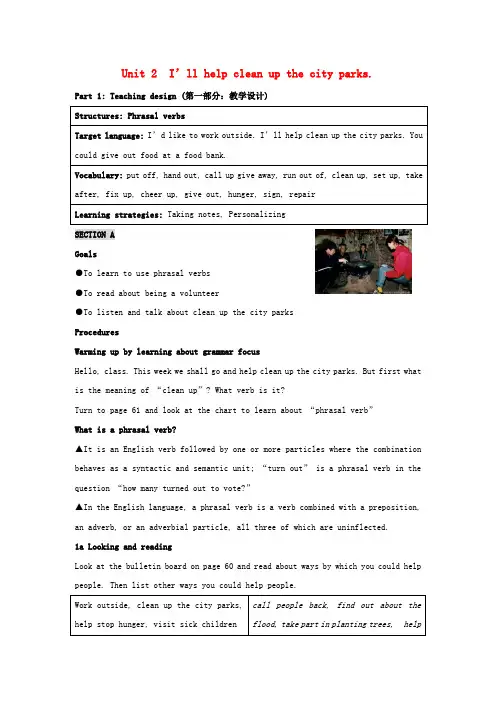
Unit 2 I’ll help clean up the city parks.Part 1: Teaching design (第一部分:教学设计)Structures: Phrasal verbsTarget language: I’d like to work outside. I’ll help clean up the city parks. You could give out food at a food bank.Vocabulary: put off, hand out, call up give away, run out of, clean up, set up, take after, fix up, cheer up, give out, hunger, sign, repairLearning strategies: Taking notes, PersonalizingSECTION AGoals●To learn to use phrasal verbs●To read about being a volunteer●To listen an d talk about clean up the city parksProceduresWarming up by learning about grammar focusHello, class. This week we shall go and help clean up the city parks. But first what is the meaning of “clean up”? What verb is it?Turn to page 61 and look at the c hart to learn about “phrasal verb”What is a phrasal verb?▲It is an English verb followed by one or more particles where the combination behaves as a syntactic and semantic unit; “turn out” is a phrasal verb in the question “how many turned out to vote?”▲In the English language, a phrasal verb is a verb combined with a preposition, an adverb, or an adverbial particle, all three of which are uninflected.1a Looking and readingLook at the bulletin board on page 60 and read about ways by which you could help people. Then list other ways you could help people.Work outside, clean up the city parks, help stop hunger, visit sick children call people back, find out about the flood, take part in planting trees, helpprovide money for the poor students, bevolunteers at the 2008 Olympics1b Listening and completingYou are going to listen to several conversations.TapescriptConversation 1Boy1:I’d like to work outside.Girl1: You could help clean up the city parks.Conversation 2Boy2: I’d like to help homeless people.Girl1: You could give out food at the food bank.Conversation 3Girl2: I’d like to cheer up sick kids.Girl1: You could visit them in the hospital.Conversation 4Girl1: I’d like to help kids with their schoolwork.Girl2: You could volunteer in an after-school study program.While listening, pay attention to information to complete the sentences on page 60 in the box.1. I’d like to work outside. You could help clean up the city parks.2. I’d like to help homeless people. You could give out food at the food bank.3. I’d like to cheer up sick kids. You could visit them in the hospital.4. I’d like to help kids with their schoolwork. You could volunteer in an after-school study program.1c Doing pairworkIn pairs you are to practice the conversations in the picture on page 60. Then make similar conversations using the information in activity 1b.▲I’d like to work outside.●I’d like to work cleaning up the schoolplayground.▲You could helpclean up the cityparks.▲I could visit sick children in the hospital.We could help stop hunger by giving out food at the food bank. ●I’d like to help homeless people in myhometown.●I’d like to cheer up sick kids.●I could visit them in the hospital.●I’d like to help kids with their English.●We could vo lunteer in an after-school cleaning up program.2a Listening and checkingSome students talking about planning a City Parks Clean-up Day. Listen to their talk and check√the things they are going to do.TapescriptBoy1; OK. Now we need to come up with a plan to tell people about the city park clean-up.Girl1:Yeah, but I’m hungry, Bob. Let’s have lunch first.Girl2: No, we can’t put off making a plan. Clean-up Day is only two weeks from now. Boy2:You’re right, Sally. While we talk, I’ll write down all our ideas. Then we can decide which ideas are best.Girl1:Um… well… we could put up signs.√Boy2:That’s a good idea!Girl2:I’ll hand out advertisements after school.√Boy1; OK. Great! And we could each call up ten people and ask them to come.√Boy2: Hey, w e’re coming up with a lot of good ideas, aren’t we?2b Listening and filling in blanksI’ shall play the tape again and you are to listen and fill in the blanks in the box on 61.1.We need to come up with a plan.2.We can’t put off making a plan. Clean-up Day is only two weeksfrom now.3. I’ll write down all our ideas.4. We could put up signs.5. I’ll hand out advertisements after school.6. We could each call up ten people and ask them to come.2c Doing pairworkLet’s go on to role play the conversa tion in activity 2b.A: We need to come up with a plan.B:Let’s have lunch first.A:No, we can’t put off making a plan. Clean-up Day is only two weeks from now. B:I’ll write down all our ideas that we come out with.A: We could put up signs after school.B:We’ll hand out advertisements at weekends.A:At home we could each call up ten people and ask them to come.B: We could get online to make our plan known to all.3a Reading, underlining and circlingOn page 62 is an article about volunteers. Read it and underline the kinds of work they do. You have to circle the reasons why they like their work.Being a volunteer is great!Number 77 High School is home to three very special young people: Li Huiping, Lan Pei, and Zhu Ming. These three students all volunteer their time to help other people. This volunteer work takes each of them several hours a week, so it is a major commitment. Huiping loves to read, and she puts this love to good use by working in the after-school care center at her local elementary school. Here, she helps young children to read. Pei loves animals, and plans to study to be a veterinarian when he leaves school. He spends every Saturday morning working in an animal hospital. Ming wants to be a professional singer. He sings for groups of people at the city hospital to cheer them up.“Volunteering is great!” says Huiping. “Not only do I feel good about helpingother people, but I get to spend time doing what I love to do.” Pei says he has learned more about animals. Ming says he has met some wonderful people at the hospital. The three students plan to set up a student volunteer project at their school. “Don’t put it off,” says Huiping. “Become a volunteer today!”Read the article again to darken the phrasal verbs found in it.3b Filling in the tableOn page 62 is a table showing the kinds of volunteer work the four students could do. Read the table and fill in it.Name Loves CouldHui Football Teach the pupils to playfootballXiao Tang Writing stories Turn the city people’slife into storiesJoy Movies Show free movies to thevillagersWei Music Play music to cheer peopleup3c Doing pairNext take turns role playing being one of the people in 3b by asking and giving advice. A:I’d like to join the school volunteer project, but I’m not sure what I should do.B: What do you like doing?A: I love playing football.B: Well, you could help coach a football team for little kids.A:I’d like to join the class volunteer project, but I’m not surewhat I should do.B: What do you like doing?A: I love writing stories.B: Well, you could help write stories forcitizens.A:I’d like to join the town volunteer project, but I’m not sure what I should do.B: What do you like doing?A: I love seeing movies.B: Well, you could help introduce good movies to the farmers.A:I’d like to join the city volunteer project, but I’m not sure what I should do.B: What do you like doing?A: I love playing music.B: Well, you could help organize a music band for the factory workers.4 Doing pairworkIn the table on bottom of page 62 write down three things you like todo and then ask your partner for advice about the kinds of volunteer workyou could do.Things I like to do Volunteer work I could do1. reading in English Help teach English to those poor inEnglish2. surfing online Help getting useful information onlinefor the farmers3. collecting ancient coins Help give a speech on ancient ChinesecultureA: I like to reading in English. What kind of volunteer work do you think I could do?B: You could help teach English to those poor in English.A: I like to surfing online. What kind of volunteer work do you think I could do? B: You could help get useful information online for the farmers teach English to those poor in English.A:I like to collect ancient coins. What kind of volunteer work do you think I could do?B: You could help give a speech on ancient Chinese culture.Closing down by reading an English poemFalling Asleep in ClassI fell asleep in class today,as I was awfully bored.I laid my head upon my deskand closed my eyes and snored.I woke to find a piece of papersticking to my face.I'd slobbered on my textbooksand my hair was a disgrace.My clothes were badly rumpledand my eyes were glazed and red.My binder left a three-ringindentation in my head.I slept through class, and probablyI would have slept some more,except my students woke meas they headed out the door.Kenn NesbittSECTION BGoals●To Learn more phrasal verbs●To listen, speak and write using phrasal verbsProceduresWarming up by brainstorming phrasal verbsHello, everyone. To begin with, we shall brainstorm a list of phrasal verbs. talk to…, begin with, laugh at…, wait for…, look after…, look up, fall asleep, get back, get off, get on, get on with…, get up, go b ack, go on, go shopping, go1 Reading and matchingOn page 63 is a box with 4 sentences. Match themwith their similar meanings on the right.1b Making sentencesOn page 63 you will find a box with some phrasal verbs. Make a sentence with each of the phrasal verbs.2a Listening and numberingListen to the recording that I am going to play and number the pictures on page 63. (Key:a4,b2,c1,d3 )Man: That’s fantastic. What gave you the idea?Boy: I guess I take after my father. He’s always helping people.Man: Wow! Your parents must be proud of you.Boy: I guess so. But now I’ve run out of money to buy old bikes.Man:Oh, that’s too bad.Boy: Yeah. I need to come up with some way of getting money or I’ll have to stop. 2b Listening and circlingYou shall listen to the recording again to circle “T” or “F”.1.Jimmy fixes up bicycles. T F2.Jimmy sells bikes. T F3.Jimmy takes after his mother. T F4.Jimmy has run out of money. T F2c Doing pairworkIn pairs practice the conversations between Jmmy and the reporter. Use the information from the activities on page 63.A: What do you do Jimmy?B: I fix up bikes and give them away.A: What kind person are you?B:People say I’m a very generous young man.A: Where do you get the old bikes?B: Well, I find or buy old bikes that nobody wants.A: Whom do you give your repaired bike to?B: I give it to kids who don’t have enough money to buy their own bikes.A: What gave you the idea?B:I take after my father. He’s always helping people.A: Are your parents proud of you?B: I guess so.A: How much money do you have?B:I’ve run out of money to buy o ld bikes.3a Reading and underliningOn page 64 is an article about Jimmy the Bike Boy. Read to understand it and underline all the phrasal verbs.Copy all the phrasal verbs and useful expressions onto your notebook.3b Making a noteRead the article again to make a note of the things that Jimmy did in order to sole his problem.1.He did a radio interview.2.He also put up some signs asking for old bikes.3.He called up all his friends and told them about the problem.4.He even handed out advertisements at a local supermarket.5.He told the teachers at school about his problem and they set up a call-in center for parents.4 Doing groupworkBy brainstorming work out a plan for helping out in your community. Write down whereand what you will volunteer and tell your classmates about your plan.teach at a night school, help at a hospital, work at an old people’s home, speak English at an English corner, write letters for people who can’t read and write, get information online for the farmers who can’t use Internet, repair bikes, radios, computers and other things for citizens…Closing down by talking about volunteer workLook at the pictures below and talk about the volunteer work that the people in thepictures are doing.SELF CHECK1.Filling and makingTurn to page 65 and fill in the blank with a correct word given in its correct form. Then make a sentence with each of the given words.Give way, take after, come up with, give out, hang out1.Be quiet please, class. I’m going to give out your test papers.2.My friend Dave comes up with a great deal of ideas. We’re goingto make a pen pal web site.3.I give away some clothes to charity because they were too smallfor me.4.On weekends I like to hang out at the sports club with my friends.5.Jim takes after his father. They are both clever and a bit quiet.1.Never give out your personal information to strangers.2.He came up with a bright idea.3.He gave away some old book to the poor students in the countryside.4.She used to hang out a lot after school.5.You don’t take after your father. He is more talkative than you are.2 Writing an article tell about SallyOn page 65 is a box with words and phrases. Write an article telling about what happens to Sally.Sally Brown/ a young woman/ wants to be a professional singer/ as a volunteer/ sing at a local hospital/ cheer up sick people/ also sing at school/ run out of money for singing lessons/ come up with ideas for making money/ put up signs asking for singing jobs/ also call up parents offering singing lessons for children/ now will be able to continue her lessons/ become a professional singerSally Brown is a young woman who wants to be a professional singer. She often works as a volunteer sing at a local hospital to cheer up sick people. She also sings at school. But now she has run out of money for singing lessons. Yesterday she came up with ideas for making money. She put up signs asking for singing jobs. She also called up parents offering singing lessons for children. Now she has money and will be able to continue her lessons. She will certainly become a professional singer. Just for funLook at the pictures and make astory out of them.Reading: I’ll send you a photo ofLucky.Before you read, listen to the recording without looking at the article.While you read, underline all the phrasal verbs, blacken all the expressions and circle all the linking words.After you read, copy down all the phrasal verbs and useful expressions into your notebook.Dear Miss Li,I’d like to thank you for sending money to “Animal Helpers”, an organization set up to help disabled people. For sure, you have helped make it possible for me to have “Lucky”, who has filled my life with pleasure. Let me tell you my story.Being blind, deaf, unable to walk, or use your hands easily is soothing that mostPart 2: Teaching Resources (第二部分:教学资源)I. What is a volunteer?A volunteer is someone who performs or offers to perform a service out of his ownfree will, often without payment. The year 2001 was the International Year of the Volunteer. 2005 is the UK Year of the Volunteer.People may volunteer to perform some work, e.g., of charitable character. Somevolunteer for clinical trials or other medical research, and may even donate their bodies to science after their death.II. What is an online Volunteer?An online volunteer is a person who contributes time and effort with an organization through an online connection, rather than in person. A wide variety of people from around the world are online volunteers and most are not technology professionals. Online volunteers may provide advice, consultancy and perform remote administration tasks for the organisation, usually a charity or non-profit organisation. The practice of donating time online goes by other names, such as virtual volunteering, cyber service, telementoring, e-volunteering, and cyber volunteering.There are many opportunities for people to donate their services using the internet. Online volunteers do a variety of tasks, such as translating documents, editing or preparing proposals, designing logos, researching information, developing strategic plans, reviewing budgets, creating web pages, designing flash presentations, moderating online discussion groups and managing other online volunteers.III. What is an ICT Volunteer?An ICT volunteer is someone who is working to foster the implementation and use of Information and Communication Technologies. He or she can install hardware, software or carry on with ICT training programmes. There is no need to be an online volunteer to be an ICT volunteer: installing hardware is a good example. Likewise, there is no need to be an ICT volunteer to be an online volunteer: teaching a language through a virtual campus is not related with ICT fostering, at least in a direct way.....。
人教新版八年级下册Unit2I’llhelptocleanupthecityparks.知识点精讲--SectionB
人教新版八年级下册Unit 2 I ’ll help to clean up the city parks.知识点精讲--Section B Section B1. I repaired it . 我把它修好了【解析】repair v “修理;修复”1) repair的对象范围很广,从房屋、道路、机器到日常生活必需品,是使受到一定损失或失灵的东西恢复其形状或功能。
Who has repaired the broken leg of the table? 谁把桌子的断腿修好了?2) mend的意思是恢复某物原来的样子(包括用针、线来缝补),一般指较小之物。
This shirt is too old to mend. 这件衣服太旧不能补了。
3) fix用于需要重新“调”物体的结构,把松散的部件固定结实,将分离的物体各部分装配起来。
用于美国口语中,与repair无多大区别。
Can you fix the broken chair? 你能修理那把坏了的椅子吗?2. I take after my mother. 我长的像我妈妈。
【解析】(1)take after =be similar to在(外貌、性格等方面)与(父母)相像(v. +adv)【短语】take back 收回,接回take down 写下take off 脱下;起飞take up 占去(时间或空间)take care 小心take care of 照顾 take place 发生take out 拿出take away 拿走(2)look like 只指在外貌上与…..相像【短语】:look after 照顾look up 向上看,查找look for 寻找look out 小心( ①)—Do you ___after your mother or your father?—My father .We both have big eyes and black hair.A. look B. take C. run( )②The girl _____ the woman. Maybe she is her daughter. A. take care B. takes after C. takes off D. look after【2011山东青岛2】Tom ___ his father, because they both are cheerful and easygoing.A. looks likeB. takes afterC. doesnt’take afterD. isn’t like3. I fixed it up. 我把它修理好了。
人教版英语初二下册 Unit 2 I`ll help to clean up the city park 知识讲解
Unit 2 I’ll help to clean up the city parks.词句精讲精练词汇精讲1. clean upclean up意为“打扫”,up为副词,此短语是动副型短语,如果宾语为代词,应放在短语中间;如果宾语是名词,可放于短语之间或两词之后。
例如:Please clean up this street at once. 请马上把这条街打扫干净。
This street is dirty. Please clean it up. 这条街道太脏了,请把它打扫干净。
2. cheer upcheer up意为“变得高兴,振奋起来”,是“动词+副词”结构的短语。
cheer up既可作及物动词短语,也可作不及物动词短语。
例如:He cheered up at once when I agreed to help him. 我同意帮助他时,他马上高兴起来。
Cheer up! The news isn’t too bad. 振作起来!这消息不是太坏。
He took her to the cinema to cheer her up. 为了让她高兴,他带她去了电影院。
【拓展】(1) cheer作不及物动词,意为“欢呼;喝彩”。
例如:The girls cheered as the famous singer arrived. 当这位著名的歌手到达时,女孩子们大声欢呼。
(2) cheer作及物动词,意为“为……欢呼,高呼”。
例如:The whole village turned out to cheer the hero. 全村人都出来向那位英雄欢呼。
(3) cheer作可数名词,意为“欢呼声;喝彩声”。
例如:We can hear the cheers of students outside the gym. 我们在体育场外就能听到学生的欢呼声。
(4) cheer on意为“为……加油”。
例如:We will have a basketball game this afternoon. Would you like to come and cheer us on?我们今天下午有一场篮球比赛,你愿意来为我们加油吗?3. give outgive out意为“散发;分发”,相当于hand out,是“动词+ 副词”结构的短语动词。
人教新目标八年级英语下册Unit 2 I’ll help to clean up the city
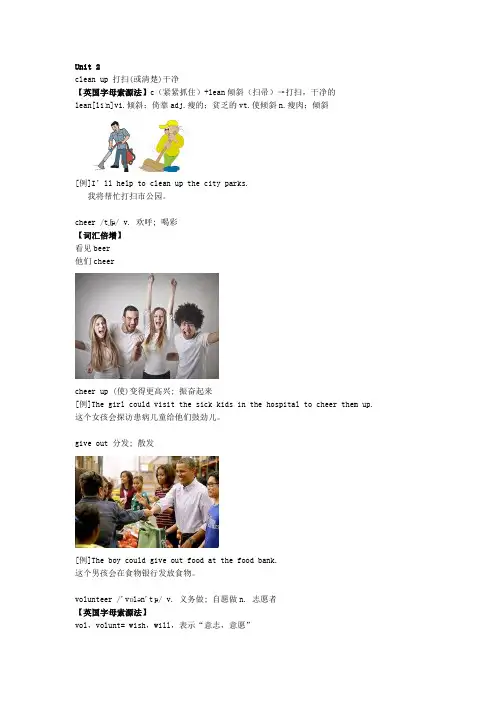
Unit 2clean up 打扫(或清楚)干净【英国字母索源法】c(紧紧抓住)+lean倾斜(扫帚)→打扫,干净的lean[liːn]vi.倾斜;倚靠adj.瘦的;贫乏的vt.使倾斜n.瘦肉;倾斜[例]I’ll help to clean up the city parks.我将帮忙打扫市公园。
cheer /tʃɪə/ v. 欢呼; 喝彩【词汇倍增】看见beer他们cheercheer up (使)变得更高兴; 振奋起来[例]The girl could visit the sick kids in the hospital to cheer them up. 这个女孩会探访患病儿童给他们鼓劲儿。
give out 分发; 散发[例]The boy could give out food at the food bank.这个男孩会在食物银行发放食物。
volunteer /'vɒlən'tɪə/ v. 义务做; 自愿做n. 志愿者【英国字母索源法】vol,volunt= wish,will,表示“意志,意愿”volunteer n 志愿者(volunt+eer人→意愿的人→志愿者)voluntary a 志愿的,自愿的(volunt+ary)[例]The girl could volunteer in an after-school study program to teach kids. 这个女孩会在一个课外学习项目中担任自愿者来教孩子。
come up with 想出; 提出(主意、计划、回答等)[例]We need to come up with a plan for the City Park Clean-UP Day.我们需要就市公园清扫日的活动做出计划。
put off 推迟[例]We should put off the meeting.我们得推迟会议。
sign /saɪn/ n. 标志; 信号[例]We could see signs.我们能看见标志。
人教版八年级英语下册Unit 2 I'll help to clean up the cit
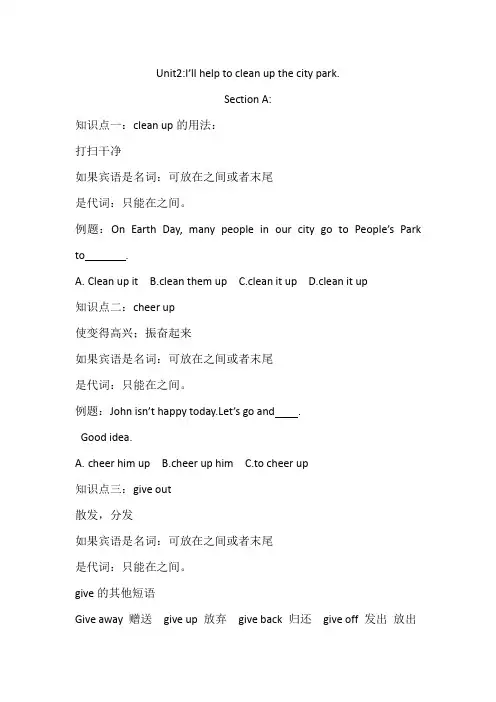
Unit2:I’ll help to clean up the city park.Section A:知识点一:clean up的用法:打扫干净如果宾语是名词:可放在之间或者末尾是代词:只能在之间。
例题:On Earth Day, many people in our city go to People’s Park to .A.Clean up itB.clean them upC.clean it upD.clean it up知识点二:cheer up使变得高兴;振奋起来如果宾语是名词:可放在之间或者末尾是代词:只能在之间。
例题:John isn’t happy today.Let’s go and .Good idea.A.cheer him upB.cheer up himC.to cheer up知识点三:give out散发,分发如果宾语是名词:可放在之间或者末尾是代词:只能在之间。
give的其他短语Give away 赠送give up 放弃give back 归还give off 发出放出Give sb sth给某人某物give in屈服例题:Could you please teach me how to red envelopes on WeChat? Sure. Let me show you.A.give outB.give backC.give way知识点四:put offput off意为“推迟”。
The concert was put off because of the heavy rain.演唱会因为大雨而被推迟了。
拓展:常见的put短语有:put off推迟;延迟穿上;put on展出;上演戴上put away收起来put out熄灭;扑灭put up with容忍put up搭建;建造张贴提升例4They the date of the meeting because of the bad weather.A.put offB.gave awayC.put onD.turn down知识点五used to的用法used to表示“过去常常;以前经常”,后跟动词原形,用来描述过去经常发生的动作或存在的状态。
人教版八年级英语下册Unit2I’llhelptocleanupthecityparks
4.设想四:多媒体辅助教学。利用多媒体手段,如视频、图片等,展示环保活动、志愿服务的场景,让学生直观地感受英语在实际生活中的运用。此外,还可以通过多媒体手段,提高学生的听力水平。
目的:引导学生关注现实生活中的环保问题,激发他们的责任感和使命感。
教师在布置作业时,要注重作业的针对性和实用性,使学生在完成作业的过程中,能够真正巩固所学知识,提高综合语言运用能力。同时,作业要具有一定的开放性和挑战性,激发学生的学习兴趣,培养他们的创新精神和团队合作能力。通过本次作业,希望学生能够将课堂所学与实际生活相结合,为我国的环境保护和志愿服务事业贡献自己的力量。
2.重难点二:词汇和短语的掌握。本节课涉及一些与环保、志愿服务相关的词汇和短语,如“cleanup”,“volunteer”,“make a difference”等。学生需要熟练掌握这些词汇和短语,以便在口语表达和写作中运用。
3.重难点三:听力技巧的提升。本节课的听力部分要求学生能够听懂并理解与本课相关的对话和短文,获取关键信息。提高学生的听力技巧,使他们能够应对不同场景的英语对话,是本节课的教学难点。
5.设想五:课后实践作业。布置与课堂内容相关的课后实践作业,如让学生设计一份关于环保活动的宣传单,或采访家人、朋友关于志愿服务的看法。这样既能巩固课堂所学,又能培养学生的社会责任感。
6.设想六:评价与反馈。采用多元化的评价方式,如小组互评、教师评价等,对学生的学习过程和成果进行评价。及时给予学生反馈,帮助他们找到自己的不足,提高学习能力。
人教版八年级英语下册Unit2I’llhelptocleanupthecityparks.SectionA(3a3c)教学设计
人教版八年级下册英语《I'll help to clean up the city parks》
the things they are going to do to tell
people about it.
a
c
e
b
d
√√
√
2bListen again. Fill in the blanks.
1. We need to _e___u_p___w_i_th____ a plan to tell people about the city park clean-up.
used to后跟动词原形,表示“过去常常做某事”.
“used to +动词原形”的各种句式: (1)肯定句:主语+used to+动词原形+其他.
他们过去住在北京。
They used to live in Beijing.
(2)否定句:“主语+didn’t use to +动词原形+其他.” 或“主语+ usedn’t to + 动词原形+其他.”,在口
5. The life _u_s_e_d_ _t_o_ _b_e_ (曾经是) very interesting in my school days.
Unit 2 I’ll help to clean up the city parks.
plan. volunteer to
2. Who willa_n_s_w_e_r___ ___ ______ (自愿回答) this
question?
notice
3. You could put up a ______ (布告) here.
4. With no one to talk to. He __f_e_lt_ very __lo_n_e_l_y ( 感觉很孤独).
人教版英语八年级下册Unit2《I’llhelptocleanupthecitypark》说课稿
人教版英语八年级下册Unit 2《I’ll help to clean up the city park》说课稿一. 教材分析人教版英语八年级下册Unit 2的主题是“I’ll help to clean up the city park”,通过本节课的学习,学生将掌握一般将来时的用法,学会如何表达将来的计划和承诺。
教材内容丰富,包括听力、口语、阅读和写作等方面,旨在培养学生的综合语言运用能力。
此外,本节课还涉及了环保意识的教育,引导学生关注环境保护,培养他们的社会责任感和公民意识。
二. 学情分析八年级的学生已经具备了一定的英语基础,能够听懂并运用一般现在时、一般过去时和一般将来时。
但在实际运用中,部分学生对时态的掌握还不够熟练,容易混淆。
此外,学生的词汇量和语法知识有限,对于一些复杂句型的理解和运用还需加强。
因此,在教学过程中,教师需要关注学生的个体差异,针对不同层次的学生进行有针对性的指导。
三. 说教学目标1.知识目标:学生能够掌握一般将来时的用法,学会如何表达将来的计划和承诺。
2.能力目标:学生能够听懂、会说、会读、会写关于将来的计划和承诺的句子。
3.情感目标:学生能够关注环境保护,培养他们的社会责任感和公民意识。
四. 说教学重难点1.教学重点:一般将来时的用法,如何表达将来的计划和承诺。
2.教学难点:一般将来时的句子结构,以及如何正确运用相关词汇和语法知识。
五. 说教学方法与手段1.教学方法:采用任务型教学法、情境教学法和交际法,引导学生参与课堂活动,提高他们的语言运用能力。
2.教学手段:利用多媒体课件、图片、卡片等辅助教学,创设真实情境,激发学生的学习兴趣。
六. 说教学过程1.导入:通过展示城市公园的图片,引导学生谈论自己对公园的印象和感受,引出本节课的主题。
2.新课呈现:讲解一般将来时的用法,展示相关句子和例句,让学生感知和理解一般将来时的结构。
3.操练环节:通过听力练习、角色扮演、小组讨论等形式,让学生在实际语境中运用一般将来时。
最新人教版八年级英语下册Unit-2-I'll-help-to-clean-up-the-city-park教案
Unit 2 I’ll help to clean up the city park s.Section A 1 (1a-2d)一、教学目标:1) 能掌握以下单词:clean up, city, cheer, cheer up, give out, volunteer, notice, used to, lonely,能掌握以下句型:① You could help to clean up the city parks.② We should listen to them and care for them.2) 能了解以下语法:情态动词could, should的用法;用should或could提出建议并对别人的建议二、教学重难点1) 掌握这些短语动词的构成和用法:clean up, city, cheer, cheer up, give out,volunteer, notice, used to, lonely2) 学会提供帮助的基本句型:I’d like to work outside.I’ll help clean the city park.You could give out food at a food bank.三、教学过程Step 1 Warming up1. 播放学生志愿者进行义务帮助别人的活动视频,通过询问他们以下问题来引导学生们了解社会上一些的志愿们进行的活动。
Step 2 New words1. city n.城市e.g. The library is in the north of the city. 图书馆在城市的北部。
2. notice n. 公告牌;通告;布告e.g. Please read the list on the notice board. 请读公告板上的名单。
3. sign n.标志;信号e.g. Look around, we could see no sign of life.环顾四围,我们看不出一点生命的迹象。
Unit2I‘llhelptocleanupthecityparks.知识点人教版八年级英语下册
9.put off doing推迟做某事
10.put up signs/notices张贴标语/通知
11.make some notices制作一些布告
12.make some plans制定计划
13.call sb. up给某人打;征召
23. I can't use my arms or legs well, so normal things like answering the telephone, opening and closing the doors, or carrying things are difficult for me.
11. Last year, she decided to try out for a volunteer afterschool reading program.
12. But you can see in their eyes that they're going on a different journey with each new book
e.g. Tell himnot to be late.
3.不定式作宾语:
(1)一些动词后常跟动词不定式作宾语,这类动词有agree, decide, forget, remember, fail, hope, wish, expect, learn, try, plan, refuse, want, need, choose, start, begin,help等。
13. For example, we can make plans to visit sick children in the hospital or raise money for homeless people.