
外研社七年级英语下册 模块9 Life History知识点归纳
外研社七年级英语下册模块9 Life History知识点归纳知识点一:模块9的短语
1. women’s Day妇女节
2.National Day国庆节
3.find out 发现,查明,弄清
4.at the age of 在……岁时
5.Children’s Day儿童节
6.New Year’s Day元旦
7.Teachers’ Day教师节8.Spring Festival春节
9.on the Internet在网络上
10.be born出生
11.as well也,还
12.in the 1860s在19世纪60年代
13.around the world世界各地
14.get married结婚
知识点二:重点词语解释
Unit one
1.Hey,we can find out about him on the Internet.嘿,我们可以在网上查明有关他的资料。
find out意为“发现;查明;弄清”,后可接名词或从句。
如:
Can you find out what time the plane takes of?你知道飞机几点起飞吗?
The students found out that their teacher was ill.学生们发现老师病了。
[辨析]find,find out,look for
find,find out和look for都含有“寻找,找到”的意思,但其含义和用法却不同。
(1)find意为“找到,发现”,通常指找到或发现具体的东西,也可指偶然发现某物或某种情况,强调的是找的结果。
如:He didn’t find his bike.他没找到他的自行车。
(2)look for意为“寻找”,是有目的地找,强调“寻找”这一动作。
如:
I can’t find my pen. I’m looking for it everywhere.我找不到我的钢笔,我正到处找。
(3)find out意为“找出;发现;查明”,多指通过调查、询问、打听、研究之后“搞清楚、弄明白”,通常含有“经过困难曲折”的含义,指找出较难找到的、无形的、抽象的东西。
如:Read this passage,and find out the answer to this question.读这篇短文,找出这个问题的答案。
2.He left school and began work at the age of twelve.在十二岁时,他离开学校开始工作。
at the age of 意为“在……岁时”,后面接基数词,常用于一般过去时。
该短语和“at+年龄”“when sb.was/were…(years old)”是同义表达。
如:
He went to America at the age of six.
=He went to America when he was six.
=He went to America was six.
他在六岁时去了美国。
3.But he took the name Mark Twain and became very famous in the 1860s.但是他在19世纪60年代开始使用马克•吐温这个名字,并且变得非常有名。
(1)take the name取名,起名
(2)become是系动词,意为“成为”,后接名词或形容词。
become一般不用于将来时态。
如:He became a teacher at the age of 20.
在二十岁时他成了一名教师。
He soon became angry.他很快就生气了。
Unit two
1.He married in 1582 and had three children.他在1582年结婚并且有三个孩子。
marry是动词,意为“结婚”,它是短暂性动词,不能和时间段搭配。
(1)用作及物动词,构成短语marry sb.,意为“和某人结婚”,marry sb.to…意为“把某人嫁给……”。
如:She married John last year.她去年嫁给了约翰。
He married her daughter to a teacher.
他把女儿嫁给了一位老师。
(2)用作不及物动词,一般用副词或介词短语来修饰,常构成短语get married to sb.,意为“和某人结婚”,与marry to sb.同义。
如:
She get married to a young man named Frank.
=She married to a young man named Frank.她嫁给了一个叫弗兰克的年轻人。
(3)若要表示“结婚的”这种状态,则用be married to sb.。
如:
Jane was married to a doctor.
简和一位医生结婚了。
【学以致用】用join,join in,take part in的适当形式填空。
(1)She joined a health club last week.
(2)They all joined in singing the song.
(3)A great number of students took part in May 4 Movement(五四运动).
我没有成功地找到工作。
(1)I wasn’t successful in getting work.
(2)I didn’t have success in getting work.
(3)I didn’t succeed in getting work.
4.Queen Elizabeth I enjoyed his works very much.女王伊丽莎白一世非常喜欢他的作品。
work是名词,意为“作品;著作”,此时是可数名词。
如:
I like the works of Lu Xun.我喜欢鲁迅先生的作品。
[拓展]work表示“工作”时,既可作不可数名词,也可作动词。
如:
It was late,but my father was still working.天已经很晚了,可是我爸爸仍在工作。
There is much work to do today.今天有许多工作要做。
5.William Shakespeare died at the age of fifty- two.威廉•莎士比亚在52岁时去世。
die是不及物动词,意为“死;去世”,是短暂性动词。
如:
The old man died last year.那位老人去年去世了。
[拓展]dead adj.死的;去世的death n.死,死亡
知识点三:语法归纳:一般过去时(3)
规则动词变过去式,通常是直接在动词原形后加- ed或是- d,但有些动词并不遵循这一规则,我们称之为不规则动词。
由于不规则动词的变化无固定规律可循,因此我们需要不断积累,加强记忆。
下面是一些常用的不规则动词及其过去式:
be - was / were leave - left begin - began meet - met come - came buy - bought drink - drank give - gave ring - rang see - saw become - became do - did
sing - sang sit - sat drive - drove go - went get - got send - sent
ride - rode know - knew keep - kept swim - swam spend - spent take - took sleep - slept break - broke speak - spoke find - found write - wrote make - made
tell - told stand - stood understand - understood build - built
除了变化形式不同外,不规则动词一般过去式的肯定、否定、一般疑问句以及特殊疑问句都与规则动词的相同,在此就不多加赘述。
外研版七年级英语下册Module 9 Life history模块知识点归纳
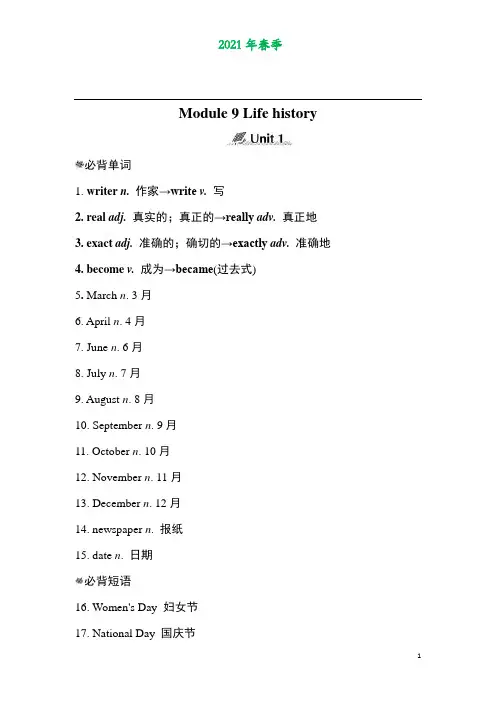
2021年春季Module 9 Life history必背单词1. writer n.作家→write v.写2. real adj.真实的;真正的→really adv.真正地3. exact adj.准确的;确切的→exactly adv.准确地4. become v.成为→became(过去式)5. March n. 3月6. April n. 4月7. June n. 6月8. July n. 7月9. August n. 8月10. September n. 9月11. October n. 10月12. November n. 11月13. December n. 12月14. newspaper n. 报纸15. date n. 日期必背短语16. Women's Day 妇女节17. National Day 国庆节2021年春季18. Children's Day 儿童节19. find out 发现;查明,弄清20. at the age of 在……岁时21. in the 1860s 在19世纪60年代必背句子22. I'm writing about him for my English class.我正在为我的英语课写关于他的东西。
23. Look at this!看这个!24. What did he do?他做什么工作?25. Enjoy the book.愿你喜欢这本书。
必背单词1. marry v.结婚→married(过去式)2. successful adj.成功的→succeed v.成功→success n.成功→successfully adv.成功地3. work n.作品;著作→works pl.4. build v. 建造→built(过去式)→building n.建筑物5. die v.死;去世→dead adj.死的→death n.死亡2021年春季6. rich adj.富有的→poor(反义词)贫穷的7. play n. 剧本;戏剧8. poem n. 诗歌9. on prep. 在……河边10. fire n. 火,火灾11. language n. 语言必背短语12. in one's life 在某人的一生中13. many other languages 许多其他的语言14. see plays 看戏剧15. finish school 毕业必背句子16. Like many people 400 years ago, Shakespeare's parents didn't learnto read or write.像400年前的许多人一样,莎士比亚的父母没有学习过读书和写作。
外研版英语七年级下册Module9Lifehistory总结
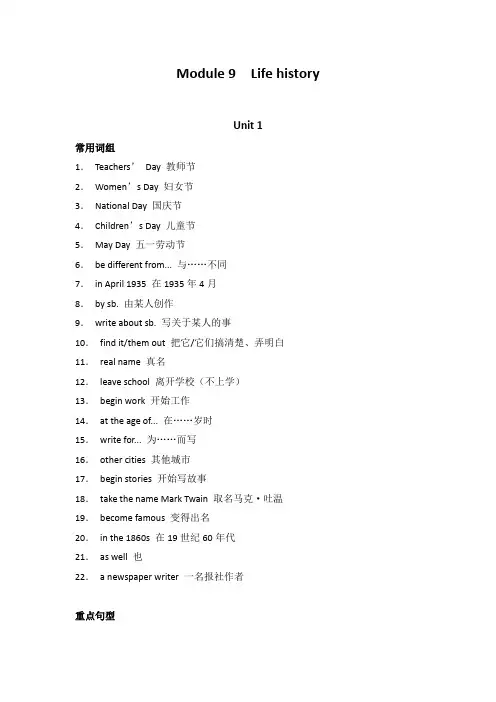
Module 9 Life historyUnit 1常用词组1.Teachers’Day 教师节2.Women’s Day 妇女节3.National Day 国庆节4.Children’s Day 儿童节5.May Day 五一劳动节6.be different from... 与……不同7.in April 1935 在1935年4月8.by sb. 由某人创作9.write about sb. 写关于某人的事10.find it/them out 把它/它们搞清楚、弄明白11.real name 真名12.leave school 离开学校(不上学)13.begin work 开始工作14.at the age of... 在……岁时15.write for... 为……而写16.other cities 其他城市17.begin stories 开始写故事18.take the name Mark Twain 取名马克·吐温19.become famous 变得出名20.in the 1860s 在19世纪60年代21.as well 也22.a newspaper writer 一名报社作者重点句型1.Betty’s grandfather’s life was different from Betty’s.贝蒂爷爷的生活与贝蒂的不同。
2.He was born in April 1935.他出生在1935年4月。
3.We can find out about him on the Internet.我们可以在互联网上查到关于他的信息。
4.He left school and began work at the age of twelve.他12岁时离开学校并开始工作。
5.Look at this!看这个!6.Enjoy the book. 享受这本书。
要点精析1. Women’s Day 妇女节women’s是所有格形式,不以-s结尾的复数名词的所有格加“’s”。
外研版七年级英语下册Module 9 Life history复习课件

3. 他做了什么? What did he do?
4. 他为一家报社写作。 He wrote for a newspaper.
5. 后来他在船上工作。 Later he got work on a boat.
4. 他为一家报社写作。 He wrote for a newspaper.
5. 后来他在船上工作。 Later he got work on a boat.
6. 但是他取名马克·吐温,并在19世纪60年代变得很出名。 But he took the name Mark Twain and became very famous in the 1860s.
Task 5 Read, spell and translate.
13. [dɪˈsembə] December
14. [ˈraɪtə]
writer
15. find out
16. [ˈriːəl]
real
17. at the age of
18. [ˈnjuːzpeɪpə]newspaper
19. [ɪɡˈzækt] exact
6. 但是他取名马克·吐温,并在19世纪60年代变得很出名。 But he took the name Mark Twain and became very famous in the
71. 8他60也s.去了欧洲。
8H. e但w是en他t 没to 来Eu过ro中pe国a。s well.
Task 9 Write.
Module 9 Life history
(Revision)
七年级英语下册Module9Lifehistory语法知识汇总复习外研版4
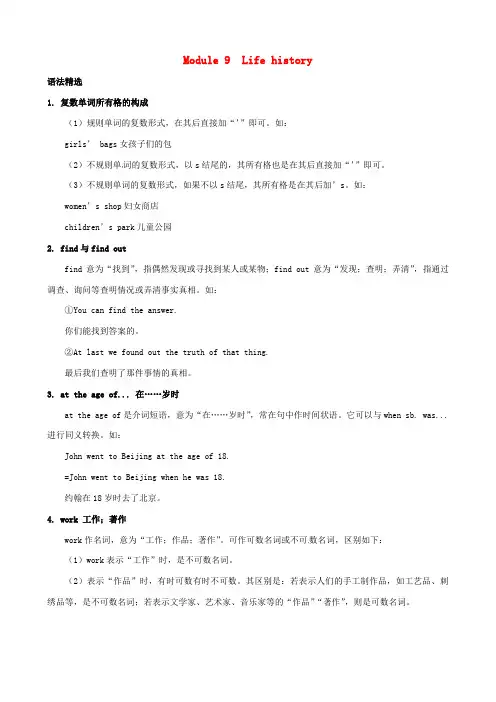
Module 9 Life history语法精选1. 复数单词所有格的构成(1)规则单词的复数形式,在其后直接加“’”即可。
如:girls’ bags女孩子们的包(2)不规则单词的复数形式,以s结尾的,其所有格也是在其后直接加“’”即可。
(3)不规则单词的复数形式,如果不以s结尾,其所有格是在其后加’s。
如:women’s shop妇女商店children’s park儿童公园2. find与find outfind意为“找到”,指偶然发现或寻找到某人或某物;find out意为“发现;查明;弄清”,指通过调查、询问等查明情况或弄清事实真相。
如:①You can find the answer.你们能找到答案的。
②At last we found out the truth of that thing.最后我们查明了那件事情的真相。
3. at the age of... 在……岁时at the age of是介词短语,意为“在……岁时”,常在句中作时间状语。
它可以与when sb. was...进行同义转换。
如:John went to Beijing at the age of 18.=John went to Beijing when he was 18.约翰在18岁时去了北京。
4. work 工作;著作work作名词,意为“工作;作品;著作”。
可作可数名词或不可数名词,区别如下:(1)work表示“工作”时,是不可数名词。
(2)表示“作品”时,有时可数有时不可数。
其区别是:若表示人们的手工制作品,如工艺品、刺绣品等,是不可数名词;若表示文学家、艺术家、音乐家等的“作品”“著作”,则是可数名词。
句法精析Spring Festival is in January or February.春节在1月或2月。
in January or February意为“在1月或2月”,在月份前用介词in。
如:We often fly kites in March.我们经常在3月放风筝。
外研版英语七年级(下) Module 9 .Life history

外研版英语七年级(下)Module 9 .Life history一.重点短语句型归纳。
lie in the sun 躺在阳光下sth to sb.stand in line 站成一排send 把...发送给某人take photos of 给...拍照sb sth.wait for...等待... 发送给某人...the Great Wall 长城 a lot= very much 非常be on a school trip 进行学校旅行go back to 回到...right now 立刻get on/off上/下(bus/train...)be on sale 出售(打折)run for... 追赶...go to the opera 去歌剧院(听歌剧)enjoy the sun 享受阳光have a drink 喝饮料二、句型。
1、at the age of…在…岁时at the age of + 基数词=基数词+years of age =基数词+years oldeg. He left school at the age of twelve. (同义句)He left school when he was twelve (years old).2. be different from 与…不同反义短语the same (…) as 与…相同His hobby is different from mine. 他的爱好和我不同。
His hobby is the same as mine.( my hobby) 注意被比较的对象:主语和宾语He has the same hobby with me.3. write for 为…写文章write about 写…写关于…4. the exact date 确切日期5. finish school 完成学业6. find out 找出,查明。
外研版七年级英语下册课件Module 9 Life history

讲解来自《点拨》
典例
D —When is ________ Day? —It’s on June 1st, Dave . (东营) A.Child C.Child’s B.Children D.Children’s
【点拨】children是child的复数形式,其所有格在后面加’s。
2
Listen and choose the correct answer .
Betty :What did he do? 魔法 Tony :He wrote for a newspaper . Later he got work on 记忆 a boat . Betty:Did he stay in Missouri? Tony:No,he went to New York,and other cities . Betty:When did he begin his stories? Tony:I don’t know the exact date . But he took the name Mark Twain and became very famous in the1860s❺ . He went to Europe as well. But he didn’t come to China . Betty:Yes,I knew that. Enjoy the book . Tony:Yes,it’s good .
1.Betty’s grandfather’s life was/wasn’t different from Betty’s . was 2.Betty’s grandfather was born in April 1935/1955 . 1935 3.Betty’s grandfather went to America/England in October/November 1941 . America;October
外研社-七下-M9-Life-history-知识点整理
at the age of =when sb was ...yool and began work at the age of twelve.(同义句转换)
• by
(1)介词
(2)含义
乘:by bus 用,通过: by email
由...创作
3、语法
• one of +最高级+n.复数+v.单数
e.g. Lu Xun is one of China.
(popular)
(writer) in
Try your best to understand and recite what you've learned!
Make Presentation much more fun
• like V. 喜欢 like+v.ing
介词,像
• marry :vi 和某人结婚:marry sb,be | get married to sbe.g. e.g. He married a beautiful girl in 1582.(同义句转换)
4、课外小语法
• 搬到某地:move to splace
@WPS官方微博 @kingsoftwps
以上有不当之处,请大家给与批评指正,谢 谢大家!
8
2、短语
• 12月份 • 节日( 教师节,妇女节,圣
诞节,国庆节,儿童节,元旦,
劳动节,春节)
• 一个著名的美国\英国作家 • 真名 • 在12岁时
• 开始使用新名字 • 在19世纪60年代 • 学习读写 • 决定成为一名演员 • 开始写剧本 • 用很多其他语言 • 全世界
3、语法
• 在...岁时
七下复习 M9 Life history 知识点整理
七年级英语下册Module9Lifehistory一般过去式(3)语法要点(新版)外研版
Module 9 语法要点在前面几个模块中,我们所接触的动词过去时多为规则变化,其基本变化规则为“动词原形+ -ed”。
但是在英语中不符合上述变化规则的动词有很多,它们的过去式构成方法独特,因此被称为不规则动词,需要靠同学们单独记忆。
We left at nine o’clock in the morning.我们是早上九点钟离开的。
We swam in the Pacific Ocean. We had a good time. 我们在太平洋里游泳,玩得很高兴。
下面是一些常用的不规则动词及其过去式:be— was/were leave — leftbuy — bought meet — metcome — came read — readdo — did see — sawget— got send — sentgo — went spend — spenthave — had swim — swamwrite — wrote take — took除了过去式的变化规则不同以外,不规则动词在肯定句、否定句、一般疑问句等各种句型中的使用都与规则动词相同。
下面我们以spend,come,go,take为例具体说明:( ) 1. —_____ he ____ his lunch?— Yes, he did.A.Does ;hasB. Does; haveC. Did;haveD. Did;had( ) 2.—Did the thieves _____ into the car?—No, they______.A.fell;didn’tB. fall; didC. jump;didn’tD. jump;did( ) 3.— When did May come back from Hong Kong?—She_____ from Hong Kong last Friday.e backB. comes backB.returned back D. came back( ) 4. ____ she _____ this dictionary in the bookshop nearby last week?A.Did;buyB. Does; buyC. Did;boughtD. Does;buys( ) 5. He ____ to the station this morning and was______ for the train.A. hurry, in timeB. hurries, on timeC.hurried, in timeD. hurried, at time( ) 6. Where _____ Uncle Sun yesterday?A.wasB. wereC. didD. does( ) 7. —Have you seen him today?—Yes, I ____ him this morning.A.seeingB. seeC. seesD. saw( ) 8. He ______ worried when he heard the news.A. isB. wasC. doesD. did( ) 9. There _____ a telephone call for my brother Steven yesterday.A. isB. areC. wasD. were( ) 10. Liu Fengwei _____ three yuan for the lost library book.A. paidB. payC. spentD. lost( ) 11. He ____ in this school in 2008.A. taughtB. teachC. teachesD. teaching( ) 12. They _____ tired so they stopped ____ a rest.A. are, haveB. were, haveC. were, to haveD. are, having( ) 13. Yesterday I _____ in bed all day because I had a fever.A. layB. lieC. laidD. lied( ) 14. It was raining hard when he ____ home.A. gotB. getC. getsD. was getting( ) 15. She said her brother ____ in Beijing. He ______ to Japan on business last week.A. wasn’t;wentB. hasn’t;wentC. wasn’t; goD. isn’t;went答案1—5CCDAC 6—10ADBCA 11—15ACAAA。
外研版英语七下第九模块《 Life history》重要知识点总结
Module 9 Life historyUnit 1 He left school and began work at the age of twelve.1.关于month的词汇及其简写:January一月(Jan.); February二月(Feb.); March三月(Mar.);April四月(Apr.); May五月(May); June六月(Jun.);July七月(Jul.); August八月(Aug.); September九月(Sept.);October十月(Oct.)November十一月(Nov.);December十二月(Dec.)2.Tom Sawyer, by the famous American writer, Mark Twain. by, 介词,意为“由……创作;出自”。
3.辨析:find out & find & look for一言辨异:eg.I looked for my umbrella everywhere, but I couldn’t find it. Please help me find out who took it by mistake.我到处寻找我的雨伞,但是没有找到。
请帮我查一下是谁错拿了它。
4.“真实的”real(1)real,形容词,意为“真实的;真正的”。
real name,“真名”。
(2)really,副词,意为“确实;真正地”。
really happy,“确实很高兴”。
一言辨异:Tom really wants to make a real friend.汤姆真的很想结交一个真正的朋友。
5.age表达法at the age of +基数词 = at + 基数词,意为“在……岁时”相当于when sb. was... (years old)。
eg.At the age of 5/At 5,Jack could learn to read and write. =Jack could learn to read and write when he was 5 (years old). Jack 5岁时就学会了读书认字。
七年级英语下册Module9Lifehistory一般过去式3语法要点新版外研版
Module 9 语法要点在前面几个模块中,我们所接触的动词过去时多为规则变化,其基本变化规则为“动词原形+ -ed”。
但是在英语中不符合上述变化规则的动词有很多,它们的过去式构成方法独特,因此被称为不规则动词,需要靠同学们单独记忆。
We left at nine o’clock in the morning.我们是早上九点钟离开的。
We swam in the Pacific Ocean. We had a good time. 我们在太平洋里游泳,玩得很高兴。
下面是一些常用的不规则动词及其过去式:be— was/were leave — leftbuy — bought meet — metcome — came read — readdo — did see — sawget— got send — sentgo — went spend — spenthave — had swim — swamwrite — wrote take — took除了过去式的变化规则不同以外,不规则动词在肯定句、否定句、一般疑问句等各种句型中的使用都与规则动词相同。
下面我们以spend,come,go,take为例具体说明:— Yes, he did.A.Does ;hasB. Does; haveC. Did;haveD. Did;had( ) 2.—Did the thieves _____ into the car?—No, they______.A.fell;didn’tB. fall; didC. jump;didn’tD. jump;did( ) 3.— When did May come back from Hong Kong?—She_____ from Hong Kong last Friday.e backB. comes backB.returned back D. came back( ) 4. ____ she _____ this dictionary in the bookshop nearby last week?A.Did;buyB. Does; buyC. Did;boughtD. Does;buys( ) 5. He ____ to the station this morning and was______ for the train.A. hurry, in timeB. hurries, on timeC.hurried, in timeD. hurried, at time( ) 6. Where _____ Uncle Sun yesterday?A.wasB. wereC. didD. does( ) 7. —Have you seen him today?—Yes, I ____ him this morning.A.seeingB. seeC. seesD. saw( ) 8. He ______ worried when he heard the news.A. isB. wasC. doesD. did( ) 9. There _____ a telephone call for my brother Steven yesterday.A. isB. areC. wasD. were( ) 10. Liu Fengwei _____ three yuan for the lost library book.A. paidB. payC. spentD. lost( ) 11. He ____ in this school in 2008.A. taughtB. teachC. teachesD. teaching( ) 12. They _____ tired so they stopped ____ a rest.A. are, haveB. were, haveC. were, to haveD. are, having( ) 13. Yesterday I _____ in bed all day because I had a fever.A. layB. lieC. laidD. lied( ) 14. It was raining hard when he ____ home.A. gotB. getC. getsD. was getting( ) 15. She said her brother ____ in Beijing. He ______ to Japan on business last week.A. wasn’t;wentB. hasn’t;wentC. wasn’t; goD. isn’t;went答案1—5CCDAC 6—10ADBCA 11—15ACAAA。