
外研版英语(新标准)八年级上册《M10 Unit 3 Language in use》A课堂同步试题及答案
M10 Unit 3一、单项选择1.Look! It's a ________ day today.Remember to take an umbrella with you when you go out.A.sunny B.windy C.cloudy D.rainy2.It's nice ______ you ______ me at the airport.A.for; meeting B.of; to meetC.for; to meet D.of; meeting3.Three days ________ he got to Beijing with his parents.A.late B.later C.after D.later on 4.—Whose schoolbag is this?—I'm not sure. It ________ be Tom's.A.must B.need C.may D.should 5.—What will the weather be like tomorrow?—It ________ be rainy,for there are lots of dark clouds.A.must B.might C.could D.can 6.—What do I need to do to lose weight?—You'd better ________ more exercise.A.to take B.take C.taking D.took7.________,Danny.If you aren't in a hurry,you may be late again.A.Come on B.Look forC.Take it easy D.Never mind8.________ Simon has done well in his studies, he still works really hard.A.Although B.Because C.Unless D.When 9.—What are you going to be when you grow up?—A singer, but my parents wish me ________ a teacher.A.am B.to be C.will be D.be 10.Helen has got two brothers. ________ of them likes chocolate, but she loves it.A.Neither B.None C.Each D.Any 二、选用may, might或probably完成下列句子11.It ________ be cold this evening.12.They ________ went to the cinema last night. I'm not sure. 13.—Do you have any plans for this weekend?—I'm not sure. I ________ go climbing Mount Tai.14.—________ I come round in the morning?—Of course.15.We're going on holiday soon, ________ next month.三、按要求改写句子16.In summer it rains a lot in the south of China.(改为同义句) In summer it________________in the south of China. 17.Maybe there will be a heavy rain tonight.(改为同义句) There ________ ________ a heavy rain tonight.18.You had better stay at home.(改为否定句)You ________ ________ ________ stay at home.19.Come on! The bus is leaving soon.(改为同义句)________ ________!The bus is leaving soon.20.Robert runs faster than any of the other students in his class.(改为同义句)Robert runs faster than________ _________ _________ in his class.Robert runs__________ __________ __________ ____________________ in his class.四、将下列句子译成英语,用上括号内所给的词汇21.雨停后,太阳出来了。
(come out)________________________________________________________ 22.这个周末我打算呆在家里。
(stay at home)________________________________________________________ 23.那支新钢笔她支付了20元。
(pay...for...)________________________________________________________ 24.他太矮了以至于够不到桌子上的面包。
(so...that...)________________________________________________________ 25.昨天晚上我不得不告诉他这件事。
(have to)________________________________________________________ 五、任务型阅读(词数:约180;建议用时:6分钟)阅读下面的短文,把A—E五个句子填入文中空缺处,使短文内容完整。
Everybody talks about the weather. It's the most popular topic of conversation (谈话). For example, people may say to each other “Isn't it a nice day?”“Do you think it's going to rain?”or “I think it is going to snow.”________26Many people think they can tell what the weather is going to be like. ________27 One man may say, “Do you see how cloudy it is in the east? It is going to rain tomorrow.” But another man may say, “Yes, it's cloudy in the east, so we are going to have a fine day tomorrow.”________28 When a farmer needs water, he looks for something to tell him it is going to rain; he won't believe other things. When people are having a picnic, but it begins to rain, they will be so sure about something that shows the weather is going to be fine very quickly. ________29 Almost everyone listens to what the weatherman says. But he does not always tell us what we want, and sometimes he makes a mistake.________30答案一、1.D点拨:此题用寻找题眼法解答。
根据题眼umbrella可知前句指的是今天是雨天。
2.B点拨:本题考查固定句型。
“It is +adj. +for / of sb. to do sth.”中,当adj.表示人的品质时,用of而不用for。
故选B。
3.B点拨:表示“以后”时,later放在时间后面,after放在时间前面。
注意:later on指不具体的时间。
4.C 5.A6.B点拨:此题用识记法解答。
had better (not) do sth.“最好(不)做某事”,是固定用法。
7.A点拨:此题用语境判断法解答。
根据后句句意“如果你不快点,你可能又迟到了。
”可知come on“快点”符合题意,故选A。
8.A9.B点拨:此题用识记法解答。
wish sb.to do sth.“希望某人做某事”。
10.A二、11.may/might12.probably13.may/might14.May15.probably三、16.often rains17.may be18.had better not19.Be quick点拨:be quick意为“快点”。
20.any other student;fastest of all the students点拨:副词最高级前的the可以省去。
四、21.The sun came out after the rain stopped.22.I'm going to stay at home this weekend.23.She paid 20 yuan for the new pen.24.He is so short that he can't reach the bread on the table. 25.I had to tell him about this last night.五、26.E27.C28.A29.D30.B。
新外研版八年级英语上册Module 10 Unit 3 Language in use【习题课件】

Module 10 The weather
Unit 3 Language in use
习题链接
提示:点击 进入讲评
1 may/might 6 A
2 probably 7 C
3 may/might 8 A
4 May
9A
5 probably 10 A
答案呈现
11 may be/is probably 12 will probably 13 may/might 14 probably 15 will probably
10. [中考·安顺 ] —Look! The man welcoming us at the school
gate be our headmaster.
—No, it _____A___ be him. He is having a meeting in the
office now.
A. must; can’t
8. [中考·十堰] —I went to Mount Wudang with my five friends in one small car last weekend. —Oh, my God! I think it ____A____ be an uncomfortable trip.
A. must B. can’t C. may D. shouldn’t 【点拨】must一定;can't不可能;may可能;shouldn't不t
C. should
D. will
语法通关练习
7. [改编·海南] —Is that Mr. Zhou? —It ____C____ be him. He has gone to Beijing. A. may B. can C. can’t D. should
八年级英语上册 Module 10 Unit 3 Language in use课件 (新版)外研版
1 It is sunny now, but let’s take an umbrella…(rain later) 2 It is not always warm in February, and…(cool)
because it might/may/will probably rain later. 2. It is not always warm in February, and
sometime it may/might be very cold. 3.It is usually hot and sunny, so we
D. must enjoy 4.-Excuse me. Is this the right way to the Summer
Palace? -Sorry, I am not sure. But it ___ be. A. might B. will C. must D. can
第六页,共29页。
Language practice
morning, but the sun will come out in the afternoon.
第二十页,共29页。
Around the world
The Amazon Rainforest
The Amazon Rainforest is one of the wettest places in the world. It has more than 200 cm of rain every year. The Amazon Rainforest has more different animals and plants than any other place in
Module 10 Unit 3 Language in use 课件 (外研版八年级上)
我能用用你的钢笔吗?
2. may/ might表示推测,常译成“也许,
可能”等, might 的可能性比may要小。否
定形式常用may not/might not。如: She may / might go to Shanghai next week. 下周她可能到上海去。 He may / might be writing a letter. 他可能正在写信。 He may(may not) come here tomorrow. 他明天也许会(不会)来这儿。
It is possible to get to the airport before seven. 七点前可能到达机场。
It is possible + that从句。如: It is possible that I tell him the wrong time. 可能我告诉了他错误的时间。
probably 意为“很可能、大概”, 可 能性在这几个词中最大。如: There’s probably life on other planets, but we haven’t known yet.
Read and pay attention to these sentences.
1,It might be rainy. 2,… so it might snow. 3,It’s probably sunny and hot
there.
may / might 的用法
情态动词may / might,没有人称
3. 表示可能的方式有很多,除使用情态动 词may / might以外,还可以使用表示可能的 形容词和副词。 maybe, perhaps和possibly都可以表示“大 概, 也许”, 此时程度相似。但maybe和 perhaps常位于句首, possibly常位于句中, maybe主要用于非正式场合, 较口语化。如:
八年级英语上册Module10TheweatherUnit3Languageinuse
Language in use
• 能正确理解和运用本模块课出现的重要单词和短语。
• 能够用may,might,或者 probably谈论天气的变化走 向。
• 能写篇文章介绍何时来你家乡是最好的时机。
What will the weather be like tomorrow? It may be snowy. It might snow. It will probably be snowy. So we have a chance to make a snowman
showery
stormy
rainy weather
cloudy
Windy
sunny
foggy
snowy
icy freezing
Speak out the weather in different places with might, probably, or may
cloudy cold snowy colder hot snowy sunny cold wet rainy
5. December is the middle of _su__m_m__e_r_ in Sydney. 6. In December, we go to the __b_e_a_c_h____ because it’s very hot and sunny. 7. In April, May and June, it often __r_a_i_n_s_____. 8. The temperature in winter is about __ei_g_h_t_e_e_n_ degrees.
________________________________________ If you come here, I will take you around my hometown.
八年级英语上册Module10Unit3Languageinuse教案(新版)外研版
⑦I can`t possibly drink any more.
我无论如何不能再喝了。
possible, possibly, probably的常用结构:
It is possible that ....
It is possible to do sth.
八、布置家庭作业.Writing a passage about the best time to visit China.
……
1、复习本模块的单词、词组、句型。
2、practice 1:Complete the sentences.
3、让学生总结语法知识。
4、播放听力,练习学生听力。
5、Give some advice on the best time to visit China.
四、Practice3:
Listen and complete the sentences.
五、Work in pairs. Ask and answer.
六、自学检测,完成练习
七、Module task: Give some advice on the best time to visit China.
2) Performing a role-play..
3)Readingand predicting.
4) Transferring information from a table to a passage
4.Task:Preparing some advice on the best time to visitChinato form a passage.
4)InAlaskathe days are long and warm in summer, but may be cool in the evening.
外研版八年级英语上册教案 Module10 Unit3
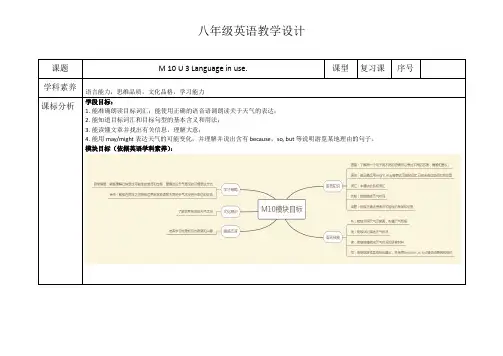
八年级英语教学设计课题M 10 U 3 Language in use. 课型复习课序号学科素养语言能力,思维品质,文化品格,学习能力课标分析学段目标:1.能准确朗读目标词汇;能使用正确的语音语调朗读关于天气的表达;2.能知道目标词汇和目标句型的基本含义和用法;3.能读懂文章并找出有关信息,理解大意;4.能用may/might表达天气的可能变化,并理解并说出含有because,so, but等说明游览某地理由的句子。
模块目标(依据英语学科素养):教材分析学情分析知识经验:已知:1.学生通过之前的英语学习和本模块第一单元的学习,掌握了基本的地理位置和天气的表达,为本节课的阅读理解奠定了一定的基础。
未知:1.本模块美国的城市学生学过New York, California,但是对其他几个城市的单词并不认识,增加了畏难情绪。
(难点)2.个性化差异:学生通过之前的英语学习和本模块第一单元的学习,有的同学may/might表可能的用法已经部分掌握。
策略经验:通过迁移策略,理解课文。
通过自学和互帮策略理解课文。
学生能够利用小组合作学习策略,交流学习心得,表达各自观点。
利用各种资源,采用自主学习策略,进行预习和自学。
生活经验:只有个别学生比较了解美国的城市地理和天气情况,对大部分学生来说,本节课的内容比较陌生。
学习目标(学习活动+学习主体+(行为程度)+评价活动)1.根据提示词,85%的学生能够写出相对应的单词和词组,句型能基本写正确,15%的学生在其他同学的帮助下能够写出单词和词组,能听懂其他同学表达的句子。
2.85%的学生通过语法点的整理与练习,能够用过去进行时和表过去的时间状语连用形成的复合句并仿照造句。
其他同学能够理解。
3.通过泛读、精读等活动,读懂关于交通规则和意外事故的文章。
重难点及突破措施重点:询问天气及温度句型表述。
难点:表示天气的名词及形容词之间的转换以及表示推测的情态动词用法。
突破措施:采用教师辅导学生回顾、总结和归纳的方式,强化单词和句型的理解记忆,提高学生的知识内化能力。
初二【英语(外研版)】M10 Unit 3 Language in use 教学设计
课例编号
初二年级【英语(外研版)33】M10 Unit 3 Language in use
学科
英语
年级
初二
学期
秋季
课题
M10 Unit 3 Language in use
教科书
书名:英语 八年级上册
出版社:外语教学与研究出版社 出版日期:2013年7月
教学人员
姓名
单位
授课教师
指导教师
教学目标
2.What might the weather be like?
3.What clothes should I bring?
4.Where can I stay?
5.What can I do?
How do we give advice on the best time to visit some place?
教学难点:
利用所学词汇和句型,为即将到中国旅行的外国游客提出建议。
教学过程
时间
教学环节
主要师生活动
8
mins
6
mins
4
mins
5 mins
Revision
ListeningBiblioteka ReadingWriting
Homework
How do we ask about the weather?
1.Ask and answer about some informationof weatherusing the key sentence structures.
3.After you answer the question, look at the map and make a weather forecast.
外研版八年级英语上册教案:Module10Unit3Languageinuse
4.学习能力:鼓励学生在合作学习中主动探索、总结和掌握动词过去式的规律,培养自主学习能力和团队合作精神。
核心素养目标紧密围绕新教材要求,旨在全面提升学生的英语学科素养,为学生的终身发展奠定基础。
三、教学难点与重点
-通过课本P68练习1和练习2,重点练习常见的动词过去式形式,确保学生能够熟练掌握。
-结合课本P69的例句,练习编写自己的句子,以巩固一般过去时的实际应用。
举例:
-学生能够正确填写表格,如“Yesterday, I ____(walk) to the park.”(正确答案:walked)。
-学生能够使用一般过去时描述过去的活动,如“Last week, we ______(visit) our grandparents.”(正确答案:visited)。
课堂上,我尝试通过提问和案例分析的方式引导学生主动思考,这样的互动让学生们更积极地参与到学习中。例如,在讲解动词过去式时,我让学生们尝试造句,并及时给予反馈,帮助他们纠正错误,加深理解。
然而,我也注意到,部分学生在口语练习时仍然显得有些拘谨,可能是因为他们对过去时的运用还不够自信。在未来的教学中,我需要更多地关注这部分学生,鼓励他们大胆开口,增强他们的自信心。
此外,小组讨论环节,学生们表现得相当积极,能够围绕一般过去时的应用进行深入的探讨。但在成果分享时,我发现有些小组的展示还不够充分,可能是由于讨论时间分配不均或是对主题理解不够透彻。为此,我计划在下次活动中,更加明确讨论要求,并在讨论过程中给予适当的指导,以提高讨论效率。
在实践活动方面,写作练习让学生们能够将所学的知识应用到实际情境中,但我也发现有些学生在构思句子时仍存在困难。针对这一问题,我打算在接下来的课程中增加一些写作技巧的讲解,如如何运用时间状语、如何连接句子等,帮助学生提升写作能力。
Module10Unit3Languageinuse教案-2020年秋外研版八年级英语上册
2.引导与启发:在讨论过程中,我将作为一个引导者,帮助学生发现问题、分析问题并解决问题。我会提出一些开放性的问题来启发他们的思考。
3.成果分享:每个小组将选择一名代表来分享他们的讨论成果。这些成果将被记录在黑板上或投影仪上,以便全班都能看到。
1.本单元的核心词汇:editor, address, magazine, include, article等。
2.主要语法点:一般现在时态的运用,特别关注动词第三人称单数形式的变化。
3.课本中的功能句型:How often...? What do you usually do...? I usually...
2.教学难点
-动词第三人称单数形式的正确变化,特别是以-s/-es结尾的规则,以及不规则变化动词的掌握。
-功能句型的灵活运用,如何根据实际情况调整疑问句和回答句的结构。
-在实际对话中,如何自然地运用一般现在时态描述日常活动,注意时态的准确性和语境的适应性。
举例:对于动词第三人称单数变化的难点,教师可以通过提供例句和练习,如“Does he play football every weekend?”来帮助学生记忆和运用;对于句型的灵活运用,教师可以设计情景对话,让学生在模拟真实场景中练习,如模拟采访同学日常习惯的对话,帮助学生突破难点。
在学生小组讨论后,成果分享环节进行得相对顺利。学生们能够较好地展示他们的学习成果,但我也发现部分学生对于同伴的评价和建议不够重视。针对这一点,我认为在以后的课堂中,应该加强对学生互评环节的引导,培养他们倾听、尊重和采纳他人意见的习惯。
-对话理解与表达:理解并能够运用课文中的对话和文章中的关键句子进行有效交流。
外研版八年级上M10_U3教案
My parents offered to take us there.
My parents agreed to take us.
We decided to stay for two hours.
I hope to understand more next time.
教学目标
语言知识目标:
1. Words & phrases生词和短语
full, silver, enjoyable, performance
2. Key sentences重点句子
She wanted to see some Beijing Opera.
My parents offered to take us there.
New words:
full,
silver,
enjoyable,
performance
教学反思或案例设计
检查意见
检查人
时 间
expressions in the box.
Check the answers by
themselves first, then go through the answers with the students.
In this procedure, revise the important grammar points of this module. Do pair work to practise verbs followed by infinitives.
S1: The food here is excellent.
S2: It’s delicious.