
英语语音训练-双元音
英语语音训练-双元音
什么是“双元音”?
双元音音素由两个元音组成,发音时由一个元音向另一个元音滑动,口型有变化。
前一个元音发音清晰响亮,且时间长;
后一个元音发音模糊软弱,且时间短。
特别要注意的三点是:
(1) 不要将前后两个音断开,应连贯成为一个整体:
(2) 不要因为后一个元音发音短小而将其忽略;
(3) 发音时滑动过程要完整,时间要充分。
“双元音”有哪些?
[ei] [ai] [ɔi] [au] [əu] [iə] [εə] [uə]
1. [ ei ]
【发音规则】舌类顶下齿,牙床半开半合,双唇扁平,由发“哀”平稳过渡到发“一”之长音。
以下这些字母及组合发这个音:
[ ei ] a ai ay ea ei ey
单词:
a - a te g a me c a ke f a ce l a zy l a bour h a tred
ai - f ai l w ai t r ai n s ai l compl ai n
ay - d ay w ay m ay
ea - br ea k gr ea t st ea k
ei - n ei ghbour ei ght w ei ght
ey - h ey th ey
句子:
Today is payday.
No pains, no gains.
2. [ ai ]
【发音规则】将口张开略圆,舌后升起,舌尖向后收缩,由发“阿”音平稳过渡到发“一”音。
以下这些字母及组合发这个音:
[ ai ] i y ai ei ie uy ye eye igh
单词:
i - b i ke r i ce s i de l i ke t i me w i de pr i vate
y - b y m y fl y cr y sk y t ry
ai - m ai n ai sle 通道
ei -ei ther ei der h ei ght
ie - l ie t ie d ie
uy - b uy g uy
ye - d ye染料
eye - eye
igh - h igh f igh t n igh t r igh t l igh t
短语/句子:
Strike while the iron is hot. 趁热打铁
Mike tried five times to get the prize.
3. [ ɔi ]
【发音规则】双唇外突成圆形,发“奥”音逐渐过渡为双唇扁平分开,发“一”之短音。
以下这些字母及组合发这个音:
[ ɔi ] oi oy
单词:
oi - o il b oi l c oi n l oi n s oi l j oi n n oi se v oi ce ch oi ce disapp oi nted
oy - b oy t oy j oy enj oy l oy al depl oy empl oy destr oy
句子:
The boy destroyed the toys.
The boy makes a loud noise.
4. [ au ]
【发音规则】将口张开略圆,渐渐合拢,双唇成圆形,由发“阿”音平稳过渡到发“屋”音。
以下这些字母及组合发这个音:
[ au ] ow ou
单词:
ow - c ow h ow n ow d ow n t ow n cr ow d all ow
b ow er p ow er fl ow er
ou - ou r ou t l ou d h ou se m ou th f ou nd m ou se
s ou nd gr ou nd c ou nter f ou ntain
句子:
He shouted louder and louder.
I have heard so much about you.
Brown spends hour after hour among his flowers.
Round and round he danced in front of the crowd.
.
5. [ əu ]
【发音规则】口半开半合,舌后微升,过渡成双唇成圆形,发“欧”之长音。
以下这些字母及组合发这个音:
[ əu ] o oa oe ou ow ew
单词:
o - s o n o b o at t o ld n o te n o se p o em th o se
potat o tomat o
oa -l oa d b oa t r oa d t oa st
oe - t oe h oe
ou - s ou l th ou gh sh ou lder
ow - b ow l sh ow thr ow tomorr ow
ew - s ew
句子:
Don’t go home alone,Joan.
Little stroke fell great oaks. 水滴石穿
As you sow, you shall mow. 种瓜得瓜,种豆得豆。
6. [ iə ]
【发音规则】双唇张开岈床由窄至半开舌抵下齿逐渐过渡至上卷,从“一”音过渡到“厄”音。
以下这些字母及组合发这个音:
[ iə ] ea ia ear eer ere iou
单词:
ea - id ea r ea l r ea lize th ea ter
ia -mater ia l industr ia l
ear - ear d ear n ear y ear cl ear
eer - b eer d eer p eer ch eer pion eer
ere - h ere m ere
iou - var iou s
句子:
The deer is full of fear.
We are near the end of the year.
They cheered the hero when he appeared.
7. [ εə ]
【发音规则】双唇张开后略圆,牙床张开相当宽,舌尖卷上渐至卷后。
以下这些字母及组合发这个音:
[ εə ] a ar are air ear ere eir
单词:
a - a rea p a rent v a rious
ar -sc ar ce
are - d are r are sp are sh are squ are
air - air f air h air ch air rep air
ear - b ear w ear p ear
ere - th ere wh ere nowh ere
eir - h eir th eir
句子:
On a mare goes the mayor 市长骑在母马上
to the fair at the square. 赶集来到了市场
Prepared to buy a little bear 打算买只小熊熊
that will sit on his fair chair. 让它坐在椅子上
8. [ uə ]
【发音规则】双唇成圆形,牙床近于半合,舌尖不触下齿,发“屋”之长音,然后从“屋”音过渡到“厄”音。
以下这些字母及组合发这个音:
[ uə ] ou ua oor ure
单词:
ou - t ou rist
ua - us ua l Febr ua ry
oor - p oor
ure - p ure s ure
句子:
I’m sure he is from a very poor family.
【语音练兵场】
一. 找出红色字母发音与音标不同的单词。
1. [ei]
A. f a ce
B. w ai t
C. h ei ght
D. gr ea t
2. [ai]
A. t i me
B. compl ai n
C. m ai n
D. n igh t
3. [ɔi]
A. m ou th
B. j oi n
C. enj oy
D. ch oi ce
4. [au]
A. d ow n
B. sh ou lder
C. c ou nter
D. fl ow er
5. [əu]
A. r oa d
B. sh ow
C. potat o
D. r ea l
6. [iə]
A. w ear
B. r ea lize
C. n ear
D. var ious
7. [εə]
A. rep air
B. sh are
C. p eer
D. wh ere
8. [uə]
A. p oor
B. us ua l
C. thr ow
D. s ure
答案:1. C 2. B 3. A 4. B
5. D
6. A
7. C
8. C。
英语语音练习题及答案

英语语音练习题及答案【篇一:英语语音学课后问答题答案】the making of(1) /t, d/ p57/t/ is a voiceless alveolar plosive consonant/d/ is a voiced alveolar plosive consonant/t/ the top of the tongue is raised to touch the teeth ridge or alveolus, the soft palate is raised, so that the nasal resonator is shut off. in this way, a closure is formed between the tip of the tongue and the teeth ridge. then the air from the lung is compressed behind this closure and then suddenly release the closure. the vocal folds are open or wide apart, while the vocal folds vibrate in producing the sound /d/.(2) /s, z/ p62/s/ is a voiceless blade- alveolar fricative sound/z/ is a voiced alveolar fricative consonantthe soft palate is raised, so that the nasal resonator is shut off. the tip and blade of the tongue make a light contact with upper teeth ridge. the air from the lung escapes through the narrow groove in the center of the tongue between the teeth.(3) /n/ p68/n/ is a voiced alveolar nasal consonanta. lower the soft palate to release the air through the nose;b. put the tip of the tongue against the upper front teeth-ridge and upper side teeth;c. keep the teeth slightly parted;d. vibrate the vocal cords.so that the airstream from the lung escapes through the narrow groove in the center of the tongue in producing the sound.(4) /l/ p65/l/ is a voiced alveolar lateral consonanta. close the nasal cavity by raising the soft palate;b. put the tip of the tongue against the upper front teeth-ridge for clear/l/, the front of the tongue being somewhat depressed;c. hold the air in the middle of the mouth;d. force the air out over both sides or one side of the tongue, making a lateral voiced sound.2. classify the vowels in different ways. p16-17the pure vowels can be classified according to different 4 principles.(2) according to the length of the vowels, they are divided into long vowels and short vowels. the pure vowels in transcription with two dots are long vowels. the diphthongs are also long. the rest are short ones.(3) according to the shape of the lips, the vowels can be divided into rounded vowels and uounded (spread) vowels. the rounded vowels are /?:/ /u:/ /?/ /?/ and the rest are uounded vowels.(4) according to the degree of tenseness of the muscles, the pure vowels are classified asthe eight diphthongs can be classified as closing diphthongs /e?/ /a?/ /??/ /??/ /a?/.and centring diphthongs /??/ /e?/ /??/.3. classify the consonants in different ways. p17-18there are 24 consonants in english. they are classified according to three different principles:1) the vibration of the vocal folds: those with the vibration of the vocal cords are called voiced consonants. those without the vibration of the vocal cords are called voiceless or breathed consonants.2) place of articulation: i.e., where the obstruction of the air passage is formed, the consonants can be distinguished as bilabial, labiodental, dental, alveolar, post-alveolar, palato-alveolar, palatal, velar, and glottal consonants.3) manner of articulation: they can be distinguished as plosives, fricatives, affricates, nasals, laterals, frictionless continuant and semi-vowels.4. how are /i:/ and /i/ produced? what’s the difference between them? p21-22/i:/: the front of the tongue is raised to a height slightly below and behind the front close position; the lips are spread; the tongue is tense; the side rims make a firm contact with the upper molars; it is generally long./i/: the rp vowel /i/ is pronounced with a part of the tongue nearer to the center than to front. it is raised just above the close-mid position; the lips are loosely spread; the tongue is lax; the side rims make a light contact with the upper molars; it is generally short.the difference is not merely the length of sound. there is also a difference in tongue position or quality. for /i:/ the part of the tongue that is highest is the centre of the “front” while for /i/ it is the hinder part of the “front”.5. what are the common features of the front vowels? p26(1) the front of the tongue is raised to various levels in the direction of the hard palate.(2) the tip of the tongue is usually kept down behind the lower teeth.(3) the lips are spread.6. how are the plosives produced? p56plosives are sounds resulting from a blocking or stopping effect on the airstream.6 plosives: /p/,/b/,/t/,/d/,/k/,/g//p/: a voiceless, bilabial plosive consonanta. raise the soft palate so that the nasal cavity is closed;b. breathe in the air and close the lips;c. hold the air behind the closure;d. part the lips open suddenly so that the air comes out of the mouth with a plosive sound;e. do not vibrate the vocal cords. /b/: a voiced bilabial consonantthe organic formation for /b/ is exactly the same as that for /p/ except that the air comes outof the mouth less forcefully and that the vocal cords vibrate./t/: a voiceless alveolar plosive consonanta. raise the soft palate so that the nasal cavity is closed;b. put the tip and blade of the tongue against the upper teeth ridge so that a closure isformed;c. hold the air behind the closure;d. release the closure and blade suddenly so that the air escapes with a plosive sound;e. do not vibrate the vocal folds. /d/: a voiced alveolar plosive consonantthe organic formation for /d/ is the same as that for /t/ except that the air is released less strongly and that the vocal folds vibrate./k/: a voiceless velar plosive consonant.a. raise the soft palate so that the nasal cavity is closed;b. lift the back of the tongue to touch the soft palate so that a closure is formed;c. stop the air stream behind the closure;d. break the closure and the plosive sound is heard;e. be careful not to vibrate the vocal folds./g/: a voiceless velar plosive consonantthe organic formation for /g/ is the same as that for /k/ except that the vocal cords vibrate when the air is released.7. how do you make the affricates /t?/and /d?/? p70/t?/: a voiceless palate-alveolar affricate consonanta. raise the soft palate to stop the air passage and put up the tip of the tongue to touch theback part of the teeth-ridge to form a retracted /t?/ closure;b. the main part of tongue is in position for /?/;c. release the closure slowly, and the air escapes all over the central part of the tongue withfriction;d. the lips are usually somewhat protruded;e. the vocal cords are not made to vibrate./d?/: a voiced palate-alveolar affricate consonantthe affricate /d?/ is formed like /t?/ except that the breath force is weaker and the vocal cords are made to vibrate.8. why are /w/ and /j/ called semi-vowels? p73the semi-vowels have both the features of vowels and consonants.9. please explain “open syllables” and “closed syllables”.p77open syllables are those without any consonant at the end. in british rp only a restricted set of vowels can occur.closed syllables are those that have one or more consonants at the end. all the vowels can appear in these circumstances.10. what is called incomplete plosion? p84when the release stage of a plosive sound is missing or delayed, it is known as incomplete plosion. it takes place in a word when a plosive is followed immediately by another plosive, or a fricative, or an affricate. it may also take place at the junction of words (unless they are separated by a pause).11. when do we have liaison? p86a. consonant (except r) + vowelthe final consonant of the preceding world is united tothe initial vowel of the next word in the same sense group.e.g. give it uphalf an hourb. –r or –re + vowelwhen a word ending with the letter”-r” or “-re” is followed by a wordbeginning with a vowel, the sound /r/ is usually inserted in the pronunciation.e.g. after all far and widec. vowel + vowelwhen a word ending in a vowel is followed by another word beginningwith a vowel, a short/j/ glide is inserted after /i:/, /i/, /ei/, /ai/ and /?i/, or a /w/ glide after /u:/,/u/,/?u/, and/au/e.g. at the endhurry up12. how do you explain assimilation? p95speech sounds seldom occur in isolation. in connected speech, under the influence of their neighbors, are replaced by other sounds. sometimes two neighboring sounds influence each other and are replaced by a new sound which is different from either of the two original sounds. this process is called assimilation.13. how many kinds of stress are there in a word? what are they? p107three principal kinds.(1) primary stress--heavily stressed, usually marked with a vertical stroke() on the upper left hand corner of a syllable carrying the stress, as in be’gin.(2) secondary stress--stressed but subordinate to the primary stress, usually marked with a vertical stroke (?) on the lower left hand corner of a syllable concerned, as in ?contribution.le stress or even stress. double stress can be marked by a high vertical stroke before each of the stressed syllable, as in /?f?f’ti:n/, /b ?:’l?n/, etc.14. how is sentence stress classified? for example. p115-119 three types: sense stress, logical stress, emotional stress.15. please define sense-groups. p140sense-groups are groups of words which are closely connected in meaning and grammar. each sense-group comprises a number of syllables. generally speaking, about six or seven syllables are considered appropriate.16. how many kinetic tones do you know? p153-154the tones which glide from one height to another are called kinetic tone. they are high fall, low fall; high rise, low rise; high fall-rise, and low fall-rise; rise-fall and rise-fall-rise.17. what is a tune? what are the features of the englishtune?p159,164the intonation of the whole tone-group is called a tune.a. normally a low prehead.b. normally a high head.c. in the body, the stressed syllables occupy mostly level pitches and they all fall downgradually in pitch. the unstressed syllables between the stresses ones have about the same height as the stressed syllable preceding them.d. the nucleus is usually at the end of the tune when something is uttered in isolation.e. the changes in the tail are determined by the nucleus. in a fall, the tail remains on a lowlevel pitch[ ]; in a rise or fall-rise, the tail rises gradually[ ]. 18. what’s the function of the falling-rising tune? p173it is used to show contrast, reservation, implication, disagreement, contradiction or warning, etc.1) declarative sentence: the falling-rising tune used in declarative sentences indicates incompleteness and implications, such as concession, gratitude, regret, apology, request, reproach and rebut, etc.2) interrogative sentences:a. special questions: the falling-rising tune used in the special question is stronger than the rising tune. it expresses surprise, interest, request, sympathy, disgust and disbelief, etc.b. general questions: the falling-rising tune used in the general question can express hesitation, request, agitation, exaggeration, etc. no answer is expected by the speaker. c. disjunctive question.3) imperative sentence: the falling-rising tune used in the imperative sentence expresses a warning or an urgent request.4) exclamatory sentence: the falling-rising tune is seldom used in exclamatory sentences. however, when used, it expresses enthusiasm, appreciation, sympathy, encouragement, regret and contempt, etc.【篇二:英语音标练习题—判断发音(含答案)[1]_2】>一、选出划线部分与其他三项发音不同的一项 ( c( a ( d ( b ( b ( a( d( b ( a ( c ( d ( c ( a ( b ( c( a ( d ( b ( a ( a ( b( c ( b ( c ( b ( d ( d ( c ( b( a ( b ( c ( c ( a( a ( b ( d ( d- 1 -- 2 -(((((((((((((((((((((((【篇三:英语语音练习题一】国际音标共48个音素,其中元音音素20个,辅音音素28个。
音标专题练习-双元音(3)

音标练习Lesson 6 双元音[iә][eә][uә]练习[iә] 发这个音的字母和字母组合eer, ere, ear, ea, ierear: ear hear teareer: deer beer careerere: hereea: ideaier: fierce根据发音规则,圈出每组中发[iә]的1个单词。
1.bear beer fair tail2.noodles pair near come3.horse near tower air4. ring king here three[eә] 发这个音的字母和字母组合air, are, ere, earair: hair chair pairear: pear bear wearare: careere: there根据发音规则,圈出每组中发[eә]的1个单词。
1. bear idea pineapple tail2. Noodles pair climb come3. horse house tower air4. ring king hare three[uә] 发这个音的字母和字母组合oor, our, ureoor: poorour: tourure: sure pure根据发音规则,圈出每组中发[uә]的1个单词。
1. clear tourist pineapple tail2. noodles pair climb fury3. beard cure tower air4. voice king pure engineer音标[iә] [eә] [uә]练习一、抄写音标,一个抄写5遍。
[iә]:____________________ [eә]:____________________[uә]:____________________二、选出下列没有相同发音的词。
( ) 1. dear beer cake teacher( ) 2. pair boy air hare( ) 3. poor tour Europe cry三、写出单词或音标。
双元音及较难辅音的练习

/aI/ /eI/ /ɔI/ /aʊ/ /əʊ/ /Iə/ /eə/ /ʊə /
发音练习一 [eI] age case date day
[aI] white rice like nice
[ɔI] boy toy noise [əʊ] low so nose
[ɔ:] law saw claw
〔 ð〕: th---these weather brother
• 十二. 浊辅音【ð】: 发音有点像汉语拼音 的 r,发音时声带震动,字母th 在英语单词 首字母发【ð】 ,字母在英语单词中间发 【ð】,字母在英语单词后结尾发 【ð】, 讲解如 下: that [ðæ t] than [ðæ n] the [ ði:] they [ðei] those [ðəuz] brother 【brʌðə] moth er mʌðə] father [ ɑ:ðə] these [ði:z] their [ ðɛə] feather [ˈfeðə] weather [ˈweðə]le ather [ˈleðə]
/ tʃ /
/ 'f3:nItʃə / / lʌntʃ/ / i:tʃ/ / mɑ:tʃ/ / spi:tʃ/ / tʃes / / 'tʃaI'ni:z /
• 十七. 清辅音 【tʃ】 : 发音有点像汉字 的吃 ,发音时声带不震动, 英语单词以 字母 ch 为首字母,中间字母和尾字母都 发 【tʃ 】,讲解如 下: chair [tʃɛə] chain [ˈt ʃein] chamb er [ˈt ʃeimbə] chalk [tʃɔ:k] challenge [ ˈt ʃæ lindʒ] chief [tʃi:f] chieftain [ˈt ʃi:ftə n] chop [tʃɔp] touch [tʌtʃ] much [mʌtʃ] such [sʌtʃ] each [ˈi:t ʃ] rich [ritʃ] san dwich [ˈsænwid ʒ, ˈsændwit ʃ]
课时5(双元音)练习精编版
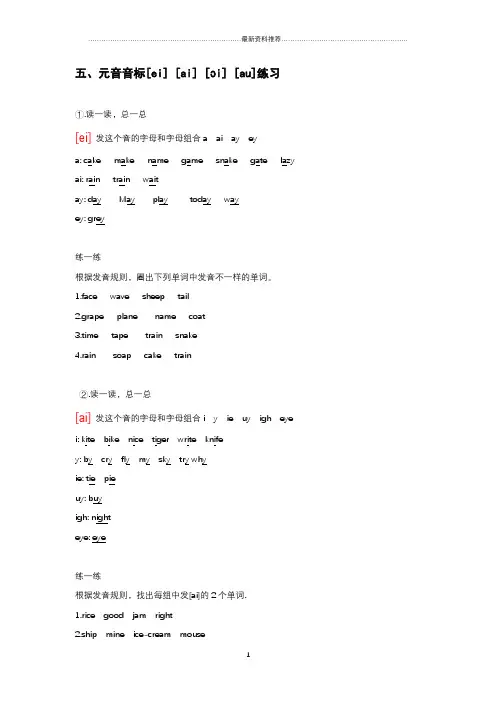
五、元音音标[ei] [ai] [ɔi] [au]练习①.读一读,总一总[ei]发这个音的字母和字母组合a ai ay eya: cake make name game snake gate lazy ai: rain train waitay: day May play today wayey: grey练一练根据发音规则,圈出下列单词中发音不一样的单词。
1.face wave sheep tail2.grape plane name coat3.time tape train snake4.rain soap cake train②.读一读,总一总[ai]发这个音的字母和字母组合i y ie uy igh eye i: kite bike nice tiger write knifey: by cry fly my sky try whyie: tie pieuy: buyigh: nighteye: eye练一练根据发音规则,找出每组中发[ai]的2个单词.1.rice good jam right2.ship mine ice-cream mouse3.cloud sit tie eye4.write small tennis kite③.读一读,总一总[ɔi]发这个音的字母和字母组合oi oyoi: oil boil coinoy: boy toy练一练根据发音规则,找出每组中发[ɔi]的2个单词.1.soil hear soy cold2. rabbit bed boy noise3.walk voice boil word4. tea enjoy toy milk④.读一读,总一总[au]发这个音的字母和字母组合ou ow ou: house mouse mouth trousers ow: flower cow how now down练一练根据发音规则,选出不发[au]的单词。
英语语音训练-双元音

英语语音训练-双元音什么是“双元音”?双元音音素由两个元音组成,发音时由一个元音向另一个元音滑动,口型有变化。
前一个元音发音清晰响亮,且时间长;后一个元音发音模糊软弱,且时间短。
特别要注意的三点是:(1) 不要将前后两个音断开,应连贯成为一个整体:(2) 不要因为后一个元音发音短小而将其忽略;(3) 发音时滑动过程要完整,时间要充分。
“双元音”有哪些?[ei] [ai] [ɔi] [au] [əu] [iə] [εə] [uə]1. [ ei ]【发音规则】舌类顶下齿,牙床半开半合,双唇扁平,由发“哀”平稳过渡到发“一”之长音。
以下这些字母及组合发这个音:[ ei ] a ai ay ea ei ey单词:a - a te g a me c a ke f a ce l a zy l a bour h a tredai - f ai l w ai t r ai n s ai l compl ai nay - d ay w ay m ayea - br ea k gr ea t st ea kei - n ei ghbour ei ght w ei ghtey - h ey th ey句子:Today is payday.No pains, no gains.2. [ ai ]【发音规则】将口张开略圆,舌后升起,舌尖向后收缩,由发“阿”音平稳过渡到发“一”音。
以下这些字母及组合发这个音:[ ai ] i y ai ei ie uy ye eye igh单词:i - b i ke r i ce s i de l i ke t i me w i de pr i vatey - b y m y fl y cr y sk y t ryai - m ai n ai sle 通道ei -ei ther ei der h ei ghtie - l ie t ie d ieuy - b uy g uyye - d ye染料eye - eyeigh - h igh f igh t n igh t r igh t l igh t短语/句子:Strike while the iron is hot. 趁热打铁Mike tried five times to get the prize.3. [ ɔi ]【发音规则】双唇外突成圆形,发“奥”音逐渐过渡为双唇扁平分开,发“一”之短音。
英语语音学试题及答案
英语语音学试题及答案一、选择题(每题1分,共10分)1. 英语中的元音音素数量是:A. 12个B. 20个C. 26个D. 5个2. 下列单词中,重音位置不正确的是:A. photo'graphyB. 'nationC. 'elephantD. 'computer3. 英语中的辅音音素数量是:A. 24个B. 26个C. 44个D. 50个4. 以下哪个音素不是英语中的摩擦音?A. /f/B. /v/C. /s/D. /h/5. 英语中的鼻音音素包括:A. /m/, /n/, /ŋ/C. /p/, /t/, /k/D. /l/, /r/, /w/6. 下列单词中,发音时舌头位置最高的是:A. /i:/ as in 'seeB. /u:/ as in 'bootC. /æ/ as in 'catD. /ɜ:/ as in 'bird7. 英语中的双元音包括:A. /eɪ/, /oʊ/, /ɪə/B. /i:/, /u:/, /ɜ:/C. /æ/, /ɔ:/, /ʌ/D. /aɪ/, /ɑʊ/, /ɔɪ/8. 英语中的半元音包括:A. /j/, /w/B. /f/, /v/C. /s/, /z/D. /h/, /ʃ/9. 下列单词中,发音时嘴唇最圆的是:A. /u:/ as in 'blueB. /ɒ/ as in 'hotC. /ɑ:/ as in 'c arD. /ɛ/ as in 'bed10. 英语中的塞音包括:A. /p/, /b/, /t/, /d/, /k/, /g/B. /f/, /v/, /s/, /z/, /h/D. /l/, /r/, /w/二、填空题(每空1分,共10分)11. 英语中的元音分为_______元音和_______元音。
12. 英语中的清辅音和浊辅音的区别主要在于_______。
英语语音-元音篇
/a:/
单词:art card large park bark calm palm father papa mama 短语:a large park father’s card keep calm father’s credit card
句子:Mama and Papa always speak in a calm voice. Barking dogs seldom bite. 爱叫的狗不一定咬人。 After a storm comes a calm. 雨过天晴,否极泰来。
/u:/
单词:food blue fool true two
短语:a new school a blue moon
a huge spoon beautiful music
句子:The soup is cool. Soon it’ll be June. Judy plays beautiful music.
Phonetic Symbols
英语语音语调
音
辅音 (28)
轻辅音 浊辅音 鼻音 似拼音 半元音 单元音 双元音
元音 (20) )
元音
单元音: 单元音:/a:/ /ɔ:/ /i:/ /u:/ /ə:/ ɔ /ʌ/ /ɔ/ /i/ /u/ / ə/ /e/ /œ/ ʌ ɔ 双元音: 双元音:/ei/ /ai/ /ɔi/ ɔ /əu/ /au/ /eə/ /iə/ /uə/
/ɔ/ ɔ
/i:/
单词:keep meal seat Peter feet eater
短语:keep the seat three sheep three meals Peter’s feet eat the meat 小诗: Peter, Peter, pumpkin eater. Had a wife and couldn’t keep her Put her in a pumpkin shell. And there he kept her very well.
小学英语口语练习:[ei]双元音
⽆忧考英语⼝语频道为⼤家整理的⼩学英语⼝语练习:[ei] 双元⾳,供⼤家参考:)
[ei] [ɔi] [εə] [s] [z]
[ei] 双元⾳(第⼀节)
这是个双元⾳,发⾳时先发第⼀个⾳/ε/(⽐单独发⾳时开⼝略⼩⼀点),这时嘴唇向两侧微分,⾆尖轻抵下齿背,⾆前部微微拱起,然后嘴唇继续向两侧分开⼀些,⾆前部相应抬⾼,⾆端靠近下齿,向第⼆个⾳/i/滑动。
⽛床由半开到接近半合,由⼤到⼩。
所以这个称为“合⼝双元⾳”。
⾳量从强到弱。
发这个⾳的要诀是前长后短,前重后轻。
这个⾳近似汉语中打电话时常⽤的“喂”的韵母。
双元⾳要饱满。
但发⾳时嘴巴不要张得太⼤,应尽⼒向两侧舒展,嘴要咧得到位。
【单词朗读练习】
1. Hay [hei] ⼲草
2. Pay [pei] ⽀付
3. Day [dei] ⼀天
4. Fame [feim] 名声
5. Plate [pleit] 盘⼦
6. Space [speis 空间
7. Lake [leik] 湖
8. Became [bi'keim] 变得
9. Spade [speid] 铲⼦
10. Sake [seik] ⽬的
【短语朗读练习】
1. Leave a space 留给⼀个空间
2. Got his pay 拿到了他的薪⽔
3. Going to the lake 到湖边去
4. Met the first lady 遇到了总统夫⼈
5. Make a mistake 犯了⼀个错误。
语音课 双元音
也许它会导致眼睑炎,
但我不会挂也不会哭, 就因为眼里掉进了一点饼。
or cry from the pie in my eye.
[ai] 与 [æ]
side write kite
sad rat cat
Out of sight, out of mind.
眼不见心不烦。 Time and tide wait for no man. 岁月不饶人。 The kite is flying high in the sky. Where did you buy your hi-fi?
双元音合口双元音集中双元音英语双元音单元音与双元音双元音有哪些双元音音标双元音发音韩语双元音发音单元音双元音
双元音
合口双元音: [ai] [ei] [əu] [au] [ɔi]
集中双元音: [iə] [ɛə] [uə]
[ai]
由[ɑ]滑至[ɪ],口型变动由大到小。
前响亮后模糊短促。
I 不是“哎”。
1、字母r在单词中,英不卷,美卷。 [ɑ:r] far car large charge smart [iər] dear clear fear cheer here [ɛər] air dare pear their where [ɔ:r] for more door pour before [u:r] sure poor tour cure fewer [ə:r] her term learn word fisrt [air] fire tired higher liar buyer [aʊr] hour flour shower power tower [ɔir] lawyer employer destroyer
[əu]后面加n的词
趣味音标讲义二-双元音及练习
------- 精选文档---------------音标第九讲双元音双元音音素由两个元音组成,发音时由一个元音向另一个元音滑动,口型有变化。
合口双元音:前一个元音发音清晰响亮,且时间长;后一个元音发音模糊软弱,且时间短。
特别要注意的三点是:(1) 不要将前后两个音断开,应连贯成为一个整体:(2) 不要因为后一个元音发音短小而将其忽略;(3) 发音时滑动过程要完整,时间要充分。
集中双元音:两个元音发音都比较清楚。
1 )集中双元音三个[e? ] [ i ? ] [ u ?]音标故事:北方的冬天十分寒冷,一个小朋友出门没有带耳罩,出去的时候还有两只耳朵,二耳[e?],过了一会太冷了,就冻掉了一只耳朵,只剩一只耳朵了[ i?],最后冻得两只耳朵都没有了:无耳[u ?]2)合口双元音有五个[a i ] [ ei ] [ i ] [ ?u ] [a u ]有口型大小的变化,前后2个音依次滑动,前重后轻,前长后短。
音标故事:有一个男孩boy[ i ] 一直不吃饭,他的妈妈就喊他:“吃饭啦!”男孩说唉[a i ],来啦!过了一会妈妈发现孩子还没来吃,就又喊了一声,孩子有点不耐烦说,诶[ei ],知道啦!男孩准备下楼,结果一不小心从楼梯上滑下去了,孩子发出嗷[a u ]的声音,妈妈很着急,喊到Oh,no ! [ ?u ]晨读常见字母和字母组合/ai/i fine nice knife ridewhy dry skyy shyie die pieye byeigh high light night/ei/a make snake name face■■ I■■ I■■wait ai mail pain paint gain rainay day play way Mayey they heyeigh eight weight/?i/oy enjoy royoi boil point noise/i?/ea realear hear beard teareer deer pioneer/u ?/oor moore poorure assure sure/e ?/are dare carefulair hair stairear wear peareir their/au/ou about arou nd south hour ow how bow/?u/o post old ope n olympicoa boat roadou soul shoulderow slow knowough though althoughHomework一、双元音有哪些,一起来回顾下二、选出划线字母正确读音,用勾号表示精选文档()1、toy A./ ?? / B. / e ?/ C. / a?/()2、here A./ ? / B. / ?? / C. / ?? / ()3、stair A. / e? / B./ ? / C. / e ? / ()4、our A. / ? / B. / ?? / C. / a? / ()5、ride A. / ? / B. / a? / C. / a: / ()6、thought A. /a? / B. / ai / C. / ?: / ()7、cold A. / ? / B. / ?? / C. / ? / 三、圈出下列单词中元音字母或元音字母组合发音例1.timetape train snake2.rain soap cake train3.cloud sit tie j eye4.write small tennis kite5.rabbit bed boy no ise6.walk voice boil word7.tow n dan ce flower house8.tower blouse now baby9.your white row coat10. boat hen nose lamp11. no odles pair n ear come12.horse n ear tower air13.horse house tower air14. ring king hare three15.beard cure tower air16.voice king pure engineer / e? / ____相同的单词,并写出其音标四、找出划线部分发音不同的选项,并写出音标eg. (D)_/ ? /_ 1、A. cold B. old C. home D. sorry () 2 A. play B. game C. taxi D. n ame() 3 A. tow n B. toy C. our D. cow() 4 A. this B. ride C. white D. bike() 5 A. small B. apple C. walk D. horse() 6 A. here B. girl C. skirt D. shirt()7. A .how B. now C. Know D. Flower()8. A. Sight B. Bite C. light D. lack()9 A. has B. banana C. taxi D. bag()10 A. near B. pear C. stair D.clear双元音练习一音标[ei] [ai] [ ?i] [au]练习一•抄写音标,一个抄写5遍。