
牛津上海版(深圳)英语三年级下册 Unit 9《A day on the farm》(第二学时)公开课课件
2. Look and say.
D
E
F
①
A
3.Right or worng.
B
Don’t cross the road.
②
A
Don’t fight.
B
Don’t push.
③
A
Don’t litter.
B
④
A B
Don’t play with fire.
⑤ Don’t pick the
In /On the_____,I can___and____. Don’t _____.Don’t ______. Let’s have a fun in the______.
1 2
Read and act Listen
and say.
Make some signs. Don’t … 3 Complete Workbook pages 58, 60 and 61.
What the rules on the farm from this picture booke road.
Don’t cross the road.
Don’t open the gate.
Don't touch the animal.
flower.
Don’t draw or write on the wall.
B
A
One team act the thing we can’t do
Let us guess. Please say “Don’t…”.
In the classroom,I can dance and sing. Don’t run.Don’t fight. Let’s have a fun in the classroom.
Rules on the farm
Don’t…
three little pigs.mp4
gate
Don’t litter. Don’t throw stones.
Don’t pick the flowers.
Don’t open the gate.
Jessy
Ben Tom Sam
Don’t climb the tree.
1.Line up.
a. Don't play with fire.
b. Don't fly a kite,
c. Don't climb d. Don't cross the tree. the road.
What rules do we have on the farm?
touch
Don't touch the animal.
Don’t fly a kite here.
power line
Don’t fly a kite here.
Don’t play with fire.
fire
Don’t play with fire.
Sam
Don’t climb the tree.
Oxford English
A day on the 9 Period 2 farm
Module Module33 My Mycolourful colourfullife life
Let’s have a look.
Kitty can see some flowers.
Can she pick the flowers?
三年级下册英语单元测试 Unit 9 A day on the farm 单元测试卷 牛津英语(三起)(含答案)
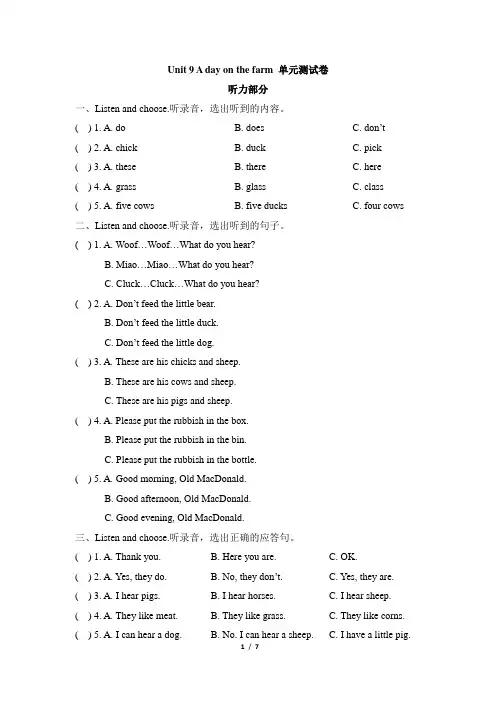
Unit 9 A day on the farm 单元测试卷听力部分一、Listen and choose.听录音,选出听到的内容。
( ) 1. A. do B. does C. don’t ( ) 2. A. chick B. duck C. pick ( ) 3. A. these B. there C. here ( ) 4. A. grass B. glass C. class ( ) 5. A. five cows B. five ducks C. four cows 二、Listen and choose.听录音,选出听到的句子。
( ) 1. A. Woof…Woof…What do you hear?B. Miao…Miao…What do you hear?C. Cluck…Cluck…What do you hear?( ) 2. A. Don’t feed the little bear.B. Don’t feed the little duck.C. Don’t feed the little dog.( ) 3. A. These are his chicks and sheep.B. These are his cows and sheep.C. These are his pigs and sheep.( ) 4. A. Please put the rubbish in the box.B. Please put the rubbish in the bin.C. Please put the rubbish in the bottle.( ) 5. A. Good morning, Old MacDonald.B. Good afternoon, Old MacDonald.C. Good evening, Old MacDonald.三、Listen and choose.听录音,选出正确的应答句。
【沪教版】牛津小学英语三年级下册(三年级起点)各单元课文翻译
三年级英语下册(三年级起点)各单元课文翻译本套教材以“话题—结构—功能一任务”为主线,设计和安排大量形式多样、语境真实、趣味性强的语言实践活动,让学生综合运用所学的英语语言知识和语言技能来体验、实践、参与、探究和合作,即“用英语做事情”。
一、教材目录Module 1 Using my five sensesUnit 1 ColoursUnit 2 TastesUnit 3 SoundsModule 2 My favourite thingsUnit 4 Animals in the zooUnit 5 ToysUnit 6 Food and drinksModule 3 My colourful lifeUnit 7 HobbiesUnit 8 Happy birhtday!Unit 9 A day on the farmModule 4 Things we enjoyUnit 10 Funny cartoonsUnit 11 Mother"s Day二、课文翻译Module 1 Using my five senses Unit 1 ColoursUint 1 Listen and say英语课文翻译What colour is your ball?你的球是什么颜色的?It's red and white.它是红色和白色相间的。
①What's the matter?怎么了?I can't find my ball.我找不到我的球了。
②What colour is your ball?你的球是什么颜色的?It's red and white.它是红色和白色相间的。
③Look! Is this your ball?看!这是你的球吗?Yes, it is! Thank you.是的,它是!谢谢你。
Unit 1 Sing a song歌曲翻译The rainbow彩虹看彩虹,The rainbow彩虹,The rainbow,彩虹。
牛津沪教版Unit9《Adayonthefarm》(第三课时)课件
Look! These are our horses. We have two horses. They are brown and strong. They can run fast.
These are our cows. They are white and black. They are big. They like grass.
Don’t pick the s. Don’t touch.
Don’t open the gate. Don’t throw stonerass.
Don’t climb the tree.
I had a lot of fun on the farm!
Kitty makes a poster of the farm.
What animals are there?
What animals are there?
How are the animals?
Look at our farm! It’s big and nice.
We have a pig. It’s pink and fat. It can eat fast.
Oxford English
Module 3 My colourful life
9
A day on the farm
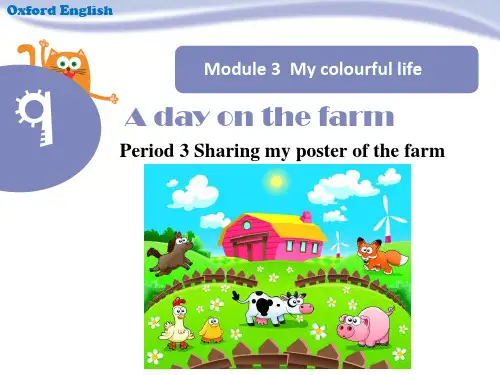
Period 3 Sharing my poster of the farm
Luke __likes to __run. He __runs with Ron. They __run a __long way. And have a __lot of fun.
We have two sheep. They are white and cute. They like grass, too.
“牛津上海版”小学英语三年级(下)知识点大全
Do you like...? Yes,I do./No,I don’t. 例: Do you like elephants? 你喜欢大象吗? Yes,I do. 是的,我喜欢。 Do you like tigers? 你喜欢老虎吗? No,I don’t. 不,我不喜欢。
I have... My...is/are... 例:I have two eyes.My eyes are big. 我有两个眼睛。我的眼睛大。
Of course.当然。
1.动词 have:I have... 2.一般疑问句:Can you...? 3.Be 动词: These are... They are... 4.代 词 : my,me,myself,yourself
May I have a try? Sure. 我能试下吗?当然。
1.特殊疑问句: What is it? What’s this/that? What are these/those? 2.一般疑问句: Are they...? 3.Be 动词:It's/They're...
重点词汇 重点语音
重点句型
补充句型 重点语法
Module3 Things around us
Unit1 Shapes
circle 圆形 square 正方形 triangle 三角形 star 星形 rectangle 长方形
-ff 例:turn off take off
What shape is it? 它是什么形状的? It’s a circle. 它是一个圆形。
重点语法
1. 祈 使 句 : 动 词 原 形 开 头 例:Close your eyes./Smell this. 2. 特 殊 疑 问 句 : How does it smell/taste? What is it? 3.一般疑问句:Is it...? 4.Be 动词:It's...
牛津上海版英语三年级下册_Module_3_Unit9_A_day_on_the_farm_练习卷
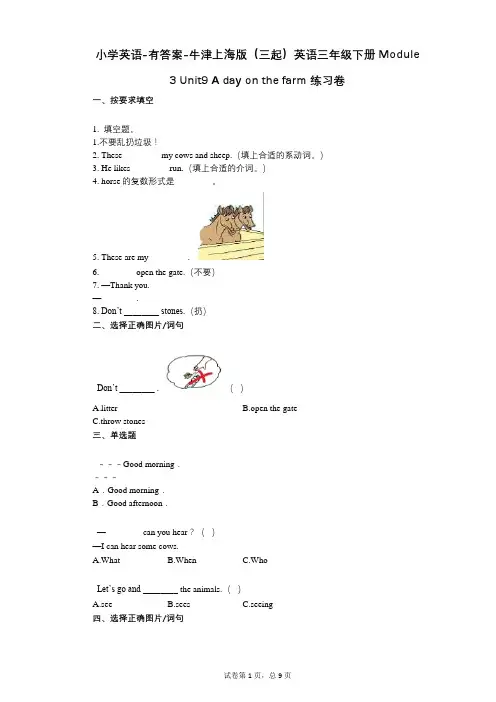
小学英语-有答案-牛津上海版(三起)英语三年级下册 Module3 Unit9 A day on the farm 练习卷一、按要求填空1. 填空题。
1.不要乱扔垃圾!________2. These ________ my cows and sheep.(填上合适的系动词。
)3. He likes ________ run.(填上合适的介词。
)4. horse的复数形式是________ 。
5. These are my ________ .6.________ open the gate.(不要)7. —Thank you.—________.8. Don’t ________ stones.(扔)二、选择正确图片/词句Don’t ________ . ()A.litterB.open the gateC.throw stones三、单选题﹣﹣﹣Good morning.﹣﹣﹣________A.Good morning.B.Good afternoon.—________ can you hear?()—I can hear some cows.A.WhatB.WhenC.WhoLet’s go and ________ the animals.()A.seeB.seesC.seeing四、选择正确图片/词句This is my ________ . ()A.dogB.pigC.catThis road is ________. ()A.shortB.longC.smallI like ________ . ()A.runB.runsC.to run—Do you like painting?()—________.A.Yes,I do.B.No, I don’t.C.Yes, I don’t.五、改写句子句型转换。
(1)Open the gate. (变为否定形式)________________(2)This is a horse.(变为复数形式)________________六、判断句子正误判断正(T)误(F)。
牛津上海版(深圳用)三年级英语下册Unit9、A、day、on、the、farm课件5

How many ducks ?
Five ducks.
What do they like doing?
They like swimming. They can waddle.
Talk more
Animals on the farm
……
… …(s). Do you like…(s)?
Enjoy more
Module3 My colourful life
9 A day on the farm —— Old MacDonald has a farm Period 1
Dear children,
I’m writing to welcome you to my farm. Before you coming here, please finish this task: learn a song. When you can sing the song well, you know more about the farm. Then we can be good friends. So, come on, do your best. See you soon. Best wishes,
It’s a beautiful day. Let’s go to the farm, OK?
Great! Let’s go!
Wow! So many animals here! What do you like, Peter?
I like ducks. They are small and cute.
Everywhere a quack-quack!
Old MacDonald has a farm, E-i-e-i-o.
沪教牛津版小学三至六年级英语单词表
沪教牛津版小学三至六年级英语单词表Word listAa(an)一;一个am是apple苹果are 是autumn秋天afraid(of)害怕…and和;同arm手臂at home在家a lot of很多;大量的a pair of一条;一副;一双afternoon下午angry生气的animal动物any任何的around在…周围;到处aunt姑妈;姨妈;伯母;婶婶;舅妈about关于again再;又all全部;所有also也;还a.m.上午April四月Art(学科)美术at night在夜晚at noon在中午at the weekend在周末August八月away去别处;朝另一个方向after在…后along沿着:;顺着always总是;一直another另一个answer回答ask问at the top of在…顶部a few几个;一些act...out表演all day一天到晚all year round一年到头anywhere任何地方art room美术室at the end of在…的最后a little少量的air空气alive活着的ant蚂蚁anything任何东西asleep睡着的a long time ago很久以前a piece of一张;一片adult成年人ago以前all the time一直;始终artist艺术家;(尤指)画家at work忙着(做事情)B banana 香蕉beautiful美丽的bed床big大blackboard黑板book书boy男孩brother哥哥;弟弟bad坏的ball球bear熊bike自行车birthday 生日biscuit饼干black黑色的blue蓝色的body身体bread面包breakfast早餐bus公共汽车;巴士bye再见behind在…后面beside在…旁边bird鸟bottle瓶子box盒子;箱子brown棕色的;棕色bus driver公共汽车司机busy忙碌的;繁忙的but但是baby宝宝;婴儿back背;背部bag袋子basketball篮球blind瞎的;失明的break休息brush…. teeth刷牙bathroom浴室;卫生间beach海滩become变成;变得bedroom卧室bedtime就寝田时间before在…以前begin开始between在…中间blow刮;吹bored无聊的both(两个)都bring带来burn燃烧;烧burn down烧毁bus stop公共汽车站by(表示方式):靠近by bike骑自行车by bus乘公共汽车by car乘小汽车because因为best最好的board布告牌;木板boat小船;舟build建筑;建造butterfly蝴蝶buy买balloon气球bee蜜蜂blue whale蓝鲸boring没趣的;令人厌倦的(be)born出生brave勇敢的building建筑物;楼房bell铃铛better and better越来越好bigger更大的blow off吹掉bright明亮的;鲜艳的broom扫帚brush画笔;刷子;刷bullet子弹by hand用手Ccat猫hair椅子clean把…擦干净;打扫close关上cold寒冷的cool 凉爽的colour颜色come in进来cup杯子cow母牛cake蛋糕can能candy糖果car小汽车card卡;卡片child孩子(复数 children) carrot胡萝卜circle圆:圆形classmate同班同学classroom教室climb trees爬树cloud云cloudy多云的computer计算机;电脑cousin表兄弟姐妹;堂兄弟姐妹catch捉住China中国Chinese(学科)语文cinema电影院city城市clock时钟;钟club俱乐部;兴趣小组careful小心的(be) careful with当心carry背;提;拿class 班;班级clever聪明的clothes衣服;服装collect收集cook厨师;烹饪cross穿越;越过cut剪;砍;切call把…叫做camera相机cap帽子change改变;变化clear清澈的coat外套;大衣crayon彩色蜡笔(或粉笔、铅笔cry哭;喊叫capital首都car museum汽车博物馆catch逮住;捕捉chicken鸡肉chocolate巧克力clean干净的;洁净的cola可乐cool使变凉country国家countryside乡村;农村cut…down把…砍倒cute可爱的can金属罐carefully仔细地carry背;提;拿centimeter 厘米(缩略形式cm) Chinese ink painting中国水墨画cloth布;布料craftsman工匠;手艺人(复数 craftsmen) crown王冠;皇冠Ddad爸爸desk书桌dog狗door门dance跳舞day天;日dear亲爱的do做doctor医生draw画画dress连衣裙drink喝December十二月dinner晚餐;正餐duck鸭子duckling小鸭diamond钻石different不同的do…homework做家庭作业drop滴:;水珠dentist牙医dictionary字典;词典dining room餐室;餐厅do a survey做调查do exercise做运动drop使落下;掉落dumpling饺子dancer跳舞者;舞蹈演员daughter女儿die死;死亡dig挖(土);掘(洞)dirty脏的drive…away把…赶走during在…期间digital数码的dinosaur恐龙drive驾驶E ear耳朵eight八eye眼睛egg蛋elephant象eat吃email电子邮件English(学科)英语evening傍晚;晚上every day每天every year每年年each other互相easy容易的enjoy享受…的乐趣early早;提早easily容易地emperor皇帝end结尾;结束enough足够的every每;每个exercise运动;锻炼;活动Earth地球east东;东部e-friend网友everyone每个人;所有人everywhere处处;到处exciting令人激动的:;使人兴奋的easily容易地enjoy oneself玩得愉快;得到乐趣envelope信封even甚至excited兴奋的Fface脸;面孔fat胖的father父亲;爸爸fine健康的;身体很好的fish鱼five五four四friend朋友farm农场flower花foot脚;足(复数feet)for给;为了fun乐趣family家庭fast快地;迅速地;快的fire火;火灾fireman消防员(复数 firemen) first第一fish鱼;鱼肉floor地板fly飞;放飞food食物forest森林full饱的February二月feel摸起来;感到football足球fox狐狸Friday星期五from从;来自from…to…从…到…fall掉落:落下far from离…远farmer农民favourite最喜欢的find发现;找到fire火;火灾flower shop花店funny滑稽的;好笑的future将来;未来far away from…远离… festival节日fever发烧;发热film电影finally最后firecracker鞭炮;爆竹firework烟火;烟花(be) full of装满…充满… future将来;未来factory工厂fairest最美丽的fall asleep睡着famous著名的;出名的finger手指fish and chips炸鱼薯条fly苍蝇forest森林fresh清新的fruit水果fairy仙子;小精灵fairy tale童话(故事)fan(足球、电影等)迷;爱好者fantastic极好的film胶卷fit健壮的follow跟随;跟着forever永远G girl女孩good好的goodbye再见go去;走grass草great很好的;很棒的green绿色的get out出去give给glasses眼镜grandfather (grandpa) (外)祖父;爷爷;外公grandmother(grandma) (外)祖母;奶奶;外婆grandparent(外)祖父;(外)祖母game游戏garden花园get得到get up起床go down落下go to bed上床睡觉go to school去上学gold金子grape葡萄grow(使)生长;成长guitar吉他gently和缓地;温柔地get off下车get through通过get to到达go shopping去购物(be) good at擅长ground地面grow crops种庄稼get well康复giant巨人go swimming去游泳glass玻璃制品;玻璃go for a walk去散步grade年级grow up长大;成长gatekeeper门卫get...in收割get lost迷路glue胶水go fishing去钓鱼H hair头发he他hello(用于打招呼)喂,你好here这里hi(用于打招呼)喂,嗨hot炎热的how many(用于问数量)多少how much(用于问价钱)多少hand手have有head头hear听见horse马house房屋how怎么;怎样how old多少岁happy开心的help帮助her她的his他的home家hungry饥饿的half半;一半half past… …点半hard坚硬的hat帽子have a party举办聚会have breakfast吃早餐have dinner吃晚餐have lunch吃午餐high高的him他happily快乐地hat帽子hate讨厌have a good time玩得高兴have fun尽情玩heat热;高温heavy重的;沉的hill小山hole洞hospital医院hour小时hurt(使)受伤hall礼堂hard努力地have a cold感冒have a fever发烧have a headache头疼have a look看一看have a meeting开会have a rest休息一下have a toothache牙疼headache头痛hers她的holiday假日;假期hotel旅馆how long多久hamburger汉堡包handsome英俊的;帅气的have to不得不healthy健康的;有益于健康的hobby业余爱好hundred一百hurt感到痛have a picnic去野餐head teacher校长high jump跳高himself他自己hit碰撞;撞击II 我in在(某段时间)内is是it 它its 它的ice cream冰淇淋idea主意in在…里面into朝;向;到…里面inside在…里面interesting有趣的ill生病的;不舒服important重要的in front of在…前面in the future将来in the south of在…的南部invent发明invention发明;创造island岛in danger面临危险in the east of在…东部in the north of在…北部in the past在过去insect昆虫insect museum昆虫博物馆in a short time很快in the middle在中间ink墨水;墨汁Jjuice果汁job工作:职业jump跳January一月join参加;加入July七月June六月job工作;职业journey旅程;旅行junior high school初级中学jack-o'-lantern南瓜灯Kkite风筝kid小孩kitchen厨房key钥匙kitchen厨房know知道keep保持keep quiet保持安静kind友好的;体贴的(be) kind to…对…友好knock down推倒;拆掉keep…alive让…活着kill杀死kind种类kilogram千克;公斤(缩略形式kg)Llate迟到long长的look看look at看leg腿lemon柠檬like喜欢lion狮子listen听litter乱扔(垃圾)little小的love爱lovely可爱的library图书馆;图书室live住;居住lunch午餐(be) late for迟到later后来;以后leaf叶子(复数leaves) lesson课lake湖left左边letter信life生活lifeguard救生员light灯;光living room客厅last最后的laugh大笑let让land陆地learn学会;学习look for寻找laugh at嘲笑lazy懒惰的life生活long Jump跳远long race长跑look out小心;当心look out of往外看lost迷路的;迷失的M me我Miss小姐mother母亲;妈妈mouse老鼠(复数mice mouth口;嘴巴Mr先生Mrs太太mum妈妈my我的make做man男人(复数men milk牛奶monkey猴子magic神奇的;有魔力的many许多meat肉meet相识;结识morning早晨;上午March三月Maths(学科)数学May五月minute一会儿;分钟Monday星期moon月亮museum博物馆Music(学科)音乐make phone calls打电话map地图match火柴model plane飞机模型mountain山;山脉move(使)改变位置;移动Ms女士must必须machine机器magazine杂志medicine药meet迎接;会见meeting room会客室;会议室mess脏乱;不整洁mine我的money钱monster怪物mooncake月饼more更多的myself我自己make noise制造噪音many kinds of各种各样的match火柴mirror镜子miss想念model car汽车模型month一个月的时十间;月份most大多数may可能;可以middle中间;中部;中心model house房子模型mountain山;山脉N nine九no不;不是nose鼻子not不是noodle面条now现在name名字near在…附近need需要new新的nice美味的;美好的nurse护士night夜晚noise响声;吵闹声noon中午November十一月never从不not at all一点也不…nail钉子newspaper报纸next紧接着;随后;紧接着的no entry禁止进入nod点头north北方;向北not…any more不再neighbour邻居next time下次noisy吵闹的north北;北部neck脖子no smoking禁止吸烟no swimming禁止游泳O one 一open打开orange桔子old老的orange橙色的our我们的office办公室old古老的;旧的on在…上面o'clock…点钟October十月or或者;还是often经常on foot步行on holiday度假outing远足over在…上方only只有;仅over there在那边ocean海洋once upon a time从前other其他的owl猫头鹰own自己的oil油oil painting油画on the left在左边on the right在右边on the way在路上one by one一个接一个地online在线地;在线的P pear梨pen钢笔pencil铅笔please请paint用颜料画panda熊猫photo照片pig猪plane飞机play玩parent父亲;母亲park公园people人;人们picture图画;照片plate盘子;碟子play with玩…playground操场potato土豆(复数 potatoes) pupil小学生PE(学科)体育piano钢琴plant植物play basketball打篮球play chess下国际象棋play football踢足球play the guitar弹吉他play the violin拉小提琴play volleyball打排球p.m.下午purple紫色的paper纸;纸张party聚会pilot飞行员play sport做运动post office邮局primary school小学put放;安置put out fires灭火place地方plan安排;计划poster海报present礼物project课题pull…out把…拔出put…on穿;戴palace王宫;宫殿part地区;区域pick采摘pick up捡起;拾起pie馅饼pizza比萨饼plant 种植plant trees植树plastic bag塑料袋police警方;警察部门policeman 警察(复数 policemen) pretty漂亮的princess 公主paints绘画颜料path小路;小径pea豌豆pen holder笔筒photographer摄影师piece碎片;碎块plastic塑料制的;塑料的pod豆荚poor贫穷的;差的;次的powerful强有力的;力量大的praise赞扬;称赞praise…for…因…而表扬… PS附言(用于信末)Q quack(鸭叫声)嘎嘎quarter一刻钟quickly快地;迅速地quiet轻声的;安静的quite相当;十分queen王后R rabbit兔子ruler尺read阅读red红色的robot机器人rain雨;下雨rainy多雨的rectangle长方形restaurant餐馆rice大米;米饭ride骑(马;自行车)run跑rise升起river河;江round圆的right右边;正确的road路;马路red packet红包relative亲戚rest休息row a boat划船recycle回收利用,再利用rhino 犀牛rubbish 垃圾reuse重新利用right away立即;马上roof屋顶rubber橡皮rubbish bin垃圾桶S schoolbag书包seven 七she她short矮的;短的sister姐姐;妹妹six六small 小的spring春天summer夏天sheep绵羊(复数 sheep) ship船sing唱歌skate滑冰sleep睡觉some一些sorry对不起sour酸的stone石头strong强壮的;坚固的sweet甜的swim游泳sad难过的;悲哀的school学校see看见shape形状sharp锋利的;尖的shirt(男式)衬衫shop商店shorts短裤sit坐skirt短裙so如此;很;所以son儿子soup汤square正方形star五角星形;星星street街道sun太阳Sunday星期天sunny阳光充足的supermarket超市Saturday星期六Science(学科)科学seed种子September九月shadow影子sky天空smell闻;嗅soft柔软的song歌曲sport体育运动start开始stop停下strawberry草莓subject学科;科目Sunday星期天swan天鹅safety安全same相同的save救;救助;节约say说sea海shell贝壳shine照耀singer歌手slowly缓慢地smoke吸烟softly轻柔地sometimes有时soon很快;不久sound声音;听起来好像station车站straight笔直地strongly强劲地sunshine阳光school gate校门;校门口seafood海鲜second秒(时间单位) see a film看电影shoe鞋should应该show给…看size尺码smile笑容;微笑sock短袜something某事;某物south南方;向南stand站;站住stay待;暂住;逗留stick粘贴;粘住story故事storybook故事书student学生study书房;学习sweater毛衣swing秋千sandwich三明治science museum科学博物馆send安排去;寄;送shall (表示提出或征求意见)shopping bag 购物袋sick生病的smoke 烟so many这么多son儿子south南;南部South China tiger 华南虎spend度过summer holiday 暑假sushi寿司(日本食物)saw锯say to oneself自言自语scarf围巾(复数 scarves或scarfs)) scissors剪刀see the world见世面short race短跑sign标识some time一段时间space太空special特别的still仍然street cleaner环卫工人street sweeper扫地车stronger更强大的sweep扫地swimming cap游泳帽swimming goggles游泳镜swimming pool游泳池swimsuit(尤指女式的)游泳衣Ttail尾巴tall高的ten十thank谢谢the(表示特指)these这些they它们;他们;她们thin瘦的this这;这个three 三two 二taste味道;尝tea茶there那里throw扔tiger老虎to给;向too也;还toy bear玩具熊train火车table桌子teacher老师that那个thirsty口渴的thirty三十tired累的;疲惫的today今天together一起toilet厕所tomato番茄;西红柿(复数 tomatoes)tooth牙齿(复数 teeth) triangle三角形try尝试T-shirt T恤衫table tennis乒乓球运动take a walk散步talk谈话;说话tell告诉them它们;他们:她们thick厚的:粗的thin薄的;细的those那些Thursday星期四time时间timetable课程表;时间表touch碰:触摸Tuesday星期二take乘坐(交通工具);带领tap水龙头taxi driver出租车司机teach教(课)tell a story讲故事their他们们的;她们的;它们的then然后;那么thing东西;事物think想toy shop玩具店tree树turn转向;转弯turn off关掉TV电视;电视机take a photo拍照theirs他们的;她们的;它们的then然后through穿过tidy整理;整洁的tidy up把…整理好tomorrow明天toothache牙痛toothless没有牙齿的travel旅行;长途行走trousers裤子try…on试穿(衣物)twice两次take care of照頋;照料team (游戏或运动的)队thousand —千tourist 游客turtle乌龟take off脱掉taller更高的tape胶带than比theatre剧院themselves他们自己;她们自己;它们自己throw away扔掉tool工具truck卡车turkey火鸡U uncle叔叔:伯伯;舅舅;姑父;姨父under在…下面ugly小丑的;丑陋的us我们underground地铁up向上;在上面use使用useful有用的usually通常umbrella伞until直到unhealthy不健康的;损害健康的unhappy不高兴的Vvery很;非常violin小提琴volleyball排球vegetable蔬菜visit看望;拜访;参观village村庄vase花瓶W warm温暖的What什么Who谁window窗;窗户winter冬天water水we我们white白色的work工作worker劳动者want想要weather天气welcome欢迎well好;健康where哪里wind风windy风大的;多风的woof(狗叫声)汪汪write写字;书写wait等待;等候wash洗wash…face洗脸water给…浇水watermelon西瓜wear穿;戴Wednesday星期三week星期whose谁的with和…一起wonderful使人愉悦的;绝妙的walk走;步行want想要watch观看;观察watch TV看电视when什么时候wind-bell风铃windmill风车word单词wall墙;围墙watch手表(be) weak in不擅长wear glasses戴眼镜week周;星期weekend周末which哪一个;哪一些why为什么wild goose大雁(复数 wild geese) will将;将会world世界writer作家wrong有毛病;不正常;错误的way路;方式;方法west西;西部wild野生环境;野生的wood木头;木材would like (表示愿意、喜欢) warm-up准备活动;热身练习weigh有…重;重well-known众所周知的;著名的Western西方的wife妻子win获胜;赢wish愿望;祝愿worry担心writer作家Yyes是;对you你;你们your你的;你们的yellow黄色的young年轻的yours你的:你信们的year年岁;年yours你的;你们的yesterday 昨天yourself你自己yard院子Z zoo动物园Daily expressions Hello.你好。
上海牛津版三年级英语下册全册教案
Module 1 Using my five sensesGrammar:1.Modal verbs ‘can/can’t: I can/can’t ---2.Wh-questions: What can you see /hear? What colour is it? What is it?3.Yes/No question: Is this your --- /Is it--- Yes, it is./ No, it isn’t.4.Possessive adjectives: your, my, her5.Imperatives: Listen to--- Touch --- Taste ---/Smell---/ Close ---6.Verb ‘to be’: It’s --- /It’s a/anVocabulary:Mirror, can, hair, brown, eye, mouth, can’t, grey, listen to, street, roof, her, cage, aeroplane, bus, car, boat, drill, telephone, hear, soft, hard, rough, smooth, touch, how, does, feel, toy, pineapple, hat, cold, lemon, sweet, sour, taste, strawberry, lime, smell, nice, fish, prawnSounds: a ( Jane, make, aeroplane)a (fat, man, jam)e (she, see, these, tree, street)e (Eddie, ten, red, peg)Daily Expressions:Hello, this is --- (on the phone)How are you? I’m fine, thank you.How does it feel? Can I help you?Unit 1 Looking and seeingLanguage functions: Talking about abilityIdentifying and describing objects in terms of colourAsking and answering questions about possessionsSaying the sound ‘a’ in its open syllable form Language skills:Use modeled phrases and sentences to communicate with teachers and other learner.Pronounce correctly a series of words in a sentence withthe vowel sound ‘a’ in its open syllable formMain points: Can use the sentences: What can you see?/What colour is it? Difficult points: Yes/No questions: Is this your ---?Teaching beach:Using the old words and sentences to learn the new words and sentences. Using the things and pictures to learn the words.Teaching times: Five periodsThe First PeriodLanguage focus:Using nouns to identify different parts of the bodyUsing modal verb ‘can/can’t’ to talk about abilityLanguage skills:Use modeled phrases and sentences to communicate with teacher and other learners.Open an interaction by asking questionsMain points: Can use the sentence “What can you see? I can see---.”Difficult Points: Can spell the words and using the sentence.Materials: a mirror , a mask , a tape, Book 3BThe Second PeriodLanguage focus: Using nouns to identify thingsUsing predicative adjectives of colour to describe thingsUsing modal verb ‘can’ to talk about abilityLanguage skills: Using modeled phrases and sentences to communicate with teacher and other learnersMaintain an interaction by replying to questionsMain points: Can spell the words and using the sentences.Difficult points: Can recite the words and write the sentences. Materials: some colour pencils, rulers, rubbers ---The Third PeriodLanguage focus: Asking ‘Wh-‘questions to find out various colours students see.Using modal verb ‘can’ to talk about abilityLanguage skills: Identify a series of words in a sentence with the vowel sound ‘a’ in its open syllable formUsing modeled phrases and sentences to communicate with teacher and other learners.Main points: Can say the sentences. Pronounce correctly a series of words in a sentence with the vowel sound ‘a’ in its open syllable form.Difficult point: Can use the sentences.The Fourth PeriodLanguage focus: Using possessive adjectives to show possession. Language skills: Use modeled phrases and sentences to communicate with teacher and other learners.Close an interaction by using appropriate formulaic.Main points: Can use possessive adjectives to show possession.Can ask and answer the sentences.Difficult points: Can contract my/your. Can copy the sentences. Materials: Cassette 3B and a cassette player Workbook 3B P3The Fifth Period (Exercises)Language focus: Asking and answering questions about possessions Talking about ability.Language skills: Use modeled phrases and sentences to communicate with teachers and other learners.Pronounce correctly a series of words in a sentence with the vowel sound ‘a’Language functions: Identifying objects by their soundsResponding to simple instructionsUsing telephone formulaeSaying the sound ‘a’ in its closes syllable form.Language skills: Open an interaction by eliciting a responseMaintain an interaction by using phrases to replyMain points: Can use imperatives to give instructions and directions. Can use the sentences to ask and answer.Difficult points: Can say and write the phrases .Teaching times: Five periodsThe First PeriodLanguage focus: Using imperatives to give instructions and directions Using nouns to identify things.Language skills: identify key words in an utterance by recognizing stress. Main point: Can spell and read the words.Can use imperatives to give instructions and directions.Difficult point: Can use the phrases .The Second PeriodLanguage focus: Using imperatives to give instructions and directions Using nouns to identify things.Language skills: identify key words in an utterance by recognizing stress. Main point: Can make a new rhyme. Can say and recite the words.Difficult point: Can make a new phyme.The Third PeriodLanguage focus: Using modal verb ‘can’ to talk about abilities.Asking ‘Wh-‘questions to find out various kinds of specific information about a person.Language skills: Open an interaction by asking a question.Pronounce correctly a series of words in a sentence with the vowel sound ‘a’in its closed syllable form.Main point: Can use modal verb ‘can’ to talk about abilities.Difficult point: Can ask ‘Wh-’ questions to find out various kinds of specific information about a person.Materials: Cassette 3B ,Workbook P5, Wallpictures 3BThe Fourth PeriodLanguage focus: Using formulaic expressions to start a telephone conversation.Using formulaic expressions to greet people and respond to greetings. Using imperatives to give instructionsLanguage skills:Using modeled phrases or sentences to communicate with other learners Maintain an interaction by replying to a question.Main point: Can use imperatives to give instructions.Difficult point: Use imperatives to give instructions. Materials: Cassette 3B and a cassette playerLanguage focus:Using modal verb ‘can’ to talk about abilities.Asking ‘yes/no’ questions using modal verb ‘can’ .Language skills:Use modeled phrases or sentences to communicate with other learners. Open an interaction by asking a question.Main point: Can use the sentences to ask and answer.Difficult point: Asking questions using modal verb ‘can’. Materials:Unit 3 Touching and feeling Language functions:Identifying objects by touchAsking questions about and describing the way things feel Identifying letters of the alphabet shapesResponding to simple instructionsSaying the sound ‘e’ in its open syllable form Language skills:Use modeled sentences to communicate with other learnersOpen an interaction by eliciting a responseProduce simple sentences involving listsPronounce correctly a series of words in a sentence with the vowel sounds ‘e’ in its open syllable formTeaching times: Five periodsThe First PeriodLanguage focus:Using adjectives to describe things.Using imperatives to give instructionsAsking ‘How’ questions to find out the texture of a thing.Asking ‘Wh-’ questions to find out a specific thing.Language skills:Maintain an interaction by replying to a question.Locate specific information in response to simple questions.The Second Period Language focus:Using adjectives to describe thingsUsing imperatives to give instructionsAsking ‘How’ questions to find out the texture of a thing Language skills:Locate specific information in response to simple questions Open an interaction by asking a questionMaintain an interaction by replying to a questionMain point:Can use the question to find out the texture of a thing Difficult point:Can use two adjectives to describe thingsMaterials:A soft toy, a bag, a balloon, an apple and a pineapple Cassette 3B, Photocopiable P6,7The Third Period Language focus:Asking ‘How’ questions to find out the texture of a thing Asking ‘yes/no’ questions to obtain simple responses Language skills:Locate specific information in response to simple questionsOpen an interaction by asking a questionMaintain an interaction by replying to a questionPronounce correctly a series of words in a sentence with the vowel sound ‘e’in its open syllable formMaterials:Cassette 3B Wallpictures 3B Workbook P7a cup of hot tea and some iceModule 1 Unit 4 Tasting and smelling Language functions:Indentifying objects by taste and smell.Asking questions about and describing the taste and smell of objectsResponding to simple instructionsSaying the sound ‘e’ in its closed syllable formLanguage skills:Use modeled sentences to communicate with teachers and other learners Open an interaction by eliciting a responsePronounce correctly a series of words in a sentence with the vowel sound ‘e’in its closed syllable formTeaching breach: Use the fruits and the food to learn the words.Act and practice the sentences.Teaching times: Five timesThe First PeriodLanguage focus :Using nouns to identify thingsUsing adjectives to describe thingsUsing imperatives to give instructionsAsking ‘Wh-’ questions to find out a specific thingsLanguage skills:Open an interaction by asking a questionMaintain an interaction by replying to a questionMain point: Using adjectives to describe thingsTeaching beach: Using the fruits and food to taste and try to say. Materials: a lemon , an apple, an orange, some chocolate, a knifeThe Second PeriodTeaching aims: Have the students to ask and answer the questions.Have the students to read the words and sentences.Language focus: Using nouns to identify thingsUsing adjectives to describe thingsAsking ‘Wh-’ questions to find out a specific thingTeaching breach: Using the things and practice.Materials: Cassette some ap0ples , some oranges , a lemon, a banana, a strawberry, a limeThe Third PeriodTeaching aims: Have the pupils to pronounce the words and vowel ‘e’in closed syllable correctly.Have the pupils to ask the feelings.Language focus: Using nouns to identify thingsUsing adjectives to describe thingsDifficult point: Can pronounce correctly a series of words in a sentence with the vowel sound ‘e’ in its closed syllable formMain Point: Can pronounce correctly a series of words in a sentence with the vowel sound ‘e’ in its closed syllable formMaterials: a pineapple, a prawn, a dried prawn, sweets, cakes , different kinds of fruit.The Fourth PeriodTeaching aims: Have the pupils to act out the dialogue. Language focus: Using formulaic expressions to start a conversation Using formulaic expressions to request somethingDifficult point: Using formulaic expressions to start a conversation Main Point: Can make a small dialogue about shopping Materials: some fruits cassetteModule 2 My favourite thingsUnit 1 Animals I likeLanguage focus: 1.Wh-questions: What are they?2. Yes/No question: Do you like…?3. Verb “to be”: They are…4. Countable nouns(plual)Skills:Speaking e modelled phrases and senyences to communicate with a teacher and other learns2.Open an interaction by eliciting a response3. Maintain an interaction by providing information to factual /yes/no questions4.Pronounce correctly a series of words in a sentence with the vowel sound “i” in itsopen syllable formListening 1 Identify key words in an utterance by recognizing the stress2. Locate specific information in response to simple questions3. Identify a series of words in a sentence with the vowel sound”i”in its opensyllable from.Writing Develop written text by reproducing sentences from teacher’s writing.Diffcult points 1.Wh-questions: What are they?2. Yes/No question: Do you like…?3. Verb “to be”: They are…4. Pronounce correctly a series of words in a series of words in a sentence withthe vowel sound “i” in its open syllable formTeaching aids: Pictures,tapeTeaching times fourFirst period: Look and learn, Look and say, Ask and answerSecond period: Look,red and say . Ask and answerThird period: Read and guess. Learn the soundFourth period: ReviewFirst PeriodContents: words: cats , dogs, rabbits, lizards, snakes, birdsSentences: Do you like cats? Yes, I like …No, I don’t like …I like…Language focus: Using nouns to identify different animals. E g. snakesUsing simple present tense to express interests and preferences.Ask yes/ no questions to obtain simple responses.Materials: pictures, recorderSecond PeriodContents: words: lions, tigers, zebras, elephants, giraffes, pandassentences: Do you like…? Yes, I like … No, I don’t like …Language focus: Using nouns to identify different animals.eg. pandasUsing simple present tense to express interests and preferences.Ask yes/ no questions to obtain simple responses. Materials: pictures of animals, recorderThird PeriodContents: sentences:They’re tall/big/black/…What are they? They’re____s.Language focus: Using adjectives to describe animals. eg. They’re tall.Ask “wh”questions to find out about animals. eg. What are they? Materials: pictures of animals., recorderFourth PeriodContents: Review Unit1Difficult points: Do you like…? Yes,I like…No,I don’t like…What are they? They are…Materials: recorderModule 2 My favourite thingsUnit 2 Toys I like: Language focus: 1 .Wh-questions: What do you like?2. demonstratives: these, this3. pronoun: weSkills:Speaking e modelled phrases and senyences to communicate with a teacher and otherlearns2.Open an interaction by eliciting a response3. Maintain an interaction by providing information to factual /yes/no questions4.Pronounce correctly a series of words in a sentence with the vowel sound “i” in itsclosed syllable formListening 1 Identify key words by recognizing the stress2. Locate specific information in response to simple questions3. Identify a series of words in a sentence with the vowel sound”i”in its closedsyllable from.Writing Develop written text by reproducing sentences from teacher’s writing.Diffcult points 1.Wh-questions: : What do you like?2. demonstratives: these, this3.Pronounce correctly a series of words in a sentence with the vowel sound “i”in its closed syllable formTeaching aids: Pictures,tapeTeaching times fourFirst period: Look and say, Ask and answerSecond period: Read a story .Third period: Make a robotFourth period: Look and say, Do a survey,Learn the soundFidth period: ReviewFirst PeriodContents: words: super, beautiful, these, bicycle,dollSentences: Do you like these bicycles ? Yes, I like …No, I don’t like…These bicycles are super. I like this bear.Language focus: Using demonstratives to refer to people or things.eg:These bicycles are super.Using simple present tense to express interests and preferences.Eg: I like this bicycle.Materials: pictures,toys recorderSecond PeriodContents: words: skateboard(s), robot(s)sentences: like …I don’t like …Language focus:Using simple present tense to express likes and dislikes.eg: like skateboards. I don’t like robots. Materials: pictures of animals ,story,recorderThird Period Contents: words: foil, glue, button, stick,sentences: Stick the foil / boxes / buttons.My name’s Ben. I’m Ron the robot.Language focus: Using nouns to identify things. Eg. Boxes, foilUsing imperatives to give instructions. Eg: Stick the foilAsk “wh”questions to find out about animals. Eg. What are they? Materials: some boxes, glue, some buttons, foil, recorderFourth PeriodContents: sentences: Do you like …? Yes,we like …No, we don’t like…sound: i--- / I /Language focus:Ask ‘yes/no’ questions to obtain simple responses. Eg: Do you like balls?Ask ‘Wh-’ questions to find out various kinds of specific information about aperson. Eg. What do you like?Using simple present tense to express likes and dislikes.eg. we like …we don’tlike…Materials: some pictures, recorderFifth secondContents: Review Unit2Difficult points: Do you like …? Yes,we like … No,we don ’t like … What do you like? I like …/We like … Materials: recorderModule 2 My favourite thingsUnit 3 People I like: Language focus: 1.Wh-questions: Who’s she? Who’s that?Where’s…? What’s in your hand?What do you like?2. Possesive adjectives : his3. verb “to have”: I have…4. How question: How are you?How is Ben?5. Demonstratives: this / thatSkills:Speaking e modelled phrases and senyences to communicate with a teacher and other learns2.Open an interaction by introducing oneself.3. Pronounce correctly a series of words in a sentence with the vowel sound “o” inits open syllable formListening 1 Identify main ideas2. Locate specific information in response to simple questions3. Identify a series of words in a sentence with the vowel sound”o”in its opensyllable from.Writing Add personal ideas and information to writing when a framework is provided. Diffcult points 1. Wh-questions: What do you like?2. How question: How are you?3. Possesive adjectives : hisTeaching aids: Pictures,tapeTeaching times SevenFirst period: Say and act, Ask and answerSecond period: Look and say, Draw and write .Third period: Read and act a storyFourth period: Read and act a storyFifth period: Say and act,Sixth period: Review soundSeventh period TestFirst PeriodContents: sentences:How old are you? How old is she / he/ Ben /…What’s your / his / her/ your brother’s /your sister’s name? Language focus:Usingformulaic expressions to instroduce oneself and others.Asking ‘Wh’ questions to find out a person’s identity.eg.Who’s she?Asking ‘How’ questions to find out their age. eg.How old are you? Difficult points: What’s your / his / her/ your brother’s /your sister’s name? Materials: pictures, recorderSecond PeriodContents: sentences: How old is she / he/ Ben /…What’s his / her name?I have two friends.。
【课内词汇背背背】沪教牛津版(一起)上海用 小学英语 三年级(上册+下册) 词汇表(pdf版)
【课内词汇背背背】沪教牛津版(一起)上海用小学英语三年级(上册+下册) 词汇表(pdf版)课文单词背背背Sand [s nd] n.沙;沙地watch [w t ] n.手表clock [kl k] n.钟表day [dei] n.白天night [nait] n.夜晚breakfast ['brekf st] n.早餐三年级(上册)late [leit] adj.迟的very ['veri] adv.很again [ 'ɡen] adv.再no [n u] interj.不please [pli:z] interj.请yes [jes] interj.是grandma ['ɡr ndmɑ:] n.(外)祖母ruler ['ru:l ] n.尺window ['wind u] n.窗kite [kait] n.风筝13dog [d ɡ] n.狗jam [d m] n.果酱box [b ks] n.盒子ear [i ] n.耳朵mouse [maus] n.老鼠cat [k t] n.猫door [d :] n.门name [neim] n.名字girl [ɡ :l] n.女孩apple [' pl] n.苹果pencil ['pens l] n.铅笔lion ['lai n] n.狮子hand [h nd] n.手book [buk] n.书bag [b ɡ] n.书包desk [desk] n.书桌elephant ['elif nt] n.象14 沪教牛津小学英语上海版(一起)词汇表课文单词背背背rubber ['r b ] n.橡皮擦school [sku:l] n.学校clock [kl k] n.钟eight [eit] num.八two [tu:] num.二nine [nain] num.九six [siks] num.六seven ['sev n] num.七three [θri:] num.三ten [ten] num.十four [f :] num.四five [faiv] num.五one [w n] num.一you [ju:] pron.你,你们your [j :] pron.你的,你们的what [hw t] pron.什么I [ai] pron.我(主格)15come(in) v.(进)来see [si:] v.看见clean [kli:n] v.把…弄干净close [kl uz] v.关open [' up n] v.开look [l k] v.看(着)are [a:] v.是Mrs ['misiz] n.夫人Hi. [hai] n.嗨Fine,thanks 很好,谢谢How are you 你好。
《上海教育出版社牛津英语三年级下册》词汇表
v1.0可编辑可修改1《上海教育出版社 英语三年级下册》词汇表(英汉对照版)★ Un it 1 Colours★ Un it 3 Sou nds bike 自行车 bus 公共汽车,巴士 二 pla ne飞机 ship 船 car 小汽车train火车can 台匕 冃匕hear 听见liste n 听• Un it 4 Ani mals in the zoobear能 八、、elephant 象 lio n 狮子 mon key 猴子 panda 熊猫 tiger老虎 like 喜欢man 男人 (复数 m e n )old 老的our 我们的stro ng 强壮的,坚固的• Un it 5 Toys kite 风筝 robot 机器人toy bear 玩具熊fun 乐趣lovely 可爱的play 玩sorry 对不起• Unit 6 Food and drinksbiscuit 饼干 bread 面包 egg 蛋 juice 果汁 milk 牛奶 water 水 breakfast 早餐 child 孩子(复数child ren )have 有some 一些 too 也,还we 我们▲ Un it 7 Hobbiesdance 跳舞 pai nt 用颜料画 read 阅读 sing 唱歌 skate 滑冰 swim 游泳 at home 在家come in 进来sleep 睡觉work 工作black 黑色的 blue 蓝色的 gree n 绿色的 red 红色的 white 白色的yellow 黄色的 and 和ball 球colour 颜色★ Un it 2 Tastescandy 糖果 ice cream 冰淇淋 lemon 柠檬 how 怎么,怎样 orange 橙色的sour 酸的sweet 甜的 taste 味道,尝v1.0可编辑可修改2worker 工人,劳动者 ▲ Un it 8 Happy birthday cake 蛋糕 card 卡片 no odle 面条 birthday 生日 dear 亲爱的for 为了,给how old 多少岁to 给, 向▲ Un it 9 A day on the farmcow 母牛 horse 马 pig 猪sheep 羊(复数 sheep ) bye 再见farm 农场J/grass 早great 很好的,很棒的litter乱扔(垃圾)stone 石头throw 扔Un it 10 Funny cartoons head 头body 身体arm 手臂hand 手leg 腿foot 脚,足(复数 f ee t ).Un it 11 Mother ' s Dayflower 花photo 照片 tea 茶cup 杯子day 天,日do 做■ ■ 、亠■、、》‘love 爱.Un it 12 Three little pigs afraid (of) 害怕bad 坏的 go 去,走 house 房屋little小的make 做now 现在there 那里very 很,非常。