
新湘少版三年级下册英语__Unit_5What_time_is_it
What’s it?
clock
We say from 1 to 10:
1 3 5ine
2 two 4 four 6 six 8 eight 10 ten
11 12 How to say it in English?
11
12
eleven
twelve
• Question 1 • Who are they?(他 们是谁?)
• Lingling and Dongdong
• Question 2 • What time do you hear?(你听到了几点钟)
It's seven o'clock
• • • • • •
What time is it? Sorry, I don't know. Look at the clock ,please. OK! It's seven o'clock. Thank you.
Are you sleeping?
Are you sleeping? Are you sleeping? Brother John. Brother John. Moring bells are ringing. Moring bells are ringring. Ding,ding,dong. Ding,ding,dong.
Summary (总结)
新单词 clock 闹钟 eleven o’clock 11点 twelve o’clock 12点 day 白天 night 晚上
• :
• 抄写本单元单词,单词4遍 英文,1遍中文(4+1)。 • 读A部分对话,并表演对话。 • 做一个钟,并用钟面就钟 点和同学或家人对话。
You and your partner situational dialogue.你 和你的搭档 情景对话
三分钟的时间,同学们 两个人一组,角色扮 演。
Summary (总结)
问现在几点,一般都用
What time is it?
回答:
It’s + 时间
例如:8:00, 11:00, It’s eight o’clock. It’s eleven o’clock.
day
night
老师随意给出整点钟面。 问“What time is it ?" 同学们一起回答."It's ...."
What time is it?
What time is it?
• Who are they?(他 们是谁?) • What time do you hear?(你听到了几点 钟)
湘少版三年级英语下册教案 Unit 5
Unit 5What time is it?第一课时教学目标(一)语言目标1. 词汇:能听懂、会说、认读新单词clock, eleven o’clock,twelve o’clock,night,day。
2. 句型:能用“What time is it?”向他人询问时间;能运用“It’s...o’clock.”回答时间。
(二)应用目标1. 会用英语表达钟点时间。
2. 能听懂、会说A部分的对话。
教学重难点1. 重点:能听懂、会说认读新单词clock, eleven o’clock,twelve o’clock,night,day。
能用“What time is it? ”向他人询问时间;能运用“It’s...o’clock.”回答时间。
2. 难点:a lock和o’clock的区别,数词eleven和twelve的发音。
教学准备用于复习单词的图片(T-shirt,trousers,dress,shorts),用于新单词的闹钟图片或实物,单词卡片,教学挂图,教学磁带等(有条件的学校可利用幻灯片、多媒体课件)。
教学过程Step 1热身/复习(Warming up/ Revision)1. Greeting.2. Enjoy the song Are you sleeping?3. Revision: Talk about the pictures.教师用课件或图片依次呈现下列四张图片T-shirt,trousers, dress,shorts,旨在复习学过的句型“Look at the...”,为导入新授部分的生词做好铺垫。
Step 2新课呈现(Presentation)1. B Let’s Learn: New words.(1)T(将闹钟走动的声音放大,使学生只听其声,不见其物,让学生猜测): What is it?(课外学过或预习过的学生):It is a clock.如果没有学生会或是答错,T(将藏着的闹钟边拿出边说):It’s a clock. A clock, It’s a clock.板书clock一词,并带读,也可采取集体练读,分组练读或单个练读等多种形式。
湘少版三年级下册英语Unit 5 What time is it教案
湘少版三年级下册英语Unit 5 What time is it教案教学目标1.了解并能够应用数字表达时间。
2.通过学习教材中的问答句及对话来提高语言运用能力。
3.培养学生的时间管理意识。
教学重点1.能够运用数字表达时间。
2.能够应用所学知识与他人进行日常问答交流。
教学难点1.能够在实际生活中良好地掌握并应用所学知识。
2.能够流利、准确地进行日常问答交流。
教学过程导入环节1.教师播放一段视频或音频,让学生预先听一遍,听取其中所有的时间表达方式,老师可以跟随着这个视频或音频进行,不断鼓励学生自己尝试跟着视频或音频说话,并给予必要的纠正,让学生掌握如何用数字表达时间。
2.老师可以引导学生形成时间表。
阶段一:预习阶段1.让学生在课前预习所要学习的课文,回答一些简单的问题来检查预习情况。
2.让学生听懂Unit 5 What time is it课文录音,并跟读课文。
3.让学生简单地了解现在时间,并用英语背诵出今天的时间。
4.发音联系,教师模仿多音节单词,让学生模仿,并进行相应的练习。
阶段二:教学阶段1.老师可以在黑板上绘制出整点时间的示意图,包括整点时间的发音和时间写法。
2.教师可以运用卡片或者游戏形式来帮助学生学习数字表达时间而不仅仅是数字。
3.教师可以组织问答,让学生练习应用数字表达时间和简单的句型问答,并督促学生在日常生活中积极练习。
4.通过学习教材中的对话,让学生模拟日常问答交流的情况,提高口语表达能力。
阶段三:巩固阶段1.老师可以让学生排队,让学生一个个地表达自己想要问或者回答的问题,在教学过程中进行指导和纠正。
2.让学生自己设计问答题目,并和同伴进行交流,在测验或者考试中进行评价。
3.让学生在课堂上写下所学时间表达方式并表达出来。
讲评与反思1.教师可以对学生在学习过程中的表现进行评价,提高学生的学习兴趣和参与度。
2.及时总结学生学习心得,让学生更好地掌握知识。
3.借助班会或者其他形式,让学生共享学习成果,并及时反思教学过程和方式,提高教学效果。
(湘少版)三年级英语下册《unit 5 第一课时》教案设计
(湘少版)三年级英语下册《Unit 5 第一课时》教案设计一、教学目标1.能准确朗读和理解词汇和短语:T-shirt、jeans、shorts、jacket、skirt、dress、socks、boots、shoes、big、small、long、short、try on。
2.能够听懂、会说并正确使用对话中的句型,如:“Can I help you?”、“I want to try on…”、“It’s too big/small/long/short”等。
3.能够进行简单的购物对话,并了解常见的购物礼节和语言表达方式。
二、教学重点1.T-shirt、jeans、shorts、jacket、skirt、dress、socks、boots、shoes这些单词的发音和辨析。
2.购物对话中的常用短语和句型的掌握和练习。
3.学生在教师的引导下进行简单的英语购物对话,提高英语口语交流能力。
三、教学内容1. 新单词、短语T-shirt、jeans、shorts、jacket、skirt、dress、socks、boots、shoes、big、small、long、short、try on。
2. 对话训练1.A: Can I help you?2.B: Yes, please. I want to try on a T-shirt.3.A: What size do you need?4.B: I need a small one.5.A: Here you are.6.B: It’s too big/small/long/short. Do you have a smaller/bigger one?7.A: Sure, here is a smaller/bigger one.8.B: This one is perfect/nice. I’ll take it.3. 练习与巩固角色扮演:演员分为两个人,一人扮演售货员,一人扮演顾客,进行英语购物对话。
Unit5Whattimeisit(单元测试)英语三年级下册含听力原文
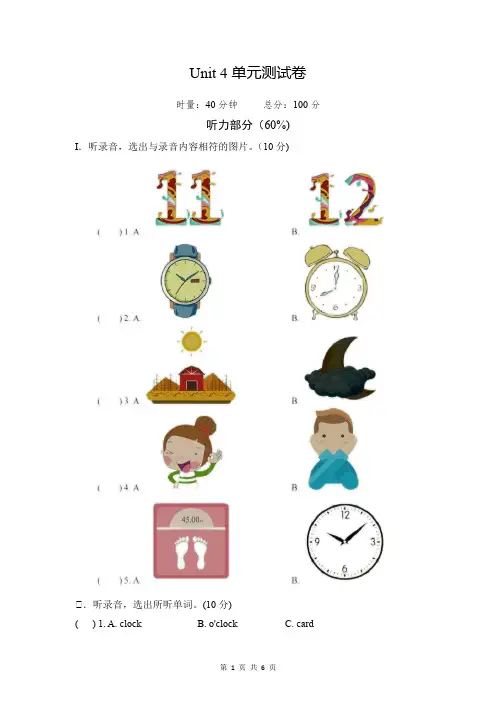
Unit 4单元测试卷时量:40分钟总分:100分听力部分(60%)I.听录音,选出与录音内容相符的图片。
(10分)Ⅱ.听录音,选出所听单词。
(10分)() 1. A. clock B. o'clock C. card() 2.A. time B. ten C. Tim() 3.A. elephant B. eleven C. evening() 4. A. nine B. night C.eight() 5.A. now B. shirt C. showⅡ.听录音,判断下列图片与录音内容是(T)否(F)相符。
(10分)Ⅱ.听录音,选出你所听到的句子。
(10分)(()1.A. It is a kite. B. The kite is light.()2.A. What colour is it? B. What time is it?()3.A.Look at the clock. B. It is a clock.()4.A.I'm eleven. B. It's eleven o'clock.()5.A. Please show ten o'clock. B. It's ten o'clock.V.听录音,将人物与对应的时间连线。
(8分)VI.听录音,在表盘上画出正确的时间。
(12分)笔试部分(40%)VII.按英文字母书写规范抄写下列单词。
(8分)colournight please o'clock eleven twelveVIII.选出不同类的一项。
(10分)()1.A. shirt B.clock C. dress()2.A. twelve B. black C. green()3.A. please B. woman C. man()4.A. morning B. afternoon C.OK()5.A. book B. show C. pencilIX.选择正确的选项,补全对话。
Unit 5 What time is it?第一课时(教学设计)-2022-2023学年英语三年级
Unit 5 What time is it?第一课时(教学设计)教学目标•能够听懂并认读数字0-60•通过练习能够正确说出时间•能够询问和回答时间教学重点•认读数字0-60•与学生练习问答时间教学准备•PowerPoint课件•时钟或手表•数字卡片•投影仪教学过程Step 1. 导入新课1.教师进入教室,向学生问好2.教师向学生介绍今天的课程:What time is it?3.教师出示一幅时钟图片,问学生:What time is it?4.教师指着时钟上的数字问学生:–What’s this number?–What’s this one?–What time is it?5.教师让学生跟着自己说:one, two, three, four, five, six, seven, eight, nine, ten6.教师继续说:eleven, twelve, thirteen, fourteen, fifteen, sixteen, seventeen, eighteen, nineteen, twenty7.教师指着数字问学生:What’s this number? What time is it?Step 2. 课堂互动1.教师出示数字卡片,让学生认读数字,并问:What’s this number?2.学生回答后,教师再问:What time is it?3.学生回答后,教师再让学生问:What time is it?4.学生找一个同桌或附近的同学,互相询问时间并回答5.部分学生来到教室前,告诉教师一个时间,其他学生猜测这个学生所说的时间是多少,然后教师与学生一起确定正确的答案Step 3. 课堂练习1.教师出示课件,让学生看数字和时钟2.学生试着说出每幅时钟显示的时间3.学生看着数字卡片,试着说出相应的时间4.教师出示一个数字,让学生试着编造一个与该数字相关的时间5.学生相互问答时间,同时教师也参与其中Step 4. 课堂总结1.教师与学生一起查看时钟和数字卡片,确认他们认知到的数字和时间2.教师与学生一起复习今天所学的数字和时间教学评估1.教师可以通过课堂互动和课堂练习来评估学生是否能够正确说出时间2.教师可以通过与学生互动来评估学生对于数字0-60的认知程度参考资料1.《英语教育三年级下册》,人民教育出版社。
(湘少版)三年级英语下册《Unit 5 Period 2》教案设计
(湘少版)三年级英语下册《Unit 5 Period 2》教案设计一、教学目标1.学生能够听懂、理解、使用单词:clock, book, computer2.学生能够根据所学掌握日常用语:What’s this? It’s a book. What’s that? It’s a clock. What’s on the desk? A computer is on the desk.3.学生能够模仿正确的发音,能够自然流利地练习句子。
二、教学重难点1.重点:单词clock, book, computer以及日常用语What’s this? It’s a book. What’s that? It’s a clock. What’s on the desk? A computer is on the desk.2.难点:学生能否正确理解和运用掌握的日常用语,以及正确的发音。
三、教学准备1.PPT课件2.音频资源3.课堂教具:教学模型(三个正方体做成)4.预先准备图片或图书、钟表、电脑等实物四、教学步骤1. Warming up(5分钟)在黑板上画一个大圆,然后请学生根据点的位置,读出时间。
例如,点在1的位置,学生回答It’s one o’clock.2. Presentation(10分钟)展示PPT,课件上放着一些图片和图书、电脑、钟表等实物,通过向学生提出问题的方式呈现。
例如,请学生看图并作出回答:•Q: What’s this?•A: It’s a book.•Q: What’s that?•A: It’s a clock.•Q: What’s on the desk?•A: A computer is on the desk.3. Practice(15分钟)根据所提供的教学模型,模仿模型音频,让学生进行模拟练习。
请老师拿起一个教学模型,提出问题,并让学生回答。
例如:•Q: What’s this?•A: It’s a book.•Q: What’s that?•A: It’s a clock.•Q: What’s on the desk?•A: A computer is on the desk.同时,老师也可以放音频进行学习和练习。
湘少版小学英语三年级下册教案(全册)
湘少版三年级英语下册教学计划计划人:一、教学目标:1、能听、说、读、写英语字母并能按字母顺序背诵、默写二十六个字母.2、根据实物、图片说出所学单词要求读音正确。
3、能比较熟练地运用所学的日常交际用语。
4、能在非语言提示的帮助下,听懂清晰的话语和录音。
5、能演唱已学过的英语歌曲,诵读已学过的歌谣.二、学情分析:学生接触英语只有一个学期,大部分学生对英语有比较浓厚的学习兴趣,但也有少数学生由于遇到困难,学习习惯也不太好,有待于端正学习态度,掌握良好的学习方法。
所以,在教学中,教师应该以学生的发展为宗旨,以培养学生的创新精神和实践能力为重点,面向全体学生,始终把激发学生的学习兴趣放在首位。
三、教材分析:三年级教材的特点:内容比较多,情景性强,语言知识点多,但是,它们都是在学生原有知识上的扩展。
所经我们在教学时要注意联系学生已有的知识,由旧知识切入新知识的学习,由旧引新,温故而知新,这样才有利于学生的理解、记忆。
四、教学措施:1、课堂教学要以学生为主体,充分发挥学生的积极性、主动性。
2、以课标理念指导教学,突出英语学科的人文性、工具性特点。
3、力求质量为先,面向全体学生,以训练促思维,促英语水平的提高,充分保证学生的自主、自学时间。
4、强化口语、听力训练,尽心辅导。
5、形成性评价列入学业学习评价,按照20% 的学习行为和口语学习评价,80%的双基评价。
以促进学生的学习为主要目的。
6、单元卷练习:任务,可以提前完成,或者同伴合作。
目的在于考核语言的掌握和兴趣的维持,不给学生太大的压力。
7、期末评价原则是:重兴趣,重双基,促能力。
五、教学进度安排:Unit 1 How are you?Period 1一、教学目标:1、能听懂、会说本课会话;2、能运用“How are you?”进行问候,并对此做出回应;力求在第一课堂就激发学生学习英语的兴趣。
二、教学重点及难点:重点:自我介绍,运用“How are you?”向他人询问情况。
三年级下册英语教案-Unit5WhattimeisitPeriod3湘少版(三起)
三年级下册英语教案Unit 5 What time is it? Period 3教学内容本节课是湘少版(三起)三年级下册英语第五单元第三课时。
教学内容围绕询问和表达时间,包括数字时钟的读法、常用的时间表达句型,以及与时间相关的日常活动。
通过本节课的学习,学生能够理解并运用句型 "What time is it?" 和 "It's time for" 进行日常交流。
教学目标1. 知识与技能目标:学生能够准确读写数字时钟的时间,并运用相关句型询问和表达日常活动的时间。
2. 过程与方法目标:通过角色扮演、小组合作等互动活动,提高学生的英语听说能力和实际应用能力。
3. 情感态度与价值观目标:培养学生的时间观念,增强其日常英语交流的自信心。
教学难点1. 数字时钟的读法:对于部分学生来说,正确快速地读写数字时钟可能是挑战。
2. 句型的灵活运用:在真实情境中灵活运用询问和表达时间的句型。
教具学具准备1. 数字时钟模型:用于直观展示时间。
2. 图片卡片:展示不同的日常活动。
3. 多媒体课件:包含本节课的单词、句型和练习。
4. 角色扮演道具:如玩具、书籍等,用于模拟真实情境。
教学过程1. 导入:通过唱英文歌曲 "Tell Me the Time" 导入,激发学生的学习兴趣。
2. 新授:介绍新单词和句型,使用多媒体课件辅助教学。
3. 操练:进行角色扮演和小组活动,练习句型和时间表达。
4. 巩固:通过游戏和练习,巩固所学知识。
板书设计Unit 5 What time is it?重点单词:clock, time, o'clock, half past, quarter to, morning, afternoon, evening.句型: What time is it? It's o'clock. It's time for 作业设计1. 书面作业:完成练习册相关练习题。
小学三年级下册第16次英语第5单元期末试卷(答案和解释)
小学三年级下册英语第5单元期末试卷(答案和解释)英语试题一、综合题(本题有50小题,每小题2分,共100分.每小题不选、错误,均不给分)1.He _______ a new bicycle last week.2.My father _______ a car.3.My friend Alice __________ (play) the piano very well. She __________ (practice) every day after school. Yesterday, she __________ (perform) in a concert and__________ (sing) a beautiful song. I __________ (go) to the concert with my mom, and we __________ (enjoy) it very much.4.My teacher __________ (explain) the lesson very clearly. She __________ (ask) us to practice the exercises at home. I __________ (do) my homework right after school and __________ (understand) everything.5.What do we call the person who teaches us in school?A. DoctorB. TeacherC. ChefD. Driver6.My school __________ (start) at 8:00 AM. I __________ (arrive) at school at 7:50 AM every day. This morning, I __________ (arrive) early because I __________ (want) to help the teacher set up the classroom.7.I ________ a student.A. amB. isC. areD. be8.What is the opposite of "day"?A. WeekB. NightC. MonthD. Morning9.What is the opposite of "hot"?A. ColdB. TallC. BigD. Fast10.They _______ (watch / watches) TV every evening.11.They ________ (study) English right now.12.Which of these is a vegetable?A. CarrotB. StrawberryC. OrangeD. Apple13.They _______ in the park at the moment.14.I __________ (1) my friend’s birthday party last Saturday. We __________ (2) alot of fun. First, we played games, and then we __________ (3) some cake. The cake__________ (4) delicious. After that, we __________ (5) some music and __________ (6) dancing. We __________ (7) a great time together.15.Today, we ______ (have) a special event at school. The teachers ______ (prepare) many activities, and we ______ (have) a lot of fun. In the afternoon, we ______ (perform) a play for the parents. I ______ (be) the main character, and my friends ______ (help) me with the lines.16.Which one is used for writing?A. TableB. PenC. ChairD. Book17.I __________ (1) my homework at 4:00 PM every day. After I __________ (2) my homework, I __________ (3) to play video games. My brother __________ (4) to play with me, but he __________ (5) to do his homework first. We __________ (6) after we__________ (7) our work.18.What color is grass?A. greenB. yellowC. blueD. red19.Which one is used for cutting?A. KnifeB. PlateC. ForkD. Cup20.Which sentence is in the simple present tense?A. She will play soccer tomorrow.B. She plays soccer every Saturday.C. She played soccer last week.D. She is playing soccer now.21.On my way to school, I walk __________. The street is always __________ with people and cars. There is a big __________ on my left, and a small __________ on my right. I cross the __________ and then walk through a __________. After that, I see my school, which is very __________. I usually arrive at school at __________ AM, just in time for the __________ bell.22.Yesterday, I ______ (eat) lunch at a restaurant. My friends ______ (order) pizza, and I ______ (choose) spaghetti. We ______ (enjoy) our meal, and then we ______ (go) shopping. It ______ (be) a nice day.23.I like to __________ in the __________. It is a good place to __________ and__________. There are many __________ and __________. I also like to __________ and watch the __________. On weekends, I often go to the __________ with my__________. We play __________ and have a great time.24.When I __________ (be) younger, I __________ (enjoy) playing with my toys. I __________ (play) outside every afternoon. But now, I __________ (prefer) reading books and drawing pictures. My interests __________ (change) as I __________ (grow) older.25.We _______ to visit the museum tomorrow.26.Which of these is a body part?A. LegB. TableC. SpoonD. Book27.What is the opposite of "happy"?A. SadB. AngryC. TiredD. Hungry28.Which of the following is a season?A. JanuaryB. WinterC. TuesdayD. December29.Which of these is a fruit?A. BananaB. CarrotC. OnionD. Lettuce30.How do you say "hello" in English?A. goodbyeB. thanksC. helloD. please31.Which of these is a day of the week?A. SundayB. RedC. ChairD. Car32.David is going to the playground. He is going to play on the __________ (1) and climb the __________ (2). After that, he swings on the __________ (3) and slides down the __________ (4).33.What color is a lemon?A. OrangeB. YellowC. GreenD. Red34.She is my _______.A. BrotherB. MotherC. SisterD. Cat35.Which of these is a mode of transport?A. TableB. BusC. SpoonD. Pencil36.You see a person sitting alone on the playground. What could you do to be kind?A. Ignore them and keep playing with your friendsB. Go over and ask if they want to join your game or talkC. Laugh at them because they are aloneD. Tell them to go away because they don’t have any friends37.Which of these is a form of transportation?A. ChairB. CarC. BookD. Spoon38.He _______ a new bicycle last month.39.Which animal is known for being very slow?A. ElephantB. GiraffeC. TurtleD. Dog40.What do we use to write on paper?A. KnifeB. EraserC. PenD. Plate41.I ________ (live) in Beijing.42.What time is it?A. It’s rainy.B. It’s 8 o’clock.C. It’s reD. D. It’s Monday.43.Tom and Jerry are best friends. They love to __________ (1) together. Today, they are going to play __________ (2) in the yard. Tom brought a __________ (3), while Jerry brought a __________ (4). Afterward, they will sit on the grass and eat some__________ (5) their moms made.44.Which one is an animal?A. AppleB. TableC. DogD. Chair45.He ________ (write) an email now.46.What is 10 + 5?A. 13B. 14C. 15D. 1647.What is the opposite of "clean"?A. DirtyB. LightC. TallD. Heavy48.We __________ (1) a new pet dog last month. It __________ (2) very cute and playful. I __________ (3) to take care of it, and we __________ (4) it every morning. We __________ (5) to the park on weekends, and it __________ (6) to run and play.49.Which of these is not a fruit?A. BananaB. AppleC. CarrotD. Orange50.Which one is used for reading?A. BookB. ChairC. TableD. Computer(答案及解释)。
湘少版小学三年级英语下Unit 5 What time is it 第一课时 课件
表示整点时,我们可以回答: It’s … o’clock.
表示非整点时,我们可以用直读法 (钟点数+分钟数):
It’s one o’clock. It’s ten ten.
What time is it? Sorry. I don’t know.
Listen and imitate
Look! It’s _d_a_y__.
It’s _ni_g_h_t_.
Good to know What time is it?
It’s 8:00 a.m.
a.m. 指午夜0时—中午12时之前 p.m. 指中午12时—午夜0时之前
It’s 10:10 p.m.
Watch and learn
Look and say
Unit 5 What time is it?
第一课时
Sharp eyes
seven
nine five
ten
four
six
two
eight
three
Let’s learn
What ‘s this?
It’s a _c_lo_c_k___.
Let’s learn
What time is it? 几点了? It’s _s_ev_e_n_o_’c_l_o_ck_._ .
Look at the clock, please.
It’s seven o’clock.
OK! Thank you.
Show time
1. Read the dialogue. 能够合作朗读对话。
2. Role-play the dialogue. 分角色表演,有一定的动
作和表情。