
小学英语五年级下册Lesson 12 A Visit to the Great Wall课件
clean and beautiful?
Don't draw or write on the Great Wall.
Learning tips: 小组内阅读,根据问题寻找关键信息和关键句型。
How to be a civilized tourist(文明游客)?
Write a Travel Card:
Read the story with emotion.
Tell the story to your parents in English.Leabharlann ×× √×
√
Group work:
In China, we call the Great Wall “The _____________ Ten-Thousands-Li Great Wall”. The Great Wall is _____,_____,______.In China, long old beautiful people say “He who not go to the _____ ______ is not a _____ Great ______ Wall true _____ man ”. draw write We don’t _____ or _____ on the Great beautiful Wall. Let’s keep it clean ____ and ______.
Lesson 12 A Visit to the Great Wall
Tian'anmen Square
the Palace Museum
Wangfujing Street
the Great Wall
A Visit to the Great Wall
★Listen carefully and answer: 1、Who are they? 2、Where do they go? 3、How do they go there?
★Read the story quietly and underline:
※How old is the oldest part of the Great
Wall?
The oldest part is more than 2000 years old.
★Read it in a group and answer:
冀教版五年级下册英语-Unit2Lesson12AVisittotheGreatWall

教案:冀教版五年级下册英语——Unit 2 Lesson 12 A Visit tothe Great Wall一、教学目标1. 知识目标:(1)能够听懂、会说、会读本课的生词和句子。
(2)能够用英语简单描述参观长城的经历。
(3)能够理解并运用本课的核心句型 "—What did you do? —I went to " 进行交流。
2. 能力目标:(1)能够运用所学的词汇和句型,进行简单的口语交流。
(2)能够根据图片或情景,运用所学知识进行创造性表达。
3. 情感目标:(1)培养学生对祖国大好河山的热爱之情。
(2)培养学生的团队协作精神,增强集体荣誉感。
二、教学内容本课主要讲述了一群学生在老师的带领下,去参观长城的经历。
通过本课的学习,学生能够掌握有关参观活动的词汇和句型,并用英语进行简单的口语交流。
三、教学重点与难点1. 重点:(1)生词的学习:wall, China, group, teacher, summer vacation, take pictures, exciting。
(2)核心句型的运用:"—What did you do? —I went to "。
2. 难点:(1)正确理解并运用情态动词 "have" 的过去式 "had" 。
(2)能够根据情景,运用所学知识进行创造性表达。
四、教具与学具准备1. 教具:多媒体课件、黑板、粉笔。
2. 学具:课本、练习册、单词卡片。
五、教学过程1. 热身(5分钟)(1)教师与学生用英语进行简单的日常交流。
(2)学生自由发挥,用英语讲述自己在上个周末的所见所闻。
2. 导入(10分钟)(1)教师出示长城的图片,引导学生说出 "Great Wall" 。
(2)教师提问:"Have you ever been to the Great Wall?" ,引导学生用英语回答。
知识点Lesson 12 A Visit to the Great Wall
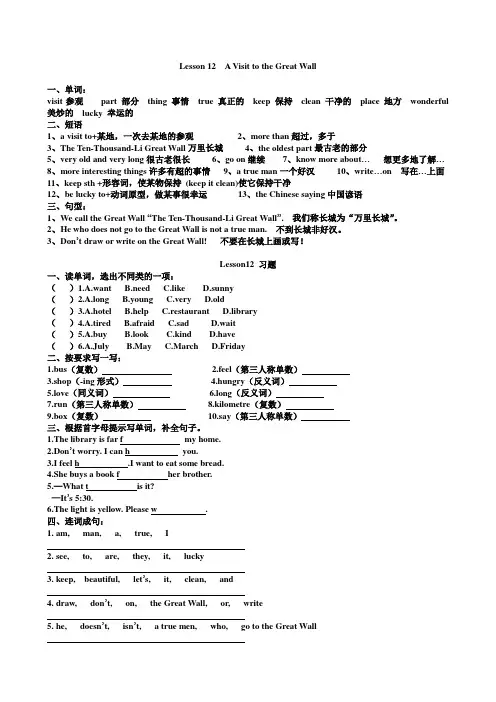
Lesson 12 A Visit to the Great Wall一、单词:visit参观part 部分thing 事情true 真正的keep 保持clean 干净的place 地方wonderful 美炒的lucky 幸运的二、短语1、a visit to+某地,一次去某地的参观2、more than超过,多于3、The Ten-Thousand-Li Great Wall万里长城4、the oldest part最古老的部分5、very old and very long很古老很长6、go on继续7、know more about…想更多地了解…8、more interesting things许多有超的事情9、a true man一个好汉10、write…on 写在…上面11、keep sth +形容词,使某物保持(keep it clean)使它保持干净12、be lucky to+动词原型,做某事很幸运13、the Chinese saying中国谚语三、句型:1、We call the Great Wall “The Ten-Thousand-Li Great Wall”. 我们称长城为“万里长城”。
2、He who does not go to the Great Wall is not a true man. 不到长城非好汉。
3、Don’t draw or write on the Great Wall! 不要在长城上画或写!Lesson12 习题一、读单词,选出不同类的一项:()1.A.want B.need C.like D.sunny()2.A.long B.young C.very D.old()3.A.hotel B.help C.restaurant D.library()4.A.tired B.afraid C.sad D.wait()5.A.buy B.look C.kind D.have()6.A.July B.May C.March D.Friday二、按要求写一写:1.bus(复数)2.feel(第三人称单数)3.shop(-ing形式)4.hungry(反义词)5.love(同义词)6.long(反义词)7.run(第三人称单数)8.kilometre(复数)9.box(复数)10.say(第三人称单数)三、根据首字母提示写单词,补全句子。
五年级下册英语教学设计-Unit 2 Lesson 12 A Visit to the Great
五年级下册英语教学设计-Unit 2 Lesson 12 A Visit to theGreat Wall∣冀教版 (三起)教学目标•能听懂、认读、口头表述并书写本课词汇:a great wall, a guide, yet •能够听懂简单的日常用语,建议教师增加词汇量和语言点•能够阅读、理解并简述本课语言材料并了解中国长城的历史和传说•能够学会尊重他人和爱护环境教学重点•学生能够理解并简述本课语言材料•学生能认读、口头表述并书写本课词汇教学难点•学生能够阅读和理解本课语言材料•学生能够口头表述本课语言材料教学准备•课件、录音机、单词卡片教学过程导入•教师播放声音和幻灯片,让学生看图片并回答问题:“Do you know what it is? Can you guess? Yes, it’s the Great Wall!”新授Step 1. 语法部分•让学生听录音并看字幕,让学生听懂并掌握句型“I haven’t been to the Great Wall yet.”解释下yet的意义。
•让学生自己造句,以此巩固所学知识点。
Step 2. 词汇部分•教师出示单词卡片: a great wall, a guide, yet。
学生跟读单词并尝试理解单词意义。
Step 3. 阅读和听力部分•教师放音频材料并要求学生听录音后拼读单词,最后回答问题,并让学生自己读一遍并回答问题。
Step 4. 练习部分•学生用所学的语法和单词造句,教师可进行适当的评价和指导。
Step 5. 总结•教师让学生复述所学内容,并让学生如果还有疑问,可以自由发言提问,教师进行解答。
教学实验•演示、视频、实地教学、实验、小组探究、研究、个案分析。
教学评价•学生能够口述本课语言材料•学生能够理解本课材料•学生能够自己造句,并运用所学的语法和单词。
参考资料•《小学英语(三起)》五年级下册第二单元第12课“参观长城(A Visit to the Great Wall)”。
冀教版五年级英语下册Lesson12 A Visit to the Great Wall
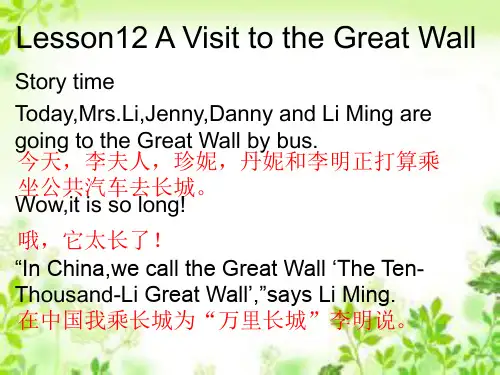
Okay,LiMing. Sorry.
李明说.好的,李明,对不起.
“Great!So now I am true man!
太好了!现在我是一个真是男人了!
Let me write my name on the Great Wall,”
says Danny.
让我把我得名字写在长城上吧,丹妮说.
Lesson12 A Visit to the Great Wall
Story time
Today,Mrs.Li,Jenny,Danny and Li Ming are going to the Great Wall by bus. 今天,李夫人,珍妮,丹妮和李明正打算乘 坐公共汽车去长城。 Wow,it is so long!
“No,Danny!Don’t draw or write on the Great Wall!
不丹妮!不要在长城上画和写!
Let’s keep it clean and beautiful,” says LiMing.
让我们让他保持保持干净和漂亮,李明说。
“What a wonderful place to visit!”says Jenny.
• The oldest part is more than 2000 years old,”LiMing goes on.
最古老的部分超过2000年了,李明接着说。
• Danny and Jenny want to know more about the Great Wall.
丹妮和珍妮想知道更多关于长城的事。
多么值得参观的美丽地方!珍妮说。
“We are lucky to see it.”
新冀教版五年级英语下册《Unit 2 In Beijing Lesson 12 A Visit to the Great Wall》教案_12

Lesson12 A Visit to the Great Wall教材分析:本节课是冀教版五年级下册第二单元In Beijing的故事课,通过主人公游览长城的情景巩固本单元有关长城的特点:old and long.呈现中国人对长城的习惯称呼、有关长城的谚语以及如何爱护长城、保护周围环境。
学生分析:五年级学生已经有了一定的英语基础,且对英语较为感兴趣,尤其是对本课的教学内容较为熟悉,教师应用多种方法鼓励学生开口说、大胆说英语。
教学目标:知识与技能目标1.在老师的帮助下读懂故事、了解有关长城的简单信息。
2.能朗读故事并在老师的帮助下复述故事。
学习策略目标:在语境中猜测词义,抓重点词句,理解故事文化意识目标:保护周围环境,爱护名胜古迹,增强民族自豪感。
教学重点:抓重点词句理解故事。
教学难点:简要复述故事。
教学准备:课件、图片。
Step 1. Warm up and lead in.Greetings and ask the students:How’s the weather today? It’s warm and sunny.The weather is so nice. Do you want to go on a trip? Where do you want to go? Students answer and then lead in the new lesson.Step 2. Presentation1.Listen to the story and answer:Can you tell me something about the Great Wall?What do you think of the Great Wall?It’s old, long, wonderful, beautiful, great ,interesting…2.The Great Wall is wonderful! Today Our friends Mrs. Li ,Jenny, Danny and Li Ming go there .Read pictures 1-3 and answer the questions: How do they go to the Great Wall?What do we call the Great Wall in China?How old is the oldest part of the Great Wall?3.What’s the meaning of “The Ten-Thousand-Li Great Wall”?Ask studentsto say it in Chinese.4.Explain the oldest. I am the oldest of us.5.Follow the recorder and practice reading.6.Danny and Jenny want to know more about the Great Wall.Do you know moreinteresting things about it? What’s the Chinese saying about the Great Wall? What’s the meaning of “He who does not go to the Great Wall is not a true man.”Ask students to say the saying in Chinese ,then the teacher gives more examples about the sayings of the Great Wall. 7.Read P5 in pairs and answer the questions:What does Danny want to do on the Great Wall? Is that right or wrong?How can we keep the Great Wall clean and beautiful? The teacher shows some more pictures and tell students what we mustn’t do when we go on atrip.8.Look at P6.When Jenny stands on it ,how does she feel?What a wonderful place to visit!Ask students to read it before the picture and experience the feeling,then use other words to take place of wonderful,such as beautiful, great,interesting…9.Students follow the recorder and practice reading.Step3.Practice1.Show the story outline and ask students to finish it in groups, thenretell the story.Today,Mrs. Li ,Jenny,Danny and Li Ming are going to the Great Wall by bus. The Great Wall is very old and very long.In China, we call it “The Ten-Thousand-Li Great Wall ”In China, people always say “He who does not go to the Great Wall is not a true man.”Danny wants to write his name on the Great Wall.But Li Ming says,“Don’t draw or write on it.Let’s keep it clean and beautiful.” What a wonderful place to visit!We love the Great Wall!2.Practice retelling the story in groups with the help of the picture.3.Ask several students to retell the story before class.Step 4.SummaryWe have learned so much about the Great Wall,the Great Wall is the pride of China.We love the Great Wall.We love China!Step 5.Homework1.Read the picture book Who Wants to Travel the Great Wall with Me?2.Make a postcard about the Great Wall.板书设计:Lesson12 A Visit to the Great WallThe Ten-Thousand-Li Great Wall.The oldest part is more than 2000years old.D on’t draw and write on the Great Wall.He who does not go to the Great Wall is not a true man.”What a wonderful place to visit!教学反思:。
五年级英语下册Unit2InBeijingLesson12《AvisittotheGreatWall》 优秀课件4(新版)冀教版(三起)
×
× √
×
√
Group work:
In China, we call the Great Wall “The _____________ Ten-Thousands-Li Great Wall”. The Great Wall is _____,_____,______.In China, long old beautiful people say “He who not go to _____ the ______ is not a _____ We Great ______ Wall true _____”. man draw write don’t _____ or _____ on the Great Wall. beautiful Let’s keep it ____ clean and ______.
Lesson 12 A Visit to the Great Wall
Tiace Museum
Wangfujing Street
the Great Wall
A Visit to the Great Wall
★Listen carefully and answer: 1、Who are they? 2、Where do they go? 3、How do they go there?
※How can we keep the Great Wall
clean and beautiful?
Don't draw or write on the Great Wall.
Learning tips: 小组内阅读,根据问题寻找关键信息和关键句型。
How to be a civilized tourist(文明游客)?
五年级下册英语-Unit2 Lesson12 A Visit to the Great Wall冀教
五年级下册英语-Unit2 Lesson12 A Visit to the Great Wall冀教版IntroductionThe Great Wall is one of the most famous cultural landmarks in China. Every year, many tourists from different countries visit it. In this lesson, we will learn about the Great Wall and its history.Vocabulary•fortress: a military building designed to defend a place against attack•hike: a long walk in the countryside•steep: a slope that is almost vertical•meander: follow a winding course•magnificent: very beautiful and impressive•minibus: a small bus that can carry up to 15 passengers•souvenir: a thing that is kept as a reminder of a person, place,or eventTextPart 1Li Ming’s aunt and uncle came to visit Beijing. They wanted to see the Great Wall, so Li Ming’s parents took them there.Li M ing’s aunt was excited to see the Great Wall. She had readabout it in many books. Li Ming’s uncle was excited to climb up the Great Wall. They all took a minibus to the Great Wall.Part 2When they arrived at the Great Wall, they saw a magnificent fortress. Li Ming’s uncle was very impressed. They walked up the steep stairs to the Great Wall. It was tiring, but they were determined to reach the top.On the way up, they saw many tourists from different countries. They also saw vendors selling souvenirs.Part 3When they reached the top of the Great Wall, they were amazed by the view. They could see the surrounding mountains and valleys. They saw the Great Wall meandering along the landscape.Li Ming’s aunt and uncle were very happy that they had visited the Great Wall. They took many pictures and bought some souvenirs.Part 4Li Ming’s uncle said that he wanted to hike along the Great Wall, but Li Ming’s parents said that it would be too tiring. They decided to take the cable car back down.As they were leaving, Li Ming’s aunt and uncle thanked them for the wonderful visit. They said that they would always remember their visit to the Great Wall.ConclusionVisiting the Great Wall is a once in a lifetime experience. It is a great way to learn about Chinese culture and history. If you ever have the opportunity to visit Beijing, don’t miss the chance to visit the Great Wall.。
五年级下册英语课件-Lesson 12《A visit to the Great Wall》| 冀教版 (三起)
Retell the story
假设你是一名小导游, 引领旅客参观长城。
Write a Travel Card
Tell the story to your parents in English.
更有趣 的事情
பைடு நூலகம்
不到长城非好汉。
true 真正
的
How can we keep the Great Wall clean and beautiful?
keep :保持
How do Danny
and Jenny feel at last (最后)?
Memory Test
In China, we call the Great Wall “TheT_e_n_-T_h_o_u_s_a_n_d_-L_i_ Great Wall”. The Great Wall is _o_l_d__,l_o_n_g__ and beautiful.In China, people say “He who does not go to _th_e___ G_r_e_a_t__ _W_a_l_l __ is not a _tr_u_e__m_a_n___”. We don’t _d_ra_w__ or _w_r_ite__ on the Great Wall. Let’s keep it c_l_e_an_ and b_e_a_u_t_if_u.l
thousand 千
注意:表示具体 几千不用复数
How old is the oldest part of the Great Wall?
old 年老的(原级) older 较老的(比较级) oldest 最老的(最高级)
more(更多), 它是 many与 much的比较级
新冀教版五年级英语下册《Unit 2 In Beijing Lesson 12 A Visit to the Great Wall》教案_33
义务教育教科书冀教版小学英语五年级下册Unit2 Lesson12 A Visit to the Great Wall教学设计一、教学内容与学情分析教材的第二单元以Travel in Beijing为中心话题,教材为学生提供了Li Ming , Mrs. Li , Jenny and Danny 一起游览北京的天安门广场,故宫和长城,并且到王府井购物这些场景,帮助学生理解并掌握外出游玩和观赏时常用的英语表达方式。
故事课A Visit to the Great Wall作为本单元的最后一课,是本单元内容游览北京景点的拓展和延伸,覆盖了本单元的部分目标词汇和句型。
学生在阅读故事的过程中巩固了所学的语言知识,提高了阅读技能,更重要的是学生在阅读故事的过程中了解了关于长城的更多的知识,体会了阅读故事的乐趣。
故事中的新词汇有more than,oldest,keep 等.五年级的学生活泼好动,想象力丰富,对新鲜事物充满了好奇心,表现欲望很强。
经过两年的英语学习他们有了一定听、说、读、写能力,掌握了一定的学习技巧。
学生英语水平不一,有学习积极性高,接受知识快,表现欲望强,富有想象力和创造力的,但也存在一部分基础较弱的,表演故事对学生来讲是有挑战性的,所以本课的教学重点是看图预测、读文验证、理解故事内容,难点是简单复述故事或表演故事。
二、教学目标1语言能力目标(1) 能借助story map分别从时间,地点,人物,以及故事的发生,发展,结果等方面梳理故事的主要情节以及人物的语言和行为,理解故事大意。
(2) 能朗读故事,做到流畅,语音准确,语气达意。
(3) 能借助story map并通过小组合作的方式复述或表演故事,发展口语表达能力。
2学习能力目标(1)根据标题预测文本内容,学会运用预测策略进行学习。
(2)通读全文,检查预测的内容与文本信息是否相符,了解文本内容,感知作者的写作意图。
(3)细读全文并提取文本信息(when, who, how, what),梳理文本细节信息,了解游览长城的过程。
五年级下英语教案-Lesson12AVisittotheGreatWall-冀教版
教案:五年级下英语教案 Lesson 12 A Visit to the GreatWall 冀教版一、教学目标1. 知识目标:(1)能够听懂、会说、会读本课的生词和重点句子。
(2)能够运用所学知识描述一次参观长城的经历。
2. 能力目标:(1)能够通过图片和文字资料,了解长城的历史和文化。
(2)能够用英语简单描述参观长城的所见所闻。
3. 情感目标:激发学生对祖国历史文化的自豪感,培养他们的爱国情怀。
二、教学内容1. 教材内容:本课主要介绍长城的历史和文化,以及一次参观长城的经历。
通过学习,让学生了解长城的壮丽景色和雄伟气势,培养他们的爱国情怀。
2. 拓展内容:通过图片和文字资料,让学生了解长城的历史和文化,提高他们的文化素养。
三、教学重点与难点1. 重点:(1)能够听懂、会说、会读本课的生词和重点句子。
(2)能够运用所学知识描述一次参观长城的经历。
2. 难点:(1)生词和短语的理解和运用。
(2)描述参观长城的经历。
四、教具与学具准备1. 教具:(1)课件:包括本课的生词和重点句子,以及与长城相关的图片和文字资料。
(2)黑板和粉笔。
2. 学具:(1)课本。
(2)练习本。
五、教学过程1. 导入:通过课件展示长城的图片,引导学生谈论长城的美丽景色,激发他们的学习兴趣。
2. 新课呈现:(1)教师引导学生学习本课的生词和短语,并通过例句展示它们的用法。
(2)教师播放课文录音,让学生跟读并模仿语音语调。
3. 课堂练习:(1)学生分组进行角色扮演,模拟一次参观长城的经历。
(2)学生用英语描述自己所见所闻,并尽量使用本课所学词汇和句型。
4. 拓展活动:学生通过查找资料,了解长城的历史和文化,并在课堂上进行分享。
六、板书设计板书设计如下:课题:A Visit to the Great Wall生词和短语:The Great WallancientChinesehistoryculturetouristattractionmagnificentclimbview句子:1. The Great Wall is an ancient Chinese tourist attraction.2. It has a long history and rich culture.3. We climbed the Great Wall and had a magnificent view.七、作业设计1. 抄写本课生词和短语,每个写5遍。