
新人教版九年级(全一册)英语 Unit 4 Period 4 Section B(2a-2f) 重点习题练习复习课件
4. Rick hasn't changed at all. He looks ____D____
the same as he did at school.
A. luckily
B. especially
C. normally
D. exactly
5. Nowadays some parents spend more time on mobile
The movie reminds me of my childhood.
【2019•武威、白银】 【A解. r析ea】llyreally真B.正ne地ar;lynearlyC几. s乎lo;wlsylowly慢D慢. h地ar;dly
hardly几乎不。结合句意“那一刻我________能控 制我的感情。那部电影使我想起了我的童年。”可 知,空处填hardly合适,could hardly意为“几乎不 能”。故选D。
【解析】考查动词短语辨析。句意为“如【今2中01国8•在山很西】 多A领. t域ak都e 取pri得de了in巨大的成就,我们B.真ta的ke为ca我re们o伟f 大的
国家而骄傲”。take pride in为……感到自豪;take
caCre. toafk照e 顾an,in照ter看es;t itnake an interest in对……感兴趣。
much work every day.
【2019•铁岭】
A. usually
B. always
C. often
D. seldom
【解析】考查频率副词辨析。usually通常; always总 是;often经常;seldom很少,不常。根据下文因为 他每天有很多的工作可推知他很少锻炼。故选D。
4. I could ____D____ control my feelings at the moment.
二、根据汉语意思完成句子, 并背记英语句子 6. 很难相信他在学校里曾经有过困难。 ____I_t___ ____i_s___ ___h_a_r_d__ ____to____ _b_e_l_ie_v_e__ that he used to have difficulties in school.
7. 他的父母搬到城里找工作。 His parents moved to the city ____to____ ___lo_o_k___ ____fo_r___ ___j_o_b_s__.
anybody else's help. 【A解. 析in 】fac根t 据答语中“He didn'Bt w. ianntpearnsyobnody else's
help.”可以推知句意为“——谁在医院照顾你生病的
奶C.奶in?to—ta—l 我的爸爸亲自照顾。D.他in不d想isa其gr他ee人me帮nt忙”。
B. more interesting
【解C析. m】o考st查in形ter容es词tin比g 较等级。Dm. uthceh可mo修st饰in形te容res词tin或g
副词的比较级,表示程度。故选B。
17. Bill says, “Robinson Crusoe is ____C____ interesting
3. The program The Reader is much ____B____ than that one.
A. interesting
B. more interesting
C. most interesting
D. interested
【解析】用结构分析法。much后接比较级表示程度, 意为“……得多”。
一、单项选择
1. China is ____C____ Asian country while England is ________ European country. 【2019•铜仁】
A. an; an
B. a; a
C. an; a
D. a; an
【解析】考查冠词辨析。Asian是以元音音素开头的,
me?
—Sure. You can look it up in the dictionary.
【解析】考查固定短语。句意为“——【我2在0理19解•贵这港个】 A新. u单nd词er方sta面nd有in困g 难。你能帮助我B吗. t?o u—nd—er当st然an可d 以
了。你可以在词典里查找它”。have trouble (in)
friends.
—That's true. Friends play an important part in
【解e析ve】ry考on查e's被li动fe语. 态的用法。句意【为20“18—•呼—和人浩们特,】 A特.别ea是sil年y 轻inf人lu容en易ce被s 他们的朋友B影. is响e。asi—ly—in那flu是en真ced
Cd. uoinndgesrsthta.意nd为“在做某事方面有D困. u难nd”er。sto故o选d A。
2. The Great Wall is too high. I have difficulty _cl_i_m_b_i_n_g_ (climb) it alone. 【2019•淮安】
3. Nelson ____D____ exercises because he has too
根据第一句话表达中国在许多领域都取得了巨大的成 就,很自然地我们会为祖国而骄傲。故选 A。
15. Xiao Hua's parents are always proud of his work. (改为同义句) Xiao Hua's parents always ___t_a_k_e__ __p_r_i_d_e__ in his work.
3. Love was totally __a_b_s_e_n_t_ (缺席) from his childhood. 4. I think that getting a job would give him his __p_r_i_d_e__
(骄傲)back. 5. No one knows his address __ex_a_c_t_l_y_ (确切地).
____A____. —Don't be upset. Sometimes losing is only a sign 【解析th】at考yo查u动re词all词y 义tri辨ed析. 。句意【为2“01—8—•东我营已改经编努】 力A学. 习fai我le的d 功课,但是仍然_____B__. _w。or—rie—d不要难过。
的。朋友在每个人的生活中起着重要的作用”。第
C一.句ar中e e主as语ily与in谓fl语ue动nc词edinfluencDe之. i间nf是lue被nc动ed关e系as,ily
应用被动语态,而且主语表示复数。故选C。
7. 昨天的会议你为什么缺席了? Why were you _a_b_s_e_n_t_f_r_o_m__ the meeting yesterday? 【2019•辽阳】
16. —Next Monday is our mother's birthday. Let's buy
some cards for her.
—Why not make some ourselves? It will be much
____B____.
【2018•眉山】
A. interesting
【解析】用同义替换法。be absent from意为“缺席; 不在”,选项A“没有参加”可以替换。
9. Too much stress will lead to __fa_i_lu__re__(fail) in exams.
10. —I had tried hard at my schoolwork but still
Unit 4 I used to be afraid of the dark.
Period 4 Section B(2a-2f)
一、根据汉语提示写单词, 并背记相应英语词汇 1. I __se_l_d_o_m__ (很少) get in touch with them. 2. Too little sleep is sure to __i_n_f_lu_e_n_c_e___ (影响) health.
5. “一带一路”倡议产生了巨大的社会影响。 The Belt and Road Initiative has had a great ___so_c_i_a_l _i_n_fl_u_e_n_c_e__.
6. —People, especially the young, ____C____ by their
8. Tom was absent from the important meeting this morning.
(同义替换) ____A_____
【2017•白银】
A. didn't take part in
B. held
C. didn't like
D. took an active part in
10. 李文的父母和他们儿子的交流比过去更多了。 Li Wen's parents had ___m_u_c_h__ ___m__o_re__ _c_o_m__m_u_n_i_c_a_t_io_n_ with their son than they used to.
1. —I have trouble ____A____ the new word. Can you help
13. Every child wants to be the __p__ri_d_e__ (proud) of their parents. 【2019•宿迁】
14. Nowadays China has made great achievements in
人教版英语九年级全一册Unit 4听力原文及翻译

Unit 4 I used to be afraid of the dark.Section A, 1bConversation 1Bob:Mario, is that you?马里奥,是你吗?Mario:Yeah, it is. It’s Bob! Hey, guys, it’s Bob! I haven’t seen you for four years!是的。
你是鲍勃。
大家看,这是鲍勃!我都四年没见你了。
Bob:Yeah. I’m here with my parents. We’re visiting for a couple days. Wow, Mario, you look different! You used to be short, didn’t you?是啊。
我和我父母在这里旅游几天。
哇哦,马里奥,你看上去不一样了。
你过去个子矮,不是吗?Mario:Yes, I did. Now I’m tall. And so are you!是的。
现在我长高了,你也是啊!Bob:That’s true. And you used to wear glasses.没错。
你过去还常常戴眼镜。
Conversation 2Bob:Hey, Amy, it’s great to see you.艾米,见到你真好。
Amy:Hi, Bob. How are you?你好,鲍勃。
你好吗?Bob:Fine. Wow, you’ve changed!还好。
哇哦,你变了!Amy:Really? How?是吗?哪里?Bob:You used to have short hair.你过去的头发短。
Amy:You remember that? Yes, I did.你还记得?是的。
Bob:And you used to be really tall!你过去还很高!Amy:Not anymore. You’re taller than me now, Bob.不再是了。
(新人教版)英语九年级全册:Unit 4 全单元ppt课件(133页)
句中作定语或表语
【学以致用】 Our English teacher is very__________ (humor). We all like
him.
答案: humorous
2. silent adj. 不说话的; 沉默的 【语境领悟】
*She was always silent in class.
【自主归纳】
helpful的用法
helpful为形容词, 意为“有用的; 有帮助的”, 它是由help
+ ful构成的形容词。help为动词或名词, 意为“帮助”。类似
的词还有useful, careful等。
【一言辨异】 Mr. Green is really helpful. He often helps others. 格林先生乐于助人。他经常帮助别人。
4. All of them are working in__________ (silent).
5. —Why is he so popular? —Because he is very kind and__________ (help). 答案: 1. walk 5. helpful 2. getting 3. humorous 4. silence
【妙辨异同】used to do sth. , be used to (doing) sth. 与be used to do sth. She used to have long 意为“过去常做某事”, used to do sth. hair. 只用于过去时态 她过去留着长发。 be used to (doing) sth. 意为“习惯于(做)某 事”, 可用于现在、过 去、将来等多种时态 He is used to getting up early. 他习惯于早起床。
人教版英语九年级全一册 Unit 4 I used to be afraid of the dark

A Teaching Design of Writing----Unit 4 Section B 3a--3bTextbook Analysis:(教材分析)Functionally, unit 4 is a transitional unit from the “past tense to passive voice”. Its topic is “taking about the past thing or person”and aims to build the Ss ‘ability to describe the changes in the past .Section b 3a is a warming-up part before writing,which encourages the Ss to talk about their own changes .Section b 3b is a writing task ,which requires the students to use the “used to” pattern to describe his /her changesBy accomplishing the tasks in Section B 3a-3b ,writing skills will be developed . The analysis of the students: (学生分析)Although the pattern “used to be ”is relatively easier than the other units ,the students would still make mistakes when practicing the structure .Also ,they may have difficulties in distinguishing the pattern “used to” and “get used to “The difficult points of this lesson :(教学难点)In this lesson ,students will have difficulty in expressing the reason of his/her change .In that case ,teaching will focus on encouraging and expressing the steps to describe the eventThe important points of this lesson :(教学重点)In this lesson ,the important point of teaching is how to let the students get familiar with the USED TO pattern and practice the application .At the same time ,students should be able to use this pattern to describe the their own or others’changes,so teaching will focus on practice speaking .Teaching design :(教学设计)III: Teaching Aims : (教学目标)I:Knowledge and Skills:1)During the speaking section ,Students are able to use target language (used to ) express their changes .2)In the writing section ,students can learn to write an article about their changes. II:Process and methods :(过程与方法)1)Students are able to get familiar with the pattern through a group competition2)Students can be inspired to talk about the changes through TALKING part3)Encourage the students to write a short passage about the changes in a limited time Emotional Attitude and value :(情感态度以及价值观)The students ’co-operation ability and harmony will be developed in this class .after this lesson, they will get better known about the saying -----Life gets better not by chance but by the changes!Teaching Procedures : (教学过程)1>Lead-inShow two pictures of RenZhengfei (任正非)and ask the students to use “used to “ pattern to describe the picturesThen show two another two pictures of a Chinese village and do the same activity,then comes to the topic of this lesson2>Talking about the pictureTopic --What did you use to be like when you were in primary school ?(self-check 2) Show Ss three groups of picture then let them talk about them in groups (appearance)P1----He used to be fat but he is much stronger now(personality)P2----She used to be nervous but she is more confident now(hobby)P3----I used to like playing ping pang but I like playing basketball more3>Brainstorm-discover the others’ changesFirst of all ,list a group words which describes one person’s appearance/personality/hobbies ,then show them the usual pattern .Ask group 1 students to describe a student’s change from another group ,as a reply ,this group’s students should describe a student’s change in group 1 .Rules: They are not allowed to use the same word as well as the same studentsIf the group could not give reply in time ,it would be the lost groupAppearance :tall, short, heavy, thin, straight/curly hair, long/short hair, wear glasses, a medium height, good eyesight, handsome good-looking, …Personality:outgoing, serious, funny, friendly, shy, serious, kind, humorous, selfish, selfless, mean, hard-working, lazy, active, careful, creative, gentle...Hobby :read cartoon/books, play the piano, play football, run, swim, play computer games, traveling, hang out with friends, watch TV/movies, eat apples/ hamburgers...Pattern :__SB___used to be ________but he is __________________SB___used to be ________.Now he is _________________SB___used to like _______.but now _____ prefer(s) ___________4>Talking--share your biggest change in the past few yearsIn this section ,students are suppose to talk more deeply about their changes and the reason .In order to make it easier and inspire them ,the following questions will be organized as follows1)What is your biggest change ?The biggest change in my life is becoming ______________In my past few years’ life ,the most unforgettable /remarkable change is that _______ The biggest change which impressed me most is __________________________2)What/who made(caused)your change?Thanks to ___SB______,my _____________Thanks to __STH____,which happened in ________If I didn’t meet ________,I wouldn’t change so muchIf I didn’t take part in ________,I ____________3)How did it happen ?What’s the event that changed you ?He /she gave me advice on ________The _____match taught me that ______________________words impressed me a lot ,and made me ________________4)What’s your feeling about the change ?Looking back at the change ,I feel very _________I think the change is _______________I feel lucky and grateful ______________5)Writing and Sharing ----- How I have changed --- Section B 3bAccording to the requirements ,ask the students to write an article no less than 90 words then give the comment on their articleRequirements:Try to write two paragraphs :Paragraph 1:General introduction about the changes in your lifeParagraph 2:The most important change and how it happenedChoose two writings of the students (。
【新】人教版九年级英语(全一册)上册第四单元《Unit4》整单元完整优质PPT教学课件(共4课时)
1c Look at the picture in 1a and make conversations.
A: Did Mario use to be short? B: Yes, he did. He used to be really short. A: What’s he like now? B: He’s tall now.
结构一样。 如果答语是肯定的,用“Yes +肯定结构”。 如果答语是否定的,用“No +肯定结构”。
-- He enjoys dancing, doesn’t he? 他喜欢跳舞,对吗?
--Yes, he does. / No, he doesn’t. 是的,他喜欢。/不,他不喜欢。
2) 回答陈述部分为否定句的反义疑问句时, Yes或是No的汉语意思与它们本身的词义相反。 --You didn’t go to work, did you?
Gina: Did he use to wear glasses? Alfred:Yes, and he used to be thin, too. But
look how big and strong he is now! Gina: He’s so popular now. Look at
all the girls around him!
medium build
handsome medium height
Personality
(性格)
outgoing
funny friendly
shy
hard-working
honest serious
What does Tom look like?
He is tall and he has short black hair.
初中英语人教版九年级全一册 Unit 4 第4课时(Section B 2c-Self Check)
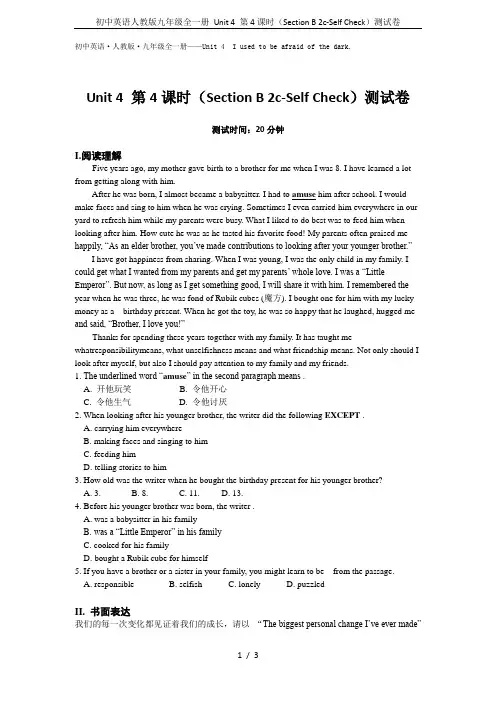
初中英语·人教版·九年级全一册——Unit 4 I used to be afraid of the dark.Unit 4 第4课时(Section B 2c-Self Check)测试卷测试时间:20分钟I.阅读理解Five years ago, my mother gave birth to a brother for me when I was 8. I have learned a lot from getting along with him.After he was born, I almost became a babysitter. I had to amuse him after school. I would make faces and sing to him when he was crying. Sometimes I even carried him everywhere in our yard to refresh him while my parents were busy. What I liked to do best was to feed him when looking after him. How cute he was as he tasted his favorite food! My parents often praised me happily, “As an elder brother, you’ve made contributions to looking after your younger brother.”I have got happiness from sharing. When I was young, I was the only child in my family. I could get what I wanted from my parents and get my parents’ whole love. I was a “LittleE mperor”. But now, as long as I get something good, I will share it with him. I remembered the year when he was three, he was fond of Rubik cubes (魔方). I bought one for him with my lucky money as a birthday present. When he got the toy, he was so happy that he laughed, hugged me and said, “Brother, I love you!”Thanks for spending these years together with my family. It has taught me whatresponsibilitymeans, what unselfishness means and what friendship means. Not only should I look after myself, but also I should pay attention to my family and my friends.1. The underlined word “amuse” in the second paragraph means .A. 开他玩笑B. 令他开心C. 令他生气D. 令他讨厌2. When looking after his younger brother, the writer did the following EXCEPT .A. carrying him everywhereB. making faces and singing to himC. feeding himD. telling stories to him3. How old was the writer when he bought the birthday present for his younger brother?A. 3.B. 8.C. 11.D. 13.4. Before his younger brother was born, the writer .A. was a babysitter in his familyB. was a “Little Emperor” in his familyC. cooked for his familyD. bought a Rubik cube for himself5. If you have a brother or a sister in your family, you might learn to be from the passage.A. responsibleB. selfishC. lonelyD. puzzledII. 书面表达我们的每一次变化都见证着我们的成长,请以“The biggest personal change I’ve ever made”为题,并根据要点和要求,用英语写一篇短文。
人教版九年级英语unit4全单元课件
Good food and taking more exercise can help you _______ healthy.
A. keeping B. keep
C. kept
D. keeps
【点拨】选B。help sb. (to)do sth. “帮助某人做某事”。
Ⅰ. 单词与图片匹配 confident,creative,shy, energetic
—Of course, you can.
A. come
B. coming
C. to come
【点拨】选C。考查固定搭配。invite sb. to do sth. “邀请某 人做某事”。
I’d introduce myself. 我会作自我介绍。 introduce作及物动词,意为“介绍”,其常用结构为:
•12.He __c_a_m_e__u_p_witha good solution to this question at the meeting.
人教版九年级英语unit4全单元课件
Task2
人教版九年级英语unit4全单元课件
• 1.医学研究
medical research
• 2.数百万 • 3.未经许可
millions of without permission
• 4.宁愿做---而不愿做 would rather do …than do…
• 5.把它捐给慈善机构 give it to charity
• 6.当众说话
speak in public
• 7.一点也不
not …in the slightest
—She would feel sorry for missing the concert someday.
九年级英语全册 Unit 4 The fourth period、The fifth period教案 (新版)人教新目标版.doc
Unit 4 I used to be afraid of the dark.The fourth periodⅠ. Teaching Aims and Demands1. Knowledge Objects(1) Key Vocabularyspider, insect, chew, gum(2) Target LanguageI used to eat candy all the time. Did you?Yes, I did. And I used to chew gum a lot.2. Ability ObjectTrain students’ ability to talk about what they used to be/do.3. Moral ObjectPeople surely change. Students should take good care of the process of their growth.Ⅱ. Teaching Key Points1. Key Vocabularyspider, insect, chew, gum2. Target LanguageI used to eat candy all the time. Did you?Yes, I did. And I used to chew gum a lot.Ⅲ. Teaching Difficult PointTalk about what you used to be/do.Ⅳ. Teaching MethodPractice methodⅤ. Teaching Aids1. A tape recorder2. A picture with spiders and a picture with insects.3. A gumⅥ. Teaching ProceduresStep 1 RevisionCheck homework. Invite different students to report what his/her grandparents, parents, aunts, uncles, or old friends used to be afraid of when they were young. Step2 1aThis activity introduces new vocabulary words and provides practice with the target language.Using pictures, teach students to practice the words spider and insect. Teach theword gum by holding up a gum. And teach the verb chew by chewing the gum.Ask students to complete the work individually.Check the answers by inviting different students to report his/her work like this: When I was a child, I used to like painting pictures and singing in music class. Say each number to the class and ask students to raise their hands for each thing they used to like to do. Then discuss the results with the class.Step 31bThis activity provides practice with the target language.Point out the box under the pictures.Read the instructions to the class. Say,You are to write some other things that you used to like to do when you were a children on the lines in the box. Remind students to write sentences.As students work, move around the room offering language support and helping them with any words they want to use.Get a student to write his/her sentences on the blackboard. Help correct any errors. Sample answers1. I used to play football with my brother.2. I used to eat hamburgers a lot.3. I used to watch cartoons.4. I used to run with my father in the morning.Step 4 2a 2bThis activity provides listening practice using the target language.Set a time limit of one minute. Ask students to look through the sentences in the box.Say, You will hear a boy and a girl talking about how life used to be when they were much younger on the recording. Listen and check the sentences you hear.Point out the sample answer. Play the recording for the first time. Students only listen.Play the recording again. This time students check the sentences they hear. Check the answers.AnswersChecked sentences: 1,2,3TapescriptGirl 1: My six-year-old brother started school this week.Boy 1: He’s really lucky. Life was great when I was six.Girl 1: Really? Why?Boy 1: Oh, schoolwork was really easy.Girl 1: Not for me. I didn’t use to like tests. Now I don’t worry about tests. Boy 1: And we used to play every day after school. Now we just study all the time. Girl 1: Yeah, but we used to walk to school. Now we have to take the bus.Boy 1: I remember one thing. I used to hate gym. Now I love gym class.Girl 1: Me, too.Step 5 2cThis activity provides oral practice using the target language.Ask a pair of students to read the sample conversation to the class.Optional activityAsk students to talk about good and bad habits. Then make sentences with “used to”to show which habits they have stopped and make sentences with “still” to show which ones they still have.Step 6 Summary and HomeworkSay, In this class, we’ve learned the new vocabulary words spider, insect, gum and chew and the target language I used to do sth. After class, finish writing the sentences in Optional Activity.The fifth periodStep 1 Fill in each blank with correct words givenStep 2 Use phrase “used to ” to write about Yu MeiStep 3 Reading▪ Martin Murray is a fifteen-year-old boy. He used to be a “problem child”,(1) . He didn’t use to give his mothermany problems. However, after his father’s death a few years ago, Martin’s life became much more difficult. His mother couldn’t afford to pay for her child’s education. To do this, she had to work, and so was not often at home. His mother looked after him as well as she could. Unfortunately,Martin still cause d problems for himself and his family. He was not interested in studying, and he often got into trouble with the police. Luckily, his mother was very patient, (2) . In the end, she made a difficult decision: to send him to a boy’s boarding school. Martin hated it and used to cause a lot of trouble. One day, he told his teacher he wanted to leave the school. (3) . The head teacher said it was necessary to talk with his mother. Martin called his mother, but to his surprise, this phone call changed his life. “It was exactly what I needed,” he said. “My mother helped me to understand how much she had given me. She also told me that even though my father was no longer with us, he was watching me, and would always take pride in everything good I do.(4) . I realize that since my father died,I have been afraid of being alone, and have tried to make my mother pay moreattention to me.” Now Martin has really changed. He has been working hard, and he is now a top student in his class. (5) . His mother’s love helped him to feel good about himself, and as Martin himself says, “It’s very important for parents to be there for their children.”Step 4 Homework。
人教新目标九年级英语全一册Unit4period4教学设计
3.引导学生深入理解文章内容,提高阅读理解能力,尤其是对文章主旨和细节的把握。
4.教会学生将理论知识与实际生活相结合,培养他们的环保行为和习惯。
(三)教学设想
1.创设情境,激发兴趣:通过展示现实生活中的环保案例,引起学生对环保话题的关注,激发他们的学习兴趣。
7.口语练习:与同学进行角色扮演,模拟一次环保主题的演讲或辩论,提高口语表达能力。
作业要求:
1.学生按时完成作业,确保作业质量。
2.家长协助监督,关注学生的作业进度。
3.教师在下次课堂上对作业进行反馈,指导学生改进。
6.反馈评价,促进成长:通过课堂提问、作业批改等方式,了解学生的学习情况,及时给予反馈,帮助学生不断进步。
在教学过程中,教师应关注学生的个体差异,灵活运用多种教学方法,注重培养学生的语言能力、思维品质和学习策略。同时,教师还要关注学生的情感态度和价值观,引导他们形成正确的环保观念,为构建和谐生态环境贡献力量。
3.每个小组汇报讨论成果,其他小组给予评价和建议。
(四)课堂练习
1.教师设计不同类型的练习题,包括词汇填空、句型转换、阅读理解和写作等,以检验学生对课堂所学知识的掌握程度。
2.学生独立完成练习题,教师巡回指导,针对学生的疑问进行解答。
3.教师选取部分练习题进行讲解,强调解题技巧和易错点。
(五)总结归纳
4.培养学生对英语学科的兴趣和热情,激发学生持续学习的动力。
5.培养学生的国际视野,使其了解全球环境问题,关注世界各地的环保举措。
二、学情分析
九年级的学生已经具备了一定的英语基础,掌握了基本的词汇、语法和句型。在此基础上,他们对环保话题有所了解,但可能对环境保护的具体措施和全球环境问题的严重性认识不足。因此,在本节课中,教师应关注以下学情:
人教版九年级英语第四单元第四课时++Unit+4+Section+A+Grammar+Focus-4
dare to... love singing...
advice:
Candy Wang
4
bad things: worry about...
3
don't have private time...
guards around ...
be prepared to ... the road to success... require... make it to the top
◆ What’s Candy’s advice to young people?
good things: travel and meet ...
2
get tons of attention...
1
Asian pop star used to be...
Life was different after she became famous.
4. Sandy / teach British English / teach American English Sandy used to teach British English. She didn’t use to
teach American English.
•
9、 人的价值,在招收诱惑的一瞬间被决定 。2021/5/102021/5/10Monday, May 10, 2021
•
10、低头要有勇气,抬头要有低气。2021/5/102021/5/102021/5/105/10/2021 6:20:31 PM
•
11、人总是珍惜为得到。2021/5/102021/5/102021/5/10May- 2110-M ay-21
•
12、人乱于心,不宽余请。2021/5/102021/5/102021/5/10Monday, May 10, 2021
新人教部编版初中九年级英语Unit 4 Unit 4 Section A (1a-1c)
Jiang Wen used to wear glasses.
长冲中学数学组-“四学一测”活力课堂
长冲中学 活力课堂
in the past
now
Kate is tall now. But she was very short in the past.
Kate used to be short.
长冲中学数学组-“四学一测”活力课堂
某事
符号
use ... to do sth. 用…做…
be used to do sth. 被用来做…
be used to doing 习惯于做某 介词
sth.
事
长冲中学数学组-“四学一测”活力课堂
use ... to do sth. 用……做……
长冲中学 活力课堂
e.g. They use the knife to cut meat. 他们用刀切肉。
e.g. Lucy has been used to (eating) Chinese food. Lucy已经习惯(吃)中餐了。 I think you’ll get used to the climate soon. 我想不久你就会习惯这种气候的。
长冲中学数学组-“四学一测”活力课堂
长冲中学 小试牛刀 从方框中选择适当的单词完活成力句课子。堂
2. Amy used to be __ta_l_l_. She used to have
__sh_o_r_t__ hair.
3. Tina used to have _r_e_d__ and _c_u_r_ly_ hair.
长冲中学数学组-“四学一测”活力课堂
长冲中学
Practice
活力课堂
1c Look at the picture in 1a and make