
英文否定前缀.
富国与穷国之间存在着
。
5.The government ________ (close) that another ambassador had been arrested for spying. 政府 另一个外交大使园间谍罪被逮捕。
6.His identity is ________ (know) to us so we
Prefixes indicating negation
在单词的 加上一个表示 含义的词缀。
:dis-; il-, im-, in-, ir-; un-; non-; mis-等;
:“非”、“无”、“不 (是)”、“未”等。
1. dis-常加在名、形、动之前。如:
disagree(ment) (分歧;不赞同)
unhappiness 不幸福
unusual
不寻常的;罕见的
unimportant 不重要的
unfriendly 不友好的
uncomfortable 不舒服的
但discomfort n/vt 不舒适 ;使…不舒服
unsafe
不安全的
unwelcome 不受欢迎的
uncommon 不常见的
unaware 没意识到的ห้องสมุดไป่ตู้
discourage vt.使气馁
disagreeable adj.不愉快的
disadvantage (不利条件;缺点)
disorder 无秩序
disappear (v.消失)
discomfort(n.不舒适 vt.使不舒适)
dishonest (adj.不诚实的)
dislike (v.不喜欢) 但 like prep 不像
3.It is _____________ (reasonable)to stick to this
absurd proposal.坚持这种荒谬的建议是
。
4.There exists the ___________ (balance)
between the rich and poor countries.
a. 常加在以字母
开头的形容词之前:
impossible (不可能的) impolite (无礼的;粗鲁的) impatient imbalanced(adj.不平衡的) 但: parallel不平行的
pleasant
popular poisonous无毒的
b.il-, ir- 加在 和 开头的形容词之前
have to confirm.他的身份 我们
,所以我们
得证实。
7.He seems to be ________ (aware)of the trouble
he is making.他似乎
他正造成的麻烦。
8.Jim is ________ (patient)with his little sister who is so noisy.
19.The mother __________(dress) her baby and gave it a bath.
20.This delay was __________ (avoidable) so we had to be patient.延迟不可避免,所以我们得 耐心
21.His income is ________ (adequate) to meet his basic needs and he has to find another job.他 的收入不足以满足基本要求,他得再找份工作。
have to gowithout water.
这水
饮用,你只能不喝水了。
15.You must be ________ (literate) if you have not
heard of Shakespeare.
如果你没听说过莎士比亚,那你一定是
。
16.He ________ (like)wearing a tie,so you will never see him in tie.
dissatisfactory adj.不令人满意的
但
satisfied
discover vt 发现
但 cover 揭露,暴露
2.in-;il-,im-,ir-(in-在辅音n,l,m,p,r前要变 体)加在形容词、名词、副词上
expensive equal 不平等的
correct valid无效的 different 冷漠的 accurate不准确的 active, direct visible, credible, curable
un-用于动词之前表示做相反的动作
lock v.锁, 锁上 lockvt.开...锁 cover vt.覆盖 covervt.揭开, 揭露 fold v.折叠 fold v.打开 dress v.穿衣 dress vt.使脱衣服 load v.装载 load v.卸货
un-未(主要用于过去分词之前)
smoking 不准吸烟的
stop a.直达的
5.ab-,ab-加在词根前,表示"相反,离去” 如:
normal(ab+normal 正常的)反常的 abuse滥用、错误使用、虐待
6.mis-加在动词、名词之前
understand 误解 judge 误判 leading 误导 fortune 不幸
illegal(非法的) illogical(不合逻辑的) irregular(不规则) irresponsible irrelevant illiterate 不识字的 irrelative无关的
但: reasonable不合理的,不公道的
3. un-加在形容词、副词、名词及用于作形容 词的分词上
经营生意而没有预算是
。
12.The bright dress is ________ (proper) for a
funeral.鲜艳的衣服对葬礼来说
。
13.Students get a ________ (count) of 25% on plane tickets.学生享有25%的机票 。
14.The water is ________ (fit)for drinking and you
Exx:根据语境,用所给词的否定形式填空
1.It is ________ (legal) to drive after drinking
alcohol. 酒后开车
。
2.___________ (lead) advertisements are not allowed by law. 的广告为法律所不允许。
expected 未预料到) locked 未上锁的 educated 未受教育的 decided 未决定的 finished 未完成的 crowded 不拥挤的 doubted 无疑的 married 未结婚的
4.non-加在名、形、副或作形容词的分词前,
表“
”之意
sense(n.胡说、废话) violent(adj.非暴力的 ) poisonous无毒的 existent不存在的
吉姆对他吵闹的小妹妹
。
9.The ____________ (expect)death of her son
made hei sad.她儿子
死亡使她伤心。
10.Her illness had made her completely ________
(mobile).她的病使得她完全
了。
11.Running a business without a budget(预算)is ________ (practical).
24.He was ________ (ability) to sleep at night because of his anxiety.由于焦虑,晚上他不能入睡。
25.The fish is a bit ________ (smell). We can't eat it.
22.It's ________ (honesty)to lie about one's age. 谎报自己的年龄是不诚实的。
23.The injured man was ________ (capable) of walking, so he had to be carried. 那个受伤的人不能走路,所以他得被人背着。
17.___________ (amaze/surprise) , he should lose his temper in public.
18._____________ (expect), the injured athlete came first in the 100-meter dash.
否定前缀有哪些单词

否定前缀有哪些单词
1、否定前缀un-
否定前缀un-可以加在形容词之前,也可以加在动词之前,构成否定。
2、否定前缀dis-
否定前缀dis-往往可以加在动词、形容词之前构成否定,这些是大家平日学习中不太熟悉的,一定要特别注意。
扩展资料
3、否定前缀mis-
否定前缀mis-基本上是加在动词前面构成否定,比如misunderstand(理解错误,误会),misread(读错,误解),mislead(带错路,误导),miscalculate(算错,错误地估计),mispronounce(发错音)
4、否定前缀non-
否定前缀non-大家平日接触的会多一些,比如non-smoking (禁止吸烟的),non-stop(中途不停的,直达的`)
5、否定前缀in-
否定前缀in-和im-,ir-,il-是有关系的,放在一起会比较好记忆,in-→im-,ir-,il-。
否定前缀
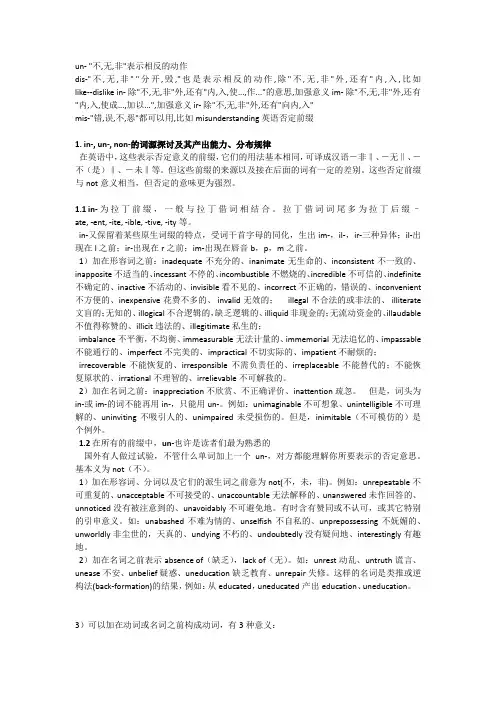
un- "不,无,非"表示相反的动作dis-"不,无,非" "分开,毁,"也是表示相反的动作,除"不,无,非"外,还有"内,入,比如like--dislike in- 除"不,无,非"外,还有"内,入,使...,作..."的意思,加强意义 im- 除"不,无,非"外,还有"内,入,使成...,加以...",加强意义 ir- 除"不,无,非"外,还有"向内,入"mis-"错,误,不,恶"都可以用,比如misunderstanding 英语否定前缀1. in-, un-, non-的词源探讨及其产出能力、分布规律在英语中,这些表示否定意义的前缀,它们的用法基本相同,可译成汉语―非‖、―无‖、―不(是)‖、―未‖等。
但这些前缀的来源以及接在后面的词有一定的差别。
这些否定前缀与not意义相当,但否定的意味更为强烈。
1.1 in-为拉丁前缀,一般与拉丁借词相结合。
拉丁借词词尾多为拉丁后缀–ate, -ent, -ite, -ible, -tive, -ity等。
in-又保留着某些原生词缀的特点,受词干首字母的同化,生出im-,il-,ir-三种异体;il-出现在l之前;ir-出现在r之前;im-出现在唇音b,p,m之前。
1)加在形容词之前:inadequate不充分的、inanimate无生命的、inconsistent不一致的、inapposite不适当的、incessant不停的、incombustible不燃烧的、incredible不可信的、indefinite 不确定的、inactive不活动的、invisible看不见的、incorrect不正确的,错误的、inconvenient 不方便的、inexpensive花费不多的、 invalid无效的; illegal不合法的或非法的、 illiterate 文盲的;无知的、 illogical不合逻辑的,缺乏逻辑的、 illiquid非现金的;无流动资金的、illaudable 不值得称赞的、illicit违法的、illegitimate 私生的;imbalance不平衡,不均衡、immeasurable无法计量的、immemorial无法追忆的、impassable 不能通行的、imperfect不完美的、impractical不切实际的、impatient不耐烦的;irrecoverable不能恢复的、irresponsible不需负责任的、irreplaceable不能替代的;不能恢复原状的、irrational不理智的、irrelievable不可解救的。
表否定的前缀

一.表示否定的前缀1.dis-加在名词、形容词,动词之前。
disadvantage(缺点)dishonorable (不光彩的)disagree(不同意)2.in-加在形容词,名词之前incorrect(不正确的),inability (无能,无力),inaccurate(不准确的)3.im-加在字母m,b,p之前impossible(不顺能的),impolite(不礼貌的),impudence(厚颜无耻)4.il-加在以1开头的词前illegal(非法的),illiterate(文盲的,无文化的)illogical(不合逻辑的)5.ir-加在以r开头的词前irregular(不稳定的),irresistable(不可抵抗的),irresolvable(不能分解的,不能解决的)6.un-加在名词,形容词,副词之前unfinished(未完成的)undoubted(无疑的)unemployment(失业)7.non-加在形容词,名词前non-existence(不存在),non-essential (不主要的),non-electrical(非电的)8.mis -加在动词、名词之前misunderstand(误解),misjudge(误判),misleading(误导),misfortune (不幸)9.dis-加地动词之前disappear (消失),disarm(解除武装),disconnect(失去联系)10.de-加在名词,形容词之前demobilize(遣散;使…复员) decolor (脱色, 漂白)11.anti-加在名词、形容词之前anti-Japanese(抗日战争),anti-social(厌恶社会的,反社会的),antidite(解毒药)12.counter-加在名词、动词前counterattack(反攻,反击),counteract(抵抗,阻碍)counterrevolution(反革命)二.表示“前before”的前缀1.pre-preconception(成见),pre-exsiting(先于……而存在的),pre-selection (选举前的)preface(前言)2.Ante-anteroom(前室,接待室),antecessor(先行者,先驱者)3.Fore-forehaed(前额),foreground (前景),foreman(工头,领班),foresee(预见,先见),foretell(预言)4.Pro-programme (计划),prologue(序幕)5.Ex-ex-president(前任总统)ex-wife (前妻)三.表示“后-post”的前缀1.post-post-war(战后),post-position (后置词),postmeridian(下午)四.表示“低”、“下”的前缀1.Hypo-Hypocrisy(伪善,虚伪),hypothesis(假设),pypocholoride(次氯酸盐)2.Infra-Infra-red(红外线),infrahuman(低于人类的),infrasonic(亚声的,次声的)3.Sub-Sub-editou(副编辑),sub-way(地铁),sub-conscious(下意识的),submarine(海下的),subtropical(亚热带的),subtitle (副标题)五.表示“回”、“再次”、“向后”的前缀1.Re-Refuel(给…加油),retranslate (再译),reinforce(加强),reconstruct(重建),return(返回)2.Retro-Retrograde(倒退的),retrospect(回顾)六.表示“共同”、“和”的前缀1.Co-co-exist(共存),co-operate (合作),co-education(男女同校)七.表示“相互”、“之间”的前缀1.Inter-Interchangeble(可互换的),interdipendert(互相依靠的),international(国际的),inter-national(交往)八. 表示“出”、“超出”的前缀1.Ec-Eclipse(蚀),ecstasy (狂想)2.Extra-Extraordinary(非凡的),extramural(校外的),extrasensory(超感觉的)九.表示“超过”的前缀1.hyper-, preter-, super-, sur-, ultra-hyper-sensitive(过敏的),preterhuman(超人的)十.其它的前缀1.auto-自automatic(自动的),auto-autobilgraphy(自传)2.mal-坏,恶Malnutrition(营养不良),maltreat(虐待)3.Micro-Microscope(显微镜),microtome(切片机)4.Tele-远Telegram (电报),telephone(电话),telescope(望远镜)5.Demi-,semi-hemi-Semi-circle(半圆),hemisphere(半球),demilune(半月,新月)6.Uni-, mono-(单一, 单独)Monotone(单调),monologue(独白),uniform(制服)7.Bi-,di-二Biyearly(二年一次的),biweekly(二周一次的),dichloride(二氯化物)8.Tri-三Triangle(三角),tripld(三角架)9.Multi-多multi-colored(颜色多样的),multi-national(多国的)10.Poly –多Polygon(多角形),polytomic(多原子的)11.Arch-首领archbishop(大主教),architect(建筑师)12.bene-善,好benefit (利益),benevolence(善意)13.homo-同homosexual(同性恋的),homograph(同形异义字)14.neo新neo-colonialism(新殖民主义),neolithic(新石器时代的)15.ortho-正确,直orthogonal(直角的),orthodox(正统)16.philo-挚爱philosopher(哲学家)17.proto-原始protohydrogen(初氢),prototype(原型),protoplasm(原生质)18.pseudo-假的, 伪的, 冒充的pseudonym(匿名),pseudo-communism (假共产主义)19.a-,ab-,abs-(只有在t,c之前)从,自avoid(避免),absent(缺少的),abstain(抑制),abstract(吸引)20.Apo-,aph-来自apology(道歉,谢罪),apostle(倡言者,先驱)21.se-分离separation(分开),secure(安全的),sedition(煽动叛乱)22.para-防parachute(降落伞),23.omni-所有的,公共的omnibus(公共汽车),omnipotence (万能)24.pan-全,泛Pan-American (全美的),pancean(万灵药),panorama(风景的全貌;万花筒)25.panto-全pantisocracy(乌托邦大同世界),pantoscopic(视野广大)26.dia-通过,借以diagonal(对角的),diagnosis(诊断),dialogue(对话)27.Per-通过,彻底,不利perambrlate(走来走去),perfect极好的28.trans-通过,横过transcript(抄本, 副本; 记录),translation (翻译),transparent(透明的),transport(运输),trans-plant(移植)29.Com-,con-,cor-,col-共同,和,完全comment(评论),compile(编辑),correlation(相互关系),collect(收集),corruption (贪污腐败),collaborate(合作,合著)30.syn-共同synonym(同义词),synchronization(同步),syntonic(谐振的),synthetic(人工的,合成的)31.meta-和,在……之后metaphor (比喻),metaphysics(形而上学)32.Cis-在这一边cisatlantic(大西洋这边的)33.pen-几乎,相近peninsular(.住在半岛上的居民,半岛(状)的, 形成半岛的)34.en-,em-往……里,使……encamp (扎营),enable(使……能),endear(使……受喜爱),embrace(拥抱,抓住(机会))35.intro内在intracardiac(心脏内部的),intramolecular (分子内部的),intracelular(细胞内部的)36.intro-到……中introduce(介绍),introspect(反省,内省)37.dys-坏dyspepsia(消化不良),dysentry(痢疾)38.Eu-优,美好eulogy(颂词),euphony(悦耳的声音)39.ambi-,amphi-两者amphibian(两栖的),ambidextrous(两只手都很灵巧的;心怀二意的;非常灵巧的)40.penta-五pentagon(五角大楼),pentagram(五角星),pentameter(五步诗句)41.sex-六sexangle(六角),sexennial (六年一度的)42.sept-七September 九月(古罗马的七月),septennial(七年一度)43.hepta-七heptab(七个成套之物),heptagon(七角形)44.octa-,octo,oct八octagon(八角形),octuple(八倍)October (十月)45.nona-,ennea-九nonagon(九角形),ennead(九个一组)46.deci-,deca-十decimal(十进位的),decagramme(十克)47.centi-百centimeter(厘米),centipede(蜈蚣)48.milli-千millenias (千年的),millimeter(毫米)49.Kilo-千kilowatt(千瓦),kilometer(千米)后缀1.-ster,-eer,-er(or)意为:从事某种职业或参与某种活动的人(person engaged in an occupation or activity)例词:gamester,gangster,songster,engineer,profiteer,mountaineer,auctioneer,driver,teacher,director,actor,professor2.-let意为:小或者不重要的东西(small,unimportant things)例词:booklet,leaflet,starlet3.-ette意为:1)小的东西(small)例词:cigarette 2)假的东西(imitation)例词:leatherette 3)女性(female)例词:usherette4.-ess意为:女性(female)例词:actress,poetess,hostess,paintress5.-hood意为:时期(status;etc.)例词:boyhood,childhood,manhood6.-ship 意为:才能,状态,资格,品质等(skill,state,condition,status,quality)例词:leadership,friendship,membership,lectureship,sportsmanship7.-ful 意为:量(the amount which noun contains)例词:cupful,handful,mouthful,spoonful8.-tion,-ion意为:1)状态,行动等(state;action;etc.)例词:action,oppression,possession,education,starva- tion 2)机构等(institution;etc.)例词:organization,foundation9.-ment意为:状态,行动等(state;action;etc.)例词:movement,enslavement,pavement10.-al意为:动作(action)例词:arrival,refusal,revival,recital,removal11.-age意为:程度,数量等(extent;amount;etc.)例词:wastage,coverage,acreage,shrinkage,breakage,hostage12.-ness;-ity (ty)意为:状态,品质(state;quality;etc.)例词:happiness,usefulness,selfishness,kindness,rapidity,activity,sanity,changeability13.-ism 意为:道义,主义,学说等(doctrine of,practice of)例词:idealism,impressionism,absenteeism,racism二、动词后缀常见的此类后缀及其具体含义如下:1.-ify意为:转为,变为(to turn into,to make or become)例词:beautify,diversify,(使多样化)simplify2.-ize;-en意为:使……,变得……(to make or become ;to make into)例词:modernize,popularize,legalize,hospitalize,symbolize,ripen,widen,heighten,threaten3.-ate意为:增加,使……(give or add,make or become)例词:originate,hydrogenate,validate,differentiate三、形容词后缀:常见的此类后缀及其具体含义如下:1.-ful意为:充满,有(full of;hav- ing;giving;etc.)例词:useful,pitiful,hopeful,helpful,forgetful,thankful,fearful2.-less意为:没有,无(without;not giving)例词:speechless,childless,harmless,hopeless,meaningless3.-ly意为:有……品质的(having the qualities of)例词:beastly,manly,brotherly,friendly4.-like意为:像……的(like)例词:childlike,statesmanlike,tiger-like5.-y;-ish意为:像……一般的(somewhat like)例词:meaty,sandy,silky,hairy,leafy,watery,foolish,girlish,blackish,thinnish6.-some意为:像……一样的;引起……的;有……品质的(like;causing;having the quality of)例词:troublesome,burdensome,wholesome,tiresome,bothersome7.-able(ible)意为:能……的;可以……的(able to be ;capable)例词:changeable,readable,drinkable,comfortable,expansible,convincible8.-ed意为:有……的(having,etc.)例词:wooded,pointed,moneyed,odd-shaped9.-al意为:有……属性的,……类型的(nature of,typical of)例词:cultural,personal,regional,musical10.-ary(ory)意为:属于……的,与……相连的(belonging to;connected with)例词:revolutionary,imaginary,contradictory11.-ous意为:富含……的;有……品质的;像……的(full of;having the quality of;like)例词:glorious,erroneous,malicious,gracious12.-ic(ical)意为:……类的;属于……的(typical of;belonging to)例词:historic,historical,methodic,methodical,dramatic,heroic13.-ive 意为:有……属性的;有某种倾向的(having thenature or quality of;given or tending to)例词:attractive,talkative,restrictive,defensive,preventive,constructive,sensitive四、副词后缀常见的此类后缀及其具体含义如下:1.-ly意为:以……方式(in a...manner;etc.)例词:happily,boldly,attentive- ly,strangely2.-ward(s)意为:表示方式或动作的方向(manner and direction of movement)例词:onward(s),backward(s),earthward(s),homeward(s),eastward(s)3.-wise意为:1)按照……方式(in the manner of)例词:crabwise,clockwise2)就……而言(as far as ...is concerned)例词:weatherwise ,educationwise有一个原因的单音节词,结尾只有一个单音辅音,在加以元音后缀是,要双写这个辅音.例词:run + er = runner hit + ing = hitting。
英语否定前缀
英语否定前缀
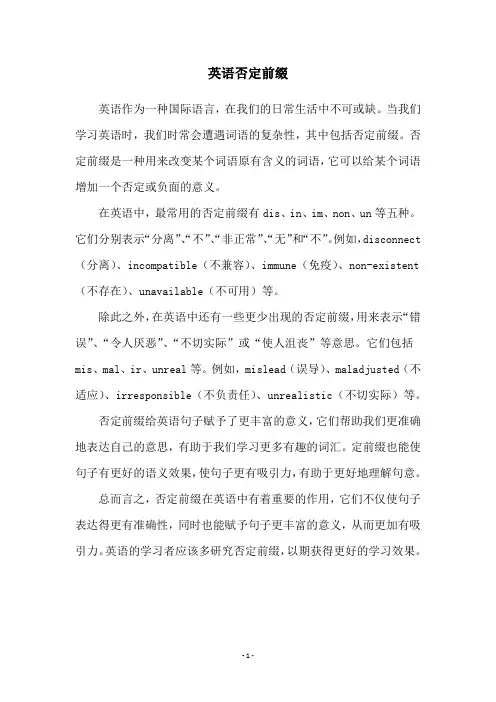
英语作为一种国际语言,在我们的日常生活中不可或缺。
当我们学习英语时,我们时常会遭遇词语的复杂性,其中包括否定前缀。
否定前缀是一种用来改变某个词语原有含义的词语,它可以给某个词语增加一个否定或负面的意义。
在英语中,最常用的否定前缀有dis、in、im、non、un等五种。
它们分别表示“分离”、“不”、“非正常”、“无”和“不”。
例如,disconnect (分离)、incompatible(不兼容)、immune(免疫)、non-existent (不存在)、unavailable(不可用)等。
除此之外,在英语中还有一些更少出现的否定前缀,用来表示“错误”、“令人厌恶”、“不切实际”或“使人沮丧”等意思。
它们包括mis、mal、ir、unreal等。
例如,mislead(误导)、maladjusted(不适应)、irresponsible(不负责任)、unrealistic(不切实际)等。
否定前缀给英语句子赋予了更丰富的意义,它们帮助我们更准确地表达自己的意思,有助于我们学习更多有趣的词汇。
定前缀也能使句子有更好的语义效果,使句子更有吸引力,有助于更好地理解句意。
总而言之,否定前缀在英语中有着重要的作用,它们不仅使句子表达得更有准确性,同时也能赋予句子更丰富的意义,从而更加有吸引力。
英语的学习者应该多研究否定前缀,以期获得更好的学习效果。
- 1 -。
英语表示否定的前缀
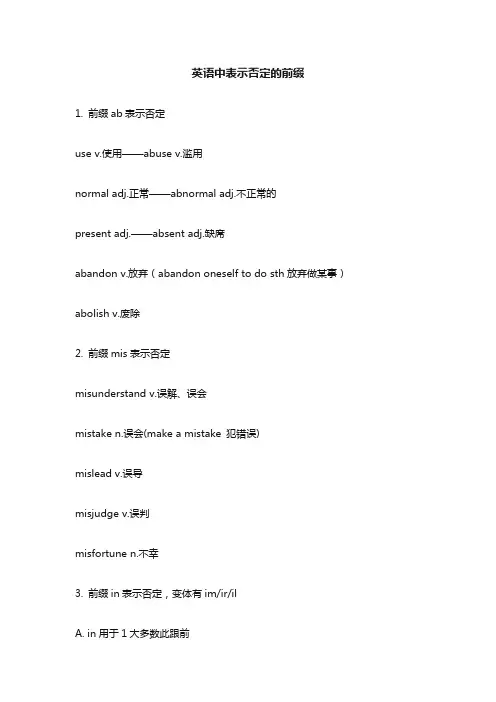
英语中表示否定的前缀1. 前缀ab表示否定use v.使用——abuse v.滥用normal adj.正常——abnormal adj.不正常的present adj.——absent adj.缺席abandon v.放弃(abandon oneself to do sth放弃做某事)abolish v.废除2. 前缀mis表示否定misunderstand v.误解、误会mistake n.误会(make a mistake 犯错误)mislead v.误导misjudge v.误判misfortune n.不幸3. 前缀in表示否定,变体有im/ir/ilA. in用于1大多数此跟前indirect adj.间接的incorrect adj.不正确indifferent adj.漠不关心的infinite adj.无限的B. Im用于b/m/p开头的词根前impossible adj.不可能的imbalanced adj.不平衡的impatient adj.不耐心的immobile adj.固定的C. Ir用于r开头的词根前irresponsible adj.不负责任irregular adj.不规则的D. il用于l开头的词根前illegal adj.不合法的illogical adj.不合逻辑的illiterate adj.不识字的(illiteracy rate 文盲率)4. 前缀dis表示否定disagree v.不同意(disagreement n.不同意)discovery n.出现disappear v.消失(disappearance n.消失)discount n.折扣disorder n.混乱disease n.疾病disadvantage n.缺点5. 前缀de表示否定decrease v.减少——increase v.增加devaluate v.贬值deline v.衰退deforest 砍伐degenerate v.退化。
15个否定前缀

15个否定前缀在英语中,否定前缀是一种很重要的语法元素,它可以改变一个词的意义,使其表示否定。
常见的否定前缀包括un-, dis-, in-, im-等等。
今天,我们来看看15个常见的否定前缀,并探讨它们的用法和例句。
1. Un-Un-是最常见的否定前缀之一,它表示"不"或"没有"的意思。
比如,unhappy意为"不开心",undone意为"未完成的"。
2. Dis-Dis-表示"相反"或"不正确"。
例如,disconnect意为"断开",disapprove意为"反对"。
3. In-In-在某些情况下表示否定,但在其他情况下表示"进入"或"内部的"。
例如,inaccurate意为"不准确的",inflow意为"流入"。
4. Im-Im-和in-具有相似的含义,表示否定或"不"。
例如,impatient意为"不耐烦的",imperfect意为"不完美的"。
5. Il-Il-是表示否定的前缀,通常用于以-l开头的词。
例如,illegal意为"非法的",illogical意为"不合逻辑的"。
6. Ir-Ir-是表示否定的前缀,通常用于以-r开头的词。
例如,irresponsible意为"不负责任的",irregular意为"不规则的"。
7. Un-Un-在有些情况下表示"不",而在其他情况下表示"解除"。
例如,unkind意为"不友善的",unlock意为"解锁"。
英文中常用否定前缀总结
英文中常用否定前缀总结anti—表示,相反的,相对的antibody 抗体non-表示“非”nonhuman 非人类英语中大部分否定前缀构词法:1〉 dis加在形容词前—— agreeable(adj。
使人愉快的)→ disagreeable(adj。
不愉快的) -— content(adj。
满意的 vt。
使满足)→discontent(adj。
不满的 vt。
令人不满 n。
不满)-— graceful(adj。
优美的)→ disgraceful(adj.使失体面的,耻辱的) —— honest(adj.诚实的, 正直的) → dishonest(adj。
不诚实的)—- satisfactory(adj.满意的) → dissatisfactory(adj。
不满意的)加在名词前-- agreement(n。
同意)→ disagreement(n.意见不同)-- honesty(n.诚实,正直)→ dishonesty(n。
不诚实, 不老实)—— ability(n.能力, 才干)→ disability(n。
无力,无能)-— grace(n。
优美, 雅致)→disgrace(n。
耻辱)-- comfort(n.舒适 vt。
安慰)→discomfort(n.不舒适 vt。
使不舒适)可以加在动词前—- agree(v。
同意)→ disagree(v.不同意)—— appear(vi.出现)→disappear(vi。
消失,不见)—— believe(相信,信任)→disbelieve(v。
不信, 怀疑)在名词前加dis得到动词,表示除去、解除.—— courage(n.勇气,精神)→discourage(vt.使气馁)—— root(n.根, 根部) → disroot / unroot(vt。
连根拔除)—- mask(n。
面具, 掩饰 v。
戴面具, 掩饰)-— burden(n.担子, 负担 v。
负担)→disburden(v。
英语否定的前缀
英语否定的前缀主要有a- ab- anti- counter- de- dis- il- im- in- ir- mal- mis- non- un- 等。
a-ab-主要加在形容词动词前,例如atypical非典型性的,abnormal非正常的;abuse 滥用、错误使用、虐待;anti-加在名词、形容词前边。
最常见的是anti-Japanese抗日战争、anti-social厌恶社会的反社会的、antidite解毒的药;counter-加在名词、动词前,例如:counterstrike反击、counteract抵抗阻碍、counterrevolution反革命。
de-加在名词、形容词前,常见的例词有decrease减少,deteriorate恶化,demobilize遣散使…复员、decolor 脱色漂白;dis-主要加在名词、形容词,动词之前,dis-为否定前缀的词有:disadvantage缺点、dishonorable不光彩的、disagree不同意、disappear消失、disarm解除武装、disconnect失去联系il-主要加在以1开头的单词的前边,比如:illegal非法的、illiterate文盲的、illogical不合逻辑的;im-加在字母m,b,p之前,这样的词有impossible不可能的、impolite不礼貌的in-常加在形容词,名词之前,如incorrect不正确的、inability无能无力、inaccurate不准确的等;ir-放在以r开头的英语单词前面,比如:irregular不稳定的、irresistable不可抵抗的、irresolvable不能分解的不能解决的;mal-主要加在形容词名词之前,例如malfunction功能紊乱,malicious恶意的;mis-加在动词、名词前,例词misunderstand误解、misjudge误判、misleading 误导、misfortune不幸;non-加在形容词、名词前,这样以non-为否定前缀的词有non-existence不存在、non-essential不主要的、non-electrical非电的;un-主要放于名词,形容词,副词前面,常见的例子有unfinished未完成的、undoubted 无疑的、unemployment失业;。
高中英语2025届高考实用单词前缀汇总(否定+方向位置+程度与状态+数量关系)
高考英语实用单词前缀英语中的前缀可以从多个角度进行分类,但按照常见性和功能性,可以大致归纳为四类:否定前缀、方向位置前缀、程度与状态前缀以及数量关系前缀。
一、否定前缀否定前缀用于表达与原词相反或否定的意义。
常见的否定前缀有:non-:不,非。
【例】non-stop(不停的)non-existent(不存在的)non-alcoholic(不含酒精的)non-profit(非盈利的)non-existence(不存在)non-essential(不主要的)non-electrical(非电的)nonsense(废话)non-smoker(不吸烟者)nonprofit(非盈利的)。
dis-:不,消失掉,分开。
【例】dislike(讨厌)disobey(不服从)distract(分心)dismiss(开除)discard(丢弃)disadvantage(缺点)dishonorable(不光彩的)dishonest(不诚实的)disagree(不同意)disappear(消失)dismantle(拆除)disarm(解除武装)disconnect(失去联系)。
un-:不,无,非。
【例】unfinished(未完成的)undoubted(无疑的)unemployment(失业)unlike(不像)unfair(不公平的)unhappy(不快乐的)unhealthy(不健康的)unable(不能的)unfriendly(不友好的)。
in-, im-, il-, ir-:不,无,非,向内。
【例】injustice(不公正)invisible(看不见的)informal(非正式的)independent(独立的)incomplete(不完整的)inaccurate(不准确的)incorrect(不正确的)inactive(不活跃的)impossible(不可能的)immoral(不道德的)imperfect(不完美的)impatient(不耐烦的)impolite(不礼貌的)illegal(非法的)illiterate(文盲)irresponsible(不负责任的)irregular(不稳定的)irresistable(不可抵抗的)irresolvable(不能分解的,不能解决的)。
表否定的前缀
一.表示否定的前缀1.dis-加在名词、形容词,动词之前。
disadvantage(缺点)dishonorable (不光彩的)disagree(不同意)2.in-加在形容词,名词之前incorrect(不正确的),inability (无能,无力),inaccurate(不准确的)3.im-加在字母m,b,p之前impossible(不顺能的),impolite(不礼貌的),impudence(厚颜无耻)4.il-加在以1开头的词前illegal(非法的),illiterate(文盲的,无文化的)illogical(不合逻辑的)5.ir-加在以r开头的词前irregular(不稳定的),irresistable(不可抵抗的),irresolvable(不能分解的,不能解决的)6.un-加在名词,形容词,副词之前unfinished(未完成的)undoubted(无疑的)unemployment(失业)7.non-加在形容词,名词前non-existence(不存在),non-essential (不主要的),non-electrical(非电的)8.mis -加在动词、名词之前misunderstand(误解),misjudge(误判),misleading(误导),misfortune (不幸)9.dis-加地动词之前disappear (消失),disarm(解除武装),disconnect(失去联系)10.de-加在名词,形容词之前demobilize(遣散;使…复员) decolor (脱色, 漂白)11.anti-加在名词、形容词之前anti-Japanese(抗日战争),anti-social(厌恶社会的,反社会的),antidite(解毒药)12.counter-加在名词、动词前counterattack(反攻,反击),counteract(抵抗,阻碍)counterrevolution(反革命)二.表示“前before”的前缀1.pre-preconception(成见),pre-exsiting(先于……而存在的),pre-selection (选举前的)preface(前言)2.Ante-anteroom(前室,接待室),antecessor(先行者,先驱者)3.Fore-forehaed(前额),foreground (前景),foreman(工头,领班),foresee(预见,先见),foretell(预言)4.Pro-programme (计划),prologue(序幕)5.Ex-ex-president(前任总统)ex-wife (前妻)三.表示“后-post”的前缀1.post-post-war(战后),post-position (后置词),postmeridian(下午)四.表示“低”、“下”的前缀1.Hypo-Hypocrisy(伪善,虚伪),hypothesis(假设),pypocholoride(次氯酸盐)2.Infra-Infra-red(红外线),infrahuman(低于人类的),infrasonic(亚声的,次声的)3.Sub-Sub-editou(副编辑),sub-way(地铁),sub-conscious(下意识的),submarine(海下的),subtropical(亚热带的),subtitle (副标题)五.表示“回”、“再次”、“向后”的前缀1.Re-Refuel(给…加油),retranslate (再译),reinforce(加强),reconstruct(重建),return(返回)2.Retro-Retrograde(倒退的),retrospect(回顾)六.表示“共同”、“和”的前缀1.Co-co-exist(共存),co-operate (合作),co-education(男女同校)七.表示“相互”、“之间”的前缀1.Inter-Interchangeble(可互换的),interdipendert(互相依靠的),international(国际的),inter-national(交往)八. 表示“出”、“超出”的前缀1.Ec-Eclipse(蚀),ecstasy (狂想)2.Extra-Extraordinary(非凡的),extramural(校外的),extrasensory(超感觉的)九.表示“超过”的前缀1.hyper-, preter-, super-, sur-, ultra-hyper-sensitive(过敏的),preterhuman(超人的)十.其它的前缀1.auto-自automatic(自动的),auto-autobilgraphy(自传)2.mal-坏,恶Malnutrition(营养不良),maltreat(虐待)3.Micro-Microscope(显微镜),microtome(切片机)4.Tele-远Telegram (电报),telephone(电话),telescope(望远镜)5.Demi-,semi-hemi-Semi-circle(半圆),hemisphere(半球),demilune(半月,新月)6.Uni-, mono-(单一, 单独)Monotone(单调),monologue(独白),uniform(制服)7.Bi-,di-二Biyearly(二年一次的),biweekly(二周一次的),dichloride(二氯化物)8.Tri-三Triangle(三角),tripld(三角架)9.Multi-多multi-colored(颜色多样的),multi-national(多国的)10.Poly –多Polygon(多角形),polytomic(多原子的)11.Arch-首领archbishop(大主教),architect(建筑师)12.bene-善,好benefit (利益),benevolence(善意)13.homo-同homosexual(同性恋的),homograph(同形异义字)14.neo新neo-colonialism(新殖民主义),neolithic(新石器时代的)15.ortho-正确,直orthogonal(直角的),orthodox(正统)16.philo-挚爱philosopher(哲学家)17.proto-原始protohydrogen(初氢),prototype(原型),protoplasm(原生质)18.pseudo-假的, 伪的, 冒充的pseudonym(匿名),pseudo-communism (假共产主义)19.a-,ab-,abs-(只有在t,c之前)从,自avoid(避免),absent(缺少的),abstain(抑制),abstract(吸引)20.Apo-,aph-来自apology(道歉,谢罪),apostle(倡言者,先驱)21.se-分离separation(分开),secure(安全的),sedition(煽动叛乱)22.para-防parachute(降落伞),23.omni-所有的,公共的omnibus(公共汽车),omnipotence (万能)24.pan-全,泛Pan-American (全美的),pancean(万灵药),panorama(风景的全貌;万花筒)25.panto-全pantisocracy(乌托邦大同世界),pantoscopic(视野广大)26.dia-通过,借以diagonal(对角的),diagnosis(诊断),dialogue(对话)27.Per-通过,彻底,不利perambrlate(走来走去),perfect极好的28.trans-通过,横过transcript(抄本, 副本; 记录),translation (翻译),transparent(透明的),transport(运输),trans-plant(移植)29.Com-,con-,cor-,col-共同,和,完全comment(评论),compile(编辑),correlation(相互关系),collect(收集),corruption (贪污腐败),collaborate(合作,合著)30.syn-共同synonym(同义词),synchronization(同步),syntonic(谐振的),synthetic(人工的,合成的)31.meta-和,在……之后metaphor (比喻),metaphysics(形而上学)32.Cis-在这一边cisatlantic(大西洋这边的)33.pen-几乎,相近peninsular(.住在半岛上的居民,半岛(状)的, 形成半岛的)34.en-,em-往……里,使……encamp (扎营),enable(使……能),endear(使……受喜爱),embrace(拥抱,抓住(机会))35.intro内在intracardiac(心脏内部的),intramolecular (分子内部的),intracelular(细胞内部的)36.intro-到……中introduce(介绍),introspect(反省,内省)37.dys-坏dyspepsia(消化不良),dysentry(痢疾)38.Eu-优,美好eulogy(颂词),euphony(悦耳的声音)39.ambi-,amphi-两者amphibian(两栖的),ambidextrous(两只手都很灵巧的;心怀二意的;非常灵巧的)40.penta-五pentagon(五角大楼),pentagram(五角星),pentameter(五步诗句)41.sex-六sexangle(六角),sexennial (六年一度的)42.sept-七September 九月(古罗马的七月),septennial(七年一度)43.hepta-七heptab(七个成套之物),heptagon(七角形)44.octa-,octo,oct八octagon(八角形),octuple(八倍)October (十月)45.nona-,ennea-九nonagon(九角形),ennead(九个一组)46.deci-,deca-十decimal(十进位的),decagramme(十克)47.centi-百centimeter(厘米),centipede(蜈蚣)48.milli-千millenias (千年的),millimeter(毫米)49.Kilo-千kilowatt(千瓦),kilometer(千米)后缀1.-ster,-eer,-er(or)意为:从事某种职业或参与某种活动的人(person engaged in an occupation or activity)例词:gamester,gangster,songster,engineer,profiteer,mountaineer,auctioneer,driver,teacher,director,actor,professor2.-let意为:小或者不重要的东西(small,unimportant things)例词:booklet,leaflet,starlet3.-ette意为:1)小的东西(small)例词:cigarette 2)假的东西(imitation)例词:leatherette 3)女性(female)例词:usherette4.-ess意为:女性(female)例词:actress,poetess,hostess,paintress5.-hood意为:时期(status;etc.)例词:boyhood,childhood,manhood6.-ship 意为:才能,状态,资格,品质等(skill,state,condition,status,quality)例词:leadership,friendship,membership,lectureship,sportsmanship7.-ful 意为:量(the amount which noun contains)例词:cupful,handful,mouthful,spoonful8.-tion,-ion意为:1)状态,行动等(state;action;etc.)例词:action,oppression,possession,education,starva- tion 2)机构等(institution;etc.)例词:organization,foundation9.-ment意为:状态,行动等(state;action;etc.)例词:movement,enslavement,pavement10.-al意为:动作(action)例词:arrival,refusal,revival,recital,removal11.-age意为:程度,数量等(extent;amount;etc.)例词:wastage,coverage,acreage,shrinkage,breakage,hostage12.-ness;-ity (ty)意为:状态,品质(state;quality;etc.)例词:happiness,usefulness,selfishness,kindness,。