
人教版 八年级英语上册 Unit 9 Can you come to my party 单元测试卷
Unit 9 Can you come to my party? 单元测试卷总分:150分时间:120分钟第一卷听力部分(20分)一、听句子,选择正确的答语(每小题1分,共5分)1. A. Tomorrow. B. The day before yesterday. C. The day after tomorrow.2. A. Oh, sorry. My mother is ill. I have to look after her.B. Yes, I would.C. No, I’d love to.3. A. Mike and Jack. B. Yes, I did. C. No, I didn’t.4. A. It’s Sunday. B. It’s sunny. C. It’s Sunday, May 16th.5. A. No, it isn’t. B. That’s all right. C. That sounds great.二、听对话,补全句子。
(5分)M: Hello! May I (6) ______to Ann, please?W: I'm sorry. She is (7) ______at the moment. Can I take a message?M: Yes, please. Can you ask her to (8) ____ me at 5:30 this evening? I have something to tell her. W: Sure. May I (9) ______ your name, please?M: Tom. And my telephone number is (10) ______.W: OK. I'll tell Ann when she comes back. Bye.M: Thank you. Bye.三、听对话,选择正确答案(每小题1分,共5分)11. When does Helen want to go to the movie?A. This Sunday.B. This Saturday.C. This Friday.12. Can Mary go to the movies with Helen?A. Yes, she can.B. No, she can’t.C. We don’t know.13. What does Mary have to do this weekend?A. She has to do her homework.B. She has to go to the doctor’s.C. Both A and B.14. What is the matter with Mary?A. She is well.B. She is fine.C. She has a flu.15. When will Mary go to the theater?A. Before she finishes her homework.B. After she finishes her homework.C. She doesn’t want to go.四、听句子,在空白处填写你所听到的单词(每小题1分,共5分)16. Mary is _________for the math exam.17. Can you come to Laura’s ________?18. Sorry, I can’t go out at night on_______.19. There are some ______ having dinner in my home.20. Thank you for your ________. I would like to come tomorrow.第二卷笔试部分(130分)一、单项选择(每小题1分,共20分)1. ---Can you come to my party? ---I’d love to, ____ I am going to go to the doctor.A. thoughB. becauseC. /D. but2. I have work to do every day.A. too muchB. lot ofC. so manyD. a lot3. My mother is busy the room.A. cleanB. to cleanC. cleaningD. cleans4. ---Would you like to go boating with me? ---Sure, .A. I’d likeB. I’d loveC. I’ll be gladD. I’d love to5. ---____go for a walk after dinner? ---That’s a good idea.A. How aboutB. Would you likeC. Why don’tD. Why not6. This one is too big. Can you show me _____one?A. the otherB. otherC. anotherD. others7. It’s _____cold today.A. too muchB. too manyC. much tooD. many too8. She can play soccer and guitar.A. /, theB. the, theC. /, /D. the, /9. ---How about _____ out _____ a walk? --- Good idea!A. go, forB. going , forC. to go, forD. goes, to10. Thanks a lot for ______ me ______ your party.A. invite, forB. invite, toC. inviting, forD. inviting, to11. ---Would you like _____ with me this weekend?A. to go fishB. going to fishC. to go fishingD. going to fishing12. Don’t forget _____ my birthday party.A. comingB. to come toC. to comeD. coming to13. Mary is fishing with her grandpa ______.A. whole dayB. whole the dayC. the whole dayD. the all day14. ---What are you ______ next Wednesday? ---I _____do my homework.A. doing, can’tB. do, mayC. does, wantD. doing, have to15. He came back _______ a windy evening.A. inB. onC. atD. to16. This man ________ be his father, I’m sure.A. canB. mayC. mustn’tD. ca n’t17. ---What’s Kate doing ? ---She is practicing _____ the piano every day.A. to playB. playC. playingD. plays18. He’d like his parents _______ a new bike for him.A. buyB. buyingC. to buyD. buys19. You’ll be _____ when you return from your vacation.A. relaxingB. relaxedC. relaxD. relaxes20. Thanks a lot ______ helping me _____ my English.A. to, inB. to, withC. for, withD. of, with二、完形填空(每小题1分,共10分)I am going to have a party tomorrow night. I promised(答应) mother that she needn’t do21 for me. My friend Jane is coming, too. She would like to help me, 22 she can’t. Because she has a piano lesson in the morning and in the afternoon she has to baby-sit her sister. So I will do everything by myself. I try to make(使)23 party a nice one.I sent invitations to my friends 24 . Now I am thinking about what I need to do tomorrow. Yes! I have to clean the room and do some shopping. I am going 25 some food, drinks and some fruit in the supermarket. I am going to make a shopping list 26 I go. I also have to decorate(装饰) the room. I need to do so many things, so I 27 see the movie “Da Vinci Code” after lunch. A terrible th ing!The party begins 28 8pm. So I must have my dinner 29 . Because I am tired after I finish 30 so many things and after dinner I can have a short rest.21. A. something B. anything C. nothing D. everything22. A. so B. although C. but D. because23. A. a B. an C. the D. /24. A. yesterday B. tomorrow C. tomorrow morning D. the day after tomorrow25. A. buy B. sell C. to buy D. buying26. A. after B. when C. how D. before27. A. can B. not C. can’t D. never28. A. at B. in C. on D. with29. A. late B. early C. short D. quick30 A. do B. to do C. did D. doing三、阅读理解(每小题2分,共30分)AIt was Jimmy's birthday, and he was five years old. He got a lot of nice birthday presents from his family, and one of them was a beautiful drum."Who gave him that thing?" Jimmy's father said when he saw it. "His grandfather did, "answered Jimmy'smother.Jimmy liked his drum very much. He made a terrible noise with it, but his father didn't mind(介意). He was working during the day and Jimmy was already in bed when he got home in the evening, so he couldn't hear the noise.But one of the neighbors(邻居) didn't like the noise at all, so a few days later, she took a sharp(锋利的) knife and went to Jimmy's house while he was hitting his drum. She said to him, "Hello, Jimmy, there is something very nice inside your drum. Here is a knife. Open the drum and let's find it."31. Jimmy got a lot of nice presents from his ________.A. classmatesB. friendsC. teachersD. family32. Who gave Jimmy the drum?________.A. His fatherB. His motherC. His neighborD. His grandfather33. Why didn't Jimmy's father stop him from making noise with the drum? Because______.A. he liked Jimmy very muchB. he didn't hear itC. Jimmy was in bedD. Jimmy only played in the evening34. One of the neighbors________.A. liked Jimmy very muchB. enjoyed listening to the sound of the drumC. wanted to show Jimmy a sharp knifeD. didn't like the noise at all35. What did Jimmy's neighbor really want him to do? To________.A. stop him making noisesB. make a noise on his drum with a knifeC. show him how to hit the drumD. find something nice in his drumBThe Lamberts are American tourists. The whole family are visiting Beijing now. This is their first visit to China. They are going to stay in China for six months. They want to visit some big cities and villages. They hope to learn some Chinese, too.Mr. Lambert is a taxi driver. He likes to drive in Beijing. Mrs. Lambert is a school teacher in California. She is visiting a city school today and a village school tomorrow. Their daughter is a middle school student. She is going to meet some Chinese students. They are taking a lot of pictures in China. When they return to America, they are going to show the pictures to their friends. They want the American people to know more about China.36. The Lamberts are staying in________ now.A. UKB. USAC. CanadaD. China37. Mr. Lambert is________.A. a teacherB. a doctorC. a taxi driverD. a worker38. How long are they going to stay in China?A. Four monthsB. Half a yearC. Eight monthsD. A year39. Why are they going to show the pictures to their friends?A. The pictures are beautiful.B. They want the Americans to come to China.C. They like China.D. Let the American people know more about China.40. The word “village” means “________”in Chinese.A. 城市B. 村庄C. 山庄D. 农场C41. You can’t go to Happy Children’s Pa lace to learn some skills(技能)on .A. MondayB. WednesdayC. ThursdayD. Sunday42. Tom is a middle school student. If he wants to improve English, he can learn it from .A. Prof. W. LambertB. Prof. G. WhiteC. Prof. J. BrownD. Mr Liu Xin43. If you’d like to learn to use the new software, you have to go to Happy Children’s Palace .A. twiceB. nine timesC. ten timesD. sixteen times44. Happy Children’s Palace is forty minutes’ ride from Henry’s hom e. After learning drawing on Friday evening,Henry can get home at about by bike.A. 9:00B. 9:10C. 9:30D. 9:4045. The underlined word “photography” means(意思是)in Chinese.A. 摄影B. 画画C. 舞蹈D. 演讲四、词语填空:选词并用其适当形式填空(10分)Hi Jim,You ask me to go swimming next Sunday. Thanks a lot for 46 me. I’d like to go with you very much, 47 I am sorry to say that I can’t go. I’m busy an d I 48 have time to take a good rest that day. In the morning, I have to get up 49 to meet my aunt at the train station. She is 50 to see my grandma. It will take me the 51 morning to wait at the station because I don’t know the arriving ti me of that 52 . And I have to study 53 the English test in the afternoon. There is 54 terrible thing in my family, my mother is ill. So I have to look after 55 at home. However(尽管如此), I can go with you next time. I hope you have a good time.Jack五、补全对话,有两项多余(每空1分,共5分)(J=John L=Li Lei)J: Hello, Li Lei!L: Hi, Jim. Can you come and play football with us on Sunday?J: Sorry, I can't. __56__.L: Do you like going out in the car?J: Yes, I do. We sometimes go out in the car on Array Saturday.L: Oh, we usually go and see my uncle onSaturday. __57__.J: I like fishing. What about you?L: I like fishing, too. __58__He always catches alot of fish. We often take the fish home forsupper. __59__.J: __60__.L: My dad. I help him. We like cooking fish!J: And eating it, too.六、词汇知识(每小题1分,共25分)第一节:根据句意和首字母提示完成下列句子(每小题1分,共7分)61. My American friend is going to v___________ me next week.62. Hey! Can you come to my b____________ party?63. I hope to _______(旅行) around the world.64. Thank you for your i____________ to visit next week.65. She enjoys music very much. She’s going to the c __________ on Sunday.66. Mary visited her cousin and had a great t ________ yesterday.67. I didn’t go out because it rained the w day.第二节:用括号中所给词的适当形式填空(每小题1分,共8分)68. Be ______ (care) when you cross the road.69. Thanks a lot for __________ (help) us with our English.70. I am ___________ (go) to the dentist soon.71. I’d like ___________ (play) volleyball.72. I want to invite them________ (come) to my party.73. I have a________ busy week. (real)74. Today is Tom's_______ birthday. (fourteen)75. I am going ________ (camp) this weekend.第三节:用方框中所词组的正确形式填空。
人教版八年级英语上册unit 9知识点归纳
Unit 9 Can you come to my party?1、主要词汇动词(V):prepare 使...准备好;hang 悬挂,垂下;catch 赶上,接住(某物);invite 邀请;accept 接受;refuse 拒绝;reply 答复;forward 转寄;delete 删除;Print 打印;名词(N):exam考试;flu流感;weekday 工作日;invitation 邀请;preparation准备工作;glue 胶水;opening 开幕式;concert 音乐会;event 事项;guest 客人;calendar 日历;daytime 白天形容词(adj):available 有空的,可获得的;sad 难过的;surprised 惊讶的;介词(prep):until 直到...为止;without 没有;2、Can you come to my party on Saturday afternoon?星期六下午你可以来我的派对吗?①向别人发出邀请,或者征求他人意见常见句式:Can you do sth?你可以/能做.......吗?Can you swim?Could you do sth?(更加委婉)Could you please turn down the radio?Would you like to do sth?你愿意做某事吗?Would you like to have some tea?Let ’s do sth !让我们来做某事吧!Let ’s prepare for the test together!How/ what about doing sth?做某事如何?How/ what about having a rest?接受邀请的回答:Sure,I ’d love to 当然,我很乐意!Sure,that sounds great!当然,听起来很不错!of course / certainly 当然可以拒绝邀请的回答:Sorry,I ’m not available抱歉,我没有空available. adj. 有空的Sorry,I ’not freeI ’d love to,but ......I ’d love to,but I ’m afraid I can’t,我很愿意,但我害怕/担心我不能......—Would you like to visit the museum?—______A.Yes,please B.Sure,I'd love to C.Sorry,I wouldn't. D.Yes,I would.—Jim, would you like to go hiking with me next Friday?—________. When shall we leave?A. Yes, I’d love toB. Sorry, I can’tC. Yes, I wouldD. No, I wouldn’tTom______(can)come to my party because he is ill.②on Saturday afternoon在星期六下午在表示具体某天时,前面要用介词onOn weekend 在周末On Monday 在星期一On December 1st在12月1号On Wednesday morning/afternoon/evening 在周三早上/下午/晚上—My mother is ill.I have to look after her at home.—______.A.Thank you B.Oh,I don't know C.Bad luck D.I'm sorry to hear that3、prepare for an exam 为考试准备Prepare for... 为...而准备I can’t go with you because I have to prepare for the coming test我不能和你一起去,因为我必须得为即将到来的考试做准备Prepare sb for sth 使某人为某事做好了准备We must prepare ourselves for the meeting我们必须使我们自己为这次会议做好准备Prepare sth for sb 为某人准备好了某物Mom prepares a delicious meal for us 妈妈为我们准备了好吃的饭菜Prepare to do sth 准备做某事I prepare to take a trip in Taiwan 我准备去台湾旅游4、exam 是examination的缩写,意为“考试”Test ,也是“考试”的意思Take / have an exam 参加考试Pass the exam 通过考试/ 考试及格Fail the exam 考试不及格5、go to the doctor 去看医生6、Have the flu 患流感/感冒了Have的原意,“有”Have English class 上英语课Have breadfast 吃早餐Have a cold 感冒have a fever 发烧have a headache头痛Have a cough咳嗽have a sore throat喉咙痛have a toothache牙痛7、Sam isn’t leaving until next Wednesday 萨姆不会离开直到下周三为止萨姆下周三才会离开Until 直到......为止Not......until...... 不会做某事直到......为止直到......才......The noise didn’t stop until midnight 噪音直到午夜才停止She won’t forgive us until we say sorry to her 我们道歉前她是不会原谅我们的I waited until three o’clock 我们一直等到三点钟He lived with his parents until he got married 他结婚前一直和父母住在一起8、Can you hang out with us on Monday night?周一晚上你可以陪我们一起逛逛吗?Hang out with sb 和某人一起闲逛Hang out 闲逛/逛街He likes reading and he often hangs out in the bookstores他喜欢阅读所以经常在书店闲逛Hang,动词,“悬挂”,hang-hungHang the picture on the wall 把这幅画挂在墙上9、I’m afraid not 恐怕不能Afraid,形容词,意为“害怕的”否定时:I ’m afraid not 恐怕不能肯定时:I ’m afraid so 恐怕如此—Can you go to the concert?你能去听音乐会吗?—Sorry. I ’m afraid not 对不起,恐怕不能—Has she missed the bus?她错过公交了吗?—I ’m afraid so 恐怕如此/恐怕是这样没错10、invite,动词,意为“邀请”I nvite sb to sp,邀请某人到某地My pen pal invites me to his hometown 我笔友邀请我去他的家乡Invite sb to do sth,邀请某人做某事Mr.Kim invites us to have dinner with him 金先生邀请我们和他一起共用晚餐Invite(v)→invitation(n)邀请My best friend often invites me ______ delicious food.A.enjoy B.enjoying C.enjoyed D.to enjoy11、accept,动词,接受Accept的近义词是receive,但二者有所区别accept 与receive的区别:accept 意为“接受”指主观上原意接受receive 意为“收到”指客观上收到或拿到某样东西She accepted my apology她接受了我的道歉He received many letters from his family他收到很多来自家里的信件Receive letter from sb 收到某人的信I received his gift yesterday,but I wouldn’t like to accept it昨天我收到了他的礼物,但是我不想接受它12、refuse,动词,拒绝accept 的反义词Refuse sth 拒绝某物He rufused the invitation from Tony 他拒绝了Tony的邀请Refuse to do sth 拒绝做某事You should’t refuse to help her 你不应该拒绝帮助她13、the day before yesterday昨天(过去式)the day after tomorrow 后天(将来时)He went for Beijing the day before yesterday 他昨天去北京了Sarah will go for Beijing the day after tomorrow萨拉后天去北京—My father is coming back on Wednesday.—Oh, today is Monday, so you can see your father ______.A. todayB. the day before tomorrowC. tomorrowD. the day after tomorrow14、weekday 与weekendWeekday 工作日(周一至周五其中一天)Weekend周末(周六至周日)15、What ’s today?直译:今天是什么?引申:今天是什么日子?What ’s today?用来提问今天是几号、星期几。
新人教版八年级英语上册Unit_9_Can_you_come_to_my_party?__Section_A-1
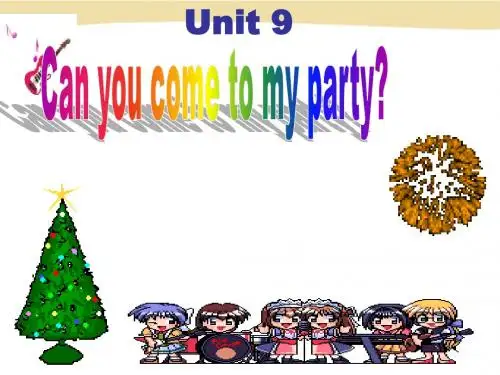
Sure, Joe. Thanks for asking.
2d Role-play the conversation.
Jeff: Hey, Nick, can you come to my house on
Saturday? My cousin Sam from Xi’an is
going to be here.
Sure, Joe. Thanks for asking.
Hey, Tom. Can you go to the movies on Saturday?
I’m sorry, I’m not available. I have to take part in the football match
That’s too bad. Maybe another time.
2a. Listen and circle can or can’t.
1. Jeff can/ can’t go to the party.
2. Mary can/ can’t go to the party. 3. May can/ can’t go to the party.
4. Mei Ling can/ can’t go to the party.
Jeff: That’s really too bad! Oh, but Sam isn’t
leaving until next Wednesday. Can you
hang out with us on Monday night?
Nick: Sure! Catch you on Monday!
Language points
Sure, I’d love to. I’m sorry, I can’t. I have to…
人教版新目标版八年级英语上册 Unit 9 Can you come to my party?单元知识归纳

Unit 9 Can you come to my party?突破词汇SectionAprepare v. 使做好准备;把……准备好→P151SectionBlook after 照料;照顾reply v.回答;答复→P157 available adj. 有空的;可获得的→P151take a trip 去旅行→P158 until conj.& prep.到……时;直到……为止→P152without prep. 没有;不(做某事)→P158hang v. 悬挂;垂下→P152catch v. 及时赶上;接住;抓住→P152surprised adj.惊奇的;感到意外的→P158invite v. 邀请→P153look forward to盼望;期待→P158 accept v. 接受→P153refuse v. 拒绝→P153把握句型1.Can you come to my party?你来参加我的聚会可以吗?注意情态动词can的运用。
2.Oh,but Sam isn't leavinguntil next Wednesday.哦,但是萨姆直到下周三才要离开。
注意until在句中的使用。
3.Bring Ms. Steen to the partywithout telling her so that shecan be surprised.带斯蒂恩老师到宴会上。
不要告诉她以便于她会惊喜。
注意介词without的运用。
熟悉语法情态动词can和have to的用法。
学会交际学会使用发出请求或邀请以及对邀请的礼貌性用语的回答的交际用语。
写作练笔学会写关于邀请及回复邀请的电子邮件。
课文翻译Section A 2dJeff:Hey,Nick,can you come to my house on Saturday?My cousin Sam from Xi'an is going to be here.Nick:Oh,Sam!I remember we went bike riding together last fall when he visited you.Jeff:Yes,that's right.Nick:I'd love to come,but I'm afraid I can't. I have an exam on Monday so I must prepare for it.Jeff:That's really too bad!①Oh,but Sam isn't leaving until next Wednesday.②Can you hang out with us on Monday night?Nick:Sure!③Catch you on Monday!杰夫:嘿,尼克,星期六你能来我家吗?我来自西安的表弟萨姆打算到这儿。
人教版英语八年级上册Unit 9《Can you come to my party》教学设计

人教版英语八年级上册Unit 9《Can you come to my party》教学设计一. 教材分析人教版英语八年级上册Unit 9主要讲述了关于邀请别人参加聚会的情境。
通过本单元的学习,学生能够掌握与聚会相关的词汇和表达方式,学会如何礼貌地邀请别人,并能够用英语进行简单的交流。
本单元的核心句型是“Can you come to my party?”,以及回答“Yes, I can.”和“No, I can’t.”。
二. 学情分析八年级的学生已经具备了一定的英语基础,能够听懂并运用简单的英语进行交流。
他们对学习英语有浓厚的兴趣,并且愿意积极参与课堂活动。
然而,部分学生可能在口语表达和听力方面还存在一定的困难,需要教师的引导和帮助。
三. 教学目标1.知识目标:学生能够掌握与聚会相关的词汇和表达方式,学会如何礼貌地邀请别人,并能够用英语进行简单的交流。
2.能力目标:学生能够听懂并运用核心句型“Can you come to my party?”进行交流,提高口语表达能力。
3.情感目标:学生能够在课堂上积极参与,培养合作意识和团队精神。
四. 教学重难点1.重点:学生能够听懂并运用核心句型“Can you come to my party?”进行交流。
2.难点:学生能够正确使用情态动词“can”来表达自己的能力。
五. 教学方法1.情境教学法:通过创设真实的聚会情境,激发学生的学习兴趣,提高他们的口语表达能力。
2.交际法:通过小组讨论和角色扮演等方式,培养学生的合作意识和团队精神。
3.任务型教学法:通过完成各种任务,引导学生主动参与学习过程,提高他们的自主学习能力。
六. 教学准备1.教学材料:教材、多媒体课件、录音机、磁带或音频文件。
2.教学环境:教室布置成聚会场景,悬挂气球、彩带等装饰物。
七. 教学过程1.导入(5分钟)教师以提问的方式引导学生回顾已学过的与聚会相关的词汇,如“birthday party”、“house party”等。
《八年级英语 Unit 9 Can you come to my party》教学设计
《八年级英语Unit9Can you come to my party?》教学设计一、教学目标1.掌握邀请和应答的表达方式,如:Can you come to...?Sure,I'd love to./Sorry,I can't.等。
2.学会用英语发出邀请、接受邀请和拒绝邀请。
3.培养学生的社交礼仪和语言表达能力。
二、教学重难点1.重点:邀请和应答的表达方式。
2.难点:根据不同情况进行恰当的邀请和应答。
三、教学方法情景教学法、角色扮演法、小组合作学习法。
四、教学过程1.导入(1)播放一段关于聚会的视频,引出话题“party invitation”。
(2)提问学生:“Have you ever been invited to a party?How did you answer?”2.词汇学习(1)教授与聚会相关的词汇,如:party,invitation,accept,decline等。
(2)让学生进行词汇拼写和发音练习。
3.句型练习(1)让学生用英语发出邀请,如:“Can you come to my birthday party onSaturday?”并进行应答练习,如:“Sure,I'd love to./Sorry,I can't.I have to study for a test.”(2)小组活动,互相发出邀请并进行应答。
4.听力训练(1)播放课本听力材料,让学生完成听力任务。
(2)检查答案,讲解重点内容。
5.角色扮演(1)让学生分组进行角色扮演,模拟聚会邀请的场景。
(2)在角色扮演中,注意语言表达的准确性和礼貌性。
6.口语表达(1)让学生分享自己曾经参加过的有趣的聚会经历。
(2)其他学生可以提问和发表自己的看法。
7.总结归纳(1)总结邀请和应答的表达方式。
(2)强调在社交场合中要注意礼貌和恰当的语言表达。
8.作业布置(1)完成课后练习。
(2)用英语写一封邀请信,邀请朋友参加自己的生日聚会。
英语教案人教版八年级英语上册Unit 9 Can you come to my party
Can you come to my party?Grade level: 8th gradeLanguage focus: Making invitations, responding to invitationsObjectives:Students will be able to use polite phrases to make invitations and respond to invitations. Students will be able to describe the activities and details of a party.Materials:Invitation templates (optional)Whiteboard and markersProcedure:Warm-upStart the lesson by asking the students if they like to go to parties and what kinds of parties they have been to. Elicit some responses and write them on the board.Vocabulary and GrammarIntroduce some key phrases for making invitations and responding to invitations. Write them on the board and have the students repeat after you. Examples of phrases include:Making invitations: "Would you like to come to my party?", "I'd love it if you could come to my party", "I hope you can make it to my party".Responding to invitations: "Thank you for inviting me", "I'd love to come", "I'm sorry, I can't make it".Invitation WritingDistribute the invitation templates or ask the students to create their own invitations. Have them include the date, time, location, activities, and RSVP information. Remind them to use polite phrases when making the invitations. Allow time for the students to work on their invitations and ask for help if needed.Role-playAsk the students to pair up and practice making invitations and responding to invitations. They should use the phrases they learned in the previous activity. Encourage them to be creative and come up with different scenarios. For example, a birthday party, a picnic, a movie night, etc.Party PlanningAsk the students to work in groups and plan a party. They should discuss the date, time, location, activities, decorations, and refreshments. They can use the invitations they created earlier as a reference. Encourage them to use the polite phrases they learned in the previous activities.Party PresentationAsk each group to present their party plan to the class. They should describe the activities, the details of the party, and use the polite phrases they learned in the previous activities.Wrap-upReview the key vocabulary and grammar from the lesson. Ask the students to reflect on what they have learned and how they can use polite phrases to make invitations and respond to invitations in their daily life.Assessment:Observe the students during the role-play and party planning activities. Check that they are using the polite phrases correctly and that their party plans are well-organized and include all the necessary details. Provide feedback and corrections as needed.。
新人教版八年级英语上册复习短语笔记资料Unit 9 Can you come to my party
Unit 9 Can you come to my party?Section A1. make an invitation 提出邀请accept an invitation 接受邀请decline an invitation = say no to an invitation=refuse an invitation =turn down an invitation 拒绝邀请2. come to the party 来参加聚会go to a party去参加聚会3. prepare for sth. = get ready for sth.为某事做准备prepare to do sth. = get ready to do sth.准备做某事4. go to the doctor = go to hospital 去看病go to the dentist 去看牙医5. have the flu得流感(注意:只有流感用the, 其他病用a) have a cold 感冒have a stomachache 胃痛have a cough 嗓漱have a fever 发烧6. study for a math / an English test为数学/英语考试而学习7. be available 有空的be available for + n.对于……来说是可用的,可得到的be available to + n. / v.可被……利用或得到的be available to sb. 对某人来说可以使用的be available to do sth.自由自在做某事;有空去做某事8. much too + adj. 太......too much +不可数名词太多...... 9. another time其他时间;别的时间maybe another time = maybe next time也许下次10. thanks for (doing) sth.= thank sb. for (doing) sth. 感谢某人做某事thanks for asking 多谢邀请11. go bike riding骑自行车旅行;骑自行车兜风12. last fall = last autumn去年秋天;去年秋季13. have an exam = take an exam(学生)参加考试hold an exam = give an exam (老师)举行考试have a rest = take a rest 休息have a look = take a look 看一看14. not…until / till...直到......才......15. hang out闲逛;常去某处hang up挂断电话;悬挂16. on Monday night = on the night of Monday 在星期一晚上on Wednesday afternoon= on the afternoon of Wednesday在星期三下午17. Catch you on Monday!=See you on Monday! 礼拜一见!Catch you later! = See you later! 回头见!18. invite sb. to do sth.邀请某人去做某事be invited to do sth.被邀请做某事invite sb. to sp.邀请某人到某处invite sb. to (have) dinner 邀请某人吃饭19. refuse to do sth. 拒绝做某事Section B20. the day after tomorrow 后天the day before yesterday 前天the year before last year 前年last year 去年this year 今年next year 明年the year after next year 后年21. have a piano lesson 上钢琴课22. on weekdays = from Monday to Friday在工作日on weekends 在周末this weekend这个周末last weekend上个周末next weekend下个周末23. look after = take care of 照顾;照料look after sb. well = take good care of sb.好好照顾;好好照料24. help sb. with sth. = help sb. (to) do sth.帮助某人做某事with one ’ s help = with the help of sb.在某人的帮助之下help out (with sth.)帮助摆脱困境/克服困难help sb. out帮助某人解决问题或摆脱困境25. see sb. do sth.看到某人做了某事(强调看见某人做过某事)see sb. doing sth.看到某人正在做某事(强调看见某人正在做某事)26. take a trip = go on / for a trip 去旅行take a trip to sp. = go to sp. for a trip到某地去旅行27. at the end of... 在......的末端;在......的尽头at the end of this month 在这个月月底at the end of the road 在路的尽头28. be glad / happy to do sth.很高兴做某事29. by +时间点到......为止by now到现在为止by this Friday到这个星期五之前为止30. be surprised 感到惊讶be surprised at sth.对某事感到很惊讶be surprised to do sth.惊讶地做某事31. think of想出;想起;认为think about考虑;思考think over好好考虑;深思熟虑32. bring sb. / sth. to sp. 带某人/某物到某地33. so that 为了;以便34. look forward to doing sth.期待做某事;盼望做某事35. hear from sb. = get / receive a letter from sb. 收到某人的来信hear about / of sth. / sb. 听说某事/某人36. plan a housewarming party策划一个乔迁聚会plan a party for sb.为某人策划一个聚会have a surprise party办一场惊喜聚会;开惊喜聚会at the party在聚会上37. make it成功;胜利(表示通过努力或经历困难后取得成功、完成某事)38. reply in writing以书面的形式进行回复reply to these letters回复这些来信reply to the question=make a reply to the question=answer the question 回答问题39. go to a concert去听音乐会give a concert开音乐会40. go to the movies = go to see a film=go to the cinema 去看电影。
人教版英语八年级上册unit9 Can you come to my party(含答案)
八年级上unit9 Can you come to my party?(含答案)一.单项选择1.—It’s too late. I have to go now. —Oh, it’s raining outside. Don’t leave________it stops.A. sinceB. untilC. while2. —Dad, must we wait until the light becomes green?—Yes, I’m afraid we________. That’s the traffic rule.A. canB. mayC. have toD. Need3. —Can you give us more examples? —OK, I’ll give you_______example now.A. otherB. the otherC. anotherD. others4 My family has two dogs. One is white, _____is black.A.otherB. anotherC. the otherD. others5.—Jenny, can you come to my birthday party on Sunday? —Sure, _______.A.I’d loveB. I can’tC. I’d love toD. I have to6.—Why are you so tired these days? —Well, I have_____work to do.A.too muchB. too manyC. much tooD. so many7.John didn’t go to bed______the football match on TV was over last night, so he was sleepy now.A.becauseB.untilC. ifD. but8.—Can you go shopping with me this afternoon, Linda?—_____. I must study for my English test.A.I hope soB. I’m afraid notC. SureD. I’d love to9.—Would you please see the film Iron Man3 with me tonight, Kate?—I’d love to, but I’ve_______Linda’s invitation to dinner.A.sufferedB. earnedC. receivedD. accepted10.H e may refuse______such a silly question.A.answerB. answeredC. answeringD. to answer11.T he speech contest will start_____2: 00pm______Friday afternoon.A. at; inB. at; onC. in; onD. at; at12. —What are you going to do this evening?—I’m not sure. I_____watch TV at home.A. mustB. have toC. mightD. should13. —______are you going to the mountains with on Sunday, Tom? —My friends.A. WhenB. WhatC. WhereD. Who14. —Jim,_______you go and play basketball with us now?—Sorry, I can’t. I have to clean my room at home.A. AreB. CanC. MustD. Do15. We have to_______ourselves when we are away from home.A. look atB. look forC. look upD. look after16. —I’m looking forward to_______my parents soon. What about you?—Me too.A. seeingB. seeC. sawD. to see17. I couldn’t do it________your great help. Thanks a lot!A. withB. withoutC. forD. to18 .One important aim of our school is to prepare us for the future_____ we can face all theA.so farB. so thatC. even ifD. if only19. Alice kept_______all day because she lost her favourite toy.A.gladB. sadC. surprisedD. tired20.We all know that fish can’t live_______water.A.withB. afterC. byD. without21.Jonson is looking forward to________the Great Wall next year.A.visitedB. visitC. visitsD. visiting22.The girl saved every coin_______she could buy her father a present on Father’s Day.A. ifB. in order toC. so thatD. because23. _______wonderful concert they are putting on in the movie theater!A. HowB. WhatC. What aD. What an24. I’ll invite all my friends_______my birthday party.A. withB. atC. inD. to25. The football match______on the evening of next Saturday in the city gym.A. wasB. willC. will beD. be26. —_______go for a picnic this weekend. —Good idea.A. Can youB. What aboutC. When do youD. Let’s27. The final exam is coming. I________try my best to study for it.A. mustB. mightC. needD. would28. The students are very ______ at the ______ news.A. surprised;surprisingB. surprising;surprisedC. surprised;surprisedD. surprising;surprising29. She spends ______ time (in) watching TV. It is bad for her eyes.A. much tooB. too manyC. too muchD. many too30. —Must I be home before nine o'clock, Mom?— No, you ________. But you have to come back before ten o'clock.A.needn't B.can't C.mustn't D. shouldn’t二.用所给词的适当形式填空1.Julia_______(have) to help her mother do the housework on weekends.2.Thanks a lot for_______(show) me around your school.3. —Are you free_______(hang) out with me this afternoon?—No, I’m not free. I might visit my grandparents.4.—Hi, Tim. When______you_______(finish) your homework? —About in half an hour.5. We’re______(plan) to play basketball after school.6. I’m glad that Vincent accepted the______(invite).7. All of us are making________(prepare) for the end-of-year party.8. I'm very sorry ______(hear)that you are ill.9. My cousin is looking forward to________(find) a good job soon.10. Ms. Yang went out of the room without__________(say) anything.11. Thanks for your ______ (prepare) for the party.12. I would love ______(make)friends with new students.13. —Can he go to the baseball game?—No,he can't.He has to ______(study)for a test.14. We ______(catch) some fish last Friday.三.先选词并用其适当形式填空A.catch, exam, flu, prepare, available1.The final_______is coming. All the students are working hard for it.2.Linda has to go to the doctor this afternoon because she has the________.3. Walk ahead, please. I’ll________you up soon.4. —Can you come over to my house this weekend? —Sorry, I’m not_______. I have to help my parents.5. —What are you busy doing now? —Well, I’m busy_______for the English party.B.weekday, what, look after, have, study1.We usually go to work on________and have a rest on weekends.2.He can’t play soccer with us this afternoon. He________a piano lesson.3.I can’t go shopping with you, Julie. I have to______for my Englis h exam.4.Julie’s mother is ill. She must________her in the hospital.5. —_______is today? —It’s Tuesday the12th.C. concert, guest, daytime, open, event1.I would like to invite you to the______of our new school.2.Nancy enjoys music. I bought her a ticket to the_______on her birthday.3.The hotel now opens to the____.4.People work in the______and sleep at night.5. The band usually plays for school______, such as School Day, School Music Festival and so on.四.按要求改写句子1. It’s twelve o’clock?(对画线部分提问)_____ ______ is it?2.I got a letter from my pen pal in Australia last night.(改为同义句)I ______ ________ my pen pal in Australia last night3.The meeting starts 10:00.(对画线部分提问)______ ______the party______?4.She has to go to see the doctor.(改为否定句)She ______ __________ to go to see the doctor.5.People in that town have to move to a new place.(改为一般疑问句)______ people in that town ______ ______ move to a new place?八年级上unit9 Can you come to my party?一.单项选择1-5.BCCCC 6-10.ABBDD 11-15.BCDBD 16-20.ABBBD21-25.DCCDC 26-30.DAACA二.用所给词的适当形式填空1.has2.showing3.to buy4.will finish5.planning6.invitation7.preparations8.to hear9.finding 10.saying 11.preparation12.to make 13.study 14.caught三.先选词并用其适当形式填空A. 1.exam 2.flu 3.catch 4.available 5.preparingB. 1.weekdays 2.has 3.study 4.look after 5.WhatC. 1.opening 2.concert 3.guests 4.daytime 5.events四.按要求改写句子1.What time2.heard,from3.When,does,start4.doesn’t,have5.Do,have,to。
人教版八上 Unit 9 Can you come to my party? 单元写作指导
单元写作指导& Section B(3a~4)
本单元的话题是“邀请”,主要谈论在日常生活中,应该怎样发出、接受或者 拒绝邀请。要求学生能用情态动词 can/could 或 would you like 有礼貌地发出 邀请,并用 would like to, be going to, have to 等来描述计划或必须做的事情。
二、串联成文
Dear Mary, Thanks a lot for your invitation.I’m sorry that 1.I can’t come to your birthday
party this Saturday (这周六我不能来参加你的生日聚会了).I’m really busy that day.I have to 2.go to an English competition (参加英语比赛) in the morning.In the afternoon I’m 3.going to the soccer club (去足球俱乐部).After that, I’m 4.going to my grandfather’s house to have dinner(去爷爷家吃晚饭) because his 70th birthday is on the same day!
二、表示回应邀请的句子 1.抱歉,我没空。我这周六要在家做家务。 Sorry, I’m not available. I have to do housework at home this Saturday. 2.我愿意去,但恐怕我不能。 I’d love to, but I’m afraid I can’t. 3.也许我们可以改天去公园闲逛。 Maybe we can hang out in the park another time.
八年级英语上册 Unit 9 Can you come to my party(第3课时)说课稿
八年级英语上册 Unit 9 Can you come to my party(第3课时)说课稿一. 教材分析《八年级英语上册》Unit 9 “Can you come to my party?” 是人教版新目标英语的重要单元,主要围绕邀请和聚会主题展开。
本节课为该单元的第三课时,主要教学内容为对话和任务型活动。
通过本节课的学习,学生将能够运用所学知识进行日常邀请交流,提高英语口语表达能力。
二. 学情分析八年级的学生已经掌握了基本的英语语法和词汇,具备一定的听说读写能力。
但是,对于某些交际用语和表达方式还不够熟练,需要通过课堂学习和实践来提高。
此外,学生的学习兴趣和积极性也是影响教学效果的重要因素。
三. 说教学目标1.知识目标:学生能够掌握并运用日常邀请和聚会相关的词汇和表达方式。
2.能力目标:学生能够听懂、会说、会读、会写关于邀请和聚会的句子。
3.情感目标:学生能够积极参与课堂活动,提高团队合作和交际能力。
四. 说教学重难点1.重点:学生能够掌握并运用日常邀请和聚会相关的词汇和表达方式。
2.难点:学生能够正确使用情态动词“can” 来表达邀请和回答。
五. 说教学方法与手段本节课采用任务型教学法,结合情境教学法和分组合作学习法。
通过设定各种真实的交际情境,引导学生积极参与课堂活动,提高口语表达能力。
同时,利用多媒体教学手段,如PPT、视频等,增加课堂趣味性和互动性。
六. 说教学过程1.热身活动(5分钟):通过播放一段关于聚会的视频,引导学生谈论自己参加过的聚会,激发学生的学习兴趣。
2.呈现新课(10分钟):教师通过展示一组关于邀请和聚会的图片,引导学生猜测图片中的人物在说什么,引出本节课的主题。
接着,教师呈现本节课的主要词汇和句型,如“Can you come to my party?” 和“I can’t comebecause…” 等。
3.操练活动(10分钟):学生两人一组,进行角色扮演,模拟邀请和回答的场景,巩固所学知识。