
英语人教版八年级下册Unit 4 Section A 1a-1c
Unit4 Why don’t you talk to your parents?
Section A(1a~1c)
浮梁县黄坛中学冯庆萍
学习目标:
1.记住并能运用下列单词及句子:allow, wrong, What’s wrong?
2.会讨论生活中遇到的问题;会使用could或should来表达建议。
3.通过谈论生活中遇到的问题及听取别人的建议,合理宣泄不良情绪,学会与他人友好相处。
课时重点:
会表达自己在生活中和学习中遇到的问题;会用句型“Why don’t you...?”来给别人提建议。
教学过程:
课堂导入At first, let’s listen to a beautiful song Little Boy.
1.太多的free time
2.空闲时间get into a fight
3.课外辅导班go to sleep
4.打架after-school classes
5.去睡觉too much
二、译一译
1.Why don’t you talk to your parents?
您为什么不和你的父母谈一谈呢?
2.I don’t have any free time to do things I like.
我没有空闲时间做我喜欢做的事。
3.I have too many after-school classes.
我要上太多的课外辅导班。
4.I got into a fight with my best friend.
我和我最好的朋友打架了。
三、想一想
1.too many和too much有什么区别?
too many修饰可数名词的复数形式;too much修饰不可数名词或动词。
2.Why don’t you do sth.?的同义句是什么?
Why not do sth.?
3.Why don’t you talk to your parents?的同义句怎么改写?
Why not talk to your parents?
合作探究
1.小组讨论:Do you have any problem at school or at home?What are they?
2.阅读教材上1a中的句子,理解它们的意思,并讨论这些问题中哪些是严重的,哪些是不严重的。
然后把句子填写在表格相应的方格中(可只填写句子前的数字)。
活动二:
1.再次浏览教材上1a中的句子。
2.听教材上1b的录音两遍,然后把听到的1a中的问题圈出来。
3.两人一组核对并讨论答案。
学习小助手在听录音之前要熟读1a中的句子,这样会起到事半功倍的效果。
完成任务所需的语言结构:
A:What’t wrong?
B:I’m really tired because I studied until midnight last night.
A:Why don’t you go to sleep earlier this evening?
2.邀请3~5组同学表演自己的对话,优秀的小组可给予积分奖励。
知识超市
My parents don’t allow me to hang out with my friends.
allow作动词,意为“允许;准许”。
有以下几种用法:
1.allow doing sth.表示“允许做某事”。
例如:
We don’t allow smoking here.我们这里不允许吸烟。
2.allow sb.to do sth.表示“允许某人做某事”,动词不定式作宾语补足语。
例如:We don’t laaow students to smoke.我们不允许学生吸烟。
3.be allowed to do sth.表示“被允许做某事”。
例如:
Teenagers aren’t allowed to smoke.青少年不允许吸烟。
[做一做]按要求完城下列各题。
一、根据汉语提示完成句子。
张老师不允许他的学生迟到。
Mr.Zhang doesn’t allow his students to be late for school.
二、单项选择。
(B)1.They shouldn’t allow in front of our buildings.
A.to park
B.parking
C.park
D.parked
(C)2.Drivers shouldn’t be allowed after drinking, or they will break the law.
A.drive
B.driving
C.to drive
D.to be driven
Why don’t you talk to your parents?
Why don’t you do sth.?=Why not do sth.?为什么不做某事?
(D)1.—Why not go to Lao She Teahouse tonight?
— .
A.It doesn’t natter
B.Thank you
C.Sorry to hear that
D.Sounds great (A)2. —Look!It’s raining heavily! take a raincoat with you?
—Well,I’ll take one night now.
A.Why not
B.Why don’t
C.Would you mind
D.Would you like
当堂检测
(A)1.She always has work to do.
A.too much
B.much too
C.too many
D.many too
(C)2. —Would you like to go to the movies this evening?
—I’d like to,but my parents don’t allow me out at night.
A.go
B.going
C.to go
D.went
(B)3.Bob had a fight Jim again.The teacher was very with them.
A.in;pleased
B.with;angry
C.with;popular
D.in;surprised
(B)4. ?
I argued with my parents.
A.How are you
B.What’s wrong
C.Can I help you
D.What are you doing (A)5. go out for a picnic next Saturday?
Good idea.
A.Why not
B.How about
C.Would you like
D.Let’s。
2020-2021学年人教版英语八年级下册Unit4SectionA1a—2d教案

本节课的核心素养目标为:
1.语言能力:培养学生掌握与动物相关的词汇和句型,如What's that? It's a(n)...,并能运用一般现在时描述动物特征和习性,提高学生的英语表达能力。
2.文化意识:通过学习世界各地动物的特点,增强学生对各国文化差异的敏感性,培养跨文化交际意识。
3.思维品质:引导学生运用观察、分析、推理等思维方法,理解并描述动物的行为,提高逻辑思维和批判性思维能力。
4.学习能力:培养学生自主、合作、探究的学习方式,通过听说读写活动,提高学生的综合语言运用能力。
三、教学难点与重点
1.教学重点
-词汇:本节课的核心词汇包括与动物相关的单词,如panda, elephant, lion等,以及描述动物特征和习性的形容词,如cute, lazy, fierce等。
2020-2021学年人教版英语八年级下册Unit4 Section A 1a—2d教案
一、教学内容
本节课为人教版英语八年级下册Unit 4 Section A 1a—2d部分。教学内容主要包括:
1. 1a部分:通过图片展示和听力练习,让学生掌握与动物相关的词汇和句型,如:What's that? It's a(n)...
五、教学反思
在今天的教学过程中,我发现学生们对于动物词汇的学习非常感兴趣,他们积极参与到课堂活动中,踊跃回答问题。通过图片和实际情景的展示,学生们能够更好地记忆和理解新词汇。然而,我也注意到,在运用一般现在时态描述动物特征和习性时,部分学生还存在一定的困难。
首先,对于词汇的掌握,我认为可以继续采用图片、实物等直观教具,帮助学生加深印象。同时,结合课后作业,让学生多读、多写,巩固所学词汇。
2020-2021学年人教版八年级英语下册 Unit 4 Section A1a-2d课件

Period 2 语言点导学
1. (1a) My parents don’t allow me to hang out with my friends. 我 父母不允许我和朋友们一起闲逛。 【探索】allow在此处作及物动词,意为“_允__许__;__准__许__”,常用短 语allow sb. to do sth. 意为“允许某人做某事”。
(1a)3. 允许;准许 ___a_l_lo_w____ (2d)4. 猜测;估计 ___g_u_e_s_s___
(2c)5. 错误的;有毛病 _w__r_o_n_g__
二、重点短语
1. (1a)空闲时间 ___________f_r_e_e_t_im__e________________ 2. (1a)允许某人做某事 _____a_l_lo_w__s_b_._t_o_d_o__s_th_.________ 3. (1a)闲逛 _______________h_a_n_g__o_u_t________________ 4. (1a)和……打架 _____g_e_t_i_n_to__a_f_i_g_h_t_w_i_t_h___________ 5. (1c)哪儿不舒服?____W__h_a_t_’_s_w_r_o_n_g_?_______________ 6. (2a)给某人写信 __w_r_i_te__sb__. _a_l_e_tt_e_r_/w__r_it_e_a__le_t_te_r_t_o_s_b_._ 7. (2a)打电话给某人 ________c_a_l_l_s_b_. _u_p______________
听力原文 听填信息
你将听到的是一封来自一位母亲的求助信。请你根据所听内 容填写下面的信息卡。短文听两遍。听短文之前,你有25秒钟的 时间阅读题目,听完后,你有25秒钟的答题时间。 (W) Dear Mr. Black,
人教版初中英语八年级上册Unit4 Section A (1a-1c)教学教案和教学反思
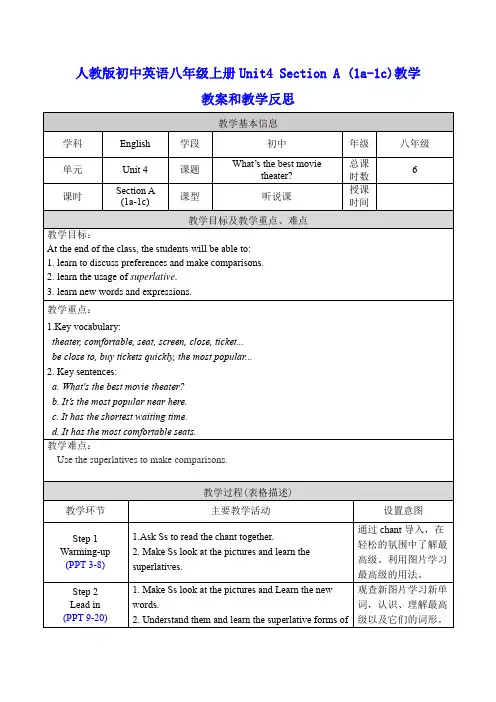
Step 1
Warming-up
(PPT 3-8)
1.Ask Ss to read the chant together.
2. Make Ss look at the pictures and learn the superlatives.
通过chant导入,在轻松的氛围中了解最高级。利用图片学习最高级的用法。
A: But I think Moon Theater has the most
comfortable seats.
2. Make Ss talk about the theaters in their town and write them down.
3. Ask some pairs to present in class.
教学目标:
At the end of the class, the students will be able to:
1.learn to discuss preferences andmake comparisons.
2.learn the usage ofsuperlative.
3.learn new wordsand expressions.
b. It’s the most popular near here.
c.Ithas the shortest waiting time.
d.Ithas the mostcomfortable seats.
教学难点:
Use the superlatives to make comparisons.
教学过程(表格描述)
Step2
Lead in
英语人教PEP版八年级(上册)Unit4SectionA(1a-1c)(2024版新教材)

4.哪家电台播放最无聊的歌曲? Which radio station plays the most boring songs? 5.它有最大的座位,坐着最舒服。 It has the _b_i_g_g_e_st_s_e_a_t_ and you can sit m__o_s_t _co_m__f_o_rt_a_b_ly
自学互研
自主学习
【新词自查】 根据句意及首字母提示完成句子。 1.They live close to the station. 2.There are 50 students in my class,so there are 50 seats in our classroom. 3.The best movie theater has comfortable seats. 4.You can see her on the TV screen quite often. 5.—What can I do for you? —I want to buy a ticket to a ball game.
A: I think comfortable seats are the most important for me .
B: For me, …and … are the most important in a movie theater.
C: But I think …is the most important. D: In my opinion, I think … is the most important
Homework
clothes store
radio station
问题探究
知识点拨
▲形容词和副词的最高级 形容词和副词的最高级在运用时,后面要有一个进行比较的 范围,通常用介词of或in构成的短语来表示;当比较的对象是 “any other+名词单数”时,可以表示最高级的含义。 有些形容词和副词的最高级是不规则变化。 good/well—better—best bad/badly/ill—worse—worst many/much—more—most little—less—least far—farther/further—farthest/furthest old—older/elder—oldest/eldest
人教版(2023)初中英语八年级上册第四单元:Section A (1a-1c)(含答案)【可打印】
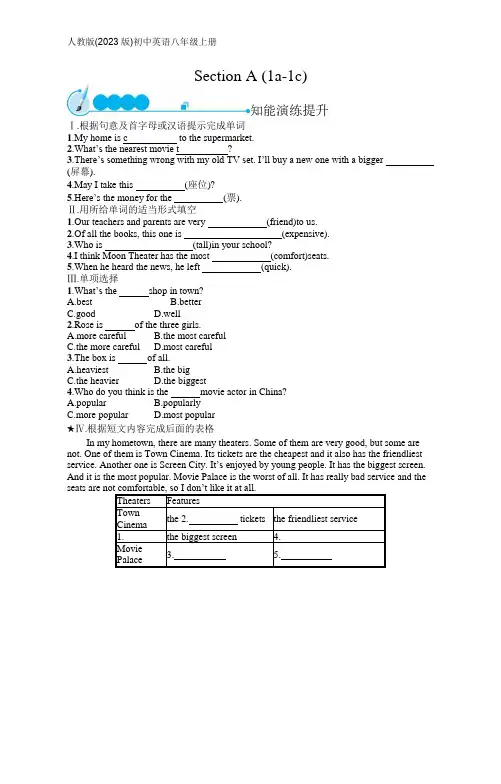
Section A(1a-1c)知能演练提升Ⅰ.根据句意及首字母或汉语提示完成单词1.My home is c to the supermarket.2.What’s the nearest movie t?3.There’s something wrong with my old TV set. I’ll buy a new one with a bigger(屏幕).4.May I take this (座位)?5.Here’s the money for the (票).Ⅱ.用所给单词的适当形式填空1.Our teachers and parents are very (friend)to us.2.Of all the books, this one is (expensive).3.Who is (tall)in your school?4.I think Moon Theater has the most (comfort)seats.5.When he heard the news, he left (quick).Ⅲ.单项选择1.What’s the shop in town?A.bestB.betterC.goodD.well2.Rose is of the three girls.A.more carefulB.the most carefulC.the more carefulD.most careful3.The box is of all.A.heaviestB.the bigC.the heavierD.the biggest4.Who do you think is the movie actor in China?A.popularB.popularlyC.more popularD.most popular★Ⅳ.根据短文内容完成后面的表格In my hometown, there are many theaters. Some of them are very good, but some are not. One of them is Town Cinema. Its tickets are the cheapest and it also has the friendliest service. Another one is Screen City. It’s enjoyed by young people. It has the biggest screen. And it is the most popular. Movie Palace is the worst of all. It has really bad service and the知能演练·提升Ⅰ.1.close2.theater3.screen4.seat 5.ticket(s)Ⅱ.1.friendly2.the most expensive3.the tallest fortable5.quicklyⅢ.1.A2.B3.D4.DⅣ.1.Screen City2.cheapest3.bad service4.the most popular5.uncomfortable seats。
八年级英语下Unit4 Section A (1a-1c)课件ppt

比一比谁读得快,翻译得准确
Guiad 1a aloud .
(比谁读得流利)
2, Practice like model in pairs .
Model:
Marcia: I’m having a surprise party for Lana on Friday night . A : What did Marica say ? B : She said she was having a surprise party for Lana on Friday night.
Unit 4
He said I was hard-working
Section A (1a-1c)
Learning aim :
Master and use the following structure:
Sb + said + clause (从句)
Guide one:
(6’)
Look at 1a and try to translate the sentences alone .
3, 他们说他们去上海 。 4,she said she was having a surprise party Lana Friday night . A, to ,on B, for, on C, for , in D to , in
Guide Three : (5’)
Listen to the tape and number the statements you hear in 1a .
Guide Four:
(5’)
Watch and summary
Tom :
I go home .
(Jim 告诉玛丽Tom说了什么 ?)
新课标人教版八年级英语下册Unit 4 He said I was hardworking--SEC
Unit 4 He said I was hardworkingPart 1: Teaching designSECTION AGoals To learn toreportwhat someone saidTo learn such words as: first of all Ever, mad, anymore, message, hardworking,surprise party, report cardProceduresWarming up learning about Direct speech and reported speechIndirect Speech (also referred to as 'reported speech') refers to a sentence reporting what someone has said. It is almost always used in spoken English.If the reporting verb (i.e. said) is in the past,the reported clause will be in a past form. This form is usuallyone step backinto the past from the original. Structures Reported speech; Simple past tense; Can for ability TargetlanguageWhat did your math teacher say? He said I was hard working. I can speak three languages. What did she say? She said she could speak three languages. VocabularyEver, mad, anymore, message, hardworking, surprise party, report card first of all Learningstrategies Listening for key words; Self-evaluatingFor example:He said the test was difficult.She said she watched TV every day.Jack said he came to school every day.If simple present, present perfect or the future is used in the reporting verb (i.e. says) the tense is retained.For example:He says the test is difficult.She has said that she watches TV every day.Jack will say that he es to school every day.If reporting a general truth the present tense will be retained.He said, “I live in Paris.”He said he lived in Paris. He said, “I am cooking dinner.” He said he was cooking dinner.He said, “I have visted London twice.”He said he had visited London twice. He said, “I went to New York last week.”He said he had gone to New York the week before. He said, “I had already eaten.” He said he had already eaten.He said, “I am going to find a newjob.”He said he was going to find a new job.He said, “I will give Jack a call.” He said he would give Jack a call. 1a Doing groupworkHello, class! We shall go to watch a soapopera first of all.But l et’s talk about these questionsfirst.What is a sopa opera?What are some of the soap oeras you know?Do you ever watch soap opera?What are some things that happen onsoap opera?Daytime dramas so named because they were originally sponsored by the makers of laundry detergent in the early days of television.Aserialized program usually dealing with sentimentalized family matters that is broadcast on radio or television (frequently sponsored by a pany advertising soap products)A soap opera is an ongoing, episodic work of fiction, usually broadcast on television or radio and most recently on mobile phones. This genre of TV and radio entertainment has been in existence long enough for audiences to recognize them simply by the term soap. What differentiates a soap from other television drama programs is their open-ended nature. ...1b Listening and numberingListen and number the statements [1-4] on page 26 inthe picture.Now you will read the tapescript for the structure of “reported speech”.1c Asking and answeringIn pairs you are to ask and answer about what the people in the soap opera said.Listen and circle true or false for each statement.the top.Listen again. What did the people on TV say? Circle the correct answers. Answers: 1-is; 2-will; 3-am; 4-am; 5-will2c Doing pairworkNow in pairs you will make a conversation about “Young Lives” that you saw last night.Next you are going to read a newspaper story on page 28 and try to fill in the blanks.Ne xt we are going to do some writing practice. Let’s imagine the next episode of “Young Lives” and try to finish the newspaper story on page 28.In groups of four you are going to role play conversations according to the three role play cards on page 28.Closing down by having a quiz on reported speechMary “I love chocolate.”Jill: “Mary said (that) she ___ chocolate.”a.lovedb. lovesc. loving Answer aMary: “I went skiing.”Jill: “Mary said (that) she ___ skiing.”a. wentb. had gonec. have gone Answer bMary: “I will eat steak for dinner.”Jill: “Mary said (that) she ___ eat steak for dinner.”a. willingb. willc. would Answer cMary: “I have been to Sydney.”Jill: “Mary said (that) she ___ to Sydney.”a. had beenb. has beenc. was being Answer aMary: “I have had three cars.”Jill: “Mary said (that) she ___ three cars.a. hasb. has hadc. had had Answer cMary: “I'm going to go to Long Beach.”Jill: “Mary said (that) she ___ going to go to Long Beach.”a. isb. wasc. went Answer bMary: “I don't like spinach.”Jill: “Mary said (that) she ___ like spinach.”a. doesn'tb. don'tc. didn't Answer cMary: “I have never been to London.”Jill: “Mary said (that) she ___ never been to London.”a. hadb. hasc. have Answer aMary: “I was swimming.”Jill: “Mary said (that) she ___ swimming.a. has beenb. had beenc. have been Answer bMary: “I had a cat.”Jill: Mary said (that) she had ___ a cat.”a. haveb. hasc. had Answer cMary: “I can't swim.”Jill: “Mary said (that) she ___ swim.”a. can'tb. couldn'tc. can not Answer bMary: “I won't buy a new car.”Jill: “Mary said (that) she ___ by a new car.”a. won'tb. willc. wouldn't Answer cMary: “I have to do my laundry.”Jill: “Mary said (that) she ___ to do her laundry.”a. hadb. hasc. have Answer a。
人教版八年级下册英语Unit4SectionA(1a1c)优秀教学案例
一、案例背景
在我国教育改革的大背景下,英语课程教学逐渐从传统的语法翻译法转向以学生为中心的交际法。人教版八年级下册英语Unit4 Section A (1a-1c)的教学内容围绕着“家务劳动”这一主题,旨在帮助学生掌握与家务相关的词汇和句型,并能运用所学进行真实情境下的交流。本案例以该单元为载体,结合学生的生活经验和认知水平,运用任务型教学法,提升学生的英语实际运用能力。
3.教学过程:
(1)教师展示与家务劳动相关的图片,引导学生学习词汇和句型。
(2)教师创设情境,让学生运用一般现在时描述家庭成员的日常家务活动。
(3)教师通过示例、讲解、练习等形式,帮助学生掌握语法知识。
(三)学生小组讨论
1.教学活动:将学生分成小组,让他们围绕家务劳动主题进行讨论,如:“What chores do you do at home? Can you describe your family members' chores?”等。
(二)问题导向
以问题为导向的教学策略可以激发学生的思考,培养他们的问题解决能力。在本章节的教学中,我将设计一系列与家务劳动相关的问题,如:“What do you do at home? Can you describe your family members' chores?”等,引导学生运用所学词汇和句型进行回答。通过这种方式,让学生在实际情境中运用英语,提高他们的语言表达能力。
2.教学目的:让学生对家务劳动产生兴趣,为新课的学习做好铺垫。
(二)讲授新知
1.教学内容:针对本节课的词汇和句型进行讲解,如clean the room, make the bed, wash the dishes等,并结合一般现在时介绍家庭成员的日常家务活动。
人教版八年级下册英语Unit 4 Section A 1a-3c练习(包含答案)
Unit 4 Why don’t you talk to your parents?Section A 1a~2d一、根据句意及首字母提示填写单词1. My parents don’t a________me to play computer for long.2. It’s a w________answer. Please do it again.3. -I g________she is your sister.-Oh, no. She is my cousin.4. The factory made a big d________with a buyer in Canada.5. That’s the best way to w________out the difficult problem.6. -What’s w________with Jack?-He has a sore throat.7. -Mom, my little sister broke my cup.-It’s not a big d________. I will buy you a new one.8. -G________what I did last Sunday.-You went camping, right?二、用所给单词的适当形式填空1. I found Jim and Mike________(play) basketball on the school playground.2. Our teacher never allows us________(be) late for school.3. Why don’t you________(call) him and say sorry to him?4. I am not good at________(speak) English. Can you help me with it?5. That news________(surprise) me a lot, because I thought he wasn’t careful.三、单项选择( ) 1. -I’m very tired these days because of the senior high school entrance examination.-Why not________music? It can make you________.A. listen to; relaxingB. to listen to; relaxedC. listen to; relaxD. to listen to; to relax( ) 2. -Don’t you see the sign “No Parking” on the right?-Sorry, I didn’t. But now I know parking________here.A. wasn’t allowedB. isn’t allowedC. won’t allowD. doesn’t allow ( ) 3. -Dad, please tell me when Mum________. I miss her very much.-She will return when she________her task. And she will bring a nice present for you.A. returns; finishedB. returns; will finishC. will return; finishedD. will return; will finish( ) 4. -________here a little earlier?-OK.A. Why don’t comeB. Why not comeC. Why not to comeD. Why you don’t come( ) 5. We________here until we________jobs in another city next year.A. don’t leave; findB. won’t leave; findC. don’t leave; will findD. won’t leave; will find( ) 6. When I got home I found her________TV in the living room.A. watchesB. to watchC. watchingD. to watching( ) 7. She always refuses________me________my favourite TV shows.A. to let; watchB. to let; to watchC. let; watchD. to let; watches( ) 8. They don’t mind him________TV all the time.A. watchesB. to watchC. watchingD. to watching( ) 9. His parents always argue________each other________a small question.A. with; withB. about; aboutC. with; aboutD. about; with( ) 10. Students shouldn’t be allowed________part-time jobs.A. to havingB. havingC. to haveD. have四、根据语境,从下列短语中选出恰当的填空work out, get into a fight, too much, so that, look through, give back1. Mom, you put________salt in the soup. It isn’t delicious.2. I hope all the things will________well.3. Let’s walk quickly________we can get there on time.4. -Must I________your bike next Monday, Bill?-Yes, I will use it.5. You shouldn’t________with Bob. After all, he is your best friend.6. Peter turned on the computer and started to________his e-mails.答案:一、1. allow 2. wrong 3. guess 4. deal 5. work6. wrong7. deal8. Guess二、1. playing 2. to be 3. call 4. speaking 5. surprised三、1-5 CBCBB 6-10 CACCC四、1. too much 2. work out 3. so that 4. give back5. get into a fight6. look throughSection A 3a-3c一、根据首字母或汉语提示填写单词1. A TV set with a large s________is quite expensive.2. -Can I help you?-I want to buy two t________for the movie.3. Take your s________, children! The movie is beginning.4. It is very c________to lie on the beach and enjoy the sunshine.5. A movie t________is a place where we can enjoy movies.6. Last year, I worked in a hospital. It is very c________to my home because it only takes five minutes to go to work.7. It’s useful to learn English by listening to some English s________.8. There are all kinds of beautiful skirts in the store. I can’t decide which one to ________.9. -What does your sister do, Linda?-She is one of the most popular ________(记者) in our town.10. The more ________(仔细地) you do your exercises, the fewer mistakes you willmake.二、用括号中所给单词的适当形式填空1. I like the movie theaters with big screens and I can sit________(comfortable), too.2. Yesterday his mother________(choose) a red T-shirt.3. It’s raining. You must drive________(careful).4. Of all the boys, David did the________(badly).5. Sometimes walking is________(fast) than driving during the busy traffic time.6. -Who gets up________(early) of all in your dormitory, Tony?-Jimmy does.7. The famous________(report) works in the TV station.8. I think one of the________(easy) ways to make you strong is to exercise more.9. My friends________(give) me a surprise at my birthday party last week.10. Most of the students think Huang Bo is one of the________(popular) movie stars in China now.三、单项选择( ) 1. They read books at home instead of________TV.A. watchB. to watchC. watchingD. to watching( ) 2. His father doesn’t allow him________swimming alone.A. goesB. to goC. goingD. go( ) 3. ________give him a watch?A. What aboutB. Let’sC. Why don’tD. Why don’t you ( ) 4. You could save some money________you can buy a gift for your mother.A. in order toB. becauseC. soD. so that( ) 5. I think the result must________him very much.A. surpriseB. surprisedC. surprisingD. surprises( ) 6. In fact, my parents don’t mind me________computer games. But they told me not________it for long.A. to play; to playB. to play; playingC. playing; to playD. playing; playing( ) 7. -Can you explain________?-Firstly, be careful when you do it. And secondly, don’t give it up.A. what to doB. what to do itC. how to doD. how to do it( ) 8. -Could you please give me some advice?-________.A. That’s all rightB. Yes, pleaseC. It doesn’t matterD. Of course( ) 9. American scientist Edward T. Hall said that in a conversation between two people, 65% of________is done through body language.A. applicationB. pronunciationC. introductionD. communication ( ) 10. -Jeff, could you tell me if it________tomorrow? If it________tomorrow, I will stay at home.-It’s reported that it will be sunny. Let’s go camping on the Fenghuang Mountain.A. rain; rainB. rains; rainC. will rain; rainsD. will rain; will rain四、根据汉语提示完成句子,每空一词1. 你和同学们相处得怎么样?How are you________ ________ ________your classmates?2. 在我们学校,师生关系正变得越来越好。
人教版八年级下册英语Unit4SectionA(1a1c)教学设计
5.采用多元化评价方式,关注学生在学习过程中的表现,激发学生的学习积极性。
(三)情感态度与价值观
1.培养学生热爱生活、关爱他人的情感态度,通过学习本节课的内容,让学生明白在与他人沟通时,要尊重对方的观点,善于倾听。
2.培养学生的责任意识,让学生明白在遇到问题时要主动承担责任,勇于承认错误。
五、作业布置
为了巩固本节课的学习内容,确保学生对知识点的掌握,特布置以下作业:
1.编写对话:运用本节课学到的词汇和语法,编写一段关于“学校生活”的对话,要求至少包含以下词汇:possibly, permission, argue, insist, respond。对话内容要贴近生活,能够反映学生在学校生活中遇到的实际情况。
人教版八年级下册英语Unit4SectionA(1a1c)教学设计
一、教学目标
(一)知识与技能
本章节的学习目标是使八年级学生能够掌握人教版英语下册Unit 4 Section A(1a-1c)的核心词汇与基本语法,提高学生的英语听、说、读、写综合运用能力。具体包括:
1.掌握本课的新单词:possibly, permission, sign, argue, achieve, upset, insist, respond, calm, actually等,并能在实际语境中正确运用。
5.视频观看:观看一段关于“学校生活”的视频,记录下视频中出现的与本节课相关的词汇和短语,并尝试运用到自己的对话中。
6.小组活动:分组讨论,每组选择一个话题,如“学校是否应该增加课外活动”,运用本节课学到的词汇和语法,进行辩论,并记录下辩论过程中的精彩观点。
作业要求:
1.学生需认真完成作业,注意书写规范,保持作业整洁。