
【范文】六年级英语下册Unit2 Good habits知识点汇总译林版
六年级英语下册Unit2 Good habits知
识点汇总译林版
六年级英语下册Unit2Goodhabits知识点汇总译林版
一、四会单词
1、habit习惯
2、tidy干净的;整齐的
3、fast快的
4、never从不
5、late迟的
6、finish完成
二、三会单词与词组
把……放得井井有条put…inorder不好的,坏的bad困的,困倦的sleepy
昨夜lastnight走进,走入gointo慢速地slowly差地,不好badly
三、短语积累:
1、agoodboy一个好男孩
2、havemanygoodhabits有许多好习惯
一个坏习惯abadhabit
3、getupearlyinthemorning在早晨早早得起床
4、nevergotobedlate从不晚睡觉
5、gotobedearly早早睡觉
6、beforebedtime睡前
7、gotobedlatelastnight昨晚很晚睡觉
8、finishhishomework完成家庭作业
9、finishprimaryschool小学毕业
10、beforedinner在晚饭前
11、afterlunch午饭后
12、shouldn’tgohomelate不应该晚回家
13、dowellathome在家做得好
14、keephisroomcleanandtidy保持房间干净并整洁
15、alsohelphisparentsdohousework
也帮助他的父母亲做家务
16、dohishomeworklateatnight
在晚上家庭作业做得晚
17、brushhisteeth刷他的牙齿
18、feelsleepy感觉困得
19、knowherwell非常了解她
20、alwaysputthingsinorder
总是把东西摆得井井有条
21、walkfast/slowly走得快/慢
22、runveryfast跑得非常快
23、listentohisteacheratschool
在学校听老师讲
24、havebreakfastontime准时吃早饭
25、shorthorses矮矮的马
26、runthroughthegrass(跑)穿过草丛
27、washyourfaceatseveno’clock在七点洗你的脸
28、cometoseeher来看她
29、showyouaroundthehouse
带你参观房子
30、gointothelivingroom进入起居室
31、bigandclean又大又干净
32、smallandnice小而干净
33、alotofbooksandtoys许多书和玩具
34、onthefloor在地上
35、underthebed在床下
36、putyourbooksandtoysinorder把你的
38、singbadly唱得不好
39、dobadly做得不好
40、swimwell游得好
42、pickone挑一个
43、pickup捡起来
Pickitup/pickthemup
44、pickapples摘苹果
45、inthestreet在街上
三、重点句型
1.Hegetsupearlyinthemorningandnevergoestobedlate.他早上起床早,从来不晚睡。
2.mysisterbrusheshisteethinthemorningandbeforebedti me.我妹妹在早上和睡觉前刷牙。
3.Ialwaysputmythingsinorder.我总是把我的东西整理得井井有条。
4.weusuallyfinishourhomeworkbeforedinner.我们通常在晚饭之前完成家庭作业。
5.Theylistentotheirteachersatschool.他们在学校听老师的话。
6.Healsodoeswellathome.他在家也表现得好。
7.Hekeepshisroomcleanandtidy.他保持他的房间既干净又整齐。
8.Heoftendoeshishomeworklateatnightanddoesnotgotobe dearly.他经常做作业做到深夜并且不早睡。
9.Hesometimesfeelssleepyinthemorning.他有时在早上感觉困。
10.wangBingknowsLiuTaowell.王兵很了解刘涛。
11.Didyougotobedlatelastnight?yes,Idid./No,Ididn’t.你昨晚睡得晚吗?是的,我是。
/不,我不是。
12.Letmeshowyouaroundourhouse.让我带你参观我们
的房子。
13.Ialwayshavemylunchontime.我总是准时吃午饭。
14.youshouldputyourbooksandtoysinorder.
你应该把你的书和玩具放得井井有条。
15.Themanissingingbadly.男士正唱歌唱得糟糕。
16.Theboyisdoingwellatschool.男孩在学校表现得很好。
四、语法知识
副词状语的顺序:
英语副词的分类
时间副词:常见的有now,then,soon,ago,lately,later,before,early,today,t omorrow,yesterday,tonight,suddenly,still,already,ju st等。
地点副词:常见的有here,there,up,down,away,nearby,home,upstairs,downst airs等。
方式副词:表示行为方式的副词大多以-ly结尾,常见的有quietly,heavily,warmly,carefully,happily,angrily等。
频度副词:常见的有always,usually,often,sometimes,never等。
程度副词:常见的有very,much,too,greatly,really 等。
如:
焦点副词:就是通过强调使之成为人们注意的焦点的副词,常见的有:only,also,just,especially,too,等。
疑问副词:就是用于引出特殊疑问句的when,where,why,how等。
1.句末/尾时:方式状语-地点状语-时间状语:地点和时间状语内部的顺序由小到大。
如:Iatesomenoodlesatschoolyesterday.昨天我在学校吃了一些面条。
2.句首时:时间状语-地点状语
如:whenandwheredidyoumeetyesterday?你们昨天什么时候,什么地方见面的?
3.频度副词位于助动词和情态动词之后、行为动词之前。
常见的频率副词有:always,usually,often,sometimes,never.但
sometimes,often等可以放在句首或句尾,usually可放在句首。
如:(1)SometimesIgetupearly.=Isometimesgetupearly.我有时起得早。
(2)Theworkersusuallyhavelunchatthefactory.工人们通常在工厂里吃午饭。
(3)Theyoftendotheirhomeworkintheevening.他们经
常在晚上写作业。
(4)Shewasalwayslaterforschoollastyear.她去年上学总是迟到。
译林版六年级下册 Unit2(含中文翻译)
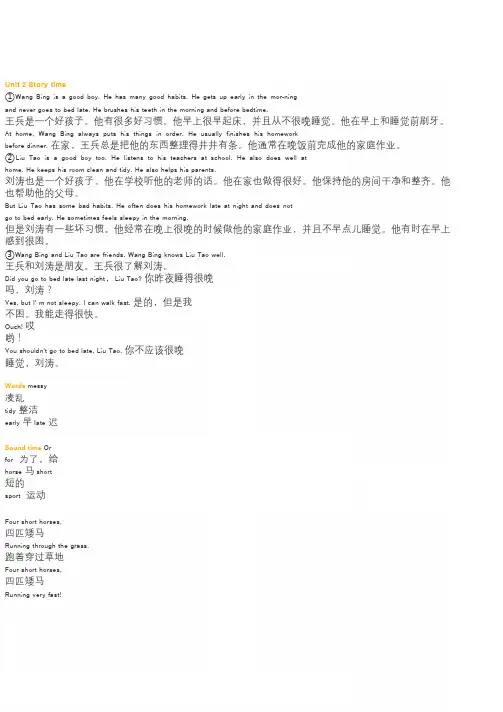
Unit 2 Story time①Wang Bing is a good boy. He has many good habits. He gets up early in the mor-ningand never goes to bed late. He brushes his teeth in the morning and before bedtime.王兵是一个好孩子。
他有很多好习惯。
他早上很早起床,并且从不很晚睡觉。
他在早上和睡觉前刷牙。
At home, Wang Bing always puts his things in order. He usually finishes his homeworkbefore dinner. 在家,王兵总是把他的东西整理得井井有条。
他通常在晚饭前完成他的家庭作业。
② Liu Tao is a good boy too. He listens to his teachers at school. He also does well athome. He keeps his room clean and tidy. He also helps his parents.刘涛也是一个好孩子。
他在学校听他的老师的话。
他在家也做得很好。
他保持他的房间干净和整齐。
他也帮助他的父母。
But Liu Tao has some bad habits. He often does his homework late at night and does notgo to bed early. He sometimes feels sleepy in the morning.但是刘涛有一些坏习惯。
他经常在晚上很晚的时候做他的家庭作业,并且不早点儿睡觉。
他有时在早上感到很困。
③Wang Bing and Liu Tao are friends. Wang Bing knows Liu Tao well.王兵和刘涛是朋友。
六年级英语下册素材-Unit2 Good habits课文翻译 译林版(三起)
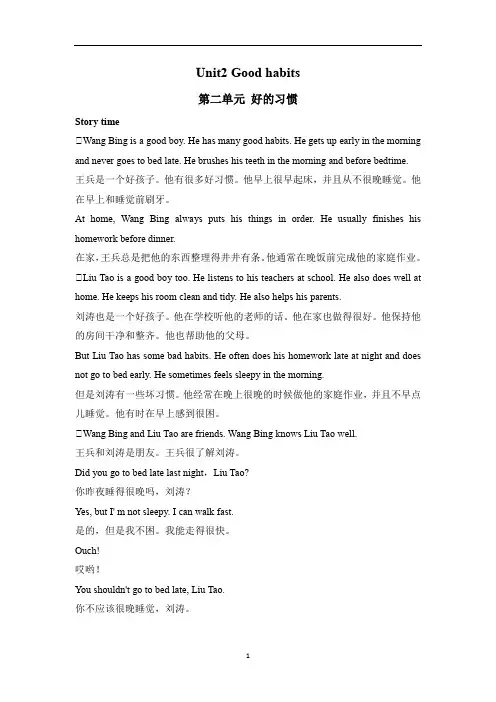
Unit2 Good habits第二单元好的习惯Story time①Wang Bing is a good boy. He has many good habits. He gets up early in the morning and never goes to bed late. He brushes his teeth in the morning and before bedtime.王兵是一个好孩子。
他有很多好习惯。
他早上很早起床,并且从不很晚睡觉。
他在早上和睡觉前刷牙。
At home, Wang Bing always puts his things in order. He usually finishes his homework before dinner.在家,王兵总是把他的东西整理得井井有条。
他通常在晚饭前完成他的家庭作业。
①Liu Tao is a good boy too. He listens to his teachers at school. He also does well at home. He keeps his room clean and tidy. He also helps his parents.刘涛也是一个好孩子。
他在学校听他的老师的话。
他在家也做得很好。
他保持他的房间干净和整齐。
他也帮助他的父母。
But Liu Tao has some bad habits. He often does his homework late at night and does not go to bed early. He sometimes feels sleepy in the morning.但是刘涛有一些坏习惯。
他经常在晚上很晚的时候做他的家庭作业,并且不早点儿睡觉。
他有时在早上感到很困。
①Wang Bing and Liu Tao are friends. Wang Bing knows Liu Tao well.王兵和刘涛是朋友。
六年级下册英语素材- Unit 2 Good Habit Story Time 译林版
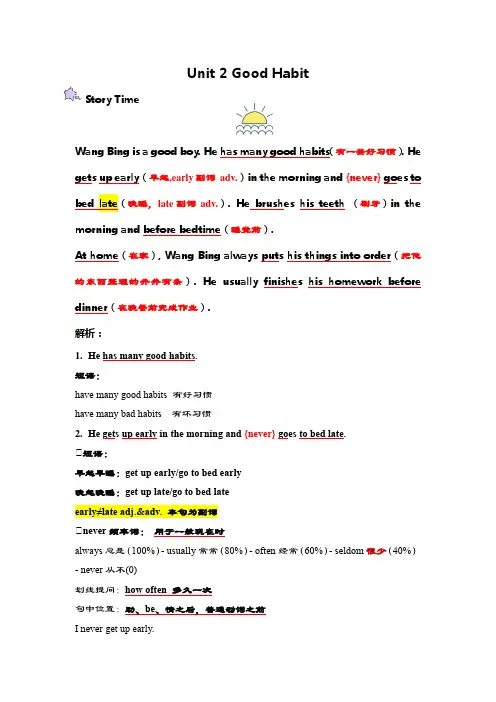
Unit 2 Good HabitStory TimeWang Bing is a good boy. He has many good habits(有一些好习惯). He gets up early(早起,early副词adv.)in the morning and {never} goes to bed late(晚睡,late副词adv.). He brushes his teeth (刷牙)in the morning and before bedtime(睡觉前).At home(在家), Wang Bing always puts his things into order(把他的东西整理的井井有条). He usually finishes his homework before dinner(在晚餐前完成作业).解析:1.He has many good habits.短语:have many good habits 有好习惯have many bad habits 有坏习惯2.He gets up early in the morning and {never} goes to bed late.①短语:早起早睡:get up early/go to bed early晚起晚睡:get up late/go to bed lateearly≠late adj.&adv. 本句为副词①never频率词:用于一般现在时always总是(100%)- usually常常(80%)- often经常(60%)- seldom很少(40%)- never从不(0)划线提问:how often 多久一次句中位置:助、be、情之后,普通动词之前I never get up early.You are always late.3.He brushes his teeth in the morning and before bedtime.①短语brush one’s teeth 刷牙wash face/hands 洗脸、洗手comb hair 梳头get dressed穿衣服have a bath 洗澡take a shower冲凉①before&afterbefore 在...之前after 在...之后before/after class 课前/后You should wash your hands before meals.你应该饭前洗手。
六年级下册英语说课稿-Unit2Good habits 译林版(三起)1

六年级下册英语说课稿-Unit2Good habits 译林版(三起)1一、教学目标1.学习并掌握单词和词组: brush, teeth, wash, face, hands, have breakfast, have lunch, have dinner.2.能听懂、会说句型”I brush myteeth every day. / I wash my face every morning. / I wash my handsbefore eating. / I have breakfast at seven o’clock. / I have lunch at twelve o’clock. / I have dinner at six o’clock.” 3.能用所学的单词、词组及句型,描述自己日常的好习惯。
4.通过学习,培养学生良好的生活习惯与健康意识。
二、教学重点难点1.学习、掌握新单词和词组。
2.听、说句型”I brush my teeth every day. / I wash my face every morning. / I wash my hands before eating. / I have breakfast at seven o’clock. / I have lunch at twelve o’clock. / I have dinner at six o’clock.”3.描述自己日常的好习惯。
三、教学过程1.引入新课1)Greet students and introduce the topic of today’s lesson. 2)Introduce the new words “brush, teeth, wash, face, ha nds, have breakfast, have lunch, have dinner” by showing some pictures and asking students to guess the words. 3)Ask students to say what they do every day and what good habits they have.2.学习新词1) Let the students read the new words and repeat after the teacher. 2) Play a game to help students memorize the new words. 3) Let the students make up sentences with the new words.3.教授新句型1) Play the recording of the dialogue and ask students to listen carefully and follow. 2) Let the students repeat the dialogue in pairs. 3) Ask some students to come to the front and act out the dialogue.4. 说一说1) Ask students to share their good habits with each other in pairs. 2) Ask some students to share their good habits with the whole class.5.活动及练习1) Word puzzle: Write the new words on the blackboard in mixed order, and ask students to find the words and then spell the correct words. 2) Role play: Students act out good and bad habits and the rest of the class guess what they are.6.巩固练习1) Workbook Unit 2: Students finish exercises 1, 2 and 3 in the workbook. 2)考查学生听力水平,播放Unit 2的录音课并让学生做题3.四、板书设计1)New words:brush, teeth, wash, face, hands, have breakfast, have lunch, have dinner. 2)Sentence pattern: I brush my teeth every day. / I wash my face every morning. / I wash my hands before eating. / I have breakfast at seven o’clock. / I have lunch at twelve o’clock. / I have dinner at six o’clock.五、教学反思本课程通过图片、游戏、听力和角色扮演等多种形式,帮助学生轻松地学习和掌握新单词、词组和句型。
Unit2Goodhabits(讲义)-译林版英语六年级下册

Unit 2 Good habits必备词汇短语habit (名词)习惯slowly(副词)慢速地never(副词)从不badly (副词)差地,不好late(副词)迟,晚good habits 好习惯finish(动词)完成show...around 带......参观tidy(形容词)干净的,整齐的brush one's teeth刷牙fast(副词)快地get up early 很早起床put...in order 把……整理得井井有条go to bed late睡觉晚bad(形容词)不好的,坏的sleepy(形容词)困的,困倦的last night 昨夜句子归纳1.He gets up early in the morning and nevergoes to bedlate.他早晨很早起床,且从不晚睡觉。
2. Did you go to bed late last night,LiuTao?你昨夜睡得很晚吗,刘涛? Yes , but Im not sleepy.是的,但是我不困。
3.You shouldn't go to bed late ,Liu Tao.你不应该很晚睡觉,刘涛。
练一练一、选择题1.We put our things _________ order. ()A.in B.on C.at 2.—Where is Bobby? We can't ______ him in the bedroom. ()—I'm here, under the bed.A.watch B.see C.look D.have 3.The teachers always tell us eating _______fast food is bad for our health. () A.too much B.too many C.too little 4.Can you teach _________ English? ()A.I B.me C.my5.We _______ any dancing classes on Friday. ()A.are having B.aren’t having C.don’t have D.are have 二、填空题三、补全对话/短文A: 11B: Yes. I am a good boy. I get up early in the morning. A: 12B: Yes, and I also brush teeth in the morning.A: Is your bedroom messy?B: 13A: How do you put your things?B: 14A: Great! You really have good habits.B: 15四、句型转换五、连词成句21.should, shoes, in, you, put, your, order (.)22.basketball, he, in, the, plays, afternoon (.)23.always, order, puts, Helen, at, her, in, things, home (.)24.boy, the, up, gets, late (.)25.brushes, he, teeth, his, in, the, morning (.)六、阅读理解Choose the best answer. 根据短文选择最佳答案。
译林小学英语六年级下册Unit1-8知识点汇总
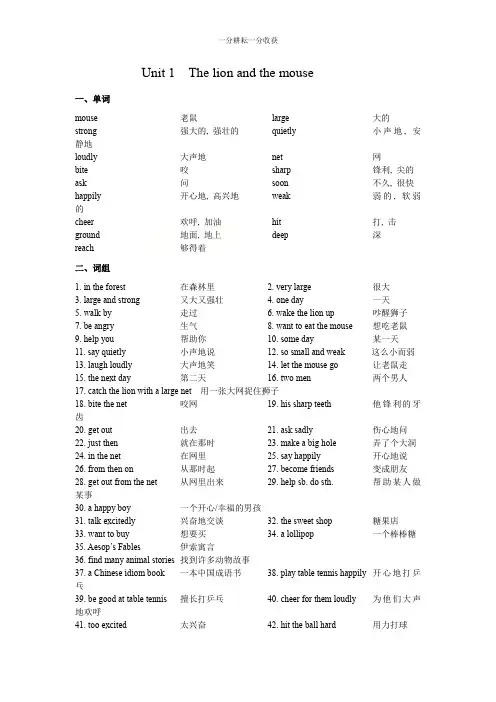
Unit 1 The lion and the mouse一、单词mouse老鼠large大的strong强大的, 强壮的quietly小声地, 安静地loudly大声地net网bite咬sharp锋利, 尖的ask问soon不久, 很快happily开心地, 高兴地weak弱的, 软弱的cheer欢呼, 加油hit打, 击ground地面, 地上deep深reach够得着二、词组1. in the forest 在森林里2. very large 很大3. large and strong 又大又强壮4. one day 一天5. walk by 走过6. wake the lion up 吵醒狮子7. be angry 生气8. want to eat the mouse想吃老鼠9. help you 帮助你10. some day 某一天11. say quietly 小声地说12. so small and weak 这么小而弱13. laugh loudly 大声地笑14. let the mouse go 让老鼠走15. the next day 第二天16. two men 两个男人17. catch the lion with a large net 用一张大网捉住狮子18. bite the net 咬网19. his sharp teeth 他锋利的牙齿20. get out 出去21. ask sadly 伤心地问22. just then 就在那时23. make a big hole 弄了个大洞24. in the net 在网里25. say happily 开心地说26. from then on 从那时起27. become friends 变成朋友28. get out from the net 从网里出来29. help sb. do sth. 帮助某人做某事30. a happy boy 一个开心/幸福的男孩31. talk excitedly 兴奋地交谈32. the sweet shop 糖果店33. want to buy 想要买34. a lollipop 一个棒棒糖35. Aesop’s Fables 伊索寓言36. find many animal stories找到许多动物故事37. a Chinese idiom book 一本中国成语书38. play table tennis happily 开心地打乒乓39. be good at table tennis 擅长打乒乓40. cheer for them loudly 为他们大声地欢呼41. too excited 太兴奋42. hit the ball hard 用力打球43. find the ball 找到球44. find a hole in the ground 在地上找到一个洞45. in the hole 在洞里46. too deep 太深47. can’t reach it 够不着它48. have an idea 有一个主意49. bring some water quickly很快拿来一些水50. pour it into the hole 把它倒进洞里51. so many balls 这么多球52. go to a shopping centre 去购物中心53. see a small boy 看见一个小男孩54. on the floor 在地板上55. take him to an office 带他去办公室56. give him a sweet 给他一颗糖57. become happy 变得高兴58. like helping people 喜欢帮助人们59. make a study plan 制定一个学习计划60. read quietly 安静地看书61. a weak animal 一个弱小的动物62. a sharp knife 一把锋利的刀63. walk by走过, 路过64. wake . . . up吵醒, 叫醒65. some day 某一天66. the next day第二天67. just then就在那时68. get out出来, 出去69. from then on从那时起70. pour… into把…. . . 倒入三、重点句型1. One day, a mouse walked by and woke the lion up. 一天, 一只老鼠走过, 吵醒了狮子。
译林 英语 六年级下册 Unit 2 Good habits
e
a
fd
c
Let’s say.
a does his homework late at night b gets up early c goes to bed late
d helps his parents e finishes his homework early f puts his things in order
仿照例句说一 说他们的习惯。
Wang Bing has some good habits. He gets up early.
Think and write.
Good habits 1. G__e_t__u_p_____ early in the morning. 2. Do not go to school _la__t_e____. 3. Listen to yourte__a_c_h__e_r_s__at school. 4. Finish your h__o_m__e__w__o_r_k____ early. 5. Help yourp_a_r_e__n_t_s__ at home. 6. Keep your roomcl_e_a_n__a__n_d__t_i_d_y___. 7. G__o__t_o__b_e__d_____ early at night.
brush teeth keep his/ her room clean and tidy
put things in order finish homework late at night
never go to bed late
help his/ her parents
Unit 2 Good habits
Unit 2 Good habits(单元解读)六年级英语下册(译林版三起)
六年级下册Unit 2 Good habits单元解读一、单元内容体现的新课标理念本单元在英语核心素养的育人价值下进行,围绕单元主题“人与习惯”展开教学。
本单元学习的主题主要是学习如何用一般现在时和频率副词表述一个人的好习惯和坏习惯等。
二、单元信息单元分为Story time、Grammar time、Fun time、Sound time、Song time、Cartoon time、Checkout time、Ticking time八部分组成。
主要学习关于习惯的一些表达。
在教学上,对本单元内容进行整合以及重组,分为四个课时进行教授。
1.Story time,这一部分是一篇文章,主要介绍了Wang Bing和Liu Tao的一些习惯。
文章首先介绍了Wang Bing有许多好习惯,比如早起等。
接着介绍了Liu Tao也是一名好学生,但是他也有许多坏习惯。
本节课当做一节阅读课进行授课,通过提问题来学习本篇文章,有目的的进行阅读,提升学生的阅读技能,以及学习如何表述习惯。
2.Grammar time&Fun time, 这两个部分作为一课时按照语法课进行教授,主要用副词如何形容一个人的习惯,以及频率副词放在一般现在时中如何使用。
并且进行练习巩固。
3.Song&Cartoon time,这两个部分作为一课时按照对话课进行教授。
Song time主要是时一首歌曲,在欣赏歌曲的同时,让学生们学唱,提高学生的兴趣,并且活跃课堂氛围。
Cartoon time是一篇对话,主要讲述了Tina的朋友们去她家拜访,对比了Tina和Bobby的卧室,一个很干净整洁,一个却很杂乱,形成了鲜明的对比。
本课时也是按照阅读课进行授课。
4.Sound time, Checkout time&Ticking time这三个部分作为一课时按照语音和复习课进行教授。
Sound time主要教授or组合在单词中的发音规则。
小学六年级下册 译林版英语:Unit 2知识点
Unit2Good habits知识汇总一、四会单词1、habit 习惯2、tidy干净的;整齐的3、fast 快的4、never 从不5、late 迟的成二、三会单词把……放得井井有条put…in order 不好的,坏的bad的sleepy昨夜last night 走进,走入go into 慢速地slowly好badly三、短语积累:1、a good boy 一个好男孩2、have many good habits 有许多好习惯一个坏习惯a bad habit3、get up early in the morning在早晨早早得起床4、never go to bed late 从不晚睡觉5、go to bed early 早早睡觉6、before bedtime 睡前7、go to bed late last night 昨晚很晚睡觉8、finish his homework完成家庭作业9、finish primary school 小学毕业10、before dinner在晚饭前11、after lunch午饭后12、shouldn’t go home late 不应该晚回家13、do well at home在家做得好14、keep his room clean and tidy 保持房间干净并整洁6、finish完困的,困倦差地,不15、also help his parents do housework也帮助他的父母亲做家务16、do his homework late at night在晚上家庭作业做得晚17、brush his teeth刷他的牙齿18、feel sleepy感觉困得19、know her well 非常了解她20、always put things in order总是把东西摆得井井有条21、walk fast/slowly走得快/慢22、run very fast 跑得非常快23、listen to his teacher at school在学校听老师讲24、have breakfast on time 准时吃早饭25、short horses 矮矮的马26、run through the grass (跑)穿过草丛27、wash your face at seven o’clock 在七点洗你的脸28、come to see her 来看她29、show you around the house带你参观房子30、go into the living room 进入起居室31、big and clean 又大又干净32、small and nice 小而干净33、a lot of books and toys 许多书和玩具34、on the floor 在地上35、under the bed 在床下36、put your books and toys in order把你的38、sing badly 唱得不好39、do badly 做得不好40、swim well游得好42、pick one 挑一个43、pick up 捡起来Pick it up/pick them up43、pick apples 摘苹果45、in the street在街上三、重点句型1.He gets up early in the morning and never goes to bed late.他早上起床早,从来不晚睡。
新版译林英语六年级下册知识点整理
2016 年苏教译林版小学六年级英语下册单元知识6B Unit 1 The lion and the mouse知识汇总一、四会单词rge 大的2. strong 强壮的3. quietly 安静地;小声地4. Weak 虚弱的5. loudly 大声地6. happily 开心地;高兴地二、三会单词老鼠 mouce 复数 mice走过,路过 walk by吵醒,叫醒 wake ⋯up某一天 same day释放不能,放开 let ⋯ go第二天 the next day网 net咬 bite锋利的,尖的 sharp难过地,伤心地 sadly不久,很快 soon从那时起 from then on欢呼 cheer打,击 hit reach迅速地,快地 quickly把⋯⋯倒入 pour ⋯into三、短语积累狮子和老虎 the lion and the mouse mouse: 复数形式 : mice辨析 mouth 嘴巴month 月份又大又强壮 large and strong又小又弱 small and weak走过⋯ walk by走过森林 walk by the forest把狮子叫醒 wake the lion up(代词宾格放中间 ) wake me up我能在某一天帮助你 I can help you some day将来不确定的某一天Some day:安静地说 say quietly quiet →quietly大声地笑道 laugh loudly loud →loudly让狮子走 let the mouse go let sb do(让某人做某事 )第二天 the next day用一个大网抓住狮子 catch the lion with a large net catch 过去式 :caught 用他的锋利的牙齿咬网 bite the net with his sharp teeth (tooth)bite 过去式 : bit出来 get out伤心地问道 ask sadly sad→sadly就在那个时候 just then就在那时 just then 深的 deep够得着开心地说 say happily happy→happily从那时起 from then on成为好朋友 become good friends become +形容词变得如何⋯糖果店 sweet shop一个棒棒糖 a lollipop他会说什么 ? what will he say?没关系 It doesn ’t matter.伊索寓言 Aesop’s Fables一本中文成语书 a Chinese idiom book开心地打乒乓 play table tennis happily擅长 be good at+名词 // be good at +动词 ing大声地为他们欢呼cheer for them loudly cheer for 为⋯欢呼击球用力 hit the ball hard hit 打,击 (过去式 : hit):最后 finally近意 : at last太深 too deep我够不到 I can ’t reach it reach 到达reach my school(注意 get to)迅速地拿一些水来 bring some water quickly把它倒进洞里 pour it in the hole干得好 ! Well done四、四会句子The mouce said quietly. 老鼠小声地说。