
外研版 必修5 Module 4 Carnival introduction and reading课件
Guess the foreign festivals with the descriptions
This is a Christian festival which comes in the middle of winter. Christmas Dec.25
This is when the Americans remember the hard times when they first arrived in the country. Thanksgiving Day
Match the words with their meanings
confusion costume magic mask mystery tradition crowd 1.A situation where things do not seem well organized confusion 2. If you wear this, it hides your face and your feelings. mask 3. A power which don’t seem to be natural. magic 4. Special clothes. costume 5. Something you can’t explain. mystery 6. Lots of people in the same place. crowd 7. A way of doing things passed on from generation to generation. tradition
Listen to the tape and do following questions
1.Carnival originates from _____. (a) South America (b) North America (c) Europe 2.It is celebrated ______. (a) Before Christmas (b) Between Christmas and Easter (c) After Ester
5. In Venice people covered their ____ with masks. (a) eyes (b) faces (c) hair
6. The government of Venice ___ the wearing of masks. (a) encouraged (b) limited (c) stopped
Reading & Vocabulary Detailed-reading
• Try to get the general idea of each paragraph
欧洲和南美洲地区的人们都庆祝狂欢节。但各 地庆祝节日的日期并不相同,一般来说大部分 国家都在2月中下旬举行庆祝活动。各国的狂欢 节都颇具特色,但总的来说,都是以毫无节制 的纵酒饮乐著称。其中最负盛名的要数巴西的 狂欢节。
Please enjoy the street carnival in the tribe of South America and Brazil
This festival is at the end of October , when “ ghosts” come out. Halloween
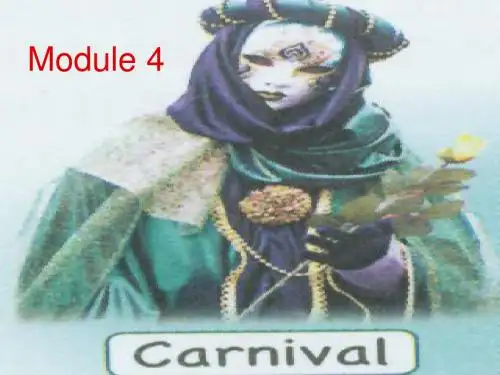
People love wearing special clothes for this festival. Carnival
狂欢节简介
狂欢节(Carnival),世界上不少国家都有狂欢节。 这个节日起源于欧洲的中世纪。古希腊和古罗马的 木神节、酒神节都可以说是其前身。有些地区还把它 称之为谢肉节和忏悔节。该节日曾与复活节有密切关系。 复活节前有一个为期40天的大斋期,即四旬斋(lent)。 斋期里,人们禁止娱乐,禁食肉食,反省、忏悔以纪念 复活节前3天遭难的耶稣,生活肃穆沉闷,于是在斋期 开始的前3天里,人们会专门举行宴会、舞会、游行, 纵 情欢乐,故有“狂欢节”之说。如今已没有多少人坚守 大斋期之类的清规戒律,但传统的狂欢活动却保留了 下来,成为人们抒发对幸福和自由向往之情的重要节日。
Some festivals in China
春节
Spring Festival
中秋节
Mid-Autumn Festival
端午节
The Dragon Boat Festival
七夕节 Valentine’s Day of China
Discussion
Describing a Chinese festival
Things you may do
eat especial food. give or receive gifts wear special clothes. dance and listen to music.
have a holiday from school.
take part in a traditional ceremony. enjoy yourself with friends or family.
3. At Carnival people_____. (a)don’t eat (b) don’t eat meat (c) eat and drink
4. The first carnival in Venice lasted for______. (a) one day (b) five days (c) forty days
7. The original Venice carnival came to an end about_____. (a) 500 (b) 200 (c) 30
8. The idea to start the carnival again came from ______. (a) tourists (b) students (c) the government
高二英语必修5(外研版)4-1Introduction
外 研 版 英 语
Module 4
Carnival
词语辨析 celebrate; congratulate celebrate和congratulate本非同义词,但都相当于 汉语“庆贺”的意思。congratulate“庆祝”后面只能 以“被庆贺的人”作宾语,它的句型是:congratulate sb.(on sth.)。
Module 4
Carnival
外 研 版 英 语
必修⑤
Module 4
Carnival
外 研 版 英 语
必修⑤
Module 4
Carnival
hide, confusion, extend, pretend, revive, book, wander, elegant, 核心 magic, relaxing, whistle, tasty, parade, multicultural, plantation, mark, trade, transport, import, master, abolish, magnificent, celebration, freedom, unite, origin come to an end, consist of, dress up 核心 祈使句+and+简单句(教材P32)
外 研 版 英 语
必修⑤
第一课时
Module 4
Carnival
即学即用 Please make a________where you think there are mistakes in the composition. A.sign C.mark 答案:C B.signal D.remark
外 研 版 英 语
英语:Module 4《Carnival》课件-Introduction (外研版必修5)共20页
END
文 家 。汉 族 ,东 晋 浔阳 柴桑 人 (今 江西 九江 ) 。曾 做过 几 年小 官, 后辞 官 回家 ,从 此 隐居 ,田 园生 活 是陶 渊明 诗 的主 要题 材, 相 关作 品有 《饮 酒 》 、 《 归 园 田 居 》 、 《 桃花 源 记 》 、 《 五 柳先 生 传 》 、 《 归 去来 兮 辞 》 等 。
英语:Module 4《Carnival》课件Introduction (外研版必
,
天
高
风
景
澈
。
7、翩翩新 来燕,双双入我庐 ,先巢故尚在,相 将还旧居。
8
、
吁
嗟
身
后
名
,
于
我
若
浮
烟
。
9、 陶渊 明( 约 365年 —427年 ),字 元亮, (又 一说名 潜,字 渊明 )号五 柳先生 ,私 谥“靖 节”, 东晋 末期南 朝宋初 期诗 人、文 学家、 辞赋 家、散
1
0
、
倚
南
窗
以
寄
傲
,
审
容
膝
之
易
安
。
16、业余生活要有意义,不要越轨。——华盛顿 17、一个人即使已登上顶峰,也仍要自强不息。——罗素·贝克 18、最大的挑战和突破在于用人,而用人最大的突破在于信任人。——马云 19、自己活着,就是为了使别人过得更美好。——雷锋 20、要掌握书,莫被书掌握;要为生而读,莫为读而生。——布尔沃
外研社必修五module4carnival全单元教案资料

精品文档Module 4 CarnivalI. 教学内容分析本模块的主题是狂欢节。
以西方的几种主要传统节日作为导入,接着通过各种活动详细介绍了狂欢节的历史、发展、种类及人们的活动、饮食、服饰和习俗。
其中有关食物和节日的词汇,和表达喜好和厌恶的句型又可以引申到中国传统节日和习俗,有益于培养学生的跨文化意识。
本模块从五幅西方节日图片的探讨开始,导入本模块的话题——Carnival。
Introduction 部分设计以西方的五种主要传统节日(Carnival, Holi, Halloween, Christmas, Thanksgiving Day)作为导入,让学生通过图片做配对练习了解西方的节日习俗,激发学生对西方节日的好奇心,达到导入整个模块的效果。
Reading and Vocabulary介绍有关狂欢节的一些知识,主要介绍了狂欢节的面具。
课文前后的四个相关练习帮助同学们学习和了解了相关词汇和文章主旨。
Grammar部分主要是通过练习复习被动语态在各种时态中的运用的语法项目。
Vocabulary and Listening分为词汇部分和听力两大部分。
词汇部分学习和巩固一些关于食物的单词;听力部分是关于西方节日的,对于同学们来说,听力材料偏生疏,因此听力要做一定的处理。
Learning to learn是关于通过听听力提高语音面貌的英语学习方法,对于提高学习策略水平有很大的帮助。
Everyday English通过学习复习Vocabulary and Listening中的句子学会一些非常有用的日常生活用语:give up, go wild about, more or less, high spot, funnily enough, in your blood, wash down 和walk off a meal。
Function介绍表达“喜欢、不喜欢和偏爱”的功能用语。
Reading and Writing集说话和写作于一体,培养的是学生语言综合运用的能力。
高中英语 Module 4 Carnival 精品 外研版必修5
1. Different carnivals √
2. The origins of carnival
√
3. Special food
4. Carnival in Venice √
rebirth of nature 万物复苏 celebrat it with picnics, and kite flying sweep and weed graves honor ancestors
Dragon Boat Festival
(Lunar May 5)
rice dumplings 棕子 Dragon Boat race 龙舟赛
New Year’ Eve (Lunar December 31)
Introduction-1. Description of Chinese festivals(3m)
Can you describe one of the Chinese festivals?
wear special clothes eat special food give or receive gifts have a holiday from school take part in a traditional ceremony dance and listen to music enjoy yourself with friends or family
lion /dragon dance
舞狮/龙
riddles written on lanterns 灯谜
exhibit of lanterns
灯会
rice glue ball/full moon ball 元宵
Ching Ming Festival / Tomb-sweeping Day
外研版 必修5 Module4 Carnival introduction课件
本模块重点词组和短语 1.化装;打扮 2.发狂(因高兴或生气) 3. 接收;掌管 4. 对----评价很高 5. 秘密地; 6. 取笑;捉弄某人 7. 用暴力迫使 8. 离开, 带走, 用散步消除 9. 冲洗, 咽下, 洗清, 冲净 10. 结束, 终止
重点词组和短语 1.dress up 2. go wild 3. take over 4. think much / highly of 5. in secret 6. make fun of sb. 7. by force 8. walk off 9. wash down 10. come to an end
两千多年前,欧洲的天主教会把11月1日定为“天下 圣徒之日” (ALL HALLOWS DAY) 。“HALLOW” 即圣徒 之意。传说自公元前五百年,居住在爱尔兰、苏格兰等地 的凯尔特人 (CELTS) 把这节日往前移了一天,即10月3 1日。他们认为该日是夏天正式结束的日子,也就是新年 伊始,严酷的冬季开始的一天。那时人们相信,故人的亡 魂会在这一天回到故居地在活人身上找寻生灵,借此再生, 而且这是人在死后能获得再生的唯一希望。而活着的人则 惧怕死魂来夺生,于是人们就在这一天熄掉炉火、烛光, 让死魂无法找寻活人,又把自己打扮成妖魔鬼怪把死人之 魂灵吓走。之后,他们又会把火种烛光重新燃起,开始新 的一年的生活。传说那时凯尔特人部落还有在10月31 日把活人杀死用以祭奠死人的习俗。
Ⅳ. 单词拼写(共10小题):
根据下列句子所给汉语注释,写出空缺出各单词的正确形式。 abolished 1. We think that bad customs and laws ought to be ________. ( 废除) confusion ( 混乱) 2. Their dormitory was in a state of ________ revived memories of his childhood.( 回想起) 3. The picture ________ .wander those countries on his own. 4. The poet wanted to ________ (漫游) elegant 5. She bought an ________ (别致)vase era 6. Some say the computer has ushered in a new ________. (时代) magic (魅力) of her voice charmed the audience. 7. The ________ 8. What was the _____ origin (起因) of the quarrel on earth? 9. The tourist season ________ extends (延续) from May till October. 10. We visited amagnificent ________ (富丽堂皇) palace in the city
高中英语Module4CarnivalSectionIntroductionReadingPrere
[原文呈现 ]
[读文清障]
festival of Easter⑩. People saw Carnival as⑪
a last chance to have fun at the end of the winter season. Having fun ⑫ meant eating, drinking, and dressing up⑬.
⑩as people prepared for the Christian 为时间状语从句。
⑪see ...as ...把……看作…… ⑫have fun 过得愉快,动名词短语
having fun 作主语,mean doing 表示“意味着做……”。 ⑬dress up 装扮;打扮
面具的魔力 [第 1~2 段译文]
without meat, as people prepared for the Christian⑨
⑥现在分词短语 meaning ...作定 语,相当于 which means ...。
⑦where it began 为定语从句,修 饰先行词 Europe。
⑧be followed by 被……跟随;紧 跟着
D uring this period, hotels in R io w ork only w ith package bookings and pre paym ent. O ne of the m ost frequent questions w e hear is “ w hat is the date of C arnivalthis year?” W ell,believe it or not, itis notan easy question to answ er. Y ou have to be part astrologer (占星 家),part m athem atician,and part priest!
外研版高二必修五四单元教案Book5Module4Carnivalintroductionandre
part3
Para.3-6
Carnival in _V__e_n_i_c_e_.
part1 people's general impression of Carnival.
crowd
1 lots of people in one place
costume
2 special clothes
carnival
4 be more aware of intercultural communication and
respect for Chinese festival.
.
How much do you know
about festivals?
•Group Competition Group A B C D
Choices:
confusion
3 a situation where things do not seem organized
excitement
4 when you feel this, your heart beats fast
part 2 The meaning and origin of Carnival. Questions:
As time passed
not allowed to wear masks at night and dress In the 14th century up as women.
At the end of 18th century
masks were banned completely, carnival became just a memory.
right
wrong
+0
Module4Carnival教案外研版必修5(精)
Module 4 CarnivalPeriod OneTeaching aims:1. To revise Chinese and western festivals.2. To develop the students reading ability.3. To understand what is about Carnival.Important and difficult points:1 Get the students to understand the history of carnival.2 Get the students to describe the festivals in groups.Teaching procedures:Step 1. Revision.Read the new words of this passage.Step 2. Introduction1. We have learned many festivals both Chinese and the Western. What festivals do you know? Divide the class into 2 groups. One group is for Chinese Festivals, the other group is for Western festivals.Make a list of them on the blackboard..2. Turn to Page 31— Match the festivals with the description.Step 3. Lead-inToday we will learn another festival ---- Carnival. It originates from Europe, and during thesedays, people often love wearing special clothes and masks for it.Step 4. Fast-readingMatch the main idea with every paragraph.Paragraph 1 A meaning of carnival and how it was celebratedParagraph 2 B the law about wearing masksParagraph 3 C general impression of carnivalParagraph 4 D how it is celebrate today in Venice and the feature of it Paragraph 5 E carnival in Venice and the problem it causedParagraph 6 F the revival of the tradition of celebrating it.(Answers: 1— 6 CAEBFDStep 5. Further-readingRead the passage and answer the questions.1. Where does Carnival come from? What does it mean?2. When was it celebrated?3. Where was the most famous Carnival in Europe?4. How long did the first Carnival in Venice last? What about now?5. Did the government of Venice encourage the wearing of masks?6. Who started the Carnival again, tourists or students?(Answers: 1. “Carnival” comes from two Latin words, meaning “no more meat”. 2. It began just after Christmas. 3. The most famous carnival in Europe was in Venice. 4. At the beginning, it lasted for just one day. 5. No. 6. The students started the Carnival. Step 6. VocabularyActivity 1: Read through the words in the box and have the students repeat them individually. Ask the students to complete the task individually, then check with a partner. Check the answers together:(Answers: 1. confusion 2. excitement 3. mask 4. mystery 5. magic 6. costume 7. crowd 8. tradition 9. atmosphereActivity 2: Choose the correct meanings of the words and phrases.Check the answers one by one.(Answers: 1— 4 babb 5— 8 abbbStep 7. DiscussionDiscuss in groups of four.1. What is the feature of carnival in Venice?2. Which is your favourite festival?Step 8. Homework1. Workbook— on Page 87.Read the passage and match the headings with the text.2. Write a short passage about your favorite festival.Period TwoTeaching aims:1. To listen to the description about western customs.2. To express likes, dislikes and preferences:(1 I love doing…;(2 I don’t like…; I hate…; I dislike…; I don’t care much for(3 I prefer…to…; I prefer doing …(4 I’d rather…than…(5 I an interested in…3. To learn several phrases.Difficult and important points:1. Get the students to express likes and dislikes2. Learn to use the phrases: give up; go wild ;more or less; high spot; funnily enough; in your blood; wash down; walk offTeaching procedures:Step 1. RevisionCheck the homework.— Ask several students to read the short passage with the name of My Favorite Festival.Step 2. Vocabulary1. Read the words about food.2. Now say which things you eat at a festival.3. Practice.Activity 2: Find these things in the box in Activity 1.(1 Two type of meat ((2 a food that consists of a tube of skin containing meat mixed with herbs. ((3 five vegetables ((4 two ingredients for making a cake ((Answers: (1 pork and chicken (2 sausages (3 beans, cabbages, garlic, onion, peas (4 flour, eggsStep 3. ListeningBefore listening— Look at the photos in Activity 4 and tell them every picture meaning a special festival..While listening— Listen to the tape twice and match the names of the festivals with the photos.After Listening:Complete the tableStep 4. Everyday English1. Read the sentences and choose the correct meaning of the words and phrases.2. Check the answers one by one. (1-b (2 a (3 b (4a (5 b (6 a (7a (8b3. Explain the words and phrases.(1give up sth. =don’t have it any more(2 go/wild with joy 欣喜若狂(3 more or less =approximately (oppositeexactly.Eg: That is approximately correct.(4 high spot= the best part(5 be/run in sb.`s blood = be /run in the blood. 生来就有的(因遗传或环境影响eg; Most of my family are teachers, it runs in the blood.(6 wash down a meal = have a drinkwalk off a meal = help the food go down by walking.Step 5. Function1. Match the sentences with the speakers. Say what they are speaking about.(1Caitlin: King Cake(2Maria: Feijoada(3 Stefan: saugages(4 Cameron: traditional Jamaican food – chicken with rice and peas.2. Number the phrases from the most negative to the most positive(1 Ask the students to do this individually.(2 Call the answers back from the whole class, one at a time, from 1--6(3 Write down them on the blackboard:3. Work in pairs. Discuss your preferences for food to eat at festival. Use the phrases in Activity2.(1 Read the example with the class.(2 Pair the students to discuss their preferences.(3 Circulate and monitor their production.Step 6. HomeworkFinish off the workbook.Period ThreeTeaching aims:1. To learn more about carnival.2. To teach them how to write an e-mail.3. To develop the students’ reading skills.Difficult and important points:1. Get the students to learn to write an e-mail.2. Get the students to understand some important sentences.Teaching procedures:Step 1. RevisionRead the words and have a dictation.Step 2. Lead-inWhat do you remember about carnival?Where did it start first?Step 3. Fast-reading:Read and underline the topic sentences ( use your own words about every paragraph. Paragraph1: We can understand what carnival is all about by reading the history of America and the meeting of two cultures.Paragraph2: The slave trade brought millions of black people to the new world. Paragraph3: The slaves were forced to watch their European masters to celebrate carnival and then they began to hold carnival with their own features.Paragraph4: Carnival became a celebration of freedom.Paragraph5: As time went on, carnival became a way of uniting different communities and now it has become a celebration of life itself.Step 4. Further reading1. What did marked the beginning of the slave trade?2. How were millions of people taken to work as slaves?3. How did the slaves begin to hold their own carnival in Trinidad?4. When was the slave trade abolished?5. How was carnival changed when the slave trade was abolished?6. When did carnival become a way to unite different communities?(Answers: 1 That the arrival of European in America, and the opening of huge farms and plantations to grow cotton, fruit and vegetables, meant there was an immediate need to people to work on them marked the beginning of the slave trades. 2 Millions of people were taken by force from their homes in America and transported to the New World to work as slaves? 3. They painted their faces white, imitating their masters and making fun of them. 4. The slave trade was abolished in 1838. 5. It became more colourful and more exciting than it had been before. 6. As people forgot their everyday problems and enjoyed themselves eating, drinking, and dancing.Step 5. Several phrases(1 by force (2 be forced to do (3make fun of sb. (4 bring good luck (5 take over (6 take part in (7 become a celebration of freedom (8 with the time passing Step 6. Discussion1. What is the meaning of carnival?2. Which Chinese festival is most like carnival?Step 7. Reading and writingActivity1. Read the email and number the things in the order you read them1. Read through the things with the whole class and make sure that they understand them all.2. Ask them to read the email and order the things individually, then check with a partner.3. Call back the answers from the whole class, in order.(Answers: 1. the atmosphere at the festival 2. the music 3. the food 4. what the writer’s doing5. what the writer’s going to doActivity2. Underline the adjectives used to describe.1. the atmosphere: noisy/ colourful2. the music: great/ exciting/ relaxing3. the food: good/ tastyActivity3 Write an email from a Chinese festival. Make sure of the details about:1. the atmosphere2. the music3. the foodStep 8. HomeworkWrite a description of the festival for visitors to China.( For example: Spring Festival Period FourTeaching aims:1. To learn new words and expressions and learn how to use them.2. To review of the passive voices.Difficult and important points:1. Get the students to know how to use passive voices:一般现在时和一般过去时的被动语态2. The usage of: hide, pretend, memory, wander, come to an end, dress up; consist of be good for ,date from.Teaching procedures:Step 1. RevisionRead the sentences and find out what grammar are they?1. Is the room cleaned every day?2. We were woken up by a loud noise during the night.3. Something must be done before it is too late.4. Have you heard the news? The President has been shot?5. The car was three years old but hadn’t been used very much.6. There’s somebody walking behind us. I think we are being followed.Step 2. Presentation—被动语态被动语态的基本形式是 : be +过去分词根据时态的不同 , be的形式有所变化 .(1 一般现在时的被动语态 : am/is /are+过去分词 (口语可用 get/become或 got /became(2 一般过去时的被动语态 :was /were+过去分词被动语态的基本用法 :不知道或没有必要提到动作的执行者是谁时用被动语态 . 强调或突出动作的承受者常用被动语态 .(有时可省略 .使用被动语态应注意的几个问题 .(1 主动变被动时双宾语的变化 . 看下列例句eg: 我朋友在我生日时送我一本有趣的书 .My friend gave me an interesting book on my birthday.— An interesting book was given to me (by my friend on my birthday.— I was given an interesting book (by my friend on my birthday.(2 主动变被动时 , 宾补成主补 (位置不变 ; 作宾补的省略 to 的不定时在被动语态中应加 to. eg: 老板让他整天工作 .The boss made him work all day long.— He was made to work all day long (by the boss.(3 短语动词变被动语态时 , 勿要掉”尾巴”.eg: 孩子们被他照顾的很好 .— The children were taken good care of ( by her.eg: 要注意一下你的发音和拼写 .— Your pronunciation and spelling should be paid attention to.(4 情态动词和 be going to, be to, be sure to ,used to, have to, had better等结构变被动语态 , 只需将它们后面的动词原形变为 be +过去分词。
高中英语Module4《Carnival》教案-Introduction_and_reading_外研版必修5
Module 4 Carnival教案---Introduction and readingTeaching aims:1. To revise Chinese and western festivals.2. To develop the students reading ability.3. To understand what is about Carnival.Important and difficult points:1 Get the students to understand the history of carnival.2 Get the students to describe the festivalsin groups.Teaching procedures: Step 1. Revision.Read the new words of this passage.Step 2. Introduction1. We have learned many festivals both Chinese and the Western. What festivals do you know?Divide the class into 2 groups. One group is for Chinese Festivals, the other group is for Western festivals.Make a list of them on the blackboard..2. Turn to Page 31—Match the festivals with the description.Step 3. Lead-inToday we will learn another festival ---- Carnival. It originates from Europe, and during these days, people often love wearing special clothes and masks for it.Step 4. Fast-reading Match the main idea with every paragraph.Paragraph 1 A meaning of carnival and how it was celebratedParagraph 2 B the law about wearing masksParagraph 3 C general impression of carnivalParagraph 4 D how it is celebrate today in Venice and the feature of itParagraph 5 E carnival in Venice and the problem it causedParagraph 6 F the revival of the tradition of celebrating it.(Answers: 1—6 CAEBFDStep 5. Further-readingRead the passage and answer the questions.1. Where does Carnival come from? What does it mean?2. When was it celebrated?3. Where was the most famous Carnival in Europe?6. Who started the Carnival again, tourists orstudents?4. How long did the first Carnival in Venice last? What about now?5. Did the government of Venice encourage the wearing of masks?(Answers: 1. “Carnival” comes from two Latin words, meaning “no more meat”. 2. It beganjust after Christmas. 3. The most famous carnival in Europe was in Venice. 4. At thebeginning, it lasted for just one day. 5. No. 6. The students started the Carnival.Step 6. V ocabularyActivity 1: Read through the words in the box and have the students repeat them individually.Ask the students to complete the task individually, then check with a partner. Check the answerstogether:(Answers: 1. confusion 2. excitement 3. mask 4. mystery 5. magic 6. costume 7. crowd8. tradition 9. atmosphere Activity 2: Choose the correct meanings of the words and phrases.Check the answers one by one.(Answers: 1—4 babb 5—8 abbbStep 7. Discussion Discuss in groups of four.1.What is the feature of carnival in Venice?2. Which is your favourite festival?Step 8. V ocabulary1. Read the words about food.2. Now say which things you eat at a festival.. Practice.Activity 2: Find these things in the box in Activity 1.(1 Two type of meat ( (3 five vegetables ((2 a food that consists of a tube of skin containing meat mixed with herbs. ((4 two ingredients for making a cake( (4 flour, eggs(Answers: (1 pork and chicken (2 sausages (3 beans, cabbages, garlic, onion, peasStep 9. Homework1. Workbook—on Page 871.Read the passage and match the headings with the text.2. Write a short passage about your favorite festival.。
高中英语 Module4 Carnival课件 外研版必修5 外研版必
√
3. Special food
4. Carnival in Venice √
Reading and Vocabulary 3—Scanning (5m)
Activity 2
1. c 5. b
2. b 3. c 4. a
6. b
7. b 8. b
Paragraph 1 What’s your general impression
) Introduction-2. western festivals(4m
• How much do you know about the
following western festivals? Christmas
This is a Christian festival which comes in the middle of winter.
Paragraph 3 Where does the writer say we can see the most famous carnival? What was it like at first?
The most famous carnival in Europe was in _V_e_n_ic_e_. People ate, drank and wore m__a_s_k_s. At the beginning, it lasted for just one day. As time passed, the carnival period was __ex_t_e_n_d_e_d_and people walked round the streets for weeks _o_n_e_n_d_doing what they wanted without _b_e_in_g__r_ec_o_g_n_i_z_ed__. Many crimes went _u_n_p_u_n_is_h_e_d_.