
冀教版初中英语八年级下册Unit 8 Save Our World lesson 48 PPT课件
我今天要好好打扫一番。 It’s your turn to clean the bedroom up.
轮到你清扫卧室了。
2
Danny found a used toy car with one broken wheel.
On Wednesday Today
__s_o_r_te_d_____ the garbage anddivided ___________intthoe garbage ________ different __m_a_d_e___ a car _o_u_t _o_f ____ garbage
L_a_t_e_r _th_i_s_____ month
Let’s Do It!
1. Read the lesson and fill in the table.
This week
On Tuesday
Later on Tuesday
We learned about pollution.
Danny, Brian and I cleaned up the schoolyard. All of our classmates helped.
assistance. 3. New words and phrases to compare
quantities.
Warm up
Look at some pictures
Think About It
Do you think garbage is interesting? What have you done in a schoolyard clean-up?
________________________________
Group work
Task 1
Make a poster about "how to divide the garbage"
.
Task 2
Introduce some interesting made by garbage.
Task 3
=The desk is made of wood.这样课桌是木制的。
Exercise
I. 根据所给首字母或汉语提示,完成单词。 1. There is some l_it_te_r___ in the living room after the party. 2. “Fix” and “mend” have the s_a_m__e meaning. 3. My uncle's son is my c_o_u_s_in__. 4. You _s_u_r_p_ri_s_e_d_ (吃惊) me a lot just now. 5. They think most of the things can be _r_e_c_y_c_le_d_ (回收利用).
On Wednesday
Today Later this moth
Danny made a car out of garbage.
Let’s Do It!
2. Complete the dialogues using the phrases in brackets.
1. A: The schoolyard is dirty. (clean up) B: _L_e_t_’s__c_le_a_n__u_p_t_o_g_e_th_e_r_. ______ 2. A: There is too much garbage. (pick up) B:__S_h_a_ll_w__e_p_ic_k__it_u_p_?___________ 3. A: What a sunny day! (go for a walk) B: _H__o_w_a_b_o_u_t_g_o_i_n_g_f_o_r_a_w__a_lk_?_______ 4. A: It’s cold outside! (put on) B: Put on your coat.
1T.eLaecahrninngeIwmvpoocratabnutlaPryoifnotrsdaenscdridbiifnfigcult Points:
materials and for comparing quantities. 2. Learn common expressions for offering
Unit8 Save Our World
Lesson 48: Garbage Is Interesting!
Teaching Aims:
1. Build the belief to save our earth. 2. Cultivate the feelings of responsibilities.
Make a report about how to prevent garbage from polluting our environment.
Language Points
1
What have you done in a schoolyard clean -up?
【点拨】clean-up 清扫,清除,清理
the report? On Tuesday
(clean up, pick up)
Later that day
(go for a walk, pick up)
On Wednesday
(sort, divide...into..)
Later this month
(go on a trip)
Today
(made...out of..)
Presentati
oRnead and fill in the
blanks
When
What
On Tueaday
__c_l_e_a_n_e_d_u_p_______ and picked up the garbage
_L_a_te_r_o_n__T_u_e_s_d_ay went for a walk and found a _u_s_e_d_____ toy
of transportation. recycling
4. They put the garbage into bags for_________ (recycle). 5. It's not right _t_o_l_a_u_g_h_ (laugh) at people in trouble.
III. 句型转换,每空一词。 1. Please throw away the broken wheel. (改为否定句) _W__h_a_t_ _w_a_s___ away the broken wheel. 2. To help our parents do the housework is right. (改为同义句) ___It___ _i_s____ right _t_o____ __h_e_lp__ our parents do
the housework. 3. Linda has more books than the other two girls. (改
为同义句) Linda has the _m_o_s_t__ books of theth_r_e_e___ girls.
Hቤተ መጻሕፍቲ ባይዱmework
1. Finish exercises of Lesson 48. 2. Remember new words and sentences in this unit.
go on a class trip to _th_e_c_i_ty__re_c_y_c_li_n_g_c_e_n_t_re____________
Retel l
The teacher asked Jenny to make a report about
garbage. If you were Jenny, how would you make
II. 用所给单词的适当形式填空。 1. The weather today is a lot _w_o_r_s_e_ (bad) than that of
yesterday. 2. One of the cars ___i_s__ (be) Uncle Wang's.
3. It makes the _l_e_a_st__ (little) pollution among all types
【点拨】used 用过的;旧的;二手的 【例】They bought a used car.
他们买了一辆旧车。
3
Today, Danny made a car out of garbage!
【点拨】made…out of…用……制成…… 其中,make后是 成品,out of后是材料名称。用于被动语态时,相当于be made of或be made from。 【例】The desk is made out of wood.
(冀教版)八年级英语下册同步课件:Unit8 Save Our Wor
他着手写一部小说。
2
Some birds live off fish.
【点拨】live off 以……为食;以……为生。 【例】Most of the Asians live off rice.
how to protect the how all living
environment and things are
then make a report. connected to each
other.
Language Points
1
Living things start out weak and slowly grow strong and big.
Teaching Important Points and difficult Points:
1. Offering help. 2. Learn new vocabulary for describing materials and
for comparing qualities. 3. Describe materials and comparing qualities.
kinds of garbage. 4. The box is made of __m_e_t_a_l _ (金属) and it is very heavy. 5. China has put a ban (禁令) on shops giving away _p_l_a_s_ti_c_ (塑料) bags from June 1st, 2008.
201X年春八年级英语下册 Unit 8 Save Our World主题写作八课件(新版)冀教版
乐观者的观点:
1.越来越多的人想成为环保主义者;
2.政府将采取更多的措施改善环境。
精选
11
单元主题写作八
担心者的观点:1.大量的树木仍将被砍伐;
2.私家车将越来越多。
你的观点及你的打算,学生自拟(至少两点)。
提示:1.短文中应包含4个要点;
2.书写工整,语句通顺、连贯,词数不少于80。
注意:文章开头已给出,不计入总词数。
Unit 8 Save Our World
单元主题写作八
精选
1
Unit 8 Save Our World
单元主题写作八
精选
2
单元主题写作八
话题分析
本单元围绕“环境保护”这一话题谈论了环境的污染、垃圾的 分类和再利用,以及保护环境的方法和措施等问题,号召我们爱 护环境,增强环保意识。最能体现本单元话题及语言运用能力的 话题作文就是如何保护环境。
总结
If everyone gives…, our world will become…
精选
5
单元主题写作八
素材积累
常用短语
1. 保护环境_p_ro_t_ec_t_t_he__en_v_ir_o_n_m_e_n_t
2. 关灯_tu_r_n_o_f_f _th_e_l_ig_h_ts
3. 骑自行车上学_r_id_e_t_o _sc_h_o_o_l __
精选
3
单元主题写作八
典型例题
以“How to Protect Our Environment”为题,谈谈你的观点,不超过 100词。 提示:1.离开教室前记得关灯; 2.尽量骑自行车去上学; 3.回收废纸、饮料瓶,不乱扔垃圾; 4.购物时带布袋,不用塑料袋。
冀教版八年级下册英语Unit 8 Save Our World课件

Unit 8 Save Our World
Lesson 43 Let’s Clean Up!
同学们,上一课学习的单词、短语和句型你们都掌 握了吗?现在大家来检验一下,点击下面的音频开始听 写吧!
When is World Environment Day? What should we do on World Environment Day?
found it! Look at this piece of paper! Danny: Oh no!
Learning Tip World Environment Day began in 1972. It's organized by the U.N. every year in different countries. Its aim is to remind people to protect the environment.
environment. What shall we do today? Look at all of this rubbish! Danny: What does “rubbish” mean?I don't know that word.
Brian:It means “garbage” in American English. Danny: Oh, I see. There's a lot of rubbish in the schoolyard.
(Jenny explains❻ the plan to the class. All the students agree to help. They wear gloves and carry brown bags. They begin to pick up the garbage.) Jenny: Danny, you lost your homework, right?I think I
冀教版八年级下册英语-Unit-8-Save-Our-World-单元话题阅读与写作课件
Carsandfactoriesmakethemostpollution.
Tomakelesspollution, peopleshouldridebikesortakebuses.
Infact,
ifeachofusmakesasmallchangeinourlife,
wecanmakeabigdifferencetoourenvironment.
2023最新整理收集 do something
Unit8
SaveOurWorld
单元话题阅读与写作
写作小练笔
Thepassageisabouthowtoprotecttheenvironment.
Tosavewater,
wecantakeshortshowers.
Weshouldoftenchecktomakesuretherearen’tanyleaksandneverfo
rgettoturnoffthetap. Wecanrecycleathome. Wesortourpopcans,
beerbottlesandwastepaper. Wereuseourplasticbags, too.
Weusethemagainandagain,
orputothergarbageinthem.
写作模板
柳暗花明又一村
——换个角度看问题
Let’题 现在环境污染越来越严重,我们应该采取什么
样的措施来改善这一状况呢?请以 HowtoProtectOurEnvironment? 为题,写一篇不少于 80词的文章。
审题指导 这类文章一般选用一般现在时。 重点内容是如何保护。
写作技法 “序列图法”写保护环境类的文章 本单元内容以保护环境为话题,可使用“序列图 法”来写作。 1. 首先指出环境保护这一主题; 2. 说明保护环境的原因; 3. 如何保护环境。
冀教版初中英语八年级下册《Unit 8 Save Our World》word教案
Unit 8 Save Our World!Lesson 43 Let’s Clean Up!Learning aims:1. Let the students understand to protect our environment is our duty.2. We should keep our school yard clean.Learning important points:1. Know how many ways we can say “garbage”.2. Talk about the destroy of the rubbish.Learning tools:audiotape, flashcards, picturesLearning steps:Step 1. Leading inShow the new words to the students. Let the students read the words first. Then let them read after the tape.Step 2. ListeningStep 3. ReadingRead the text and check the answers silently. At the same time, answer the following questions:1. Where are Jenny, Brian and Danny?2. How’s the weather?3. What do English people call “rubbish”?4. What is Jenny studying in class this week?5. What does the teacher think of Jenny’s idea?Step 4. Read the text in roles loudly. Then let some students act it out in front of the class.Step 5. PracticeStep 6. HomeworkListen to the text and read it again.Finish off the activity book.Write about the garbage you make everyday.Lesson 44 Environment ClubsLearning aims:1. This lesson focuses on the environment issues.2. It presents some solutions to the problems that pollution poses.Learning important points:1. It presents thought-provoking facts and figures abut pollution in North America.2. Call on the students to take personal action to reduce pollution.Learning tools:audiotape, flashcards, picturesLearning steps:Step 1. Leading inStep 2. ReadingRead the song as a lyric poem. Let the students read after you. Then let them read and translate it. They must add their feelings in it.Step 3. Come to “Think About It”●What can you do to stop pollution?●What do you do when you see someone throw garbage on the ground?Step 4. Ask some volunteers to come to the front and act it out.Step 5. PracticeWork in groups of three or four. Give examples of the things that we can do around us. Discuss and give a report to the class.Lesson 45 Let’s Sort Garbage!Learning aims:1. Master the new words and expressions: sort, metal, weight, percent2. Call on the students to take actions to protect our environment.3. Learn about the pollution problems in our life.Learning important points:1. Offering help.2. Learn new vocabulary for describing materials and for comparing qualities. Learning tools:audiotape, flashcards, picturesLearning steps:Step 1. Remind the students:1. What kinds of rubbish do you throw every day? Can you name them?2. What can be recycled?Step 2. Work in groupsLet the students go to the dustbin to collect some garbage and take them to the classroom.Ask the students name them and compare the qualities.Let the students look up the books and the dictionaries when they are in trouble.Help them when they can’t express correctly.Step 3. ListeningListen to the tape finish Exercise 2 in the activity book.1. Every year, each person in North America makes about 1000 kilograms of garbage.2. Plastic makes the most garbage.3. In just one day, Americans throw out 136 million kilograms of packaging.4. Packaging makes the most garbage.Step 4. ReadingRead the text and check the answers.Let the students read the text in roles. Then ask several students to act out the dialogue.Step 5. Come to “PROJECT”Bring the students to pick up the garbage in the school yard. Put the garbage into bags and bring it to school for our project.Take a walk around your neighbourhood, take a bag with you and pick up any garbage you see. Wear gloves, because garbage in dirty.Now sort the garbage into paper, plastic, metal, glass and others.Then compare the garbage in school yard with that in neighbourhood.Have students work in the same groups or in new groups. Each group will make a poster about what things they can do to help reduce pollution in the world.Lesson 46 Protect Our EnviormentLearning aims:Know about the pollution in our country.We all should take care of our environment.Learning important points:How do you think the pollution in our country?What should we do to stop pollution?Learning tools:audiotape, flashcards, picturesLearning steps:Step 1. Come to “THINK ABOUT IT.”How often do you take a shower?Why should we take short showers?What can you do to save water?Step 2.Show the new words to the class. First let them read them by themselves. Then read them after the teacher. Practice the words for a while.Step 3. Let’s Do ItWhat good things has Katie done for the environment?Do you feel the same or different about the environment as Katie? Why?Step 4. ListeningStep 5. ReadingRead the text in silence. Check the answers. Then let the students read the textin class loudly.Step 6. DiscussionLesson 47 Connected to NatureLearning aims:Call on the students to take actions to protect our environment.Learn about the pollution problems in our life.Learning important points:Offering help.Learn new vocabulary for describing materials and for comparing qualities.Describe materials and comparing qualities.Learning difficult points:The words and expressionsLearning tools:audiotape, flashcards, picturesLearning steps:Step 1. ListeningStep 2. Play the tape againLet the students read after it for several times. Ask the students to read the text loudly in class.Step 3. PracticeStep 4. Come to “LET’S DO IT!”Step 5. Homework1. Finish off the activity book.2. Go on the next reading in the student book.Lesson 48 Garbage Is Interesting!Learning aims:1. Master the new words and expressions: used, divide, pile, seat, lid, ton, duty2. Call on the students to protect the environment.3. Think about many ways to reduce pollution.Learning important points:1. Sum what we learn in this unit.2. Learn the knowledge of protecting environment.Learning tools:audiotape, flashcards, picturesLearning steps:Step 1. Leading-inHow do people do with the collected rubbish?Step 2. Come to “Think About It”What kinds of things can be recycled and reused?Step 3. ReadingStep 4. DiscussionAnalyze the text with the students. Discuss the main idea of this text. Let the students sum some language points and practice in class.Step 5. Ask the students show what they have make out of the garbage. Present them to the class. Explain to the students how they work. Demonstrate in the class.Step 6. TalkingTalk about what you feel about our environment. After they learn the text, what do they want to do? What are they doing these days?。
八年级英语下册 Unit 8 Save Our World教案 (新版)冀教版
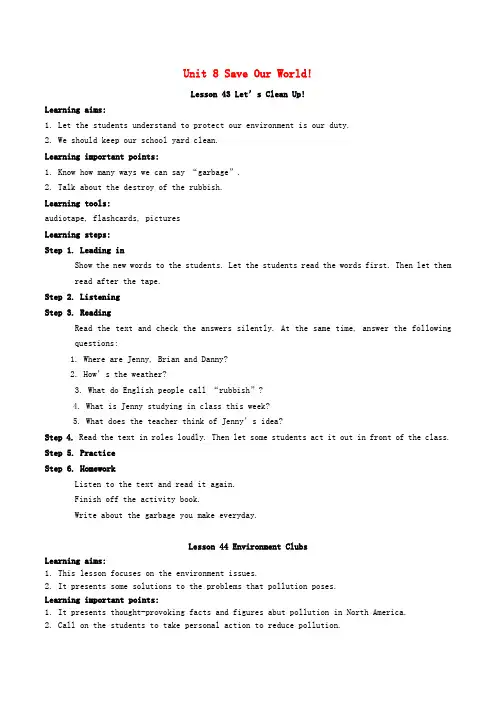
Unit 8 Save Our World!Lesson 43 Let’s Clean Up!Learning aims:1. Let the students understand to protect our environment is our duty.2. We should keep our school yard clean.Learning important points:1. Know how many ways we can say “garbage”.2. Talk about the destroy of the rubbish.Learning tools:audiotape, flashcards, picturesLearning steps:Step 1. Leading inShow the new words to the students. Let the students read the words first. Then let them read after the tape.Step 2. ListeningStep 3. ReadingRead the text and check the answers silently. At the same time, answer the following questions:1. Where are Jenny, Brian and Danny?2. How’s the weather?3. What do English people call “rubbish”?4. What is Jenny studying in class this week?5. What does the teacher think of Jenny’s idea?Step 4. Read the text in roles loudly. Then let some students act it out in front of the class. Step 5. PracticeStep 6. HomeworkListen to the text and read it again.Finish off the activity book.Write about the garbage you make everyday.Lesson 44 Environment ClubsLearning aims:1. This lesson focuses on the environment issues.2. It presents some solutions to the problems that pollution poses.Learning important points:1. It presents thought-provoking facts and figures abut pollution in North America.2. Call on the students to take personal action to reduce pollution.Learning tools:audiotape, flashcards, picturesLearning steps:Step 1. Leading inStep 2. ReadingRead the song as a lyric poem. Let the students read after you. Then let them read and translate it. They must add their feelings in it.Step 3. Come to “Think About It”●What can you do to stop pollution?●What do you do when you see someone throw garbage on the ground?Step 4. Ask some volunteers to come to the front and act it out.Step 5. PracticeWork in groups of three or four. Give examples of the things that we can do around us. Discuss and give a report to the class.Lesson 45 Let’s Sort Garbage!Learning aims:1. Master the new words and expressions: sort, metal, weight, percent2. Call on the students to take actions to protect our environment.3. Learn about the pollution problems in our life.Learning important points:1. Offering help.2. Learn new vocabulary for describing materials and for comparing qualities.Learning tools:audiotape, flashcards, picturesLearning steps:Step 1. Remind the students:1. What kinds of rubbish do you throw every day? Can you name them?2. What can be recycled?Step 2. Work in groupsLet the students go to the dustbin to collect some garbage and take them to the classroom.Ask the students name them and compare the qualities.Let the students look up the books and the dictionaries when they are in trouble. Help them when they can’t express correctly.Step 3. ListeningListen to the tape finish Exercise 2 in the activity book.1. Every year, each person in North America makes about 1000 kilograms of garbage.2. Plastic makes the most garbage.3. In just one day, Americans throw out 136 million kilograms of packaging.4. Packaging makes the most garbage.Step 4. ReadingRead the text and check the answers.Let the students read the text in roles. Then ask several students to act out the dialogue. Step 5. Come to “PROJECT”Bring the students to pick up the garbage in the school yard. Put the garbage into bags and bring it to school for our project.Take a walk around your neighbourhood, take a bag with you and pick up any garbage you see.Wear gloves, because garbage in dirty.Now sort the garbage into paper, plastic, metal, glass and others.Then compare the garbage in school yard with that in neighbourhood.Have students work in the same groups or in new groups. Each group will make a poster about what things they can do to help reduce pollution in the world.Lesson 46 Protect Our EnviormentLearning aims:Know about the pollution in our country.We all should take care of our environment.Learning important points:How do you think the pollution in our country?What should we do to stop pollution?Learning tools:audiotape, flashcards, picturesLearning steps:Step 1. Come to “THINK ABOUT IT.”How often do you take a shower?Why should we take short showers?What can you do to save water?Step 2. Show the new words to the class. First let them read them by themselves. Then read them after the teacher. Practice the words for a while.Step 3. Let’s Do ItWhat good things has Katie done for the environment?Do you feel the same or different about the environment as Katie? Why?Step 4. ListeningStep 5. ReadingRead the text in silence. Check the answers. Then let the students read the text in class loudly.Step 6. DiscussionLesson 47 Connected to NatureLearning aims:Call on the students to take actions to protect our environment.Learn about the pollution problems in our life.Learning important points:Offering help.Learn new vocabulary for describing materials and for comparing qualities.Describe materials and comparing qualities.Learning difficult points:The words and expressionsLearning tools:audiotape, flashcards, picturesLearning steps:Step 1. ListeningStep 2. Play the tape againLet the students read after it for several times. Ask the students to read the text loudly in class.Step 3. PracticeStep 4. Come to “LET’S DO IT!”Step 5. Homework1. Finish off the activity book.2. Go on the next reading in the student book.Lesson 48 Garbage Is Interesting!Learning aims:1. Master the new words and expressions: used, divide, pile, seat, lid, ton, duty2. Call on the students to protect the environment.3. Think about many ways to reduce pollution.Learning important points:1. Sum what we learn in this unit.2. Learn the knowledge of protecting environment.Learning tools:audiotape, flashcards, picturesLearning steps:Step 1. Leading-inHow do people do with the collected rubbish?Step 2. Come to “Think About It”What kinds of things can be recycled and reused?Step 3. ReadingStep 4. DiscussionAnalyze the text with the students. Discuss the main idea of this text. Let the students sum some language points and practice in class.Step 5. Ask the students show what they have make out of the garbage. Present them to the class.Explain to the students how they work. Demonstrate in the class.Step 6. TalkingTalk about what you feel about our environment. After they learn the text, what do they want to do? What are they doing these days?中国书法艺术说课教案今天我要说课的题目是中国书法艺术,下面我将从教材分析、教学方法、教学过程、课堂评价四个方面对这堂课进行设计。
冀教版英语八下Unit 8《Save Our World》单元教学设计
冀教版英语八下Unit 8《Save Our World》单元教学设计一. 教材分析冀教版英语八下Unit 8《Save Our World》的主题是保护地球,内容涵盖了环保的重要性、污染问题、可持续发展等方面。
本单元通过丰富的语言材料,旨在提高学生的环保意识,培养他们热爱大自然、保护地球的责任感。
本单元包括两个读写任务,三个听力任务,两个口语任务和一个语音任务。
教材内容贴近学生的生活,有利于激发他们的学习兴趣。
二. 学情分析八年级的学生已经掌握了英语学习的基本语法和词汇,具备一定的听说读写能力。
他们对环保有一定的认识,但深入了解环保问题的背后原因和解决办法还有待提高。
此外,学生在学习过程中容易出现发音不准确、词汇记忆不牢固等问题。
三. 教学目标1.知识目标:学生能掌握本单元的重点词汇、句型和语法;能正确运用所学知识描述环保问题、表达个人观点。
2.能力目标:学生能听懂、会说、会读、会写与环保相关的句子;能运用所学知识解决实际问题。
3.情感目标:学生增强环保意识,认识到保护地球的重要性,培养热爱大自然、保护地球的责任感。
四. 教学重难点1.重点:本单元的重点词汇、句型和语法。
2.难点:正确运用所学知识描述环保问题、表达个人观点。
五. 教学方法1.任务型教学法:通过设置具有实际意义的任务,激发学生的学习兴趣,提高他们的参与度。
2.情境教学法:创设真实的语言环境,让学生在特定的情境中学习英语。
3.交际教学法:通过小组讨论、角色扮演等活动,培养学生的交际能力。
4.激励评价法:注重过程评价,鼓励学生积极参与,提高他们的自信心。
六. 教学准备1.教学课件:制作课件,展示本单元的重点知识点。
2.教学素材:收集与环保相关的图片、视频、文章等素材。
3.教学设备:投影仪、计算机、音响等设备。
4.分组安排:将学生分成若干小组,便于开展小组活动。
七. 教学过程1.导入(5分钟)利用投影仪展示地球污染的图片,引导学生关注环保问题。
Unit8《SaveOurWorld》课件1(11页)(冀教版八年级下)
Can you list the things we throw away every day ?
What can we do to save our world ? Do you clean up your school yard ?
Pair work .To work in pairs and then show your to your classmates !
Listen read and talk .Listen to the tape and then answer the questions below .
1.Is there any rubbish in the school yard ? A bit of or a lot of ?
2.How long does Brian think it would to finish cleaning up the school yard ? 3.What are they studying in class this week ? 4.Who explains the plan to the class that afternoon ?
Exercises : Fill in the blanks with the proper forms of the given words .
八年级英语下册 Unit 8 Save Our World教案 冀教版
Unit 8 Save Our World!Lesson 57 Let’s Clean Up!Learning aims:1. Master the new words and expressions: yard, rubbish, pick up, bit, a bit of, big, garbage,pollution, finish doing, get to work2. Let the students understand to protect our environment is our duty.3. We should keep our school yard clean.Learning important points:1. Know how many ways we can say “garbage”.2. Talk about the destroy of the rubbish.Learning tools:audiotape, flashcards, picturesLearning steps:Step 1. Leading inShow the new words to the students. Let the students read the words first. Then let them read after the tape.Step 2. ListeningListen to the tape and do Exercise 3 in activity book.Step 3. ReadingRead the text and check the answers silently. At the same time, answer the following questions:1. Where are Jenny, Brian and Danny?2. How’s the weather?3. What do English people call “rubbish”?4. What is Jenny studying in class this week?5. What does the teacher think of Jenny’s idea?Step 4. Read the text in roles loudly. Then let some students act it out in front of the class. Step 5. PracticeExplain some language points to the class. Then ask the students to make up sentences with them.1. But look at all of the rubbish!2. Somebody should pick up that garbage!3. It would take too long.4. Each student could clean up a bit of the school yard.5. We would finish cleaning in an hour.Lesson 58 Stop PollutionLearning aims:1. Master the new words and expressions: less, environment, throw away,least, take out, waste, fix, toilet2. This lesson focuses on the environment issues.3. It presents some solutions to the problems that pollution poses.Learning important points:1. It presents thought-provoking facts and figures abut pollution in North America.2. Call on the students to take personal action to reduce pollution.Learning tools:audiotape, flashcards, picturesLearning steps:Step 1. Come to “THINK ABOUT IT.”Step 2. Show the new words to the class. First let them read them by themselves. Then read them after the teacher. Practice the words for a while.Step 3. Talk about the questions:Show some pictures about our environment to the class. Let the students work in three or four to finish the task.1. What do you think our environment?2. What can we do to reduce pollution?3. Do you know anything about the environment in foreign countries? Can you give an example? Step4. ListeningListen to the tape and finish Exercise 2 in activity book.1. In North America, many students help their school make more pollution.2. In an environment club, people work together to make the environment clean.3. Environment clubs encourage students to bring their lunches in plastic bags.4. They give prizes to the classes that make the least garbage.5. On a no-car day, only teachers come to school by car. No students come to school by car.6. A leaking toilet can waster twenty to forty litres of water an hour.7. In environment clubs, students don’t fix leaky toilets and sinks.8. A hundred kilograms of recycled paper saves seventeen trees.Step 5. ReadingRead the text in silence. Check the answers. Then let the students read the text in class loudly.Step 6. DiscussionAnalyze the text and make a further discussion about it. Let’s discuss its details.1. What do people in an environment club do?2. On no-car day, how do people come to work? How do students come to school?3. What do you know about a leaking toilet?Lesson 59 Let’s look at Garbage!Learning aims:1. Master the new words and expressions: sort, metal, weight, percent2. Call on the students to take actions to protect our environment.3. Learn about the pollution problems in our life.Learning important points:1. Offering help.2. Learn new vocabulary for describing materials and for comparing qualities.Learning tools:audiotape, flashcards, picturesLearning steps:Step 1. Remind the students:1. What kinds of rubbish do you throw every day? Can you name them?2. What can be recycled?Step 2. Work in groupsLet the students go to the dustbin to collect some garbage and take them to the classroom.Ask the students name them and compare the qualities.Let the students look up the books and the dictionaries when they are in trouble. Help them when they can’t express correctly.Step 3. ListeningListen to the tape finish Exercise 2 in the activity book.1. Every year, each person in North America makes about 1000 kilograms of garbage.2. Plastic makes the most garbage.3. In just one day, Americans throw out 136 million kilograms of packaging.4. Packaging makes the most garbage.Step 4. ReadingRead the text and check the answers.Let the students read the text in roles. Then ask several students to act out the dialogue. Step 5. Come to “PROJECT”Bring the students to pick up the garbage in the school yard. Put the garbage into bags and bring it to school for our project.Take a walk around your neighbourhood, take a bag with you and pick up any garbage you see.Wear gloves, because garbage in dirty.Now sort the garbage into paper, plastic, metal, glass and others.Then compare the garbage in school yard with that in neighbourhood.Have students work in the same groups or in new groups. Each group will make a poster about what things they can do to help reduce pollution in the world.Lesson 60 Fix and MendLearning aims:1. Master the new words and expressions: mend, must, touch, repair, cassette, deck, buzz, exactly,reuse, power2. Learn about the knowledge of environment.3. Tell the students to save and protect the resources is our duty.Learning important points:1. In order to save our environment, we should fix and mend something in our daily life.2. Feel the beauty of music.Learning tools:audiotape, flashcards, picturesLearning steps:Step 1. Leading inAsk the students some questions:1. What do you do when your pants have a hole?2. What do you do with when your shoes have a tear?Work in pairs and discuss the questions. Step2. Listen to the tape. Feel the rhythm of the song.Step 2. ReadingRead the song as a lyric poem. Let the students read after you. Then let them read and translate it. They must add their feelings in it.Step 3. ListeningListen to the tape again. Let’s sing after it.Step 4. Ask some volunteers to come to the front and act it out.Step 5. PracticeWork in groups of three or four. Give examples of the things that we can do around us. Discuss and give a report to the class.Lesson 61 What Was in the Bags?Learning aims:1. Master the new words and expressions: more, most, bad, litter, a little bit2. Build the belief to save our earth.3. Cultivate the feelings of responsibilities.Learning important points:1. Learn new vocabulary for describing materials and for comparing quantities.2. Learn common expressions for offering assistance.Learning tools:audiotape, flashcards, garbageLearning steps:Step 1. Leading-inTake out the garbage and put it on the floor. Let’s discuss what we can reuse and recycle.Ask the students work in their groups and imagine what we can do with it. Give a report to the class.Step 2. ListeningListen to the tape and finish the exercise.Danny and Jenny are very _______ to know that people throw ______ _______ waste things away.Danny finds a _______ ______. One of the ________ is broken. He will take it _______ and _______ it. After he _______ it, he will give it to _________ _______, Debbie. ________ should throw away a toy like tat. It’s not _______ to waster things.A lot of the ______ is broken. That’s bad! Once Danny _______ his foot on a piece of brokenglass.Step 3. ReadingRead the text and check the answers. Let the students it loudly in class. Then read it in roles.Step 4. DialogueUse the garbage we have brought to the class. Act the dialogue out in front of the class. Step 5. PracticePractice some word s and expressions: too much, more…than…, most, less…than…too much:S1: There is too much garbage in the school yard.S2: There was too much rain last summer.m ore…than…S3: I have more glass than metal.S4: they have more dresses than pants.mostS5: Who has the most paper?l ess…than…S6: Do you have less plastic than metal?Step 6. ExerciseDo Exercise 3 in activity.Fill in the blanks according to the text.There are 10 kilograms of paper, 8 kilograms of plastic, and 5 kilograms of metal. There ______ 3 kilograms of glass. So there is ______ paper than plastic, and ______ metal than plastic. Glass is the ______. Paper is the ______. Some of _______ is only use on ______ side. We can ______ it.Step 7. DiscussionDiscuss the text in detail.1. Is the garbage in the book the same as that we collect in the school yard?2. What can we use the garbage to do?3. What do you feel about the garbage?Lesson 62 Take Short Showers!Step 2. Play the tape againLet the students read after it for several times. Ask the students to read the text loudly in class.Step 3. PracticeWork in groups. Discuss the following questions.1. What do you think of the city in which you live?2. What’s your advice to stop pollution?3. What’s your plan to reduce pollution?Step 4. Come to “LET’S DO IT!”Step 5. Homework1. Finish off the activity book.2. Go on the next reading in the student book.Lesson 63 Garbage Is Interesting!Learning aims:1. Master the new words and expressions: take a walk, seat, can, clean-up, lid, sort…into…,take a trip2. Call on the students to protect the environment.3. Think about many ways to reduce pollution.Learning important points:1. Sum what we learn in this unit.2. Learn the knowledge of protecting environment.Learning tools:audiotape, flashcards, picturesLearning steps:Step 1. Leading-inLet the students sum what we learn in this unit. Ask them to repeat the main idea, but not word by word.Step 2. ListeningListen to the tape and fill in the blanks according to the text.On Tues day, we started a school yard clean-up. We all took bags and worked _______. We picked up all the _______.O n Wednesday, Brian, Danny and I took a _______ through our neighbourhood. We _______ up any garbage we _______. Danny found a ______ car with a broken wheel. He took it home, cleaned it and ______ it.The next day, we _______ all the garbage into plastic, metal, glass and _______.Most of garbage was paper. People ________ a lot of paper.Step 3. ReadingRead the text silently and check the answers. Then read it again and do the exercises.Read the diary and answer true (T) or false (F).1. Jenny learned something about geography this week.2. On Tuesday, Jenny and her friends started a school yard clean-up.3. On Thursday, Danny found a toy car with one broken wheel.4. On Thursday, they took their bags of garbage to school and sorted all of it.Step 4. DiscussionAnalyze the text with the students. Discuss the main idea of this text. Let the students sum some language points and practice in class.Step 5. Ask the students show what they have make out of the garbage. Present them to the class.Explain to the students how they work. Demonstrate in the class.Step 6. TalkingTalk about what you feel about our environment. After they learn the text, what do they want to do? What are they doing these days?Lesson 64 Unit ReviewLearning aims:1. Master the words and expressions from Lesson 57 to Lesson 63.2. Learn to save the sources and the earth.3. Reducing pollution is our duty.Learning important points:1. Learn some words and expressions about the materials and quantities.2. Learn to sort and recycle the garbage.Learning tools:audiotape, flashcards, picturesLearning steps:Step 1. Leading-inPlay the audiotape. Let’s sing the song in this unit together. At the same time, show some pictures of fixing and mending to the students.Step 2. TalkingTalk about the meaning of saving our environment and reducing the pollution.Work in groups and talk freely. Then all the students in the group s sum their ideas ona piece of paper. Then give a report in class.Step 3. GrammarPractice the main grammar: the Object ClauseLet some students come to the front and write their sentences on the blackboard. Ask them to explain them in English.Step 4. RevisionReview some language points in this unit.The styles are making up sentences or making dialogues.Step 5. ExerciseDo with the exercises in this lesson. Discuss some difficulties on the blackboard together.。
英语:Unit-8-《Save-Our-World》lesson58课件(2)(冀教版八年级下)
Exercises : Write out comparatives and superlative .
1.little _l_e_s_s__ __le_a_s_t__ 2. Many/much _m__o_r_e___ __m_o_s_t__ 3.funny _f_u_n_n_i_er__ ___f_u_n_n_i_es_t 4. full _f_u_l_le_r__ _f_u_l_le_s_t__ 5.clean _c_le_a_n_e_r_ ___c_le_a_n_est 6.exactly _m_o_r_e__e_x_a_ct_l_y__ __th_e__m_o_s_t_e_x_a_c_t_ly 7.gently m__o_r_e_g_e_n_t_l_y__ _t_h_e__m_o_r_e_g_e_n_t_l_y_ 8.humous _m_o_r_e__h_u_m__o_u_s ___T_h_e__m_o_s_t__h_u_mous
Sink,tap ,recycle ,save pollute
3.Learn to do the things we can do everyday to save our environment .
Compare :
big
bigger
biggest
small
smaller
smalleቤተ መጻሕፍቲ ባይዱt
little
Lesson 58 Stop pollution
Learning aims :
1.Master the new words : less,least ,environment,throw away ,reusable ,waste,fix,toilet ,ta ke out .