
新人教版高中英语必修三高一英语人教版必修3_Unit1__Festivals_around_the_world_Grammar课件精品ppt课件
Will you type this, please? 请打印这个, 好吗? Won't you sit down? 请坐下, 好吗? 3. would比will客气委婉。 e.g.: Would you help us, please? 请您帮助我们,好吗? (表请求)
I’d go there withill是助动词或是情态动词? will用于构成将来时是助动词。用于 表示“意志”“决心”“请求”是情态 动词。would亦同理。 e.g. I will tell you something important. 我要告诉你一些重要的事。 (助动词)
Will you tell her that I'm here? 请您告诉她说我在这儿,好吗? (情态动词) 2. 在疑问句中用于第二人称,提出请 求或询问。 e.g.: If you want help - let me know, will you? 如果你需要帮助, 让我知道, 好吗?
这条路可能不通了。
The road can be blocked. 这条路可能会是不通的。 在疑问句中,表示可能性用can。 如:Where can he be? 他会在哪呢?
C. 表示祝愿;但语气较正式: e.g. May you succeed! May you have a good journey! might 的用法有: 多在间接引语中表示过去的可能和 允许。如: She said that he might take her bike. 她说他可以拿她的自行车去用。
只作情态动词的 可情态可实义的
can / could, may /
might, ought to, must
need, dare would
可情态可助动词的 shall / should, will / 相当于情态动词的 have to, had better
can 和could: 1) can的主要用法是: A. 表示体力或脑力的能力: eg. The girl can dance very well. B. 表示说话的推测﹑事物的可能性等: eg. Can the news be true? C. 在口语中, can可以表示请求或允许: eg. Can I sit here?
e.g. --I believe the man is from England.
--But I may be wrong.
The guest may arrive this afternoon.
在肯定句中,may的可能性比can 高, may表示现实的可能性,can表示理论 上的可能性。如:
The road may be blocked.
can表示“能够”时与短语be able to同义,
但can只用于一般现在时或过去时,而后
者可用于各种时态。另外,can表示个人
有某种能力,而be able to表示某人通过努
力、克服困难做成某事,相当于succeed in
doing sth.;叙述过去事实时,最好用was / were able to,因为could只表示过去具有 某种能力。
除了在间接引语中以外,might 一般 不表示过去的可能或者许可。如要表示 过去的可能可以用could, 表示过去的许 可可以用was (were) allowed to 或者had permission to 。
表示现在的可能,其可能性要比may
小。如:
She might go home tomorrow. 说不定他明天会回家。 表示现在的许可, 语气比may较委婉, 一般用于疑问句(包括间接疑问句), 不可 用于肯定句或者否定句。 如: Might I have a word with you? 我可以和你说句话吗?
气较can客气、委婉:
e.g. Could you lend me your dictionary? Could I use your bike? 3) can和could接动词的完成形式,表 示可能已经做某事。can用在否定和疑 问句中, 表示不相信、怀疑等态度。 e.g. They can't have gone out because the light is still on.
Grammar
情态动词的语法特征
1) 情态动词不能单独做谓语, 除ought和 have外, 后面只能接不带to的不定式。 2) 情态动词没有人称, 数的变化, 但有些情 态动词, 如can、will也有一般式和过去式 的变化。 3) 情态动词的“时态”形式并不是时间区别 的主要标志, 不少情况下, 情态动词的现在式 形式和过去式形式都可用来表示现在时间、 过去时间和将来时间。
(表意愿) 我要和你一块到那儿去。 Teacher wouldn’t allow it. (表许可) 老师不会允许这件事。
如: Can you understand the different kinds of English these people are using? Two years later, he was able to speak very good Chinese.
2) could的主要用法是: A. could 是can的过去式, 表示与过去 有关的能力和推测: e.g. We all knew that the young man couldn’t be a doctor. B. could可以代替can表示请求, 但语
以could或would提问时,不能再以
could或would作答,而应该用can或will。
如:
—Could I borrow your dictionary?
—Yes, of course you can.
may 和might : may 常用来表示: A. 表示请求、允许; 比can较为正式: e.g. May I come in ? You may go now. B. 表示说话人的猜测: “也许” “可 能”: 通常只用于肯定句和否定句中。
2020新人教版高中英语必修三--全部课文( 英汉对照)
2019新人教版高一英语必修三全部课文( 英汉对照)Unit 1 Festivals and CelebrationsWHY DO WE CELEBRATE FESTIVALS我们为什么庆祝节日?Festivals are celebrated all around the world. They have a wide range of origins, such as the seasons of the year, religions, famous figures, and important events. Every festival has its different customs and unique charms. However, no matter how different they may seem, all over the world, the spirit of sharing joy, gratitude, love, or peace is common in all festivals.世界各地都庆祝各种节日。
节日的由来五花八门,比如时节、宗教、著名人物及重要事件。
每个节日都有其不同的习俗和独特的魅力。
然而,无论它们多么迥异,在世界各地,分享快乐、感恩、友爱或和平的精神存在于所有节日之中。
Of all the traditional festivals, the harvest festival can be found in almost every culture. This important agricultural festival takes place after all the crops have been gathered in. People celebrate to show that they are grateful for the year’s supply of food. In ancient Egypt, the harvest festival was celebrated during the springtime—the Egyptian harvest season. It featured a parade and a great feast with music, dancing, and sports. Today, in some European countries, people decorate churches and town halls with flowers and fruit, and get together to celebrate over a meal. During the Mid-Autumn Festival in China, families gather to admire the shining moon and enjoy delicious mooncakes.在所有的传统节日中,丰收节几乎可见于每一种文化之中。
人教版高中英语(2019)必修第三册Unit-1-Festivals-aro

eggs are the symbol of the festival.
Easter
A Sunday in March or April between March 21st and April 25th
It is a western festival for lovers.
Valentine’s Day
Halloween 万圣节
old beliefs
the return of the spirits of dead people
dress up and ask for sweets
play a trick on…
Type 2 Festivals to Honour
People
Purpose:
be held to honour famous people
1. Festivals of the Dead 2. Festivals to Honor the People 3. Harvest Festivals 4. Spring Festivals
Read the last paragraph and answer the following question.
Light lamps and play music to lead the ancestors back to earth.
The Day of the Dead 亡灵节
Food in shape of skull and cakes with "bone" on them
Offer food, flowers and gifts to the dead
My favorite festival is __________. It takes place on__________. It celebrates___________.
高中英语人教版必修3第一单元Unit1-Festivals-and-celebrations说课稿+文档.doc

Book3(高中英语人教版必修3第一单元) Unit1 Festivals and celebrations《节日与庆典》我说课的内容是高一英语必修3Unit1阅读 Festivals and celebrations ,这是一节综合技能课,我说课内容包括以下几个部分:教材分析、学情分析、说教法、学法以及教学程序和教学反思。
一.教材与学情分析1.教材内容、地位和作用本单元以”节日”为话题。
本文的题目是Festivals and Celebrations.这一部分是本单元主题的重要体现形式。
本篇阅读主要介绍古今中外节日的种类、由来、以及人们的活动和习俗。
使学生不仅增进了对我国传统节日的理解,而且对外国的节日也有所了解和感悟,提高学生的文化素质,进而拓展社会文化背景、增加跨国文化知识。
2.学情分析由于本单元是安排在春节过后,寒假开学时的第一个单元,学生并对所学相关内容作了很好的铺垫,并有一定的生活积累,而且对“节日”这个话题既熟悉又比较感兴趣,因此可以激发学生的求知欲,更深层次的理解本课内容。
但由于学生基础薄弱,课文也涉及到西方文化,学生学习和理解有一定难度。
二.课程标准与教学目标新课程标准对这一课的要求是:通过介绍古今中外节日的种类、由来、以及人们的活动和习俗,使学生掌握阅读技巧,提高阅读能力。
根据《新课程标准》的要求和学生实际情况,确定了以下三维教学目标:知识与技能目标:熟悉中外节日,培养学生猜词能力,通过略读,找读、细读等方法,提高阅读能力和技巧。
过程与方法目标:通过对课文的阅读,教师引导,学生自主探究与合作学习,熟悉中外节日、掌握词汇,提高阅读能力。
情感、态度与价值观目标:在熟悉中外节日的基础上,提高学生的文化素质,进而拓展社会文化背景、增加跨国文化知识。
三. 教学重点和难点重点:1.熟悉中国和其他国家的节日。
(阅读)2.分析整理课文中的细节内容。
(详细阅读)难点:用所学知识谈论中国和其他国家的节日和庆祝方式。
高中英语 Unit1 Section Ⅰ 新人教版必修第三册
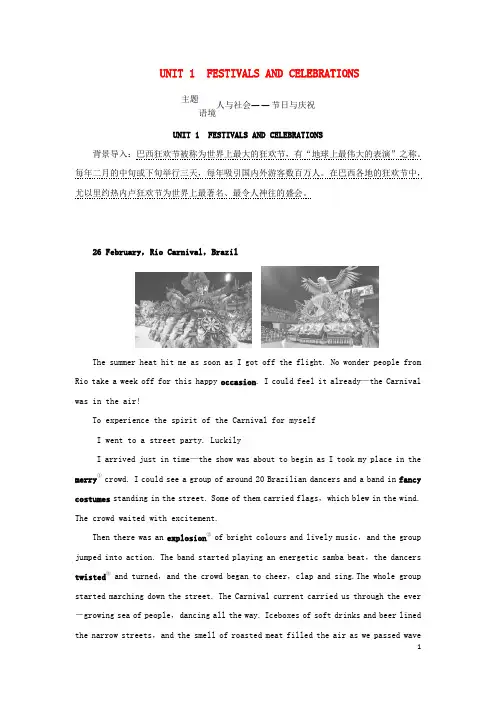
UNIT 1 FESTIVALS AND CELEBRATIONS主题人与社会——节日与庆祝语境UNIT 1FESTIVALS AND CELEBRATIONS背景导入:巴西狂欢节被称为世界上最大的狂欢节,有“地球上最伟大的表演”之称。
每年二月的中旬或下旬举行三天,每年吸引国内外游客数百万人。
在巴西各地的狂欢节中,尤以里约热内卢狂欢节为世界上最著名、最令人神往的盛会。
26 February,Rio Carnival,BrazilThe summer heat hit me as soon as I got off the flight. No wonder people from Rio take a week off for this happy occasion. I could feel it already—the Carnival was in the air!To experience the spirit of the Carnival for myselfI went to a street party. LuckilyI arrived just in time—the show was about to begin as I took my place in the merry①crowd. I could see a group of around 20 Brazilian dancers and a band in fancy costumes standing in the street. Some of them carried flags,which blew in the wind. The crowd waited with excitement.Then there was an explosion②of bright colours and lively music,and the group jumped into action. The band started playing an energetic samba beat,the dancers twisted③ and turned,and the crowd began to cheer,clap and sing.The whole group started marching down the street. The Carnival current carried us through the ever -growing sea of people,dancing all the way. Iceboxes of soft drinks and beer lined the narrow streets,and the smell of roasted meat filled the air as we passed waveafter wave of street stands. I was so caught up in④ the party fever that I hardly noticed five hours fly by!Even as I lay in bed that evening,the bright colours and lively music were still swimming all around me. What an amazing first day in Rio!(选自译林版新教材必修第二册Unit 3)①merry /'meri/ adj.欢乐的,愉快的②explosion /ɪk'spləʊʒn/n.爆炸;爆炸声③twist /twɪst/ vt. &vi.缠绕;扭动(身体部位)④be caught up in 被卷入,陷入I was so caught up in the party fever that I hardly noticed five hours fly by!我沉浸在派对狂热中,几乎没有注意到五个小时过去了![句式分析] 此句含有so...that...“如此……以至于……”的句型。
新人教版高中英语必修三Unit1Festivals and Celebrations单元分析讲义
Unit 1 Festivals and celebrations单元分析本单元主题:人与社会——社会与文化单元内容分析本单元从呈现不同节日和庆祝活动入手,引导学生思考人们为何要庆祝节日,通过回顾节日的产生、发展和变化,展示不同国家和民族各具特色的节日习俗、庆典仪式、欢聚活动以及特色食品等,启发学生思考和探究节日的丰富内涵。
学习不同国家和民族的节日,不仅能拓宽学生的视野,增加文化积累,促进语言表达,同时还能增强学生的文化认同感,充分认识文化差异,培养学生的跨文化交际能力,增进国际理解。
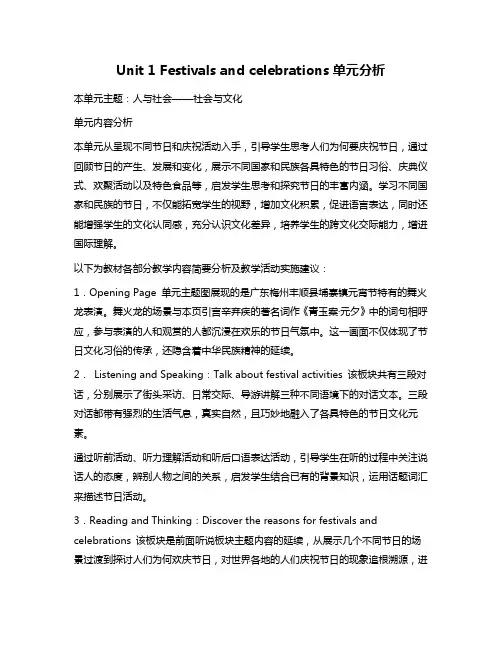
以下为教材各部分教学内容简要分析及教学活动实施建议:1.Opening Page 单元主题图展现的是广东梅州丰顺县埔寨镇元宵节特有的舞火龙表演。
舞火龙的场景与本页引言辛弃疾的著名词作《青玉案·元夕》中的词句相呼应,参与表演的人和观赏的人都沉浸在欢乐的节日气氛中。
这一画面不仅体现了节日文化习俗的传承,还隐含着中华民族精神的延续。
2.Listening and Speaking:Talk about festival activities 该板块共有三段对话,分别展示了街头采访、日常交际、导游讲解三种不同语境下的对话文本。
三段对话都带有强烈的生活气息,真实自然,且巧妙地融入了各具特色的节日文化元素。
通过听前活动、听力理解活动和听后口语表达活动,引导学生在听的过程中关注说话人的态度,辨别人物之间的关系,启发学生结合已有的背景知识,运用话题词汇来描述节日活动。
3.Reading and Thinking:Discover the reasons for festivals and celebrations 该板块是前面听说板块主题内容的延续,从展示几个不同节日的场景过渡到探讨人们为何欢庆节日,对世界各地的人们庆祝节日的现象追根溯源,进而谈论节日的传承与发展变化,目的在于启发学生的深层思考,体会节日文化的内在实质,感悟世界各国人民共同的精神追求和美好愿望。
新人教版必修三Unit1Festivalsandcelebrations课件

a festival of the dead(亡灵节)
Some Chinese traditional festivals
Festival of Lanterns Children’s Day
National Day
B
Easter Festival
B
Brainstorming
festivals of foreign countries
Thanksgiving Day
Easter
Christmas
Carnival
festivals
Father’s Day
Mother’s Day Valentine’s Day
all over the world.
Discussion :
1.Tell your friends your favorite festival and your reason .
2.Should we, Chinese students, celebrate western festivals like Christmas? Why or why not ?
6 Which of the following festivals is not celebrated in Japan? A Easter B. Oal D.
Mid-autumn Festival
7.What’s the main idea of the passage? Give one sentence to describe it.
Dragon Boat Festival
New Year’s Day
人教版高中英语必修3 unit1 Festivals around the world 课件
Mexico
Halloween
western countries
Dragon Boat Festival
China
Festivals to Honor People
Columbus Day
USA
Festival to Honor Gandhi
India
Harvest Festivals
Thanksgiving
Unit 1 Festivals around the world
Spring Festival Christmas
Unit 1 Festivals around the world
Tibetan New Year
Unit 1 Festivals around the world
Task 1
Scanning
Easter and some western
carnivals
countries
Cherry Blossom Japan Festival
Kinds of Festivals
Names of Festivals
Countries
Obon
Japan
Festivals of the Dead
Day of the Dead
A. 生病 B. 发疯
C. 受伤 D. 挨饿
2.Which one is used to honour someone?
A. Spring Festival
B. Thanksgiving
C. Dragon Boat Festival
D. Mid-autumn Day
3. Which of the following is not mentioned?
人教新课标必修3 Unit 1 Festivals around the world Reading 课件(共38张PPT)
1)How do Japanese honour their ancestors?
They have a festival called Obon, when people should go to clean graves and light incense to honour their ancestors. They light lamps and play music.
Christmpasossible. Now Father's Day let’s read theApril Fpooal’ssDsayage and shMoodtwhteiortf’shgoDefteahireyetttrrhhapmeneenkoosptrrloeeerklaoiinvsnedofsnosromffaoftreiotshnti…evamab…l.osuatnd
Words Review
grave incense in memory of Mexico
feast skull bone Halloween belief dress up
n. 坟墓;墓地 n. 熏香;熏香的烟
纪念;追念
n.墨西哥(拉丁美洲国家) n. 节日;盛宴 n. 头脑;头骨 n. 骨;骨头 n. 万圣节前夕;诸圣日前夕 n. 信任;信心;信仰
4) Compare the festivals of the dead in Mexico, Japan and China. which aspects are similar and which are different?
The Chinese, Japanese and Mexican festivals of the dead all have customs to honour the dead. The Chinese and Japanese go to clean their ancestors’ graves, and the Mexicans offer food, flowers and gifts to the dead. However, there are some dpecial food that looks like bones, something the Chinese and Japanese do not do.
高一英语(人教版)-必修三-Unit-1-Festivals-and-Celebrations
5. What was the best part of the festival?
Activity 1
• Song Lin and Max are talking about a recent festival experience. Listen to their conversation and answer the questions. (P7 Ex.1)
• Song Lin and Max are talking about a recent festival experience.
What topics might be covered in the conversation?
✓ Activities; ✓ Food; ✓ Feelings; ✓…
2. What did Max do during the festival? activities
Listen and check
• Listen to this part and find out the answer to the question.
Song Lin: Good for you! So what did you do when you arrived home? Max: Well, first I helped decorate the Christmas tree and put presents under it. Then I helped my mum prepare for the family dinner on Christmas Eve.
Review
• Why are festivals important in our life?
Festivals … ✓ are occasions that allow us to relax and enjoy life, and forget about
高一英语人教版必修3 unit 1Festivals around the world
Brainstorming
How many festivals do you know in China?
In China
The Spring Festival
The Double Ninth Festival
Spring Festivals: Fill in the blanks.
Festivals Spring Festival Carnivals
Activities Eating good foods; giving children
_lu_c_k_y_ money; _d_r_a_g_o_n__ _d_a_n_c_e_s__ and
To honor Ganhdi who helped gain Indian’s independence from Britain.
4. How do Europeans celebrate Thanksgiving festivals?
Decorate churches and town halls with flowers and fruits; people get together to have meals.
Festivals Activities
Obon
The Day Halloween
of the Dead
Cleaning Eating
Children
_g_r_a_v_e_s; cakes with _d_r_es_s__u_p
lighting _b_o_n__e_s on _i_n_c_en__se_ them; and lamps; offering