
人教版英语八年级下册 Unit 10 Section B 阅读
Words & expressions
nowadays adv. 现今;现在;目前 search v. & n. 搜索;搜查 among prep. 在(其)中;……之一 crayon n. 彩色铅笔(或粉笔、蜡笔) shame n. 羞耻;羞愧;惭愧 regard v. 将……认为;把……视为 count v. 数数
fun time with friends Zhong Wei feels w__a_r_m___ when he thinks of his
hometown that holds his childhood memories.
2b Underline the words in the passage. Then match them with the words in 2b.
Para 1
Changes in hometowns
Para 2&3 Things never change
Para 4
Facts of Chinese who leave hometowns
Careful Reading: Para 1
1.Read Part 1 and finish the chart
里学会了读书和数数co。unt at my old primary school. 7. 自从20世纪中期 since mid-20th century 8. 建一所新学校 build a new school
9. 他认为如此的发展是好的。
He thinks such developments are good.
hold v. 拥有;抓住
On Chinese New Year's Eve many people who work outside all year round return home to spend Spring Festival with family members.
Q1:Why do millions of Chinese leave the countryside every year?
search for work
寻找;搜索
Many people leave their hometown to earn more money in the cities.
study
Leaving home for educational purpose has become very familiar with students, especially who come from the countryside.
2c
Complete the summary with words from the passage. You may need to change the
forms of the words.
Many Chinese people these days leave their h__o_m_e_t_o_w_n_s_ to work in the __ci_t_ie_s___. They usually _r_e_t_u_r_n_/_g_o__b_a_c_k_ to their hometowns one or two times a __y_e_a_r_. Zhong Wei hasn’t been back in close to three years. He has been working in a __c_r_a_y_o_n__ factory in Wenzhou for the past 13 years.
hometown that holds his childhood memories.
Careful reຫໍສະໝຸດ dingPara 4 Things never change
3. What do these memories refer to(指的是)?
His happy childhood
a big old tree
the following words and phrases:
now/today
look for in the middle/midst of go back nearly
Tip(温馨提醒): Read
carefully and pay attention to
the context(上下文语境).
Unit 10
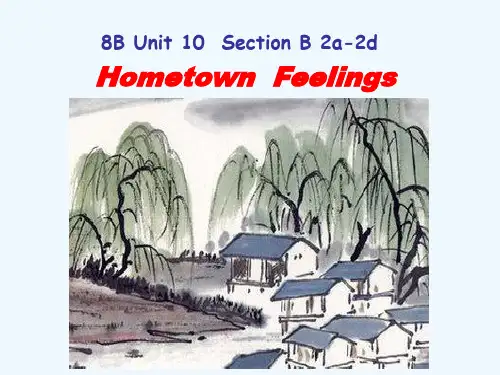
Hometown Feelings
To master the important words and expressions in this passage and review the Present Perfect Tense;
Try to guess what a text is about by using what we already know;
People like him are __in_t_e_r_e_st_e_d__ in how their hometowns are changing. New buildings are often built by the _g_o_v_e_r_n_m__e_n_t. Zhong Wei thinks these changes are _g_o_o_d__ because things need to change in order to become better. But he also thinks some things _w/_wi_l_ol _nn_’et_v_e_r change, and his hometown is still the place that holds all his childhood _m__e_m__o_ri_e_s__.
10. 总是保持一样 always stay the same 11.根据 according to
12. 在我的故乡 in my hometown
13. 这个地方的象征 a symbol of the place
14. 尤其在暑假es期pe间cially during the summer holidays 15. 是如此幸福的童年It .was such a happy childhood. 16.我们的故乡在我们的心里
1. 到城市寻早工作 search for work in the cities 2. 一个46岁的丈夫与父亲
a 46-year-old husband and father
3. 一年至少一次 at least once a year 4. 在许多地方 in many places 5. 从城市派老师来帮sen助d teachers from the cities to help 6. 孩子们已经在我的旧Ch小ild学ren have learned to read and
A. 离开 B. 带走 C. 留下 D. 遗忘
Careful reading
Para 4 Things never change
3. What do these memories refer to(指的是)?
His happy childhood
a big old tree
fun time with friends Zhong Wei feels w__a_r_m___ when he thinks of his
_a_n_d__n_e_w__sc_h_o_o_l_s_have appeared.
teachers
The government __h_a_s_s_e_n_t___ teachers from the cities __to__h_e_lp____.
students Students _h_a_v_e_l_e_a_rn__ed_ to read and c_o_u_n_t
How often does he return at least once a year home?
Para 2&3
Great Changes of Their Hometowns
buildings Perhaps l_a_r_g_e_h_o_s_p_i_ta_l_s_, __n_e_w_r_o_a_d_s____
adv. 尤其;特别;格外
Predicting What is the passage about?
Title: Hometown feelings
changes
The feelings to the changes of hometown
Fast reading
Match each part with the main ideas.
Name
Age Work place How long has he lived there? How often does he go homes?
Tip(温馨提醒): Read
carefully and pay attention to
the details(细节信息).
2. Find the expressions in Para 1 that have the same meanings as
留下了许多温柔和甜美的回忆。
Our hometown has left many soft and sweet memories in our hearts.
Retelling:
People and their
hometowns
Many Chinese people leave …to…. Zhong Wei hasn’t …. He has been working ….
search for return regard (v.) places development according to (prep.) opposite (prep.)
2020年人教版八年级下册英语练习题 Unit 10

初中英语·人教版·八年级下册——Unit10I’ve had this bike for three years.Unit10I’ve had this bike for three years.Section A基础闯关全练拓展训练Ⅰ.根据句意及首字母提示写出所缺的单词1.The old things bring back some s memories.2.I bought the gift for only90c.3.—The b games are good for the children.—I agree with you.4.—Why not get your mother a s on her birthday?—That’s a good idea.I’m very glad to receive your e-mail.Great changes have1taken place since you left.Our living conditions are getting better and better.Villagers have moved into big and comfortable2,and many live in well-equipped blocks of flats.Almost all have been equipped with telephones.They have3not only color TV sets,but also washing machines,fridges,etc.Wide roads have been built to connect villages and towns.Some families4their own tractors,trucks or even cars.Besides,children can now enjoy very good education.Our government cares very much5the reconstruction of our countryside.We are speeding up the citifying(城市化)of the villages.I hope that you and Aunt will come back and have a visit to the new village.Best wishes.Yours,Lin Xue 1. 2. 3. 4. 5.Ⅲ.单项选择1.(2018湖南湘潭中考)My cousin100model planes since2015.A.collectsB.is collectingC.has collected2.(2018山东青岛市北区期末)Tom is honest boy.He likes playing board games.A.a;theB.a;/C.an;theD.an;/3.(2018山东青岛中考)It’s my daughter’s birthday today.She’s years old.A.eighteenB.eighteenthC.the eighteenD.the eighteenth4.(2019湖南岳阳中考)The toys are really old,I still want to keep them.A.orB.andC.but5.(2019河南漯河郾城区期末)—Kids often feel better in a happy family.—That’s true.A happy family provides a loving for their children.cationB.environmentC.experienceD.direction能力提升全练拓展训练Ⅰ.情景交际(2019广西玉林中考)从方框中选择恰当的句子补全下面对话。
英语人教版八年级下册u10 sectionB 2a-2d
interested in how their People like him are _________ hometowns are changing. New buildings government Zhong are often built by the ___________. good Wei thinks these changes are _____ because things need to change in order to become better. But he also thinks some (will) never change, and his things ___________ hometown is still the place that holds all memories his childhood _________.
shame
How is Zhong Wei’s old primary school now?
since 1950
Para. 4
soft and sweet
What things will never change? BCD • A. The old school. • B. The symbol of the place • C. The happy childhood • D. The soft and sweet memories
Nowadays, millions of Chinese leave their countryside for cities. With hard jobs, they hardly ever return home. They feel sorry. They think it’s a shame. They miss their hometowns. They regard with great interest how their hometowns have changed. According to them, they spent such a happy childhood in their hometown and their hometown has left many soft and sweet memories in their hearts.
英语人教版八年级下册unit10-sectionB-2a-2d(共27张PPT)

Reading:
Hometown Feelings
My hometown—Dazhou Enjoy the song
THaokme emtoewhnoims ea,rceoaul ngtrreyat place for ruosa. dNso matter where we have moved and ho--w-bfyarJoahwnayDewnevaerre. we can't get away from homesickness (乡愁). DWoeygoeutlhikoemtheissicskon(g想? 家的) because Wthehraet’sariteasboomute?things that we love.
some things will never change.
across
“In my hometown, there was a big from
old tree opposite the school. It is in one’s still there and has become quite a opinion symbol of the place. …
After reading: Listen and read the passage
Complete the summary with words from the passage. You may need to change the forms of the words.
Many Chinese people these days leave their _h_o_m_e_t_o_w_n_ to work in _c_i_ti_e_s__. They usually _r_e_tu_r_n__ to their hometown one or two times a _y_e_a_r__. Zhong Wei hasn’t been back in close to three years. He has been working in a _c_r_a_y_o_n__ factory in Wenzhou for the past 13 years.
人教版英语八年级下册unit10知识点总结

Unit 10 I ’ve had this bike for three years。
Section A1. for +一段时间表示动作持续一段时间,用于现在完成时2。
keep (kept ;kept)保留*用作系动词,保持(某种状态),其后常接形容词作表语。
Please keep quiet / silent! 请保持安静!*用作实义动词(1)保管;保存;保留Please keep these things for me while I am away.(2)赡养;饲养I used to keep sheep in my childhood.(3)坚持;继续接V-ing 形式作宾语。
If you keep practicing your spoken English,you'll soon make great progress.(4)阻止;阻碍keep sb/sth from doing sth 其中介词from 不能省略The heavy rain didn’t keep them from watchin g the football match.(5)保持其后常接复合宾语,表示使(某人或某物)保持某种状态或使某一动作继续。
① keep + sb/sth + 介词If your hands are cold, keep them in your pockets。
② keep + sb/sth + 形容词These gloves will keep your hands warm。
③ keep + sb/sth + V—ing ,“让某人/ 某物一直……”,强调动作的持续性。
I’m sorry I've kept you waiting. 很抱歉,让你久等了.keep a record 保持记录,keep in touch (with)保持与……的联系keep out (of)把……关在外面keep up 保持;使……不能入睡keep one's / an eye on密切注视keep away (from) 离开keep in mind 牢记keep one’s word 遵守诺言3。
人教版八年级下册英语 Unit 10 课时2 Section A (3a-3c) (2)

E. ThentheysitaDlld. aTyhweayitipnugtfotrhseommeoountestoidtaekethemh
their houses.
Ittellswhenandwheretheyar dsalewilltakeplace. Earlyinthemorning, peopletaketheirthingsoutoft hehouse. _____29
unior
4. TheworkersarebuildinganewrfromaBilewijaiyngtoGuangzhou. 5.【2021·新疆】
Bobissuchanhboythatallhisfriendstrusthimalot. onest
二、用括号内所给词的适当形式填空。
6. Myparents___________ (own) asmallrestaurant, owned
ewasnothingwrong.
五、阅读理解。
21. HowoldisLisa? C A. Five. B. Nine.
C. Fourteen. D. Sixteen.
【点拨】根据原文句子 IgotthismusicboxonmyninthbirthdayandI’vehaditforfi veyears.可知答案。
___________________________, welikeMr. Tobehonest
Liu’sclassesverymuch.
20. 那位老师查看了电脑,确保它没有问题。
Theteacher__________________thecomputertomakesurether checkedout
D 25. Whatcanweknowfromthepassage? A. Lisa’sfathersentthemusicboxtoher. B. Mikewantstobeascientist. C. Pauldoesn’tlikehistoycar. D. Judymayfeelsadtopartwithhertoybear.
人教版八年级英语下册Unit 10 晨读本

Unit 10 I've had this bike for three years.Section A重点单词➢朗读下列单词。
1. *yard [jɑ:d] n. 院子2. *sweet [swi:t] adj. & n. 甜的,糖果3. memory [ˈmemərɪ] n. 记忆,记忆力,回忆4. *cent [sent] n. 分,分币5. *toy [tɔɪ] n. 玩具6. *bear [bɛə] n. 熊7. *maker [ˈmeɪkə(r)] n. 生产者,制造者8. *scarf [skɑ:f] n. 围巾,披巾,头巾9. *soft [sɔft] adj. 柔软的10. check [tʃek] n. & v. 餐馆账单;检查11. *board [bɔ:d] n. 板子,甲板12. *junior [ˈdʒu:nɪə(r)] adj. 地位低下的13. clear [klɪə] v. 清除,清理14. *bedroom [ˈbedru:m] n. 卧室15. own [əun] v. 拥有;有16. *railway [ˈreɪlweɪ] n. 铁路,铁道17. part [pɑ:t] v. 离开;分开18. certain [ˈsə:tn] adj. 某一,确定的,无疑的19. honest [ˈɒnɪst] adj. 诚实的,正直的20. while [wail] conj. 当...时候,一段时间,一会儿21. *truthful [ˈtru:θfl] adj. 诚实的,真实的22. hometown [ˈhəʊmtaʊn] n. 家乡,故乡➢朗读下列单词变形。
1. sale (名词)—sell (动词)2. toy (名词)—toys (复数)3. make (动词)—maker (名词)4. junior (形容词)—senior (对应词)5. own (动词)—owner (名词)6. certain (形容词)—certainly (副词)7. honest (形容词)—dishonest (反义词)—honesty (名词)8. true (形容词)—truth (名词)—truthful (形容词)—truly(副词)9. sweet –candy (同义词)—sour(对应词)10. scarf—scarfs /scarves (复数)11. hard—soft(对应词)重点短语➢朗读下列短语。
人教版英语八年级下册Unit 9 - Section B教材全解知识点课件
上课时间: 老师:
1b
• For thousands of tourists from China, this small island in Southeast Asia is a wonderful and safe place to take a holiday. (1)thousands of意为“数以千计的;许许多多的“ thousand数词,意为“一千”,当表示一个确切的数目时, thousand前面有具体数字,其后不加-s,不和of连用 若表示一个不确切的数目,thousand前面没有具体数字, 其后要加-,且与of连用。 Thousands of tourists come to visit the Great wall everyday. There are about six thousand students in our school.
2b
• For thousands of tourists from China, this small island in Southeast Asia is a wonderful and safe place to take a holiday. (1)thousands of意为“数以千计的;许许多多的“
a half 二分之一
one sixth六分之一
two thirds 三分之二
2b
• On the one hand, more than three quarters of the population are Chinese , so you can simply speak Putonghua a lot of the time. On the other hand, Singapore is an English-speaking country, so it's also a good place to practice your English ! (2)three quarters意为“四分之 三”,其中quarter用作可数名词,意 为“四分之……” [拓展]分数作主语时,谓语动词的单复数一般要与分数后面的名词 的数保持致。若名词为可数名词复数形式,谓语动词用复数形式; 若名词为可数名词单数形式或不可数名词,谓语动词用第三人称 单数形式。
Unit10SectionB以读促写教学设计教案人教版英语八年级下册
(以读促写教学设计I’ve had this bike for three years.”)(第一课时)本课属于“人与自我”主题范畴,涉及“生活与学习中身边的事物与环境”。
语篇Section B, 2aHometown FeelingsMany people choose to leave their towns and villages to search for work in the city. Among these people is Zhong Wei, a 46yearold husband and father. He has worked in Wenzhou for almost 13 years. With a busy job in a crayon factory, he doesn't have time to return to his village often. On a recent visit, he said,“It's a shame that I had to leave my hometown. I've always wanted to move back. It has improved so much since I left."Nowadays, more and more hometowns are changing for the better. Large hospitals and new schools have appeared. And in many places, the government has also built new roads and bridges. This has made traveling between villages, towns, and cities much easier. Thanks to the new roads around his village, Zhong Wei will now be able to open an online shop that sells delicious food from his hometown.Zhong Wei also likes the new school in his village. “The old school opened in the middle of the last century," said Zhong Wei.“The classrooms we used to read and count in were really small. Now there's a pletely new school with a big library. Some city schools have also sent teachers to help out."Zhong Wei regards such developments as important steps for his hometown. According to him, however, one thing will never change. "In my hometown, there is a big old tree opposite the school. It has bee quite a symbol of the place. When I was young, my friends and I liked to play under that big tree, especially in the summer. We had such a happy childhood. Our hometown has given us so many great memories."教学设计理念This class adopts taskbased teaching method and municative method under the concept of unit holistic design, and creates a real situation in which everyone has something to sell according to key petency advocated by the English Curriculum Standard for pulsory Education (2022 Edition) and the cognitive level of eighth grade students based on Bloom’s classification of cognitive learning objectives.教学目标通过本课的学习,学生能够:Language petence:1.Understand and master the words: look for, consider, across from go back, changes, area and so on.2.Master the sentence patterns of present perfect tense.3.To write an article about hometown’s changes.Cultural awareness:1.Let students understand the life of migrant workers in cities and respect their labor andcontribution to urban development.2.make students think about the impact of changes in their hometowns and society, and to valuethe changes in things around them.Thinking quality:1.To accurately obtain and express information about hometown’s changes and favorite old things.2.Develop students’ ability of writing in English, so that students can write position to achieve the purpose of munication.Learning capacity:To develop good learning habits and use strategies such as mind map and recording key information to improve learning efficiency.教学重难点Key points: Master the words, phrases, sentence patterns and the structure of the passage. Learn to use these correctly in their writing.Difficulties: To practice more sentences by using the present perfect tense with “since” and “for”.教学过程分析教学过程教学过程设计意图:To create relaxing atmosphere at first and make use of pictures and conversations to设计意图:To get a overview about the passage before reading tasks so that students can linguistically and thematically prepare for the reading task.设计意图:To develop students’ writing skill and check their understanding of the expressions.设计意图:Offer students chances to produce their own language and consolidate the new language in context and make use of the target language to write an essay.作业布置板书设计Unit 10 I’ve had this bike for three years。
【初中英语】人教版八年级下册Unit 10 第4课时分层训练(Section B2 2a—2练习题
人教版八年级下册Unit 10 第4课时分层训练(Section B2 2a—2d)(1022)1.(根据)the ne w tr a ff ic la w,pe o p le mu stn't d r ive a f te r d r in k in g wine.2.H o w d o yo u lik e th e mo vie la s t n ig h t? (改为同义句)d o yo u the mo vie la s t n igh t?3.Th e re is a d ru g s to re o pp o s ite th e sc ho o l.(改为同义句)T h e re is a d ru g s to r e the s ch o o l.4.H e h a s live d in C h ina f or n e ar ly 13 y ear s.(对画线部分提问)h a s h e live d in Ch in a?5.I b o ug h t the b o ok in th e mid-20th ce n tu r y.(用s in c e改写句子)I the bo o k th e mid-20th c en tu r y.6.We s pe n t su ch a h app y c h ild h o od th a t we wo u ld n't f o rg e t it f o reve r.(改为同义句) We sp e n t tha t we wo u ldn't f o rg e t it f or e ve r.7.—Time pa s t ca n no t b e c a lle d b ac k a ga in.—Ye s.Wa s ting time is a .()A.p r e s su r eB.f a irn e s sC.ch o iceD.sh a me8.In th e ir c o un tr y,re d is re g a rd ed a s ymb o l o f g oo d lu c k.()A.a sB.fo rC.withD.o f9.H e is in te r e s te d in all k in d s o f sp o r ts,s k a tin g.()A.h a r d lyB.es p ec ia llyC.ne a r lyD.c o mp le te ly10.—D o yo u kn o w ?—We ca n tr y to p r od uc e le s s wa s te,r e us e o r r ec yc le th in g s.()A.wh y c a n we live a gr e e n lif eB.ho w ca n we live a gr e e n lif eC.wh y we c an live a gr e e n lif eD.h o w we ca n live a gr e e n lif e11.M r.S mith is a s u c c e s s fu l ma n.H e is ve r y r ic h.H e live s in a b ig c ity n o w.La s t mo n th he c a me b a ck to h is h o me to wn.22 p e op le kn e w h im bec a u se h e le f t th e r e wh en h e wa s a c h ild.A nd wh e n he s to pp e d ne a r a23 ho u s e h e s aw a n o ld wo ma n s itting in the su n en jo yin g he rs e lf.H e r 24we re c lo s ed a n d sh e d idn't n o tic e the r e wa s a ma n lo o k ing a t h e r c a re f u ll y.“Au n t!” M r.S mith c a lle d ou t.“Au n t!” T h e o ld wo ma n d id n't b e lie ve h e r n ep h e w(侄子) h a d c o me to s e e he r.Sh e wa s ve r y g la d a nd ex c ited.Tea r s(泪水)25 h e rf a c e.Th ir ty ye a r s! It wa s f o r th ir ty ye a r s t h a t sh e ha d n't s e en h im.A s a26 b o y in th e s ma ll villag e he wa s a lwa ysh u ng r y a n d h ad little f o od to e at.S o h e we n t to th e c it y to f in d a27 .He d idn't c o me b a c k a f te r th a t.So h e cou ld n't s e e h is p a r en ts or h is a un t 28.M r.S mith on ly h a d a29 ho lid a y.H e a s ke d s o me n e ig hbo r s to re p a ir h is a u n t's s ma ll o ld h ou s e.He ne ve r f o rgo t h is te a ch e r M r.G r e en wh o o f te n h e lp ed h im 30 h e g o t in to tr o ub le.S o h e wen t to th e sc ho o l.“31I s e e M r.Gr e e n, s ir?” h e a s ke d an o ld ma n a t th e sc h oo l g a te(门口).“S o r r y,yo u c an't,”a n s we r e d th e o ld ma n.“Bu t wh y? Wh a t h a ppe n e d to h im?”“He d ie d two ye a r s a go!”M r.S mith fe lt ve r y s a d wh en h e he a r d the ne ws.Wh a t a p ity! H e c ou ld ne ve r sa y th a n k s to M r.G re e n.(1)A.M a n yB.Lo ts o fC.A fe wD.Fe w(2)A.s ma llB.b igC.n ic eD.b e au tif u l(3)A.e yeB.mo u thC.e ye sD.mo u ths(4)A.ru n d o wnB.r an d o wnC.ru n a wa yD.ra n a wa y(5)A.twe lve-ye a r-o ldB.twe lve-ye a r s-o ldC.twe lve ye a r s o ldD.twe lve ye a r o ld(6)A.wo r kB.job sC.jobD.wo r k s(7)A.a n y lo n g e rB.no lon ge rC.no t mo r eD.n o mo r e(8)A.we e kB.wee k'sC.wee k sD.we e k s'(9)A.wh e r eB.ho wC.whe nD.wh ile(10)A.C anB.S h a llC.WillD.M u s t12.With a s ma ll c a me r a, a 25-ye a r-o ld b o y, Wa ng Tian c he ng h a s tr a ve le d a r ou nd 30 c o un tr ie s with h is f r ie nd s.O ve r th e pa s t 10 ye a r s, h e h a s ta ke n mo r e tha n 100,000 ph o to s o f tr a ins in n ea r ly 30c o un tr ie s a n d a r ea s,in c lud in g In d ia,M a la ys ia,Mo ng o lia, Ru s s ia a n dT h a ilan d…In 1995, Wan g Tia n che n g wa s b o rn in D aq ing, He ilo n g jian g.H e d e ve lo p ed h is in te r e s t in tr a in s f r o m h is c h ildh o od.“E ve r y mo n th, m y p a r e n ts to o k me to vis it my g r a n d p a r en ts b y tr a in wh o live d in an o th e r c ity a b ou t 300 kilo me te r s a wa y,” h e s aid.“I wa s a lwa ys too e x c ited to f a ll a s lee p be f o r e th e tr ip.I f e e l s o luc k y th a t my p a r e nts h a ve tr u s ted me a n d g ive n me f r e ed o m(自由)s in c e my c h ild h o od.T h e y a ls o su p po rt(支持)my id e a s.”A r ou nd2005, Wa n g ma d e f r ie n ds with tho s e wh o sh a re d th e ir in ter e s t in tr a in so n lin e.A f te r th a t, he be ga n h is ne w lif e o f c o lle c ting tra in in f o r ma tio n.Wan g tr a ve le d with h is f r ie nd s.A t f ir s t, h e ju s t to ok g ood-lo o k in g p ic tu re s.B u t la te r, h e p a id mo re a tte n tio n to wh a t's b e hin d th e ra ilwa y, a n d e xp l or e d th e re la tio n sh ip a mo n g the tr a in, time a n d p eo p le.H is ph oto g r a ph y(摄影技术)sk ill h a s b e en mu c h b ette r.With the s ma ll c a me r a,he ha s tak e n o ve r100,000 me a n in gf u l p ic tu re s.Wa ng s tud ie d h a rd a t Zh e jia n g U n ive r s ity.H e wa s po pu la r b e c au s e o f h is o u ts tan d in g p e r f o r ma n ce a t s c ho o l.He's b u s y p r e p a r ing f o r f u r the r s tu d y, b u t ta k in g ph o tos o f tr a ins h a s b e co me p a r t o f h is lif e.O ve r th e ye a r s, h e h a s fa c ed ma n y c h a lle n g e s, su c h a s d an ge r f r o m a n ima ls in th e wild a nd po o r we a the r an d b a d tr a ff ic co n d itio n s.“Tr a in s a r e a s ymb o l o f h is to r y,” Wa ng sa id.“I will n e ve r s to p my s t u d y o f ra ilwa y c u ltu r ea n d I ho p e to d e ve lo p mo r e to p ic s in the f u tu r e.”(1)Wan g Tia nc he n g wa s wh e n h e s ta r ted c o llec tin g tr a in in f or ma tio n.()A.14B.12C.10D.8(2)Ac c or d ing to th e pa s s a ge, Wa n g Tian-c he n g h a s e ve r be e n to .()A.J a p anB.S in ga p o reC.A me r ic aD.R us s ia(3)Th e u n de r lin ed wo rd“ex p lo re d”me a n s “” in Ch in e se.()A.研究B.参加C.查看D.保护(4)W h ic h se n ten c e is TR UE a bo u t Wa n g Tian c h en g?()A.H is g r an d pa r en ts live d in a villa g e in Daq in g.B.H e lik ed ta k in g a tra in whe n h e wa s a c h ild.C.It's e a s y f o r h im to ta k e p ic tu r es o f tr a in s a n ywh e r e.D.He s tud ie d in f o r ma tio n o f tr a in s in the unive r s it y.(5)W ha t ca n b e th e b es t title o f the pa s s ag e?()A.A c h a llen ge o f ta k in g p h o to s o f tr a in sB.A h a pp y tr a ve le r th r o u gh30co un tr ie s an d a r e a sC.A 25-ye a r-o ld b o y's wo n de r f u l d r ea mD.Ne ve r s to p ta k in g ph o to s o f tr a in s13.A re c en t s tud y in Au s tr a lia sh o ws th a t par e n ts a re a th e to p f ive wo r ld's h a r d e s t jo b s.14.—H o w ma n y a p p les a r e th e r e in the ba s ke t?—I d o n't k n o w.Le t's c th e m.15.You mu s t h my h a nd, o r yo u ma y g e t lo s t.16.T he y (搜寻)for th e los t s he e p in the f o r e s t a n d f in a lly f o un d it.17.I s p en t my e a r ly (童年) in my h o me to wn.18.P a u l h a s f o un d a ne w jo b a nd is (考虑)mo vin g to a n e w fla t n e a r h is c o mp a n y.19.Mo s t o f th e c h ild r en(在我的时代) lik e d to p la y to g e th e r.20.(数百万的) C h in e s e le a ve the co u n tr ys id e to s e a rc h fo r work in th e c itie s.21.H e h as f in ish e d h is h o me wo r k (到目前为止).22.I wr o te (接近) f if t y in vita tio n s th is mo r n in g.23.It to o k h im two days to(返回他的故乡).参考答案2.【答案】:What;think;of3.【答案】:across;from4.【答案】:How;long5.【答案】:have;had;since6.【答案】:so;happy;a;childhood7.【答案】:D【解析】:考查名词辨析。
课时练八年级下册英语人教版Unit 10 Section B 试题试卷 含答案解析(1)
Unit10I've had this bike for three years.Period5(Section B3a-Self Check)一、阅读理解Most cities and towns in China have night markets.They usually take place on the same streets every day.During the day,these streets are quiet.At night,they become ually, people arrive at three or four in the afternoon.By6:00,the streets are like rivers of people.Night markets are fun places to shop.Sellers put their things on the street.You can buy clothes,shoes,and many other things.If the price is too high,you can bargain(讨价还价)with the sellers.You can also buy lots of delicious food.When you are just a little hungry,you can buy snacks(零食).When you're really hungry,you can sit down for a meal.There are also games to play.In one game,you throw plastic(塑料的)rings around the top of a bottle.In another game,you shoot balloons(气球)with a toy gun.If you are lucky,you can win a prize.Do you like to play these games?Do you like to win anything?Everything at night markets is cheap!You don't need a lot of money to have a great time.()1.We can find night markets________.A.only in the countryside B.in every town in ChinaC.in a supermarket D.in most cities and towns in China ()2.When do night markets become busy?A.In the morning.B.At12:00at noon.C.At6:00in the evening.D.Only on weekends.()3.What can you do if you think the price is too high?A.Bargain with the seller.B.Shout at the seller.C.Tell the police.D.You can't do anything.()4.How do you win a prize?A.By buying a snack.B.By buying balloons.C.By playing a game.D.By drinking something from a bottle.()5.Which of the following is NOT true about night markets?A.There are many things to eat.B.Everything is expensive.C.People can bargain with sellers.D.You can buy lots of different things.二、根据短文内容和所给汉语提示,在空白处写出单词的正确形式,每空一词One morning on my way to work,I saw a little girl carrying a beautiful Hello Kitty schoolbag 1________(在其中)the students.I could imagine that she must love her schoolbag.It was so big that it held lots of things.Since it had two2________(轮子),it was easy to carry.I remembered my first schoolbag was a green cloth(布)bag.Its maker is my mom.It 3(花费)her a week to make it.At that time,my schoolbag was so light.When I jumped, it jumped.All things in it gave out cheerful sounds all the way along.As I went to4________high school(初级中学),my schoolbag became heavier and heavier. After a long5________(一段时间),it lost its color.Finally it came to an end.My mother bought me a new schoolbag.It had a few pockets(口袋)and either side of the schoolbag could carry something.I6(把……视为)it as my best friend.To my7(惭愧),I lost it when I was playing in a park two years later.8________(尽管)my first schoolbag was small,it was made by my mother9________(她自己).It's the real Hello Kitty schoolbag in my heart.I put it in a nice box.Every time I take it out to have a look,10(甜蜜的)memories come back.三、语法填空阅读下面短文,按照句子结构的语法性和上下文连贯的要求,在空格处填入一个适当的词或使用括号中词语的正确形式填空(每空不多于3个单词)。