
上海教育版英语六年级下册Unit 10《Great storybooks》word教案
6B Unit 10 Great storybooks单元教学目标:1能在语境中正确运用本单元的核心词汇,复习已学相关核心词汇.2 能简单介绍自己喜欢的经典故事或名著.3 初步了解句子语调的基本知识,能用正确的语调朗读句子.4了解著名童书的相关背景,培养阅读的兴趣.教学重点:1 词汇学习:blow off, take off2 句型复习:Andersen wrote the stories.Children around the world enjoy reading his stories.3 语音学习:初步了解陈述句、一般疑问句和特殊疑问句的语调.教学难点:1 经典故事或名著中人名、书名等的发音.第一课时教学目标:学生能运用适当的阅读策略,了解三本童话书及其作者.学生能介绍和评价自己所喜欢的经典故事,并且能够复述课文.运用百科全书或网络等资源查寻有关安徒生、格林兄弟及伊索的作品,师生相互交流.能善于抓住机会与同学交流合作,丰富知识.加强对西方著名作家及其文学作品的了解.通过本课的学习,引导、教育学生要多读书、读好书.通过读书吸收前人的智慧,不断丰富学识和提高自身素质.教学重难点:句型复习:Andersen wrote the stories.Children around the world enjoy reading his stories.教学方法与手段:本节课我采用导学自悟法,对话法进行教学.采用PPT课件,卡片,录音机作为教学辅助手段.使用教材构想:本节课学生在对课文进行整理,理解基础上,构建思维导图,并根据思维导图进行问答,介绍自己喜欢的作品.教学方法和过程:Pre-task preparations1 用图片的形式展示一些童书的封面,让形式试着说说这些书名,中英文均可.同时出示这几个作者的照片.T:(show the covers of the books)Look at these books. Did y ou read them?S1:Yes, I did. It’s Andersen’s Fairy Tales...T:(show some pictures of the writers)Do you know who wtote these books? These are the writes. Who is he?S2:He’s Andersen.学生尝试将人物图片和书配对.2教师说出答案,引导学生正确朗读每本书的名称和作者的名字,引出主题.T: Aesop’s Fables. Do you know who wrote it?S1:Aesop.T: Andersen’s Fairy Tales. Who wrote it?S2:Andersen.Grimms’Fairy Tales. Who were the writers?S3:The Grimm brothers....While-task procedures1 教师出示一些故事名称及Listen and say的后续练习,让学生根据已有知识先念一下故事名,并说说是谁写的.T:Here are some stories. Did you read any of these stor ies before?S1;Yes, I read “Snow White”.S2:I know “Cinderella.”T:Do you know who wrote these stories?Ss:No.T:Today we’re going to find out who wrote these stories .播放课文录音,让学生边听边看,了解课文大意.2 将学生分成三人小组,每人负责一段,先自行阅读,然后在小组中朗读,并将相关阅读信息告诉组员,其他学生核对正误,小组共同完成后续练习.T:Now read in groups. First, read it once or twice by yo urselves. Then read it to your group. Tell your group memb ers what stories the writers wrote.S1:(read Paragraph1)Andersen wrote “The emperor’s ne w clothes”and “The ugly duckling”.S2:(read Paragraph2)The Grimms brothers wrote “Snow White”,”Little Red Riding Hood”and “Cinderella”.S3:(read Paragraph3)Aesop wrote”The fox and the grape s”,”The wind and the sun”,”The farmer and the snake”.3小组内说完以后,教师请若干小组说说.接着让学生独立朗读课文,完成Listen and say的后续练习.然后让学生试着介绍三个作者及其作品.S1:Andersen was a Danish writer. He wrote Andersen’s Fairy Tales. “The emperor’s new clothes”and “The ugly duc kling”are from the book.4 提出问题,帮助学生进一步了解相关作家.可以采用思维导图的方法,让学生补充更多关于作者的信息,通过引导性问题帮助学生提取核心信息.Aesop was a famous writer.1)Where did he come from?2)What book did he write?3)What is the book about?4)Why is his book so famous?/Whydo people like his book?用同样的方式帮助学生了解Andersen和the Grimms brothers. Post-task activities1 学生通过上一个练习对作者有一个更具体的认识之后,教师可以运用思维导图作提示,帮助学生口头表达.每个学生选一位作家的思维导图,对该作者的作品等具体内容进行介绍.本练习按照学生的能力弹性处理,如果学生不能用核心词汇及句型组织语言,可以使用课文中的内容来介绍.S1:I want to tell you something about the writer Anders en. Andersen was a Danish writer. He is a famous book c alled Andersen’s Fairy Tales. In thisbook, there are many i nteresting fairy tales such as “The ugly duckling”and”The e mperor’s new clothes”.Children like reading these storiesa lot. I like ”The emperor’s new clothes”best.2 学生补充一下自己对作者或作品的认识.教师可鼓励学生通过网络等平台寻找更多关于作者的信息,帮助学生丰富主题内容的语言.板书设计:Unit 10 Great storybooksHomework1.Read “listen and say”two times .2. Collect some other stories of great storybooks.第二课时教学目标1. 通过阅读《伊索寓言》故事《风和太阳》,学习相关语言知识,感受诗歌语言的韵律和美.2. 通过完成课后练习,引发学生思考并理解故事的寓意.3. 通过Do asurvey的活动,帮助学生操练和巩固语言知识.4,通过学习学生懂得劝说比强迫更有效的道理.引导、教育学生要多读书、读好书.通过读书吸收前人的智慧,不断丰富学识和提高自身素质. 教学重、难点1. Words and Phrases:blow off take off2. Sentencesreview: I’ll blow off his clothes.3. Daily English :Let’s see. Your turn.Step One:Pre-task preparations1.Greeting.2. Free talkingT:Please introduce one of the writers.S1:I want to tell you something about the writer Aesop. He wrote Aesop’s Fables.In the book, there are many fables about animals.T:Good. Today we are going to learn a story from Aesop’s Fables. “ The wind andthe sun” Do you know anything about the story? Let’s learn it together.Step Two:While-task procedures1. Play the story(PPT)/Read the story /Answerthe questions(1)(Whichbook is the story from?(2) Who are in the story?(3)Who is stronger. Mr Wind or Mr Sun?(4)What can you learn from this story?2. Read again.( Answer the questions P65)Step3. Post-task activities1. Retell the story .One day, the wind met the sun. He thought he was _________ than the sun. But the sun did not think so.Mr Wind blew ________.Mr Sun made the plants ________.Mr Wind tried to _______ the man’s clothes. Mr Sun went behind a ________.The man felt ________ and he ________ his scarf.Mr Sun ________.It was Mr Sun’s turn.He began to _________.The man felt ______.He _________ his clothes and went __________.At last, ________ won.2.Act it out.Homework1. Tell the story to your parents .2. Read other stories you like .板书设计Unit 10 Great storybooksblow off take off吹掉脱下Put on 穿上第三课时教学目标:1 通过Do a survey的活动,帮助学生操练和巩固语言知识,相互了解同学最喜欢的故事;2通过Think and write的写作活动,帮助学生巩固和综合运用语言知识.3. 通过Learn thesounds 的教学活动,帮助学生了解句子的语调.2. 教学重、难点学习句子的语调.Step One:Pre-task preparations1.Quick responseT(show some pictures of the stories)S1:“The emperor’s new clothes”S2:“Snow White”S3:“The fox and the grapes”S4:“Cinderella”2 .Talk in groupsT: Did you read these stories ?Please pick out the ones you read and tell your group what the stories are about.S1: I read the story “The ugly duckling” It’s about an ugly duckling .He becomes a beautiful swan.S2:I read the story“The emperor’s new clothes”It’s about an emperor.He liked new clothes.He was silly.He walked in the street without any clothes.S3: I read the story“The fox and the grapes”. It’s about a fox.He wants to eat the grapes but he can’t get it.So he thinks that the grapes are sour.Step Two:While-task procedures1.T:What’s your favorite story?S1: My favorite story is…T:What’s the story about?S1: It’s about….T:Who wr ote this story?S1:…2.Do a survey.学生分组,根据以上方式进行问卷.S1:What’s your favorite story?S2: My favorite story is…S1:What’s the story about?S2: It’s about….S1:Who wrote this story?S2:…3.学生整理信息,汇报调查结果.4.Learn the sounds1)出示句子1.Are these pens ↗yours? Yes, they ↘are说明:向上的箭头表示升调,向下的箭头表示降调.2)播放录音,学生模仿.Step3. Post-task activities教师出示Think and write 的写作练习.让学生思考自己喜欢的故事. My favourite story is “…”It’s about …… wro te this story.板书设计Unit 10 Great storybooksMy favourite story is “…”It’s about …… wrote this story.HomeworkAsk your parents what their favourite stories are,then write them down.。
小学英语牛津上海版六年级下册《Module 4 Unit 10 Great storybook》教案
《Unit 10 Great storybooks》教学设计教学目标设计教学策略设计学习评价设计【主要内容】1. Check students ‘homework: read the name of the books and match the stories with the books.【评价反馈】小组评价【主要内容】1. Read and answer. The teacher asks students to read paragraph 1 and 2, and then answer the questions.2. Read and retell. Ask students to find the key words in Para 3 and 4, and then retell the test with your own words.3. Do a survey. Ask students to do a survey about the classmate’s favorite story and make a report.【评价反馈】1.教师评价2.学生评价【主要内容】1. Find some Chinese classical books and share to our classmate.2. Make a reading card about your favorite Chinese stories.【评价反馈】1.组长评价2.教师评价教学过程设计【激趣导入】 1.The teacher shows some pictures about students reading books in ourschool.2. Ask the question “What is he thinking about?” “Do you like reading?”“What kind of books does you like reading?”【设计意图】1.通过图片引出本课主题。
沪教版六年级英语下册Unit 10 Great story books教学设计
业 第二课 1. Copy the phrases for three times. (put on, take off, blow off)
设时
2. Make sentences (比较级)
计
第
第三课 Write down their favorite stories.
时
课题
教学设计续页
Unit 10 Great storybooks
教 1. 听说法,通过听录音,整体感知课文内容。
学 2. 多媒体课件,给学生一个直观形象的概念,帮助学生理解课文内容。
方
法
与
手
段
课时划分与分课时目标
板块 单元知识
整合与拓展的知识
教学目标 主题语境
Story 单 wrote
Danish Collected German
Listen 第
and say 一
3. 能谈论自己喜欢的故事和名著。
Unit 10 Great storybooks
1. Anderson was a ______ writer. He wrote _________________.
板书 设计
2. The Grimm brothers were _______ writers. _________, _________ and __________ are from Grimms’ Fairy Tales.
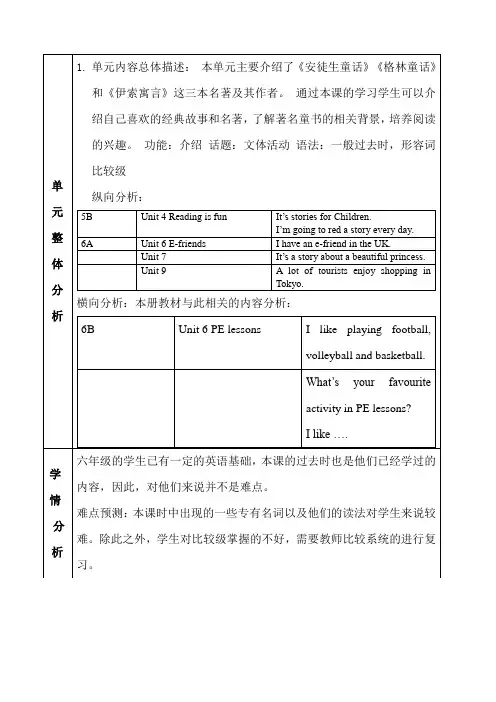
It’s stories for Children.
整 6A
Unit 6 E-friends
I’m going to red a story every day. I have an e-friend in the UK.
上海沪教牛津版英语六年级下册Unit 10 Great storybooks 课件
达想法;也可意为“谈论”,
婴儿是如何学说话的? They're talking about the weather.
强调两人或多人对话。
他们正在谈论天气。
say 强调说的内容。
She says she'll come here. 她说她将来这里。
后面常跟语言类名词,意为 speak “说某种语言”。
……………………………………………………………………………………… ………………………………………………………………………………………
……………………………………………………………………………………………………………………………………………………………………
……………………………………………………………………………………………上……海……沪……教…牛……津……版……六……年……级……教……学……课…件……… 1
11
……………………………………………………………………………………… ………………………………………………………………………………………
……………………………………………………………………………………………………………………………………………………………………
知识轻松 易 解
“We can usually learn something from these stories. ”本句中learn…from… 意为“从…… 学到……”,from后面可以加人或事物。
……………………………………………………………………………………………………………………………………………………………………
2
……………………………………………………………………………………… ………………………………………………………………………………………
《Great storybooks》PPT教学课件
上海教育出版社 六年级 | 下册
More about Andersen
Hans Christian Andersen was a Danish author. He was born in the town of Odense, Denmark, on 2nd April, 1805. He was an only child.
Step 2: Write (in simple words)
上海教育出版社 六年级 | 下册
Step 3: Share
…’s favourite story is “…” It’s about … … wrote the story.
上海教育出版社 六年级 | 下册
上海教育出版社 六年级 | 下册
Do you know these stories? The first printed version of Aesop’s Fables in English was published on 26th March, 1484, by William Caxton.
Think and say
上海教育出版社 六年级 | 下册
1 Which book is the story from? It is from Aesop’s Fables.
2 Who is stronger, Mr Wind or Mr Sun? Mr Sun is stronger.
3 What do you learn from this story? Strength is not everything.
Act out the story
上海教育出版社 六年级 | 下册
Step 1: Form groups of four. Step 2: Prepare. Step 3: Act out.
牛津沪版六下M4 Unit 10《Great storybooks》word教案(省优)2
Module 4 Things we enjoyUnit 10 Great storybooks教案2教学目标:〔1〕知识目标:能够熟练运用Do you remember the story…? He╱She wrote a lot of interesting fairy tales and stories. Children around the world enjoy reading his stories等句子,并且能够听、说、认读写collect ,emperor, remember.〔2〕能力目标:能够熟练的运用所学句子,能够掌握询问你还记得什么故事与答复,同时在学句子中学会新单词,学会新的句子运用。
〔3〕情感目标:理解小故事中包含大道理。
教学重点:听懂、会说:Do you remember the story…? He╱She wrote a lot of interesting fairy tales and stories. Children around the world enjoy reading his stories等句子,能够听、说、认读写词组collect ,emperor, remember.在问答题目练习中能够及时反响,补充未完成的句子。
将问题清晰答复。
教学难点:新句子较为难以记忆,句子容易弄混,学生记忆困难。
学生恐难以记住。
教学准备:ppt课件,教案。
教学设计:Lead-in.T:同学们有听过什么故事吗?S1….〔老师开场提问学生问题,问题贴近学生对学生进行提问。
〕〔设计意图:利用同学们所熟悉的东西吸引同学们的注意力,同时引起同学们答复以下问题的兴趣,为接下来句子的学习增强趣味性。
〕Step1. PresentationLet’s learn some new phrases简单的用图文并展的方式首先将新单词引入,教同学识读单词collect ,emperor, remember 〔设计意图:直接的语音教学让学生牢记单词发音,为接下来句子的运用打下根底。
上海教育版英语六年级下册Unit 10《Great storybooks》word教案

6B Unit 10 Great storybooks单元教学目标:1能在语境中正确运用本单元的核心词汇,复习已学相关核心词汇。
2 能简单介绍自己喜欢的经典故事或名著。
3 初步了解句子语调的基本知识,能用正确的语调朗读句子。
4了解著名童书的相关背景,培养阅读的兴趣。
教学重点:1 词汇学习:blow off, take off2 句型复习:Andersen wrote the stories.Children around the world enjoy reading his stories.3 语音学习:初步了解陈述句、一般疑问句和特殊疑问句的语调。
教学难点:1 经典故事或名著中人名、书名等的发音。
第一课时教学目标:学生能运用适当的阅读策略,了解三本童话书及其作者。
学生能介绍和评价自己所喜欢的经典故事,并且能够复述课文。
运用百科全书或网络等资源查寻有关安徒生、格林兄弟及伊索的作品,师生相互交流。
能善于抓住机会与同学交流合作,丰富知识。
加强对西方著名作家及其文学作品的了解。
通过本课的学习,引导、教育学生要多读书、读好书。
通过读书吸收前人的智慧,不断丰富学识和提高自身素质。
教学重难点:句型复习:Andersen wrote the stories. Children around the world enjoy reading his stories.教学方法与手段:本节课我采用导学自悟法,对话法进行教学。
采用PPT课件,卡片,录音机作为教学辅助手段。
使用教材构想:本节课学生在对课文进行整理,理解基础上,构建思维导图,并根据思维导图进行问答,介绍自己喜欢的作品。
教学方法和过程:Pre-task preparations1 用图片的形式展示一些童书的封面,让形式试着说说这些书名,中英文均可。
同时出示这几个作者的照片。
T:(show the covers of the books)Look at these books. Did y ou read them?S1:Yes, I did. It’s Andersen’s Fairy Tales...T:(show some pictures of the writers)Do you know who wtote these books? These are the writes. Who is he?S2:He’s Andersen.学生尝试将人物图片和书配对。
六年级英语下册Module4Unit10Greatstorybooks重点知识梳理牛津沪教版
Unit 10 Great storybooks词汇1.fairy tale[童话(故事)]2.adult(成年人)3.well-known(众所周知的;著名的)4.stronger(更强大的)5.than(比)6.scarf(围巾)7.blow off(吹掉)8.take off(脱掉)知识点1.描述某人身份或职业的句型He was a Danish writer. 他是一位丹麦作家。
2.描述某人喜欢做某事的句型Children around the world enjoy reading his stories.全世界的孩子们都喜欢读他的故事。
3.both的用法Both adults and children like their stories.成年人和孩子们都喜欢他们的故事。
4.表示某人从某事中学到某物的句型We can usually learn something from these stories.我们通常能够从这些故事中学到一些东西。
5.表示两个事物或两个人之间的对比的句型I’m stronger than you. 我比你更强壮。
6.询问某人最喜欢什么的句型及答语—What’s your favourite story? 你最喜欢的故事是什么?—My favourite story is “The ugly duckling”.我最喜欢的故事是《丑小鸭》。
7.询问某物的内容的句型及答语—What is the story about? 这个故事是关于什么的?—It’s about an ugly duckling.它是关于一只丑陋的小鸭子。
8.询问作者是谁的句型及答语—Who wrote this story? 谁写的这个故事?—Andersen.安徒生。
1。
上海教育出版社小学英语三年级起点六年级下册 10 Great storybooks-优秀
Module 4 Things we enjoy Unit 10 Great storyboos 单元教学内容与目标分课时教学目标一、任务预设学生能够简单描述自己喜欢的书,包括书的名称、作者姓名、书的大意等,制作一幅读书周的海报。
二、课时分配第二课时ething about the writer Aesoany fables about animals There are some well-nown fables lie“The fo and the gra Aeso Aeso an3)What did Mr Sun and Mr Wind do They had a race4)What did the man do when Mr Wind blew He an do when Mr Sun shone He too off his coat6)Who was stronger,Mr Wind or Mr Sun Mr Sun学生观看完或听完故事后,尝试回答以上问题。
2 根据学生的回答,在黑板上呈现故事概要,学生理解故事大意。
板书如下:尝试让学生根据板书概述故事的大意,可以通过小组或个人的方式完成。
S1: One day,Mr Wind and Mr Sun had a race They wanted to see who was stronger They saw a man Mr Wind blew strongly The man felt cold,so he an The man felt hot and too off his coat So Mr Sun won the race He was stronger3 把学生分成四人一组准备表演课本剧。
在表演前先让学生在组内决定个人承担的角色。
T:Now let's act out the story First,tell me how many characters there are in the storyS1:FourT:Who are theyS2:They're the man,Mr Wind,Mr Sun and the narratorT:Yes,the storyS1:Being ean you are strongT:Sometimes indness also maes us strong,right家庭作业:1 Listen to and read Student’s Boo pages 64 and 652 Retell the story on Student’s Boo pages 64 and 653 Finish Worboo pages 57 and 59板书设计:Unit 10 Great storyboos 第二课时。
沪教版六年级英语下册Unit 10 Great story books 第三课时课件
• Man: I am hot! I will ____ ____.
• Mr Sun: See! He ___ ___ his clothes.
•
I win, Mr Wind.
1 Which book is the story from? 2 Who is stronger, Mr Wind or Mr Sun? 3 What do you learn from this story?
Module4 Things we enjoy
Unit10 Great storybooks
Period three
1 可以通过调查,操练巩固所 学句型,运用这些句型进行 书写练习.
2 通过learn the sounds活动,帮 助学生了解句子的语调。
Roles: Mr Sun Mr Wind The Man
clothes. Man: I’m ___. I’ll ___ ___ my coat. Mr Sun: Ha,ha,ha!!I told you,
you are not stronger than me.
Part3
• Mr Wind: Your turn, I had mine.
• Mr Sun: OK.
Step 1: Ask
1 What’s your favourite story? 2 What’s the story about? 3 Who wrote this story?
Step 2: Write (in simple words)
Step 3: Share
…’s favourite story is “…” It’s about … … wrote the story.
【优质】小学英语沪教版六年级下册Unit 10《Great storybooks》优质公开课教案第一课时
Unit 10《Great storybooks》第一课时教案教材分析本节内容选自沪版英语教材六年级(下),本单元主要内容围绕“Great storybooks”展开,通过本单元的学习,使学生能初步认识经典故事和名著。
首先,从视听入手,让学生整体感知课文内容。
然后指导学生阅读,通过问答的形式加强学生的口语练习。
于都后阶段是真实运用语篇的重要环节。
通过同学间的对话表演来训练他们的口语表达能力。
通过对后面的小故事使学生将所学的语言得到有效延伸。
根据课程标准对本节课的要求,针对小学生的心理特点和认知水平,结合教材,本着面向全体学生,基于学全面发展的原则,确定本节课的教学目标。
1.掌握本课时的一些日常活动用语:fairy, adult, well- known,stronger, than, scarf, blow off, take off等2.能够听懂并运用句型:Anderson wrote the stories. Childrenaround the world enjoy his stories.同时要注重培养学生积极生活的态度。
教学重点:培养学生爱读书的好习惯。
学生分析本单元学习如何废物利用,孩子们需要提前预习,学习里面的新短语,新单词。
从学生年龄特点和认知特点,以及对英语学习的情感表现来看,本单元的教学对象是小学六年级的学生,他们学习英语的热情虽然没有低年级学生那么高、兴趣也没那么浓,但他们喜新好奇,求知欲强,富有想象力,并且具有较高的表现欲,且经过几年的英语学习,他们已有一定的词汇和语言基础。
而且他们也有比较强的竞争意识,尤其是我所教的班级,更是喜欢小组竞赛和个人竞赛以及各种表演,更喜欢通过活动游戏等形式学习新知。
教学目标Knowledge objectives知识与技能1.掌握本课时的一些日常活动用语:fairy, adult, well- known,stronger, than, scarf, blow off, take off等2.能够听懂并运用句型:Anderson wrote the stories. Childrenaround the world enjoy his stories.同时要注重培养学生积极生活的态度。