
新人教版八年级英语上册Unit7 Will people have robots导学案
课题 Unit 7 Will people have robots?(Section A 1a-2c)(第1课时)一、学习目标1.熟练掌握词汇:future,environment,planet,building,play a part,world peace2.熟练掌握以下句型 (1)In the future,there will be...(2)A:Will there be... ? B:Yes,I hope so.3.学习一般将来时态的相关知识,学会对未来进行预测。
二、重点,难点:◆重点由will构成的一般将来时态的句式。
◆难点 1.more,less,fewer的用法。
2.there be 句式的一般将来时态there will be…三、自主学习Step 1 Review (忆一忆):1.你认为人们家里将会出现机器人吗?_________________________________2.孩子们将会去学校上学吗?__________________________________________3.他们将在自己家里通过电脑学习。
_____________________________________4.人们将可以活到200岁。
_____________________________________________5.将会有更少的人。
__________________________________________________6.机会有更少的空闲时间。
_________________________________________7.将会有更多的污染。
_______________________________________________Step 2 learning new words and key phrases (单词、短语)1. in the future__________2.be in great danger___________3. move to ____________4.play a part in doing sth _________5. save the earth_______________6.see blue skies_____________7. spend time together_________________Step 3 Difficult sentences showing(重难点展示)1.in ten years的汉语意思为________________,用于__一般将来时态__(时态)。
10年之后还可以用________after+时间_ 表示,但一般用于__过去时态___(时态). He _____ ____(find) a pleasant job in ten years. He ______ ___(come) back to Ch ina after ten years. •after 和in 都有在……之后的意思, after后跟___________(时态).in 后只能跟_____________(时态).四、合作探究一般将来时表示将来某个时间将要发生的动作或存在的状态,也表示将来经常或反复发生的动作,常与表示将来的时间状语,如tomorrow, next week, next month, in 100 years等连用。
1.由“助动词will+动词原形”构成,will在代词后常简写为’ll, will not 常简写为won’t。
在疑问句中,主语为第一人称(I和we)时,常用助动词shall。
2.由“be going to+动词原形”构成,表示将要发生的事或打算、计划、决定要做的事情。
What are you going to do tomorrow? 你明天打算做什么?五、达标测评1.将来时态训练(1)Kids will come back to school tomorrow.Kids _________come back to school tomorrow.(改为否定句)_______ _______ come back to school tomorrow?(改为一般疑问句)Yes,_______ _______./ No,_______ _______.(作肯定及否定回答)(2)There will be a heavy rain tomorrow._______ _______ be a heavy rain tomorrow. (改为否定句)_______ _______ _____ a heavy rain tomorrow? (改为一般疑问句)Yes,_______ _______./ No,_______ _______.(作肯定及否定回答)2用所给词的适当形式填空.(1)In five years, I ________ (be) able to ______ (go) to college.(2)There will be _____ (little) pollution in the future.(3)In ten years, she _______ (be) a doctor. Now she ______ (be) a student.(4)People ______________ (fly) rockets to the moon for vacations one day.(5)Linda _______ (study) in a language school three years ago.She _______(become) an English teacher in two years.3.用more/fewer/less 练习填空1)Can you give us some water!We are thirsty. We have _________ water to drink.2)Don’t be so rude to your friends. Or you will have ________ friends.3)Don’t worry. We’ll give you _________ advice.4)I’m healthy, because I eat _________ vegetables every day.4.试着写出下里下列词组。
①更多的树 ____________________ ②较少的时间 ______________________ ③更多的钱 ____________________ ④较多的污染 ______________________⑤较多的运动 __________________ ⑥较少的学生 ______________________5.选择( ) 1 We’ll try our best to do the work with _____ money and _____ people.A few, littleB a few, a littleC less , fewerD fewer, less( ) 2 There _____ a sports meeting next week.A isB areC will haveD will be( ) 3 The city will have _____ trees and _____ pollution.A more, lotB less, fewerC more , lessD less, less( ) 4 Five years ago, Sally _____ soccer, but today she _____ soccer. She ____ basketball in five years.A .played, doesn’t play, will play B. played, didn’t play, will playC. plays, won’t play, will playD.played, doesn’t play, plays六、课后反思课题 Unit 7 Will people have robots?(SectionA 2d-3c)(第2课时)一、学习目标:1.掌握单词及短语:in five years, play a part, peace, sea, sky2.掌握句型:What will the future be like?There will be fewer trees and the environment will be in great danger.Everyone should play a part in saving the earth.二、学习重难点:1.一般现在时和一般将来时的运用。
2. 1.more,less,fewer的用法三、自主学习:I.哈哈,我会变!1. I often _______ up at 6:00 in the morning, but tomorrow morning I ________________up at 7:00 (get).2. My father_______ a teacher in 10 years ago, but now he ______ a policeman. ( be)3. Many people in our village _______a lot of tall _________ last year. ( build)4. Last Friday night, I_________(have) a birthday party at home.5. There______________(not be) an English test the day after tomorrow.II.轻松选择1. Five years ago, Li Mei ______ soccer. A. plays B. played C. will play2. _____ more buildings in our school in the future.A. There areB. There wereC. There will be3. Her grandmother lived_________103 years old. A. to B. be C. to be4.—_____________ will Mary’s cousin come back from Shanghai? —In a week.A. How longB. How oftenC. How soon5. Usually Mike spends __________ time doing homework than Jack.A. littleB. fewerC. less四、合作探究1. 辨析:more,less 和fewermore是much,many的比较级,意为“更多的,较多的”,修饰不可数名词或可数名词。
人教版英语八年级上册Unit 7《Will people have robots》教学设计

人教版英语八年级上册Unit 7《Will people have robots》教学设计一. 教材分析人教版英语八年级上册Unit 7 “Will people have robots” 主要围绕未来科技的发展,特别是机器人的应用进行展开。
本节课主要通过一个关于未来世界的对话,让学生掌握一般将来时的用法,以及如何谈论未来的一些预测。
教材还包括一些阅读材料和任务,旨在提高学生的阅读理解和口语表达能力。
二. 学情分析八年级的学生已经掌握了基本的英语语法和词汇,对一般现在时和一般过去时已经有了初步的了解。
但是,对于一般将来时的用法和如何准确地谈论未来的预测还需要进一步的讲解和练习。
此外,学生在阅读理解和口语表达方面还需要加强。
三. 教学目标1.学生能够理解和运用一般将来时。
2.学生能够通过阅读材料和对话,了解未来科技的发展趋势。
3.学生能够提高自己的阅读理解和口语表达能力。
四. 教学重难点1.一般将来时的用法。
2.如何准确地谈论未来的预测。
3.阅读理解和口语表达能力的提高。
五. 教学方法1.任务驱动法:通过设定一些与学生生活息息相关的情景,让学生在完成任务的过程中学习和运用语言。
2.交际法:通过模拟真实的交流场景,让学生在实际的语言环境中学习和运用语言。
3.合作学习法:通过小组讨论和合作,让学生相互学习,共同提高。
六. 教学准备1.教材和教学参考书。
2.多媒体教学设备。
3.与课程内容相关的网络资源。
七. 教学过程1.导入(5分钟)通过向学生展示一些机器人的图片,引起学生的兴趣,然后提问:“你们认为未来的人们会拥有机器人吗?”,让学生发表自己的看法。
2.呈现(10分钟)老师通过讲解和示范,向学生介绍一般将来时的用法,并举例说明如何准确地谈论未来的预测。
3.操练(10分钟)学生分组进行角色扮演,模拟真实的交流场景,运用一般将来时进行对话。
老师对学生的表现进行指导和评价。
4.巩固(10分钟)学生阅读教材中的阅读材料,理解并回答相关问题。
八年级人教版英语上册unit7-Will people have rober-Section A
A. Did, do B. Does, do C. Do, do D. Is, doing
3. She dances better than Mary _______.
A. is B. has C. does
D. dance
4. They ______ four English classes a week last term.
Unit 7 Will people have robots?
Section A
100 years from Wnhoawt d…o you think it is?
What do you think life will be?
By the year 3000,you won’t carry a backpack. It will carry you.
trees/pollution/cars/free time
知识点探究
fewer 与less及more表数量的用法
1)few(形容词)几乎没有,很少的,修饰可数名词。
其比较级、最高级为规则变化: few-fewer-fewest
a few表示一些,few带否定含义,意思是几乎没有。
2)little(形容词)很少的,几乎没有的,修饰不可数名 词。
Unit 7 Will people have robots (人教八年级英语上册)
on computers.
___A ___D 5. There will only be one country.
___A ___D 6. People will live to be 200 years old.
应用实践类活动
1b Listen and circle the predictions you hear in 1a.
新课标•示范课
1. Do you think there will be robots in people’s home?
there will be... 意为“将会有......;会有......”,是there be句型 的一般将来时,可以用“there is going to be ...”进行句型转换。
Practice
Use your imagination (想象力) fully to talk about the future in pairs.
Will ... in the future /in 100 years?
Yes, ... will. /No ... won’t. ...
Presentation
新课标•示范课
应用实践类活动
Let’s enjoy another video.
新课标•示范课
应用实践类活动
新课标•示范课
What are they talking about? They are predicting the future. What will your life be like in the future? Let’s learn to predict our future.
新课标•示范课
in 100 years 在100年以后,in+时间段,表示“在一段时间后”。
人教新目标八年级英语上册Unit 7 Will people have robots知识点归纳
人教新目标八年级英语上册Unit 7 Will people have robots?知识点归纳第1课时 SectionA(1a2d)papern . 纸,纸张。
不可数名词,“一张纸”表示为a piece of paper pollutionn . 污染,污染物。
不可数名词。
其动词形式为pollute ,形容词形式为pollutedprediction n . 预言,预测。
其动词形式为predict future n . 将来,未来environment n . 环境。
其形容词形式为environmentalplanetn . 行星plantv . 种植; n . 植物part n . 部分。
常用于短语:play a part 参与,发挥作用; play a part in 参与……;发挥作用的一份力量,后常接v .ing 形式【拓展】 in the future 和in future 用法辨析·in the future 在将来,在未来。
指的是将来的某一时刻,不一定从现在开始。
如:Who can tell what will happen in the future? 谁能说得清将来会发生什么事?·in future 今后。
指从现在开始的以后,相当于from now on 。
如:We should study hard in future. 今后我们应该努力学习。
live to be活到……岁in 100 years100年以后in greatdanger处于极度危险之中。
其反义词组为out of danger ,表示“脱离危险”on the earth 在地球上【拓展】(1)in与after用法辨析·in prep. 用来表示从现在算起的“过一段时间以后”,常用于将来时态的肯定句中,一般与go, come, start, arrive, return (be back), finish等表示瞬间动作的终止性动词连用。
八年级英语上册Unit7Willpeoplehaverobots题型总结及解题方法(带答案)
八年级英语上册Unit7Willpeoplehaverobots题型总结及解题方法单选题1、There _________ a fashion show this weekend. Shall we go to watch it together?A.will haveB.will beC.is going toD.is going to have答案:B句意:这个周末将有一场时装秀。
我们一起去看好吗?考查there be句型和时态。
根据“There”可知,此处是there be结构,be动词不能用其他词代替,排除A/D 选项;结合“this weekend”可知,句子应用一般将来时,结构是there will be或there is going to be,故选B。
2、It usually takes us quite a long time to ________ master a skill. A.trulyB.simplyC.hardlyD.probably答案:A句意:我们通常需要很长时间才能真正掌握一项技能。
考查副词辨析。
truly真正地;simply简单地;hardly几乎不;probably大概。
根据“It usually takes us quite a long time to”可知,需要很长时间才能真正地掌握一项技能,结合选项,truly符合句意。
故选A。
3、Nora opened the box. To her surprise, ______________ was a gold watch. A.outsideB.insideC.besideD.behind答案:B句意:Nora打开盒子,令她吃惊的是里面有一块金表。
考查介词。
outside在外面;inside在里面;beside在旁边;behind在后面。
根据Nora opened the box.可知她打开盒子后发现的,应是在盒子里面,故用inside,故选B。
新人教版八年级上册英语 Unit 7 第1课时 教案(教学设计)
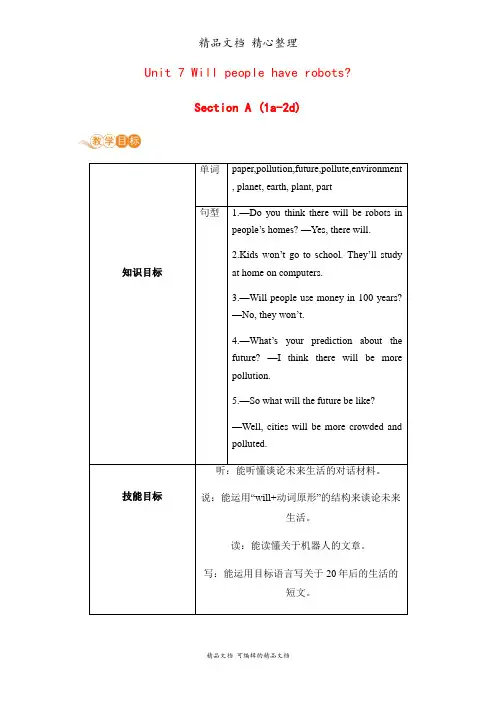
Unit 7 Will people have robots?Section A (1a-2d)单词paper,pollution,future,pollute,environment1.掌握一般将来时的意义和结构。
2.掌握There be句型的一般将来时的结构。
1.掌握more/fewer;more/less的用法。
2.“will +动词原形”表达一般将来时态。
Step 1以机器人相关视频来导入新课,调动学生学习的积极性。
Warming up and leading inShow Ss a video about robots and ask them some questions after watching it:What can you see in the video?Do you think it possible that every home has a robot?What can robots do for us?Step 2用形象的方式帮助学生掌握新词汇。
让学生在预测的过程中加深对词汇的理解。
1.New wordsShow Ss some pictures of the new words in this period: paper, pollution, future, planet, earth, plant.2.Work on 1a①Ask Ss to read the predictions in 1a. Let them think about how the world will be different 100 years from now.②Get Ss to check (√)A for agree or D for disagree. Then check the answers with the class together.【Keys: Answers will vary.】Step 3让学生在听的过程中掌握抓住关键信息的方法。
Unit 7 Will people have robots 单元单词课件( 人教版英语八年级上册
1. paper /'peɪpə(r)/ n.纸;纸张 →纸(不可数) a piece of paper
two pieces of paper 可数名词,报纸,论文,试卷(newspapers) 2. pollution /pə'lu:ʃn/ n.污染;污染→ 物 pollute(v.)污染 3. prediction /prɪ'dɪkʃn/ 预言;预测→(v.)
(过去式、adj. polluted 受污染的) e.g. Bicycle is a good exercise. It doesn’t pollute the air
air pollution 大气污染 water pollution 水污染 noise pollution 噪音污染 Air pollution is a great problem now,we must take action to make the air less polluted.现在空气污染是个 大问题, 我们必须采取行动减少污染。
13. sea /si:/ n. 海;海洋 同音词 see,C ocean the Pacific Ocean
14. build /bɪld/ v. (build) 建筑;建造 →n.(表人) builder建设者→(表物) building建筑物;楼 房 →过去式 built n.体格身材 be of medium build/height中等身材/身高 e.g. She is of medium build with long hair. be built of 用·…….建造 e.g. The house was built of wood
人教版英语八年级上册Unit7Willpeoplehaverobots?SectionA含答案
姓名:班级Unit 7 Will people have robots?Section A本课重点1.will构成的一般将来时态的肯定句、否定句、一般疑问句及回答2.做预言,用will来讨论未来发生的事情3.用will来表达将来时,并能熟练运用there be 句型表达将来时4.明确区分可数名词和不可数名词;正确使用more,less,fewer 本课难点1.用will来表达将来时,并能熟练运用there be句型表达将来时2.明确区分可数名词和不可数名词;正确使用more,less,fewer 常考句型 1.Kids won't go to school. They will study at home on computers.2.People will live to be 200 years old.3.—Will people use money in 100 years?—No,they won't. Everything will be free.4.I think there will be more pollution.5.I don't think so.I think there will be fewer trees.6.It's a book about future.7.What will the future be like?8.Will we have to move to other planets?9.Everyone should play a part in saving the earth.一、单项选择1.Lingling and I __________ to Lao She Teahouse last night.A.go B.are going C.went D.will go2.There _______ a football match on TV this evening.A.will have B.will be C.has D.is going to have 3.—What's your aunt's plan for tomorrow?—She _________ to the theatre to see the Beijing Opera.A.go B.will go C.went D.goes4.When the rain ________, we’ll go home at once. But no one knows when the rain ________. A.stops; stops B.will stop; will stopC.stops; will stop D.will stop; stops5.If we do nothing to protect giant pandas, there ________ no more giant pandas in the future. A.will have B.will has C.will be D.will be going to have 6.—Will you go to the cinema with me tomorrow?—Sorry, I _____ skating with Tom.A.go B.goes C.went D.will go7.What will the future ________ like?A.is B.are C.am D.be8.— Will there be more schools in 20 years’ time?—________. I think students will study by Internet at home.A.No, there aren’t B.Yes, there are C.No, there won’t D.Yes, there will 9.The air ________ here makes me uncomfortable.A.discussion B.relationship C.pollution D.information 10.——How soon will he come back? ——___________ two days.A.Before B.After C.In D.For二、用所给词的适当形式填空。
人教新目标八年级上册英语《Unit 7 Will people have robots?》Secti
人教新目标八年级上册英语《Unit 7 Will people have robots?》Section A_教学设计1一. 教材分析人教新目标八年级上册英语《Unit 7 Will people have robots?》Section A主要讨论了未来社会人们的生活将会随着科技的发展而发生变化,其中涉及到机器人在日常生活中的应用。
本节课主要通过阅读和听力练习来培养学生的语言技能,提高他们的阅读理解和听力理解能力。
教材内容丰富,贴近学生的生活,能够激发学生的学习兴趣。
二. 学情分析八年级的学生已经掌握了基本的英语语法和词汇,具备一定的阅读和听力理解能力。
他们在学习过程中善于发现问题、解决问题,并且具备一定的合作意识和团队精神。
但是,部分学生在英语学习中存在发音不准确、词汇量不足等问题,需要教师在教学过程中给予关注和指导。
三. 教学目标1.知识目标:学生能够掌握本节课的重点词汇和句型,理解文章大意,提高阅读和听力理解能力。
2.能力目标:学生能够在日常生活中运用所学知识进行简单的交流,提高语言运用能力。
3.情感目标:学生能够培养对科技发展的兴趣,树立正确的价值观,关注未来社会的发展。
四. 教学重难点1.重点:本节课的重点是让学生掌握关键词汇和句型,能够运用所学知识进行阅读和听力理解。
2.难点:学生需要理解文章中关于未来社会和机器人的描述,能够正确运用所学知识进行实际操作。
五. 教学方法1.任务型教学法:通过设定各种任务,让学生在完成任务的过程中运用所学知识,提高语言运用能力。
2.情境教学法:创设生活情境,让学生在真实的环境中感受和理解语言。
3.小组合作学习:鼓励学生互相合作,共同完成学习任务,提高团队协作能力。
六. 教学准备1.教师准备:备好相关教学资料,如PPT、教学视频等。
2.学生准备:预习本节课的单词和句型,提前了解相关背景知识。
七. 教学过程1.导入(5分钟)教师通过向学生展示一些机器人图片,引导学生谈论机器人,激发学生的学习兴趣。
八年级英语上册 Unit 7 Will people have robots?(第2课时)说课稿
八年级英语上册 Unit 7 Will people have robots?(第2课时)说课稿一. 教材分析《八年级英语上册》Unit 7 “Will people have robots?” 是人教版新目标英语教材的一个单元。
本单元主要围绕未来科技的发展,特别是机器人在日常生活中的应用进行讲解。
通过本单元的学习,学生可以掌握一般将来时的被动语态,提高自己的听说读写能力,并激发他们对未来科技的想象和思考。
二. 学情分析八年级的学生已经掌握了英语学习的基本语法和词汇,具备一定的听说读写能力。
他们对新科技充满好奇,善于接受新鲜事物,但同时也可能对一些抽象的概念和语言表达感到困惑。
因此,在教学过程中,我们需要关注学生的个体差异,因材施教,激发他们的学习兴趣和积极性。
三. 说教学目标根据《义务教育英语课程标准》和教材内容,本节课的教学目标如下:1.知识目标:学生能够掌握一般将来时的被动语态,理解与未来科技相关的词汇和表达。
2.能力目标:学生能够在真实情境中运用所学知识进行交流,提高听说读写能力。
3.情感目标:激发学生对未来的想象和思考,培养他们对科技发展的积极态度。
四. 说教学重难点1.教学重点:学生能够熟练运用一般将来时的被动语态进行表达。
2.教学难点:学生能够准确理解与未来科技相关的词汇和表达,以及在真实情境中运用所学知识进行交流。
五. 说教学方法与手段本节课采用任务型教学法,结合情境教学法和分组合作学习法,利用多媒体教学手段,激发学生的学习兴趣,提高他们的参与度和积极性。
六. 说教学过程1.导入:通过展示一段关于未来科技的短片,引发学生对未来的想象,激发他们的学习兴趣。
2.呈现:教师通过PPT展示本节课的主要内容,引导学生关注一般将来时的被动语态和与未来科技相关的词汇。
3.操练:学生分组进行角色扮演,运用所学知识进行对话,教师给予指导和反馈。
4.巩固:学生完成一组有关未来科技的练习题,检测他们对知识的掌握程度。