
Asking for and giving directions问路指路英语教程
2017中考英语第二部分话题复习9问路与指路复习.doc
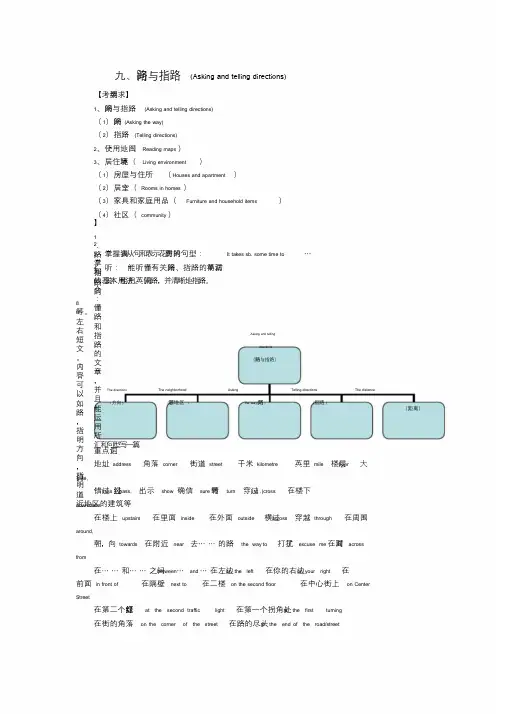
九、问路与指路 (Asking and telling directions)【考纲要求】1、问路与指路 (Asking and telling directions) (1)问路 (Asking the way) (2)指路 (Telling directions)2、使用地图( Reading maps )3、居住环境( Living environment )(1)房屋与住所(Houses and apartment )(2)居室( Rooms in homes )(3)家具和家庭用品( Furniture and household items )(4)社区( community ) 】1.路、指路的 2.掌和的基本用法。
3.掌握宾语从句和表示花费时间的句型: It takes sb. some time to ⋯ 4.听: 能听懂有关问路、指路的简单对话。
5.说: 能用英语问路,并清晰地指路。
合:懂路和指路的文章,并且能运用所汇和句型写一篇 8左右短文。
内容可以如路,指明方向,指明道近地区的建筑等 等。
Asking and tellingdirections(问路与指路)The directions The neighborhood Asking Telling directions The distance(方向 )(邻近地区 ) the way(问路 ) (指路 ) (距离)重点词汇 地址 address 角落 corner 街道 street千米 kilometre 英里 mile 楼层f loor 大门g ate, 错过m iss 经过pass, 出示 show 确信 sure 转弯 turn 穿过( vt .)cross 在楼下 downstairs在楼上 upstairs 在里面 inside在外面 outside横过a cross 穿越 through在周围around,朝,向 towards 在附近 near 去⋯ ⋯ 的路 the way to 打扰了 excuse me 在对面 acrossfrom在⋯ ⋯ 和⋯ ⋯ 之间b etween ⋯ and ⋯ 在左边o n the left 在你的右边o n your right在前面 in front of 在隔壁 next to在二楼 on the second floor在中心街上 on Center Street在第二个红绿灯 at the second trafficlight在第一个拐角处a t the firstturning在街的角落 on the corner of the street在路的尽头a t the end of the road/street重点句型 1.Excuse me, is there a ⋯ near here?请问,这附近有超市吗?________________________________________________________________________ 2.Could you please tell me where ⋯ is?你局?________________________________________________________________________ 3.How far ⋯ ?医院离这有多远?走路只需要 5 分钟。
英语问路指路范文

英语问路指路范文Asking for directions and giving directions are common situations in our daily life. Whether you are a tourist in a new city or a local resident trying to find a specific location, knowing how to ask for and give directions in English is an important skill. In this article, we will provide you with some useful phrases and expressions for asking for and giving directions in English.Asking for Directions:When you need to ask for directions, it's important to be polite and clear. Here are some common phrases you can use:1. Excuse me, could you tell me how to get to the nearest subway station?2. I'm looking for the post office. Can you point me in the right direction?3. Sorry to bother you, but I'm a bit lost. Could you help me find my way to the museum?Giving Directions:When giving directions, it's important to be clear and specific. Here are some common phrases you can use:1. Sure, the subway station is just two blocks down this street. You can't miss it.2. The post office is on the corner of Main Street and Elm Street. Just go straight for two blocks and you'll see it on your left.3. The museum is about a 10-minute walk from here. Just go down this street, turn left at the second intersection, and you'll see it on your right.Useful Expressions:In addition to the above phrases, there are some useful expressions that can help you ask for and give directions more effectively:1. Is it within walking distance?2. How far is it from here?3. Can I take a bus or a taxi to get there?4. Is there a landmark nearby that can help me find it?5. Could you write down the directions for me?Remember, when asking for directions, it's important to listen carefully and follow the instructions given. If you're not sure about something, don't hesitate to ask for clarification. When giving directions, try to be as clear and detailed as possible, and be patient with the person asking for help.In conclusion, knowing how to ask for and give directions in English is a valuable skill that can help you navigate unfamiliar places with ease. By using the phrases and expressions provided in this article, you can improve your communication in situations where asking for or giving directions is necessary. So next time you find yourself in need of directions, don't be afraid to ask for help, and if someone asks you for directions, be ready to lend a helping hand. With clear communication and a friendly attitude, finding your way around will be a breeze.。
问路指路ask for or give directions

Hi Sarah. I'm glad you can come to my party on Friday night. My house is easy to find. From your house go straight up Broadway to the corner of Broadway and Second Avenue. Turn right. Go straight two blocks and then turn left. It's on the left on the corner of First Avenue and Central Street. See you on Friday!
Dialog 3 A - Excuse me. How do I get to the restaurant? B – Go straight past the bookstore and the hotel. Turn left onto Main Street. It’s the second building on the left, between the hotel and the bank. A – Thank you.
Hale Waihona Puke DOGBALLExample: ball/table - The ball is under the table 1. basket/table _____________________________________________
2. tree/bicycle _____________________________________________
1. 2. 3. 4. 5. 6. 7.
BEHIND The house is_________ the car. BELOW the sun. The dog is _________ The tree is to the ______of the house. LEFT IN FRONT OF the house. The car is ___________ ABOVE The sun is _________ the dog. BETWEEN the dog and the tree. The house is _________ The dog is to theRIGHT _____ of the house.
英语话题--问路指路
DIALOGUE Check! Fill in the gaps: -Excuse me, Can you ___tell______ me the way to the post office? - Sure, go ___along_______ this street and _____turn______ left at the crossroads. The post office is __on____ the left. -Thank you! -You're welcome!
●
GIVING DIRECTIONS
●
GIVING DIRECTIONS
Go straight on Turn left/right (into … street). Go along /up / down … street Take the first/second road on the left/right It's on the left/right.
FILL THE GAPS WITH THE WORDS PROVIDED: Check!
A- ___excuse _______ me, how __can______ I get to the castle? B- Go ___along______ this road, then _turn_______ left and continue for about 100 metres. Then___take_________ the second turning on the __right__________. Go ___straight_________ on for about 150 metres. The castle is at the _end______ of the road, __ opposite________ the cinema. A- Thank you very much. B- You're __welcome__________.
问路和指路及There be句型

Name_____________ No._______一、a/an的用法英语中表示“一个(块,片,只,本,杯......)”应用不定冠词"a/an"来表达。
an[An]用于以元音开头的字母或可数单数名词(可单名)前,a [[]用于以辅音开头的字母或可数单数名词(可单名)前。
例如:a book[bUk] 一本书,an apple[5Apl]一个苹果1、一个a/e/i/o用an,一个以a/e/i/o开头的单词前也常用an.an a, an e, an i, an o2、一个u用a,一个以u开头的单词前用a/an均可。
当“u”发[ju:]时,用a,当“u”发[Q]时,用an. a u, an uncle, a UFO3、一个"h"用an,一个以h开头的单词前用a/an均可。
当h不发音时,用an;当“h”发[h]时,用a。
an h, an hour[5aU[], a hat4、一个"f/l/m/n/s/x/r"用an,一个以f/l/m/n/s/x/r开头的单词前用a。
5、一个" b/c/d/j/k/p/q/t/v/w/y/z"用a ;一个以" b/c/d/g/j/k/p/q/t/v/w/y/z"开头的单词前常用a。
二、the的用法the 可以修饰不可数名词,单数可数名词,复数名词,但是不可以单独用。
the+可数单数名词=this/that+可数单数名词,the+复数名词=these/those+复数名词1、用于世界上独一无二的十五前。
the USA the UN the UK2、用于介词短语中。
on the table in the backpack3、当名词作主语时,其前常用the. The pen is on the table.4、一个可数单数名词第一次出现用a/an,再次出现用the;一个复名词第一次出现用some,再次出现用the.This is a pen.The pen is nice.These are some pens.The pens are nice.5、一般在一般疑问句中常用a/an,在特殊疑问句中常用the。
指路的英文

指路的英文指路的英文可以用“Directions”来表达。
下面是一个关于指示路线的英文短文,希望能对你有所帮助。
DirectionsIf you are new to a place or looking for directions in English, here are some useful phrases and vocabulary to help you navigate and find your way easily.Asking for Directions:- Excuse me, can you help me find...?- I’m looking for...- Could you tell me how to get to...?- Do you know where... is?- Which way is it to...?- Is it far from here?- How long does it take to get there?- Can you give me directions?Giving Directions:- Go straight ahead.- Turn left / right at the junction.- Take the first / second / third street (on the left / right).- Walk for about...- Cross the road / intersection.- Go past the park / supermarket / bank.- It’s on your left / right.- It’s ju st around the corner.- Take the bus / train / subway to...- Get off at the next / third stop.- It’s about... meters / kilometers away.- You can’t miss it.Useful Vocabulary and Phrases:- Road / Street: A paved way for vehicles and pedestrians.- Junction / Intersection: The point where two or more roads meet.- Crossroad: A road crossing another road.- Traffic lights / Signals: The lights that control the flow of vehicles.- Roundabout / Traffic Circle: A circular intersection where vehicles move in one direction.- Pedestrian Crossing: A designated area for pedestrians to cross the road.- Sidewalk / Pavement: A path for pedestrians alongside the road.- Bus stop: A designated place for buses to pick up and drop off passengers.- Train station: A place where trains stop for passengers to get on and off.- Subway / Underground station: A station for underground trains.- Landmarks: Famous or easily recognizable buildings or places.- North / South / East / West: The four main directions.- Map: A graphical representation of an area, showing streets, landmarks, etc.Remember, when giving or receiving directions,it's important to be polite and express gratitude. For example, you can say "Thank you" or "Thanks a lot" after someone helps you. Additionally, it might be helpful to have a map or use navigation apps on your phone to assist you in finding your way.。
英语作文100词指路用语
英语作文100词指路用语Title: Essential English Phrases for Giving Directions。
When it comes to navigating in English-speaking countries, having a good grasp of directional phrases is indispensable. Whether you're asking for directions orgiving them, these phrases will prove invaluable in guiding you to your destination.Asking for Directions:1. Excuse me, could you tell me how to get to [place]?2. I'm a bit lost. Can you help me find my way to [place]?3. Do you know where [place] is located?4. Could you please point me in the direction of [place]?5. Is there a [place] nearby? If so, how do I get there?Giving Directions:1. Sure, to get to [place], you need to...2. First, go straight ahead until you reach...3. Take a left/right turn at the next intersection.4. After that, continue walking/driving for about [distance].5. When you see [landmark], you're almost there.6. [Place] should be on your left/right.Providing Additional Information:1. You can't miss it; it's right across from [landmark].2. If you reach [landmark], you've gone too far.3. It's about [distance] away from here.4. Feel free to ask someone else if you need further assistance.5. Would you like me to draw you a map?Mastering these phrases will empower you to navigate confidently in English-speaking environments. Practice using them, and soon, finding your way around will become second nature.。
Asking for and giving direction地图指路
Practice 1: Command-Response
Attention / at ease Turn left/right/around Eye left/ right/front March/double march Close/extend 3 step forward Sit down/ rise Halt/mark time
• 顺着这条路走五百米 take this road /go down this street for 500m。 • 第三个路口左转 turn left at the third turning • 路过左手边的一个超市 you'll pass a supermarket on your left • 你走错路了 you‘re going the wrong way
Showing the way
Go straight. / Go ahead.
Turn right / left.
Turn right / left at the second turning. It is on the right / left.
• • • • • • • •
No parking Buses only School ahead Sidewalk Zebra crossing One way No left/ u turn Keep clear
ktv 图书馆 Jing 麦当劳 Guang Rd 火车站 公车站 二七纪念塔 Chang 小学 体育中心 Jin 商场 公 饭店 园 酒店 Hang 地铁站 Zi dong 医院 Jing Shan 饭 店 Rd Hai Rd 书 店 Rd 电 酒 银 影 店 行 院 Jiang 网吧 小吃 小吃 小吃 Rd 小吃 Shui 动物园 Ave Cheng
问路指路英语知识点总结
问路指路英语知识点总结Asking for directions:1. Polite expressions:When asking for directions, it is important to use polite expressions to show respect to the person you are asking. Some common polite expressions to use include:- Excuse me, could you tell me how to get to...?- I'm sorry to bother you, but could you point me in the direction of...?- Do you know where I can find...?2. Vocabulary:It is helpful to know some basic vocabulary related to giving and understanding directions. For example:- Turn left/right- Go straight ahead- Take the first/second/third street on the left/right- It's on the corner of...- It's opposite the...3. Understanding different types of locations:When asking for directions, it is important to be able to specify the type of location you are looking for. For example, you might be looking for a street, a specific building, a landmark, a public transport stop, or a specific type of establishment (e.g. a restaurant, a bank, a hotel). Understanding the different types of locations and using the correct vocabulary to specify what you are looking for will help you to get clearer and more accurate directions.Giving directions:1. Vocabulary and prepositions:When giving directions, you will need to use vocabulary and prepositions to describe the route. For example:- Turn left/right at the corner- Go straight on- Cross the street- It's on the left/right/next to/at the end of the street- It's opposite/behind/in front of the...2. Giving landmarks:Using landmarks as reference points can be very helpful when giving directions. Landmarks are easily recognizable features in the area that can help the person asking for directions to find their way. For example:- It's near the big red building- You'll pass a park on your right- It's next to the train station3. Sequencing and clear instructions:When giving directions, it is important to use clear and sequential instructions to guide the person to their destination. For example:- First, you need to go down this street, then turn right at the second intersection- After that, you'll see a sign for the museum, so turn left there- Once you've passed the supermarket, it's just a few blocks ahead on the rightCommon language points:1. Use of imperatives:When giving directions, it is common to use imperatives to give clear instructions. For example:- Turn left at the traffic lights- Walk straight until you reach the bridge- Take the second right after the roundabout2. Asking for clarification:If you are giving directions and the other person seems confused or unsure, it is important to be able to ask if they need further clarification. Some useful phrases for this include:- Do you need me to repeat that?- Did you get that?- Is there anything else you need to know?3. Confirming understanding:It is also important to make sure that the person asking for directions has understood your instructions. Some useful phrases to confirm understanding include:- Do you know how to get there now?- Are you clear on the directions?- Let me know if you need me to explain anything again.Cultural considerations:When asking for and giving directions in English, it is also important to consider cultural differences that may affect communication. For example, in some cultures, people may be more or less direct in their communication, and this can affect how directions are given and understood. It is also important to be aware of potential language barriers and to be patient and considerate when communicating with someone who may be struggling to understand or express themselves in English.In summary, asking for and giving directions in English involves a range of language and knowledge points, including polite expressions, vocabulary, prepositions, landmarks, clear instructions, imperatives, asking for clarification, confirming understanding, and cultural considerations. By mastering these language and knowledge points, you will be better equipped to navigate your way around and communicate effectively in English-speaking environments.。
(完整版)问路指路askfororgivedirections
Diaห้องสมุดไป่ตู้og 3
A - Excuse me. How do I get to the restaurant? B – Go straight past the bookstore and the hotel. Turn left onto Main Street. It’s the second building on the left, between the hotel and the bank. A – Thank you.
Hi Sarah. I'm glad you can come to my party on Friday night. My house is easy to find. From your house go straight up Broadway to the corner of Broadway and Second Avenue. Turn right. Go straight two blocks and then turn left. It's on the left on the corner of First Avenue and Central Street. See you on Friday!
Which is Amanda's house? ( )A ( )B (X )C ( )D
1. The cat is_____U_ND_E_R_ the table. 2. The vase is _______O_N _ the table. 3. The flowers are ________IN_ the vase.
TREE
BICYCLE
CLOUD
TABLE DOG
BASKET