
仁爱英语八年级上册Unit 3 Topic 1 Section C
Now,do you know how to make a scrapbook ?
How do you make a scrapbook?
you should decide what you want to collect. First , __________________________________ you will need a book with background Second, ________________________________
Because it will help us …
A class book
Self introduction First, … School life Second , … Friends Third, … Class photos
You can report like this:
Many students like making a class book when they finish their school. They call it a friendship book. They keep their class blog, the school life, lovely friends and other things they want to remember. It is easy to get started. First, you should decide what you want to keep. Second, collect the information you need. Third, put it in order. It’ll be a lot of fun to make a class book. It will help you remember your school life and keep the friendship.
A. am not used to
C. didn’t use to
B. wasn’t used to
D. don’t use to
3. When people are sick, hobbies can help them get ______ .
A. good B. nice C. best D. well
B: They used to make snowmen.
in winter
Do you know what kind of book it is ?
剪贴簿
Let’s learn how to make a scrapbook.
Watch the flash of 1a , then find out the answer.
Thank you !
A: What did they use to do in spring ?
B: They used to go traveling.
in spring
A: What do Kangkang and Michael often do in summer ? B: They often go swimming.
B. The History of Scrapbooking
C. What is a Scrapbook ?
D. How to Make a Scrapbook
Listen and read 1a,then answer the 录音1a-P59 视频1a-P59 following question.
A: What did they use to do in summer ?
B: They used to go boating.
in summer
A: What do Kangkang and Michael often do in fall? B: They often climb moutains.
Topic 1 What’s your hobby ?
walk a pet dog
fly a kite
I used to walk a pet dog, but I didn’t use to fly a kite.
I used to climb mountains, but I didn’t use to swim.
climb mountains
swim
listen to music
play chess
I used to listen to music, but I didn’t use to play chess.
I used to collect stamps, but I didn’t use to water flowers.
our happy time.
3
Work in groups and discuss how to make a class book. Then write a passage about your ideas. The following table and 1a may help you. Name What to collect How to make Why to make it it
视频1a-P59
The title should summarize the main idea of a passage. It can help you predict what a passage is about.
What’s the best title of the passage ?
A. Scrapbooking
collect stamps
water flowers
2
Look and say
in spring
in summer
in fall
in winter
A: What do Kangkang and Michael often do in spring ? B: They often fly kites.
What may people collect in scrapbooks today ? the world’s most stupid ideas A. ___________________________________ pictures of the world’s most ugly dogs B. ___________________________________ stories about bad weather C. ___________________________________
paper, scissors and glue. ______________________
Do you want to remember the happy hours that you spend with your classmates at school ?
Let’s make a scrapbook about
I know some phrase :
start with
need … to do…
share … with …
I know how to make a scrapbook. First,… Second,… Third,…
1. Read 1a, and try to retell the passage. 2. Make a scrapbook in your free time.
Choose the correct answer.
1. Bob and I are good friends, and we ___ interests with each other. A. like B. hate C. share D. with
2. I ___ play sports , but now I like it.
A:o in fall ?
B: They used to go cycling.
in fall
A: What do Kangkang and Michael often do in winter ? B: They often ski.
A: What did they use to do in winter?
1. It is easy to get started. 很容易着手(做剪贴簿)。
get started 开始
It is + adj. (for sb. ) to do sth.
(对于……来说),做某事是……
Eg: 对于我们来说,学一门外语是很重要的。 for us to learn a foreign It’s important ______________ language. 2. start with 以……开始
Eg: 我们的晚会以一首歌来开始。
Our party started with a song.
3. You need the scissors to cut out the pictures or stories. 你需要一把剪刀来剪下图片或故事。 cut out 剪下,裁剪 need sth. to do sth. 需要某东西做某事 eg: 天太冷了,孩子们需要厚衣服来保暖。 need thick It’s too cold ! The children ___________ to keep warm. clothes _________ 他们需要一辆 汽车去上班 。 need a car to go to work. They _________________ 4. share sth. with sb. 与某人分享某东西
八年级仁爱英语上册unit1topic3sectionC课件

2b
Work alone
Read 2a again and complete the table.
U1 T3 SC
Year
1984
2000 2004 2008
Host city Los Angeles
Sydney Athens
Beijing
Gold medal 15 28
32 51
Session
23rd
I took part int_h_e_b_o_y_s_’ 4_0_0_-_m__e_te_r_r_a.cIedid my best and was t_h_e_f_i_rs_t_t_o_c_r_o_s_s_ the _f_in_i_s_h_li_n_e___.Thise_n_c_o_u_ra_g_e_s me a lot. Now I love sports more. I _w_a_n_t_t_o_b_e_ a soccer player. I will do more exercise every day and I hope s_o_m__e_d_a_y_ i’ll _b_e_a_b_l_e_t_o_t_a_k_e__ part in the Olympic Games.
Last week our school held a sports meet. Everyone in our class felt very excited because we were the w__in_n_e_r_s. _In__th_e__b_o_y_s’_r_e_la_y__ra_c_e_,Michael ran very fast and our class _W_o_n__(_th_e_)_f_ir_s_t_p_l_ac_e_.Yu Ting _i_s_g_o_o_d_a_t____ the long jump and she also won .We are sorry that we _d_id__b_a_d_ly_i_n____ the high jump, but we’re sure we can _d_o_b_e_t_t_e_r _ next time.
仁爱版八年级英语上册 Unit 1 Topic 3 知识汇总
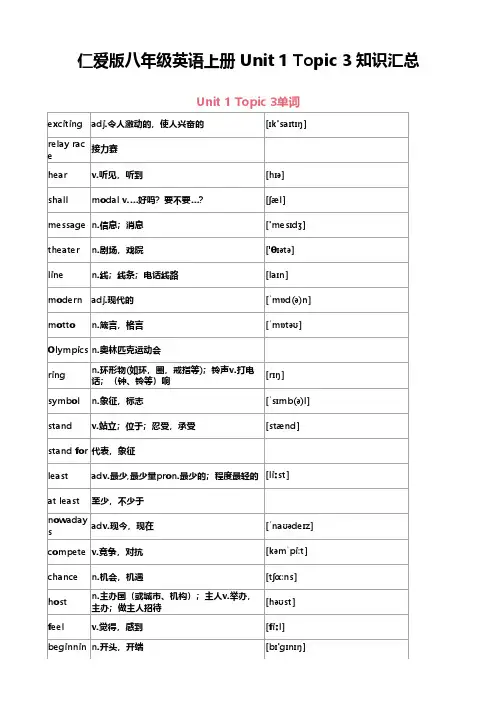
仁爱版八年级英语上册 Unit 1 Topic 3 知识汇总Unit 1 Topic 3单词exciting adj.令人激动的,使人兴奋的[ɪk'saɪtɪŋ]relay rac接力赛ehear v.听见,听到[hɪә]shall modal v.…好吗?要不要…?[ʃæl]message n.信息;消息['mesɪdʒ]theater n.剧场,戏院[ˈθɪәtә]line n.线;线条;电话线路[laɪn]modern adj.现代的[ˈmɒd(ә)n]motto n.箴言,格言[ˈmɒtәʊ]Olympics n.奥林匹克运动会[rɪŋ]ring n.环形物(如环,圈,戒指等);铃声v.打电话;(钟、铃等)响symbol n.象征,标志[ˈsɪmb(ә)l]stand v.站立;位于;忍受,承受[stænd]stand for代表,象征least adv.最少,最少量pron.最少的;程度最轻的[liːst]at least至少,不少于nowadayadv.现今,现在[ˈnaʊәdeɪz]scompete v.竞争,对抗[kәmˈpiːt]chance n.机会,机遇[tʃɑːns][hәʊst]host n.主办国(或城市、机构);主人v.举办,主办;做主人招待feel v.觉得,感到[fiːl]beginnin n.开头,开端[bɪ'gɪnɪŋ]gwhether conj.是否['hweðә]gold n.金,金子 adj.金色的[ɡәʊld]medal n.奖章;勋章[ˈmed(ә)l]badly adv.差;很,非常;严重地['bædli]able adj.能够;有能力的['eɪbl]really adv.答话时表示感兴趣或惊讶;真正地['rɪәli]another pron.另一(事物或人)[ә'nʌðә]break v.(使)破,碎;打破(记录)[breɪk]freestyle n.自由泳;自由式adj.自由式的male adj.男性的;男的[meɪl]swimmer n.(会)游泳者record n.记录;唱片v.记录,记载[ˈrekɔːd]successfadj.获得成功的[sәkˈsesfʊl]ulJamaican adj.牙买加(人)的widely adv.普遍地;广泛地['waɪdli]regard v.认为…是;把…视为[rɪ'gɑːd]Unit 1 Topic 3同步翻译Unit 1 Playing sportsSection C 1a Read and understand现代奥运会现代奥运会于1896年起源于希腊雅典。
Unit 3 Topic 1 Section A-八年级英语上册课件(仁爱版)
Key points
Helen: What do you often do in your free time? in one’s free time
在某人的空闲时间 Wen Wei: I often go fishing. It’s my favorite hobby. And I also enjoy reading stories and
1b Listen to 1a and choose the correct answer.
What are Helen and Wen Wei talking about ? A. Going to the movie theater. B. Their hobbies. C. Outdoor activities.
poems.
4. I like _s_l_e_e_p_i_n_g__.
6. I am fond of__a_c_ti_n_g__.
7. I __p_r_e_f_e_r___
playing soccer.
While-listening 1a Look, listen and say.
Helen: What do you often do in your free time? Wen Wei: I often go fishing. It’s my favorite hobby.
be interested in doing sth. 喜欢做某事 recite poems 背诗
Make dialogs.
A: What’s your hobby? B: I like/love/enjoy/prefer/am fond of/am interested in .......
八年级仁爱英语Unit1- Topic1-Section C

八年级仁爱英语Unit1- Topic1-Section C一、She spends half an hour exercising in the gym every day.她每天花半小时在体育馆锻炼。
spend意为“花费”,通常接表示时间和金钱的名词,辨析spend,pay,cost,take(1)spend的主语一般为人,用来表示“花金钱/时间/精力干什么/在什么方面等”。
主要句型是sb. + spend…on sth. /(in) doing sth. Don’t spend too much time on computer games. 不要在电脑游戏上花费太多时间。
I spend an hour(in)practicing English every day.我每天花1小时练习英语。
She spends half an hour (in)exercising in the gym everyday.她每天在体育馆花费半小时锻炼身体。
(2)pay的主语是人,其句型为:pay..for“付款、偿付”。
如:He paid 300 yuan for the meal.他为这顿饭付了300元。
(3)cost的主语必须是“物”或“事,可表示“花时间、金钱、功夫”。
用于sth. costs(sb.) some money结构中。
如:This cost me a lot of me.这花了我大量时间。
The book cost me 30 yuan last week.上周买这本书花费了我30元。
(4)take“花费时间、精力,一般用物作主语或者it作形式主语代替不定式,即it takes/took sb. sth. to do sth.如:It took me one hour to finish the job.完成这项工作花了我一个小时It takes me an hour to do my homework every day.每天做作业花费我一个小时的时间。
仁爱版八年级英语上册精品教学案U3T1SC
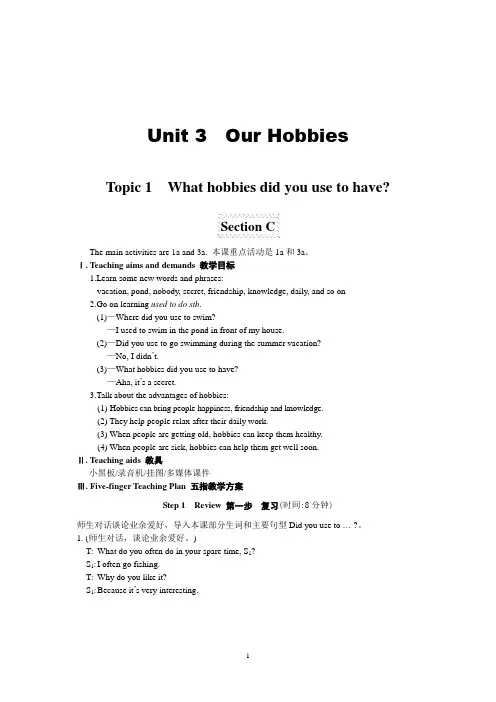
Unit 3 Our Hobbies Topic 1 What hobbies did you use to have?Section CThe main activities are 1a and 3a. 本课重点活动是1a和3a。
Ⅰ. Teaching aims and demands 教学目标1.Learn some new words and phrases:vacation, pond, nobody, secret, friendship, knowledge, daily, and so on2.Go on learning used to do sth.(1)—Where did you use to swim?—I used to swim in the pond in front of my house.(2)—Did you use to go swimming during the summer vacation?—No, I didn’t.(3)—What hobbies did you use to have?—Aha, it’s a secret.3.Talk about the advantages of hobbies:(1) Hobbies can bring people happiness, friendship and knowledge.(2) They help people relax after their daily work.(3) When people are getting old, hobbies can keep them healthy.(4) When people are sick, hobbies can help them get well soon.Ⅱ. Teaching aids 教具小黑板/录音机/挂图/多媒体课件Ⅲ. Five-finger Teaching Plan 五指教学方案Step 1 Review 第一步复习(时间:8分钟)师生对话谈论业余爱好,导入本课部分生词和主要句型Did you use to … ?。
仁爱版英语八上Unit3Topic1《What’syourhobby》(SectionC)说课稿

仁爱版英语八上Unit 3 Topic 1《What’s your hobby》(SectionC)说课稿一. 教材分析仁爱版英语八上Unit 3 Topic 1《What’s your hobby》(Section C)是一篇关于个人爱好的阅读材料。
通过描述不同人物的不同爱好,引导学生学会询问和介绍个人的爱好,培养他们开口交际的能力。
本节课主要通过阅读理解,让学生掌握相关词汇和句型,并能运用到实际生活中。
二. 学情分析八年级的学生已经掌握了基本的英语语法和词汇,具备一定的阅读理解能力。
对于本节课的内容,他们容易产生共鸣,因为爱好是每个人都会有的。
但部分学生可能在表达能力上还存在一定的问题,需要教师在教学中给予指导和鼓励。
三. 说教学目标1.知识目标:学生能掌握描述个人爱好的相关词汇和句型,如“What’syour hobby?”, “I like playing basketball.”等。
2.能力目标:学生能通过阅读理解,提高自己的英语阅读能力。
3.情感目标:学生能积极参与课堂活动,大胆表达自己的爱好。
四. 说教学重难点1.重点:描述个人爱好的词汇和句型的运用。
2.难点:如何准确、流畅地表达自己的爱好。
五. 说教学方法与手段1.任务型教学法:通过设置各种任务,让学生在完成任务的过程中,自然地学会描述个人爱好的词汇和句型。
2.情境教学法:创设各种情境,让学生在真实的语境中,学会表达自己的爱好。
3.小组合作学习:通过小组讨论,培养学生的合作精神和团队意识。
六. 说教学过程1.导入:教师通过提问,引导学生谈论自己的爱好,激发学生的学习兴趣。
2.阅读理解:学生独立阅读课文,回答相关问题,教师给予解答和指导。
3.新课导入:教师引导学生学习描述个人爱好的词汇和句型。
4.课堂实践:学生进行小组讨论,用所学的词汇和句型描述自己的爱好。
5.总结提升:教师对学生的表现进行评价,总结课堂所学。
七. 说板书设计板书设计如下:What’s your hobby?•I like playing basketball.•She enjoys listening to music.•He spends his free time reading books.八. 说教学评价教学评价主要通过以下几个方面进行:1.学生课堂参与度:观察学生在课堂上的表现,是否积极参与、主动发言。
仁爱版英语八年级上册Unit3Topic2《Whatsweetmusic》(SectionC)说课稿
仁爱版英语八年级上册Unit 3 Topic 2《What sweet music》(SectionC)说课稿一. 教材分析仁爱版英语八年级上册Unit 3 Topic 2《What sweet music》(Section C)是一篇关于音乐欣赏的阅读材料。
通过讲述一篇关于一位音乐家和他的音乐的故事,让学生在阅读过程中感受音乐的美丽,提高他们的阅读理解能力和音乐鉴赏能力。
此篇课文内容丰富,语言优美,贴近学生生活,有助于激发学生对音乐的热爱。
二. 学情分析八年级的学生已经具备了一定的英语基础,对音乐有一定的了解和兴趣。
但他们在阅读理解、词汇运用和音乐鉴赏方面还存在一定的困难。
因此,在教学过程中,教师需要关注学生的个体差异,充分调动学生的积极性,引导他们主动参与课堂活动。
三. 说教学目标1.知识目标:让学生掌握 Section C 课文中的关键词汇和句型,提高阅读理解能力。
2.能力目标:培养学生运用英语进行交流的能力,提高音乐鉴赏能力。
3.情感目标:激发学生对音乐的热爱,培养他们欣赏美好事物的能力。
四. 说教学重难点1.教学重点:课文的理解和词汇的掌握。
2.教学难点:音乐术语的理解和运用,阅读策略的培养。
五. 说教学方法与手段1.教学方法:采用任务型教学法,让学生在完成任务的过程中提高英语运用能力。
2.教学手段:利用多媒体课件、音频和视频材料,激发学生学习兴趣,提高课堂效果。
六. 说教学过程1.Pre-reading:引导学生谈论自己对音乐的喜爱,激发学习兴趣。
2.While-reading:分组阅读课文,讨论课文内容,回答问题。
3.Post-reading:学生展示自己的音乐作品,进行音乐欣赏和评价。
七. 说板书设计板书设计应简洁明了,突出重点。
可采用思维导图的形式,将课文内容、关键词汇和音乐术语进行整理,帮助学生巩固记忆。
八. 说教学评价1.课堂参与度:观察学生在课堂活动中的积极参与情况,评价他们的学习态度。
仁爱英语八年级上册Unit1-Topic1-SectionC重要且易混知识点
仁爱英语八年级上册Unit1-Topic1-SectionC重要且易混知识点1、be sure 的用法:①be sure = make sure 确定,确信②be sure to do sth. 确定做某事③be sure +(that) +句子(谓语动词常用将来时)④be sure +of/about....对…有把握2、make的用法:过去式(made)①make sb./sth. +adj. 使某人或某物…样(形容词常用clean、strong、happy)②make sb./sth. +n.选某人当…(名词常用monitor、headteacher、headmaster)③make sb./sth. +动原让/使某人做某事(eg:make him clean the classroom)3、keep的用法:意为“保持,保存,饲养”,过去式(kept)①keep (sb./sth.) + adj.让某人/某物处于某种状态eg:keep healthy/fit/quiet/open/safe②keep (sb./sth.) + v-ing 让某人/某物一直做某事eg:My mom keeps me studying/working hard.妈妈让我一直努力学习。
③keep (on) + doing 继续/坚持做某事eg:Keep (on) trying.继续努力4、help的用法:一、帮助某人做某事:①help (sb.) to do sth. ②help (sb.) do sth.③help sb.with sth.二、在某人的帮助下:④with the help of sb.⑤with one’s help。
仁爱版八年级英语上册Unit1_Topic3_SectionC优质课教案设计
Unit1 Topic3 SectionC优质课教案1. The analysis of teaching material:The topic of this unit talks about the school sports meet and the Olympic Games, there are three topics in this unit: “I’m going to play basketball.”, “I’ll kick you the ball again.”, and “The school sports meet is coming.” In this class students will read a passage and finish three tasks. After reading the text and surfing more information on the internet. The students may know something about the modern Olympics.2. The analysis of students:The students are in Grade Eight. This topic is close to their daily life, most students have deep interest in sports, and they look forward to knowing more about the Olympics, so they are eager to learn more. They are active but their vocabulary is limited. They can remember less words and phrases; they hardly are able to write several sentences. What’s more, most boys in our class are afraid of learning English, they aren’t interested in English. Most students seldom preview the text before class, so I lead them to learn the knowledge by looking at the pictures, it will be easier for students to finish the tasks.3. The analysis of teaching goals:(1)To know something about the modern Olympics.(2)To read the passage, understand and complete the tasks.(3)To develop students’ ability of reading skills, individual reading and scanning.4. Key points and difficult points:(1)Key point: To read the passage, and complete the tasks.(2)Difficult point: To develop students’ ability of reading skills, individual reading and scanning.5. Teaching aids: multimedia, textbook, blackboard.6. Teaching methods: Task-Based Language Teaching,Five Steps Teaching.7. Teaching Procedures:Step1 Lead—inLet’s enjoy a song: Pass the flame.The teacher asks students: Do you like this song? And do you know what the song is about?Pass the flame is the theme song of the Olympic Games in Athens in 2004. Do you want to know more about the Olympics?Step2 Presentation (pre—reading)Teacher shows some pictures about the modern Olympics on the PPT, let students find out the years and the host cities. They should learn to say these sentences:The modern Olympics started in Athens, Greece in______.In 2000 ______ held the 27th Olympic Games.In 2004______ hosted the28th Olympic Games.______ hosted the 29th Olympic Games in 2008.London held the 30th Olympics in______.The 31st Olympics was held in ______ in2016.Then ask them to think about the two questions:Do you know when the next Olympics will be held?Which city will host the next Olympic Games?Activity 1: Match the years with the host cities of the Olympic Games.2000 Rio2004 London2008 Beijing2012 Athens2016 SydneyNext we will learn: the symbol of the Olympics and what do the five rings stand for? Olympic motto is: Faster, Higher, Stronger!Step3 Practice (while—reading)Task 1: Read the passage 1a and choose the correct answers.( ) 1. The modern Olympics started in______.A. 1952B. 1896C. 1996D. 2000( ) 2. What is the symbol of the Olympic Games?A. The Olympic emblems(会徽)B. The Olympic mascots (吉祥物)C. The Olympic ringsD. The flag of each country( ) 3. What do the five rings stand for?A. Five parts of the worldB. Five countriesC. Five citiesD. Five colors( ) 4. The Olympic Games are held every ______ years.A. 2B. 3C. 4D. 5( ) 5. Which of the following is TRUE?A. You can find one color in the flag of each country.B. The players from all over the world meet to compete and they can’t be friends.C. Only in Athens the Olympic motto is “Faster, Higher, and Stronger.”D. The Olympic Games will be more and more popular and exciting.While students doing this part, the teacher writes down the key words and phrase on the black board, after finishing the task, teacher retells the passage according to these tips.Task 2: Retell the passageThe modern Olympics started in Athens, Greece in ______. Its motto is “Faster, ______, Stronger”. The Olympic rings are a ______ of the Olympic Games. There are five rings, and they______ (代表)the five parts of the world. The ______ and Winter Olympics are held every four years. Nowadays, different cities hold the Olympics Games______(轮流). The Olympics are becoming______(越来越.......)popular and exciting.Step4 Summary: complete the notes (post—reading)1. The year of the first modern Olympics: __________________________________.2. The host city of the first modem Olympics:_________________________________.3. The motto of the Olympics Games:_______________________________________.4. The symbol of the Olympics Games:______________________________________.6. The colors of the rings:________________________________________________.7. The Summer Olympic Games are held every______ years.Step5 Homework1. Read this passage aloud.2. Finish part 2, 3 on page 228. Blackboard designTopic 3 The school sports meet is coming. (Section C)The modern OlympicsStarted in: 1896Stand for: the five parts of the worldBe held: every four yearsIn the future: more and more excitingThe Olympic motto: Faster, Higher, Stronger!9. Teaching reflectionIn this class, I think there are three successful points:(1) Listen to a song to attract students’ interest.(2) Lead students to learn more by reading other materials.(3) I integrate the textbook effectively that can make students understand easily. But there is also shortcoming, I pay less attention to individual students, focus on their learning results.I believe I will do better after my hard work.。
新科普版八年级英语上册《nit 3 Our Hobbies Topic 1 What's your hobby. Section C》优质课教案_18
仁爱英语八年级上册unit3 topic1 sectionC 教学设计I、教学设计思路:本课主要是讲述scrapbook的制作,并要求学生能够动手参与,提升对制作scrapbook的兴趣。
首先通过录制的一个简短视频来复习谈论兴趣时used to do, like, enjoy等的用法,并要求学生也能够运用此句型;其次通过一些图片,导入本课主题,再通过对一些单词和句子的讲解,为学生在后面的阅读中打下基础;接着就是学生们进入课文阅读阶段,分别完成找中心思想、回答问题及思维导图等题目。
最后,让学生们自己动手制作一个简单的剪贴簿并进行作品展示,完成本课学习。
II、Teaching aims:1.knowledge aims:(1). 学习并掌握新词汇:glue, scissors, background, friendship, stupid, funny, ugly ;(2). 能正确熟练地应用used to do sth, like/enjoy/be interested in…and so on.(3). 能正确使用表示顺序的此如:first, second, next .2. Skill aims:(1). 能够介绍scrapbook的制作过程。
(2). 能正确模仿本课课文,通过书面形式介绍自己的一种爱好。
3. Emotional aims:通过本课的学习,培养学生能够感受事物的美好,并了解美好的事物都需要靠勤劳的双手来创造。
III、The key points and difficult points:1.Key points:(1). 学习运用mind map 的阅读策略;(2). 复习表达喜好的短语、单词:used to do, like/enjoy/be fond of…(3). 学习表示顺序的词:first, second, next and so on..1. Difficult points:(1). 运用mind map 进行阅读;(2). 正确使用顺序词来描述文章。