
冀教版五年级英语下册Lesson7-Arriving-in-Beijing课件
Practice
Finish the part 2 let’s do it! Look and match
choose and say
Summary
• What can we learn from this lesson?
A young woman is singing. Some old women are dancing.
A man is running. Some old men are doing Tai Chi.
Fill and check.
1. A child is flying a kite.
Some ______ are ______football. 2. A young woman is _____.Some old ______ are ______.
ቤተ መጻሕፍቲ ባይዱ
名词单数变复数口诀
• (一)规则变化 • 名词单数变复数,直接加 -s 占多数; book-books pen-pens • s, x, z, ch, sh 来结尾,直接加上 -es; dress-dresses box-boxes buzz-buzzes watch-watches brush-brushes • 词尾是 f 或 fe,加 -s 之前先变 ve; leaf-leaves wife-wives knife-knives
Tian’anmen Square
the Palace Museum
the Great Wall
Listening
• When do they arrive in Beijing?
• At 1: 17 in the afternoon.
A child is flying a kite. Some ____are playing football . children
Boys and girls are children .
Men, women and children are people .
• Li Ming, Danny, Jenny and Mrs. Li arrive in Beijing at 1:17 in the afternoon. They are on the way to the hotel.
(二) 不规则变化 • 男人女人 a 变 e,足牙 oo 变 ee; man-men woman-women foot-feet tooth-teeth • 孩子加上 ren,鱼鹿绵羊不用变 child-children fish-fish deer-deer sheep-sheep ※ this---these(这些) ※ that -- those(那些)
What are the children What’s the child doing doing? ? The children child is playing. are playing.
child children
What’s What are the the woman women doing doing? ?
Homework
• Talk about Beijing with your friends or family. Finish the Exercise BOOK of Lesson 7
• •
•
•
•
辅音 + y 在词尾,把 y 变 i 再加 -es; baby-babies city-cities 元音+y在词尾, 只加s就足够 boy – boys day – days 词尾字母若是 o,常用三个已足够, 要加 -es 请记好,hero, tomato, potato。 黑人和英雄爱吃土豆和西红柿。 negro-negroes hero-heroes potato-potatoes tomato-tomatoes 其余o结尾的词加s, photo-photos
have-------having sit-------sitting make-------making run------running swim------swimming ※ listen-------listening
open-------opening
2:
写出下列名词的 复数形式。
1. map picture apple 2. bus box dress watch 3. city baby country 4. leaf wife knife 5. foot child man woman
The woman women is are cooking. cooking.
woman women
This is a man.
These are men .
man -- men
This is a woman .
These are women .
woman -- women
A boy is a child , A girl is a child , too.
Lesson 7
Arriving in Beijing
1:
写出下列单词 的动名词形式。
1. fly sleep cook do listen walk
2. dance give use move ride
3. run swim put cut stop get
动词变现在分词口诀
动词加上-ing, 这种形式真有趣。 哑e结尾去掉e, 然后再加-ing. 结尾重读闭音节(辅元辅),双写再加-ing。 -w,-y结尾不双写,你可千万别生气 listen,open是特例,直接加上-ing。
冀教版小学英语五年级下册教学设计-Lesson 7 Arriving in Beijing(教案)

重点、难点:1.学生能听懂、会说、认读并书写下列词汇:people, many, child, women, men
2.学生能认读,理解并运用下列基本句型结构:
They are on their way to _____. There are many _____.
Let’s read the text, find the answer.
借助图片介绍单数句子与复数句子,注意is, are的用法。
This/ That is a/an _____.
These /Those are ____.
介绍名词的单复数形式,尤其不可数名词:
Woman---women
Man---men, child---children…
二、New concept
They arrive in Beijing.When do they arrive?Where do they live?
Let’s listen !
播放光盘。
整体感知文本,理解大意。
听的时候给出问题,带着问题去听,让学生听的更集中更有针对性。
They are on their way to the hotel. What do they see on the way?
教学准备:教学光盘
教学过程:
一、Class opening and review
Greeting:How do you feel?
Review:
What do you see on the street/ in the picture?
What is he/she doing?
五年级下册英语教案-Lesson7ArrivinginBeijing|冀教版

教案:五年级下册英语教案 Lesson 7 Arriving in Beijing |冀教版教学目标:1. 让学生能够运用所学语言知识进行简单的日常交流,提高学生的英语口语表达能力。
2. 通过学习本节课的内容,使学生了解北京的一些基本情况,拓展学生的视野。
3. 培养学生对英语学习的兴趣和积极性,激发学生对北京文化的热爱。
教学内容:1. 单词:北京(Beijing),中国(China),长城(Great Wall),自行车(bicycle),飞机(plane),火车(train),地图(map)等。
2. 句型:Where are we going? We are going to Beijing, China. How are we going there? We are going thereplane/train/bicycle. What will we see there? We will see the Great Wall and other interesting places.教学重点与难点:1. 重点:让学生能够熟练掌握并运用所学单词和句型进行日常交流。
2. 难点:对于一些地名和交通方式的表达,以及如何将这些词汇和句型结合起来进行运用。
教具与学具准备:1. 教具:课件、地图、图片等。
2. 学具:笔记本、彩色笔等。
教学过程:Step 1: 热身活动(5分钟)1. 教师与学生进行简单的英语对话,引导学生复习已学过的词汇和句型。
2. 学生进行小组活动,用英语进行自我介绍,练习日常交流用语。
Step 2: 引入新课(10分钟)1. 教师通过展示北京的图片,引导学生猜测今天要学习的内容。
2. 教师播放课件,介绍北京的基本情况,让学生了解北京的一些著名景点和文化。
Step 3: 新课学习(10分钟)1. 教师引导学生学习单词:北京(Beijing),中国(China),长城(Great Wall),自行车(bicycle),飞机(plane),火车(train),地图(map)。
【英语教案】五年级下册-Lesson7ArrivinginBeijing冀教版
教案:英语五年级下册Lesson 7 Arriving in Beijing 冀教版教学目标:1. 能够听懂、会说、会读本课的生词和重点句子。
2. 能够运用所学的句子和词汇描述到达北京的情景。
3. 培养学生的听力、口语和阅读能力,提高学生的英语水平。
教学内容:2. 句子: We have arrived in Beijing.Look, this is our hotel.Here is your room key and the map of Beijing.Of course, I'd be happy to show you around.教学重点与难点:2. 难点:单词 Beijing、plane、airport 的发音和用法,以及句型的运用。
教具与学具准备:1. 教具:PPT、图片、单词卡片、录音机、磁带等。
2. 学具:课本、练习本、铅笔、橡皮等。
教学过程:Step 1: 热身(5分钟)1. 教师与学生用简单的英语进行问候,营造轻松的课堂氛围。
2. 学生听录音,模仿发音,复习上节课的内容。
Step 2: 引入(10分钟)1. 教师出示图片,引导学生说出与北京有关的单词,如:Beijing、airport、plane等。
2. 学生听录音,模仿发音,巩固单词。
Step 3: 新课呈现(10分钟)2. 学生跟读,模仿发音。
4. 学生跟读,模仿发音。
Step 4: 课堂练习(10分钟)1. 学生分角色朗读对话,模仿语音语调。
2. 教师抽取学生回答问题,检查学生对对话的理解。
Step 5: 小组活动(10分钟)1. 学生分组,进行角色扮演,运用所学句子和词汇进行对话。
2. 教师巡回指导,纠正学生的错误。
2. 学生抄写本节课所学单词和句子,加强记忆。
板书设计:Lesson 7 Arriving in BeijingSentences:We have arrived in Beijing.Look, this is our hotel.Here is your room key and the map of Beijing.Of course, I'd be happy to show you around.作业设计:1. 抄写本节课所学单词和句子。
五年级英语下册课件-Lesson 7 Arriving in Beijing(259)-冀教版
• Look and match.
Lesson 7 Arriving in Beijing
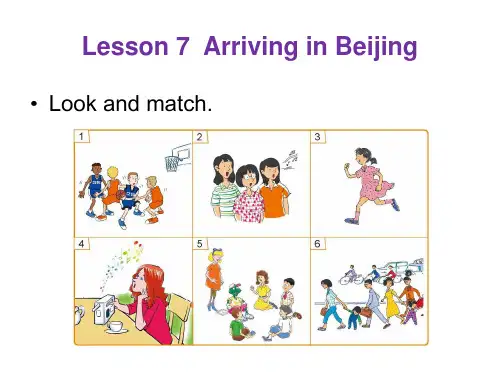
• These people are walking. • These men are playing basketball. • These women are singing. • The girl is running. • These children are playing. • The woman is listening to music.
1:15
Lesson 7 Arriving in Beijing
• What time is it? • It’s 8:45 in the afternoon.
8:45
Lesson 7 Arriving in Beijing
• When do they arrive in Beijing? • They arrive in Beijing at 9:20 in the
Lesson 7 Arriving in Beijing
• A man is running. • Some old men are
doing Tai Chi.
Lesson 7 Arriving in Beijing
• Read Part 1. Answer the questions.
Lesson 7 Arriving in Beijing
• A man is running. Chi.
Some old men are doing Tai
Lesson 7 Arriving in Beijing
• What do you know about Beijing?
2024年冀教版五年级英语下册Lesson7 Arriving in Beijing-课件

Practice
Read and say
Practice
Read Part1. Answer the questions.
When do they arrive in Beijing? What do they see on their way to the hotel? What do you know about Beijing?
五年级下册
Lesson 7 Arriving in Beijing
(单击图片可播放动画)
Presentation
a man
men
Presentation
a woman women
Presentation
people
Presentation
children
Presentation
Answer these questions
都二
能分
运浇
用灌
好,
“八
二分
八等
定待
律;
”二
,分
我管
们教
一,
起八
,分
静放
待手Leabharlann 花;开二。分成
➢ Pure of heart, life is full of sweet and joy!
绩 ,
八
分
方
法
。
愿
全
天
下
所
有
父
母
我们,还在路上……
When does Jenny arrive in Beijing? She arrives in Beijing at 1:17 in the afternoon.
五年级英语下册课件-Lesson 7 Arriving in Beijing(74)-冀教版
A girl is running .
Some children are playing.
A young woman is reading a book.
Some men are playing cards.
二、将下面的单数句子变为复数。
1. A girl is singing. Some girls are singing.
What is the child doing ? A child is flying a kite .
What are the children doing ? The children are playing football.
What is the woman doing ? The woman is singing .
2. A man is playing football. Some men are playing football.
1. 复数 man—men woman—women child—children
2. 现在进行时 ( Be+动词-ing)
He/She is 动词-ing
They are 动词-ing
What can you see on your way to the school ?
Try to write!
Homework Thanks for watching!
What can you see on your way to the school? write it down.
Good—bye!
a child
some children
a woman
some women
These are men.
冀教三起英语五下《Lesson 7 Arriving in Beijing》
Lesson7 arriving in Beijing一、教学目标:1. 掌握本课四会单词:men, women, children, people, many2. 能够正确运用四会单词:men, women, children, people, many3.学生能够理解并掌握下列单词的单复数形式:child/ children ,man/men ,woman/women.二、教学重、难点:掌握与运用men, women, children, people三、教具学具多媒体、卡片四、教学过程(一) 1. Greeting:2. Chant: What do you see?(二) 1. Show CAI (or posterabout many people in the trai n station.2. Let class discuss and answer: What do you see in this CAI.3. Learn men, women, children and people.4. Listen and follow5. Let’s Chant: Leave Arrive Chant6. Look at the CAI again, then answer these questions: 1) What are the women doing? 2) What are the children doing? 3) What are the men doing?7. Listen the tape carefully, then answer my question:Who is tired and hungry?8. Open your book and look at the second part,and then follow the tape.9. Show the poster to practice五、Homework1、四会词语一汉五英。
五年级下册英语教案-Lesson7《ArrivinginBeijing》|冀教版
教案:五年级下册英语教案 Lesson 7 《Arriving inBeijing》|冀教版教学目标:1. 让学生能够听懂、会说、会读本课的生词和句子。
2. 让学生能够运用所学知识,描述到达北京的情景。
3. 培养学生的观察能力、表达能力以及合作意识。
教学内容:1. 学习生词:bus, train, plane, port, airport, tall, modern, old, big, bridge, hotel。
2. 学习句子: How do you get to ? I get to I stay at教学重点与难点:1. 重点:掌握生词和句型,能够用英语描述到达北京的情景。
2. 难点:正确发音单词和句子,能够运用所学知识进行实际操作。
教具与学具准备:1. 教具:PPT、图片、卡片。
2. 学具:课本、练习册、文具。
教学过程:Step 1: 热身(5分钟)1. 教师与学生用英语进行简单的交流,营造轻松的学习氛围。
2. 学生自由讨论他们知道的关于北京的信息。
Step 2: 引入(10分钟)1. 教师播放PPT,展示北京的图片,引导学生说出他们所知道的关于北京的信息。
2. 教师提问:“How do you get to Beijing?”,学生回答:“I get to Beijing train/bus/plane”Step 3: 生词学习(10分钟)1. 教师出示生词卡片,学生跟读,教师纠正发音。
2. 教师将生词卡片分成两组,让学生进行pair work,练习使用生词。
Step 4: 句子学习(10分钟)1. 教师出示句子卡片,学生跟读,教师纠正发音。
2. 教师将句子卡片分成两组,让学生进行pair work,练习使用句子。
Step 5: 小组活动(10分钟)1. 教师将学生分成小组,每组选一个角色(导游、乘客),用所学知识进行对话。
2. 教师巡回指导,纠正发音和语法错误。
1. 教师邀请学生汇报本节课的学习内容。
五年级英语下册课件-Lesson 7 Arriving in Beijing(259)-冀教版
• A man is running. Chi.
Some old men are doing Tai
Lesson 7 Arriving in Beijing
• What do you know about Beijing?
• Beijing is the capital city of our country. • The Palace Museum is about 600 years old. • The Great Wall is about 6000 kilometres long. It’s about
9:20
Lesson 7 Arriving in Beijing
• What time is it? • It’s 11:30 in the morning.
11:30
Lesson 7 Arriving in Beijing
• What time is it? • It’s 1:15 in the afternoon.
• They are on their way to the hotel. • What do they see on their way to the hotel?
Lesson 7 Arriving in Beijing
• Beijing is great! • Look! • There are many people in the park.
Lesson 7 Arriving in Beijing
• A child is flying a kite.
• Some children are playing football.
Lesson 7 Arriving in Beijing
五年级英语下册课件-Lesson 7 Arriving in Beijing(254)-冀教版
Listen and answer the questions
• 1. How many people are there in the story? There are four.
• 2.What time is it when they arrive in Beijing? I
• 3.Are the children tired and hungry?
Yes, everyone is tired and hungry.
Let’s chant!
I am sitting. I am standing. I am walking. I am running.
Homework
• Go over the words and sentences.
• Use the words to write a passage.
Thank you!
• Can you find the boys________ cards?
Can you find it ?
• These w__o_m_e_n__ are_b_u_y_i_n_g___tickets. • These_c_h_il_d_re_n__ are crying. • These men aret_a_l_k_in_g_____. • These children arep_l_a_y_in__g_c_a_r_d_s___
四、Use the sentances:
Chant again!
What are you doing? I am sitting.