
2021年中考宁夏专用英语外研版教材复习课件七年级下册Modules 9—12
14.Before he was six , he played ___n_o_t__ __o_n_l_y__the piano __b_u_t____ __a_l_s_o__the violin. 还不到6岁,他就既会弹钢琴,又会拉小提琴。
语法 1.不规则动词的一般过去时 3.祈使句(顺序与规则) 话题 Module 9 作家 Module 10 旅游与交通 Module 11 肢体语言 Module 12 娱乐
Module 10 20.guess v.猜;猜测 21.arrive v.到达 22.relax v.放松 23.French adj.&n.法国的;法国人(的);法语(的) 24.on adv.在使用中;开着的 25.palace n.宫殿
Module 11 26.bow v.鞠躬;弯腰 27.kiss v.&n.吻;亲吻 28.shake v.摇晃 29.smile v.&n.微笑 30.nod v.点(头) 31.head n.头;头部 32.hug v.拥抱;紧抱 33.each pron.各个;每个
பைடு நூலகம்
2.一般过去时的Wh问句 4.选择疑问句;感叹句
考点梳理 拓展素养
考点1
He married in 1582 and had three children. 他于1582年结婚并育有三个孩子。(Module 9 P56) 【点拨】 marry既可作及物动词,意为“嫁;娶;与……结婚”; 也可作不及物动词,意为“结婚”。其常见用法如下:
17.not at all一点也不 18.in fact事实上 19.on time准时 20.on the river ...坐落于/位于……河畔 21.in the center of在……的中心 22.dance music舞曲
词汇拓展 1.write v.→__w_r_it_e_r_n.作家 2.real adj.→ __r_e_a_ll_y_ adv.真正地;确实;的确 3.become v.→ _b_e_c_a_m_e_(过去式)
5.We waited__u_n_t_il_/t_il_l__all the lights __w_e_r_e__ ___o_n___. 我们一直等到所有的灯都亮了。 6. D_o_n_’_t__ s_ta_n__d_too close to North Americans! __g_iv_e__ _t_h_e_m__ more
→ _f_e_e_li_n_g_ n.感觉;直觉看法
重点句型 1.He__l_e_ft__school and_b__eg_a_n_ work ___a_t__ the age of twelve. 12岁时,他离开了学校,开始工作。 2.—Where ___a_r_e_ you _g_o_i_n_g_ __o_n___ holiday,Tony? 托尼,你准备去哪里度假? —To Los Angeles.去洛杉矶。 3. _H__o_w__ _l_o_n_g__ did it __ta_k_e__ to get there? 到那儿花了多长时间? 4.Jenny and Ia_r_ri_v_e_d_ __b_y___ plane the day before yesterday.珍妮和我前天乘飞机到达了。
9.relax v.→ r_e_l_a_x_in_g_ adj.令人愉悦的;使人放松的 → _r_el_a_x_e_d_ adj.放松的;自在的
10.French n.→ F__r_a_n_c_e_法国
11.sell v.→ _s_o_ld__(过去式/过去分词)卖;出售
→ __s_a_l_e_n.卖;出售
12.wonder n.→ _w__o_n_d_e_r_f_u_l adj.绝妙的;了不起的 13.Britain→ _B__ri_t_is_h_ adj.英国的;英国人的 14.German n.&adj.→ _G_e_r_m__a_nspl.德国人
→ G__e_r_m_a_n_yn.德国
15.Japan→ _J_a_p_a_n_e_seadj.&n.日本的;日本人(的);日语(的)
→ _b_e_c_o_m_e_(过去分词)成为 4.marry v.→ _m_a_r_r_i_e_d adj.已婚的;结婚的 5.success n.→ __s_u_c_c_e_ss_f_u_l_ adj.成功的
→ _s_u_c_c_e_s_sf_u_l_ly_ adv.成功地 → _s_u_c_c_e_ed_ v.成功 6.build v.→ __b_u_i_l_t _(过去式/过去分词)建造
用法
含义
例句
sb.marry
She married a German.
嫁给某人;娶了某人
sb.
她嫁给了一个德国人。
Mr. Green married his daughter to an marry sb. (父母把女儿)嫁给某人;
engineer. to sb. (父母让儿子)娶某人
格林先生把女儿嫁给了一位工程师。
30.century n.→ c_e_n_t_u_r_ie_spl.世纪 31.old adj.→ __e_l_d_e_r_ adj.年长的 32.sad adj.→ _s_a_d_n_e_s_s n.悲伤 33.slow adj.→ __sl_o_w_l_y_ adv.缓慢地 34.feel v.→ ___fe_l_t__(过去式/过去分词)感觉;觉得
9.take photos (of ...)拍照 10.shake hands握手 11.nod one's head点头 12.each other互相;彼此 13.body language肢体语言 14.arm in arm臂挽臂地 15.wave to say goodbye挥手告别 16.somewhere else别的地方
9.This is Western music,_i_sn__’t__ ___i_t__? 这是西方音乐,不是吗?
10.—Do you like__tr_a_d_i_ti_o_n_a_l__Western music___o_r___pop music? 你喜欢西方传统音乐还是流行音乐? —I like ___b_o_th___.两者我都喜欢。 11.You listen to pop music,Lingling, ___d_o_n_’t_ __y_o_u__ ? 玲玲,你听流行音乐,不是吗? 12. __W__h_a_t__ _____a___ beautiful city! 13. 一座多么美丽的城市啊! 13.His dance music ___m_a_d_e__ ___h_im____ _f_a_m__o_u_s_ all over Europe. 他的舞曲使他闻名整个欧洲。
personal space.不要和北美人站得太近!给他们更多的个人空间。 7.In Britain many people don't like other people_t_o_t_o_u_c_hthem__a_t_ __a_ll_. 在英国很多人一点儿也不喜欢别人碰他们。 8.In some places,it__i_sn__’t_ _p_o_l_it_e_ ___t_o__look at people when you talk. 在一些地方,交谈时看着对方是不礼貌的。
55.opera n.歌剧 56.drum n.鼓 57.believe v.相信 58.centre/center n.中心 59.another pron.又一个;再一个 60.poor adj.贫穷的 61.perfect adj.完美的 62.sad adj.令人悲伤的;令人难过的
重点短语 1.find out发现;查明;弄清 2.at the age of在……岁时 3.in the 1860s在19世纪60年代 4.around the world世界各地 5.the day before yesterday前天 6.first of all首先 7.wait in line排队 8.learn about了解
→ _p_e_r_s_o_n_a_l_it_y n.个性
22.hold v.→ __h_e_l_d__(过去式/过去分词)握着;使不动 23.polite adj.→ _im__p_o_li_t_e(反义词)不礼貌的
→ _p_o_l_it_e_l_y adv.礼貌地 24.bring v.→ _b_r_o_u_g_h_t(过去式/过去分词)带来 25.live adj.→ __li_v_e_ly__ adj.活泼的;轻快的 26.noise n.→ __n_o_i_sy__ adj.吵闹的 27.violin n.→ _v_io_l_in_i_s_t n.小提琴手 28.West n.→ _W__e_st_e_r_nadj.西方的 29.music n.→m__u_s_ic_i_a_nn.乐手;音乐家
8.November n.11月 9.December n.12月 10.newspaper n.报纸 11.exact adj.准确的;确切的 12.date n.日期 13.play v.剧本;戏剧 14.marry v.结婚 15.build n.建造
16.fire n.火;火灾 17.rich adj.富有的 nguage n.语言 19.young adj.年轻的
34.together adv.一起;共同 35.touch v.触摸;接触 36.finger n.手指 37.mouth n.嘴;口 38.foreign adj.外国的 39.hold v.握着;使不动 40.move v.移动 41.polite adj.礼貌的
42.somewhere adv.某处;某个地方 43.wave v.挥(手);招(手);摆(手) 44.fact n.事实;细节 45.rude adj.粗鲁的;无礼的 46.bring v.带来
合集下载
外研版英语七年级(下册)期末复习资料全ppt课件

• 9. Who find it just now ? ________f_o_u_n_d_________________________
25
• 1. His mother ____w_a_s____ (be) a shop assistant
last year.
• 2. She d__id_n_’_t_p_r_a_c_t_ic_e_(not practice) the guitar
• 说话的对象都是“你”或“你们” • 以动词原形开头 • 否定时用“don’t” • 有时候可在最前面加上“please”
28
1. ____B_e____ (be) a good boy! 要做一个好孩子! 2. It’s an important meeting. D__o_n_’_t _b_e (not be) late. 3. ___L_o_o_k__ (look) out! A car is coming. 4. __D_o_n_’_t_w_o_r_r_y_ (not worry). Be happy. 5. Please __C___ look outside. Look at the blackboard.
14
Module5 特殊疑问句
• 1、掌握常用的几个特殊疑问词。以及明确 是对什么成分进行提问的。 how much how long what colour how many how often why
• 2、结构:特殊疑问词+一般疑问句的结构。 (特殊疑问词后面跟be或者助动词)
15
Example 例子
• 2.He go to school by bus last week. ______w_e_n_t___________________
25
• 1. His mother ____w_a_s____ (be) a shop assistant
last year.
• 2. She d__id_n_’_t_p_r_a_c_t_ic_e_(not practice) the guitar
• 说话的对象都是“你”或“你们” • 以动词原形开头 • 否定时用“don’t” • 有时候可在最前面加上“please”
28
1. ____B_e____ (be) a good boy! 要做一个好孩子! 2. It’s an important meeting. D__o_n_’_t _b_e (not be) late. 3. ___L_o_o_k__ (look) out! A car is coming. 4. __D_o_n_’_t_w_o_r_r_y_ (not worry). Be happy. 5. Please __C___ look outside. Look at the blackboard.
14
Module5 特殊疑问句
• 1、掌握常用的几个特殊疑问词。以及明确 是对什么成分进行提问的。 how much how long what colour how many how often why
• 2、结构:特殊疑问词+一般疑问句的结构。 (特殊疑问词后面跟be或者助动词)
15
Example 例子
• 2.He go to school by bus last week. ______w_e_n_t___________________
外研版七年级下册 Unit 9 Life history PPT课件
15
Task 2 words 重点词汇
16
词汇拼读
March April June Women’s Day National Day Children’s Day July August September October November December writer
real newspaper exact date become play poem marry successful work build on fire
Bring-brought; buy-bought; catch-caught; teach-taught
8
语法讲解: 一般过去时(实义动词) 不规则动词过去式变化规则:
(4) i 变为o
ride-rode; drive-drove; write-wrote
(5) ow/aw 变为ew
know-knew; grow-grew; throw-threw; draw-drew
(6) 以d结尾的动词,把d变为 t
lend-lent; build-built; spend-spent; send-sent
9
语法讲解: 一般过去时(实义动词) 2. 结构:含实义动词句子的一般过去时结构: 否定形式:主语+didn’t+动词原形+其他 例如: Betty didn’t buy the new book just now. My father didn’t drive home yesterday.
12
练习:
1. 他搬到伦敦,并参加了一个戏剧公司。 He ___m_o_v_ed_ ___to___ London and joined a theatre company.
Task 2 words 重点词汇
16
词汇拼读
March April June Women’s Day National Day Children’s Day July August September October November December writer
real newspaper exact date become play poem marry successful work build on fire
Bring-brought; buy-bought; catch-caught; teach-taught
8
语法讲解: 一般过去时(实义动词) 不规则动词过去式变化规则:
(4) i 变为o
ride-rode; drive-drove; write-wrote
(5) ow/aw 变为ew
know-knew; grow-grew; throw-threw; draw-drew
(6) 以d结尾的动词,把d变为 t
lend-lent; build-built; spend-spent; send-sent
9
语法讲解: 一般过去时(实义动词) 2. 结构:含实义动词句子的一般过去时结构: 否定形式:主语+didn’t+动词原形+其他 例如: Betty didn’t buy the new book just now. My father didn’t drive home yesterday.
12
练习:
1. 他搬到伦敦,并参加了一个戏剧公司。 He ___m_o_v_ed_ ___to___ London and joined a theatre company.
初中英语外研版七年级下册《英语下册复习课件》课件

--Where are you going to have it ? --I'm going to have it at the Children's Palace. --Why are you going to have it? --Because I like music. --Who are you going to do it with? --I'm going to have it with my mum. --When are you going ? --I'm going to have it on Sunday morning.
5.It's raining now.We can't go
out to
play.
7.Work in pairs.Look at the map.Ask for and give directions.
along between next to opposite turn left /right
Student A: 1.You're at the station.Ask the way to the cinema. 2.You're at the cinema.Ask the way to the market.
12.Listen to the poem and read.
Perseverance By Mrs.Coleman
My teacher says this is done well. How glad,how proud am l!
Shop supermarket market clothes shop shoe store store
最新外研版七年级英语下册复习课件全册

2020/10/18
8.teach (v.) teacher (n.)教师 taught (过去式)教;讲授 9.worry (v.) worried (adj.)着急的;担心的 10.fly (v.) flew (过去式) flown (过去分词) 11.swim (v.) swimmer(n.)游泳者swimming (现在分词) swam(过去式) swum(过去分词) 12.win (v.) winner (n.)获胜者 won (过去式) 13.early (adj.&adv.) earlier (比较级) earliest (最高级) 14.life (n.) lives (pl.)生活;生命
最新外研版七年级英语Байду номын сангаас册复习课件全套
2020/10/18
七年级(下)Modules 1~4
2020/10/18
重点词汇拓展
1.watch (n.) watches (pl.)手表 2.lose (v.) lost (adj.)迷路的;丢失的 3.I (pron.) mine (名词性物主代词)我的 4.hers (pron.) her (形容词性物主代词)她的 5.careful (adj.) careless (adj.反义词)粗心的 carefully (adv.)仔细地 6.piano (n.) pianist (n.)钢琴家 7.ride (v.) rode (过去式) ridden (过去分词)
2020/10/18
重点句型 1. Here are some nice gloves. 这(儿)是一些漂亮的手套。 2.— Whose bag is this? 这是谁的包? —It's mine . 它是我的。 3.I can play the piano,but can't play table tennis. 我会弹钢琴,但不会打乒乓球。 4.I'd like to join the Music Club because I can play the violin. 因为我会拉小提琴,所以我想加入音乐俱乐部。 5.I'm sure everybody would like a clean classroom,just like home. 我相信大家都想要一个干净的教室,就像一个家一样。
8.teach (v.) teacher (n.)教师 taught (过去式)教;讲授 9.worry (v.) worried (adj.)着急的;担心的 10.fly (v.) flew (过去式) flown (过去分词) 11.swim (v.) swimmer(n.)游泳者swimming (现在分词) swam(过去式) swum(过去分词) 12.win (v.) winner (n.)获胜者 won (过去式) 13.early (adj.&adv.) earlier (比较级) earliest (最高级) 14.life (n.) lives (pl.)生活;生命
最新外研版七年级英语Байду номын сангаас册复习课件全套
2020/10/18
七年级(下)Modules 1~4
2020/10/18
重点词汇拓展
1.watch (n.) watches (pl.)手表 2.lose (v.) lost (adj.)迷路的;丢失的 3.I (pron.) mine (名词性物主代词)我的 4.hers (pron.) her (形容词性物主代词)她的 5.careful (adj.) careless (adj.反义词)粗心的 carefully (adv.)仔细地 6.piano (n.) pianist (n.)钢琴家 7.ride (v.) rode (过去式) ridden (过去分词)
2020/10/18
重点句型 1. Here are some nice gloves. 这(儿)是一些漂亮的手套。 2.— Whose bag is this? 这是谁的包? —It's mine . 它是我的。 3.I can play the piano,but can't play table tennis. 我会弹钢琴,但不会打乒乓球。 4.I'd like to join the Music Club because I can play the violin. 因为我会拉小提琴,所以我想加入音乐俱乐部。 5.I'm sure everybody would like a clean classroom,just like home. 我相信大家都想要一个干净的教室,就像一个家一样。
外研版英语七年级下册课件Module9单元课件

• To understand conversations about life in the past To understand and be able to ask questions with “did” To learn months of the year
Words and expressions
2. He left school and began work at the age of 12.
at the age of…在……岁时
a. He can speak English at the age of five.
他五岁时就可以说英语。
b. Daniel could swim at the age of 10. 丹尼尔10岁时就会游泳了。
外研版英语 七年级下册单元课件
Module 9
2018年12月
Module9
• 1.unit1 • 2. unit2 • 3. unit3 • (单击上面课题进入对应幻灯片)
9
Unit 1 He left school and began work at the age of twelve.
Teaching aims and demands
become v. 成为
in the 1860 在19世纪60年代
Months
Festivals
Seasons
What festival can you think of?
Christmas
Thanksgiving
Halloween
New Year’s Day
Spring Festival
May Day
April May June
Examples: Spring Festival is in January or February.
Words and expressions
2. He left school and began work at the age of 12.
at the age of…在……岁时
a. He can speak English at the age of five.
他五岁时就可以说英语。
b. Daniel could swim at the age of 10. 丹尼尔10岁时就会游泳了。
外研版英语 七年级下册单元课件
Module 9
2018年12月
Module9
• 1.unit1 • 2. unit2 • 3. unit3 • (单击上面课题进入对应幻灯片)
9
Unit 1 He left school and began work at the age of twelve.
Teaching aims and demands
become v. 成为
in the 1860 在19世纪60年代
Months
Festivals
Seasons
What festival can you think of?
Christmas
Thanksgiving
Halloween
New Year’s Day
Spring Festival
May Day
April May June
Examples: Spring Festival is in January or February.
新外研版七年级下册英语 Module 9 Unit 1 教学课件
Labour Day Spring Festival
第八页,共二十七页。
July August
September
October
November
December
新课讲解
Work in pairs
1.Which month is the first in a year?
January. 2. Which month is the last in a year?
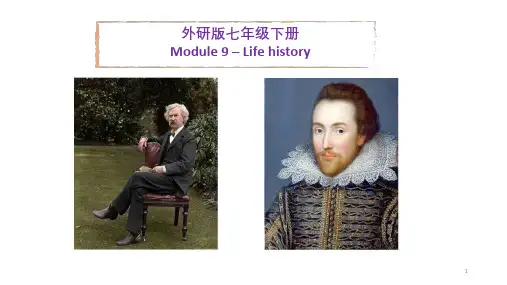
1. He began work at the _______aogfetwelve. 2. His ___r_e_a_l_ name was Samuel Clemens. 3. He wrote for a(n) __n_e_w__sp__a_p_e.r 4. He _b_e_c_a_m__e very famous.
—_________ (woman) Day.
Women’s
第二十二页,共二十七页。
当堂小练
5.Danny’s brother ___b_e_c_a_m__e (become) a policeman last
Monday. 6.—What’s your little brother’s favourite festival?
1.They usually ___g_o_ shopping on Sundays.But last Sunday they ____w_e_n_t__ to Shanghai for a trip.(go)
2.Did you ____g_e_t ___ (get) home early yesterday morning? 3.Look!Many girls are _____w_a_s_h_in(wgash) their clothes by the river. 4.—What festival is on March 8?
第八页,共二十七页。
July August
September
October
November
December
新课讲解
Work in pairs
1.Which month is the first in a year?
January. 2. Which month is the last in a year?
1. He began work at the _______aogfetwelve. 2. His ___r_e_a_l_ name was Samuel Clemens. 3. He wrote for a(n) __n_e_w__sp__a_p_e.r 4. He _b_e_c_a_m__e very famous.
—_________ (woman) Day.
Women’s
第二十二页,共二十七页。
当堂小练
5.Danny’s brother ___b_e_c_a_m__e (become) a policeman last
Monday. 6.—What’s your little brother’s favourite festival?
1.They usually ___g_o_ shopping on Sundays.But last Sunday they ____w_e_n_t__ to Shanghai for a trip.(go)
2.Did you ____g_e_t ___ (get) home early yesterday morning? 3.Look!Many girls are _____w_a_s_h_in(wgash) their clothes by the river. 4.—What festival is on March 8?
外研版七年级英语下册期末复习课件全册
课前自学反馈
中考考点聚焦
当堂效果检测
第3课时┃ Modules 1-6 [七年级下册]
类别
课标考点要求
22.leave→__l_e_f_t___(过去式) 23.play→_p_l_a_y_e_r__n. 24.certain→_c_e_r_t_a_i_n_l_y_adv. 词汇 25.heavy→__h_e_a_v_i_l_y adv. 拓展 26.fit→_f_i_t_n_e_s_s_n.→_h_a_e_l_t_h_y_ (同义词) 27.rise→___r_o_s_e__ (过去式)→__r_i_s_e_n__ (过去分 词) 28.life→___l_i_v_e_s_ (复数)
—Certainly. Go across…
课前自学反馈
中考考点聚焦
当堂效果检测
第3课时┃ Modules 1-6 [七年级下册]
语法 结构
话题 写作
1. 名词性物主代词和情态动词can的用法 [详见P75,语法互动(三);P91,语法互动 (九)] 2. 一般将来时态的结构及用法[详见P87, 语法互动(八)] 3. 特殊疑问句和方位的表达方式[详见P97, 语法互动(十三);P80,语法互动(五)]
_T_h_a_t_'_s__ __w_h_y____ there are lost and found
offices at airports and stations.
课前自学反馈
中考考点聚焦
当堂效果检测
第3课时┃ Modules 1-6 [七年级下册]
3.我确信每个人都想要一个干净的教室。 ____I_'_m__ __s_u_r_e___ everybody would like a clean 句型 classroom. 再现 4. 未来的生活将会是什么样子的? What ___w_i_l_l__ life ____b_e___ ___l_i_k_e__ in the future?
外研版英语七年级下册 module 9 巩固与复习 课件(共20张PPT)
Module 9
Life histo ry.
Knowledge allows you to dream.
01. 单 词
目 录 02. 词 组
CONTENTS 03. 句 型
04. 语 法
单词的发音和 词性巩固 归纳不同的短 语类型 重点句子回顾
一般过去时
第一章
单词发音与词性
March [mɑːtʃ] n. 3月 April ['eiprəl] n. 4月 June [dʒu:n] n. 6月 July [dʒʊˈlaɪ]n. 7月 August [ɔː'gʌst] n. 8月 September [sep'tembə] n. 9月 October [ɒk'təʊbə] n. 10月 November[nə(ʊ)'vembə] n. 11月 December [dɪ'sembə] n. 12月 writer ['raɪtə] n.作家 date n.日期
三、一般疑问句句形式: 在含有动词的一般过去时态中, 其一般疑问句的改法, 须添加助动词 did。 注意添加助动词后, 原句中的谓语动词须用原形。 如: They came into the classroom quickly. 他们很快地走进了教室。 Did they come into the classroom quickly? 他们很快进了教室吗?
9. 老剧院发生过火灾。 There was a fire in the old theatre. 10. 威廉•莎士比亚52岁去世。 William Shakespeare died at the age of 52. 11. 你现在依然可以看见他的戏剧以英文和其他许 多语言在演出。 You can still see his plays in English and in many the languages. 12. 他举世闻名。 He’s famous around the world.
Life histo ry.
Knowledge allows you to dream.
01. 单 词
目 录 02. 词 组
CONTENTS 03. 句 型
04. 语 法
单词的发音和 词性巩固 归纳不同的短 语类型 重点句子回顾
一般过去时
第一章
单词发音与词性
March [mɑːtʃ] n. 3月 April ['eiprəl] n. 4月 June [dʒu:n] n. 6月 July [dʒʊˈlaɪ]n. 7月 August [ɔː'gʌst] n. 8月 September [sep'tembə] n. 9月 October [ɒk'təʊbə] n. 10月 November[nə(ʊ)'vembə] n. 11月 December [dɪ'sembə] n. 12月 writer ['raɪtə] n.作家 date n.日期
三、一般疑问句句形式: 在含有动词的一般过去时态中, 其一般疑问句的改法, 须添加助动词 did。 注意添加助动词后, 原句中的谓语动词须用原形。 如: They came into the classroom quickly. 他们很快地走进了教室。 Did they come into the classroom quickly? 他们很快进了教室吗?
9. 老剧院发生过火灾。 There was a fire in the old theatre. 10. 威廉•莎士比亚52岁去世。 William Shakespeare died at the age of 52. 11. 你现在依然可以看见他的戏剧以英文和其他许 多语言在演出。 You can still see his plays in English and in many the languages. 12. 他举世闻名。 He’s famous around the world.
英语7年级下外研版全册精品PPT课件2(36份)Module 9 Unit 1
Did you watch TV yesterday evening? 昨晚你看电视了吗? 注意:加了did后构成的疑问句中,谓语
动词要变成原形。请看下面列表:
肯定
否定
He moved to He didn’t move to London at 28. London at 28.
一般疑问句
Did he move to London at 28?
Phrases and useful expressions
at the age of be different from write about find out on the Internet real name as well
在……岁时 与……不同 写关于…… 查明 在因特上
真名
也
Practice
New Year’s Day in January
Spring Festival in January or February
Women’s Day in March
Labour Day in May
Children’s Day in June
Teachers’ Day in September
Presentation
January February March April May June July August September October November December
一月 二月 三月 四月 五月 六月 七月 八月 九月 十月 十一月 十二月
1.Which month is the first in a year? January. 2. Which month is the last in a year? December. 3. Which month is before/after…? It’s …
动词要变成原形。请看下面列表:
肯定
否定
He moved to He didn’t move to London at 28. London at 28.
一般疑问句
Did he move to London at 28?
Phrases and useful expressions
at the age of be different from write about find out on the Internet real name as well
在……岁时 与……不同 写关于…… 查明 在因特上
真名
也
Practice
New Year’s Day in January
Spring Festival in January or February
Women’s Day in March
Labour Day in May
Children’s Day in June
Teachers’ Day in September
Presentation
January February March April May June July August September October November December
一月 二月 三月 四月 五月 六月 七月 八月 九月 十月 十一月 十二月
1.Which month is the first in a year? January. 2. Which month is the last in a year? December. 3. Which month is before/after…? It’s …
外研版七年级英语下Module9Unit1(共26张PPT)
He is looking for __w_o_r_k_ now and he wants to find a ___jo_b___.
What’s your____jo_b___?
4.He took the name Mark Twain and became very famous in
the 1860s. 在19世纪60年代,他取名为马克·吐温,并变得非常有名。 become 此处为__连__系__动__词___意为“变得” ,后面接_形__容__词_ 作_表__语__。 become 还有“成为”的意思。 她16岁时成为一名著名的歌手。
January February March April May June
Teachers’ Day Women’s Day Christmas National Day Children’s Day New Year’s Day Labour Day
July August September October November December
_S_h_e__b_e_c_a_m__e__a__fa__m_o__u_s_s_i_n_g_e_r__a_t_t_h_e__a_g_e__o_f_1_6__. _
in the 1860s译为“在十九世纪六十年代”, “in+the+整十 年份+s/’s”是表达年代的固定用法。
又如:在二十世纪二十年代___in__t_h_e__1_9_2_0_s____
Listen and fill in the blanks.
When Betty’s father was young, his life was very __d_if_fi_c_u_lt__. He was born in __A_p_r_il_ 1935. He wasn’t born in America and he was born in _E_n_g_la_n_d_. They come to America in _O_c_t_o_b_er_ 1941 when he was __s_ix__ years old.
What’s your____jo_b___?
4.He took the name Mark Twain and became very famous in
the 1860s. 在19世纪60年代,他取名为马克·吐温,并变得非常有名。 become 此处为__连__系__动__词___意为“变得” ,后面接_形__容__词_ 作_表__语__。 become 还有“成为”的意思。 她16岁时成为一名著名的歌手。
January February March April May June
Teachers’ Day Women’s Day Christmas National Day Children’s Day New Year’s Day Labour Day
July August September October November December
_S_h_e__b_e_c_a_m__e__a__fa__m_o__u_s_s_i_n_g_e_r__a_t_t_h_e__a_g_e__o_f_1_6__. _
in the 1860s译为“在十九世纪六十年代”, “in+the+整十 年份+s/’s”是表达年代的固定用法。
又如:在二十世纪二十年代___in__t_h_e__1_9_2_0_s____
Listen and fill in the blanks.
When Betty’s father was young, his life was very __d_if_fi_c_u_lt__. He was born in __A_p_r_il_ 1935. He wasn’t born in America and he was born in _E_n_g_la_n_d_. They come to America in _O_c_t_o_b_er_ 1941 when he was __s_ix__ years old.