
(完整word版)新闽教版小学英语六年级知识点归纳
六年级上册语言知识点归纳(单词)一.单词1.国家:Australia 澳大利亚Australian 澳大利亚的the USA(America)美国American 美国的the UK(England) 英国English 英国的China 中国Chinese 中国的;中国人;汉语2.奥运会有关单词:Olympic Games 奥林匹克运动会Summer Olympic 夏季奥运会Winter Olympic 冬季奥运会the 29th Olympic Games 第29届奥运会ring 环hold 举办world 世界dream 梦想3.家务:make the bed 整理床pick up the toys 拾起玩具water the flowers 浇花wash clothes 洗衣服4.服装:dress 连衣裙shorts 短裤trousers 裤子schoolbag 书包socks 短袜cap 鸭舌帽a pair of shoes 一双鞋子 a pair of glasses 一副眼镜5.食品:fruit salad 水果色拉hot dog 热狗candy 糖果corn 玉米soup 汤beef 牛肉vegetable salad 蔬菜色拉6.宇宙:sun 太阳moon 月亮star 星星earth 地球7.节日:Thanksgiving dinner 感恩节晚餐National Day 国庆节Tree Planting Day 植树节Teachers’ Day教师节8.生活物品:basket 篮子washing machine 洗衣机plant 植物9.动词:pass 传递catch 接住bring 带来keep 保持walk 步行water 水;浇水10.房间:bedroom 卧室toilet 卫生间floor 地板11.其他类menu 菜单strong 强壮的12. 动词词组类walk to school 步行上学take a taxi 打的六年级上册语言知识点归纳(句子)1. They take place every four every years. 他们每四年举行一次。
2. China held the 29th Olympic Games in Beijing.中国在北京举办第29界奥运会。
3. Does he often play basketball? 他经常打篮球吗?Yes, sometimes he also plays football. 是的,有时候他也踢足球。
4. They are cheering for their class team. 他们在为自己班队加油。
5. Bring me a basket, please. 请给我一个篮子去。
6. Take an umbrella with you. 请带一把伞。
7. Can I help you, madam ? 女士,我能帮助你吗?Yes, I need a dress. 好,我需要一件连衣裙。
8. Whose schoolbag is this? 这是谁的书包?It’s Lily’s. 它是丽丽的。
9. First make the bed. 首先整理床铺。
Then pick up the toys on the floor. 然后捡起地板的玩具。
10. Wang Tao usually gets up at half past six. 王涛通常六点半起床。
11. But this morning he got up at half past seven.但是今天他七点半才起床。
12. What did you do last night? 你昨晚做了什么?I watched a football game. 我看了一场足球比赛。
13. When did you go to bed? 你什么时候去睡觉?At half past eleven. 11点半。
14. Pass me the corn, please. 请把玉米递给我。
Here you are. 给你。
15. Would you like some soup? 你要一些汤吗?Yes, please. 好,请。
16. Are there any trees on the moon? 月亮上有树吗?No, there aren’t. 不,没有。
17. Is there a rabbit on the moon? 月亮上有一只兔子吗?No, there isn’t. 不,没有。
六年级上册语言知识点归纳(单词练习)一.看图片写单词1. 2. 3.4. 5. 6.7. 8. 9.二. 根据图片完成单词。
1. 2. 3. 4.b sk d ty w k tr s s5. 6. 7. 8.s l d pl t s p t let三.根据汉语完成单词。
1. 浇水2. 座位3. 保持4. 梦想w t s t k p dr m 5. 菜单 6. 世界7.锻炼8. 举办m n w ld ex c se h d四、看汉语写英语。
1. 小时2. 盒子3. 坏的4. 环5. 牛肉6. 强壮的7.游戏8.食物五.补全单词,完成句子。
1. P me the fish, please. Here you are.2. Bring me a glass of water. I’m very t .3. Take an umbrella with you. It may r in the afternoon.4. Where are you from? I’m from C .5. Candy is bad for your t .六.根据题意,完成句子。
1. Spring is . It’s getting warm.2. The sun shines and .3. Fruits and vegetables are for us.4. Thanksgiving is an holiday.5. Tree Planting Day is on .六年级下册语言知识点归纳——词汇工作(job)职业famer 农民cook 厨师nurse 护士dancer 舞蹈演员police officer 警察driver 驾驶员singer 歌唱演员worker 工人doctor 医生scientist 科学家疾病类:fever 发烧headache 头疼wrong 不正常的medicine 药toothache 牙痛ill 病的,不适的地点类dining room 餐厅lab 实验室middle school 中学teachers’ office 教师办公室computer room 电脑室music room 音乐室科目subjectphysics 物理chemistry 化学geography 地理history 历史lesson 功课math 数学反义词类thin 瘦的fat 胖的light 轻的heavy 重的tall 高的short 短的动词类词travel 旅行show 给……看cross 横穿open 张开break 摔断feel 感觉到carry 携带hope 希望hear 听见kiss 亲吻love 爱grow 种植learn 学习study 学习miss 想念动词词组go back 回到have a cold 感冒have a fever 发烧have a toothache 牙疼名词词组the Yangtze river 长江Ice and Snow Festival 冰雪节year book 毕业留念册其它类street 街道address 地址information 信息surprise 惊喜a lot of 大量的soon 不久true 确实的famous 著名的六年级下册语言知识点归纳——重点句型Unit 1 Winter ActivitiesDid you go anywhere in winter? 冬天你有去哪里吗?I climbed a mountain. 我去爬山了。
I traveled along the Yangtze River. 我沿着长江旅行。
I listened to music. 我听音乐。
I went back to my hometown. 我回我老家。
It’s short and fat. 它又矮又肥。
It’s tall and thin. 它又高又瘦。
A: Show me the dress, please. 请给我看那件连衣裙。
B: Which dress? 哪一件?A: The long one. 长的那件。
Unit 2 Helping Each OtherWang Tao broke his leg. 王涛摔伤了他的腿。
I am sorry to hear that. 听到这个我很遗憾。
He didn’t do well in high jump. 他跳高没跳好。
The basket is heavy. 篮子很重。
Let me carry it. 让我来提它。
I can help you with your math. 我帮你补数学。
I am worried about my lessons. 我担心我的功课。
Unit 3 Seeing a DoctorWhat’s wrong with you? 你怎么了?I have a headache. 我头痛。
I have a cold. 我感冒了。
I have a toothache. 我牙疼。
I have a fever. 我发烧了。
You must take the medicine. 你必须吃药。
You must drink a lot of water. 你必须多喝水。
You mustn’t go to school. 你不能去上学了。
Unit 4 Mother’s DayWhat will you do for your mother? 你要为你的妈妈做些什么?I will make a card for her. 我要为她制作一张贺卡。
I will give her some flowers. 我要给她一些花。
I will give her a big kiss, 我要给她一个大大的吻,and say “I love you”. 并说“我爱你”。
What an interesting book!多有趣的一本书呀!What a surprise! 多么令人惊讶呀!Unit 5 OccupationWhat does he do? 他是做什么的?He is a doctor. 他是一名医生。
闽教版小学英语六年级上册Unit 5 单元知识梳理
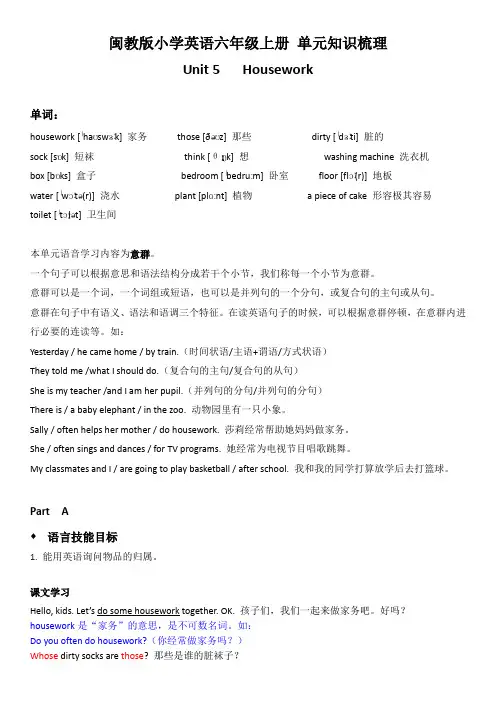
闽教版小学英语六年级上册单元知识梳理Unit 5 Housework单词:housework [ˈhaʊswɜːk] 家务those [ðəʊz] 那些dirty [ˈdɜːti] 脏的sock [sɒk] 短袜think [θɪŋk] 想washing machine 洗衣机box [bɒks] 盒子bedroom [ˈbedruːm] 卧室floor [flɔː(r)] 地板water [ˈwɔːtə(r)] 浇水plant [plɑːnt] 植物 a piece of cake 形容极其容易toilet [ˈtɔɪlət] 卫生间本单元语音学习内容为意群。
一个句子可以根据意思和语法结构分成若干个小节,我们称每一个小节为意群。
意群可以是一个词,一个词组或短语,也可以是并列句的一个分句,或复合句的主句或从句。
意群在句子中有语义、语法和语调三个特征。
在读英语句子的时候,可以根据意群停顿,在意群内进行必要的连读等。
如:Yesterday / he came home / by train.(时间状语/主语+谓语/方式状语)They told me /what I should do.(复合句的主句/复合句的从句)She is my teacher /and I am her pupil.(并列句的分句/并列句的分句)There is / a baby elephant / in the zoo. 动物园里有一只小象。
Sally / often helps her mother / do housework. 莎莉经常帮助她妈妈做家务。
She / often sings and dances / for TV programs. 她经常为电视节目唱歌跳舞。
My classmates and I / are going to play basketball / after school. 我和我的同学打算放学后去打篮球。
(完整word版)闽教版小学英语词汇手册.docx
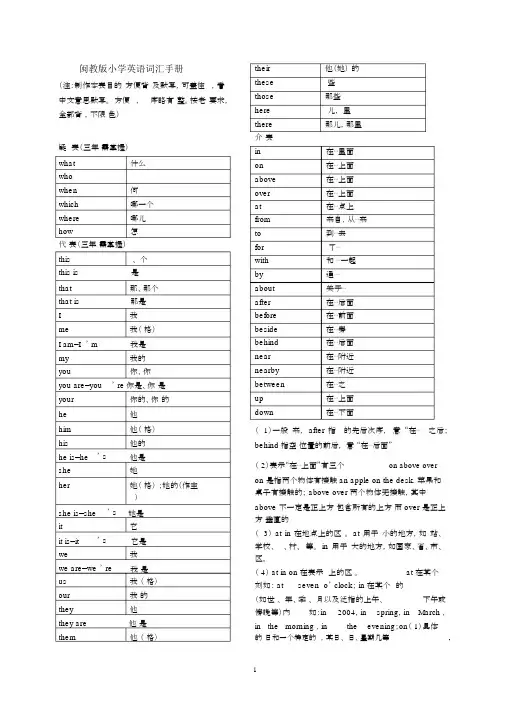
闽教版小学英语词汇手册(注:制作本表目的方便背及默写,可盖住,看中文意思默写。
方便,序略有整。
按老要求,全部背,不限色)疑表(三年需掌握)what什么whowhen何which哪一个where哪儿how怎代表(三年需掌握)this、个this is是that那、那个that is那是I我me我(格)I am=I ’ m我是my我的you你、你you are=you’ re你是、你是your你的、你的he他him他(格)his他的he is=he’ s他是she她her她(格);她的(作主)she is=she’ s她是it它it is=it’ s它是we我we are=we ’ re我是us我(格)our我的they他they are他是them他(格)their他(她)的these些those那些here儿,里there那儿,那里介表in在⋯里面on在⋯上面above在⋯上面over在⋯上面at在⋯点上from来自,从⋯来to到⋯去for了⋯with和⋯一起by通⋯about关于⋯after在⋯后面before在⋯前面beside在⋯旁behind在⋯后面near在⋯附近nearby在⋯附近between在⋯之up在⋯上面down在⋯下面(1)一般来,after 指的先后次序,意“在⋯之后;behind 指空位置的前后,意“在⋯后面”( 2)表示“在⋯上面”有三个on above overon 是指两个物体有接触 an apple on the desk. 苹果和桌子有接触的; above over 两个物体无接触,其中above 不一定是正上方包含所有的上方而 over 是正上方垂直的(3) at in 在地点上的区。
at 用于小的地方,如站、学校、、村、等。
in 用于大的地方,如国家、省、市、区。
( 4) at in on 在表示上的区。
at 在某个刻如: at seven o’ clock; in 在某个的(如世、年、季、月以及泛指的上午、下午或傍晚等)内如:in2004,in spring,in March ,in the morning ,in the evening;on( 1)具体的日和一个特定的,某日、日、星期几等,如: on Children ’ s Day, on New Year’ s write wrote Day, on the 5th of May ,on Sunday ( 2) know knew 在某个特定的早晨、下午或晚上。
闽教版小学英语六年级上册期末复习材料
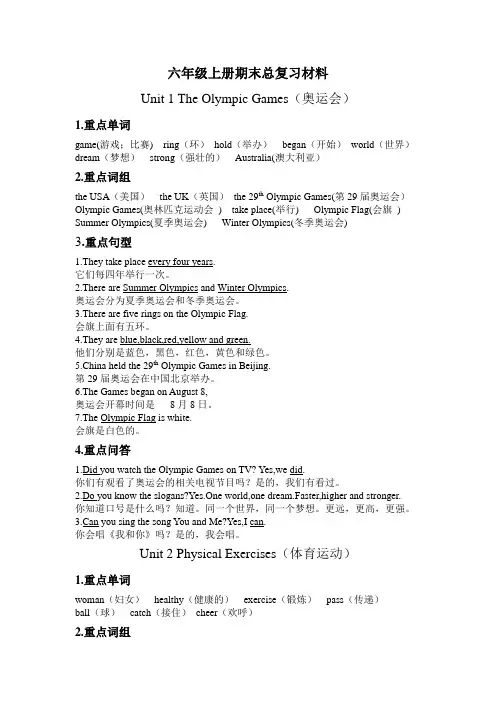
六年级上册期末总复习材料Unit 1 The Olympic Games(奥运会)1.重点单词game(游戏;比赛) ring(环)hold(举办)began(开始)world(世界)dream(梦想)strong(强壮的)Australia(澳大利亚)2.重点词组the USA(美国)the UK(英国)the 29th Olympic Games(第29届奥运会)Olympic Games(奥林匹克运动会) take place(举行) Olympic Flag(会旗) Summer Olympics(夏季奥运会) Winter Olympics(冬季奥运会)3.重点句型1.They take place every four years.它们每四年举行一次。
2.There are Summer Olympics and Winter Olympics.奥运会分为夏季奥运会和冬季奥运会。
3.There are five rings on the Olympic Flag.会旗上面有五环。
4.They are blue,black,red,yellow and green.他们分别是蓝色,黑色,红色,黄色和绿色。
5.China held the 29th Olympic Games in Beijing.第29届奥运会在中国北京举办。
6.The Games began on August 8,___奥运会开幕时间是___8月8日。
7.The Olympic Flag is white.会旗是白色的。
4.重点问答1.Did you watch the Olympic Games on TV? Yes,we did.你们有观看了奥运会的相关电视节目吗?是的,我们有看过。
2.Do you know the slogans?Yes.One world,one dream.Faster,higher and stronger. 你知道口号是什么吗?知道。
新闽教版小学英语六年级知识点归纳

新闽教版小学英语六年级知识点归纳完美WORD格式编辑六年级上册语言知识点归纳(单词)一.单词1.国家:XXXAmerican澳大利亚的美国的the USA(America)美国the UK(England)China2.奥运会有关单词:Olympic GamesWinter Olympicringworld3.家务:make the bedwater the flowers4.服装:dresstrouserssocksa pair of shoes5.食品:fruit saladXXX英国English英国的XXX中国的;中国人;汉语奥林匹克运动会Summer Olympic夏季奥运会夏季奥运会the 29th Olympic Games第29届奥运会环hold举办世界dream梦想整理床pick up the toys拾起玩具浇花XXX洗衣服连衣裙shorts短裤裤子schoolbag书包短袜cap鸭舌帽一双鞋子a pair of glasses一副眼镜水果色拉hot dog热狗糖果corn玉米研究指导参考资料完美WORD格式编辑soupXXX6.宇宙:sunXXX蔬菜色拉牛肉太阳moon月亮star 7.节日:Thanksgiving XXX Tree Planting Day8.生活物品:XXXXXX9.动词:passbringwalk10.房间:bedroomfloor11.其他类menu12.动词词组类walk to schoolXXX戴德节晚饭National Day 植树节Teachers’Day篮子washing machine动物传递catch带来keep步行water卧室XXX地板菜单strong步行上学take a taxi研究指导参考资料地球国庆节教师节洗衣机接住保持水;浇水洗手间强健的打的圆满WORD花式编纂六年级上册言语常识点归结(句子)13. They take place every four every years.14. China held the 29th他们每四年举行一次。
闽教版小学英语六年级三大时态(一般现在时、一般过去时、一般将来时..
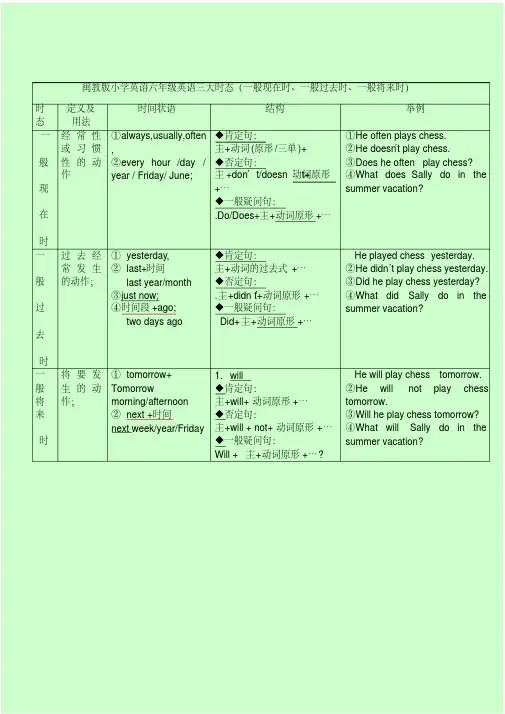
闽教版小学英语六年级英语三大时态(一般现在时、一般过去时、一般将来时)时态定义及用法时间状语结构举例一般现在时经常性或习惯性的动作①always,usually,often,②every hour /day /year / Friday/ June;◆肯定句:主+动词(原形/三单)+◆否定句:主+don’t/doesn’t+动词原形+…◆一般疑问句:.Do/Does+主+动词原形+…①He often plays chess.②He doesn’t play chess.③Does he often play chess?④What does Sally do in thesummer vacation?一般过去时过去经常发生的动作;①yesterday,②last+时间last year/month③just now;④时间段+ago;two days ago◆肯定句:主+动词的过去式+…◆否定句:.主+didn’t+动词原形+…◆一般疑问句:Did+主+动词原形+…He played chess yesterday.②He didn’t play chess yesterday.③Did he play chess yesterday?④What did Sally do in thesummer vacation?一般将来时将要发生的动作;①tomorrow+Tomorrowmorning/afternoon②next +时间next week/year/Friday1.will◆肯定句:主+will+动词原形+…◆否定句:主+will + not+动词原形+…◆一般疑问句:Will + 主+动词原形+…?He will play chess tomorrow.②He will not play chesstomorrow.③Will he play chess tomorrow?④What will Sally do in thesummer vacation?一、选择题( ) 1.Ben usually at 6:40. A.got up B.get up C.gets up ( ) 2.In the past my mother my bed. A.make B.made C.makes ( ) 3.Where you in the summer vacation?A.areB.isC.were( ) 4.Did you a good time in the USA?’tA.have; Yes,I didB.had; Yes,I didC.have; No,I don( ) 5.Do you often do housework at home?A.Yes,I does.B.No,I don’t.C.Yes,I am.( ) 6.Does he clean his room now?’t.A.Yes,she does.B.Yes,he does.C.No,he don( ) 7.li Hong usually at 6:30 in the morning.But this morning she at 7:00.A. get;gotB. gets;getC.gets;got( ) 8. How Mike go to school every day?A.doB.isC.doesD.are( ) 9. The students the football match now.A.watchB.to watchC.are watchingD.watching( ) 10. Did you your room yesterday?A.cleanB.cleansC. cleanedD.cleaning二、填空题1.Listen,there are many students (sing)in the classroom.2.. Look! Sarah is (dance).3. My mother often (wash)clothes on the weekends.4. He (buy) a present for his mother yesterday.5. John (visit)Qingdao next Sunday.6.He usually____(go) to school on foot.7.Does she_____(go) to school on foot?8.Did she ____(go) to school on foot?9.They_____(go) to school on foot yesterday.10.____ she going to school on foot?助动词do,does,did或者它们的否定形式的使用1) you like this magazine?2) The girl like bread for breakfast.3) ---What she at the weekends?---She usually plays games with her friends.4) ---What you do last Sunday? ---I wrote to my friend.5) -- He not visit a farm last National Day holiday.6) They not like playing volleyball.7) --- Jim have a picnic with his family every Saturday?---Yes, he8) Helen with Yang Ling go to school by bike every day? 9) [Do/Does]______ you go to school everyday? No, I don’t. 10) [Do/Does]______ Jack and Peter like apples?11)[Do/Does]______ he watch TV at night? Yes he does. 三.连词成句(请注意大小写)1. the summer you where were in vacation2.did do yesterday what youA good did have time the you in a4. Wang Tao his yesterday did make bed?5. does often housework home Sally at do6.will where you for the go holidays7. to bookstore yesterday he went the.。
闽教版六年级上册英语(三起点)全册知识点汇总
闽教版六年级上册英语(三起点)全册知识点汇总老师好帮手整理there be句型精讲精练there be句型有特点,主语放在be后边,1. 表示:某处有某物2. 构成:There is / are + 某物+ 某处。
句子中的is / are 和后面的名词在数方面保持一致。
3. 特殊情况(1) 如果在be 动词后面出现的是不定代词(something, anything, nothing...),be 动词用is。
(2) there be 之后如果有几个名词(两个或两个以上)时,be 动词与最近的名词在数上保持一致。
4. 句型结构(1) 肯定的陈述句:there is / are + 某物+ 某处。
(2) 否定的陈述句:there isn't / aren't + 某物+ 某处。
(be动词后面直接加not)(3) 一般疑问句:Is / Are there + 某物+ 某处?(be动词提前,结尾标点变问号)肯定回答:Yes, there is / are.否定回答:No, there isn't /aren't.(4) 特殊疑问句:疑问词+一般疑问句?注意:在变换成一般疑问句和否定句时应注意下面的特殊情况。
如果句子中含有some时,应注意把some变换成any。
口诀:变疑问很简单,(1)把be提到there前(2)小写变大写(3)遇到some变any (4)句号变问号。
变否定也不难,(1)be的后面not添(2)遇到some变any 肯定句中用some, 疑问、否定any换。
介词短语表地点,"有"表"存在"记心间。
There be在主语前,have/has在主语后。
There be表"存在", have/has表"所有"。
练习:按要求完成句子。
1. We have two English _________(class) in the morning. (用单词的正确形式填空)2. There is a library in my school. (改为复数形式)____________________________________用There be句式填空。
闽教版小学英语六年级上册知识点(课文解读)
闽教版小学英语六年级上册知识点(课文解读)Unit 1 Part A课文解读1. Did you watch the Olympic Games on TV?(你们从电视上看到奥运会了吗?)该句是过去时态的一般疑问句。
did是助动词do的过去式,没有人称和数的变化,后接动词原形。
Did you…?用来询问对方是否做过某事,回答用“Yes, I/we did.”或者“No, I/we didn’t.”。
例:Did you go to the zoo yesterday?2. What do you know about the Olympic Games?(你们对奥运会了解多少?)该句是由what引导的特殊疑问句。
know about译为“知道/了解关于……”。
What do you know about…?用于询问关于某事物对方了解什么?例:What do you know about China?3. They take place every four years.(它们每四年举行一次。
)take place译为“举行,举办”。
every four years译为“每隔四年”。
every+基数词+时间单位,表示时间的间隔,译为“每……,每隔……”。
they指代奥运会。
例:①The sports meeting will take place next month.②Sally goes to see her grandparents every two weeks.4. There are five rings on the Olympic Flag.(奥运会会旗上有五环。
)there be句型表示“某地有某物”,be动词用单数还是复数,取决于离它最近的名词是单数还是复数,即“就近一致”原则。
例:①There is a girl and two boys in the classroom.②There are two boys and a girl in the classroom.5. What color are they?(它们是什么颜色的?)What color…?用来询问某物的颜色。
新闽教版小学英语六年级知识点归纳
六年级上册语言知识点归纳 (单词)一.单词1.国家:Australia 澳大利亚 Australian 澳大利亚的the USA(America)美国 American 美国的the UK(England) 英国 English 英国的China 中国 Chinese 中国的;中国人;汉语2.奥运会有关单词:Olympic Games 奥林匹克运动会 Summer Olympic 夏季奥运会Winter Olympic 冬季奥运会 the 29th Olympic Games 第29届奥运会ring 环 hold 举办world 世界 dream 梦想3.家务:make the bed 整理床 pick up the toys 拾起玩具water the flowers 浇花 wash clothes 洗衣服4.服装:dress 连衣裙 shorts 短裤trousers 裤子 schoolbag 书包socks 短袜 cap 鸭舌帽a pair of shoes 一双鞋子 a pair of glasses 一副眼镜5.食品:fruit salad 水果色拉 hot dog 热狗candy 糖果 corn 玉米soup 汤 beef 牛肉vegetable salad 蔬菜色拉6.宇宙:sun 太阳moon 月亮star 星星earth 地球7.节日:Thanksgiving dinner 感恩节晚餐National Day 国庆节Tree Planting Day 植树节Teachers’ Day教师节8.生活物品:basket 篮子 washing machine 洗衣机plant 植物9.动词:pass 传递catch 接住bring 带来keep 保持walk 步行water 水;浇水10.房间:bedroom 卧室 toilet 卫生间floor 地板11.其他类menu 菜单strong 强壮的12. 动词词组类walk to school 步行上学take a taxi 打的六年级上册语言知识点归纳(句子)1. They take place every four every years. 他们每四年举行一次。
闵教版小学英语六年级下册Unit 3 Seeing a Doctor Part A(1)
闽教版小学英语知识点复习学习单词,背诵课文,基础知识很重要!闽教版小学英语和你一起共同进步学业有成!Unit 3 Seeing a DoctorPart A教学目标◆语言知识目标1.学习词汇:ill,wrong,headache,toothache,fever,have a cold等。
2.学习句型:What’s wrong with you?I have a headache.3.学唱歌曲:Five Little Monkeys。
4.复习巩固字母组合ar,er,ir,or,ur在单词中的发音。
5.功能:谈论身体的健康状况和就医。
◆语言技能目标1.能根据拼读规律,读出单词ill,headache,toothache等单词。
2.能够询问他人的健康状况并给予帮助。
3.能根据模拟的情景进行表演和对话。
◆情感态度能够主动关心同学或他人的健康,表达关切之情,并帮助他们做一些力所能及的事情。
教具准备1.本课新单词卡片和本课挂图。
2.hill,daughter等旧单词卡片。
3.一张医生图片和一支体温计。
4.录音机或多媒体教学光盘。
教学过程Step 1 Warming up1.师生互致问候。
2.学唱歌曲:Five Little Monkeys。
3.呈现课题并教学单词doctor。
(1)教师指着歌词中的两句话:One fell down and broke his head. Mama called the doctor.边说边做动作,并出示医生的图片,帮助学生理解这两句话的意思。
(2)在黑板上板书doctor并教学。
然后出示单词daughter,与doctor进行比较学习活动,区别它们发音的不同之处。
(3)揭示课题并板书:Unit 3 Seeing a Doctor Part A。
Step 2 Presentation(一)教学单词:ill,headache,toothache,fever。
教学句子:I have a headache/toothache/fever/cold.1.教师出示课本的第一幅图说:“This is Ben. What’s wrong with him?”并板书What’s wrong with him?然后请学生听录音或观看课文的多媒体教学光盘,初步感知课文内容。
完整版)六年级英语语法知识点汇总
完整版)六年级英语语法知识点汇总六年级语法总复一、词汇一)一般过去时态一般过去时态表示在过去的某个时间发生的动作或存在的状态,通常与表示过去的时间状语连用,如yesterday。
last weekend。
last Saturday等。
基本句型为:“主语+动词的过去式+其他”。
例如:“What did you do last weekend?”,“I played football last weekend.”规则动词过去式的构成1.一般在动词原形末尾加-ed,如play—played。
2.词尾是e的动词直接加-d,如dance—danced。
3.末尾只有一个辅音字母的重读闭音节词,先双写这个辅音字母,再加-ed,(停止)ped。
4.结尾是“辅音字母+y”的动词,变“y”为“i”,再加-ed,如study--studied。
一些不规则变化的动词过去式am/is—was,are—were,see—saw,take—took,read—read,sleep(睡觉)—slept,go—went,come—came,swim—swam,fly—flew,e—became,do—did,get—got,have—had,draw—drew,say—said,hurt—hurt,win—won,tell—told,will—would,eat—ate,cut(切)--cut,sit(坐)—sat,think—thought,find—found,make—made,drink—drank,run(跑)—ran,wear—wore,begin(开始)—began,buy—bought,give(给)—gave,sing—sang。
二)一般现在时态一般现在时态表示包括现在时间在内的一段时间内经常发生的动作或存在的状态,表示惯性或客观存在的事实和真理,通常与often。
always。
usually。
sometimes。