
外研版高中英语必修5 Module 4《Carnival》(SectionⅣ)ppt课件
4.使役动词have,make,let以及感官动词 see,watch,notice,hear,feel, observe 等在主动语态中后跟不带to的动词不定式作宾 补;在被动语态中后跟带to的动词不定式。
(可简单记为:make,let与have,感官动词
help,动词原形作宾补,被动语态要加to) Someone saw a stranger walk into the
课堂讲练互动
示“开始、结束、关、停、转、启动”等意义时。
The fish smells good.鱼闻起来很香。 The book written by that famous writer is selling very well.那位作家写的书很畅销。 Cotton feels soft.棉花摸起来很柔软。
These flowers want/require/need watering.
这些花需要浇水。
课堂讲练互动
These books are worth reading. 这些书值得读。 4.在“be+adj.+to do”中,不定式的逻辑宾 语是句子的主语,用主动表被动。例如: This apple isn’t fit to eat.这个苹果不能吃。
4.My bike __________________by Tom
now.
课堂讲练互动
[自我探究] 被动 上面几句话的谓语都使用了 ________语态。
be+过去分词 be 构成形式为 “_________________” ,_____
的变化构成各种时态的被动语态。
课堂讲练互动
讲解归纳
一、英语的及物动词有两种语态 主动语态和被动语态。主动语态中主语是谓 语动词的执行者;被动语态中主语是谓语动词 的承受者。被动语态由助动词be+动词的过
Module 4
Carnival
Section Ⅳ
Grammar & Writing
课堂讲练互动
语法精讲专项突破
[品味经典]
was stolen 1. His bag _____________yesterday.
has been said 2 . Enough ___________________about this question. will hospital be built ______________in our 3.A new is being repaired city.
课堂讲练互动
她上星期受伤了。 3.双宾语结构用于被动语态时,通常将间接
宾语变为主语。
His mother gave him a present for his birthday. →He was given a present by his mother for his birthday.
课堂讲练互动
building.
课堂讲练互动
→A stranger was seen to walk into the building. 四、主动形式表被动意义 1.当feel,look,smell,taste,sound等 系
动词后面接形容词时;当cut,read,sell,
wear,cook,shut,dry,drink,wash等 表示某种性质时且带状语修饰语时;当动词表 例如:
去分词构成。助动词be随主语有人称、数和
时态变化。
课堂讲练互动
被动语态的各种时态形式 is/am/ 一般现 are 在时 done is/am/ are has/have 现在进 现在完 being been 行时 成时 done done was/were 一般过 was/we 过去进 过去完 had been being done 去时 re done 行时 成时 done will/shall will/sha would/ have 过去将 将来完 should be 将来时 ll be been 来时 成时 done done done
These cups clean easily.这些杯子很容易洗。
课堂讲练互动
2.下面的短语经常使用主动语态: come out,come into being,go off,
run out,give out,give in,belong to,
happen,come true。 3.want,require,need,worth后面的动 名词用主动形式表示被动意义。例如:
课堂讲练互动
专项训练
Ⅰ.用动词的适当形式填空 smells 1.Something____________(smell)burnt.L ook around to see if is anything_________________(burn)right being burnt now. was made is 2.This invention____________(make)two being used thousand years ago,but it____________still widely____________(use)all over the
课堂讲练互动
二、用法 1.不知道动作的执行者,或没必要说出或不 愿或不便说出动作的执行者时。 The window hasn’t been cleaned for weeks.
Байду номын сангаас窗户已有数星期没擦了。
You are wished to do it more carefully. 希望你做的更仔细些。
课堂讲练互动
2.强调或突出动作的承受者或事件本身时。
All the employees except the manager are encouraged to work online at home. 鼓励除了经理外所有的雇员在家里上网工作。 3.当动作的执行者不是人时。
The children were all shocked by the death
of their mother. 听到妈妈的死讯孩子们都震惊了。
课堂讲练互动
三、被动语态的特殊形式 1.含有情态动词的被动结构为:情态动词+ be+过去分词。 He must be prevented from going. 必须阻止他去。
2.get+过去分词为被动语态的变化形式,强
调结果。 She got hurt last week.
外研版必修5Module4Carnival---listening教学课件
• Do you eat any special food?
• CAI: Well, there’s King Cake, which is a
•
cake for the Carnival King.
• INT: Is it very special?
• CAI: Well, funnily enough, it isn’t. It’s a
Because Carnival is in the Brazilian’s blood.
If something is in your blood it is ______
A. natural
B. healthy
be/run in one’s blood 遗传, 世代相传 Blood is thicker than water. 血浓于水
Most of his family are musicians; it runs in the blood.
He has bravery in his/the blood.
2. What do people often do after eating and drinking?
They go for a walk on the beach.
carnival is held in the summer? A.Because of the weather B.Because of the habit 2. Who started it? A.African immigranItsprtoeftehreitUtKo .more spicy food B.Carribean immigrbaenctasutsoetiht’esUsiKmple. 3. What kind of food does Cameron
高中英语 Module 4 Carnival 精品 外研版必修5
1. Different carnivals √
2. The origins of carnival
√
3. Special food
4. Carnival in Venice √
rebirth of nature 万物复苏 celebrat it with picnics, and kite flying sweep and weed graves honor ancestors
Dragon Boat Festival
(Lunar May 5)
rice dumplings 棕子 Dragon Boat race 龙舟赛
New Year’ Eve (Lunar December 31)
Introduction-1. Description of Chinese festivals(3m)
Can you describe one of the Chinese festivals?
wear special clothes eat special food give or receive gifts have a holiday from school take part in a traditional ceremony dance and listen to music enjoy yourself with friends or family
lion /dragon dance
舞狮/龙
riddles written on lanterns 灯谜
exhibit of lanterns
灯会
rice glue ball/full moon ball 元宵
Ching Ming Festival / Tomb-sweeping Day
外研版高中英语必修5课件-Module 4 Carnival
2.翻译佳句,放眼高考
More and more people begin to cherish their health, so refuse
smoking! ①Smoking is not only bad for his health, but also bad for others’.
In many public places, we can see the sign “No Smoking”. More and more people begin to cherish their health, so refuse to smoke,
2.As time passed, however, the carnival period was extended,
so that it began just after Christmas.
[信息提取] as引导时间状语从句,意为“随着”。 [例句仿写] 随着年龄的增长,他的信心增强了。 ___A_s_h_e__g_re_w__o_l_d_e_r__, he gained in confidence.
Module 4 Carnival
(1) World No Smoking Day May 31st is World No Smoking Day. We all know that smoking is bad for our health, especially for the young people. It’s a bad habit. Does your father smoke? If he does, try to advise him to give up
外研版高中英语必修5教案 Module 4 Carnival
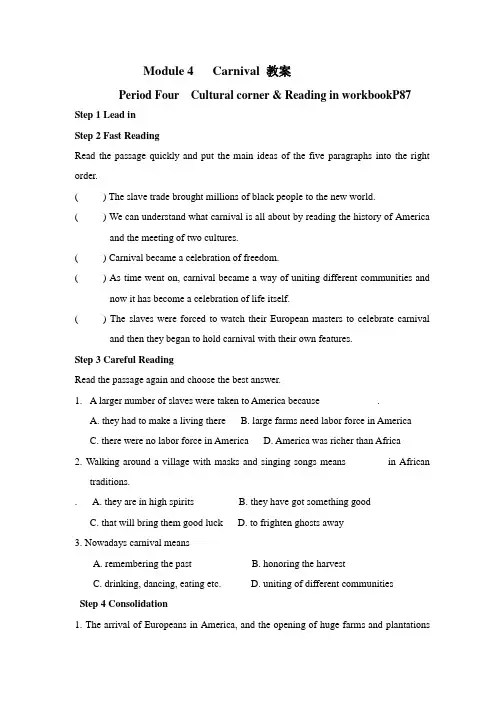
Module 4 Carnival 教案Period Four Cultural corner & Reading in workbookP87 Step 1 Lead inStep 2 Fast ReadingRead the passage quickly and put the main ideas of the five paragraphs into the right order.( ) The slave trade brought millions of black people to the new world.( ) We can understand what carnival is all about by reading the history of America and the meeting of two cultures.( ) Carnival became a celebration of freedom.( ) As time went on, carnival became a way of uniting different communities and now it has become a celebration of life itself.( ) The slaves were forced to watch their European masters to celebrate carnival and then they began to hold carnival with their own features.Step 3 Careful ReadingRead the passage again and choose the best answer.1. A larger number of slaves were taken to America because ___________.A. they had to make a living thereB. large farms need labor force in AmericaC. there were no labor force in AmericaD. America was richer than Africa2. Walking around a village with masks and singing songs means _______ in Africantraditions.. A. they are in high spirits B. they have got something goodC. that will bring them good luckD. to frighten ghosts away3. Nowadays carnival means______________A. remembering the pastB. honoring the harvestC. drinking, dancing, eating etc.D. uniting of different communitiesStep 4 Consolidation1. The arrival of Europeans in America, and the opening of huge farms and plantationsto grow cotton, fruit and vegetables, meant________________________(急需)for people to work on them.lions of people ________________(被强行带走)from their homes in Africa and ________(运送) to the New World to________________(当奴隶) .3.When the slave trade _____________(被废除)in 1838 the former slaves ____________(沿袭了)the carnival.4.They painted their faces white, _________(模仿)their masters and ________ _______ ______(取笑) them.5._________________________(随着时间的流逝), the white inhabitants of the islands began to ________ _________ ________(加入) the carnival, too.Step 4 Post-readingRead the passage “Christmas Traditions” in the workbook on page 87 and finish doing activities 7&8.Step 5 Discussion: Describing a Chinese festival (eg: the Spring Festival)Work in groups. Choose a Chinese festival. Discuss with things and write notes:●where and when it is celebrated●what happens during the festival●costumes and foodStep 5 HomeworkWrite a description of the festival for visitors to China.。
高中英语Moudle 4《Carnival》教案(外研版必修5)
Module 4 CarnivalPeriod OneTeaching aims:1. To revise Chinese and western festivals.2. To develop the students reading ability.3. To understand what is about Carnival.Important and difficult points:1 Get the students to understand the history of carnival.2 Get the students to describe the festivals in groups.Teaching procedures:Step 1. Revision.Read the new words of this passage.Step 2. Introduction1. We have learned many festivals both Chinese and the Western. What festivals do you know?Divide the class into 2 groups. One group is for Chinese Festivals, the other group is for Western festivals.Make a list of them on the blackboard..2. Turn to Page 31—Match the festivals with the description.Step 3. Lead-inToday we will learn another festival ---- Carnival. It originates from Europe, and duringthesedays, people often love wearing special clothes and masks for it.Step 4. Fast-readingMatch the main idea with every paragraph.Paragraph 1 A meaning of carnival and how it was celebratedParagraph 2 B the law about wearing masksParagraph 3 C general impression of carnivalParagraph 4 D how it is celebrate today in Venice and the feature of it Paragraph 5 E carnival in Venice and the problem it causedParagraph 6 F the revival of the tradition of celebrating it.(Answers: 1—6 CAEBFD)Step 5. Further-readingRead the passage and answer the questions.1. Where does Carnival come from? What does it mean?2. When was it celebrated?3. Where was the most famous Carnival in Europe?4. How long did the first Carnival in Venice last? What about now?5. Did the government of Venice encourage the wearing of masks?6. Who started the Carnival again, tourists or students?(Answers: 1. “Carnival” comes from two Latin words, meaning “no more meat”. 2. Itbeganjust after Christmas. 3. The most famous carnival in Europe was in Venice. 4. At the beginning, it lasted for just one day. 5. No. 6. The students started the Carnival. ) Step 6. VocabularyActivity 1: Read through the words in the box and have the students repeat themindividually.Ask the students to complete the task individually, then check with apartner.Check the answers together:(Answers: 1. confusion 2. excitement 3. mask 4. mystery 5. magic 6. costume 7. crowd 8. tradition 9. atmosphere)Activity 2: Choose the correct meanings of the words and phrases.Check the answers one by one.(Answers: 1—4 babb 5—8 abbb)Step 7. DiscussionDiscuss in groups of four.1. What is the feature of carnival in Venice?2. Which is your favourite festival?Step 8. Homework1. Workbook—on Page 87.Read the passage and match the headings with the text.2. Write a short passage about your favorite festival.Period TwoTeaching aims:1. To listen to the description about western customs.2. To express likes, dislikes and preferences:(1) I love doing…;(2) I don’t like…; I hate…; I dislike…; I don’t care much for(3) I prefer…to…;I prefer doing …(4) I’d rather…than…(5) I an interes ted in…3. To learn several phrases.Difficult and important points:1. Get the students to express likes and dislikes2. Learn to use the phrases: give up; go wild ;more or less; high spot; funnily enough; in your blood; wash down; walk offTeaching procedures:Step 1. RevisionCheck the homework.—Ask several students to read the short passage with the name of My Favorite Festival.Step 2. Vocabulary1. Read the words about food.2. Now say which things you eat at a festival.3. Practice.Activity 2: Find these things in the box in Activity 1.(1) Two type of meat ( )(2) a food that consists of a tube of skin containing meat mixed with herbs.( )(3) five vegetables ( )(4) two ingredients for making a cake ( )(Answers: (1) pork and chicken (2) sausages (3) beans, cabbages, garlic, onion, peas (4) flour, eggs)Step 3. ListeningBefore listening—Look at the photos in Activity 4 and tell them every picture meaning a special festival..While listening—Listen to the tape twice and match the names of the festivals with the photos.After Listening:Step 4. Everyday English1. Read the sentences and choose the correct meaning of the words and phrases.2. Check the answers one by one. (1)-b (2) a (3) b (4)a (5) b (6) a (7)a (8)b3. Explain the words and phrases.(1)give up sth. =don’t have it any more(2) go/wild with joy 欣喜若狂(3) more or less =approximately (opposite)exactly.Eg: That is approximately correct.(4) high spot= the best part(5) be/run in sb.`s blood = be /run in the blood. 生来就有的(因遗传或环境影响)eg; Most of my family are teachers, it runs in the blood.(6) wash down a meal = have a drinkwalk off a meal = help the food go down by walking.Step 5. Function1. Match the sentences with the speakers. Say what they are speaking about.(1)Caitlin: King Cake(2)Maria: Feijoada(3) Stefan: saugages(4) Cameron: traditional Jamaican food –chicken with rice and peas.2. Number the phrases from the most negative to the most positive(1) Ask the students to do this individually.(2) Call the answers back from the whole class, one at a time, from 1--6(3) Write down them on the blackboard:3. Work in pairs. Discuss your preferences for food to eat at festival. Use the phrases in Activity2.(1) Read the example with the class.(2) Pair the students to discuss their preferences.(3) Circulate and monitor their production.Step 6. HomeworkFinish off the workbook.Period ThreeTeaching aims:1. To learn more about carnival.2. To teach them how to write an e-mail.3. To develop the students’ reading skills.Difficult and important points:1. Get the students to learn to write an e-mail.2. Get the students to understand some important sentences.Teaching procedures:Step 1. RevisionRead the words and have a dictation.Step 2. Lead-inWhat do you remember about carnival?Where did it start first?Step 3. Fast-reading:Read and underline the topic sentences ( use your own words ) about every paragraph. Paragraph1: We can understand what carnival is all about by reading the history of America and the meeting of two cultures.Paragraph2: The slave trade brought millions of black people to the new world. Paragraph3: The slaves were forced to watch their European masters to celebrate carnival and then they began to hold carnival with their own features. Paragraph4: Carnival became a celebration of freedom.Paragraph5: As time went on, carnival became a way of uniting different communities and now it has become a celebration of life itself.Step 4. Further reading1. What did marked the beginning of the slave trade?2. How were millions of people taken to work as slaves?3. How did the slaves begin to hold their own carnival in Trinidad?4. When was the slave trade abolished?5. How was carnival changed when the slave trade was abolished?6. When did carnival become a way to unite different communities?(Answers: 1 That the arrival of European in America, and the opening of huge farms and plantations to grow cotton, fruit and vegetables, meant there was an immediate need to people to work on them marked the beginning of the slave trades. 2 Millions of people were taken by force from their homes in America and transported to the New World to work as slaves? 3. They painted their faces white, imitating their masters and making fun of them. 4. The slave trade was abolished in 1838. 5. It became more colourful and more exciting than it had been before. 6. As people forgot their everyday problems and enjoyed themselves eating, drinking, and dancing.)Step 5. Several phrases(1) by force (2) be forced to do (3)make fun of sb. (4) bring good luck (5) take over (6) take part in (7) become a celebration of freedom (8) with the time passingStep 6. Discussion1. What is the meaning of carnival?2. Which Chinese festival is most like carnival?Step 7. Reading and writingActivity1. Read the email and number the things in the order you read them1. Read through the things with the whole class and make sure that they understand them all.2. Ask them to read the email and order the things individually, then check with a partner.3. Call back the answers from the whole class, in order.(Answers: 1. the atmosphere at the festival 2. the music 3. the food 4. what the writer’s doing5. what the writer’s going to do)Activity2. Underline the adjectives used to describe.1. the atmosphere: noisy/ colourful2. the music: great/ exciting/ relaxing3. the food: good/ tastyActivity3 Write an email from a Chinese festival. Make sure of the details about:1. the atmosphere2. the music3. the foodStep 8. HomeworkWrite a description of the festival for visitors to China.( For example: Spring Festival)Period FourTeaching aims:1. To learn new words and expressions and learn how to use them.2. To review of the passive voices.Difficult and important points:1. Get the students to know how to use passive voices:一般现在时和一般过去时的被动语态2. The usage of: hide, pretend, memory, wander, come to an end, dress up; consist of be good for ,date from.Teaching procedures:Step 1. RevisionRead the sentences and find out what grammar are they?1. Is the room cleaned every day?2. We were woken up by a loud noise during the night.3. Something must be done before it is too late.4. Have you heard the news? The President has been shot?5. The car was three years old but hadn’t been used very much.6. There’s somebody walking behind us. I think we are being followed.Step 2. Presentation—被动语态被动语态的基本形式是: be +过去分词根据时态的不同, be的形式有所变化. (1) 一般现在时的被动语态: am/is /are+过去分词(口语可用get/become或got /became)(2) 一般过去时的被动语态:was /were+过去分词被动语态的基本用法:不知道或没有必要提到动作的执行者是谁时用被动语态.强调或突出动作的承受者常用被动语态.(有时可省略).使用被动语态应注意的几个问题.(1) 主动变被动时双宾语的变化. 看下列例句eg: 我朋友在我生日时送我一本有趣的书.My friend gave me an interesting book on my birthday.—An interesting book was given to me (by my friend) on my birthday.—I was given an interesting book (by my friend) on my birthday.(2) 主动变被动时,宾补成主补(位置不变);作宾补的省略to的不定时在被动语态中应加to.eg: 老板让他整天工作.The boss made him work all day long.—He was made to work all day long (by the boss).(3) 短语动词变被动语态时,勿要掉”尾巴”.eg: 孩子们被他照顾的很好.—The children were taken good care of ( by her).eg: 要注意一下你的发音和拼写.—Your pronunciation and spelling should be paid attention to.(4) 情态动词和be going to, be to, be sure to ,used to, have to, had better等结构变被动语态,只需将它们后面的动词原形变为be +过去分词。
高中英语 Module4 Carnival课件 外研版必修5 外研版必

√
3. Special food
4. Carnival in Venice √
Reading and Vocabulary 3—Scanning (5m)
Activity 2
1. c 5. b
2. b 3. c 4. a
6. b
7. b 8. b
Paragraph 1 What’s your general impression
) Introduction-2. western festivals(4m
• How much do you know about the
following western festivals? Christmas
This is a Christian festival which comes in the middle of winter.
Paragraph 3 Where does the writer say we can see the most famous carnival? What was it like at first?
The most famous carnival in Europe was in _V_e_n_ic_e_. People ate, drank and wore m__a_s_k_s. At the beginning, it lasted for just one day. As time passed, the carnival period was __ex_t_e_n_d_e_d_and people walked round the streets for weeks _o_n_e_n_d_doing what they wanted without _b_e_in_g__r_ec_o_g_n_i_z_ed__. Many crimes went _u_n_p_u_n_is_h_e_d_.
高中英语 4.1 Carnival课件 外研版必修5
country to another but the excitement is the same everywhere.It began
in Europe.People saw 3. it
as a last chance to have fun at
the end of the winter season.Having fun meant 4. eating (eat),
ⅠⅡⅢⅣ
6.I like my clothes to be simple but elegant. 含义 高雅的 7.The child thought the toy car worked by magic. 含义 魔力 8.His death marked the end of an era. 含义 时代
Module 4 Carnival
Section Ⅰ Introduction,Reading & Vocabulary
ⅠⅡⅢⅣ
Ⅰ.写作词汇
预习Introduction,Reading & Vocabulary部分的词汇,完成以下语
境
During the National Day,I 1. booked (预定)a seat to see a
ⅠⅡⅢⅣ
5.What is the key to the carnival in Venice? A.Music and movement. B.Music and dance. C.It can attract many foreigners. D.The mystery of the mask. 答案:D
drinking,and dressing up.The most famous carnival in Europe was in
外研必修五Module-4-课文及翻译
Module 4 CarnivalThe Magic of the MaskThink of carnival, and you think of crowds, costumes, and confusion想到狂欢节你就会想到群众、服装和混乱。
The sounds and sights change from one country to another but the excitement is the same everywhere随着国家的变化听到的和看到的都是不同的,但是任何地方人们都是兴奋的。
“Carnival” comes from two Latin words, meaning “no more meat”“狂欢节”是由俩个拉丁词演变而来的,它的意思是“不要吃肉”。
In Europe, where it began, carnival was followed by forty days without meat, as people prepared for the Christian festival of Easter欧洲是狂欢节的发源地,在接近狂欢节的四十天里是不能吃肉的,人们准备迎接基督教的“复活节’。
People saw Carnival as a last chance to have fun at the end of the winter season Having fun meant eating, drinking, and dressing up人们把狂欢节做为冬天结束前最后的一个玩乐机会,尽情的吃喝玩了、打扮。
The most famous carnival in Europe was in Venice欧洲最著名的狂欢节是在威尼斯。
At the beginning, it lasted for just one day People ate, drank, and wore masks刚开始的时候,狂欢节只持续了一天。
外研版高中英语必修五Module 4CarnivalReading教案4
Module 4 CarnivalPeriod 2 Reading----The magic of the maskTeaching Goals:1. Students can learn about the development of carnival2. Students can develop their basic reading skills.3. Students can know the western festival---Carnival, by knowing other’s festival , we come to know our own festival more clearly, students learn to view the world in a multicultural vision.Teaching key point and difficult point:1. The key point of this lesson is to develop students’ scanning and skimming skills.2. The difficult point of this lesson is some difficult words and phrases . Teaching methods:1. Communicative teaching method2. Task-based” teaching method3.Cooperative learning methodTeaching equipment:multi-media computer, tape recorderTeaching Procedures:Step 1 Lead inPurpose: To arouse Ss’ interest in learning about the festivals.1. Ask Ss to name some chinese festivals.2. Small discussion:Which one is your favorite Chinese festival?3. Ask Ss to name the foreign festivals in the pictures.Step 2 ReadingPurpose: To develop some basic reading skills and get some information about carnival.Task1. Listen to the tape and choose the topics of the text.Task 2. Skim the text and match the topics with the paragraphs.Task 3. Scan the text and answer the detailed questions.Task 4. Read the text carefully and fill in the blank.Task 5. Test about the readingStep 3 Key pointsPurpose: This step is a practice section, aims to demonstrate their own ability of using language to do things.1.Think of carnival, and you think of crowds, costumes, and confusion.2.In Europe, where it began , carnival was followed by forty dayswithout meat,as people prepared for the Christian festival of Easter.3.Having fun meant eating ,drinking and dressing up.4.Ordinary people could pretend to be rich and important, while famouspeople could have romantic adventures in secret .Step 4 Retelling the textPurpose: Enable Ss to learn about the details of text and help them to talk about carnival. Let them to know what they have learnt during the class.Step 5 Homework1.Activity 3 on P32 and Activity 4 on P33.2.Finish V ocabulary exercises in WB .。
外研版高中英语必修五5-4狂欢节carnival_课件
Halloween Parade 万圣节游行
Easter eggs
复活节彩蛋
Easter复活节
(March 23 to April 25)
Easter Bunny
复活节兔子
This is a Christian holiday in March or April when Christians remember the death of Christ and his return to life.
Carnival
Carnival in Rio, Brazil
Carnival in Cologne(科隆), Germany
enjoy the fun. Spirit The spirit of Venice carnival is the
mystery of the mask.
Summary
Carnival is a western festival which is celebrated in many countries.
and the feature of the carnival in Venice .
Para __6___
Careful-reading Read part 1(para.1and2)
1.What is your general impression of carnival?
crowds costumes confusion sounds sights excitement
This is when Americans remember the hard times when they first arrived in the country.