
一般过去时&过去进行时&过去完成时 (2)
过去完成时的运用
(1) 与过去完成时连用的时间状语可以多种多样,使用 它的主要依据是看其是否发生在“过去的过去”。如: 在来这儿之前我学过一些英语。 He had learnt some English before I went here. 到去年他已经写了三篇故事。 He had written three stories by last year. 当他到那儿时,我们已经把房子弄干净了。 We had cleaned the room when he got there. 他把事做完之后,就去哪儿了。 He went there after he had finished his work.
3)一个长动作延续的时候,另一个短动作发生。 长动作用过去进行时表示,短动作用一般过去 时表示。 Eg : I was doing my homework when someone knocked at the door.
区分
一般过去时表示在过去某时发生的动作或存在的
状态强调的是动作的发生、结束或完成。
2)表示在过去一段时间内,经常性或习惯性的动 作。 Eg : When I was a child ,I often watched cartoon series.
3)表示过去发生的一连串动作。 Eg : The monkey jumped off the tree , picked up a big stone and threw it at us. 4)一般过去时也可以与表示一段时间的状语连 用。强调在过去一段时间做了某事。 Eg : Mr Li is living in the countryside now , but he once worked in Nanjing for more than thirty years.
例句
When I got home ,mom had cooked supper. 当我回到家,妈妈已经做好晚餐了。 We had learnt fifteen lessons by last week. 到上周为止,我们学完了十五篇课文。
他走之前在这儿呆了两天。 He had stayed here for two days before he left. 他说他十岁起就住在那儿了。 He said that he had lived there since he was ten.
过去进行时
句子结构 was/were+doing 信号词 At 8 yesterday evening/then/at that time/主句 (过去进行时)+从句(过去时)
过去进行时
(二)过去进行时 1)表示过去某一时刻或某一段时间内正在进行 的动作。 Eg : He was watching TV at 8 o’clock last night. 2)过去进行时的主要用法是描述一件事发生的 背景。 Eg : The sun was shining , the wind was blowing , and a group of soldiers were marching. Eg: He hurt his leg when he was playing basketball. 把腿弄伤发生在打篮球的过程中,就是 弄伤腿的背景
2.可表示过去某个时间或动作之前所发生的动 作一直持续到过去某个时间(常接时间状语:sinc e +时间点, for + 时间段)。
过去完ห้องสมุดไป่ตู้时
句子结构: “主语+had + 过去分词(done)” Eg When I got to the station, the train had left. 当我到达车站时,火车已经开走了。
过去进行时表示某一时刻或过去某一段时间正在
进行的,强调的是动作的持续性 Eg: They were building a bridge last winter.(可能还未建成) They built a bridge last winter.(已经建成)
过去完成时
1.过去完成时既可表示过去某个时间或动作之 前所发生的事情(常用时间状语有already, before, ever, just, never, still, yet)
(2) 过去完成时还经常用于主句为过去时的间接引语中。 如: He said he had been a soldier. 他说他当过兵。 They said they had seen the film. 他们说这幕电影他们看 过。
过去完成时与一般过去时
(1) 过去完成时表示以过去某时间为起点以前所 发生的动作或存在的状态,即:过去完成时强调 “过去的过去”, 一般过去时只表示以现在时间为起点以前所发生 的事情或存在的状态。如: He studied there two years ago. 他在那儿学习了两年。(离现在两年) He said he had studied there two years ago. 他说他在那儿学习了两年。(离他说话时两年)
一般过去时 过去进行时 过去完成时
一般过去时
句子结构 be → was be → were do → did 信号词 ago , yesterday , last year , last month , once
一般过去时
(一)一般过去时 1)表示在过去某时刻发生的动作或存在的状态。 Eg : I was born in 1990.
一般过去时单词表
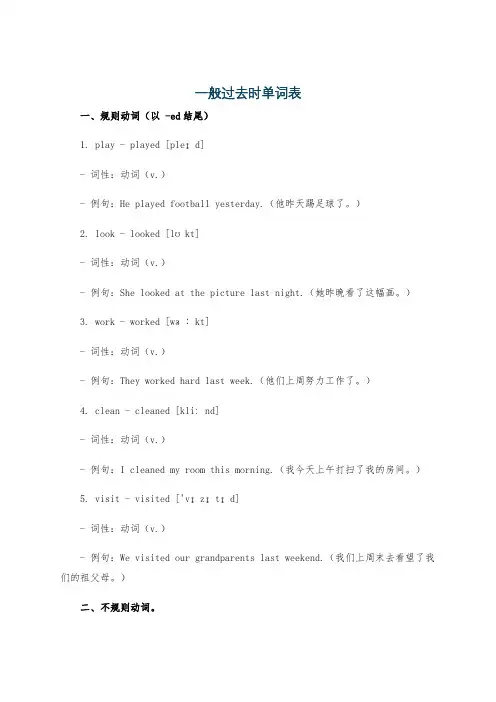
一般过去时单词表一、规则动词(以 -ed结尾)1. play - played [pleɪd]- 词性:动词(v.)- 例句:He played football yesterday.(他昨天踢足球了。
)2. look - looked [lʊkt]- 词性:动词(v.)- 例句:She looked at the picture last night.(她昨晚看了这幅画。
)3. work - worked [wɜːkt]- 词性:动词(v.)- 例句:They worked hard last week.(他们上周努力工作了。
)4. clean - cleaned [kliːnd]- 词性:动词(v.)- 例句:I cleaned my room this morning.(我今天上午打扫了我的房间。
)5. visit - visited ['vɪzɪtɪd]- 词性:动词(v.)- 例句:We visited our grandparents last weekend.(我们上周末去看望了我们的祖父母。
)二、不规则动词。
1. go - went [went]- 词性:动词(v.)- 例句:He went to school by bike yesterday.(他昨天骑自行车去上学了。
)2. see - saw [sɔː]- 词性:动词(v.)- 例句:I saw a movie last night.(我昨晚看了一部电影。
)3. eat - ate [eɪt]- 词性:动词(v.)- 例句:She ate an apple this morning.(她今天上午吃了一个苹果。
)4. come - came [keɪm]- 词性:动词(v.)- 例句:They came to my house last Sunday.(他们上周日来到了我家。
)5. do - did [dɪd]- 词性:动词(v.)- 例句:What did you do yesterday?(你昨天做了什么?)6. have - had [hæd]- 词性:动词(v.)- 例句:He had a great time at the party last night.(他昨晚在聚会上玩得很开心。
一般过去时归纳与总结
一般过去时归纳与总结一般过去时是英语中常用的时态之一,用来描述过去发生的动作、状态或习惯。
在本文中,我们将对一般过去时的用法进行归纳与总结。
一、肯定句的构成一般过去时的肯定句由主语 + 动词的过去式构成。
例如:1. I studied English last night.2. She went to the park yesterday.3. They played football in the afternoon.二、否定句的构成一般过去时的否定句由主语 + did not (didn't) + 动词原形构成。
例如:1. I didn't study English last night.2. She didn't go to the park yesterday.3. They didn't play football in the afternoon.三、疑问句的构成一般过去时的疑问句由Did + 主语 + 动词原形构成。
例如:1. Did you study English last night?2. Did she go to the park yesterday?3. Did they play football in the afternoon?四、一般过去时的常用时间状语一般过去时常与以下时间状语连用,表示过去发生的动作或状态:1. yesterday:昨天2. last week/month/year:上周/上个月/去年3. in 1990:在1990年4. when I was a child:当我还是个孩子的时候5. at that time:那时候6. ago:以前例如:1. He visited his grandparents last week.2. We went to the beach yesterday.3. They lived in London in 1990.4. When I was a child, I played football every day.5. She bought a new car ten years ago.五、一般过去时的特殊用法1. 表示过去的习惯或经常性动作,常与副词often, usually, always连用。
一般过去时 用法

一般过去时用法一般过去时是英语语法中的一个重要时态,用来描述发生在过去的动作或状态。
在英语中,一般过去时的构成和用法有一些规则和特点,需要我们在学习和使用时加以重视。
本文将详细解释一般过去时的构成、用法和一些常见的注意事项,旨在帮助读者更深入地掌握一般过去时的用法。
一、一般过去时的构成一般过去时的构成主要涉及动词的变化形式。
在英语中,一般过去时的动词通常是通过在动词原形后加上-ed或-d来构成的。
但也有一些不规则动词需要特殊记忆它们的过去式形式。
1. 规则动词的过去式构成对于大多数动词,它们的一般过去时形式是在动词原形后面加上-ed。
例如:- talk → talked- walk → walked- play → played对于以不发音的-e结尾的动词,只需加-d即可构成过去式。
例如:- dance → danced- admire → admired- escape → escaped2. 不规则动词的过去式构成也有一些动词的过去式是不规则的,需要记住它们的过去式形式。
例如:- go → went- be → was/were- eat → ate- see → saw- do → did以上是一般过去时构成的基本规则,掌握这些构成规则对于正确使用一般过去时非常重要。
下面我们将介绍一般过去时的用法。
二、一般过去时的用法一般过去时用来表示过去某个时刻或一段时间内的动作或状态。
在语法上,一般过去时还可以用于肯定句、否定句和疑问句中,其用法如下:1. 肯定句在肯定句中,一般过去时的动词形式是直接加上过去式。
例如:- I studied English last night.- She visited her grandparents yesterday.- We watched a movie on Friday.2. 否定句在否定句中,一般过去时的动词需要使用助动词did+ not构成,主语可以直接跟在助动词后,动词本身用原形。
一般过去时

三.一般过去时(simple past tense)1.概念一般过去时表示过去某一时刻,某一段时间发生的动作或存在的状态。
一般过去时用动词的过去式表示。
2.构成一般过去时用动词的过去式表示。
be的过去式有was,were两种; have 的过去式是had;规则动词的过去式在动词词尾加-ed,具体构成规则如下:1)一般情况,动词后加ed,例词work-worked,clean-cleaned,play-played,wash-washed2)以不发音的e结尾,-d,例词live-lived,move-moved,hope-hoped,arrive-arrived 3)以辅音字母+y结尾,变y为 i再加-ed,例词study-studied,carry-carried,cry-cried,identify-identified 4)以辅音字母结尾的重读闭音节,双写最后一个辅音字母加-ed,例词plan-plannedstop-stopped,beg-begged,grab-grabbed 3.用法 (1) 表示发生在过去的动作或存在的状态。
如:He went shopping with his friends last week.They arrived ten minutes ago.He became a hotel manager ten years ago.Did you go to the concert last night?(2) 表示在过去经常发生的动作或习惯动作。
如:He visited his grandparents once a month last year.She usually went to work by car last year.When I was at school, I always went to school by bus.4.如何识别一般过去时常见的标志词有:1). yesterday, the day before yesterday.2). last week / year / month / term …(简称last系列)3). two hours ago, three years ago, a moment ago…(简称ago系列)4). in / on + 过去的年/月/日,如 in 1999, on April, 20055). just now, once upon a time, one day…5.易错点例析:(1)——Your phone number again? I _________ quite catch it.——It’s 4331577A. didn’tB. couldn’tC. don’tD. can’t(2)——Mr. Smith isn’t coming tonight.——But he _________.A. promisesB. promisedC. will promiseD. had promised(3) ——Hey, look where you are going!——Oh, I’m terribly sorry. _________.A. I’m not noticingB. I wasn’t noticingC. I haven’t noticedD. I don’t notice(4) ——Oh it’s you ! I _________ you.——I’ve had my hai r cut.A. didn’t realizeB. haven’t realizedC. didn’t recognizeD. don’t recognized(5) ——Since you’ve agreed to go, why aren’t you getting ready?——But I _________ that you would have me start at once.A. don’t realizeB. didn’t realizeC. hadn’t realizedD. haven’t realized(6) ——It’s twelve o’clock, I think I must be off now.——Oh, really? I _________ it at all.A. don’t realizeB. haven’t realizedC. didn’t realizeD. hadn’t realizedKey:ABBCBC6.中考真题及模拟(2009朝阳区一模)He went into his room, _______ the light and began to work.A. has turned onB. will turn onC. turns onD. turned on(2009海淀一模)——What’s the best food have you had in Beijing, Alex?——Roast duck! I _________to a famous restaurant to have it last week.A. have goneB. goC. will goD. went(2009宣武区一模)——Do you know how many gold medals the 23-year-old Michael Phelps _____________at the 2008 Summer Olympic Games?——Eight.A. winB. winsC. wonD. has won(2008北京)We were in Qingdao last week and __________ great fun there.A. will haveB. have hadC. hadD. have(2007北京)——What did you do after school yesterday?——I _________basketball with my friends.A. playB. playedC. will playD. am playing(2005北京)---Hi, Kate. You look tired. What’s the matter?---I ______well last night.A. didn’t sleepB. don’t sleepC. haven’t sleptD. won’t sleep (2008四川泸州)Yesterday,Tony’s family _________ a good time.A. hasB. haveC. had(2007湖南湘潭)I’m sorry you’ve missed the train. It _______10 minutes ago.A. leftB. has leftC. had left(2007福州)——Mr Green, __________you________ Three Lanes and Alleys(三坊七巷)last Sunday?——No, but I’ll visit them next week.A. will; go toB. have; been toC. did; go toD. have; gone to (2007浙江)——What did the teacher say just now?——He __________us not to play computer games all day.A. tellsB. toldC. has toldD. is told(2007江西)——Inventors have changed the way we live.——So they are famous for the great things they _________.A. doB. didC. are doingD. had done(06江西)——Where’s the cake I made this morning?——We _______ it, mum. Can you make another one for us?A. ateB. eatC. will itD. were eating。
一般过去时
(1)一般过去时表示在过去某个特定时间发生,也可以表示过去习惯性、经常性的动作。
一般过去时不强调动作对现在的影响,只说明过去的事情。
句式:主语+动词过去式+宾语+其它I had a word with Julia this morning.今天早晨,我跟朱丽亚说了几句话。
He smoked many cigarettes a day until he gave up. 他没有戒烟的那阵子,抽烟抽得可凶了。
(2) 一般过去时常与表示过去的时间状语或从句连用,如:yesterday,last week,in 1993,at that time,once,during the war,before,a few days ago,when 等等。
补充内容:(句子中谓语动词是用一般过去时还是用现在完成时,取决于动作是否对现在有影响)。
Have you had your lunch? 你吃过午饭了吗?(你现在不饿吗?)Yes,I have. 是的,我已经吃过了。
(已经吃饱了,不想再吃了。
)When did you have it? 你是什么时候吃的?(关心的是吃的动作发生在何时。
)I had it about ten minutes ago. 我大约是十分钟以前吃的。
)Used to do something 表示过去常做而现在已经停止了的习惯动作。
I used to work fourteen hours a day. 我过去常常一天干十四个小时。
I ate it at 6:45。
我在六点四十五分吃了。
(3)带有确定的过去时间状语时,要用过去时。
如:yesterday(昨天)、two days ago…(两天前…… )、last year…(去年…)、the other day(前几天)、once upon a time(很久以前)、just now(刚才)、in the old days(过去的日子里)、before liberation(解放前…)、 When I was 8 years old(当我八岁时…)、at+一个时间点Did you have a party the other day?前几天,你们开了晚会了吗?Lei Feng was a good soldier.雷锋是个好战士。
英语学习:一般过去时特殊用法大全
一般过去时特殊用法大全一、描述过去的特定事件一般过去时可以用来描述过去发生的特定事件,强调该事件已经发生并且与现在没有直接联系。
例如:“Last night, I watched a movie”(昨晚,我看了一部电影)。
二、表达过去的习惯或经常发生的事情使用一般过去时可以表达过去的习惯或经常发生的事情。
例如:“Every Sunday, we went to the park”(每周日,我们都去公园)。
三、用于虚拟语气,表示与现实相反的情况在虚拟语气中,一般过去时可以用来表示与现实情况相反的情况。
例如:“If I were you, I would do it”(如果我是你,我会去做这件事)。
四、在间接引语中,描述对方过去所说的话在间接引语中,通常使用一般过去时来描述对方过去所说的话。
例如:“She said that she would come”(她说她会来)。
五、在时间状语从句中使用,描述过去某个时间点之前或之后发生的事情在时间状语从句中,可以使用一般过去时来描述过去某个时间点之前或之后发生的事情。
例如:“After I finished my homework, I went to bed”(我完成作业后,就睡觉了)。
六、描述历史事件和史实在描述历史事件和史实时,通常使用一般过去时。
例如:“The Civil War broke out in 1861”(内战于1861年爆发)。
七、在文学和新闻报道中,描述过去发生的事情在文学和新闻报道中,使用一般过去时来描述过去发生的事情是非常常见的。
例如:“The news reported that the plane had crashed”(新闻报道称飞机失事了)。
八、在电影和电视剧中,描述虚构的过去事件在电影和电视剧中,一般过去时可以用来描述虚构的过去事件,以构建剧情。
例如:“In the movie, the characters traveled back in time to the 1920s”(在电影中,角色们穿越回了20世纪20年代)。
一般过去时知识点
一般过去时一、一般过去时的定义一般过去时表示过去某一时候或某一段时间所发生了的事情或存在的状态。
二、标志语:yesterday(昨天), this morning(今天早上), just now(刚刚), a moment ago(片刻之前), last night (昨晚) last year (去年)last week(上周), at that time(在那个时候), the day before yesterday(前天), before(在...之前)in+过去年份(in 2018),what happened?(发生什么事了?)三、Be动词一般过去时:⑴am 和is在一般过去时中变为was。
(was not=wasn’t)⑵are在一般过去时中变为were。
(were not=weren’t)(肯定句)I was a student ten years ago.主语+was/were+其他.(否定句)I was not a student ten years ago.主语+wasn’t/weren’t+其他.(一般疑问句)Were you a student ten years ago?Yes,I was/No,I wasn’t.Was/were+主语+其他?Yes,主代+was/were.No,主代+wasn’t/weren’t.注意:带有was或were的句子,其否定、疑问的变化和is, am, ar e一样,即否定句在was或were后加not,一般疑问句把was或wer e放到句首,第一人称变第二人称。
(特殊疑问句)1.对I提问:Who was a student ten years ago?(Who作为主语时,谓语动词用三单)四、实义动词一般过去时:(肯定句)I walked to school yesterday.主语+动词过去式+其他.(否定句)I didn’t walk to school yesterday.主语+didn’t + 动词原形+其他.否定句变化规则:1、找be动词2、若无be动词,找情态动词(could)3、若无情态动词,请助动词(did)来帮助4、did放于主语的后面,动词的前面,加上not,did not= didn't5、动词变原形6、some->any and->or too->either(一般疑问句)Did you walk to school yesterday?Yes,I did. No,I didn’t.Did +主语+动词原形+其他?Yes,主代+did.No,主代+didn’t.一般疑问句变化规则:1、找be动词2、若无be动词,找情态动词(could)3、若无情态动词,请助动词(did)来帮助4、did放于开头,首字母大写5、第一人称变第二人称6、动词变原形7、some->any and->or too不变either(特殊疑问句)I went to school on foot yesterday.1.对I 提问:Who went to school on foot yesterday?2.对went to school 提问:What did you do on foot yesterday?3.对school 提问:Where did you go on foot yesterday?4.对on foot 提问:How did you go to school yesterday?5.对yesterday提问:When did you go to school on foot?动词变化规则:1、直接在动词后面加ed。
一般过去时
一般过去时(the past simple tense)用法:1.表示过去确定时间内发生的动作或状态,常与yesterday,last year, ago, once upon a time, just now, recently, during the day, for many years ect.2.表示过去连续发生的动作3.表示过去一段时间内经常或反复的动作,常与always ,never连用4.在since引导的从句中,主句用现在完成时,从句用一般过去时。
5.在时间,条件状语从句中,用一般过去时表示过去将来时结构:肯定:主+动词过去式+其他否定:主+wasn’t/weren’t +其他主+didn’t +动原+其他一般疑问句:was/were+主+动原+其他?Did +主+动原+其他?练习Ⅰ.用所给词的适当形式填空1.Jenny (not go to bed) until 11:00 o’clock last night.2.I (see) Li Lei (go) out just now.3.He (do) his homework every day. But he (not do)it yesterday.4.When I was young, I (play) games with my friends.5. She likes _________ newspapers, but she _________ a book yesterday. (read)6. _______ they ________ (sweep) the floor on Sunday? No, they _________.7.It ____ (be) the 2nd of November yesterday. Mr White ___ (go) to his office by car.8.I want to ______ apples. But my dad _______ all of them last month. (pick)9. Jim's mother _________ (plant) trees just now.10.He _______ football now, but they _______ basketball just now. (play)Ⅱ.改错1.How is Jane yesterday?2.What did he last week?3.Did you saw him just now?4.H e often goes home at 11:00 last month.5.Tom wasn’t watch TV last night.6.Tom suddenly is ill last night and have to stay at homefoeanother day.Ⅲ.改写句子1.I watched the night sky for about an hour. 改为否定句2.He waited for you three hours ago. 改为一般疑问句3.Was he a doctor two years ago? 做否定回答4.She went shopping with her friends. 对划线部分提问5.Karen had extra classes next week. 对划线部分提问。
一般过去时
一般过去时1.一般过去时的定义一般过去时表示过去某个时间发生的动作或存在的状态也可以表示过去经常发生或反复发生的动作2.be动词和实义动词过去式的构成系动词be的过去时有两种形式was和were 其中was是is和am的过去式were是are的过去式规则动词过去式的构成①一般在动词原形末尾加ed如:walk-walked work-worked②以e结尾的动词末尾只加d如:love-loved decide-decided③结尾是辅音字母+y结尾的动词先将y变为i再加ed如:study-studied worry-worried注意以元音字母加y结尾的动词变过去式直接在词尾加ed④末尾只有一个辅音字母的重读闭音节先双写该辅音字母再加ed如:plan-planned stop-stopped drop-dropped常见的不规则动词的过去式Do-did go-went have-had buy-bought teach-taught can-could will-would3.一般过去时的句子结构①肯定句一般过去时的肯定句由主语+was/were+其他或主语+动词过去式+其他如:he was busy yesterday②否定句含有be动词的一般过去时肯定句变为否定句时直接在was或were之后加not 构成否定句其中was were可与not缩写为wasn’t weren’t 句型是主语+was/were +not+其他如:he wasn’t busy yesterday含有实义动词的一般过去时肯定句变为否定句要把谓语动词改为didn’t+动词原形句型为主语+didn’t+动词原形+其他如:he did not play tennis last week③疑问句含有be动词的一般过去时变为一般疑问句时把was或were提前并放在句首句型为was/were+主语+其他?肯定回答为yes 主语+was/were 否定回答为no+主语wasn’t/weren’t 如:was he busy yesterday ?Yes he wasNo he was not含有实义动词的一般过去时变为一般疑问句时在句首加did同时把句中的动词变为原形句型为did +主语+动词原形+其他肯定回答为yes 主语+did 否定回答为no+主语+didn’t 如:did he play tennis last week?Yes he didNo he did not⑤特殊疑问句一般过去时的特殊疑问句由特殊疑问词+一般疑问句构成如:where were your parents yesterday afternoon4.一般过去时的时间状语①时间副词yesterday或由yesterday/last 构成的短语:yesterday morning/afternoon/eveningthe day befor yeaterday ,last night/weekend/year/Sunday②时间段+ago构成的短语:two days ago,three years ago③介词+表示过去时间的词如:in 2005,on Aoril 1st④其他表示过去的词语或短语:just now,a morning ago,once,then等。
一般过去时时间标志词口诀
一般过去时时间标志词
一般过去时表示过去发生的动作或状态,常与表示过去的时间标志词一起使用。
以下是一般过去时时间标志词:
1. yesterday:表示“昨天”,用于描述过去某个具体的日期或时间点。
2. ago:表示“……以前”,用于描述过去某个具体的时间点距离现在的时间长度。
3. last week/month/year:表示“上周/上个月/去年”,用于描述过去某个时间段内的事件或状态。
4. in the past/recent/recent days:表示“过去的/最近的/最近几天”,用于描述过去某个时间段内的事件或状态。
5. a moment ago/just now:表示“刚刚”,用于描述过去某个非常短暂的时间段内的事件或状态。
6. before:表示“以前”,用于描述过去某个时间点之前发生的事件或状态。
7. already和yet:表示“已经”和“还没有”,用于描述某个动作或状态是否已经完成。
需要注意的是,一般过去时时间标志词并不是所有情况下都能使用,具体使用要根据句子语境和时态要求来确定。