
译林牛津版英语八年级下册 Unit 3 一般过去时与现在完成时区别专题与练习(有答案)
译林牛津版英语八年级下册Unit 3一般过去时与现在完成时区别专题与练习一、前言:初一下学期同学们学习了一般过去时态的相关知识,即将到来的初二上学期英语学习中,现在完成时是重要的学习内容。
本文通过对比一般过去时和现在完成时,对现在完成时进行初步讲解,希望使同学们读新学期的学习有所准备。
二、现在完成时1. 现在完成时的构成现在完成时是由助动词have (has)+动词的过去分词构成。
助动词说明该谓语是属于现在时范围。
它和主语的人称、数要保持一致。
过去分词是主要的谓语动词,说明句子的意义。
2. 现在完成时的用法现在完成时表示过去某时发生的行为对主语目前产生的影响。
即用过去发生的某个行为来说明现在的某种情况。
We are good friends.(现在的情况)I knew him in 1997.(过去的动作)We have known each other since 1997.(现在完成时把过去的动作和现在联系起来并着眼于现在)(1)表示动作发生在过去某个不确定的时间,但对现在留下了某种影响和结果。
常被just、already、yet 等副词修饰。
如:-Have you had lunch yet?-Yes, I have. I've just had it.你(已经)吃午饭了吗?我刚刚吃过。
(现在我不饿了)(2)表示从过去某一时刻开始一直持续到现在的动作或状态。
这个动作可能刚停止,可能仍然在进行。
常带有for和since等表示一段时间的状语。
如:He has taught here since 1981他自1981年就在这儿教书。
(可能还要继续教)I haven't seen her for four years.我有四年没见到她了。
(3)表示说话前发生过一次或多次的动作,现在成为一种经验,一般译为汉语“过”,常带有twice, ever,never, three times等时间状语。
如:I have been to Beijing twice.我去过北京二次。
3.现在完成时的时间状语(1)现在完成时属于现在时范围,故不能和过去的时间状语连用。
如:yesterday, last Sunday,in1990,three years ago等。
但是,在强调动作产生的后果和影响时,可以和一些表示不确定的时间状语连用。
a. 用副词already和yet。
already一般用于肯定句中,yet一般用于否定句和疑问句中。
如:We have already finished our homework.我们已完成作业了。
They haven't finished their homework yet.他们还没有完成作业。
b.用ever 和never。
多用于否定或疑问句中,表示“曾经”或“从未”等。
如:-Have you ever been to the Great Wall? 你曾经去过长城吗?-I have never been to the Great Wall.我从未去过长城。
c.用表示到说话为止的过去时间状语,如just, before, up to now, the past few years等。
例如:I have seen her before, but I can not remember where.我以前见过她,但记不起在哪里见过。
He has been there three times the last few days.近几天他去过那里三次了。
d.用包括“现在”在内的时间状语,如:now, today, this morning (month, year, term)等。
例如:-Have you met him today? -No, I haven't.今天你见过他吗?我没有。
How many times have you been there this year?今年你去过那里多少次?(2)现在完成时可以和带有since或for等表示“一段时间”的状语连用,表示动作或状态从某一时刻开始,一直持续到现在。
如:I haven't seen him for two years.但是,像come, arrive, buy等终止性动词不能与表示“一段时间”的状语连用。
要用,必须改为“be(在)”等延续性动词来表述。
现归纳总结一下由非延续性动词到延续性动词的转换:arrive →be here begin(start)→be ondie→be dead come back →be backleave →be away fall ill(sick, asleep)→be ill(sick, asleep)get up →be up go out→be outfinish →be over put on→wear 或be onopen→be open join→be in或be a member of…close→be closed go to school →be a studentborrow→keep buy→havecatch(a cold)→have(a cold)get to know →knowbegin to study →study come to work →work等如:He has been a soldier for three years.他参军三年了。
His father has been dead for two years.他父亲去世二年了。
The film has been on for ten minutes.电影已开始十分钟了。
We have studied English for three years. 我们(开始)学英语已三年了。
4.几点注意事项(1)have been(to)与have gone( to)的区别:have been(to)表示“去过某地(现在已经回来了)”,可用于各人称;have gone(to)表示“去某地了(说话时某人不在当地)”,常用于第三人称,前者可与once ,never, several times等连用,后者则不能。
如:They have been to Beijing twice.他们去过北京两次。
He has gone to Beijing .他去北京了。
(2)如单纯表示一段时间,或强调一段时间,虽有since一词,也不必用完成时。
如:It is two years since his father died.=His father has been dead for two years.他父亲去世已有两年了。
(3)终止性动词现在完成时的否定式,已变成一种可以延续的状态,因此可以和表示一段时间的状语连用。
如:I haven't left here since 1997.自从1997年以来,我一直没有离开过这儿。
(4) 表示行为或状态从过去一直持续到现在时,用现在完成时,要加表示一段时间的时间状语时,常用for+一段时间, since+时间点。
I have lived here since my childhood.我从小就一直住在这里。
I have lived here for 10 years. 我在这已经住了10年了。
(5) 在提问现在完成时的时间状语时通常用how longHow long have you lived here?注意:在表示某一行为状态持续多长时间时,根据终止时间的不同,时态使用是不一样的。
如:I lived here for a week last summer.去年夏天我在这里住了一周。
I have lived here for a week by now. 到现在为止,我已经在这里住了一周。
I will live here for a week next year.明年我会在这里住一周。
二、现在完成时与一般过去时的区别现在完成时用来表示之前已发生或完成的动作或状态,其结果的确和现在有联系。
动作或状态发生在过去,但它的影响现在还存在;而一般过去时表示过去的事实,不表示和现在的关系。
I have just been to London. I went there last month. 我刚去过伦敦,是上个月去的。
1. 过去时表示过去某时发生的动作或单纯叙述过去的事情,强调动作;现在完成时为过去发生的,强调过去的事情对现在的影响,强调的是影响。
2. 过去时常与具体的时间状语连用,而现在完成时通常与模糊的时间状语连用,或无时间状语。
一般过去时的时间状语:yesterday, last week,…ago, in1980, in October, just now, 具体的时间状语共同的时间状语:this morning, tonight, this April, now, once,before, already, recently,lately现在完成时的时间状语for, since, so far, ever, never, just, yet, till / until, up to now, in past years, always,3.现在完成时可表示持续到现在的动作或状态,动词一般是延续性的,如live, teach, learn, work, study, know.过去时常用的非持续性动词有come, go, leave, start, die, finish, become, get married等。
举例:I saw this film yesterday. (强调看的动作发生过了。
)I have seen this film.(强调对现在的影响,电影的内容已经知道了。
)Why did you get up so early? (强调起床的动作已发生过了。
)Who hasn't handed in his paper? (强调有卷子,可能为不公平竞争。
)She has returned from Paris. 她已从巴黎回来了。
She returned yesterday.她是昨天回来了。
He has been in the League for three years. (在团内的状态可延续)He has been a League member for three years. (是团员的状态可持续)He joined the League three years ago. ( 三年前入团,joined为短暂行为。
)I have finished my homework now.---Will somebody go and get Dr. White?---He's already been sent for.句子中如有过去时的时间副词(如yesterday, last, week, in 1960)时,不能使用现在完成时,要用过去时。
2020-2021学年牛津译林英语八年级下册Unit 3一般过去时和现在完成时专练+ 基础知识练习

1. The two white _____________ (老鼠) in the cage look lovely.2. China is the biggest country in _____________ (亚洲).3. During the next few days, I have decided to have a good rest by taking a walk or seeing a film. I really need to ______ (放松).4. We all know that success comes from ___________ (辛苦的) work.5. Hainan is one of the biggest ___________ (岛屿) in China.6. The children carefully wrote their names at the __________ (底部) of their pictures.7. The CCTV program The Readers interests __________ people of all pages.A. thousandB. thousands ofC. thousand ofD. thousands of8. It rained __________,and there are ______ any people in the shop.A. hard; hardB. hardly; hardC. hardly; hardlyD. hard; hardly9. His family are worried about him because they haven’t _______ letters from him for a long time.A. acceptedB. receivedC. writtenD. collected10. –Hainan _________ its blue sky and fresh air.--So it is. That’s why more and more visitors spend their holidays here.A. is weak inB. is famous forC. is used to11. –I don’t sleep well often. What should I do?--Why not _________ to some _________ music before you go to bed?A. listen; relaxedB. listen; relaxingC. listens; relaxedD. to listen; relaxing1. There is a bookstore ____________ (在…对面) our school.2. We walked along the __________ (海岸) and the sea was so nice.3. It’s not easy for people to ___________ (预定) train tickets a few days before the Spring Festival.4. How many famous __________ (澳大利亚的) cities do you know?5. Two hundred years ago, the __________ (统治者) of the place were French.6. It gives me great ________ (愉快) to introduce our guest speaker.7. Don’t disturb Allen now. He ________ for the Spelling Bee competition.A. preparesB. preparedC. is preparingD. will prepare8. – Your sweater looks nice. Is it _______ wool?--Yes, and it’s _________ Inner Mongolia.A. made of; made ofB. made of; made inC. made up of; made inD. made from; made of9. –I have difficulty working out the problem by myself. Could you help me ?--__________.A. It’s my pleasureB. with pleasureC. No, I couldn’t10. 你介意向我展示如何使用这种新型手机吗?Do you ________ _________ _______ ________ ______ _______ this new type of mobile phone?11. 这个学习小组由3个中国学生和5个美国学生组成。
2023年牛津译林版八年级英语下册unit3现在完成时语法知识点讲解习题
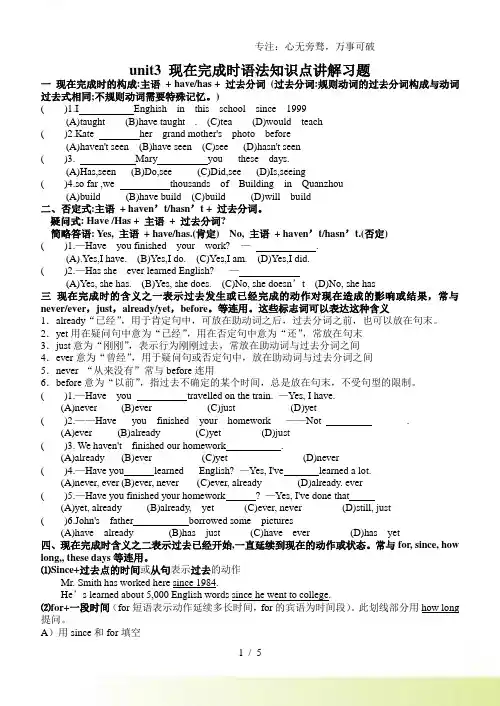
unit3 现在完成时语法知识点讲解习题一现在完成时的构成:主语+ have/has + 过去分词(过去分词:规则动词的过去分词构成与动词过去式相同;不规则动词需要特殊记忆。
)( )1.I Enghish in this school since 1999(A)taught (B)have taught (C)tea (D)would teach( )2.Kate her grand mother's photo before(A)haven't seen (B)have seen (C)see (D)hasn't seen( )3. Mary you these days.(A)Has,seen (B)Do,see (C)Did,see (D)Is,seeing( )4.so far ,we thousands of Building in Quanzhou(A)build (B)have build (C)build (D)will build二、否定式:主语+ haven’t/hasn’t + 过去分词。
疑问式: Have /Has + 主语+ 过去分词?简略答语: Yes, 主语+ have/has.(肯定) No, 主语+ haven’t/hasn’t.(否定)( )1.—Have you finished your work? —.(A).Yes,I have. (B)Yes,I do. (C)Yes,I am. (D)Yes,I did.( )2.—Has she ever learned English? —(A)Yes, she has. (B)Yes, she does. (C)No, she doesn’t (D)No, she has三现在完成时的含义之一表示过去发生或已经完成的动作对现在造成的影响或结果,常与never/ever,just,already/yet,before。
牛津译林版八年级英语下册:现在完成时讲解和练习(有答案)
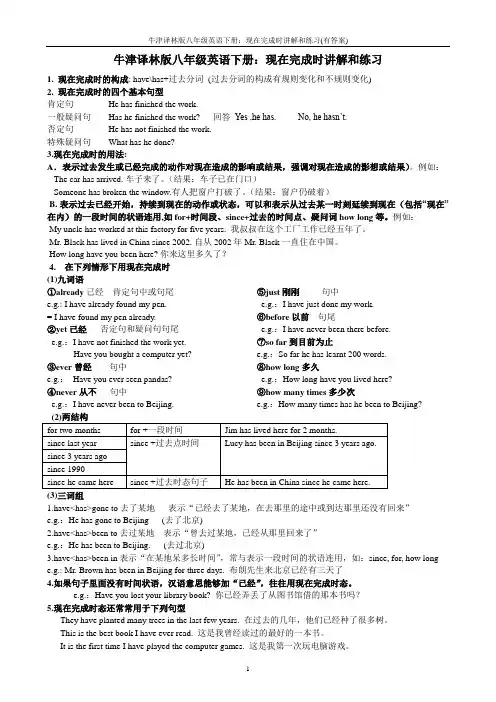
牛津译林版八年级英语下册:现在完成时讲解和练习1. 现在完成时的构成: have\has+过去分词(过去分词的构成有规则变化和不规则变化)2. 现在完成时的四个基本句型肯定句He has finished the work.一般疑问句Has he finished the work? 回答Yes ,he has. No, he hasn’t.否定句He has not finished the work.特殊疑问句What has he done?3.现在完成时的用法:A.表示过去发生或已经完成的动作对现在造成的影响或结果,强调对现在造成的影想或结果)。
例如:The car has arrived. 车子来了。
(结果:车子已在门口)Someone has broken the window.有人把窗户打破了。
(结果:窗户仍破着)B. 表示过去已经开始,持续到现在的动作或状态,可以和表示从过去某一时刻延续到现在(包括“现在”在内)的一段时间的状语连用,如for+时间段、since+过去的时间点、疑问词how long等。
例如:My uncle has worked at this factory for five years. 我叔叔在这个工厂工作已经五年了。
Mr. Black has lived in China since 2002. 自从2002年Mr. Black 一直住在中国。
How long have you been here? 你来这里多久了?4. 在下列情形下用现在完成时(1)九词语①already已经肯定句中或句尾e.g.: I have already found my pen.= I have found my pen already.②yet已经否定句和疑问句句尾e.g.:I have not finished the work yet.Have you bought a computer yet?③ever曾经句中e.g.:Have you ever seen pandas?④never从不句中e.g.:I have never been to Beijing. ⑤just刚刚句中e.g.:I have just done my work.⑥before以前句尾e.g.:I have never been there before.⑦so far到目前为止e.g.:So far he has learnt 200 words.⑧how long多久e.g.:How long have you lived here?⑨how many times多少次e.g.:How many times has he been to Beijing?(3)三词组1.have<has>gone to去了某地表示“已经去了某地,在去那里的途中或到达那里还没有回来”e.g.:He has gone to Beijing (去了北京)2.have<has>been to去过某地表示“曾去过某地,已经从那里回来了”e.g.:He has been to Beijing. (去过北京)3.have<has>been in 表示“在某地呆多长时间”,常与表示一段时间的状语连用,如:since, for, how longe.g.: Mr. Brown has been in Beijing for three days. 布朗先生来北京已经有三天了4.如果句子里面没有时间状语,汉语意思能够加“已经”,往往用现在完成时态。
Unit1-Unit3语法现在完成时讲义牛津译林版八年级英语下册

牛津译林版8B Unit 1 Unit 3 语法现在完成时讲义一、现在完成时的定义1.现在完成时表示从过去持续到现在的动作或状态;2.表示已经完成但是对现在有一定影响的动作;3.用来表示迄今为止动作发生的次数。
二、现在完成时的句式1.肯定句:主语+ have/has + 动词的过去分词+ 其他.2.否定句:主语+ have/has + not + 动词的过去分词+ 其他.3.一般疑问句:Have/Has + 主语+ 动词的过去分词+ 其他?肯定回答:Yes, 主语+ have/has.否定回答:No, 主语+ haven’t/hasn’t.4.特殊疑问句:特殊疑问词+ have/has + 主语+ 动词的过去分词+ 其他?三、现在完成时的用法1.表示从过去某一时间开始一直延续到现在,也有可能继续进行下去的动作或状态。
→和表示一段时间的状语连用。
Eg:for + 一段时间;since + 时间点。
2.表示过去某个动作对现在产生的影响或结果。
3.表示过去发生的动作到现在为止发生的次数。
→和表示次数的词连用。
Eg:once,twice,three times...四、现在完成时的时间状语1.already:“已经”,常用于肯定句,通常置于have/has与过去分词中间,有时也置于句末。
2.yet:“仍,还”,常用于否定句和疑问句,通常置于句末。
3.ever:“曾经”,用于疑问句,通常置于have/has与过去分词中间。
4.never:“未曾,从未”,用于否定句,通常置于have/has与过去分词中间。
5.recently:“最近”,可以用于肯定句、否定句和疑问句中,通常置于句末。
6.just:“刚刚”。
→注意:区别just now“刚才”(用于一般过去时)。
7.so far:“迄今为止”。
8.for + 一段时间:“长达……”。
9.since + 过去的时间点/一般过去时/一段时间+ago:“自从……以来”。
牛津译林版英语八下_Units 1-3 现在完成时语法讲解和练习
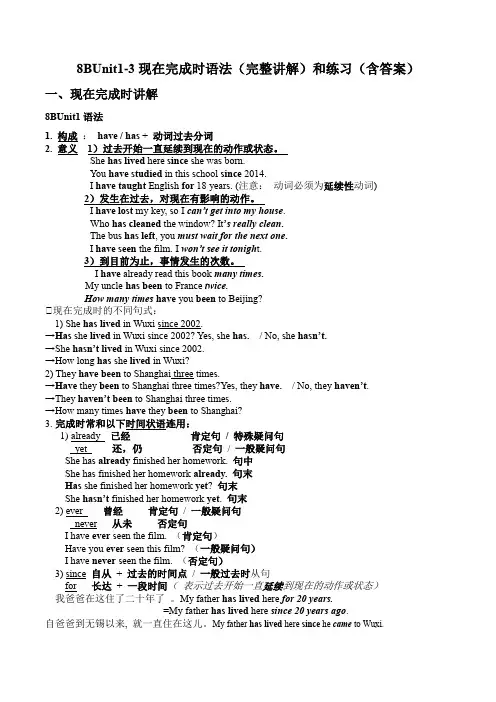
8BUnit1-3现在完成时语法(完整讲解)和练习(含答案)一、现在完成时讲解8BUnit1语法1. 构成:have / has + 动词过去分词2. 意义1)过去开始一直延续到现在的动作或状态。
She has lived here since she was born.You have studied in this school since 2014.I have taught English for 18 years. (注意:动词必须为延续性动词)2)发生在过去,对现在有影响的动作。
I have lost my key, so I can’t get into my house.Who has cleaned the window? It’s really clean.The bus has left, you must wait for the next one.I have seen the film. I won’t see it tonigh t.3)到目前为止,事情发生的次数。
I have already read this book many times.My uncle has been to France twice.How many times have you been to Beijing?★现在完成时的不同句式:1) She has lived in Wuxi since 2002.→Has she lived in Wuxi since 2002? Yes, she has./ No, she hasn’t.→She hasn’t lived in Wuxi since 2002.→How long has she lived in Wuxi?2) They have been to Shanghai three times.→Have they been to Shanghai three times?Yes, they have./ No, they haven’t.→They haven’t been to Shanghai three times.→How many times have they been to Shanghai?3.完成时常和以下时间状语连用:1)already 已经肯定句/ 特殊疑问句yet 还,仍否定句/ 一般疑问句She has already finished her homework. 句中She has finished her homework already.句末Has she finished her homework yet? 句末She hasn’t finished her homework yet. 句末2) ever 曾经肯定句/ 一般疑问句never 从未否定句I have ever seen the film. (肯定句)Have you ever seen this film? (一般疑问句)I have never seen the film. (否定句)3) since 自从+ 过去的时间点/ 一般过去时从句for 长达+ 一段时间(表示过去开始一直延续到现在的动作或状态)我爸爸在这住了二十年了。
牛津译林版八年级下册现在完成时讲解和练习(无答案)
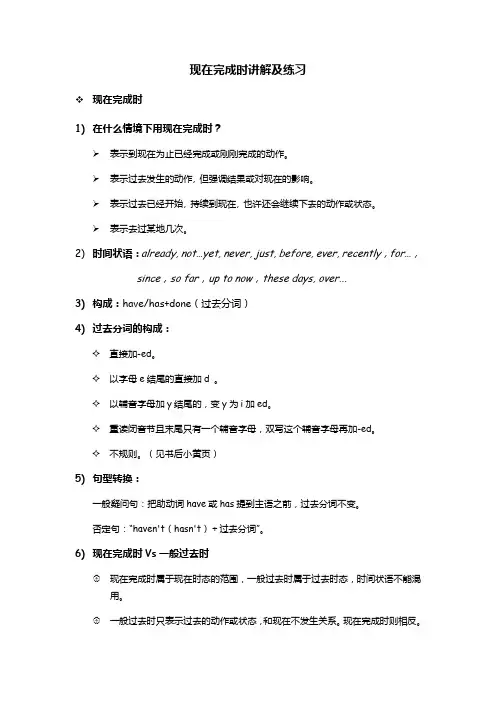
现在完成时讲解及练习❖现在完成时1)在什么情境下用现在完成时?➢表示到现在为止已经完成或刚刚完成的动作。
➢表示过去发生的动作, 但强调结果或对现在的影响。
➢表示过去已经开始, 持续到现在, 也许还会继续下去的动作或状态。
➢表示去过某地几次。
2)时间状语:already, not…yet, never, just, before, ever, recently,for…,since,so far,up to now,these days, over…3)构成:have/has+done(过去分词)4)过去分词的构成:✧直接加-ed。
✧以字母e结尾的直接加d 。
✧以辅音字母加y结尾的,变y为i加ed。
✧重读闭音节且末尾只有一个辅音字母,双写这个辅音字母再加-ed。
✧不规则。
(见书后小黄页)5)句型转换:一般疑问句:把助动词have或has提到主语之前,过去分词不变。
否定句:“haven't(hasn't)+过去分词”。
6)现在完成时Vs一般过去时现在完成时属于现在时态的范围,一般过去时属于过去时态,时间状语不能混用。
一般过去时只表示过去的动作或状态,和现在不发生关系。
现在完成时则相反。
eg--- I have seen the film.eg--- I saw the film last week.eg--- He has lived here since 1993.eg---- He lived here in 1993.7)have gone to Vs have been to Vs have been inhave gone to:没回来。
He has gone to Xi’an. 他去西安了。
(没回)have been to:回来了。
He has been to Xi’an twi ce. 他曾去过西安两次。
(已回)have been in: 待在某地一段时间He has been in Xi’an for weeks. 待在西安数周。
译林版英语八下_Unit 3 单元语法梳理和知识点梳理
Unit3 Online tours 单元语法讲解与训练一般过去时和现在完成时的区别一般过去时和现在完成时都可以表示过去发生的动作,但是在具体的语境中,这两种时态有明显的区别:1、一般过去时只表示过去某个时间发生的动作或存在的状态,和现在无关,说话的侧重点在陈述一件过去发生的事情。
它可和表示过去的时间状语连用,如:yesterday, last week, two years ago, just now, in 2012 等。
汉译英时可加“过”、“了”等词。
简言之,仅谈过去,不关现在。
例:(1)I read the novel last month.我上个月看了这本小说。
(只说明上个月看了,不涉及现在是否记住)(2) Tom visited China in 2009. Tom于2010年到过中国。
(只说明来过,对现在没有造成影响)2、现在完成时表示过去发生的动作或存在的状况,但和现在有联系,强调的是对现在造成的影响或结果,它不能同表示过去的时间状语连用,通常和表示频度的副词或者表示一段时间的状语连用,如:many times, never, these days, already, since…,for…,so far 等。
汉译英时可加“已经”等词。
简言之,利用过去,说明现在。
例:(1)I have already read the novel written by the world-famous writer.我已经读过了由世界著名作家写的小说。
(已经看过,且了解这本书的内容)(2)I have been to HK many times .(去过香港许多次所以对香港很了解)阶梯训练一、用所给动词的适当时态填空。
1.The old man ________(sit) down and began to read his newspaper.2. My father is a good teacher , he _______(love) all of his students.3. The man ________(leave) the mall just now.4. The Blacks ________(live) in the street for more than 20 years.5. 一Look! What _____ they _______(do) over there?一They ________(get) ready for the sports meeting.6. In the past few years there ____________(be) great changes in my hometown.7. Who ________(give) us a talk tomorrow?8. 一It’s dangerous to swim here. Look at the sign.一Oh, I _________(not notice) it. Thanks for telling me.9. 一I called you this morning, but nobody answered.一My mother and I ___________(grow) flowers in my garden at that time.10. 一Can you give me some information about Paris ?一Sorry , I _________(not travel) to Paris ,so I know nothing about it . Li Hua _________(go) there last month, you can ask her.11. Simon is lazy. He______often________(not do ) his homework carefully.12. There ______(be) a fashion show here in a week.13. 一Where is Simon ?一I hear he _________(go) to Qingdao for his holiday.一Oh, how nice ! Do you know when he ________(leave)?一Three days ago,14. 一Why are you still here ? It’s almost nine o’clock.一Because I ________(not finish) my work.15. 一Why didn’t Jim go shopping with us this afternoon?一He ________(wait) at the station for his cousin from Beijing.16. The old man _______(be) to China many times in the past 5 years.17. Peter _______(call)me if he gets home.18.Don’t make so much noise. The baby _________(sleep).st year I ________(pay) 200 yuan for the coat . That means I _________(have) the coat for a year.20. Daniel _______(come) to Nanjng three years ago. Now , he ________(make) lots of good friends.二、句型转换1、I have seen the film already。
牛津译林版八年级英语下册:现在完成时讲解和练习(有答案)
牛津译林版八年级英语下册:现在完成时讲解和练习(有答案)The Present Perfect XXXThe present perfect tense is formed with "have/has" and the past participle (which XXX)。
There are four basic sentence structures for the present perfect XXX:1.Affirmative sentence: XXX.2.Interrogative sentence: XXX the work。
Answer: Yes。
he has。
No。
he hasn't.3.Negative sentence: He has not finished the work.4.Special interrogative sentence: What has he done?The present perfect tense is used in two main ways:A。
To show the effect or result of a past n on the present。
For example:The car has arrived。
(Result: the car is now at the door.)XXX(Result: the window is still broken.)B。
To show an n or state that XXX up to the present。
with a time n indicating the n of the n or state。
For example:XXX.Mr。
Black has lived in China since 2002.How long have you been here?Use the present perfect tense in the following ns:1.Already (in affirmative sentences or at the end of a sentence)e.g.: I have already found my pen.2.Just (in the middle of a sentence)e.g.: I have just done my work.3.Yet (at the end of negative or interrogative sentences)e.g.: I have not finished the work yet.4.Ever (in the middle of a sentence)e.g.: Have you ever been there before?5.Before (at the end of a sentence)6.So far (to indicate up to the present)e.g.: So far he has learnt 200 words.7.How long (to ask about the n of an n or state)Have you ever seen pandas。
江苏省2019-2020学年牛津译林版英语八年级下册现在完成时总结精讲及提高训练(Word版含答案)
译林版八年级下册现在完成时总结精讲及提高训练1、含义:①表示过去已经开始,持续到现在的动作或状态。
②表示过去发生或已完成的动作对现在造成的影响和结果。
③表示一个动作至今为止已经发生了几次。
*2、现在完成时和一般过去时的区别:一般过去时表示过去的事实,和现在没有联系;现在完成时表示过去开始、现在还在继续或依然与现在有联系的动作或情况。
3、基本结构: (助动词) have/ has+ 过去分词(P.P)句式变化:肯定:have/ has+过去分词否定:have/has+not+ 过去分词疑问句:have,has 提前回答:用have, has回答4、过去分词的构成:①一般在动词原形末尾加ede.g. look-looked ;play-played;start-started②以e结尾的动词加de.g. live-lived;hope-hoped;use-used③以辅音字母+y结尾的动词,变y”"为“i”再加ede.g. study-studied;carry carried;worry-worried④以一个元音和一个辅音字母结尾的重读闭音节词双写这个辅音字母,再加ede.g. stop-stopped;step-stepped;shop-shoppedmop-mopped;fit-fitted;drop-droppedtrap-trapped;clap- clapped;plan-plannedchat-chatted;control-controlled⑤不规则变化(见P122-123不规则动词表,需熟记)5、常与以下时间状语连用:①already(肯定句句中或句末,“已经”)yet (否定句/疑问句,“还没有、已经”)ever (疑问句,“曾经”)never(否定句,“从不”)just(肯定句,“刚刚”)recently(肯定句/否定句/疑问句,“最近”)over the years(在这些年)So far(迄今为止) by now/ til now/up to now (到目前为止)all one's life(某人一生)before (以前)once /twice / many times How many times+问句last最近的*over /in/during the last /past....... years(在过去的...年中)②表示过去已经开始,持续到现在的动作或状态,可以和表示从过去某一时刻延续到现在的一段时间的状语连用。
【期末考点精练】专题04_牛津译林版八下英语重点语法及专练(解析版)
【期末考点精练】专题04 牛津译林版八下重点语法及专练(解析版)一.现在完成时1. 构成形式:sb. have/has done2. 现在完成时用法:表示过去发生的或已经完成的某一动作对现在造成的影响或结果。
表示动作或状态在过去已经开始,持续到现在,也许还要持续下去,常和for, since连用。
3. 动词过去分词变化规律:一般情况下,直接在动词词尾加ed以“e”结尾的动词,在词尾加d以辅音字母+y结尾的动词,将y变成i 再加ed重读闭音节结尾,末尾只有一个辅音字母,双写辅音字母,再加ed4. 相关句型一般疑问句:Have/Has +主语+done…?否定句:主语+have/has + not +done…5. have/ has been 与have/ has gone 用法的区别1). have/ has been表示去过某地,说话时已从该地回来。
例句:He has been to China. 他去过中国。
(表示现在他已回来)Have you ever been here before? 你以前到过这儿吗?2). have/ has gone其含义是“到某地去了(还没有回来)”。
注意:这种结构不用于第一人称,也不用于第二人称,仅用于第三人称。
例句:He has gone to England. 他去了英格兰。
(表示他现在不在说话处,他可能在去英格兰的途中,也可能已在英格兰了)A: Where's Tom? A:汤姆在哪里?B: He's gone to the shop. B:他到商店去了。
A: Has Mary gone there with him? A:玛丽跟他去那里了吗?B: No, she hasn't. B:不,她没有。
6 for与since的用法1). forfor+时间段常和现在完成时连用,句中谓语动词为延续性动词。
例句:I have been a teacher for 10 years.我当教师已经有10年了。