
英语人教版八年级下册Unit1 Section B 3a-Selfcheck
Remember the words, phrases and sentences in this unit.
Dialogue 2: A:What's the matter?
B:I have a toothache. What should I do? A:You should see a dentist. B:OK. Thanks.
1 Write different health problems next to the body parts. Then write more health problems you know of. have a headache Head:_________________________________ have a sore back Back:_________________________________ have a sore throat Throat:_______________________________ Tooth:________________________________ have a toothache have a stomachache Stomach:______________________________ have a fever/a nosebleed Other problems:________________________
Make dialogues
Problems Give advice
have a cold
get tired
take some medicine
sleep
be stressed out
have a toothache
have a good rest
see a dentist
have a sore throat
3b
Write a conversation between the nurse and the student using the notes in 3a. Use the questions and phrases below to help you. What's the matter?/What happened?/Are you OK? No, I don't feel well./I feel ... /I have a ... /Should I ... ? You should .../You shouldn't ... fell down/got hit by ... /cut myself/hurt my ...
.
summary
2) It’s important for us to have good habits. 3) We shouldn’t watch TV or play computers for a long time. 4) We can also take part in some sports club to make ourselves keep fit. 5) We shouldn’t leave without having breakfast in the morning. 6) Bandage it at once so that it wouldn’t lose too much blood. 7) Stop working and have a rest for a few days. 8) You can run it under water right away, then use the cling film putting on it. 9) Although we can save ourselves. But the best way to keep away from the sick is to do more exercise.
Accident or He/She health problem should
He/She shouldn't
In order to get better, you should lie down and rest. drink some hot tea with honey. see a dentist and get an X-ray. take your temperature. take some medicine. put some medicine on it. take breaks. go to a doctor. go to the hospital. get some sleep. put a bandage on it. run it under water. put your head back
Unit 1 What's the matter?
Section B 3a-Self Check
—What's the matter? fell down when —He _________ he played soccer.
—What's the matter? has a cold He is going to see a —He _________. doctor.
Brainstorm Healthu are the school nurse and a student just had an accident or a health problem. Make notes about what he/she should and shouldn't do.
2 Put these questions and answers in order to make a conversation. ___ 2 I hurt myself playing soccer.
I have a sore leg. ___ 4 What should I do? ___ 5 I think you should see a doctor and get an X-ray. ___ 6 OK, thanks. I’ll do that now. ___ 1 What's the matter? ___ 3 Oh, that doesn't sound good.
have a headache
drink hot water
see a doctor
Dialogue 1: A:What's the matter with Alice?
B:Oh, she has a cold.
A:What should she do?
B:She should take some medicine.
3 Write advice for these people.
1. Problem: Alan cut himself. Advice:______________________ Put some medicine on it. 2. Problem: Cindy has a headache. Take a temperature and rest. Advice:__________________________ 3. Problem: My cousins have bad colds. Lie down, rest and drink more water. Advice:________________________________ 4. Problem: Jack hurt his back playing volleyball. Go to the hospital and get an X-ray. Advice:________________________________
Nurse:_______________________________________________________ Student:______________________________________________________
Nurse:_______________________________________________________
Unit+1+Section+B3a-Self+Check+教案 人教版八年级英语上册
Unit 1 Where did you go on vacation?Section B (3a-Self Check)一、教学内容1.重点单词:duck,dislike2.重点短语:learn something important,in the shopping center,find out,go on,come up 3.重点句式:How did you feel about the trip?Did you dislike anything?I didn't bring back anything from Malaysia.My classmates told me to keep going.So I went on.Everyone jumped up and down in excitement.It was so beautiful that we forgot about the last five hours.二、教学目标1.知识目标:能掌握本课时的新词汇(duck, dislike, the Palace Museum, Tian’anmen Square);能综合运用所学重难点词汇和所学技巧写好旅行日记。
2.能力目标:学会日记书面表达的审题和计划,并根据风格进行词语润色;知道如何在有限的时间内快速构思和勾勒文章。
3.情感目标:通过写日记记录日常生活,传达旅游意识。
三、重难点1.能综合运用所学重难点词汇和所学技巧写好旅行日记。
2.能运用英语根据相关提示来记自己某次旅行的经历。
四、教学准备课件,多媒体五、教学过程Step 1Lead-inHave you ever been to Beijing?There are many famous places,such as Tian'anmen Square,the Great Wall,Beijing Hutong and so on.Now please tell us something about your trip to visit the famous places in Beijing.Step 2Presentation1.完成教材3a—4的任务1)两人一组大声朗读3a的单词和短语,然后选择合适的单词或短语来补全短文,完成后集体核对答案,并大声地朗读短文。
人教版英语八年级下册Unit1 Section B 3a-3b Self check
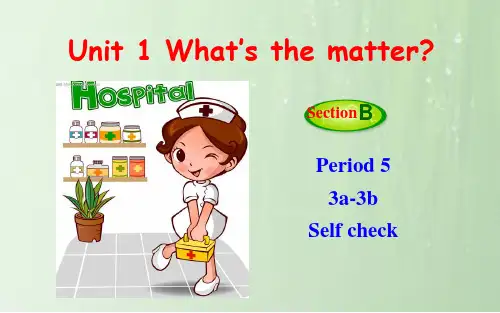
_4__ What should I do? _5__ I think you should see a doctor
and get an X-ray.
_6__ OK, thanks. I’ll do that now. _1__ What’s the matter? __3_ Oh, that doesn’t sound good.
have a fever/have a Other problems: _n_o_s_e_b_l_ee_d_/_c_u_t_o_n_e_s_e_lf___
2 Put these questions and answers in
order to make a conversation.
_2__ I hurt myself playing soccer. I have a sore leg.
Work in Pairs
A: What’s the matter with…? B: He/She has a …
hurt have a fever have a cold have a toothache have a headache have a sore throat
人教八年级英语下册Unit6SectionB3a,3b,SelfCheck1,2说课稿

在新知讲授阶段,我会首先介绍过去时态的用法,通过展示几个简单的例子,让学生直观地理解过去时态的概念。接着,我会引导学生阅读3a部分的文本,让学生在阅读过程中注意过去时态的使用。在阅读之后,我会组织讨论,让学生分享他们对文章的理解和感受。随后,我会讲解描述人物、地点、事件的表达方式,并提供一些常用句型和词汇。在这个过程中,我会使用互动式教学,鼓励学生提问和参与,确保他们能够深入理解所学内容。
1.知识与技能:
(1)掌握过去时态的运用;
(2)能够用英语描述人物、地点、事件;
(3)提高阅读理解能力;
(4)提高写作能力。
2.过程与方法:
(1)通过阅读、讨论、写作等环节,学会分析文章结构,提取关键信息;
(2)运用所学知识,完成写作任务;
(3)通过合作学习,提高解决问题的能力。
3.情感态度与价值观:
这些互动方式旨在营造一个积极参与和合作的学习氛围,让学生在互动中学习,在实践中提高。
四、教学过程设计
(一)导入新课
新课导入是激发学生学习兴趣和吸引注意力的关键环节。我将采用情境导入法,通过展示一张动物园的图片,引导学生回忆自己是否有过类似的难忘经历。接着,我会邀请几位学生分享他们的经历,并用英语简单描述。这样的导入方式能够快速吸引学生的注意力,因为他们可以分享自己的故事,感到自己被重视。随后,我会引入本节课的主题,告诉学生我们将学习如何用英语描述难忘的经历,并宣布今天的阅读和写作任务。
(三)学习动机
为了激发学生的学习兴趣和动机,我将采取以下策略或活动:
1.利用多媒体教学,展示生动有趣的图片和视频,吸引学生的注意力;
2.创设情境,让学生在真实的语境中运用所学知识,提高学习的实用性;
3.设立学习小组,鼓励学生合作学习,共同解决问题,提高学生的团队协作能力;
Unit 1 Section B 3a-Self Check课件人教版八年级英语
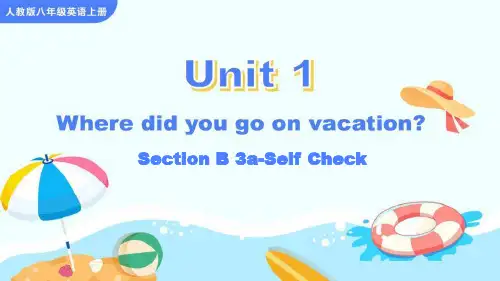
noodles
Weather
sunny
cool
souvenirs
sun glasses
a cap
Self Check
1 Complete the conversations with the correct words in the box.
anything everything nothing anyone everyone no one
1. A: Did anyone go on vacation with you last month?
B: Yes, my family went to the countryside with me. 2. A: Did your family go to the beach with you last weekend?
B: No. N__o_o_n_e__ from my family went, but my friend went with me.
3. A: I didn’t bring back anything from Malaysia. B: _N__o_th_i_n_g_at all? Why not?
box to help you.
Tian’anmen
the Palace Museum
a Beijing hutong
hot and sunny Beijing duck take some photos buy something special learn something important
tired delicious beautiful interesting August
For dinner we had B__ei_j_in_g__d_u_c_k__. It was _d_e_li_c_io_u_s_.
人教版八年级上册Unit2SectionB(3aselfcheck)说课稿

在总结反馈阶段,我将引导学生进行自我评价,并提供有效的反馈和建议。首先,我会让学生回顾本节课所学内容,分享自己的学习心得和体会。然后,我会根据学生的表现和作业完成情况,给出具体的评价和建议。对于学生的正确答案和积极表现,我会给予肯定和鼓励;对于学生的错误,我会耐心指出并提供正确的指导。此外,我还会鼓励学生互相评价,培养他们的自我反思和批判性思维能力。
人教版八年级上册Unit2SectionB(3aselfcheck)说课稿
一、教材分析
(一)内容概述
本节课内容为人教版八年级上册Unit2 Section B (3a self-check)部分。本单元的主题为“School Life”,本节课位于该单元的Section B部分,是对单元内容的巩固与拓展。3a self-check作为单元的自我检测环节,旨在让学生运用所学知识进行实际的语言交流。其主要知识点包括:
五、板书设计与教学反思
(一)板书设计
我的板书设计注重清晰性和逻辑性,布局合理,主要内容突出,风格简洁明了。板书通常分为三个部分:标题、知识点和总结。标题位于黑板顶部,明确标注本节课的主题。知识点部分详细列出本节课的主要学习内容,包括新词汇、语法规则和例句等,采用列表或图表形式,便于学生理解和记忆。总结部分位于黑板底部,概括本节课的核心内容和学习要点。板书在教学过程中的作用是提供视觉辅助,帮助学生把握知识结构,强化记忆。为确保板书清晰简洁,我会提前规划板书内容,避免过度拥挤,并在书写时保持字体工整、大小适中,确保所有学生都能清晰阅读。
(1)掌握与学校生活相关的词汇,如“club”、“project”、“homework”等。
(2)学会运用一般现在时态描述日常活动。
(3)能够运用所学知识询问和描述他人的日常活动。
人教版八年级下册英语 Unit 1 SectionB (3a-selfcheck) 练习(含答案)
Unit 1 What’s the matter?Section B(3a-selfcheck)一、根据首字母及汉语提示填写单词1.--How many apples would you like to buy?--Three k________,please.2.We enjoyed o________swimming in the pool yesterday morning.3.I have a t________,so I go to see a dentist.4.I know your sister works in a hospital,but is she a doctor or a n ________.5.The old man’s d________made him very sad.二、用括号中所给单词的适当形式填空1.She is a mountain ________(climb).She likes climbing the mountains.2.I have two________(knife) and I can lend one to you .3.Lucy________(have) a headache.She should see a doctor.4.The young man stopped his car and helped the girl without ________(think)twice.5.At the same time,Tom saw his dog________(lie)on the floor.三、单项选择1.It’s important for us to learn how to learn________.A.by ourselvesB.to ourselvesC.for ourselvesD.in themselves2.--Mom,I have a sore throat.--Well,you should drink some hot tea ________ honey.A.inB.onC.withD.of3.Mike talked________ last night and didn’t drink enough water.He has a sore throat now.A.much tooB.so manyC.too manyD.too much4.When I walked past the park,I saw some old people________ kung fu.A.doingB.doC.didD.to do5.Miss White speaks loudly________students can hear her clearly.A.in order toB.so thatC.as soon asD.even though四、根据汉语意思完成句子1.那个女孩每天坚持弹钢琴。
Unit2 SectionB 3a-Self check 课件人教版英语八年级下册
素养探究 用方框中所给单词的适当形式补全短文(每词限用一次)
deep, thank, give, once, begin , whole, until, work, people, or
The Lei Feng Spirit Carrying on "It is not hard to do one good deed, but it is hard to do good deeds all your life," a great man
came out, people 61. began to know more about him than before. Now the term "Living Lei Feng" has become a name for anyone who is brave, anyone who has 62. deep love for his country, anyone who works hard, 63. or anyone who is always ready to help
Dear Sir or Madam, 引出话题
What
I am writing to you about volunteering at the library. I’m interested in computers
and teaching, and I want to volunteer as a computer teacher for people who lack
Why do you like to do that?
I’ll help to clean up the city parks.
I hope to work outside.
人教版八年级英语下册《Unit 1 Unit 1 What’s the matter?》教案.doc
《Unit 1 Unit 1 What’s the matter?》教案教学目标:1语言目标:描述健康问题的词汇,及如何根据别人的健康问题提建议。
2 技能目标:能听懂谈论健康问题的对话材料;能根据别人的健康问题提建议;能写出重点单词和重点句型,并能描述怎样对待健康问题。
3 情感目标:通过开展扮演病人等活动,培养学生关心他人身体健康的品质。
通过本课的阅读,培养学生处理紧急事件的基本能力,树立紧急事件时互相帮助的精神。
Section A 1 (1a – 2d)Step 1 Warming up and new words1.Look at a picture and learn the parts of the body.2.New words and phrases.Step 2 Presentation1a Look at the picture. Write the correct letter [a-m] for each part of the body.___arm ___ back ___ ear ___ eye ___ foot___hand ___ head ___ leg ___ mouth___ neck ___nose ___ stomach ___ toothStep 3 Listening1b Listen and look at the picture. Then number the names 1-5Listen to the conversations again and fill in the blanks.Conversation 1Nurse: What’s the matter, Sarah?Girl: I ___________.Conversation 2Nurse: What’s the matter, David?Boy: I _________________.Conversation 3Nurse: What’s the matter, Ben?Boy: I _________________.Conversation 4Nurse: What’s the matter, Nancy?Girl: I _________________.Conversation 5Betty: What’s the matter, Judy?Ann: She __________________.Step 4 Speaking1c Look at the pictures. What are the students’ problems? Make conversati ons.ExamplesA: What’s the matter with Judy?B: She talked too much yesterday and didn’t drink enough water.She has a very sore throat now.A: What’s the matter with Sarah?B: She didn’t take care of herself on the weekend. She was p laying withher friends at the park yesterday. Then it got windy, but she didn’t puton her jacket. Now she has a cold.Step 5 Guessing gamesGuess what has happened to the students by using the important sentenc es. Step 6 Listening2a Listen and number the pictures [1-5] in the order you hear them.2b Listen again. Match the problems with the advice.Step 7 Speaking2c Make conversations using the information in 2a and 2bA: What’s the matter?B: My head feels very hot.A: Maybe you have a fever.B: What should I do?A: You should take your temperature.Step 8 Role–playImagine you are the school doctor. A few students have health problems.Role-play a conversation between the doctor and the students.2d Role –play the conversationStep 9 Language points and summary1. What’s the matter?这是人们特别是医生和护士询问病人病情时最常用的问句, 意思是“怎么了?”其后通常与介词with连用。
初中英语人教版八年级下册Unit 2 Section B 3a-Self Check
for little kids.
Self Check
1 Fill in each blank with a possible verb to make a phrasal verb.
I love working with computers and I’m good at explaining how to use new software to younger students at my school. I’ve taught my grandparents how to use e-mail and word processing software.
I like to help people to enjoy computers as much as I do, so I think I’d be good at this job.
I want to help out as a volunteer at your library because I know that many people go there to use your computers.
2. 这些词都很重要,请把它们记下来。
These words are all very important. __W__r_it_e _t_h_e_m__ d_o__w_n__, please. 3. 你知道谁在校门口分发广告了吗? Do you know whoh_a_n_d__e_d__o_u_t__a_d_v_e_r_t_is_e__m_e_n_t_s_ at the school gate?
最新人教版 八年级下册 Unit_1_What's_the_matter_Section_B 3a-Self check
【2013山东聊城】28. —Jim, please help ______ to some bread. —Thank you. A. himself B. yourself C. herself D. myself
【答案】B. 【解析】考查反身代词的用法。himself 是 “他自己”, yourself 是“ 你自己”, herself 是 “ 她自己”,myself 是“我自 己”。help yourself ( 或 yourselves ) 是固 定短语, “(请你、你们) 随便吃”,根 据句意“ 请随便吃一些面包 ”,所以选 B 。
反身代词
表示反射或强调的代词叫做反身 代词。反身代词是由第一人称、第二 人称形容词性物主代词或第一人称人 称代词宾格形式,词尾加self或selves 组成。反身代词可译为“本人”、 “本身”,为加强语气,也常译为 “亲自”、“自己”。请见下表:
人称 第一人称 数 单数 myself
第二人称 yourself
3 Write advice for these people.
1. Problem: Alan cut himself. Advice: _____________________________ 2. Problem: Cindy has a headache. Advice: _____________________________ 3. Problem: My cousins have bad colds. Advice: _____________________________ 4. Problem: Jack hurt his back playing volleyball. Advice: _____________________________