
北师大版英语必修二unit5:lesson3experimentinfolk
拓展 quit oneself of sth./sb.摆脱某物/某人 be quit of sth./sb.(作形容词)摆脱某物/某人 quit doing sth.停止做某事
运用 完成句子,每空一词
However, he didn't quit, and he became a great pianist.然而,他没有放弃,他成为了伟大的钢琴家。(P26, L18)
2.quit vt. & vi.停止;辞职 典例 He decided to quit smoking after he got the disease. 他得病后决定戒烟。
运用 完成句子,每空一词 (1)___I_n____ __s_o_m__e__ __w__a_y_s__ (在某些方面),they are the same. (2)A lot of difficulties are ____in_____ ____t_h_e____ ___w_a_y____ (挡道). (3)____I_n____ ____n_o____ _____w_a_y_____ (绝不) can theory be separated from practice.
二、同义句转换,每空一词 1.Since you have all your equipment, we can get started. __N__o_w___ ___t_h_at___ you have all your equipment, we can get started. 2.I am saving money so that I can buy a house. I am saving money ____in____ __o_r_d_e_r__ ___th_a_t___ I can buy a house.
The day breaks, for the birds are singing. 天亮了,因为鸟在叫。
You ought to have a good rest now that you've finished the work. 既然已经完成了工作,你就应该好好休息一下。
注意: 1.because 表示直接的原因,具有很强的因果关系,专门 回答对 why 的提问,不能与 so 连用。如: —Why were you late again?你为什么又迟到了? —I was late because I didn't catch the bus. 我迟到是因为没赶上汽车。
(1)Though he met great s dream, he never ___q_u_it___ (放弃).
(2)He was glad to ____b_e____ ___q_u_it___ ____o_f___ (摆脱) the troublesome job.
2 .since =now that, 表示已知或显然的原因,意为“既 然”,通常放在句首。如:
Since/Now that you are busy, I will do it for you. 既然你忙,我替你做吧。
3.for 的语气不如 because 强,是用来表示一种附带或补充 解释、说明,通常不放在句首。如:
运用 用所给单词的适当形式填空 1.The great _m_u_s_i_c_ia_n_ writes the ___m_u_s_i_c___ for this famous movie.(musician) 2.He is a __ta_l_en_t_e_d_ young dancer.(talent) 3.She was _b_e_a_u_ti_fu_l_ when she was young, but her __b_e_a_u_ty__ faded over the years.(beauty) 4.You mustn't worry about your_a_p_pe_a_ra_n_c_e;you look fine.(appear) 5.The twentieth century has seen a great worldwide political, economic and cultural ___tr_a_n_s_fo_r_m_a_t_io_n___.(transform)
一、完成句子,每空一词 1._B__ec_a_u_s_e_ (由于) her mother was ill, she had to look after her. 2.My father works hard ___i_n____ __o_r_d_e_r__ ___t_h_a_t __ (为了) he may support us. 3.The boy ran ___s_o____ ___f_a_st___ ___th_a_t___ (如此快…… 以至于) I couldn't catch him. 4.The days are short, ___f_o_r___ (因为) it is now December. 5 .__S_i_n_c_e_e_ ( 既然) you have finished your homework, you can play basketball.
运用 完成句子,每空一词 (1)Everyone may make mistakes ___a_t____ ___ti_m_e_s__ (有时). (2)I can only carry one box ____a_t____ _____a____ ___t_im__e___ (每次). (3)She was laughing and crying ___a_t____ ___th_e___ __s_a_m__e__ ___ti_m_e___ (同时).
Not until I have fulfilled my task shall I be able to go to the movies.直到完成任务我才能去看电影。
(2)使用“It is/was...that”强调句型。如: It was not until he was actually dying that he said, “I can work for the people no more.” 直到他临终之前,他才说:“我再也不能为人民工作了。” 两种句型可以相互转换:
拓展 by the way 顺便说,附带说 on the/one's way (to)去……的途中 all the way (一路上)一直,从头到尾 in a way在某种程度上;有点 in no way 绝不(置于句首,句子要倒装) in the way 妨碍,挡道 in this/that way 用这种/那种方式 by way of经由 under way 在进行中
He was unhappy, because his mother was ill. 他不高兴是因为他妈妈病了。
Since everyone knows it, I will not say anything. 因为每个人都知道了,我就不多说了。
You must hurry up as there is little time left. 你必须快点,因为没有多少时间了。
1.at times 有时,不时 典例 You can be really annoying at times. 你有时候真让人恼火。
拓展 at a time 一次,每次 at one time 曾经,一度 at the same time 同时;然而 at any time 随时,任何时候 at no time 决不 in no time 立刻,马上
2.His mother couldn't buy him a piano until he was seven. 直到 7 岁,他母亲才给他买了一架钢琴。(P26, L12)
点拨 not...until 意为“直到……才”,引导时间状语从句。 拓展 若对 not...until 引导的时间状语从句进行强调,有以 下两种形式: (1)将 not until 引导的从句置于句首,此时主句部分倒装。 如:
But after years of performing, he felt that in some ways he had lost his identity.但是多年演奏之后,他觉得自己在 某些方面迷失了自我。(P26, L24)
4.in some ways 在某些方面 典例 The change is beneficial in some ways but not in others. 这种变革在某些方面有好处,某些方面却没好处。
高中英语课件
madeofcanruohanxing
Lesson 3 Experiment in Folk
He was made to practise the piano so much that, at times, he thought about giving up.( 母亲) 让他每天花很长时间 练习弹奏钢琴,有时他真想放弃。(P26, L16)
(3)The teacher ___q_u_i_t___ _t_e_ac_h_i_n_g_ (停止教学) and engaged in painting.
Because of Kong's talent and hard work, he became famous worldwide.由于他的天分和努力,孔祥东闻名于世。 (P26,L23)
It was not until the rain stopped that he left the room. →Not until the rain stopped did he leave the room. 直到雨停了他才离开房间。
运用 完成句子,每空一词 (1)Not until he finished his homework ___d_i_d___ he ___g_o____ ___o_u_t ___ to ___p_l_a_y__ _f_o_o_t_b_a_ll_ (他才出去踢足球). (2)____It____ ___w_a_s___ ___n_o_t___ ___u_n_ti_l__ his father came back ___th_a_t___ (直到……才……) he went to bed.
北师大版必修二Unit5Rhyme Lesson 3 Experiment in Folk考点精讲(

北师大版必修二Unit5Rhyme Lesson 3 Experiment in Folk考点精讲(有答案)【基础词汇】1.n. 钢琴家,钢琴演奏者2.n. 音乐家3.有时,不时4.vt. 离开;放弃;停止5.n. 人才,才能,天才6.adj. 全世界的adv. 全世界地7.在某些方面,在某种程度上8.n. 身份;特性9.n. 根10.vt. 重新发现;再发现11.n. 美;美丽;美人;美好的东西12.n. 外貌,外观;出现13.vt. 剃,刮14.n. 发型15.v. 转变,转换,改变答案:1.pianist2.musician3.at times4.quit5.talent6.worldwide7.in some ways8.identity9.root10.rediscover11.beauty12.appearance13.shave14.hairstyle15.transform【必备短语】1.prefer A to B 比起B更喜欢A2.prefer doing A to doing B 比起做B更喜欢做A3.prefer to do sth更喜欢做某事4.prefer doing sth. 更喜欢做某事5.prefer to do A rather than do B 宁愿做A不愿做B6.prefer sb. to do sth. 更喜欢某人做某事7.go for sth. 选择某物努力争取某物8.go over 仔细思考反复考虑9.It surprises sb. that... 惊讶某人的是......10.in surprise 惊讶地11.at times 时不时地12.give up 放弃13.quit doing sth. 停止做某事14.quit school 退学15.quit the show 退出节目16.win the prize 赢得了奖品17.have a talent for... 有......的天赋18.have a gift for... 有......的天赋19.in some ways 在某些方面20.in a way 在某种程度上21.transform...into... 把......转换为......22.a great success 一个伟大的成功23.expert to do sth. 预计做某事24.expect sb. to do sth. 期望某人做某事【重点句式】1.not...until... “直到......才......”对时时间进行强调:教材原文:Her mother couldn't buy him a piano until he was sen.直到他7岁时,母亲才给他买了一架钢琴。
北师版英语必修2 Unit 5 lesson 3 Experiment in Folk 3
Unit 5 lesson 3 Experiment in FolkObjectives■To practise the vocabulary relating to music.■To read and understand a newspaper article.■To express opinions and give reasons for them.■To practise using adverbial clauses of cause, result and purpose with because, as, since, so that and so/such…that.■To distinguish between because and because of and practise using them correctly. Resource usedthe Internet, Cassette, Grammar Summary 4, Mini-Grammar 4Possible problems■Students may have problems distinguishing between because and because of.■Some students may feel less confident in expressing their own opinions orally and giving reasons in English than other students.BackgroundKong Xiangdong, a famous Chinese name in the music world, is one of the most successful young pianists in the world.Kong Xiangdong has performed in more than 40 countries and has received numerous prizes, including the first prize and four other special prizes at the 1992 Sydney International Competition of Australia. He is the youngest prize winner ever in both Moscow’s 1986 Tchaikovsky International Competition and Spain’s 1987 Santander International Competition and is also the only Chinese pianist winning two gold medals at international competitions.He loves the piano, and he loves his homeland. Therefore, he became the best pianist of the Huanghe River Piano Concerto. In Hong Kong, the sales of his laser disc, Yellow River Piano Concerto have reached about 100,000 and have earned him a Platinum Record. In the US, he’s the first Asian pianist to sign a contract with the BMG/RCA record company.In face of all these achievements, Kong never forgets his mother and his teacher, Fan Dalei, from whom both Kong Xiangdong has benefited a lot.Routes through the material■If you are short of time, omit Exercise 8 and 9.■If you have time, do Options activity.■If you have two periods for a lesson, a suitable natural break is after Exercise 4.Language Power: pages 70?C71.Mini-Grammar: 4Before you startExercise 1Key Wordsclassical, folk, jazz, traditional, pop, rock ’n’ roll■Read through the Key Words with the class.■Ask students to talk about different kinds of music and famous musicians relating to the kind of music—-encourage them to say as much as possible and to give their opinions.Example:Kong Xiangdong is a world-famous pianist. He plays not only classical music, but folk as well.■Elicit information about Kong Xiangdong from students to arouse their interest in him. Show some photos of Kong Xiangdong to students if necessary.Read to learnExercise 2■Ask student to skim the title, the picture and the first sentence of each paragraph to get the general idea of the text.■Students read through the questions first and guess the possible answers. Then ask them to scan the text for the answers and take notes if necessary.■Students compare their answers in pairs before checking them as a class. Answers1 He is most famous for classical music.2 He became the youngest prize winne r in Moscow’s Tchaikovsky International Competition.3 He shaved off his hair to show that his music style was new, just like his new hairstyle.Exercise 3■Students read the text again to check their answers and further understand the text. Match the beginnings to the endings then.Answers1 b2 c3 a■Students cover the text and in pairs, talk about Kong Xiangdong, seeing how much they can remember from the text.■Encourage students to exchange ideas about how they tackled the task—-did theyread the whole text again from the beginning? What clues did they use, e.g. the questions in Exercise 2? the combined sentences in Exercise 3? the notes they have made?... Ask students what strategies they would use for a similar talk with a text in Chinese.Exercise 4■In groups, students roleplay interviewers and interviewees about music to find out their preferences and their reasons.■Choose one or two groups to report their findings to the class.■Suggestion: Provide more questions for students to voice their opinions. For example: What do you think of Kong Xiangdong?■In class, students talk about why Kong Xiangdong has achieved so much and what they can learn from him.GrammarADVERBIAL CLAUSES (II): CAUSE, RESULTAND PURPOSEExercise 5■Students read the sentences and identify the adverbial clauses of cause, result or purpose.Answersa) adverbial clause of cause;b) adverbial clause of result;c) adverbial clause of result;d) adverbial clause of cause;e) adverbial clause of cause;f) adverbial clause of purpose;■When checking the answers, also check students’ understanding of the clauses. Exercise 6■Students complete the rule individually, and then go to Grammar Summary for reference.AnswersBecause, as, since? cause; So... that, such (a/an)...that? result; So that? purposeExercise 7■Students do the exercise individually and then compare the answers in pairs before checking them as a class.Answers1 C2 C3 C4 P5 R6 P7 RExercise 8■Students do the exercise individually and compare the answers in pairs. Exercise 9■Students do the exercise individually and then check the answers in pairs. Answers1 a2 b3 b4 aExercise 10■Students do the exercise individually and compare the answers in pairs. Answers1 because of2 because3 because4 because of5 because of6 becauseExercise 11■Read through the example first so that students have a model to follow.■Students work in groups, introducing their favourite music and the time they usually listen to music. Encourage them to give reasons by using the given linking words.■Have one student in each group report their discussion to the class if you have time.OptionsExtensionIn groups, students choose one of their favourite singers, musicians, dancers or artists, etc. and write a brief introduction about him/ her.The groups then take turns to read their instructions to the class and the other students guess who they are describing.。
北师大版高中英语必修二 unit5 lesson3 Experiment in Fork

RhythmExperiment in FolkPart A Reading: Experiment in FolkBefore you start1. Do you know any famous musicians? Do you know the kind of music they play? Tell the class. Use the Key Words to help you.Read to learn2. Read the text and answer these questions.(1) What kind of music is Kong Xiangdong most famous for?(2) What did Kong achieve in 1986?(3) Why did Kong shave off his hair?3. Match the beginnings and endings of the sentences according to the text.(1) Music has always been an imortant part of Kong‟s life.(2) Kong wanted to play Chinese folk music .(3) Kong became an award-winning musician in 1986 .a) Because he perserved through hardship.b) Because his mother was a great music lover.c) Because he wanted to try something new.Kong goes for folk!The famous classical pianist, Kong Xiangdong, surprised his fans last week by giving a concert combining classical music with Chinese folk music. Kong explained that he tried this because he wanted to create something new. “As a musician, playing the same music in different cities of the world is veryboring,” says Kong. He also feels that playing Chinese folk music on the piano ca n help bring it to the rest of the world.Music has always been part of Kong‟s world. As his mother was a great music lover, he lived with music from birth. But it wasn‟t always easy for the young Kong Xiangdong. His mother couldn‟t buy him a piano until he was seven. She had to draw piano keys on a piece of paper so that he could learn to play as early as possible. The 5-year-old Kong would practise on the paper piano as his mother clapped the rhythm. He was made to practise the piano so much that, at times, he thought about giving up. However, he didn‟t quit, and he became a great pianist. In 1986, at the age of 18, he became the youngest prize winner in Mosco w‟s Tchaikovsky International Competition. He went on to win awards in competitions across the world.Because of Kong‟s talent and hard work, he became famous worldwide. But after years of performing, he felt that in some ways he had lost his identity. This is why he went back to his root s and rediscover ed the beauty in Chinese folk music. He began experimenting with different styles and his Dream Tour Concert is the result.Kong‟s new experiment in Chinese folk music is so important to him that he even changed his appearance. When he arrived at his concert last week, he had shave d off all his hair! Since his music style was new, he decided his hairstyle had to be new too!Whether Kong is changing his appearance or transform ing his music, he is a pioneer in music today. The concern last week was such a success that Kong‟s Dream Tour Concert is expected to run for the next two years in Beijing, Shanghai, and other main cities before going to Paris and New York.Voice your opinion4. What kinds of music do you know? Which type of concert would you prefer to go to, classical or Chinese folk music? Give your reasons.课后作业1. 选择正确的词组并以正确的形式填空。
北师大版高中英语必修模块2Unit 5 Rhythm Lesson 3 Experiment in Folk同步练习
北师大版高中英语必修模块2Unit 5 Rhythm Lesson 3 Experiment in Folk同步练习Ⅰ.原因状语从句:常用的引导连词有because , as和since。
三者的区别是:在回答问题的时候,使用because;对于显而易见的原因,常用as或since;as和since的从句常放在主句之前,而because的从句常放在主句之后。
eg.Why did you go? I went because Tom told me to go.你为何去?那是因为汤姆叫我去。
He was angry not because we were late but because we made a noise.他很生气不是因为我们来迟了,而是因为我们弄出了声音。
As it was raining hard, we had to be indoors.由于雨太大,我们只好呆在家里。
Since you feel ill, you’d better not go to work.既然你感觉不舒服,你最好不要去上班了。
注意:because是连词,引导原因状语从句,不能与so连用;二because of 是短语介词,只能引导表示原因的短语。
Ⅱ.结果状语从句:引导结果状语从句的常用连词有:so…that/such/…that(如此……以至于);so that(结果)。
常用句型为:so +形容词/副词+ thatso + 形容词+ a/an + 单数可数名词+ thatsuch + a/an + 形容词+ 单数可数名词+ thatsuch + 形容词+ 复数可数名词+ thatsuch + 形容词+ 不可数名词+ thatHe spoke so fast t hat I couldn’t follow him.他讲得太快我跟不上。
It was such a good day(=It was so good a day)that we all went swimming.天气那么好,我们都去游泳了。
北师大版英语必修二 Unit 5 Lesson 3 Experiment in folk(共21张P
Unit 5
Lesson 3 Experiment in Folk
Lesson 3
Kong goes for folk
Fast Reading: Read the text quickly and find out the key words of each paragraph.
Para 1 An introduction of Kong’s__s_u_r_p_r_is_in_g_
He became the youngest prize winner in Moscow’s
Tchaikovsky International Competition.
Success is never final.
Careful reading:
Para1﹠Para3﹠4 Experiment ﹠reason
2.Why did he shave off all his hair?
Since his music style was new, he decided his hairstyle had to be new too.
surprise
3.Why did he try this new experiment?
shanghai…( result )
Describe the following picture using the given words.
because /since
Since his music style was new, he decided his hairstyle had to be new too.
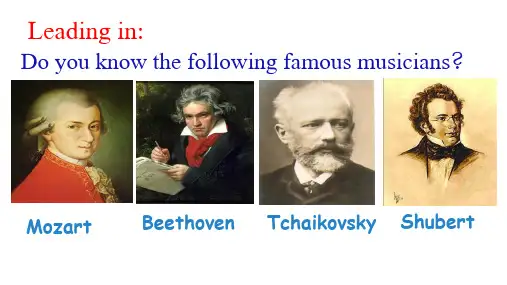
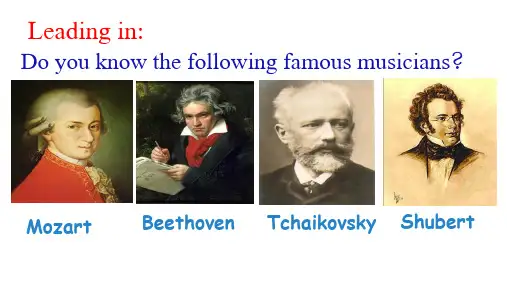
Leading in:
Do you know the following famous musicians?
北师大版英语必修二 Unit 5 Lesson 3 Experiment in folk(共21张PPT)
Describe the following picture using the given words.
because /since
Since his music style was new, he decided his hairstyle had to be new too.
(2)He is called a pioneer in music today.
Discussion:
1.Why could he make such great achievements?
His strict mum’s help His own talent His hard work His consistence
His creativity and love for our culture
2.What should we do?
We should be hard-working . No matter how much difficulty we will meet, we should be consistent. We shouldn’t be content with our own achievement . Be creative. Keep on trying new things . Above all, we should love our own country and treasure our culture and bring it to the rest of the world.
Careful reading:
Para1﹠Para3﹠4 Experiment ﹠reason
1.What was his new experiment in music? How about his fans’ reaction? He gave a concert combining classical music with Chinese folk music,which surprised his fans.
北师大版高中英语 Module 2 unit 5 lesson 3 Experiment in Folk教学课件 (共16张PPT)
Rule:
We can introduce a clause which explains the
more
_c_a_u_s_e_____ of a certain action or situation with
2. He came to help us ___ he had plenty of work to do.
A. as B. while C★. although D. whenever
3. ___ the earth is round, why do we not fall off?
A. Though B★. Since C. For D. Because
• He told us such funny stories that we all laughed.
Rule:
We can introduce a clause which describes the
__re_s_u__lt____ of a certain action with _s_o__+_a_d_j_. _+_a__+_
_f_o_r_f_e_a_r_t_h_a_t_______. In the clause we always use
a __m__o_d_a_l _v_e_rb____, like can, could, may, et.
9
Adverbial of pu as to arrive there before ten o’clock.
Module 2 unit 5
Lesson 3 Experiment in Folk
北师大版高中英语Module2unit5lesson3ExperimentinFolk教学课件
result
so + adj. + a +
noun + that such + a + adj. + noun + that
such + adj. + noun (pl. / u) + that
8
back
Adverbial clause of purpose
purpose
so that in order that in case
第五页
5
Adverbial clause of cause
more
cause
because
as
since
6
AAddvveerrbbiiaall ooff ccaauussee
cause
because of owing to
due to
7
thanks to
back
Adverbial clause of result
3. Scan for the key words provided.
4. Go over the questions.
5. Let’s go!
6. Vocabulary.
第四页
4
Teaching aims
Key words Reading skills Grammar Adverbial clause of cause Adverbial clause of result Adverbial clause of purpose Practice
4. Though he is over sixty, ___ he works as hard as a young man.
英语:Unit5lesson3experimentinfolk教案(北师大版模块2)
英语:Unit5lesson3experimentinfolk教案(北师大版模块2)Lesson3 Experiment in Folk 教案Teaching objectives1. To practise the vocabulary relating to music.2. To read and understand a newspaper article.3. To express opinions and give reasons for them.4. To practise using adverbial clauses of cause, result and purpose with because, as, since, so that and so/such…that.5. To distinguish between so…that and so that and practise using them correctly.Teaching difficult points1.seeking information about the newspaper article2.Learning adverbial c lausesTeaching procedures:Step 1 Leading inBrief introduction to Kong Xiangdong.1.ask students whether they know anything about Kong Xiangdong.2.Then teacher will say something around the following pictures.Step 2 SkimmingRead the text and answer these questions1.What kind of music is Kong Xiangdong most famous for?He is famous for classical music.2.What did Kong achieve in 1986?He became the youngest prize winner in Moscow’s T chaik ovsky International Competition. 3.Why did Kong shave off his hair?He shaved off his hair to show that his music style was new, just like his new hairstyle.Step 3 SkanningTrue of false statements( )1.As famous pianist, Kong surprised his fans by giving a concert of Chinese folk music yesterday. ( )2.After playing pop music for years, Kong felt the needs to be different from other musicians. ( )3.When he was 18, he got his first international prize in America.( )4.Kong decided to rediscovered the beauty in Chinese classical music.( )5.Kong wants to play Chinese folk music so as to be popular among Chinese.( )6.Kong’ mother was a great music lover.Step 4 Post-ReadingFilling the missing words accor ding to the text.1.The famous _____ pianist ,Kong Xiang dong ,surprised his fans last week by giving a concert ____classical music ____Chinese folk music.2.Music has always been ____ of Kong’s world. As his mother was a great music ____,he lived with music from his_____.3.Because of Kong’s ____ and hard work, he became famous______.4. Whether Kong _____ his appearance or transforming his music, he is a_____ in music today. Step 5 DiscussionTalk something about Kong Xiangdong .For example:What do you think of him?Why can he achieve co much?What can they learn from him?Step 6 Language points1. Which type of concer t would you prefer to go to, classical or Chinese folk music? prefer (v.)--choose sth. rather than sth else. like sth. better (preferred)1) I prefer tea.2) I prefer to walk there.3) He prefers making speeches after careful preparation.4) Mike preferred her not to come.5) Would you prefer that I come on Friday instead of Monday?6) I prefer the town to the country.7) While he was in the office, he preferred doing sth. to doing nothing.8) He prefers to walk there rather than go by bus.(prefer to do sth. rather than do sth.)。
Unit 5 Lesson 3 Experiment in folk 教案 北师大版必修2
北师大版高一英语Module 2 Unit 5 Lesson 3 教案Lesson 3 Experiment in folkTeaching aims:To practice using adverbial clauses of cause, result and purpose with because, as, since, so that and so/suc h…that.To express opinions and give reasons for themTeaching difficulties:To practice using adverbial clauses of cause, result and purpose with because, as, since, so that and so/suc h…that.Teaching Aids: computer and cassetteTeaching procedures:Ⅰ. Warming upListen to some music including piano, flute, violin, jazz and so on. T: “How do you find the music you just listen to?” “What kind of music do you like?”S:T: just now some students said they liked piano, another said they liked traditional Chinese music, do you have an idea that we combine western music with traditional Chinese folk?S:T: In fact a musician has such an idea. He is Kong Xiangdong,-- a pianist. Have you heard of him?S:T: Today we will read an article about music, the title is “Experiment in Folk”Ⅱ ReadingNow read the text and let’s see what’s the matter.After reading the text, show a picture of Kong Xiangdong, give a brief profile:A famous Chinese man in the music world, one of the most famous pianists in the world. He has performed in more than 40 countries and has won numerous prize. He combine western music and folk music well. How much do you understand the text and answer the following questionsDo the exercise 2Do the exercise correct errors1. Playing the same music in different cities of the world are very boring.2. The concert last week was such a success he had to give another two concerts.3. Because Kong’s talent and hard work, he become famous worldwide.4. He was made to practise the piano so much that, at time, he thought about giving up.5. He gave a concert combine classical music with Chinese folk music.6. This is why he went back his roots and study Chinese folk music.7. He didn’t quit, he became a great pianist.Answers: 1. are改为is 2. success 后加that 3. Because 后面加of 4. time改为times 5. combine 改为combined 6. back 后加to 7. he前加andⅢ Language points1. combine… with … “把… 与…结合”Diets are most effective when combined with exercise.节食与运动相结合才会更有效。