
英语人教版八年级下册unit6SectionA教学设计
Unit 6 An old man tried to move the mountains.Period One Section A(1a-2d)I. Teaching Goals:nguage goals:(1)Words &expressions:Be able to use the words and phrases:shoot, stone, weak, god, remind, silly,once upon a time, a little bit, instead of(2)Grammar:❖Be able to use conjunctions such as “as soon as, so...that...,unless” to tell a story❖Be able to use “how, what, who, why”etc.to ask about a story.(3)Structure::❖How does the story begin?❖Once upon a time, there was a very old man...❖What happened next?❖As soon as the man finished talking, Yu Gong said that his family could continue to move the mountains after he died.❖Why was Yu Gong trying to move the mountains?❖Because they were so big that it took a long time to walk to the other side2.Ability goals:By learning, Ss can tell a story in English, using the target language.3.Moral goals:By learning the story of Yu Gong, Ss are expected to realize that nothing is impossible if we have enough determination and perseverance.II. Teaching Importance1. To understand and ask about how the story goes on.2. To have Ss tell a story and use the conjunctions properly while telling.III. Teaching Difficulties:To enable Ss to tell Chinese legends or stories and give some opinions.in EnglishIV. Teaching Methods:Audio-visual Method; Task-based Teaching Method;; Communicative Method.V. Teaching Aids: CAI, PPTVI. Teaching Strategies: Summarize the stories according to the conversationVII. Teaching Procedure:Play a music video called Yu Gong Moved the Mountains by Jiang Tao.Ask “Have you heard of this song before?”and tell Ss that it sings about an ancient Chinese traditional story. Ask who knows the name of it and then present the language goal in Unit 6: Tell a story.1. T: In Section A, we’ll learn about some famous Chinese traditional stories. Can you guess what stories these are? Look at the screen and guess.Divide the class into two teams. A and B.Present a picture of a story little by little on the screen until one team correctly calls out the name of the story in English or Chinese, e.g. “Hou Yi Shoots the Suns”. Show the story title on the screen ask “Who is the main character in each story?”Give this team a point and then continue the game the same way one after another.2.Work on 1aSs read the story titles and match them with the pictures in 1a, then check the answers. Make sure that Ss can understand the new word “shoot”.Journey to the West b Yu Gong Moves a Mountain dHou Yi Shoots the Suns a Nu Wa Repairs the Sky cTask 3: Listening (3 mins)1.T tells Ss that Anna and Wang Ming are talking about a story and ask Ss to listen the conversation once and find out which story it is. Ss who get the answer may raise hands.2.Play the recording once more, Ss listen and check the facts they hear.3.Check the answers.√The two mountains were very high and big.√ A very old man tried to move the mountains.A man told Yu Gong that he could never do it.Task 4: Discussing (5 mins)Work on 1c1.T: Now Let’s discuss these questions in the box.(Have Ss read the questions, make sure that they understand each question.)2.Ss discuss the questions in pairs, they can use the tapescripts on P103 for help.(While Ss are discussing, show the useful expressions on the screen to offer tips)once upon a time; there was/were ; so... that....3.Have some pairs volunteer to ask and answer the questions.4.Task 5: ListeningWork on 2a (4 mins)1.Pre-listening.Show the pictures in 2a. Say”These pictures show how the story of Yu Gong went on, but they are in the wrong order.What happened in each picture?”( Ss can volunteer to say something about the pictures ) After that , have Ss try to number the picturesaccording to what they think the story should be like.2.While listening:Say “Let’s continue to listen to this story. Listen to Wang Ming carefully.”Play the recording, Ss listen and check if their guessings in advance are right or wrong.3.After listeningCheck the answers in class.Work on 2b (6 mins)(Listen for specific items in conversations.)1. Pre-listeningBefore listening, have Ss read each sentence and explain some difficult sentences (e.g. “as soon as, remind and unless”)for Ss to make sure that they understand them. And then Ss predict and underline the answers they think will be correct.2.While listeningPlay the recording again and Ss circle the words they6 hear.3.After listeningReview the correct answers by reading the whole sentence with the class,and have Ss raise their hands if they predicted the answers correctly in advance.Task 6: Look and talk (8mins)1.T: Well, Wang Ming told us the story of Yu Gong today. Can you try to tell this story as him? Just do it . Let’s say “YES, I CAN.”(The whole class say “YES, I CAN.”loudly.2.T shows all the pictures about the story in order.Ss look at the pictures and try to tell the story in their own words.Remind them using the information in 1b and 2b. Ss can also use the tapescripts for help 3.Ask individuals to retell the whole story one after another.Task 7: Role-play (10 mins)Work on 2d1.T: Thanks for telling us the famous story. Well, what do you think we can learn from this story or the character Yu Gong?Then ask for some personal opinions about the story.After this, T may say “Wow! you have so many different ideas about the story. Why don’t we listen to other people’s opinions about it ?”2.Pay Ss’ attention to 2d and Show the following chart to Ss . Ask Ss to listen to the conversation and underline the correct information to completer the chart.Then check the answers by asking individuals to answer.3.Let Ss read after the teacher and find some verb phrases that they have learned.E.g: try to do sth, keep doing sth, give up, agree with sbThen have Ss find the new expressions and try to explain how to use them. E.g:✧I think it’s a little bit silly.a little bit (= a little) + 形容词或副词时,表示“一点儿”✧But what could Yu Gong do instead of moving the mountains?instead of 是复合介词,后接名词、代词、动词的-ing形式或介词短语等,意为“代替,作为……的替换”。
八下英语 第六单元 Unit6 SectionA3a-3c教学设计

Unit 6 An old man tried to move the mountains.Section A (3a-3c)一、学习目标【知识目标】掌握重要单词短语句型及语法内容。
【能力目标】1.学会对角色进行描述。
2.学会在阅读中提取信息。
【情感目标】培养学生的正义感,责任感,使命感,对中国传统文化的自豪感。
二、教学重点:1.单词、短语: called, be able to, turn into, hide, tail, magic, stick,come out, western, become interested in...2.句型:1)Unless he can hide his tail, he cannot...2)To fight bad people, the Monkey King...3)And as soon as the TV program came out 30 years ago, Western children...3.语法:unless 引导的条件状语从句,不定式做目的状语,because 引导的表语从句。
三、教学难点:学习掌握单词,词汇,短语并灵活运用。
学会在阅读中准确提取有用信息。
四、教学过程:Step1.warming-up1.Listen to the music and look at the pictures.2.Try to answer the questions.1)Who are they?2)Which character do you like best?3.Let’s watch a video about the Monkey King.Step2.Listening part1.Listen and answer the questions.(Listen to 3a)1). Which book is talked about?2). Who is the main character?3). What is he like?T: Let’s check the answers.3.T: Nowadays, we can see all kinds of Monkey Kings.(Show pictures of different Monkey Kings)Step3.Reading part1.Read the passage and complete the chart about the Monkey King.1)What he can do...2)What he cannot do...2.T:Read the passage, I’ll analyze it for you.(Explain important language points)plete the sentences below in 3c with phrases from the passage.1)Journey to the West is a ___________ Chinese book. It tells one of the most popular stories in China.2)When the English TV program Monkey _________ in 1979, Western children __________________________ this wonderful story.3)The Monkey King can ________________ to his body. He is able to ________________ different animals and objects.4)The Monkey King ________________ make his magic stick small or large.Step4.Practicing part1. Choose the correct words.1) Four years later, Laura gave _____ to a son.2) They want to ____ the old houses into a hotel.3) England lies to the _______ part of Europe.4) She broke her ______ mirror into pieces.5) Dogs wag their ____ when they’re pleased.6) Don’t ____ behind the door. It’s not safe.2. Fill in the blanks.1) A neighbor _____ (call) Tony, helped me repair my fence yesterday.2)The Monkey King can make 72 _______ (change) to his shape and size.3)His uncle isn’t interested in _______ (play) chess at all.4)The two boys kept ______ (skate) for one hour.5)No one ____ (be) able to answer him at that time.Step5.Extension partT:I think the reason so many people love this monkey king is that he is always ready to help the weak and never gives up.Step6.Homework1.Make sentences with these words:be able to; make 72 changes, turn…into; so…that; came out; become interested in; keep doing sth.2. Draw a mind map and try to recite the passage.。
人教版英语八年级下册Unit6_Section A (3a~4c)教案与反思

Section A 第二课时(3a~4c)物以类聚,人以群分。
《易经》原创不容易,【关注】店铺,不迷路!类别学习重点重点单词object,agic,stick,excite,Western,fit,couple,smile,marry重点短语forte,infact,turn…into,comeout,becomeinterestedin,onceuponatime,fallinlove,getmarried重点句式1.SometimesaketallteinterestedinreadingtonkeyKingkeepsfightingtohelpth eweakandnevergivesup.课前预习写一写1.物体;物品object2.隐藏;隐蔽agic6.使激动;使兴奋excite7.西方国家的;西方的western8.适合;合身fit9.夫妻;两人couple10.笑;微笑smile11.结婚marry译一译1.能beableto2.第一次forte3.事实上infact4.把……变成turn…into5.出来;出版;开放comeout6.对……感兴趣be/becomeinterestedin7.从前onceuponatime8.爱上;喜欢上fallinlove9.结婚getmarried背一背1.有时他能将金箍棒变得如此之小以至于他能把它放到耳朵里。
SometimesaketallteinterestedinreadingtonkeyKingkeepsfightingtohelpt heweakandnevergivesup.新课导入TeaccalledJourneytotsuretousc?W?Canyousaysomet? LetsomeoftethingaboutJourneytotheWest.新课展示【完成教材3a~3c的任务】1.快速阅读短文,找出方框中的3个问题的答案,完成后让学生展示答案,教师点拨。
人教版八年级英语下册Unit6SectionAGrammarFocus4c优秀教学案例

最后,我会布置一个作业来让学生巩固所学的知识。我会让学生写一个小短文,用一般过去时被动语态来描述昨天发生的事情。这样既可以让学生运用所学的知识,又可以提高他们的写作能力。在作业布置后,我会对学生的学习情况进行总结,对他们的进步给予肯定,并提出一些改进的建议。通过这样的教学内容与过程,我希望能够帮助学生扎实掌握一般过去时被动语态的用法,提高他们的英语水平。
(四)反思与评价
1.学生自我评价:学生对自己的学习过程进行反思,总结收获,找出不足,制定改进措施。
2.同伴评价:学生相互评价,给予意见和建议,共同提高。
3.教师评价:教师对学生的学习过程和成果进行评价,关注学生的进步,给予鼓励和指导。
在教学过程中,我将注重学生的反思与评价,让他们在总结经验、发现不足的过程中不断提高。同时,我会给予学生及时的反馈,关心他们的成长,激发他们的学习动力。通过反思与评价,学生能够更好地认识自己的学习情况,提高学习效果。
人教版八年级英语下册Unit6SectionAGrammarFocus4c优秀教学案例
一、案例背景
本案例背景基于人教版八年级英语下册Unit 6 Section A Grammar Focus 4c的内容。本节课的主题是关于一般过去时的被动语态。通过学习,学生能够理解并运用一般过去时的被动语态来描述过去发生的事情。在教学过程中,我采用了任务型教学法和交际式教学法,旨在提高学生的语言运用能力和合作意识。
为了巩固所学,我在课后布置了相关的练习任务,要求学生运用一般过去时被动语态进行创作。通过这样的教学设计,我希望学生能够在实践中不断提高自己的英语水平,养成良好的学习习惯。
二、教学目标
(一)知识与技能
1.学生能够理解并掌握一般过去时的被动语态结构,即“was/were +过去分词”。
初中英语八年级下册教案unit6Section A 第1课时 (1a~2d)
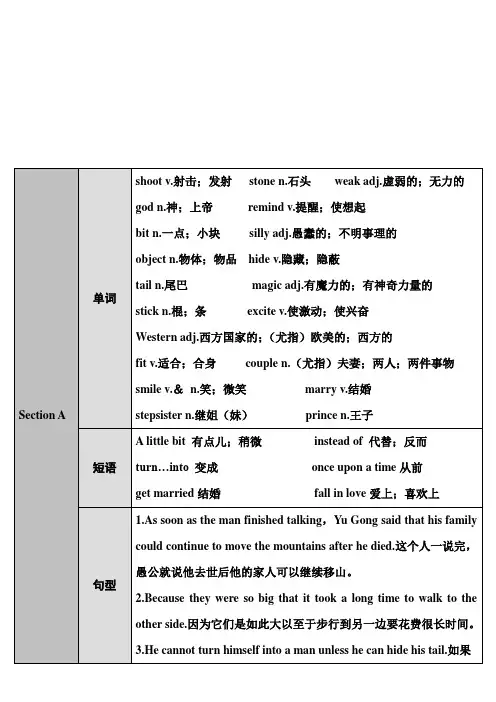
句型1.Tonight,when the moon is shining bright,we’ll be able to see the stones.今晚,当月光明亮地照耀着大地时,我们就能看见这些石头了。
2.As soon as you wake up,you must go to the forest with your father.你们一醒就必须和你们的父亲去森林。
3.It’s leading us to that wonderful house made of bread,cake and candy.它正把我们带向一座由面包、蛋糕和糖果组成的漂亮房子里去。
语法连词unless, as soon as和so… that的用法知识目标掌握并能灵活运用本单元的重点词汇及相关短语,能够正确掌握并运用连词unless,as soon as和so…that的用法。
能力目标能够从时间,地点,人物及事件等方面描述英文故事。
情感目标通过一些经典故事,学会乐于助人,主动地去帮助处于困境中的人们;在生活中,当面对困难抉择时,要勇敢地面对一切,决不放弃。
【课时建议】本单元建议5课时Section A (1a~2d)………………………………………………………………………………………1课时Section A (3a~4c)……………………………………………………………………………………1课时Section B (1a~1d)……………………………………………………………………………………1课时Section B (2a~2e)……………………………………………………………………………………1课时Section B (3a~3b)……………………………………………………………………………………1课时词汇短语:主要采用图片及多媒体展示助记法。
基本句子:采用多媒体展示及交际法(利用多媒体展示两人进行交际时的情景)。
人教八年级下册Unit6SectionA(3a3c)教学设计

3.课堂活动:设计丰富多样的力。
教学策略:结合教材内容,设计不同类型的练习题,让学生在活动中巩固所学知识,提高语言技能。
4.个性化教学:关注学生的个体差异,给予每个学生个性化的指导和帮助。
三、教学重难点和教学设想
(一)教学重难点
1.重点:本节课的重点在于学生对一般将来时态的掌握,以及运用该时态描述未来计划和行动。同时,新词汇和短语的识记、理解和运用也是教学的重点。
难点:如何引导学生在实际场景中灵活运用一般将来时态,以及如何帮助学生在交流中准确使用新词汇和短语。
2.重点:培养学生通过听力、口语、阅读等多种途径获取信息,提高其综合语言运用能力。
(二)过程与方法
1.通过小组合作、讨论等形式,让学生在互动中学习,培养其团队协作能力和解决问题的能力。
2.运用多媒体教学资源,如图片、视频等,创设真实语境,帮助学生理解和记忆目标词汇和句型,提高学生的学习兴趣和积极性。
3.引导学生通过听力、口语、阅读等多种方式获取信息,培养其综合语言运用能力。
(三)情感态度与价值观
3.交流展示:各小组展示旅行计划,组内成员用目标句型进行汇报,如:“I will visit my aunt and go shopping.”
(四)课堂练习
1.听力练习:教师播放3c部分的听力材料,学生听后完成相应的练习,巩固一般将来时态的用法。
2.口语练习:学生两人一组,根据3c部分的提示,进行角色扮演,模拟旅行场景,练习目标句型。
3.鼓励学生互相分享、交流作业成果,互相学习,共同进步。
4.家长应积极配合,关注孩子的学习进度,共同参与孩子的学习过程。
人教版英语八年级下册Unit6SectionA1a~2d教学设计
为了巩固本章节所学知识,提高学生的英语综合运用能力,特布置以下作业:
1.书面作业:
(1)完成课本练习册中与本节课相关的练习,如语法填空、翻译等,以巩固词汇和句型。
(2)根据本节课学习的家庭成员和日常生活习惯,编写一段对话,运用一般现在时态描述。
2.口语作业:
(1)与家人或朋友进行英语对话,互相介绍家庭成员的日常生活习惯和性格特点,并尝试运用新学的词汇和句型。
示例问题:
- Can you tell me something about your family members?
- How do you describe what your family members usually do using the simple present tense?
2.教学资源运用:利用多媒体展示一些家庭场景的图片,让学生观察并描述图片中的家庭成员及其行为。
2.培养学生积极向上的生活态度,学会珍惜时间,养成良好的生活习惯。
3.增强学生的团队合作意识,学会在小组合作中互相尊重、互相学习。
4.培养学生的责任感和使命感,认识到自己作为家庭成员应尽的责任,为家庭和谐贡献力量。
二、学情分析
八年级下册的学生已经具备了一定的英语基础,他们已经掌握了基本的词汇、语法和句型,能够进行简单的日常交流。在此基础上,针对本章节的内容,学情分析如下:
2.能够运用一般现在时态描述家庭成员的日常行为习惯及其性格特点,提高语言表达能力。
3.通过听力训练,提高获取关键信息的能力,培养良好的听力技巧。
4.学会在对话中运用目标词汇和句型,进行真实情境下的口语交流。
(二)过程与方法
在本章节的学习过程中,学生将通过以下方法提升英语能力:
人教版英语八年级(下)Unit6SectionA(1a-1c)教案设计
初中英语八年级下册Unit 6 SectionA (1a—1c)教学设计1.教学目标1.知识与技能:让学生学会用英语讲述一个故事。
2.过程与方法:通过复述故事,让学生学会掌握一个故事的细节和人物,并能利用目标语言讲述一个传说或故事。
3.情感、态度与价值观:教育学生在生活中不怕困难,培养他们不言放弃的精神。
2.学情分析1. 八年级的学生积累了一定的词汇量,也学过过去时态,对于本课内容的理解并不难。
但在叙述故事过程中有大量的复杂句,对于长句子的理解、复述和表达成为本课难点。
所以对于部分使用率高的复杂句,利用课件中大量的图片进行练习,让学生掌握扎实。
2. 本班学生两极分化严重,后面的学生基础非常薄弱,且对英语学习兴趣不高,他们在本课学习上会有很大的困难。
所以本课我使用了大量的图片、视频提升学生兴趣,帮助他们首先理解授课内容,反复练习达到基本上口的目标,然后充分发挥思维导图的优势帮助他们学习讲述故事。
小步子,快节奏,低台阶,层次强的授课模式来激发学生的兴趣,增强学习英语的自信,训练能力的提升。
3.重点难点教学重点:学习讲述故事中的人物和相关细节。
教学难点:学习本课时的目标语言,能用自己的语言讲述一个故事。
教学过程第一学时教学活动活动1【导入】创设情景Step1 Warmig up(1)Free talk&enjoy a story named a wolf is coming .1. Do you like stories?2. What kind of stories do you like? (老师可以鼓励学生给出尽可能多的答案)教学设计说明:通过自由讨论故事,欣赏动画故事,承上启下,引出本单元话题。
活动2【讲授】呈现新课Step 2. Presentation(呈现新知识)1.Present the new words :stoone shoot2.Present the name of the story with the picture(教师用同样的方法教授其它故事的名字:1)Journey to the West2)Yu Gong Moves a Mountain3)Hou Yi Shoots the Sun4)Nu Wa Repairs the Sky教学设计说明:教师利用对图片的讨论和问答教授四个故事的名字,形象生动,且能了解故事概要。
人教新目标版八年级英语下册unit6SectionA(1a2d)教学设计
5.口语表达:设计角色扮演、小组讨论等活动,鼓励学生运用所学时态表达个人经历和感受,提高口语表达能力。
6.写作实践:让学生根据课堂所学,撰写一篇关于自己或他人梦想的小短文,运用一般过去时和现在完成时,巩固所学知识。
2.过程与方法方面:重点在于培养学生的听力策略,如预测、关键词识别等,以提高学生在实际语境中的听力理解能力。难点在于如何引导学生有效地运用阅读策略,如扫读和精读,以快速获取文章主旨和细节信息。
3.情感态度与价值观方面:重点在于激发学生对梦想的追求,并培养学生面对困难时的积极态度。难点在于如何通过教学活动,让学生内化这些价值观,并将其转化为实际行动。
2.学生能够理解并运用一般过去时和现在完成时描述过去发生的事情,以及过去的事情对现在造成的影响。
3.学生能够通过听力训练,提高获取关键信息的能力,如:理解人物的经历、梦想和成就等。
4.学生能够在阅读过程中,运用阅读策略(如:预测、扫读、精读等)获取文章大意,提高阅读理解能力。
(二)过程与方法
1.通过小组合作、讨论、分享等形式,培养学生合作学习的能力和口语表达能力。
4.学生互相批改作文,分享优秀作品,教师给予点评和指导。
(五)总结归纳(500字)
1.教师引导学生回顾本节课所学内容,总结一般过去时和现在完成时的用法。
2.学生分享学习心得,讨论如何将所学知识应用到实际生活中。
3.教师强调梦想的重要性,鼓励学生为实现梦想而努力奋斗,面对困难时保持积极态度。
4.教师布置课后作业,要求学生运用所学知识,撰写一篇关于梦想的短文,巩固课堂所学。
人教版英语八年级下册Unit6SectionA3a3c优秀教学案例
一、案例背景
本案例背景以人教版英语八年级下册Unit 6 Section A 3a 3c为例,本节课主要围绕“Will people have robots in the future?”这一主题展开。通过阅读短文,学生能够了解未来社会中机器人的应用前景,提高他们的阅读理解能力。同时,通过本节课的学习,学生能够运用所学知识进行情景交际,提高他们的语言运用能力。
4.教师利用多媒体课件、网络资源等现代教育技术,为学生提供丰富的学习材料,帮助学生更好地理解和掌握知识。
(三)学生小组讨论
1.教师将学生分成小组,每组选择一个特定的话题,如医疗、教育、交通等,讨论未来机器人在该领域的应用前景。
2.每个小组选择代表,向全班同学分享他们的讨论成果,其他同学可以提出问题或给予评价。
3.教师引导学生进行小组内讨论,鼓励他们发表自己的观点,培养他们的团队合作意识和沟通能力。
(四)总结归纳
1.教师引导学生总结本节课所学的知识,如重点词汇、句型和情景交际等。
2.教师强调本节课的重点和难点,提醒学生注意掌握。
3.教师针对学生的讨论成果,进行总结归纳,提炼出未来机器人应用前景的共性和特点。
(五)作业小结
1.教师布置作业,要求学生运用所学知识进行情景交际,如设计一个机器人,编写一个关于机器人的故事等。
2.教师提醒学生在完成作业的过程中,注意运用本节课所学的词汇和句型。
3.教师鼓励学生在课后进行自主学习,查找相关资料,拓宽自己的知识视野。
4.教师对学生的课堂表现和学习成果进行评价,给予鼓励和建议,为学生的后续学习提供指导。
(二)讲授新知
1.教师引导学生通过阅读短文,理解并掌握文章的主旨大意。
八年级英语下册Unit 6 Section A教学设计
Unit 6 Section A 1a-1c教学设计Knowledge aims:1. Words and phrases: shoot, remind, once upon a time, as soon as, so…that2. Expressions:The story reminds us that you can never know what’s possible unless you try to make it happen. Once upon a time, there was / were…Ability aims:1. The students can get the general ideas of the story by listening.2.To improve the students’ listening and speaking abilities.3. To train the students’ ability of retelling the story.Emotional aims: You can never know what’s possible unless you try to make it happen.※教学重难点※Teaching important points: How to retell a story and how to use the conjunctions.Teaching difficult points: How to make the familiar Chinese story in English.※教学准备※Teaching aids※教学过程设计※Step 1 warming up1. Show some pictures of the Chinese story.2. 1a. Students enjoy the pictures and say the names of the four pictures in 1a.Step 2 Presentation & talk1. Show on the screen some pictures about Yu Gong .Students talk something about Yu Gong.Eg. Yu Gong was born in the Western Zhou Dynasty.2. The reason why Yu Gong wanted to move the mountains was that there were two big mountains near his house and they were so big and high that it took a long time to walk to the other side. Step 3 Listening (1b)1. Get the students to listen and check the facts they hear.2. Listen again and check the answer.Step 4 Discussion (1c)Discuss the questions in pairs first, then ask some pairs to make dialogues by asking and answering.Step 5 ExerciseStep 6 HomeworkR etell the story of “Yu Gong Moves a Mountain”.。