
2016初中英语语法归纳 人教版初中英语八年级下册英语各单元重点短语句型及语法归纳总结
2016初中英语语法归纳2015-2016学年人教版初中英语八年级下册英语各单元重点短语、句型及语法归纳总结【精品】导读:就爱阅读网友为您分享以下“2015-2016学年人教版初中英语八年级下册英语各单元重点短语、句型及语法归纳总结【精品】”资讯,希望对您有所帮助,感谢您对的支持!2015-2016学年人教版初中英语八年级下册英语各单元重点短语、句型及语法归纳总结Unit 1 What’s the matter?一、重点短语1. have a fever 发烧23. make a decision 做出决定2. have a cough 咳嗽24. without thinking twice 没有多想3. have a toothache 牙疼25. get off 下车4. talk too much 说得太多26. have a heart problem 有心脏病5. drink enough water 喝足够的水27. to one’s surprise 使....... 惊京讶的6. have a cold 受凉;感冒28. thanks to 多亏了;由于7. have a stomachache 胃疼29. in time 及时8. have a sore back 背疼30. save a life 挽救生命9. have a sore throat 喉咙痛31. get into trouble 造成麻烦10. lie down and rest 躺下来休息32. right away 立刻;马上11. so that 以便33. because of 由于12. see a dentist 看牙医34. get out of 离开;从……出萍13. get an X-ray 拍X 光片35. hurt oneself 受伤14. take one’s temperature 量体温36. take risks 冒险15. give up 放弃37. fall down 摔倒16. keep on doing sth. 坚持做某事38. feel sick 感到恶心/感到不舒服17. sound like 听起来像39. have a nosebleed 流鼻血18. run out (of) 用完; 用尽40. so. . . that 如此… …以至于…19. in the same way 以同样的方式41. have problemsbreathing 呼吸困难20. be used to doing sth. 习惯做某事42. be in control of 掌管;管理21. go along 沿着……走二、重点句型1. What’s the matter with you? / What’s wrong with you? 你怎么了?2. What should she do? 她该怎么办呢?→ 主语+ should/shouldn’t + 动词原形. .. ①You should lie down and rest. 你应该躺下休息一会儿。
②You shouldn’t go out at night. 你晚上不应该出去。
3. Do you think it comes from a newspaper or a book?你认为它是来自报纸还是书呢?4. I think I sat in the same way for too long without moving. 我想我以同样的姿势一动不动地坐得太久了。
5. She said that the man had a heart problem and should go to the hospital三、重点语法11. have在涉及健康问题的句子中的应用。
2. 情态动词should和shouldn’t表“建议”、“提议”或“请求”等。
3. 反身代词。
4. see sb. doing sth.表示“看到某人正在从事某事或正处于某种状态”see sb. do sth (注:不定式不必带to)表示“看见某人/某物做完某事”5. thanks to sb./sth.表示“多亏;因为;由于”。
Unit 2 I ’ll help to clean up the city parks.一、重点短语1. Clean-Up Day 清洁日16. put up 建造;举起;张贴2. an old people’s home 养老院17. hand out 分发;散发;发给3. help out with sth. 帮助解决困难18. call up 打电话;召集4. used to 曾经… … ;过去19. put off 推迟;延迟5. care for 关心;照顾20. for example 比如;例如6. the look of joy 快乐的表情21. raise money 筹钱;募捐7. at the age of 在......岁时22. take after 与......相像;像8. clean up 打扫(或清除)干净23. give away 赠送;捐赠9. cheer up (使)变得更高兴;振雀24. fix up 修理;修补;解决10. give out 分发; 散发25. be similar to 与……相似11. come up with 想出;提出26. set up 建立;设立12. make a plan 制订计划27. disabled people 残疾人13. make some notices 做些公告牌28. make a difference 影响;有作用14. try out 试用;试行29. be able to 能够15. work for 为…工作;为…. 效力30. after-school reading program课外阅读项目二、重点句型1. The boy could这个男孩可以在食品救济站分发食物。
2. Clean-Up Day is only two weeks from now. 清洁日离现在仅仅两周的时间。
3. He volunteers at an animal hospital every Saturday morning.每周六上午,他都在一’家动物医院当志愿者。
4. Last year, she decided 去年,她决定去参加一个课外阅读项目的志愿者的选拔。
5. I want to 我想把我在动物医院工作的计划推迟到明年夏天。
7. Most people today are only worried about getting good jobs to make lots of money. 现在的大部分人只是为找一份能挣许多钱的好工作而着急。
8. You helped to make it possible for me 在你的帮助下,我才有可能拥有“幸运儿”。
三、重点语法21. 动词不定式作宾语;状语和宾语补足语。
2. 情态动词could表建议的用法。
3. 动词短语。
Unit 3 Could you please clean your room?一、重点短语1. go out for dinner 出去吃饭23. do house work 做家务2. stay out late 在外面待到很晚24. shout back 大声回应3. go to the movies 去看电影25. enough stress足够的压力4. get a ride 搭车26. share the housework 分担家务5. work on 从事27. look after/take care of 照顾;照看6. finish doing sth. 完成做某事28. in surprise 惊讶地7. depend on依赖;依靠29. get something to drink 拿点喝的东西8. do the dishes 洗餐具30. in order to为了9. take out the rubbish 倒垃圾31. hang out 闲逛10. fold your/the clothes 叠衣服32. do one’s part in (doing ) sth.11. sweep the floor 扫地做某人分内的事12. make your/the bed 整理床铺33. lend sb. sth. 把某物借给某人14. no problem 没问题34. get good grades取得好成绩15. welcome sb. 欢迎某人35. hate to do sth. 讨厌做某事16. come home from work下班回家36. do chores 做杂务17. throw down 扔下37. help sb. do / with sth 帮助某人干某事18. a waste of time浪费时间38. mind doing sth. 介意做某事19. make sb. do sth. 使某人做某事39. buy some snacks买些小吃20. take sb. for a walk 带某人去散步40. go to the store去商店21. all the time 一直;总是41. invite sb. to a party邀请某人参加聚会22. all day/evening 整曰/夜二、重点句型1. Could you please…..do sth. ? / Could you please clean your room?2. I have to do some work. 我必须干些活。
3. Could I+ do sth. ? → Could I use your computer?4. She won’t be happy if she sees this mess.如果她看到这样乱七八糟的话,她会不高兴的。
5. For one week, she did not do any housework and neither did I.整整一周,她什么家务活都不干了,我也一样。
6. My mom came over as soon as I sat down in front of the TV .我一在电视机前坐下,我妈妈就过来了。
7. hate + ( to do/ doing) sth. → I hate to do chores.三、重点语法31. Could表礼貌的请求或者请求允许。
(word完整版)人教版英语八年级下册重点词组、句型及语法点汇总,文档
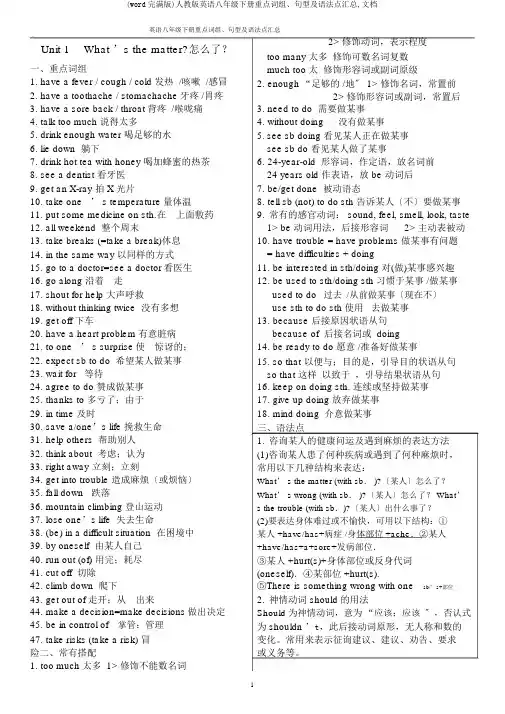
英语八年级下册重点词组、句型及语法点汇总Unit 1 What ’s the matter?怎么了?一、重点词组1. have a fever / cough / cold 发热 /咳嗽 /感冒2.have a toothache / stomachache牙疼 /胃疼3.have a sore back / throat背疼 /喉咙痛4.talk too much 说得太多5.drink enough water 喝足够的水6.lie down 躺下7.drink hot tea with honey 喝加蜂蜜的热茶8.see a dentist 看牙医9.get an X-ray 拍 X 光片10.take one ’ s temperature量体温11.put some medicine on sth.在上面敷药12.all weekend 整个周末13.take breaks (=take a break)休息14.in the same way 以同样的方式15.go to a doctor=see a doctor看医生16.go along 沿着走17.shout for help 大声呼救18.without thinking twice 没有多想19.get off 下车20.have a heart problem 有意脏病21.to one ’ s surprise使惊讶的;22.expect sb to do 希望某人做某事23.wait for 等待24.agree to do 赞成做某事25.thanks to 多亏了;由于29.in time 及时30.save a/one’s life 挽救生命31.help others 帮助别人32.think about 考虑;认为33.right away 立刻;立刻34.get into trouble 造成麻烦〔或烦恼〕35.fall down 跌落36.mountain climbing 登山运动37.lose one’s life 失去生命38.(be) in a difficult situation 在困境中39.by oneself 由某人自己40.run out (of) 用完;耗尽41.cut off 切除42.climb down 爬下43.get out of 走开;从出来44.make a decision=make decisions做出决定45. be in control of掌管;管理47.take risks (take a risk) 冒险二、常有搭配1.too much 太多 1> 修饰不能数名词2> 修饰动词,表示程度too many 太多修饰可数名词复数much too 太修饰形容词或副词原级2.enough “足够的 /地〞 1> 修饰名词,常置前2> 修饰形容词或副词,常置后3.need to do 需要做某事4. without doing没有做某事5.see sb doing 看见某人正在做某事see sb do 看见某人做了某事6.24-year-old 形容词,作定语,放名词前24 years old 作表语,放 be 动词后7.be/get done 被动语态8.tell sb (not) to do sth 告诉某人〔不〕要做某事9.常有的感官动词: sound, feel, smell, look, taste 1> be 动词用法,后接形容词2> 主动表被动10.have trouble = have problems 做某事有问题=have difficulties + doing11.be interested in sth/doing 对(做)某事感兴趣12.be used to sth/doing sth 习惯于某事 /做某事used to do过去/从前做某事〔现在不〕use sth to do sth 使用去做某事13.because 后接原因状语从句because of 后接名词或 doing14.be ready to do 愿意 /准备好做某事15.so that 以便与;目的是,引导目的状语从句so that 这样以致于,引导结果状语从句16.keep on doing sth. 连续或坚持做某事17.give up doing 放弃做某事18.mind doing 介意做某事三、语法点1.咨询某人的健康问运及遇到麻烦的表达方法(1)咨询某人患了何种疾病或遇到了何种麻烦时,常用以下几种结构来表达:What’ s the matter (with sb. )?〔某人〕怎么了?What’ s wrong (with sb. )?〔某人〕怎么了? What’s the trouble (with sb.)?〔某人〕出什么事了?(2)要表达身体难过或不愉快,可用以下结构:①某人 +have/has+病症 /身体部位 +ache.②某人+have/has+a+sore+发病部位.③某人 +hurt(s)+身体部位或反身代词(oneself).④某部位 +hurt(s).⑤There is something wrong with one sb/’s+部位2.神情动词 should 的用法Should 为神情动词,意为“应该;应该〞,否认式为 shouldn ’t,此后接动词原形,无人称和数的变化。
人教版八年级下册单元重点短语归纳总结(完整版)

人教版八年级下册单元重点短语归纳总结Unit 1have a cold感冒have the flu患流感What’s the matter? 出什么问题了?have a stomachache肚子痛lie down躺下take one’s temperature量体温take breaks休息take a rest休息一下get off下车get on上车to one’s surprise令某人吃惊的是right away立刻,马上get into… 陷入……be used to doing sth.习惯做某事take risks冒险run out (of…) 用完,用尽cut off切除get out of… 出来……be in control of… 控制……give up放弃cut oneself切到某人自己see a dentist看牙医sound like… 听起来像……have a fever发烧on the weekend在周末thanks to… 幸亏……fall down摔倒get sunburned晒伤by oneself独自一人mountain climbing爬山make a decision做决定Unit 2clean up大扫除cheer up使振奋起来;喝彩give out分发come up with… 提出……,想出……put off推迟,拖延hand out分发call up打电话used to… 过去常常……care for… 关爱……try out尝试fix up修理give away捐赠set up建立make a difference起作用make plans做计划help out帮助a strong feeling of satisfaction强烈的满足感at the age of… 在几岁的时候at the same time同时put up搭建;张贴be worried about… 担心……raise money筹钱take after… 长得像……run out of… 用完……,用尽……Unit 3take out the rubbish倒垃圾all the time一直,总是as soon as… 一……就……in order to… 为了……,目的是……depend on… 依赖……,依靠……take care of… 照顾……do the dishes洗碗sweep the floor拖地make the bed整理床铺fold the clothes叠衣服clean the living room打扫客厅get a ride骑行at least至少at most至多take the dog for a walk遛狗shout back吼回去walk away走开a waste of time浪费时间do chores做家务Unit 4What’s wrong? 出什么问题了?look through… 浏览……big deal大事情,大问题work out 解决,计算出get on with… 相处……cut out切掉compare…with… 把……与……比较in one’s opinion在某人看来call up打电话talk about sth. with sb. on the phone通过电话与某人交谈某事give back归还sit down坐下communicate with… 与……交谈be oneself做自己play sports做运动hang out with friends和朋友闲逛Unit 5go off(闹铃)响了pick up捡起,拾起,(开车去)接,接电话fall asleep熟睡die down逐渐变弱,逐渐消失have a look看一看make one’s way前往,费力地前进in silence 沉默,无声take down拆除,往下拽,记录at first首先wait for… 等待……in the neighborhood在附近make sure确保,确信Unit 6turn…into… 把……转变成……once upon a time很久以前fall in love (with…) 爱上(……)get married结婚lead to… 导致……be moved by… 被……感动give up放弃give in屈服get/be lost迷路,丢失wake up醒来Unit 7feel free(可以)随便(做某事)as far as I know据我所知take in… 吸收……,吸入……in the face of… 面对……even though(if)即使,虽然at birth出生时up to… 到达……,至多有……walk into… 走路时撞着……fall over绊倒or so大约in the world在世界上take care of… 照顾……,照料……a symbol of… ……的标志every two years每两年,每个一年cut down砍倒,消减Unit 8be full of… 充满……,填满……hurry up快点be filled with… 填满……,充满……science fiction科幻小说country music乡村音乐ever since自从one another相互used to do… 过去常常……come to realize… 逐渐意识到……belong to… 属于……Unit 9amusement park娱乐公园tea art茶艺thousands of… 数以千计的……all year round一整年on the one hand在一方面on the other hand在另外一方面three quarters四分之三in the past在过去the Great Wall万里长城in a rapid way以一种飞快的方式Unit 10give away捐赠in need处于需要中welcome to… 欢迎……no longer不再as for… 至于……to be honest说实话part with… 分开……even though/if即使millions of… 数以百万计的……according to… 根据……look for… 寻找……go back返回across from… 在……对面in one’s opinion在某人看来。
最全面人教版八年级下册英语各单元知识点总复习归纳总结
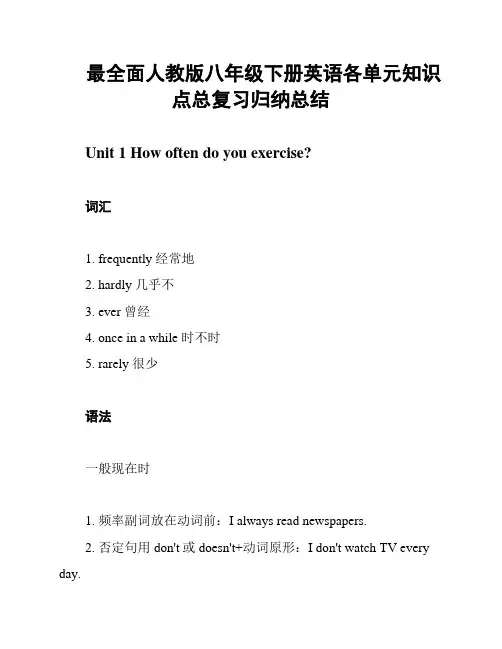
最全面人教版八年级下册英语各单元知识点总复习归纳总结Unit 1 How often do you exercise?词汇1. frequently 经常地2. hardly 几乎不3. ever 曾经4. once in a while 时不时5. rarely 很少语法一般现在时1. 频率副词放在动词前:I always read newspapers.2. 否定句用don't或doesn't+动词原形:I don't watch TV every day.3. 疑问句用do或does+主语+动词原形:Do you play soccer every week?Unit 2 I used to be afraid of the dark.词汇1. used to 过去常常2. get over 克服3. nervous 紧张的4. confident 有信心的5. stage 舞台语法1. Be used to+动名词表示惯或适应,I am used to studying English at night.2. Used to+动词原形表示过去常常,I used to read books every day.3. Get over+名词/代词/动名词,表示克服,She got over the flu last week.Unit 3 Could you please tell me where the restaurants are?词汇1. instruction 说明2. turn right/left 向右/左转3. excuse me 对不起4. straight 直走5. opposite 对面语法1. Could you please/could/may I+动词原形,请求礼貌地做事,Could you please help me with my English?2. Would like+名词 / 动名词,表示想要做某事,I would like to go shopping with you.3. May I ask+句子,礼貌地询问某事,May I ask where the restroom is?Unit 4 Why don't you talk to your parents?词汇1. conversation 对话2. listener 听众3. honest 诚实的4. conversation starter 聊天开场白5. effective 有效的语法1. How about/What about+动名词/名词,表示建议和提议,What about watching a movie?2. Why not+动词原形,表示建议和提议,Why not go swimming?3. Let's+动词原形,表示建议和提议,Let's have a party on the weekend.Unit 5 It must belong to Carla.词汇1. sweater 毛衣2. by accident 偶然地3. honest 诚实的4. lose 丢失5. owner 拥有者语法1. Can/Can't+动词原形,表示能力或可能性,I can dance.2. Must/Mustn't+动词原形,表示肯定或否定的推断,She must be the new teacher.3. Have/Has to+动词原形,表示必须做的事情,I have to finish my homework first.词汇1. graduate 毕业生2. physics 物理学3. ambitious 有抱负的4. career 职业5. education 教育语法一般将来时1. be going to+动词原形,表示打算做某事,I am going to see a film tonight.3. be + going to+现在进行时,表示不久会发生的事情,They are going to sing a song later.Unit 7 How do you make a banana milk shake?词汇1. recipe 食谱2. whip 打(奶油)3. peel 去皮4. slice 切片5. pour 倒语法1. What/How/Which+系动词+主语+谓语,表示特定的主语或具体的内容。
八年级下册英语各单元重点短语+句型语法 人教版

八年级下册英语各单元重点短语+句型语法人教版1. Unit 1Important phrases:- get to know: I want to get to know my new classmates.- make friends with: I hope to make friends with some local students.- be interested in: She is interested in learning a new language.- take part in: Are you going to take part in the school talent show?- show off: Don't show off in front of your friends.- be proud of: I am proud of my brother for winning the race.Sentence patterns and grammar:- Present continuous tense: He is playing football in the park.- Comparative adjectives: My sister is taller than me.- Superlative adjectives: This is the best pizza I've ever tasted.2. Unit 2Important phrases:- turn off: Don't forget to turn off the lights before you leave.- set off: We will set off for the beach early in the morning.- look forward to: I am looking forward to the schooltrip next week.- get along with: I get along with my classmates very well.- break down: Our car broke down on the way to the airport.- run out of: We ran out of milk, so I need to go to the store.Sentence patterns and grammar:- Past continuous tense: They were playing basketball when the rain started.- Modal verbs: You should study harder for the exam.- Reported speech: She said that she was going to the movies.3. Unit 3Important phrases:- be strict with: My teacher is very strict with homework deadlines.- get into: She wants to get into a good university.- take care of: Don't forget to take care of your little brother.- be good at: I am good at playing the piano.- look up to: I look up to my older sister as a role model.- come up with: We need to come up with a plan for the project.Sentence patterns and grammar:- Future perfect tense: By next year, I will havefinished high school.- Present perfect continuous tense: She has been studying English for five years.- Conditional sentences: If I had known, I would have helped you.4. Unit 4Important phrases:- call for: This situation calls for a serious discussion.- hold on: Please hold on while I transfer your call.- look out: Look out for the car coming down the road.- put off: Don't put off until tomorrow what you can do today.- try out: I want to try out for the school basketball team.- fall apart: Our friendship fell apart after the argument.Sentence patterns and grammar:- Present perfect tense: I have finished my homework.- Past perfect tense: She had already left when I arrived.- Passive voice: The cake was made by my mom.5. Unit 5Important phrases:- set up: We need to set up the equipment for the presentation.- take off: The plane will take off in an hour.- go through: I will go through my notes before the exam.- look into: The police will look into the matter.- pick up: Can you pick up some milk on your way home?- be satisfied with: I am satisfied with my test results.Sentence patterns and grammar:- Future continuous tense: They will be having dinner at7 PM.- Reported questions: He asked her where she was goingfor the holidays.- Relative clauses: The boy who won the race is my friend.6. Unit 6Important phrases:- be proud of: She is proud of her achievements.- look after: My sister looks after our pet dog.- give up: Don't give up on your dreams.- make a decision: I need to make a decision about which college to attend.- put up with: I can't put up with his behavior any longer.- take after: My son takes after his father in terms of looks.Sentence patterns and grammar:- Past perfect continuous tense: She had been studying all night when her parents arrived.- Reported commands: He told her to clean her room.- Adverb clauses: I will call you when I get home.。
八下英语人教版短语及重点句子

八下英语人教版短语及重点句子如下:
重点短语
spend time with sb. 和某人一起度过时光
after all 毕竟,终究
get into a fight with sb. 与某人吵架/打架
be angry with sb. 生某人的气
be excited to do sth. 对做某事感到兴奋
take a deep breath 深呼吸
make up one's mind 下定决心
in the end 最后,终于
apologize to sb. for sth. 为某事向某人道歉
get married 结婚
fall in love with sb. 爱上某人
as soon as possible 尽快
make sure 确保
重点句子
I'm sorry, but I can't go to the party tonight. 很抱歉,但我今晚不能去参加聚会了。
You should/shouldn't do sth. 你(不)应该做某事。
It's important to do sth. 做某事很重要。
Thanks for doing sth. 谢谢做某事。
I'm looking forward to doing sth. 我期待着做某事。
人教版八年级下册英语各单元知识点归纳总结
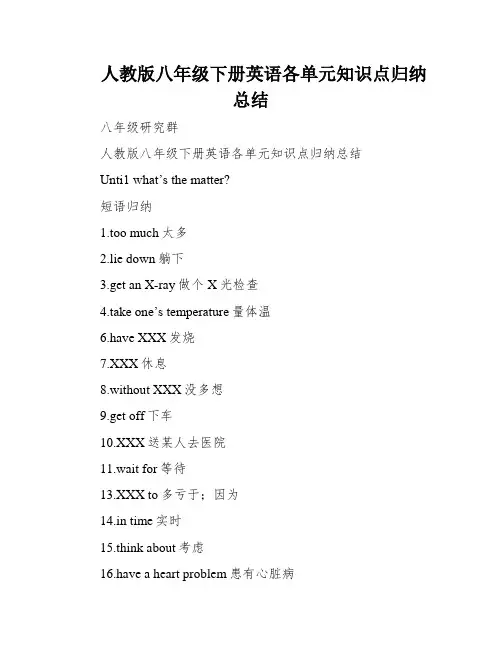
人教版八年级下册英语各单元知识点归纳总结八年级研究群人教版八年级下册英语各单元知识点归纳总结Unti1 what’s the matter?短语归纳1.too much太多2.lie down躺下3.get an X-ray做个X光检查4.take one’s temperature量体温6.have XXX发烧7.XXX休息8.without XXX没多想9.get off下车10.XXX送某人去医院11.wait for等待13.XXX to多亏于;因为14.in time实时15.think about考虑16.have a heart problem患有心脏病17.get into the trouble遇到麻烦18.do XXX做正确的事情事情19.fall down跌倒21.get hit/sunburned摔伤/烧伤23.be used to惯于....24.XXX挑战25.XXX落空生命26.because of因为27.run out of用完28.cut off切除29.get out of从...出来30.XXX做决意31.be in control of掌管;管理32.give up放弃用法归纳1.need to do sth .需要去做某事2.XXX看见某人正在做某事3.XXX询问某人某事4.4.XXX期望某人做某事5.agree to do XXX同意做某事6.help sb (to) do XXX匡助或人做某事7.want to do XXX想要做某事8.tell sb to do sth通知或人做某事9.have problems(in) XXX做某事有困难10.XXX用某物去做某事used to doing XXX惯于做某事12.seem to do XXX好像做某事13.keep XXX继续做某事14.XXX做某事语法点1.讯问或人的安康题目及碰到贫苦的表达办法2.情态动词should的用法3.不定代词的用法Unit 2 I’ll help to clean the city parks短语归纳1.clean up打扫干净2.cheer up(使)变得更高兴;振奋起来3.give out分发5.give away赠予;捐赠6.set up树立;设立7.make a difference有作为e up with想出9.put off推迟10.put up张贴11.call up打电话给13.care for照顾;照看14.give up放弃15.try out for参加选拔e true实现17.run out of用光19.fix up修理用法归结1.need to do sth需要做某事2.make plan to do sth制订打算做某事3.ask sb (not ) to do sth请求或人(不要)做某事ed to do sth曩昔经常做某事5.decide to do XXX决意做某事6.help sb (to)do XXX帮助某人做某事8.make it possible for sb to do sth使得做某事对或人来讲是可能的拓展链接动词+副词短语XXX up使高鼓起来clean up清扫洁净put up张贴mix up 修缮give away赠送give out分发give up放弃use up用光get up起床hand in上交put off推延pick up捡起think over细致思考turn down关小音量set up建立set off出发look out小心动词+介词短语hear of听说pay for支付wait for等待动词+副词+介词短语get out of制止come up with想出catch up with追上遇上look forward to等候渴望go on with继续动词+名词短语have a rest苏息一下take a walk漫步make XXX出错have a try试一下XXX发生tell a XXX撒谎make a decision做决定动词+名词+介词短语Be+形容词+介词短语XXX for迟到be angry with生气be fond of喜欢be good at 擅长动词不定式归纳只跟动词不定式做宾语的动词决心学会有希望(decide,learn,wish,hope)同意计划莫假装(agree,plan,pretend)忘记拒绝会失望(forget,refuse,fail)准备设法来帮忙(prepare,try,manage,help)提供请求负担起(offer,beg,afford)记得阻止理应当(remember stop,be supposed)题链接1.-Tom failed the exam again-Sorry to hear that. We should do XXX.A. XXXC.XXX2.XXX.A. XXXC. XXX cleaning3.XXX XXX.A. used to beB. is used to beC.was used to beD.is4.The old man lives,but he doesn’t feel .A. alone;XXX;lonelyC.lonely;aloneD. alone;lonely5.XXX, I have XXX tell6.--The old manall his money to a XXX.We all feel after hear of the news.A.excited;excitingB.exciting;excitingC.excited;excitingD.exciting;excitedUnit3 Could you please clean your room?短语归结1.do XXX洗餐具2.XXX out the XXX倒垃圾3.at least至少4.throw down扔下5.all the time一向;重复6.in surprise惊讶地10.provide XXX向某人提供某物11.depend on依赖;信赖12.look after照顾;照看13.take care of照顾14.as a result结果用法归结1.XXX XXX做完某事2.want sb to do XXX想要某人做某事3.try (not) to do sth尽力(不)做某事4.let sb do XXX让或人做某事6.XXX做某事7.learn to do sth研究做某事8.learn how to do sth研究怎样做某事语法点神态动词could的用法表示请求与准许,could委婉有礼貌;表示能力会不会,could只把过去表Unit 4 why don’t you talk to your parents?短语归结1.too much太多(修饰不可数名词)2.hang out闲逛3.too many太多(修饰可数名词复数)4.get into a fight争吵5.call sb up给某人打电话6.XXX谈论7.XXX浏览8.give back清偿9.be angry with sb生或人的气10.a big deal紧张的工作11.work out解决;算出12.get on with sb与某人和睦相处13.XXX与某人交流16.in front of在...前面17.not... any more不再...18.so much/many那末多pete with sb与某人竞争20.cut out删除;删去21.all kinds of各类百般23.XXX...看24.turn down调小用法归纳1.allow sb to do XXX允许某人做某事2.why don’t you do sth?为甚么不做某事呢?3.why not do sth ?为什么不做某事呢?4.find sb doing XXX发觉或人在做某事5.tell sb to do XXX告诉某人做某事6.refuse to do XXX回绝做某事7.let sb do XXX让或人做某事8.offer to do XXX主动提供做某事9.not....until....直到....才...10.it’s time to do sth该做某事了12.keep XXX连续做某事13.what do you think of...?你认为....怎么样?语法点came?短语归纳1.wait for等候2.look for寻觅3.go off (闹铃)发出声音4.XXX洗澡5.pick up接德律风;捡起6.make sure确信;务必7.have fun玩的开心8.fall asleep入眠;睡觉9.die down逐突变弱;逐步消逝10.wake up醒来;叫醒11.in a mess杂乱无章12.take photos照相13.turn on翻开14.in silence缄默沉静地;无声地15.XXX down摧毁;拆卸;记下16.tell XXX说实话17.point out指出18.go XXX消逝19.as well也用法归结1.XXX忙于(做)某事2.XXX看见某人或某物正在做某事3.begin/start to do sth开始做某事4.try to do XXX努力去做某事5.have trouble(in)doing sth做某事有艰巨语法点曩昔举行时过去进行最好记,was/were+doing特定时间有暗示,过去某刻某时段一定主语在句首,普通问句Be提早否定句式更简朴,Be后只把not添Unit 6 An old man tried to move the mountains短语归纳1.work on从事3.XXX...XXX拿走,带走4.a good way to do sth做某事的好办法5.a little bit一点儿6.once upon a time从前7.turn...into..变成8.XXX呈现,出版,结果是9.get married立室10.fall in love with sb爱上某人11.be born出生12.all over the world全球13.make a plan to do sth制订打算做某事14.along the way沿路15.be lost迷路16find out找出17.learn about了解用法归纳1.try to do sth设法做某事2.XXX XXX完成做某事3.continue to do XXX连续做某事4.make sb do XXX让某人做某事5.keep XXX一向做某事6.instead of XXX代替做某事7.be able to do能够做某事9.have no time to do sth没有工夫做某事10.XXX XXX对做某事感乐趣11.can’t stop doing XXX禁不住做某事12.XXX听到或人正在做某事13.XXX引导某人到某处14.XXX把某物遗忘在某地15.XXX向某人展示某物语法点1.unless引导的条件状语从句2.XXX...引导的结果状语从句3.as soon as指导的工夫状语从句Unit7 XXX?短语归纳1.take in吸入;吞入2.in the face of面临(题目;艰巨)3.XXX出身时4.as you can see正如你所看到的5.as far as I know据我所知6.up to直到7.prepare ...for...为...筹办...8.fall over摔倒10.cut down砍倒11.take care of照顾;照看12.or so大约;左右13.in XXX处于危险之中用法归纳4.what’s the+形容词最高级+名词in the world?世界上最....的....是什么?5.XXX..保护....使不受;防备6.XXX胜利做成某事8.send sb to do XXX派某人去做某事1.数词hundred,thousand,million,XXX的用法2.形容词和副词的比较级和最高级用法比较级变革划定规矩比较品级要变革,普通词尾加-er词尾如有哑音e,间接加r就能够一辅重读闭音节,辅音字母要双写辅音字母加y结尾,要把y改i加erUnit8 Have you read Treasure Island yet?短语归纳1.be full of充满2.grow up长大3.XXX up赶快4.XXX带回到某地5.more than超过6.in the middle of在....中央7.fight over为....争吵;争斗8. think about斟酌9.XXX XXX开始意识到10.ever since then从那时起11.a kind of一种12.such as比方13.XXX属于14.find out找出;查出15.at the end of the day在一天竣事的时候16.be famous for因为...而出名17. leave XXX遗忘;留下18.the importance of money and success金钱和成功的重要性用法归结1.XXX XXX完成做某事2.XXX抵达某地3.learn to do sth研究做某事4.XXX看到某人正在做某事6.XXX教或人某事e sth to do用某物做某事8.love to do/doing XXX喜欢做某事9.can’t wait to do sth迫不及待做某事10.be kind to sb对某人友好11.hope to do XXX希望做某事12.have time to do sth有时间做某事13have nothing to do没什么事情可做语法点目前完成时Unit9 Have you ever been to a museum?短语归纳1.have a great time玩的兴奋2.put up搭建;支起3.in such a rapid way用如此快速的方式4.be able to do XXX能够做某事5.a couple of少数;几个6. on the other hand另一方面7.three quarters四分之三8.whether...or...不论...照旧...9.wake up醒来10.all year round一年到头,长年11.close to靠近用法归纳1.a great way to do sth一个做某事的好办法2.watch sb to do sth观看或人做了某事4.XXX do XXX勉励或人做某事5. have problem (in)doing sth做某事很费力6.as...as..和...一样7.the best time to do sth做某事的最好工夫8.choose to do sth选择做某事9.tell sb to do XXX告诉某人做某事语法点现在完成时区分:have been to和have gone toUnit10 I’v had this bike for three years短语归纳1.h0w long多长,多长时间3.welcome to ...欢迎到....4.XXX察看5.at first起初6. no longer不再;不复7..as for ...至于....8..to XXX说实在的9.search for寻找11.according to依据;按照12.in one’XXX...看13.in order to为了用法归结3.have been in+地点在某处待了多久5.hope to do XXX希望做某事7.one of+the +描述词最初级+可数名词复数+V单数最....的...之一是....ed to do XXX过去常常做某事9.need to do sth需求做某事语法点目前完成时1.since和for指导状语的辨别2.延续性动词和瞬间动词瞬间动词转为为延续动词表borrow-XXX-havecatch a cold-have a coldput on-wearget to know-knowget to sleep-XXXgo out-XXX-be(in)die-be XXX-be overfall ill-be illjoin-be in/be a member offall XXX XXX响应的介词close-be close。
人教版八年级英语下册重点短语、句型及语法(精华全面)
八年级下册英语短语、句型及语法Unit 1 What’s the matter?一、重点短语1. have a fever 发烧2. have a cough 咳嗽3. have a toothache 牙疼4. talk too much 说得太多5. drink enough water 喝足够的水6. have a cold 受凉;感冒7. have a stomachache 胃疼8. have a sore back 背疼9. have a sore throat 喉咙痛10. lie down and rest 躺下来休息11. hot tea w ith honey 加蜂蜜的热茶12. see a dentist 看牙医13. get an X-ray 拍X 光片14. take one’ s temperature 量体温15. put some medicine on sth. 在……上面敷药16. feel very hot 感到很热17. sound like 听起来像18. all weekend 整个周末19. in the same way 以同样的方式20. go to a doctor 看医生21. go along 沿着……走22. on the side of the road 在马路边23. shout for help 大声呼救24. without th inking twice 没有多想25. get off 下车26. have a heart problem 有心脏病27. to one’ s surprise 使....... [京讶的28. thanks to 多亏了;由于29. in time 及时30. save a life 挽救生命31. get into trouble 造成麻烦32. right away 立刻;马上33. because of 由于34. get out of 离开;从……出萍35. hurt oneself 受伤36. put a bandage on sth. 用绷带包扎37. fa ll down 摔倒38. feel sick 感到恶心39. have a nosebleed 流鼻血40. cut his knee 割伤他的膝盖41. put her head back 把她的头向后仰42. have problems breathing 呼吸困难43. mountain climbing 登山运动44. be used to doing sth. 习惯做某事45. run out (of) 用完;用尽46. so that 以便47. so. . . that 如此… …以至于…48. be in control of 掌管;管理49. in a difficult situation 在闲境屮50. keep on doing sth. 继续或坚持做某事51. make a decision 做出决定52. take risks 冒险53. give up 放弃二、重点句型1. Wha t’ s the matter?Wha t’ s the matter with you?= What’s the trouble w ith you?= Wha t’ s wrong with you? 你怎么了?2. What should she do?她该怎么办呢?Should I take my temperature?我应该量一下体温吗?主语+ should/shouldn’t + 动词原形. ..①You should lie down and rest.你应该躺下休息一会儿。
人教版初中英语八年级下册全册各单元知识点、语法归纳整理
人教版初中英语八年级下册全册各单元知识点、语法归纳整理人教版初中英语八年级下册全册各单元知识点、语法归纳整理Unit1 W hat’s the matter?一.重点短语归纳1. foot---feet 脚tooth---teeth 牙齿2. have a cold 感冒3. have a stomachache 胃疼4. have a sore back背疼5. have a sore throat喉咙疼6. have a fever发烧7. lie down and (have a)rest 躺下休息have a rest 休息8. hot tea with honey 加蜜的热茶9. see a dentist 看牙医see a doctor 看医生10.drink lots of water多喝水11.lots of ,a lot of, 许多。
大量a lota lot of=lots of,可以修饰可数名词复数和不可数名词,一般用在肯定句中。
:There are lots of (a lot of)books in our library.There is a lot of water on the grounda lot,是一个副词词组,跟动词连用;表示十分,很等意思;Thanks a lot.12. have a toothache牙疼13. That’s a good idea好主意14. go to bed 去睡觉go to bed early 早上床睡觉15. feel well感到好 feel ill 感到不舒服I don’t feel well= I’m not feeling well我感觉不舒服.16. start doing/ to do sth开始做某事to do 是一件事情完成了,开始做另外一件事情doing是原来的那件事情做到一半,现在又开始做了,是同一件事情。
人教版八年级下册英语重点词汇,短语,句型,语法总结
Unit 1 will people have robots?一、重点词汇:probably;able;interview;company;shape;impossible.二、重点短语:1. be scared of sb./sth. 恐惧某人/某物2. go up 上升,与rise 同义,与go down 或set 相反3. make a noise 发出声响,吵闹4. arrive in 到达,表示到达某一城市、国家等大地方时,用介词in;表示到达某一村庄、车站等小地方时,用介词at ;到达的地方用副词表示时,可不用介词。
5. not…until…直到……才……6. see…doing…停止做某事7. go cycling 相当于go to ride a bike ,意思是去骑车。
8. nit sb. on the head 表示“打某人的头”,表示的“打某人的脸”要用hit sb. in the face 。
9. turn around 转身10. fall off 摔下来11. give sb. a push 推某人一下12. help sb. do sth. = help sb. with sth. 帮助某人做某事13. get off 从……下来,通常指下火车、巴士、轮船、飞机等。
14. think about 思考、想起、想到(某人或某事)15. all day 一整天16. one by one 一个接一个地,类似有year by year 一年又一年;day by day 一天又一天。
17. hold on 有两个意思,一个是“(电话)不挂断”;一个是“抓紧”。
18. come down 下来三、重难点解析:1.比较级:less 最高级least2.agree:1) 表示“同意某人意见”时用agree with sb,该短语不能用于被动语态。
2) 表示“同意(某计划、办法、建议、条件)”时,用agree to(to在此用作介词,其后接名词、代词或者相当于名词的成分),该短语可以用于被动语态。
人教版八年级英语下册各单元语法点汇总
U n i t1W h a t’s t h e m a t t e r 一、询问某人的健康问运及遭到麻烦的表达方法1询问某人患了何种疾病或遇到了何种麻烦时;常用以下几种结构来表达:What’s the matter with sb.某人怎么了What’s wrong with sb.某人怎么了What’s the trouble with sb.某人出什么事了What happened to sb.某人发生了什么事Are you OK你没事吧Is there anything wrong with sb. 某人有什么事吗(2)要表达身体疼痛或不舒服;可用以下结构:①某人+have/has+病症.The twins have colds.双胞胎感冒了..某人+have/has+a+headache/toothache/stomachache/backache/earache.She had a stomachache last night.她昨晚肚子痛..③某人+have/has+a+sore+发病部位. He has a sore throat.他喉咙痛..④某人+hurts+身体部位或反身代词. He hurt his leg.他的腿受伤了..⑤某部位+hurts.My head hurts badly.我头痛得厉害..⑥某人+have/has+a pain+in one’s+身体部位; I have a pain in my chest.我胸口痛..⑦There issomething wrong with one’s+身体部位.There is something wrong with my right eye..我的右眼有毛病..⑧其他表达方式She has a heart trouble.她有心脏病..He got hit on the head他头部受到了撞击..She cut her finger.她割破手指了..二情态动词should的用法1.Should为情态动词;意为“应该;应当”;否定式为shouldn’t;其后接动词原形;无人称和数的变化..常用来表示征询意见、建议、劝告、要求或义务等.. You should drink hot water with honey.你应该喝加有蜂蜜的开水..He should put his head back他应该把头后仰..We should try our best to help him.我们应当尽力去帮助他.. You shouldn‘t watch TV.你不应该看电视..2.Should用于主语为第一人称的疑问句;表示征询意见.. Should I put some medicine on it 我应当给它敷上药吗 Should we tell her about it我们应该告诉她这件事吗拓展在英语中;表示建议的说法有很多;而且都是中考考查的重点..主要结构有:①Would you like to do sth.你想要/愿意做某事吗Would you like to play basketball with me你想要和我一起打篮球吗②Shall I/we do sth 我/我们做好吗Shall we go to the zoo tomorrow明天我们去动物园;好吗③Why not do sth 为什么不呢Why not join us为什么不加入到我们当中来呢④How/What about doing sth 做某事怎么样 How about going swimming去游泳怎么样⑤Let’s do sth让我们做吧.. Let’s go home.咱们回家吧..⑥You’d better not do sth你最好不要做某事..You’d better not go there alone.你最好不要一个人去那儿..Unit 2 I'll help clean up the city parks动词不定式A. 作主语——为避免句子的头重脚轻;常用it作为形式主语;而真正的主语动词不定式后置..常用句型:It +be+adj./n.+for/of sb. to do sth./It takes sb. some time to do sth.B. 作宾语——动词want; decide; hope; ask; agree; choose; learn; plan; need; teach; prepare…常接动词不定式作宾语..C. 作后置定语——常用于“have/has+sth.+to do”或“enough+名+to do”“It’s time to do sth.”等结构中..D. 作宾语补足语——tell; ask; want; invite; teach; like; call等可接带to的动词不定式作宾语补足语;构成tell/ask/want /call/invite sb. to do sth.结构..“一感feel;二听listen to; 注意动词不定式作使役动词和感官动词的宾语补足语时应省去to:hear;三让let; make; have;;四看look at; see; watch; notice;半帮助help”..E. 动词不定式作状语主要用来修饰动词;表示目的;结果或原因..为了强调目的;有时可以把动词不定式放在句首;或在不定式前加in order to 或so as to “为了;目的是”..常用结构有too + adj./adv. + to do sth.等..F. 固定句式中动词不定式的用法常见的形式有:had better not do sth./Would you like to do sth./Why not do sth./Would you please not do sth.等..Unit 3 Could you please clean your roomCould you please...句型1请求别人时通常用此句型;也可以说:Can you...please情态动词could或can在这里均表示请求;在意思上无区别;但是用could在于其上显得更委婉、客气、诚恳..在日常生活中常使用could you/I...若在句末加上please;则显得更礼貌..Could you help me find my book;please你能帮我找到我的书吗(2)对could you/I...的问句作出肯定回答;常用“sure/certainly/of course”等;如果作否定回答;常用“sorry或oh;please don’t”.. 一般不用no开头;用no显得语气生硬、不礼貌..(3)表示请求的句式:Would you like to do... Would you mind doing... Let’s do.... Shall I/we do... Please do...祈使句前加please提示:could you please...与could I Please...两种问句;前者是请求别人帮忙的句式;后者是有礼貌地向别人请求允许的交际用语..试比较:Could you please help me请你帮我一下好吗Could I please invite my friends to my birthday party;Mom 妈妈; 我能邀请我的朋友参加我的生日聚会吗Unit 4 Why don't you talk to your parents1.提建议向别人发出邀请;请求;建议;或征求某人的意见的其他表达方式:How /what about doing sth.about是个介词;可跟名词或动名词“…怎么样”You’d better not do something.“你最好不做某事”Would you like sth …:“你想要某物Let s do sth…What should I do … should表示请求、征询对方意见2.学会谈论问题和学会用why don't you…提建议向别人发出邀请;请求;建议;或征求某人的意见的表达方式:Why don t you do something =Why not do something 你为什么不做某事呢来表示请求、征询对方意见3.until; so that ;although引导的状语从句:1until:在带有till或until引导的时间状语从句里;如果主句用肯定式;其含义是“一直到……时”;谓语动词只能用延续性动词..如果主句用否定式;其含义是“直到……才……”; “在……以前不……”; 谓语动词可用瞬间动词..Don t get off until the bus stops.2so that引导目的状语从句为了;以便例如:He studies hard so that he could work better in the future3although的用法意思相当于though尽管;虽然;引导让步状语从句..引导的从句不能与并列连词but;and; so等连用;但可以和yet; still等词连用.. 例如:Although he was tired; he went on working.尽管他很累;但是他继续工作..Unit 5 What were you doing when the rainstorm came过去进行时1. 基本概念:过去进行时表示在过去某一时刻或一段时间内正在进行的动作..这一特定的过去时间除有上下文暗示以外; 一般用时间状语来表示..2.结构 was / were not + 动词-ing3.句式肯定式:I/He/She/It was working. We/You/They/ were working.否定式:I/He/She/It was not working.We/You/They/ were not working.疑问式和简略回答:Was I working Yes; you were. No; you were not. Were you working Yes; I was. No; I was not. Was he/she/it working Yes; he/she/it was. No; he/she/it was not. Were we/you/they working Yes; you/we/they were. No; you/we/they were not. 注:1 was not常缩略为wasn’t; were not常缩略为weren’t..2 一般过去时与过去进行时用法的比较: 一般过去时表示在过去某个时间发生过的动作或存在的状态; 而过去进行时则表示在过去某一时刻或某一段时间正在进行的动作.. 例如: David wrote a letter to his friend last night. 大卫昨晚给他的朋友写了封信..信写完了..David was writing a letter to his friend last night. 大卫昨晚一直在给他的朋友写信..信不一定写完..4.过去进行时中的when和whilewhen; while 区别:1)由when引导的时间状语从句;主句用过去进行时;从句应用一般过去时;由while引导的时间状语从句;主句用一般过去时;从句应用过去进行时..When the teacher came in; we were talking.当此句改变主从句的位置时;则为: While we were talking; the teacher came in. 2如果从句和主句的动作同时发生;两句都用过去进行时的时候;多用while引导..如:They were singing while we were dancing.Unit 6 An old man tried to move the mountains1. unless引导条件状语从句unless = if … not ―除非;若不They will go tomorrow unless it rains.= They will go tomorrow if it doesn’t rains.2. as soon as引导时间状语从句.. ―……就He will come and see you as soon as he can.3. so.......that引导结果状语从句句型1:主语+谓语+so+形容词/副词+that从句The wind was so strong that we could hardly move forward.句型2: so +形容词 + a/an + 单数名词 + that从句It was so hot a day that they all went swimming.句型3. so + many/ few + 复数名词 + that从句He has so few friends that he often feels lonely.句型4: so +much/ little + 不可数名词 + that 从句I had so little money that I couldn’t buy a pen.Unit 7 What’s the highest mountain in the world形容词副词的原级、比较级和最高级一原级句型:1. A is as+原级+ as+ B 表示A 与B一样…eg: He is as tall as me.2.A is not as/so +原级+ as B表示A不如B…eg:He is not as tall as me.3.只能修饰原级的词;very;quite;so;too;so; enough; pretty等例如;He is too tired to walk on.他太累了以至于不能再继续走了..(二)比较级句型可以修饰比较级的词;much;a lot;far;…的多a little;a bit;…一点儿 even甚至;still 仍然Eg. Lesson One is much easier than Lesson Two.第一课比第二课容易得多.. Tom looks even younger than before.汤姆甚至比以前更年轻..1.当句中有than 时则用比较级.. eg: He is fatter than me.2.当句子中的比较对象为两者时用比较级:“特殊疑问词+be+形容词比较级;A or B ”eg: Which is bigger;the earth or the moon 哪一个大;地球还是月球3. “比较级+and+比较级”表示“越来越……”..eg.The flowers are more and more beautiful.花儿越来越漂亮..加more构成比较级的形容词则用more and more +形容词表示越来越…eg: English is more and more important.4.“the+比较级;the+比较级”表示“越……;越……”..Eg. The more careful you are;the fewer mistakes you’ll make.5.“A+be+the+形容词比较级+of the two+……”表示“A是两者中较……的”..Eg.Look at the two boys. My brother is the taller of the two.6.A+be+形容词比较级+than+any other+单数名词+介词短语”表示“A比同一范围的任何一个人/物都……”;含义是“A最……”..Eg. The Yangtze River is longer than any other river in China.=The Yangtze River is the longest river in China.三最高级常用句型结构1.“主语+be+the+形容词最高级+单数名词+in/of短语”表示“……是……中最……的”.. eg:Tom is the tallest in his class./of all the students.This apple is the biggest of the five.2.“主语+be+one of the+形容词最高级+复数名词+in/of短语”表示“……是……中最……之一”..Eg:Beijing is one of the largest cities in China.3.“特殊疑问词+be+the+最高级+A;B;or C ”用于三者以上eg Which is the biggest The moon;the sun or ths earth4.“the +序数词+最高级+单数名词+范围”..表示…是第几大…eg: The Yellow River is the second longest river in China .注意形容词最高级之前要加the;但当最高级之前有形容词性物主代词或名词所有格时则不用加theeg: He is the best student in my class. He is my best friend.(四)形容词副词的规则与不规则变化规则变化1.一般在词尾直接加er或est;例如;tall-taller-tallest;long-longer-longest2.以不发音的字母e结尾的单词在词尾直接加r或st;例如;nice-nicer-nicest3.以辅音字母+y结尾的词;把y变为i;再加er或est;例如;heavy-heavier-heaviest4.重读闭音节;末尾只有一个辅音字母;双写这个辅音字母;再加er或est;eg. big-bigger-biggest5.部分双音节词和多音节词分别在原级前加more构成比较级和most构成最高级;例如;slowly-more slowly-most slowly;beautiful- more beautiful-most beautiful 不规则变化Unit 8 Have you read Treasure Island yetUnit 9 Have you ever been to a museum现在完成时 Present Perfect Tense1表示过去发生或已经完成的动作对现在造成的影响或结果..—It’s so dark. 太黑了..—Someone has turned off the light. 有人把灯关上了..2表示从过去某一时间开始并一直持续到现在的动作或状态..常与since+过去的时间点;for+一段时间;since+时间段+ego; so far等时间状语连用.. Eg. I have lived here for ten years.我已经住在这里10年了..从10年前开始;持续到现在还住这儿Eg. I have lived here since 2003. 自从2003年我就住在这儿..从2003年开始;持续到现在还住这儿3 基本结构及句型转换:主语+have/has+过去分词done 当主语是第三人称单数has;其余人称用have..①肯定句:主语+have/has+过去分词+其他 I have finished my homework. 肯定句②否定句:主语+have/has+not+过去分词+其他 I have not finished my homework. 否定句③一般疑问句:Have/Has+主语+过去分词+其他—Have you finished your homework—Yes; I have. / No; I haven’t; 一般疑问句及肯定、否定回答4has gone to; has been to; has been in 的区别Have/Has goneto :去了现在不在说话现场Eg. ---Where is your father---He has gone to Shanghai.Have/Has been to :去过已不在去过的地方Eg. My father has been to Shanghai.Have/has been in:呆了多久还在所呆的地方Eg. My father has been in Shanghai for two months. =My father has been in Shanghaisince two months ago.5现在完成时的标志:①常与just; already; yet; ever; never; before; so far 等连用;强调动作的完成;不强调动作的持续..Have you ever been to Japan I have just finished my homework.②for + 时间段;since + 过去的时间点;since + 段时间 ago;since + 一般过去时的句子..They have known each other for five years. Since he was a child; he has lived in England.(6)动词过去式和过去分词的变化规则变化: 1. 一般在动词词尾直接加ed..如:pick → picked → picked; wish →wished → wished; stay → stayed → stayed2. 以不发音的e结尾的动词后面加d..如:like → liked → liked; hope → hoped →hoped; phone → phoned → phoned3. 以―辅音字母 + y‖结尾的动词;变y为i;再加-ed..如:study → studied → studied; hurry → hurried → hurried; reply → replied → replied4. 词尾只有一个辅音字母的重读闭音节动词;要双写辅音字母;再加-ed..如:stop →stopped → stopped; clap → clapped → clapped不规则变化:5.以不变应万变..如:let → let → let; put → put → put; read → read → read6. 若中间有双写e;则去掉一个e;单词末尾再加t..如:feel → felt → felt; keep → kept → kept; sleep → slept → slept7. 结尾的字母d变t..如:lend → lent → lent; build → built → built; send →sent → sent8. 变为以-ought或-aught结尾..如:buy → bought → bought;bring → brought → brought; catch → caught → caught; teach → taught →taughtUnit 10 I've had this bike for three years.短暂性动词buy; die; join; finish等不能直接与for; since 连用; 需要改变动词..1)beginstart--be on2 open--be open3)become--be4)die--be dead5) fall asleep-- be asleep6)close -- be closed7)end/ finish---be over8) put on--wear9)leave-- be awayfrom 10)catch a cold--have a cold11)join the army--in the army/be a soldier12)borrow---keep13)join the party-- be in the party/ be a party member14) buy---have15come/go/ arrive/reach/get /move to---be in /at总结:1.现在完成时表示过去发生的动作对现在造成的影响和结果;2.还可以表示过去发生的动作;一直持续到现在;也有可能持续下去.3..一般情况下;for+时间段; since+过去的时间点;since + 段时间 ago;since + 一般过去时的句子4.句型:现在完成时态have/has+延续性动词的过去分词+ for/ since...。