
仁爱版英语七年级下册Unit 5 Topic 1 Section D优质课课件
key words
new friend, Michael, school life
of American students, take a yellow school bus or walk, have lunch, begin class, in their free time, play basketball and soccer
Read the interview again and answer the questions. Then act it out.
1. How do American students usually go to school? They usually take a yellow school bus or walk to school. 2. Where do the students usually have their lunch? They usually have lunch at school. 3. What time is school over? At about 3 o’clock. 4. What do they do after school? They often play basketball and soccer.
Survey your classmates about their school life.
Item How to Where When What go to to have to leave to do school lunch school after school
Name Li Wei …
Compare the school life of American students with yours and report it to the class.
ቤተ መጻሕፍቲ ባይዱ
You may begin like this:
The school life of American students is different from ours …
Three times a week. / Very often. / Every day.
Grammar
Adverbs of Frequency I never go to school by subway.
I seldom walk to school. Maria sometimes takes the subway home.
1. Review adverbs and phrases of frequency. 2. Sum up the present simple tense. 3. Sum up the useful expressions in this topic.
Write a short passage about your daily activities, using adverbs of frequency as many as possible. (Present Simple Tense, at least 50 words)
How often does she/he …
Work in groups to make a comparison between Chinese students’school life and American students’ school life.
Chinese Students American Students
A B
E E
C
D
(A)1.Miss Yang _______ always goes to Wuhan by bus. (D)2.Mr. Rui seldom goes to Nanjing ________. by train sometimestakes the subway to his office. (B )3.Mr. Brown _________ never (E )4.Ms. Wang ____________ visits the Great Wall. (C)5.He often ___________ drives a car to the park for a picnic on Sundays.
The interviewer and Michael are talking about the school ______ life of American students. ___________
Key Points
1. be over 结束 2. Many students usually take a yellow school bus or walk to school. 3. I’m sorry we have no more time. 4. Nice talking to you.
Functions
Happy New Year! Happy New Year! /The same to you. The early bird catches the worm.
She goes to bed at about a quarter to ten.
How often do you come to the library?
Write a passage. You may use the expressions in Functions if necessary. • You may begin like this: • The school life of American students is different from ours …
Li Xiang often rides a bike to school. We usually go to the park on foot. They always go to the zoo by bus.
Listen to the sentences and fill in the blanks.
仁爱版七年级下Unit5TOPIC2SectionA市公开课一等奖省优质课获奖课件
Do you often read books in the library? Yes, I do. /No, I don’t. How often do you go to library? Three times a week. /Very often./ Every day./ Seldom.
2、They are doing their homework . (改为否定句)
They
their homework .
3、Are the children sleeping ?(作否定回答)
No,பைடு நூலகம்
.
4、He is listening to the teacher . (变为复数形式)
listening to the teacher .
(借) them ?
3.They are talking
(在失物招领室).
4.I’m
(寻找) my purse .
5.The girl wants to buy
(一双鞋).
二、句型转换。
1、I’m putting a map on the wall .(改为普通疑问句)
you
a map on the wall ?
第4页
Read 3 and make a similar dialog in pairs
A:Hello,Jane What are you doing now? B:Guess! A:Are you doing your homework? B:No,I’m not. A:Are you watching TV? B:Yes,I am .What are you doing ? A:I’m making cards . B:Would you like to play basketball? A:Good idea! See you soon.
仁爱版英语七年级下册Unit5Topic3SectionB市公开课一等奖省优质课获奖课件
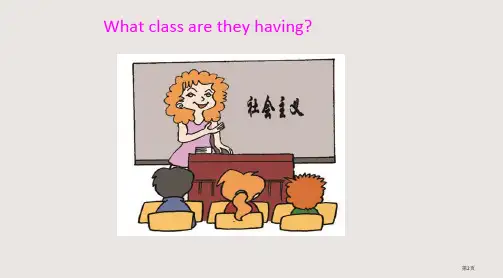
B: They are having a history class.
learning about the past
学习,了解
第3页
Ask and answer questions with
Example:
your partner.
A: They are … in the class. What class are
Name
Like
Reason
Dislike
Reason
Tom music
interesting
art
boring
...
**
**
**
**
**
**
**
**
**
**
**
**
**
**
Group Work
-
**
第17页
Thank you
第18页
What class are they having?
第2页
Ask and answer questions with
Example:
your partner.
A: They are learning about the past in the
class. What class are they having?
第8页
Look, listen, and read.
第9页
Read 1a again and complete the table.
Name Subject
Zhou Yan
English history
Maria English
Reason
It’s a little difficult.
仁爱版英语七年级下册Unit5 topic 1 section D 教学设计

仁爱版英语七年级下册Unit5 topic 1 section D 教学设计一. 教材分析本课是仁爱版英语七年级下册Unit 5 Topic 1 Section D。
本节课主要讨论了关于天气的话题。
通过本节课的学习,学生能够掌握有关天气的词汇和表达方式,并能够运用所学知识进行简单的日常交流。
教材内容丰富,插图生动有趣,有利于激发学生的学习兴趣。
二. 学情分析七年级的学生对英语有了一定的了解和掌握,但部分学生对英语的学习兴趣不高,学习积极性有待提高。
在学习过程中,学生需要更多的鼓励和引导。
此外,学生的英语水平参差不齐,因此在教学过程中需要关注全体学生,尽量让每个学生都能参与到课堂活动中来。
三. 教学目标1.知识目标:学生能够掌握有关天气的词汇和表达方式,如sunny,cloudy, rny, windy等。
2.能力目标:学生能够运用所学知识进行简单的日常交流,如询问和描述天气情况。
3.情感目标:通过本节课的学习,学生能够培养对天气变化的关注,增强环保意识。
四. 教学重难点1.重点:学生能够掌握有关天气的词汇和表达方式。
2.难点:学生能够运用所学知识进行简单的日常交流,并能够正确运用语法描述天气情况。
五. 教学方法1.任务型教学法:通过设定各种真实的任务,让学生在完成任务的过程中运用所学知识,提高学生的实际运用能力。
2.情境教学法:创设各种天气情境,让学生在具体的情境中学习和运用有关天气的词汇和表达方式。
3.小组合作学习:通过小组讨论、合作完成任务等方式,激发学生的学习兴趣,提高学生的团队协作能力。
六. 教学准备1.教材、PPT及相关教学资料。
2.教学课件及多媒体设备。
3.教学道具(如晴天、雨天、风天等卡片)。
4.学生分组准备。
七. 教学过程1.导入(5分钟)利用多媒体展示各种天气现象的图片,引导学生谈论天气。
例如,展示晴天、雨天、风天等图片,让学生用英语描述这些天气现象。
2.呈现(10分钟)教师展示PPT,呈现本节课的主要内容,如有关天气的词汇和表达方式。
仁爱英语七年级下册Unit5_Topic1_SectionA_优教精品课件
二、句型转换 1. It’s time for breakfast.(同义句转换) It’s time __to____ _h_a_v_e__ breakfast. 2. They go home by subway.(同义句转换) They go home ___b_y__u_n_d_e_r_g_ro_u_n_d_. 3. My sister goes to school by train.(对画线部分提问) _H__o_w__ _d_o_e_s__ your sister go to school?
D. She goes to school by subway.
Choose correct answers according to 1b.
A. by bus B. by bike C. on foot D. by subway/ underground
Kangkang comes to school ___B____. Jane comes to school ___A____. Helen comes to school ___D____. Michael comes to school____C____.
Homework
1. 登录“优教 同步学习网”完成 SectionA随 堂练习。 2. Review the means of transportation. 3. Read the sounds and words in 3a. 4. Memorize the new words.
2.—_D_o_ you often come to school _b_y_ bike? —Yes, I do.
3.—_H_o_w_ do you usually come to school? —I usually come to school _b_y_ subway.
仁爱版英语七年级下册Unit5Topic2period3市公开课一等奖省优质课获奖课件

5
2
4
1
3
Class is over. The students are in the classroom. ...
1. read English newspaper 2. write a letter
3. do one’s homework 4. talk
5. clean the blackboard at the back of the classroom
第7页
(In the gym) Three students are swimming in the swimming pool. What about the girls over there? Oh! They are dancing. But Helen isn’t dancing with them. She is playing pingpong with Ann.
Summary
1. Learn other new words and phrases: show sb. around, sit, write, at the back of, draw
2. Consolidate the present continuous tense. 3. Review the names of school buildings.
在图书馆 in the library 在操场上 on the playground 在电脑室 in the computer room 在食堂 in the dining hall 在办公室 in the teachers’ office 在游泳池 in the swimming pool
A: Is /Are … in the library?
七年级英语下Unit5-Topic2-Section-B课件(仁爱版)完美版市公开课一等奖省赛课获奖
a library also has some _n_e_w__s_p_a_p_e_r for the readers, too. Look! Mary is in the library now. She is l_o_o_k_i_n_g_ __fo_r__ an English _w_o_r_k_b_o_o_k_ on the _sh_e_l_v_e_s_. She wants to borrow it and _k_e_e_p__ it for two weeks. But she must _r_e_tu__rn__ it _o__n___ __t_im__e__.
Topic2 A new students are running around the playground Section B
第1页
学习目标
一、掌握以下单词和短语:borrow, workbook, course, of course, use, look for, shelf (shelves), keep等。
meeting taking swimming writing teaching telling having sitting
第4页
Presentation—Ask and answer
Where is she?
She is _i_n__th_e__g_y_m___. Is she __d_a_n_c_in__g__? Yes, she _i_s___ .
第9页
Fill in the blanks with the correct form of the words.
仁爱版英语七年级下册:Unit5 Topic1 Section B教案
Unit 5 Our School LifeTopic 1 I usually come to school by subway.Section BTeaching aims:1.Learn some new words and phrases:never, seldom, sometimes, often, usually, always2.Go on learning phrases about means of transportation:on foot, by bus, by ship, by train, by car, by plane, by bike, by subway.3. Talk about how we go to some places in two different ways.4. Encourage the students to be diligent:The early bird catches the worm.The key points and difficult points:Two different ways to express means of transportation. Teaching aids:Computer multimedia projector.Teaching procedures:Step 1 Lead-in1. Enjoy the picturesShow some pictures about the beautiful scenery of Yunnan.2. Set the routeSet the route from Hengyang to Kunming. We will be through four cities, Shaoyang, Guiyang, Anshun, Qujing.( Hengyang - Shaoyang - Guiyang - Anshun - Qujing - Kunming)Step 2 PresentationTask 1: Individual & Group work1.New phrases:on foot, by bus, by train, by plane, by car, by ship, by subway2.Watch the video and write down the phrases, and then present twoways of expressing means of transportation.--- How do you go to ...?--- I go to ... by ... /on foot.--- I take ... to ...3.Study the example to understand the two ways of expressing the samemeaning.Task 2: Pair work1. Play a game.2. Ask and Answer: Give some pictures to students, and ask them to talkabout how to go to some different places.Step 3 Consolidation1.Listen to 1a, and complete the sentences with adverbs of frequency. And then teach them how to use them correctly.2.Watch the flash of 1a, and answer the four questions.3.Read after the tape sentence by sentence and dub for the dialogue(英语趣配音).nguage points.Step 4 PracticeChoose the lucky number and finish the task.Step 5 HomeworkStep 6 Summary & Moral teachingWe should go to bed early and get up early. As the saying goes, " The early bird catches the worm ".Step 7 Blackboard design。
七年级英语Unit1 Topic1 Section D仁爱版 教案
Unit1 Topic1 Section D The main activities are 1, 2 and 5. 本课重点活动是1, 2和5。
Ⅰ. Teaching aims and demands 教学目标1. (1)Review greetings:①Hi! Hello!②Good morning! / Good afternoon!③How are you? / I’m fine, thank you./Fine, thanks.④How do you do? / How do you do?⑤Nice to meet / see you. / Nice to meet/see you, too.⑥Wele to China!(2)Review the introduction:①—I’m… Are you…?—Yes, I am.②This is…(3)Review farewells:①—See you later.—See you.②—Goodbye.—Bye.2. Review the letters Aa-Zz.Ⅱ. Teaching aids 教具录音机/投影仪/字母卡片Ⅲ. Five-finger Teaching Plan 五指教学方案Step 1 Review 第一步复习(时间:10分钟) 1. (复习课堂用语。
)T: Good morning, class!Ss: Good morning, Mr. …/Miss…2. (复习问候语,老师先和学生对话做示X,后让学生自己表演。
巩固问候语的英文表达法,做到学以致用。
)T: Let’s review the greetings.(1)T: Hi! S1.(老师作挥手打招呼状。
)S1: Hello! Mr. …/Miss…T: Nice to meet/see you.(教师作握手状。
)S1: Nice to meet/see you, too.(2)T: Good morning, S2.(老师作挥手打招呼状。
仁爱英语七年级下Unit5-Topic-1-Section-A(共25张PPT)省名师优质课赛课获奖
I. by boat
A: How do you usually come to school? B: I usually come to school__b_y__c_a_r____.
1a Look, listen and say
Kangkang meets Jane and Helen at the school gate.
by plane by air
How does he usually come to school ?
by boat by ship
on foot
A. by subway
B. by bike C. by plane D. on foot E. by car
F. by train G. by ship H. by bus I. by boat
For example:
A: How do you usually come to school?
B: I usually come to school by bike.
C: I usually come to school on foot. ......
You may report li来自e this: In our group, three of us come to
school by bike.....
2023/12/5
words: by train
by car
by subway
by bus
by jeep
by bike
by boat
by ship
by plane
Senteces:--How do you usually come to school?