
仁爱英语七年级上册Unit3-topic1复习
• 但是我只是有点喜欢。
• but I like it a little.
•
我们是好朋友,我们互相帮助。
• We are good friends and we help each other.
• she wants to visit Beijing. • She lives in England. • He works in a hospital. • She teaches in a high school. • She likes to play with Kitty.
• 了解很多关于 know a lot about
• 住在英国
live in England
词组
• 我们班的许多学生 many students in our class
• 一点点喜欢
like ... a little
• 一点也不喜欢 not like ... at all
• 不是很好
not very good
A. very
B. much
C. at all
D. little
8.I like the little cat a lot but she likes
it ____. B
A. a lot
B. a little
C. lot
D. much
9.Sally often helps me study English. And
可以这样说
My pen pel speaks English, but he knows a lot
about China.
. 10. 你想询问对方的国籍是不是美国,你可以这样问: Are you from America_? 11.当别人问你可不可以帮他做一件事情的时候 你可以这样
词组
• 告诉我你的名字 tell me your name
• 告诉某人某事 tell sb. sth
• 来自
come from
• 讲一些中文 speak some Chinese
• 帮助某人某事 help sb. with sth.
• 没问题
no problem
• 非常喜欢
like…very much/ a lot
—Sorry, I don’t knowB____.
—____ is a new student.
A. she; She
B. her; She
C. her; Her
D. she; Her
5—.—HeWliv_he_es_r_e
does he live? in Shanghai.
A. lives
B. live
七上Unit 3 Topic1 1. 你想询问对方的名字,你可以有礼貌地这样问: Excuse me, could you please tell me your name? 2. 你的英语不怎么好,想请求别人帮你学习, 你可
以这样问:
My English is not very good. Could you please help me with my English?
B. we; her
C. our; her
D. we; she
词汇
• ['ɔ:f(tə)n] ____o_ft_en___ _______ • [wɪð] ______w_i_th_ __________ • [ɔv] [ʌv] ___o_f _____ __________ • ['veri] ______ve_r_y_ __________ • [wɔnt]_______w_a_nt________ • ['prɔbləm] ___p_r_ob_l_em__ ___________ • [sʌm] [səm] _s_o_m_e_____ _________ • ['meni] ______m_a_ny_ __________ • [lɔt] ________lo_t __________ • ['litl] _______li_tt_le__________ • [kud] ______c_o_ul_d __________
词汇
• [ðem] ______th_e_m_ _________ • [səu] _______so__ __________ • [lɪv] _______li_ve_ __________ • [mʌtʃ] _____m_u_c_h_ __________ • ['vɪzɪt] ______vi_si_t _ __________ • [tel] _______t_e_ll __________ • [ɔ:l] _______a_l_l __________ • [seɪ] _______s_a_y _________
3. What __d_o_e_s he _s_a_y__ in the letter?
(say)
He _w_a_n_ts__ to visit the Great Wall.
(want)
1. Could you please + 动词原形
表示“你能…吗、请问你可不可 以…”,用于礼貌地请求别人做某事。
B: Yes, I am.
(I/me, he/him)
B: Yes, he is. We like him very much.
B: No problem. She is the teacher in red.
(we/us, she/her)
A: We want to give this letter to
—____ is a new student.
A. she; She B. her; She C. her; Her
( )5. ____ often helps ____ with ____ English.
A. His; her; hers
B. She; him; his
C. She; him; her
• ③ 以辅音字母加y结尾的动词,改y为i再加es • e.g. study → studies fly → flies
1. _D_o_e_s__ he s_p_e_a_k__ Chinese? ( speak) No, he doesn’t. Hes_p_e_a_k_s__ English.
2. Where _d_o_e_s__ he _liv_e___ ? ( live ) He _li_ve_s___ in England.
3.你想知道Jane是否喜欢汉语,你可以这么问她: Jane,do you like Chinese_? 4. 你想告诉别人你非常喜欢英语,可以这样说: I like English a lot/very much 5.你想知道这是谁的来信,可以这样问: Who is the letter from?
D. He; me; mine
( )6. —Is this your book, Alice?
—Yes, it is ____ book.
A. his B. her
C. hers D. my
( )7. Miss Wang teaches __ English.
We all like ___.
A. us; her
• 动词第三人称单数的变化规则(和名词单数变复 数规则大致相同)
• ① 一般情况下,在动词词尾加s • e.g. like → likes play → plays
• ② 以字母s, x, sh, ch, o结尾的动词词尾加es • e.g. guess→ guesses watch → watches
Miss Wang. But we don’t know
her . Could you help us ?
( )1. —What are those? —____ are cakes.
A. These B. It C. They
( )2. —Are the black shoes ____?
—No. It’s ____.
大家好
Unit3 topic1
人
第一人称 第二人称
第三人称
称
单数
复 数
单 数
复数
单数 复数
主 格 I we you you he she it they
宾 格 me us you you him her it them
用法口诀: 人称代词分两格,主格宾格来分说; 主格定把主语作,宾格作宾不会错。
C. is live
D. to live
6.Li Lei oftenh_e_lp__s Lin Tao _B___ his
English.
A.help; to
B. helps; with
C. helps; to
D. help; with
7.He doesn’t like apples _C___.
看谁填得又对又快!
my your his her mine yours his hers
it our your their its ours yours theirs
名词性物主代词=形容词性物主代词+名词
A: Excuse me , are you from Canada?
A: Is Mr. Brown your English teacher?
• 互相帮助
help each other
• 在信中
in the letter
• 想要做某事
want to do sth.
• 请告诉我你的名字。 • Could you please tell me your name? • 我有一个笔友在加拿大。 • I have a pen pal in Canada. • 你能帮助我学习英语吗? • Could you help me with my English? • Could you help me study English? • 没问题 • No problem.
3仁爱英语七年级-上Unit-3-Topic-1--3知识点归纳及提升练习

Unit 3 Topic 1重点句型。
1.----Excuse me, could you please tell me your name?---Sure.2. Please tell Maria about it.3. Please give this letter to Maria.4. Could you ask her to call me back this evening? –Sure.5. He can speak some English.6. ---What does he say in the letter?---He wants to visit Beijing.7. ---Could you help me with my English?---Sure. /No problem.8. My pen pal can speak English very well.9. ---Who is the letter from? ---It’s from my pen pal, Sam.10. ----Does he live in England? ---Yes, he does.11. He knows a lot/a little/much about China.12. Many students in our class like English a lot, but I like it a little.13. We are good friends and we help each other.14. ---Do you like Chinese?---Yes, I like it very much/a little/ a lot./No, I don’t like it at all.一、单词1.for short简称2. in the same class 在同一班3.study … with… 与…一起学习… 3.very much 非常4. No problem 没问题5.Of course =Sure 当然15.at home在家6.help"study each other 互相帮助/学习7.learn from one another互相学习8.pen pal笔友9.speak Chinese 讲汉语 10.want to do sth. 想要做某事 11.visit the Great Wall 参观长城12. in English 用英语 13. be helpful to… 对…有帮助 14.at the English corner 在英语角二、句型:1. May I do sth.? 我可以做某事吗?e.g. : May I know"have"ask your name?May I study English with you?May I call you Mike?2.Could you please tell me your name?你可以告诉我你的名字吗?Sure. My name is …当然可以,我叫……2. like … very much " a lot 非常喜欢……like … a little 有点喜欢…not like … at all 根本不喜欢……not like … very much 不是很喜欢……三、语法:(一) 一般现在时1.肯定句: We speak Chinese否定句: We don't speak Chinese.一般疑问句: Do you speak Chinese?回答: Yes, we do. No, we don't.2.肯定句: Mike speaks English.否定句: Mike doesn't speak English.一般疑问句: Does Mike speak English?回答: Yes, he does. No, he doesn't.第二部分基础知识运用(55分)Ⅰ.单项选择。
仁爱版七年级英语上册Unit3知识点总结
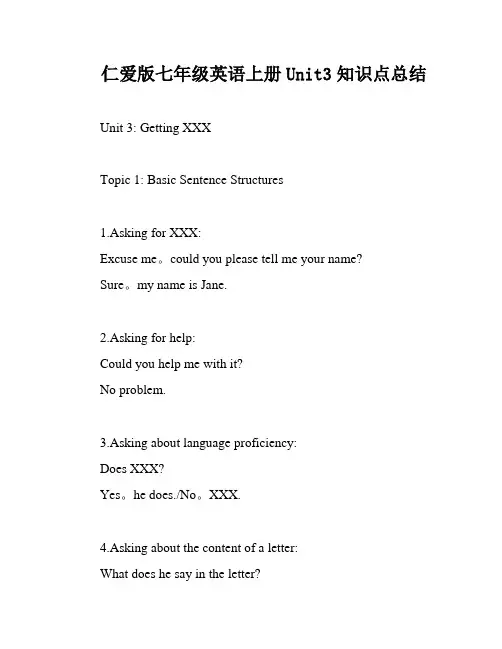
仁爱版七年级英语上册Unit3知识点总结Unit 3: Getting XXXTopic 1: Basic Sentence Structures1.Asking for XXX:Excuse me。
could you please tell me your name?Sure。
my name is Jane.2.Asking for help:Could you help me with it?No problem.3.Asking about language proficiency:Does XXX?Yes。
he does./No。
XXX.4.Asking about the content of a letter:What does he say in the letter?5.Describing friendship:Jane。
Sally。
and I are good friends.6.Describing mutual help:We often help each other.7.Expressing different degrees of liking:Many students in our class like English a lot。
but I like it a little.What about you。
Sam?No。
I don't like English at all.Useful Phrases:9.Pen palXXX11.A lot12.Not。
at all13.Each other14.A little15.Very much16.A lot of17.Every dayPersonal Pronouns and Simple Present XXXXXX or things。
and they have ns in person。
singular or plural。
仁爱版七年级上册英语全册复习笔记
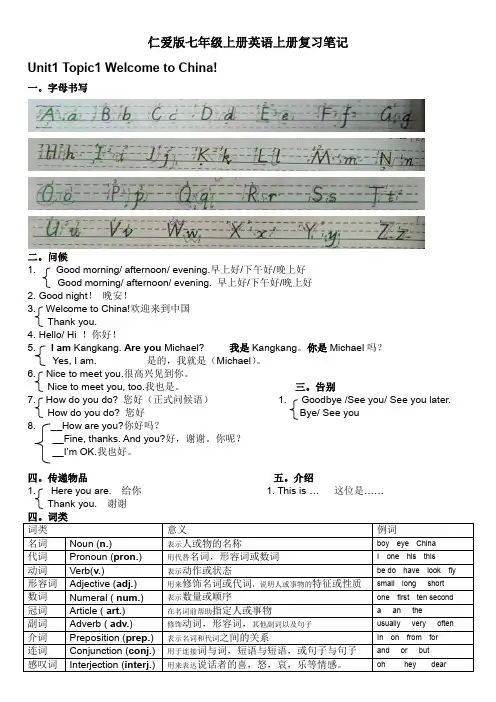
仁爱版七年级上册英语上册复习笔记Unit1 Topic1 Welcome to China!一。
字母书写二。
问候1. Good morning/ afternoon/ evening.早上好/下午好/晚上好Good morning/ afternoon/ evening. 早上好/下午好/晚上好2. Good night!晚安!3. Welcome to China!欢迎来到中国Thank you.4. Hello/ Hi !你好!5. I am Kangkang. Are you Michael? 我是Kangkang。
你是Michael吗?Yes, I am. 是的,我就是(Michael)。
6. Nice to meet you.很高兴见到你。
Nice to meet you, too.我也是。
三。
告别7. How do you do? 您好(正式问候语) 1. Goodbye /See you/ See you later.How do you do? 您好Bye/ See you8. __How are you?你好吗?__Fine, thanks. And you?好,谢谢。
你呢?__I’m OK.我也好。
四。
传递物品五。
介绍1. Here you are. 给你 1. This is …这位是……Thank you.谢谢四。
词类词类意义例词名词Noun (n.) 表示人或物的名称boy eye China代词Pronoun (pron.) 用代替名词,形容词或数词I one his this动词Verb(v.) 表示动作或状态be do have look fly 形容词Adjective (adj.) 用来修饰名词或代词,说明人或事物的特征或性质small long short数词Numeral ( num.) 表示数量或顺序one first ten second 冠词Article ( art.) 在名词前帮助指定人或事物 a an the副词Adverb ( adv.) 修饰动词,形容词,其他副词以及句子usually very often 介词Preposition (prep.) 表示名词和代词之间的关系In on from for连词Conjunction (conj.) 用于连接词与词,短语与短语,或句子与句子and or but感叹词Interjection (interj.) 用来表达说话者的喜,怒,哀,乐等情感。
Unit 3Topic 1 知识梳理 仁爱版英语七年级上册

Unit 3 Topic 1 知识梳理一.重点单词△can(modal v..)——could(过去式)well(adv./adj.)——good(adj.)pen pal(n.)——penfriend(同义词)many(pron.+可数名词复数)——much(pron.+不可数名词) 二.词组Section Ae from= be from 来自于…2.help sb. with sth.= help sb. do sth. 帮肋某人做某事3.help me with my Chinese 帮助我学汉语4.no problem. 没问题5.speak Chinese / English very well 汉语/英语说得很好Section B1.know a lot about sth. 对某事很了解; 对某事知道得很多2.live in 居住在….3.in the letter 在信中4.want to do sth. 想要做某事5.visit Beijing 参观北京Section C1.like...a lot/very much 非常喜欢2.like...a little 有点喜欢3.help each other 互相帮助4.not…at all 一点也不; 根本不Section D1. a lot of+名词复数/不可数名词许多=many +名词复数/ much+不可数名词2. a lot of people 许多人3.every day 每天4.pen pal=penfriend 笔友5.read books 看书三.知识点解析Section A1. Excuse me, could you please tell me your name?请您把名字告诉我好吗?“Could you please ...?”是一种常用的委婉、客气的表达请求句型,用来征求别人的意见,是一种较为礼貌的用语,后接动词原形。
(完整)仁爱英语七年级上册Unit3,topic1知识点讲解及随堂练习,文档
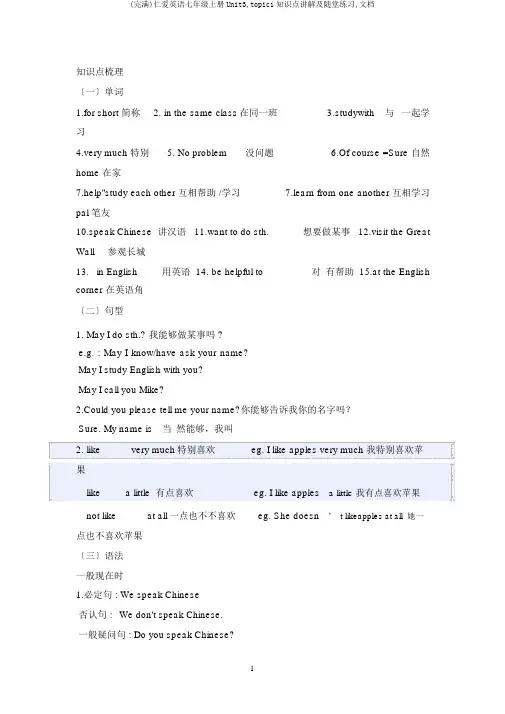
知识点梳理〔一〕单词1.for short 简称2. in the same class在同一班3.studywith 与一起学习4.very much 特别5. No problem没问题6.Of course =Sure 自然home 在家7.help"study each other 互相帮助 /学习7.learn from one another 互相学习pal 笔友10.speak Chinese讲汉语 11.want to do sth.想要做某事 12.visit the Great Wall参观长城13.in English用英语 14. be helpful to对有帮助 15.at the English corner 在英语角〔二〕句型1.May I do sth.? 我能够做某事吗 ?e.g. : May I know/have ask your name?May I study English with you?May I call you Mike?2.Could you please tell me your name?你能够告诉我你的名字吗?Sure. My name is当然能够,我叫2. like very much特别喜欢eg. I like apples very much 我特别喜欢苹果like a little 有点喜欢eg. I like apples a little 我有点喜欢苹果not like at all一点也不不喜欢eg. She doesn’ t likeapples at all她一点也不喜欢苹果〔三〕语法一般现在时1.必定句 : We speak Chinese否认句 : We don't speak Chinese.一般疑问句 : Do you speak Chinese?答复 : Yes, we do. No, we don't.2.必定句 : Mike speaks English.否认句 : Mike doesn't speak English.一般疑问句 : Does Mike speak English?答复 : Yes, he does. No, he doesn't.3.动词第三人称单数构成形式 :见书本 107 页代词人称代词 : 数/格人称单数复数主格宾格主格宾格第一人称I me we us第二人称you you you you第三人称he him they themshe herit it主格 :在句中当句子主语e.g. I have a good friend.He has a good friend.宾格 : 在句中当动词的宾语或介词的宾语,形成动宾或介宾结构 .Please call me Mike. (动宾 )Give it ( 动宾 ) to me (介宾 ) .Help us find him. (动宾 )人称代词排列序次:〔可记住口诀〕 you, he and I; we, you and they; he and she口诀:对你敬爱 you 在前,谦虚礼貌I 最后;我们人多力量大, we 要排在 you 从前, they 委屈垫在后;两性并列不一样样,绅士风范放一边,he 在前 she在后。
仁爱版英语七年级上册Unit3Topic1复习课件

-No,I ___. But I want to study it now. A. say ; don’t B. speak ; do C. speak ; don’t D. say ; do
( A ) 5. She has a pet. She likes it___.
( A )2.—Where does he live?
—He ____ in Shanghai.
A. lives B. live C. is live D. to live
( B )3.Li Lei often ____ Lin Tao ____ his English.
A. help; to B.helps; with C.helps; to D.help; with
7. Could you please tell _m__e_ (I) your name? 8. Do you speak _C_h__in_e_s_e_ (China)? 9. He wants __t_o_v_i_s_it__ (visit) the Great Wall. 10. I help her _(_t_o_) _s_tu_d_y(study) Chinese.
有点喜欢/不是很喜欢
don’t/doesn’t like…
不喜欢
don’t/doesn’t like ... at all
一点不喜欢
独自完成下面各题,看谁做得又对又快!
(C ) 1、 He doesn’t like apples____.
A.very B. me the little cat a lot but she likes it ____.
七年级仁爱英语上册知识点总复习.doc
Unit 1 Making New FriendsTopic 1 Welcome to China!一、重点词组及句子1、Good morning/afternoon/evening!早上好!/下午好!/晚上好!2、Welcome to SW 欢迎到某处来3、Thankyou!=Thanks!谢谢!4、Nice/Glad/Pleased to meet/see you.认识你很高兴。
(通常用于初次见面介绍相识之后,以示礼貌的常用语。
)5、Nice to meet you, too! Too意为"也”。
一般放在句末,可用逗号隔开。
6> How do you do?你好!首次见面的正式问候语。
通常回答也用How do you do?7、How are you?你好吗?通常用于熟人之间的问候,口语中类似的表达还有:How are you doing?回答时用I'm fine, thank you. / Fine, thanks. / Very well.(彳艮好。
)/ Not bad.(不错。
)/Just so-so.(还可以。
)等。
8、See you later = See you.再见。
是告别用语,类似的还有:See you then.到时候见。
Goodbye. / Bye-bye. / Bye.再见。
二、常用句型1、初次见面介绍某人时常用This is......2、自我介绍用I'm xxx.3、询问对方是不是某人用Are you xxx?肯定回答用:Yes, I am.(注意不能缩写)否定回答用:No, Tin not.三、语法要点1、Be动词的用法Be动词有三个am, is, are。
Am只能跟I搭配;is用于单数主语的后面he, she , it或是xxx; are用于复数主语的后面you, they, we.2、一般疑问句的用法如何将陈述句改为一般疑问句(1)如果句中有Be动词或是情态动词can, could, will, would, may等直接把Be动词或情态动词提到句首。
仁爱英语七年级上册Unit3Topic1知识总结
Unit3. Topic1. Do you like English?一.核心词汇could tell sure speak some pour with problem pet often want live say visit great wall many lot all so study little them very much home its dog any of二.常用词组pen pal help sb with sth want to do sth the Great Wall a lot not…at all each other a little very much at home三.重点句子He can speak some Chinese. Do you like Chinese? Yes, I do/ No, I don’t What does he say in the letter? He wants to visit the Great Wall. Many students in our class like English a lot, but I don’t like it at all. And I help her study Chinese. We help each other. 四.交际用语Excuse me, could you please tell me your name? Sure. Could you help me with it. No problem. Do you like English? Yes, I like it very much/a lot/ a little.五.语法精粹do 和does引导的一般疑问句及其肯定和否定回答Do you want a pen pal? Yes, I do./No, I don’t. Does he speak Chinese? Yes, he does./ No, he doesn’t. 表示喜欢的程度I like it very much/a lot/ alittle. I don’t like it at all. 人称代词的用法六.其他情态动词could 的运用学习辅音音标/tr/ /dr/ /ts/ dz/七.金点剖析1.Excuse me, could you please tell me your name? 打扰一下,请把你的名字告诉我好吗?(1)“Could you please+动词原形+其他?”用于礼貌的请求别人做某事,译成“你能….吗?肯定答语用Sure/Of course.或 No,problem。
仁爱英语七年级上册Unit3,Topic1复习课件
V.语法V梳.语理法理
二、一般现在时 1. 表示主语现在的性质、状态、特征、能力等。 2. 表示经常性、习惯性的动作。 3. 表示客观事实或普遍真理。
V.语法梳理
4. 标志词:often, usually, sometimes, always, never, on Sundays,
every day/month/year 句子结构:
III.考点解析
【辨析】speak, talk, tell和say
强调说话的能力,是不及物动词,常用短语 speak to/with sb. 意为“与 speak 某人谈话”;表示 “讲某种语言”时是及物动词,如 speak English。
意为“谈话,交流”,是不及物动词,常用短语 talk about sth. with sb. talk 意为“与某人谈论某事”。
III考点分析
(2)否定形式为:Could you please not do sth? 如:Could you please not stand here? 请你不要站在这儿好吗?
III考点分析
4.He can speak some Chinese. 他会说一些汉语。 (1) speak v 说、讲(某种语言),演讲。
III考点分析
5.Could you help me with it? 你能帮助我(学汉语)吗? help sb with sth=help sb( to )do sth 帮助某人做某事。 如:They help me with my Chinese.
=They help me (to) study Chinese.他们帮助我学汉语。
III考点分析
III.考点解析
3.Excuse me, could you please tell me your name? 打扰一下, 请把你的名字告诉我好吗?
Unit 3 Topic 1-3复习 22-23仁爱版七年级上册
teach
[tiːtʃ] v. 教
act
[ækt] v. 扮演,表演
drive
[draɪv] v. 驾驶,开车
aunt
• [ænt] [ɑːnt] n.婶母,伯母,姨母, 舅母,姑母
uncle brother sofa
• ['ʌŋkl] n.叔,伯,舅,姨父,姑父 • ['brʌðə(r)] n. 兄,弟 • ['səʊfə] n. 沙发
3. family tree 家谱
4. on the sofa 在沙发上
5. live in 住在某地 6. live with 和某人生活在一起
想要参观a lot of /many
许多a little
一点点
not ···at all
一点也不
live with sb each other help each other
和某人住在一起 互相,相互 互相帮助
重 like sth a lot/very much/ a little 非常喜欢某物/喜欢某物一点
name is Mike.
Translation
1.—你能告诉我你的电话号码吗? --当然可以。
Could you tell me your phone number? Sure. 2.你喜欢(说)英语吗? 是的。 Do you like (speaking) English? Yes, I do. 3.你能帮我学习中文吗? 没问题。
A. come;come B. come;comes C. comes;come
( B)6. They often help___ study English, so we like __ very