
八年级英语上册Unit 1 Where did you go on vacation教学反思
Unit1 Where did you go on vacation 本节课我是通过一首轻松诙谐的英文歌曲“How was your vacation?”进行导入,并借这首歌的题目进行提问,询问学生对于假期的感觉,学生自然的联想起相关的短语,学习的兴趣和积极性不知不觉的被调动起来。
接下来,我利用幻灯片的放映的方式来展示了我在去年假期旅游的几张图片,让学生们猜测我去哪里度假了,引起学生的兴趣,导入了本单元的话题:“Where did you go on vacation?”并让学生进行快速的对话练习,哪个组最快完成,最先展示的机会就属于哪个小组。
这样,学生们在这种紧张的学习氛围中即学到了知识,又锻炼了自己的口语表达能力。
在此环节,课后我询问学生了意见,学生们对我在上海世博会的照片很感兴趣,但是由于图片播放的较快,此环节并没有更深入的展开,就觉得有点意犹未尽的感觉。
对次环节,应多给学生时间展开更深入的讨论,不局限于就本单元的话题进行讨论,可以给学生更宽泛的选择,结合以往学过的知识来描述人物特征,描述天气情况等,这样自由的讨论方式来练习对话,不仅能给学生提供更贴近生活的学习内容,更让学生在爱学,乐学的氛围中得到了全方位的锻炼。
但回顾本课教学,发现了自己在创设情境,培养口语交际能力时,限制了学生的思维只是用固定的对话让学生练习,可以让学生根据我所展示的旅游照片,进行对话练习。
这样学生的积极性和兴趣都会显著提高。
所以在今后的教学中,我会把口语交际与创新教育结合到一起,不仅要让学生运用句型会说,敢说,更要让学生联系实际说,有自己的创新,有自己的发挥,更有自己的独特的表达方法。
在听力部分,由于时间问题,只播放了一遍,个别学生没能及时掌握,在今后的教学中,较难的听力材料,就要多播放几遍,通过反复的听力练习,逐渐加强学生的听说能力的培养,潜移默化的培养学生的语感。
在今后的英语教学中,我会本着“以学为主,当堂达标”的课改理念,“不断地完善、不断地探索、不断地创新”,将英语新课改与英语教学更有效地结合起来,旨在做到“让学生动起来,让课堂活起来,让效果好起来”。
八年级上册英语:Unit-1-Where-did-you-go-on-vacation试题及答案
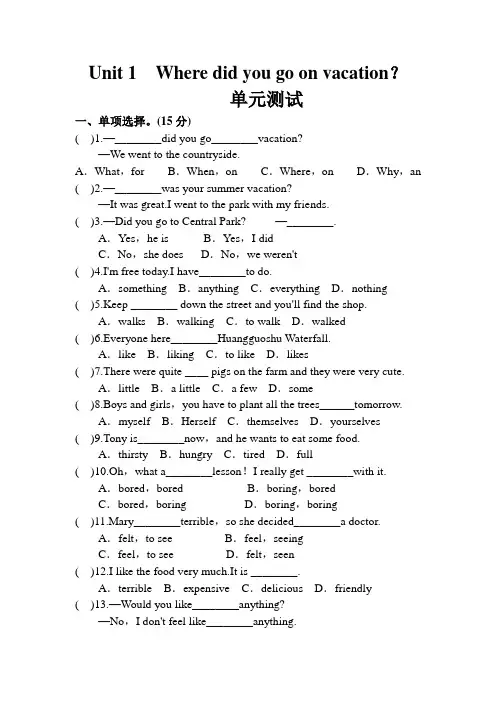
Unit 1 Where did you go on vacation?单元测试一、单项选择。
(15分)()1.—________did you go________vacation?—We went to the countryside.A.What,for B.When,on C.Where,on D.Why,an ()2.—________was your summer vacation?—It was great.I went to the park with my friends.()3.—Did you go to Central Park? —________.A.Yes,he is B.Yes,I didC.No,she does D.No,we weren't()4.I'm free today.I have________to do.A.something B.anything C.everything D.nothing()5.Keep ________ down the street and you'll find the shop.A.walks B.walking C.to walk D.walked()6.Everyone here________Huangguoshu Waterfall.A.like B.liking C.to like D.likes()7.There were quite ____ pigs on the farm and they were very cute.A.little B.a little C.a few D.some()8.Boys and girls,you have to plant all the trees______tomorrow.A.myself B.Herself C.themselves D.yourselves()9.Tony is________now,and he wants to eat some food.A.thirsty B.hungry C.tired D.full()10.Oh,what a________lesson!I really get ________with it.A.bored,bored B.boring,boredC.bored,boring D.boring,boring()11.Mary________terrible,so she decided________a doctor.A.felt,to see B.feel,seeingC.feel,to see D.felt,seen()12.I like the food very much.It is ________.A.terrible B.expensive C.delicious D.friendly()13.—Would you like________anything?—No,I don't feel like________anything.A.eating,eating B.eating,to eatC.to eat,eating D.to eat,to eat()14.—Do you like football? —______.I play it every afternoon.A.Of course B.Sorry C.That's OK D.Thanks a lot ()15.—Long time no see!—Oh!it________like years since(自从) I saw you last time.A.looks B.seems C.sounds D.tastes二、阅读理解。
8年级上册英语单词表人教版

8年级上册英语单词表人教版Unit 1 Where did you go on vacation?anyone [ˈeniwʌn] pron. 任何人anywhere [ˈeniweə(r)] adv. 任何地方 n. 任何(一个)地方wonderful [ˈwʌndəfl] adj. 精彩的;极好的few [fjuː] adj. 很少的;n. 少量most [məʊst] adj. 最多的;大多数的;something [ˈsʌmθɪŋ] pron. 某事物;nothing [ˈnʌθɪŋ] pron. 没有什么;没有一件东西everyone [ˈevriwʌn] pron. 每人;人人;所有人of course [əv kɔːs] 当然;自然myself [maɪˈself] pron. 我自己;我本人yourself [jɔːˈself] pron. 你自己;您自己hen [hen] n. 母鸡;雌禽pig [pɪɡ] n. 猪seem [siːm] vi. 似乎;好像bored [bɔːd] adj. 厌倦的;烦闷的someone [ˈsʌmwʌn] pron. 某人;有人diary [ˈdaɪəri] n. 日记;日记簿Unit 2 How often do you exercise?housework [ˈhaʊswɜːk] n. 家务劳动;家务事hardly [ˈhɑːdli] adv. 几乎不;几乎没有ever [ˈevə(r)] adv. 在任何时候;从来;曾经once [wʌns] adv. 一次;曾经twice [twaɪs] adv. 两次;两倍Internet [ˈɪntənet] n. (国际)互联网;因特网program [ˈprəʊɡræm] n. 节目;程序;课程;节目单full [fʊl] adj. 忙的;满的;充满的swing [swɪŋ] n. 秋千;v. 摇摆;旋转maybe [ˈmeɪbi] adv. 大概;或许;可能least [liːst] adj. 最小的;最少的 adv. 最小;最少Unit 3 I'm more outgoing than my sister.outgoing [ˈaʊtɡəʊɪŋ] adj. 外向的better [ˈbetə(r)] adj. 更好的;较好的 adv. 更好地loudly [ˈlaʊdli] adv. 大声地;高声地;花俏地quietly [ˈkwaɪətli] adv. 安静地;悄悄地;平静地hard-working [ˌhɑː d ˈwɜːkɪŋ] adj. 勤勉的;努力工作的competition [ˌkɒmpəˈtɪʃn] n. 比赛;竞赛;竞争fantastic [fænˈtæstɪk] adj. 极好的;了不起的which [wɪtʃ] pron. & adj. 哪一个;哪一些clearly [ˈklɪəli] adv. 清楚地;清晰地;明白地win [wɪn] v. 赢;赢得;获胜;获得 n. 胜利Unit 4 What's the best movie theater?theater [ˈθɪətə(r)] n. 剧场;电影院;戏院comfortable [ˈkʌmfətəbl] adj. 舒适的;充裕的seat [siːt] n. 座位;screen [skriːn] n. 屏幕;银幕close [kləʊz] v. 关;合拢;不开放;停业 adj. 接近的;亲密的worst [wɜːst] adj. 最坏的;最差的cheaply [ˈtʃiːpli] adv. 廉价地;粗俗地song [sɒŋ] n. 歌曲;歌唱choose [tʃuːz] v. 选择;决定carefully [ˈkeəfəli] adv. 小心地,认真地Unit 5 Do you want to watch a game show?sitcom [ˈsɪtkɒm] n. 情景喜剧news [njuːz] n. 新闻;消息soap [səʊp] n. 肥皂;肥皂剧educational [ˌedʒuˈkeɪʃənl] adj. 教育的;有教育意义的plan [plæn] n. 计划;方法 v. 打算;计划hope [həʊp] v. & n. 希望;期望;盼望discussion [dɪˈskʌʃn] n. 讨论;谈论stand [stænd] v. 站立;忍受happen [ˈhæpən] vi. 发生;碰巧;出现;偶遇may [meɪ] modal v. 也许;可能;可以expect [ɪkˈspekt] v. 预期;期待;盼望Unit 6 I'm going to study computer science.doctor [ˈdɒktə(r)] n. 医生engineer [ˌendʒɪˈnɪə(r)] n. 工程师violinist [ˌvaɪəˈlɪnɪst] n. 小提琴手pilot [ˈpaɪlət] n. 飞行员pianist [ˈpɪənɪst] n. 钢琴家scientist [ˈsaɪəntɪst] n. 科学家be sure about 确信;对……有把握make sure 确保;查明college [ˈkɒlɪdʒ] n. 大学;学院;高等专科学校education [ˌedʒuˈkeɪʃn] n. 教育Unit 7 Will people have robots?paper [ˈpeɪpə(r)] n. 纸;纸张pollution [pəˈluːʃn] n. 污染;污染物prediction [prɪˈdɪkʃn] n. 预言;预测future [ˈfjuːtʃə(r)] n. 未来;将来pollute [pəˈluːt] v. 污染environment [ɪnˈvaɪrənmənt] n. 环境planet [ˈplænɪt] n. 行星earth [ɜːθ] n. 地球;泥土plant [plɑːnt] v. 种植 n. 植物Unit 8 How do you make a banana milk shake? peel [piːl] v. 剥落;削皮pour [pɔː(r)] v. 倒;倾倒yogurt [ˈjəʊɡət] n. 酸奶;honey [ˈhʌni] n. 蜂蜜watermelon [ˈwɔːtəmelən] n. 西瓜spoon [spuːn] n. 勺,调羹add [æd] v. 增加;添加finally [ˈfaɪnəli] adv. 最后;最终salt [sɔːlt] n. 盐Unit 9 Can you come to my party?prepare [prɪˈpeə(r)] v. 预备;准备exam [ɪɡˈzæm] n. 考试available [əˈveɪləbl] adj. 可得到的;有空的;hang [hæŋ] v. 悬挂;(使)低垂catch [kætʃ] v. 赶上;抓住;捕捉invite [ɪnˈvaɪt] v. 邀请accept [əkˈsept] v. 接受refuse [rɪˈfjuːz] v. 拒绝Unit 10 If you go to the party, you'll have a great time! meeting [ˈmiːtɪŋ] n. 会议;集会;会面video [ˈvɪdiəʊ] n. 录像,录像带potato [pəˈteɪtəʊ] n. 土豆;马铃薯chocolate [ˈtʃɒklət] n. 巧克力upset [ʌpˈset] adj. 难过,失望;沮丧taxi [ˈtæksi] n. 出租汽车;的士advice [ədˈvaɪs] n. 劝告,建议travel [ˈtrævl] v. & n. 旅行;游历agent [ˈeɪdʒənt] n. 代理人,经纪人expert [ˈekspɜːt] n. 专家;能手。
人教版英语八年级上册 Unit 1 Where did you go on vacati

go out 出去
last month 上个月
take photos 拍照
quite a few 相当多;不少
have a good time 玩得开心 go shopping 去购物
of course 当然;自然
seem to do sth. 似乎做某事;好像做某事
keep a diary 写日记
Unit 1 Where did you go on vacation?
单元知识盘点
常用短语
on vacation 度假
go to the mountains 去爬山
stay at home 待在家里 go to the beach 去海滩
summer camp 夏令营
play volleyball 打排球
经典句型
1. ...I bought something for my father. ……我给我爸爸买了一些 东西。
2. Everything tasted really good! 所有的食物尝起来都很美味! 3. How did you like it? 你认为它(三亚)怎么样? 4. It was sunny and hot, so we decided to go to the beach near our
5. |烟台中考|—Look at my new smartphone.
—Wow, it’s so cool. When and where C you
it?
A. do; buy
B. have; bought
C. did; buy
D. have; had
6. —I have seen The Adventures of Alice in Wonderland. What
人教版英语八年级上第一单元Unit1Wheredidyougoonvacation知识点梳理

人教版英语八年级上第一单元Unit1Wheredidyougoonvacation知识点梳理Unit 1 Where did you go on vacation?知识梳理一、词型转换Section A1.wonder →(adj.) wonderful2.I →(反身代词) myself3.you →(反身代词) yourself4.yourself →(pl.) yourselves5.seem →(pt.) seemedSection B1.activity →(pl.) activities2.decide →(n.) decision3.try →(pt.) tried4.bike →(同义词) bicycle5.build →(n.) building6.difference →(adj.) different7.like →(反义词) dislike8.below →(反义词) above二、短语归纳Section A1.go to Central Park 去中央公园2.on vacation 在度假3.buy something special 买特别的东西4.meet someone interesing 遇见有趣的人5.go out with someone 和某人一起出去6.take quite a few photos 拍相当多的照片7.most of the time 大多数时间8.go shopping 去购物9.keep a diary 记日记10.of course 当然;自然Section B1.have a good time 玩得高兴;过得愉快2.go to the beach 去海滩3.feel like 感觉像4.the houses of the Chinese traders 中国商人的房子5. a lot of new buildings 许多新的建筑物6.in the past 在过去7.over an hour 一个多小时8.too many people 太多的人9.get to the top 到达顶部10.because of the bad weather 因为不好的天气11.one bowl of fish 一碗鱼肉12.another two hours 另外两个小时13.the top of the hill 山顶14.learn something important 学习重要的东西Self Check1.go to the countryside 去乡下2.in the shopping center 在购物中心3.have a fun time 玩得高兴;过得愉快4.after three hours 三个小时以后5.keep going 一直走6.twenty minutes later 20分钟后重点句子1.Where did you go on vacation?你去哪儿度假的?2.Long time no see.好久不见。
初中英语人教版八年级上册《Unit1 Where did you go on vacation.Se
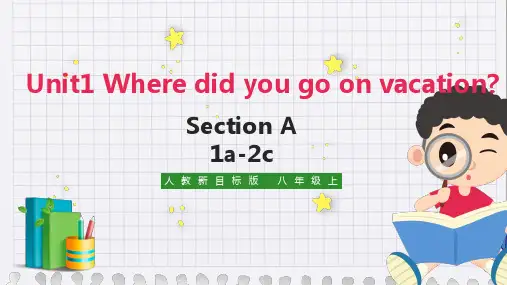
Grace
Kevin
Julie
Where did they go on vacation? Did they go with anyone?
Did they meet anything interesting?
Did they eat anything delicious?
2a Listen. Where did the people go on vacation? Complete the chart.
work-- __w__o_rked visit-- ___v_i_sited stay-- ___s_t_ayed play-- ___p_l_ayed
live-- __l_iv__ed move-- _m__o__ved use-- ___u__sed dance-- __d_a_n_ced
study-- _s_t_u_d_ ied carry-- __c_a_r_ried try-- ____t_ried copy-- __c_o__pied
They went fishing.
anything interesting一些 有趣的事情
Girl: What did you do on vacation,Sally?
Sally: Nothing. I just stayed at home.
Conversation 2
Girl: And did you do anything interesting,Bob?
参观
Quick response
去度假
去纽约市
拜望我的叔叔
去夏令营
参观博物馆
Simple past tense
动词原形
go to the mountains go to New York City go to the beach go to summer camp stay at home visit my uncle visit museums
人教版八年级英语上册 Unit 1 Where did you go on va
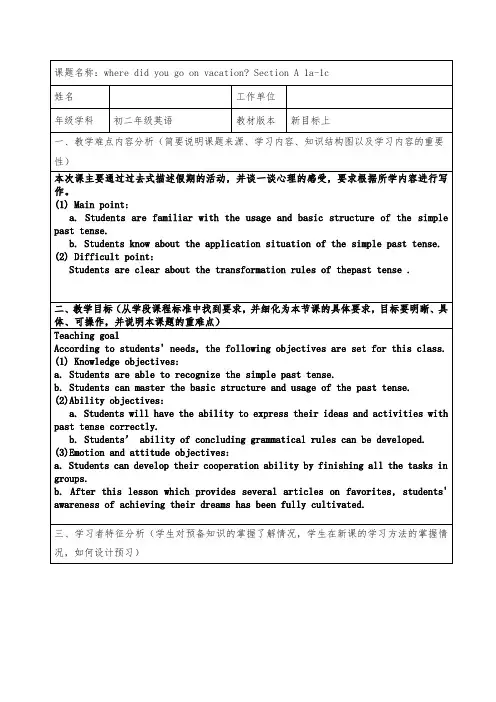
我掌握的词汇:
我掌握的短语:
我掌握的句型:
教师评价: 口头作文 ;笔头作文
七、教学板书(本节课的教学板书)
Questions
I
partner
where did you go?
I went to......
He/She went to......
What did you see?
I saw......
7.Did you buy anything?
8.What did you buy?
9.Why didn’t you buy anything?
10..........
Step3 Role-play.Work in pairs to ask and answer the questions above and fill the form on the screen.(运用多媒体制作表格帮助学生归纳总结)
And your partner’s summer vacation.
Step5.Listening sectionA 1b
Look at the picture above in 1a,do you know who they are and where they went on their vacation?Listen and finish exercise in 1b.
四、教学过程(设计本课的学习环节,明确各环节的子目标)
Step1:lead-in
T: where did you go on vacation? What did you see?How did you feel about it?
S:I went to...../I saw....
人教版八年级英语上册教案Unit 1 Where did you go on vacatio
Period 4 (Section B 2a-2e)设计说明本节课从“Let’s have a chant.”入手进行复习热身,通过看图学习生词、师生问答、朗读与翻译,全面学习本课时的重点词汇;本课时另一个重点是Jane的日记内容,通过读前、读中与读后的各项任务的操练,让学生充分理解日记中的内容,并对课文中重点词的用法进行合作探究。
教学目标1. 知识目标:(1)掌握单词和短语:enjoyable,activity,decide,try,paragliding,bird,bicycle,building,trader,wonder,difference,top,wait,umbrella,wet,below,enough,hungry,as,hill,feel like,because of。
(2)阅读两篇旅游日记,学会用英语描述假期情况。
2. 能力目标:(1)通过阅读两篇英文日记,获得相关信息,提高学生的综合阅读能力。
(2)学会用英语描述假期情况,从而学会写旅行日记。
3. 情感目标:通过阅读旅行日记,谈论假期经历,增进相互了解并享受生活的乐趣。
重点难点1. 重点:(1)掌握本课时出现的生词及短语。
(2)阅读短文,获得相关信息,提高学生们的综合阅读能力。
(3)掌握英语日记的书写格式。
2. 难点:(1)学生阅读策略的指导和运用。
(2)文本中长难句的理解。
教学准备1. 让学生搜集马来西亚的图片,了解这个国家的风土人情。
2. 教具:与本课词汇有关的图片及材料,多媒体课件、录音机和磁带。
教学过程Step 1Warming up & Leading inStep 2PresentationT:Look at the pictures. Let’s learn the new words. What’s this?S1:It’s a bicycle. (板书bicycle)T:Do you usually go to school by bicycle?S1:Yes,I do.T:In Picture 2,what are these?S2:They’re umbrellas. (板书umbrella)T:What’s he doing?S3:He’s trying paragliding. (板书try paragliding)T:Is he flying like a bird? (板书bird)S3:Yes,he is....Step 3Practice the new words1. Read the new words after the tape.2. Read and translate the following words and phrases into Chinese.activity 活动decide 决定;选定umbrella 伞;雨伞bird 鸟building 建筑物;房子trader 商人wonder 想知道;琢磨difference 差别;差异because of 因为top 顶部;表面wait 等待;等候wet 湿的;潮湿的;下雨的bicycle 自行车;脚踏车hungry 饥饿的as 像……一样;如同hill 小山;山丘try 尝试;设法;努力paragliding 滑翔伞运动enjoyable有乐趣的;令人愉快的feel like 给……的感觉;感受到below在……下面;到……下面enough 足够的(地);充足的(地);充分的(地)Step 4Reading1. Before readingTask 12a 1. Discuss the two questions with your partner.(1)What do people usually do on vacation?(2)What activities do you find enjoyable?2. Give students some possible answers:People usually go to some places of interest on vacation.I find fishing enjoyable.3. Students discuss the two questions. Write down their answers. Let several groups report their answers.Task 2T:Today I will show some pictures about Malaysia to let you know more about it.And show some exciting and interesting videos to you about paragliding. Let’s know about it.2. While readingT:Are you excited? Do you want to try paragliding? Now we’ll learn Jane’s diary entries about her vacation. She went to Penang in Malaysia. She went to the beach and tried paragliding. Now,let’s know about her vacation.Task 12b Read Jane’s diary entries. Answer the questions:Did Jane have a good time on Monday? What about on Tuesday?Check the answers and find out relative sentences.Answers:Yes,she did. Jane didn’t have a good time on Tuesday.Task 22c Read them again. Fill in the chart.Answers will vary.Task 3(1)Read the diary entries carefully,and fill in the blanks.Jane went to Penang in Malaysia. She went with her family. The weather was sunny and hot on Monday,so they went paragliding on the beach. In the afternoon,they rode bicycles to Georgetown. But the next day was not as good. Jane and her father went to Penang Hill but the weather became bad and it started to rain. They waited a long time for the train and they were wet and cold because they forgot to bring an umbrella. And that was not all! They didn’t bring enough money with them,so they only had one bowl of rice and some fish. But it tasted great!(2)Retell the text.Step 5Cooperative inquiryGet the class to read the following sentences and sum up.①It was sunny and hot,so we decided to go to the beach near our hotel.My father and I decided to go to Penang Hill today.We wanted to walk up to the top,but then it started raining a little so we decided to take the train.②I felt like I was a bird. =I felt like a bird.I feel like eating dumplings for dinner tonight.③And because of the bad weather,we couldn’t see anything below.=And because the weather was bad,we couldn’t see anything below.Lisa didn’t go to school because of her cold (感冒).=Lisa didn’t go to school because she had a cold.④My father didn’t bring enough money,so we only had one bowl of rice and some fish.Linda is old enough to go to school this year.a. decide+to do sth. 意为“决定做某事”。
人教新目标版英语八上Unit1《Wheredidyougoonvacation》精美说课稿
人教新目标版英语八上Unit 1《Where did you go on vacation》精美说课稿一. 教材分析《Where did you go on vacation》是人教新目标版英语八上Unit 1的内容。
本节课主要讨论过去发生的事情,通过询问对方度假的地点来展开对话。
教材内容丰富,插图生动,激发学生的学习兴趣。
本节课的主要目的是让学生掌握一般过去时的疑问句和回答,并能够运用所学知识进行实际对话。
二. 学情分析八年级的学生已经掌握了基本的英语语法知识,对于一般过去时有一定的了解。
但在实际运用中,部分学生可能会出现语法错误。
此外,学生的词汇量有限,可能会影响他们对文本的理解。
因此,在教学过程中,需要关注学生的个体差异,因材施教,帮助学生更好地掌握知识。
三. 说教学目标1.知识目标:学生能够掌握一般过去时的疑问句和回答,正确运用动词过去式进行对话。
2.能力目标:学生能够听懂、说出一般过去时的疑问句和回答,提高英语口语表达能力。
3.情感目标:通过讨论度假经历,培养学生热爱生活、分享快乐的感情。
四. 说教学重难点1.重点:学生能够掌握一般过去时的疑问句和回答。
2.难点:学生能够正确运用动词过去式进行实际对话。
五. 说教学方法与手段1.情景教学法:通过设置度假场景,让学生在真实情境中学习一般过去时的疑问句和回答。
2.任务型教学法:学生分组进行角色扮演,完成对话任务,提高口语表达能力。
3.信息技术辅助教学:利用多媒体课件、网络资源等,丰富教学手段,提高学生的学习兴趣。
六. 说教学过程1.导入:教师通过提问“Where did you go on vacation?”引导学生思考并回答,激发学生的学习兴趣。
2.新课呈现:教师展示教材插图,介绍一般过去时的疑问句和回答。
3.课堂活动:学生分组进行角色扮演,完成对话任务,教师巡回指导。
4.巩固练习:学生进行小组竞赛,看哪个小组能够在最短时间内完成一般过去时的疑问句和回答。
人教新目标八年级上册英语《Unit 1 Where did you go on vacation?》
人教新目标八年级上册英语《Unit 1 Where did you go on vacation?》Section A_教学设计3一. 教材分析人教新目标八年级上册英语《Unit 1 Where did you go on vacation?》Section A,主要讲述了假期旅游的话题。
通过本节课的学习,学生能够掌握一般过去时的提问和回答方式,学会使用“Where did you go?”, “What did you do?”等句型来询问别人的假期经历。
教材内容丰富,插图生动,有助于激发学生的学习兴趣。
二. 学情分析八年级的学生已经掌握了基本的英语语法知识,对一般过去时有所了解。
但在实际运用中,可能还存在一定的困难。
学生的词汇量和对英语文化的了解有限,需要通过大量的操练来提高运用所学知识进行交际的能力。
三. 教学目标1.知识目标:学生能够掌握一般过去时的提问和回答方式,学会使用“Where did you go?”, “What did you do?”等句型来询问别人的假期经历。
2.能力目标:学生能够在日常生活中,运用所学知识进行简单的交流。
3.情感目标:通过本节课的学习,学生能够增进与同学之间的友谊,分享彼此的假期经历,培养对英语学习的兴趣。
四. 教学重难点1.重点:学生能够掌握一般过去时的提问和回答方式。
2.难点:学生能够在实际情景中,灵活运用所学知识进行交际。
五. 教学方法采用任务型教学法,通过创设情境,引导学生参与课堂活动,充分调动学生的积极性和主动性。
在教学过程中,注重师生互动,生生互动,让学生在实践中学习,提高语言运用能力。
六. 教学准备1.教师准备:准备好相关的教学材料,如PPT、图片、卡片等。
2.学生准备:学生提前预习教材内容,了解一般过去时的基本用法。
七. 教学过程1.导入(5分钟)通过展示一些假期旅游景点的图片,引导学生谈论自己的假期经历,引出本节课的主题。
2.呈现(5分钟)教师通过PPT展示本节课的主要句型:“Where did you go?”, “What did you do?”等,同时给出相应的回答,让学生感知和理解这些句型的用法。
八年级上册Unit1Wheredidyougoonvacation八年级英语上册
Unit 1 Where did you go on vacation?本单元课时安排Section A (1 a — 1 c )(一课时) Section A (2a —2")(一课时)Section A {Grammar Focus —3c )(一课时) Sec 而〃 B (la-le )(一课时)Section B (2a —Self Check" 一 课时)本单元方法指导 1 .能利用句子重音捕捉关键信息,把握所听内容的大意。
2 .能通过词义的积极性或消极性判断、理解文章中人物的感受。
3 .能利用话题思维导图对词语归类整理,提高词语识记效率。
第一课时 Section A (la — 1c)教学环节自学互研》二Stepl 自主学习 【新词自查】 汉译英。
1 .待在家里 stay at home2 .去纽约城 go to New York Cily3.看望我的叔叔visit my uncle4. 去夏令营go lo summer camp5. 去爬山go to [he mountains6.去海滩go lo the beach7.参观博物馆visit museumsStep 2情景导入【参考案例】T: What did you do last Sunday?Ss:•••T: Today we are going to learn how(o talk about (he past events.设计意图:从询问全班学生的休息日情况入手,让学生初步理解对过去事情的谈论以及其基本结构。
激发学生学习本单元的兴趣,自然地导入新课。
导学达标》二Step 3完成教材la —1c的任务【操作案例】1.要求学生翻开课本P1,理解la中短语的意思,并按要求完成课本上相应的任务。
T: What can you see in the picture? Each picture shows something a person did in the , please match each phrase with one of the pictures.2.检查答案,先要求几名同学给出他们的不同意见,并全班一起讨论,让学生进一步理解la中动词或动词短语的过去式。