
仁爱版英语七年级上册Unit1知识点
Unit2知识点
短语:
①come from = be from 来自
②look the same 看起来像
③look different 看起来不同
④look like 看上去很像···
⑤ a pair of 一双···;一副···
⑥give sth. to sb.= give sb. sth. 把某物给某人
⑦形容词修名词语序:数+大小(长短)+形+颜+名four big round red apples
⑧want sth. 想要某物
⑨want to do sth. 想要做某事
⑩look at 看着
11in+a/an/the+颜色+名词或in+颜色穿着某种颜色的衣服
12next to 靠着···,挨着···,与···相邻
13help sb.(to)do sth.= help sb.with sth.帮助某人做某事
句型:见练习册第18页句型集锦
1)Do we/you/they have...? Yes, we/you/they do./ No, we/you/they don’t.
2)Does+主语+have+...? Yes, 主语+ does./ No, 主语+ doesn’t.
3)What does/do+主语+look like? 某人长得什么样?
语法:
◆have/has的用法
1.Li Lei and Li Jun___big noses.
A.has
B.have
C.are
2.Excuse me. Who ___ an eraser?
I ___ one. Here you are..
A.have;has
B.has;have
C.have;have
3.I ___ long arms and my sister ___ long arms,too.
A.have;has
B.has;have
C.have;have
◆陈述句变为一般疑问句
1.We are from China
___ ___ from China?
2.Mr.Lee can speak English.
___ Mr.Lee ___ English?
3.I want a pen pal.
___ you ___ a pen pal?
4.My sister has a round face.
___ ____ sister ___ a round face?
◆名词性物主代词=形容词性物主代词+名词
1.Look! Where’s that woman?
She is next to___baby.
A.her
B.hers
C.she
2.___ hair is long.
Yes,you’re right. ____ has long hair.
A.Hers,She
B.Her,She
C.She,Her
3.Are these toys ___?
No, they are not___. They are Lily’s.
A.yours,hers
B.yours,mine
C.Lily’s,yours。
Unit 1 Topic 1 重难点知识归纳总结2021-2022学年仁爱版英语七年级上册
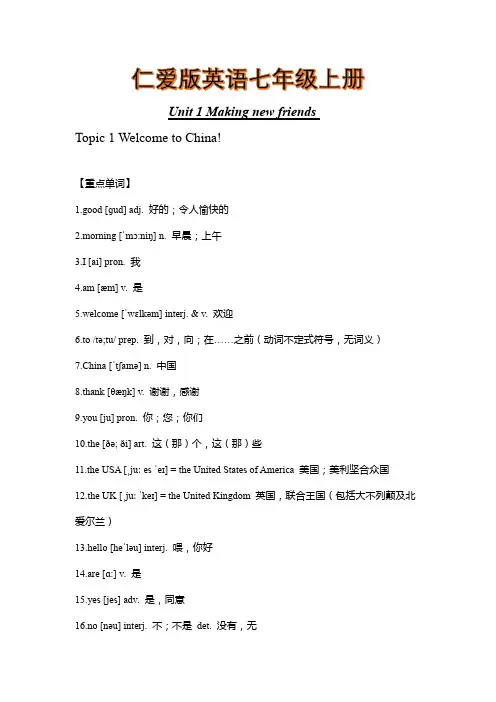
Unit 1 Making new friendsTopic 1 Welcome to China!【重点单词】1.good [ɡud] adj. 好的;令人愉快的2.morning [ˈmɔ:niŋ] n. 早晨;上午3.I [ai] pron. 我4.am [æm] v. 是5.welcome [ˈwɛlkəm] interj. & v. 欢迎6.to /tə;tu/ prep. 到,对,向;在……之前(动词不定式符号,无词义)7.China [ˈtʃaɪnə] n. 中国8.thank [θæŋk] v. 谢谢,感谢9.you [ju] pron. 你;您;你们10.the [ðə; ði] art. 这(那)个,这(那)些11.the USA [ˌjuː es ˈeɪ] = the United States of America 美国;美利坚合众国12.the UK [ˌjuː ˈkeɪ] = the United Kingdom 英国,联合王国(包括大不列颠及北爱尔兰)13.hello [heˈləu] interj. 喂,你好14.are [ɑ:] v. 是15.yes [jes] adv. 是,同意16.no [nəu] interj. 不;不是det. 没有,无17.not [nɔt] adv. 不;没有18.oh [əʊ] interj. 哦;啊19.nice [nais] adj. 令人愉快的;友好的20.meet [mi:t] v. 结识;遇见21.too [tu:] adv. 也;太;很22.hi [hai] interj. 喂23.thanks [θæŋks] interj. & n. 感谢;谢谢24.Mr. =mister /ˈmɪstər/ n. 先生25.see [si:] v. 遇见;看到;明白26.mom [mɔm] (mum [mʌm] BrE)n. 妈妈27.this [ðɪs ] pron. & det. 这,这个28.is [ɪz] v. 是29.my [maɪ] det. 我的30.teacher [ˈti:tʃə] n. 老师,教师31.how [hau] adv. 怎样;多少;多么32.do [du] v. aux. 构成否定句、疑问句的助动词,无词义v. 做33.dad [dæd] n. 爸爸34.Miss [mis] n. 女士;小姐35.Ms. /miz/ n. 女士36.afternoon [ˌɑ:ftəˈnu:n] n. 下午37.goodbye [ˌɡudˈbai] interj. 再见38.bye [baɪ] interj. 再见39.fine [fain] adj. 健康的;晴朗的40.and [ænd, ənd] conj. 和41.OK /əʊ'keɪ/ adj. (口语)安然无恙interj. 好,行42.here /hɪr/ adv. 在这里【重点短语】1.Good morning. 早上好2.Welcome to... 欢迎来到……3.Thank you. 谢谢。
仁爱版英语七年级unit1知识点
仁爱版英语七年级unit1知识点仁爱版英语七年级Unit 1知识点Unit 1是初中英语中的开端单元,为学生奠定了基础知识。
作为学习英语的起点,Unit 1包含了一些基础知识和技能,帮助学生越来越了解英语文法和语言使用基础。
本篇文章将介绍Unit 1中的一些重要知识点。
1. 英文字母Unit 1中的第一个也是最基础的知识点是英文字母。
英语拥有26个字母,它们是A~Z。
在学习单词和构建句子时,字母是非常重要的。
因此,学生需要正确掌握每个字母的大小写形式及其读音。
2. 句子的基本结构句子是英语交流的基础。
深入理解句子的结构有助于学生使用英语表达自己的想法。
英语句子包括主语和谓语,其中主语是句子的主体,谓语则是主语所做的事情或者状态。
有了这些基础知识,学生开始构建自己的句子,把单词和短语组合在一起并使之产生意义。
3. 代词代词是表示人、动物或物体的名称。
代词可以作为主语或宾语,用来代替一个名词或一个名词短语,以便轻松编写句子,避免单调。
例如,代词“he”可以用来代替男性的人或动物。
学生需要掌握常见的代词表,并知道如何正确使用它们。
4. 一般现在时一般现在时是英语最常用的时态之一。
学生需要理解这个时态的用法以及如何正确构成它。
一般现在时表达的是经常性事件或习惯性行为。
例如,当我们说“I usually have breakfast at 7am.”时,我们使用的就是一般现在时。
5. 非谓语动词非谓语动词是在句子中作为名词、形容词或副词的动词形式。
学生需要掌握基本的非谓语动词形式,包括不定式、动名词和现在分词。
这些动词形式可在句子中担任多种不同的语法角色。
6. 副词副词是描述动词、形容词或其他副词的词语。
它们通常回答“如何”、“何时”、“为什么”等问题。
学生需要理解副词的运用方法,包括其常见的表达方式,如程度、时间和方向。
7. 动词时态时态是指动词在时间上的位置。
英语有多种不同的时态,每个时态代表一种特定的时间或状态。
仁爱版七年级英语知识点梳理
仁爱版七年级英语知识点梳理Unit 1 How Do You Study for a Test?Vocabulary•academic (adj.) 学术的•advice (n.) 建议•chart (n.) 图表•classical (adj.) 古典的•experiment (n.) 实验•grade (n.) 年级,分数•method (n.) 方法•musician (n.) 音乐家•suggestion (n.) 建议,提议Useful Phrases•get ready for… 为…做好准备•make flashcards 制作抽认卡• a variety of 各种各样的•in order to 为了•take breaks 休息Grammar1.动词不定式•用于表达目的或意图–They study hard to get good grades.•接副词修饰–She plays the guitar beautifully to impress her friends.2.祈使句•用于表达建议或命令–Take a break and relax.Unit 2 What Is the Greenest Way to Travel? Vocabulary•bicycle (n.) 自行车•electric (adj.) 电动的•environment (n.) 环境•motorbike (n.) 摩托车•pollution (n.) 污染•public transportation 公共交通•recycle (v.) 回收利用•reuse (v.) 重复使用•walk (v.) 步行Useful Phrases• a lot of 很多•be made of 由…制成•in order to… 为了…•take advantage of 利用Grammar1.一般现在时•描述经常性活动或状态–I usually take the bus to school.•描述客观真理–The sun rises in the east.2.非谓语动词•表示相对于主语的动作或状态–I like walking in the park on weekends. Unit 3 Why Do You Like Pandas? Vocabulary•adorable (adj.) 可爱的•bamboo (n.) 竹子•behavior (n.) 行为•extinct (adj.) 灭绝的•habitat (n.) 栖息地•mammal (n.) 哺乳动物•natural (adj.) 自然的•survival (n.) 生存•wildlife (n.) 野生动物Useful Phrases•be famous for 因…而闻名•be used to 习惯于…•in danger 处于危险中•take care of 照顾Grammar1.一般过去时•描述过去的动作或状态–I liked pandas when I was young.•描述客观真理中的过去状态–Dinosaurs were extinct long before humans appeared.2.形容词的比较级和最高级•比较两个或多个物体或人的大小、高低、数量等–Pandas are cuter than koalas.•比较三个或三个以上物体或人的大小、高低、数量等–Elephants are the biggest land animals in the world. Unit 4 Can You Tell Me Where the Bank Is? Vocabulary•bank (n.) 银行•bookstore (n.) 书店•department store 百货商店•post office 邮局•skyscraper (n.) 摩天大楼•subway (n.) 地铁•supermarket (n.) 超市•traffic light 交通信号灯•turn left/right 向左/右转Useful Phrases•be across from 在…的对面•go straight 直走•next to 紧挨着•on the corner of 在…街角的Grammar1.介词短语表示方位•表示物体或人相对位置–The bank is across from the post office.•表示物体或人所在的位置–The supermarket is next to the bookstore.2.方位副词•表示方向或位置–Turn left at the traffic light.Unit 5 Do You Want to Watch a Game Show? Vocabulary•cheer (v.) 欢呼,喝彩•contestant (n.) 参赛者•entertainment (n.) 娱乐•host (n.) 主持人•live (adj.) 直播的•quiz (n.) 测验•reality show 真人秀•sitcom (n.) 情景喜剧•talent show 才艺秀Useful Phrases•have fun 玩得愉快•have a good time 过得愉快•in my opinion 在我看来•be similar to 与…相似Grammar1.情态动词 can 表示能力或请求•表示能力–I can speak Chinese and English.•表示请求–Can you help me with my homework?2.双宾语动词•受词可以是人也可以是物–My parents bought me a new bike for my birthday. Unit 6 I’m More Outgoing Than My Sister. Vocabulary•athletic (adj.) 运动的•creative (adj.) 有创造力的•friendly (adj.) 友好的•funny (adj.) 有趣的•outgoing (adj.) 外向的•quiet (adj.) 安静的•serious (adj.) 严肃的•shy (adj.) 害羞的•talkative (adj.) 多话的Useful Phrases•as…as 和…一样•be interested in… 对…感兴趣•in total 共计•be good at… 擅长于…Grammar1.形容词和副词的比较级和最高级•形容词比较级和最高级–My dog is bigger than yours.–Elephants are the biggest land animals in the world.•副词比较级和最高级–She sings better than everyone else in the class.–He always gets up the earliest in his family.2.非限制性定语从句•描述前面主句中人或物的情况–My sister, who is outgoing, loves making friends. Unit 7 What Does He Look Like?Vocabulary•bald (adj.) 秃头的•beard (n.) 胡子•curly (adj.) 卷曲的•handsome (adj.) 英俊的•mustache (n.) 小胡子•slim (adj.) 苗条的•tall (adj.) 高的•wavy (adj.) 波浪形的•overweight (adj.) 超重的Useful Phrases•be fond of 喜爱•be proud of 为…感到自豪•have a beard 留胡子•have curly hair 有卷发Grammar1.一般现在时表状态•描述可以看到或感觉到的状态–She has short, straight hair.•描述情感状态–They love animals and have a lot of pets.2.情态动词 should 表示建议•给出建议–You should eat more fruits and vegetables.Unit 8 How Was Your School Trip?Vocabulary•exciting (adj.) 令人兴奋的•get lost 迷路•hike (v.) 徒步旅行•learn about 学习•performance (n.) 表演•sightseeing (n.) 观光•souvenir (n.) 纪念品•visit (v.) 参观•waterfall (n.) 瀑布Useful Phrases•be afraid of 害怕•be surprised at 对…感到惊讶•look forward to 期待•take pictures 照相Grammar1.过去进行时•描述过去某个时刻正在进行的动作–We were hiking in the mountains when it started raining.•描述过去的某个时间段内正在进行的动作–They were sightseeing in Paris for a week.2.不定式作宾语•跟在某些动词、形容词或名词后面–We decided to visit the museum.Unit 9 How Do You Make a Banana Milk Shake? Vocabulary•blender (n.) 搅拌器•chop up 切碎•cook (v.) 烹饪•delicious (adj.) 美味的•ingredient (n.) 食材•mix (v.) 混合•recipe (n.) 食谱•salad (n.) 沙拉•sandwich (n.) 三明治Useful Phrases•add 加入•be good for 对…有益•instead of 代替…•follow…instructions 按照…的步骤Grammar1.现在进行时表示将来•表示已经安排好的未来事件–I am meeting my friends at the cinema tonight.•表示即将发生的事件–We are going to a party this weekend.2.不定式作状语•修饰动词–Jane went to the store to buy some fruits and vegetables.•修饰形容词或副词–It’s important to eat healthily and exercise regularly.Unit 10 I’d Like Some Noodles.Vocabulary•beef (n.) 牛肉•chicken (n.) 鸡肉•cook (n.) 厨师•duck (n.) 鸭肉•noodles (n.) 面条•pork (n.) 猪肉•seafood (n.) 海鲜•shrimp (n.) 虾•spicy (adj.) 辣的Useful Phrases•be allergic to 对…过敏•be full of 充满着…•be healthful 对…有益•be high in 富含…Grammar1.物主代词•代替名词作定语或宾语–His parents are both doctors.–I lost my phone on the way to school.2.祈使句表示命令或请求•命令–Try the spicy noodle soup. It’s really good.•请求–Could you pass me the salt, please?。
仁爱版七年级英语上册知识汇总(最新版)

仁爱版七年级英语上册知识汇总Unit 1 Making New Friends【重点短语】1. good morning/ afternoon / evening 早上/下午/晚上好2. glad / nice to meet / see you 见到你很高兴3. welcome to + 地点欢迎来到……4. let’s + v让我们做……5. stand up 起立6. sit down 坐下7. this is... 这是……8. thanks = thank you 谢谢9. see you = see you later = goodbye 再见10. ID number 身份证号码11. be from=come from 来自12. in English 用英语【重要句型】1. ---What’s your name? ---My name is Sally.2. ---Where are you from? ---I’m from China.---Where do you come from? ---I come from China.3. ---Where is he/ she from? ---He/She is from Japan.4. ---What’s this/ that in English? --- It’s a/ an…5. ---What’re these/ those in English? ---They’re…6. ---How do you spell it? ---E-R-A-S-E-R, eraser.7. ---Can you spell it? ---Yes, M-A-P, map.8. —How old are you/ is he/ are they?—I’m/ He is/ They are eleven.9. —What’s your telephone number?—It’s 4567967.10. —What class/ grade are you in?—I’m in Class Ten, Grade Seven.(注意大小写)11. Good morning/ afternoon/ evening.12. —Hello!/Hi! —Hello!/Hi!13. —Nice/Glad to see/meet you. —Nice/Glad to see/meet you, too.14. —Welcome to China/my home. —Thanks.15. —How do you do? —How do you do?16. —How are you? —Fine, thank you. And you? —I’m OK.17. —See you then/ later. —See you.18. —Goodbye. —Bye.19. —Thank you. —You’re welcome./That’s OK./Not at all.【重点语法】1. 元音字母:Aa Ee Ii Oo Uu包含有以下元音的字母:[e] Aa Hh Jj Kk[i:] Ee Bb Cc Dd Gg Pp Tt Vv[aɪ] Ii Yy[ju:] Uu Qq Ww[e] Ff Ll Mm Nn Ss Xx Zz2. 大小写句首字母,人名,地名,称呼语,专有名词,星期的首字母要大写,引人注意。
仁爱英语七年级上册u1t1知识点汇总
七上英语知识点
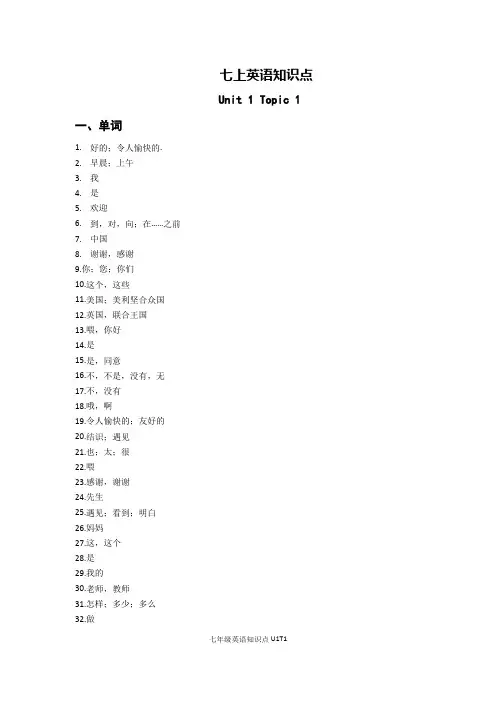
Unit 1 Topic 1
一、单词
1.好的;令人愉快的.
2.早晨;上午
3.我
4.是
5.欢迎
6.到,对,向;在……之前
7.中国
8.谢谢,感谢
9.你;您;你们
10.这个,这些
11.美国;美利坚合众国
12.英国,联合王国
13.喂,你好
14.是
15.是,同意
16.不,不是,没有,无
17.不,没有
18.哦,啊
19.令人愉快的;友好的
20.结识;遇见
21.也;太;很
22.喂
23.感谢,谢谢
24.先生
25.遇见;看到;明白
26.妈妈
27.这,这个
28.是
29.我的
30.老师,教师
31.怎样;多少;多么
32.做
七年级英语知识点U1T1
33.爸爸
34.女士,小姐
35.女士
36.下午
37.再见
38.再见
39.健康的;晴朗的
40.和
41.安然无恙;好,行
42.在这里
二、句子
1、早上好!
2、下午好
3、见到你很高兴(两种)
4、见到你也很高兴(两种)
5、欢迎到中国来!谢谢。
6、你好!(两种)
7、你(身体)好吗?很好,谢谢。
8、我是康康。
9、你是麦克儿吗?是/不是。
10、妈妈,这是我的老师布郎先生。
布郎先生,这是我的妈妈。
11、再见!(两种)
12、给你。
谢谢。
七年级英语知识点U1T1。
仁爱英语七年级上册知识点归纳
仁爱英语七年级上册知识点归纳Unit 1 Me- 认识数字:one, two, three, four, five, six, seven, eight, nine, ten- 认识颜色:red, yellow, green, blue, black, white, pink, purple, orange, brown, gray- 问候和介绍自己:Hello! What's your name? My name is... Nice to meet you. How are you? I'm fine, thank you. And you?- 询问国籍:Where are you from? I'm from...- 询问年龄:How old are you? I'm...years old.- 询问电话号码:What's your telephone number? My telephone number is...Unit 2 My Family- 家庭成员的称呼:father, mother, parents, brother, sister, grandparents- 描述家人外貌特征:He/She has... He/She is... tall/short/fat/thin...- 询问家人的职业:What does your father/mother do? My father/mother is a...- 描述家人的工作:My father/mother is a teacher/engineer/nurse/doctor...- 谈论喜好:I like... He/She likes...- 谈论家人的爱好:My father/mother likes reading/watchingTV/singing/dancing/playing sports...Unit 3 At School- 学科名称:Chinese, English, math, music, art, P.E., science- 表示上课的动词:study, have, take- 学习用品:books, pencils, rulers, erasers, dictionaries- 描述课程活动:read, write, listen, speak, sing, dance, play...- 学校地点:classroom, library, playground, gym- 询问上学和放学时间:What time do you go to school/come home? I go to school at... I come home at...- 描述学校日常活动:We have Chinese/English/math/music/art/P.E./science class.Unit 4 Food and Drinks- 食物:bread, eggs, noodles, rice, dumplings, vegetables, fruits- 饮料:water, milk, juice, tea, coffee, soda- 询问食物和饮料的喜好:Do you like...? Yes, I do. / No, I don't.- 描述食物和饮料的味道:It'sdelicious/tasty/yummy/healthy/sour/sweet/hot/cold...Unit 5 My Day- 表示时间的词汇:morning, afternoon, evening, night, o'clock, half past,quarter past, quarter to- 描述一天的安排:I get up at... I go to school at... I have lunch at (I)come home at... I do my homework at... I go to bed at...- 谈论每天做的事情:I usually... I sometimes... I often... I always... on weekdays/on weekends.- 描述一周的安排:Monday, Tuesday, Wednesday, Thursday, Friday, Saturday, Sunday. On Monday, I have Chinese/English/math/music/art/P.E./science class.Unit 6 In the Classroom- 描述教室物品:desk, chair, blackboard, bookcase, door, window, computer, clock- 表示教室位置:in front of, behind, next to, on, under, in, between- 询问教室物品的位置:Where is the...? It's... In/on/under/next to/between... - 描述教室活动:sit, stand, open, close, read, write, listen, speak, draw, sing, dance, play...- 询问和回答问题:What's this? It's a/an... What are these? They're...- 数词:first, second, third, fourth, fifth, sixth, seventh, eighth, ninth, tenthUnit 7 Sports and Hobbies- 描述体育运动:play basketball/football/tennis/volleyball/baseball/table tennis/badminton/swimming...- 描述爱好:My hobby is... I like... I enjoy...- 提问对方的爱好:What's your hobby? Do you like...? Yes, I do. / No, I don't. - 数词:every day, once a week, twice a month, three times a year- 谈论周末的活动:On weekends, I often... I sometimes... I never...以上是仁爱英语七年级上册的知识点归纳,希望对您有所帮助。
仁爱七年级上册u1t1知识点
仁爱七年级上册u1t1知识点为了更好地学习英语,今天我们来介绍仁爱七年级上册U1T1的知识点。
一、词汇1. introduce:介绍2. name:名字3. spell:拼写4. family name:姓5. first name:名6. country:国家7. nationality:国籍8. language:语言9. greet:问候10. say goodbye:告别二、句型1. What's your name?:你叫什么名字?2. How do you spell it?:怎么拼写它?3. What's your family name?:你的姓是什么?4. What's your first name?:你的名字是什么?5. Where are you from?:你来自哪里?6. What's your nationality?:你是哪国人?7. What language do you speak?:你说什么语言?8. How do you do?:你好吗?9. Nice to meet you.:很高兴见到你。
10. Goodbye.:再见。
三、语法两个重要的单词是代词和动词be。
1. 代词代词用于代替特定的人或物。
常用的代词有I,you,he,she,it,we,they。
2. 动词be动词be有三种形式:am,is,are。
它用于描述人或物的状态。
例如:I am a student.(我是一个学生。
)。
四、常用表达1. How do you do?(你好吗?)这是一种正式的问候方式,通常用于第一次见面时,回答时可以说:How do you do?或者I'm fine, thank you.(我很好,谢谢。
)2. What's up?(怎么样?)这是一种非正式的问候方式,通常用于熟悉的人之间。
3. See you.(再见。
仁爱英语七年级unit1知识点总结
仁爱英语七年级unit1知识点总结仁爱英语七年级Unit 1知识点总结仁爱英语是一套外语教材,随着社会经济水平的提高,英语已经成为我们生活、工作中必备的一种语言。
然而,英语学习的前提是汇聚足够的英语知识,Unit 1是典型的初级班课程,在此我们将对Unit 1的全部知识点进行总结,方便孩子们的学习。
一、动词的三个形态1. 一般现在时:表示经常或习惯性的动作或状态。
2. 进行时:表示正在发生或进行的动作。
3. 一般过去时:表示已经发生的动作。
二、介词1. at 用于表示时间、强调地点2. in 用于表示月份、年份、具体时间段、一天中的时段、境内的地名等3. on 用于表示日期、星期几、具体某一天、电视、广播、舞台剧、大学等三、数词1. 基数词表示个数,序数词表示顺序。
2. 当基数词是以4、6、8结尾时,除了11、12、13外,其余的都结尾为-ty。
四、冠词1. a/an 是不定冠词,用于泛指,表示一种或未特指2. the 是定冠词,用于特指,表示唯一或已经知道的人、物、事物。
五、代词1. 人称代词:I、you、he、she、it、we、you、they2. 物主代词:my、your、his、her、its、our、your、their六、名词1. 普通名词:表示一般事物的名称2. 物质名词:表示无法数清的物质3. 抽象名词:表示精神和信仰等概念的词语七、形容词1. 表示人、物的特征和性质2. 常常和名词搭配,置于名词之前八、副词1. 表示时间、地点、程度等2. 通常以-ly结尾,在句中修饰动词、形容词和副词等。
九、对话1. 对话的基本用语:问候语、介绍、感谢、道歉、道别。
2. 对话的语气:问句、声明句、祈使句、感叹句。
以上是Unit 1的全部知识点总结,每一项内容都涵盖对语言基础知识和语言使用技能的掌握,让孩子们更好地入门英语。
同时,这篇总结也有利于孩子们系统地复习、强化知识点,从而提高英语水平。
仁爱七年级英语上册unit1知识点
七年级英语(上)Unit 11.早上/下午/晚上好Good morning/afternoon/evening2.喂!/你好!Hello/Hi!3.(初次见面)你好吗?How do you do?4.A:你好吗?How are you?B:好,谢谢.你也好吗?Fine,thanks.And you?/How are you?A:我也很好。
I’m OK./I’m fine,too.5.A:认识/见到你很高兴。
Nice to meet/see you.B: 认识/见到你也很高兴。
Nice to meet/see you,too.6.A:欢迎到中国来!Welcome to China! B:谢谢!Thanks./Thank you.7.A:再见!See you later. B:再见!See you.8.A:再见!Good-bye. B:再见!Bye-bye.9.让我们开始吧!Let’s begin!10.请起立!Stand up,please!11.请坐下!Sit down,please!12.妈妈,这是我的老师,李先生。
Mom,this is my teacher,Mr.Lee.13.A:打扰了,你是简吗?Excuse me, Are you Jane?B:是的,我是。
/不,我不是。
Yes,I am./No,I’m not.14.A:他/她是李华吗?Is he/she Li Hua? B:是的,他/她是。
//不,他/她不是。
Yes,he/she is. // No,he/she isn’t.15.A:他们都来自英格兰吗?Are they from England?B:是的,他们是。
/不,他们不是。
Yes ,they are./ No,they aren’t.16.A:你/他/她的名字是什么?What’s your/his /her name?B:我/他/她的名字是刘星。
My/His/Her name is Liu Xing.17.A:你/他/她的电话号码是多少?What’s your/his/her telephone number? B:我/他/她的电话号码是…My /His/Her telephone number is …18.来自be from = come from19.A:你来自于哪儿?Where are you from?= Where do you come from?B:我来自于加拿大。
仁爱版七年级英语上册Unit1知识点总结
仁爱版七年级英语上册Unit1知识点总结在七年级英语上册的第一个单元学习中,我们主要掌握了一些基础的英语语法和词汇。
下面我将对本单元的知识点进行总结。
一、动词Be的用法动词Be是英语中最基础也最常用的动词之一。
它有三种基础形式,即am、is、are,分别用于表示第一人称单数,第三人称单数和第一/第三人称复数。
例如:I am a student.She is my teacher.We are classmates.另外,动词Be也可用于构成简单的现在进行时态,表示正在进行的动作。
其构成方式为:主语 + am/is/are + 动词的-ing形式。
例如:We are playing basketball.He is studying English.二、名词的单数形式和复数形式名词是指人、事、物等的名称。
根据不同的情况,名词可以分为单数形式和复数形式。
一般来说,名词的单数形式是在词尾加上-s,而复数形式则要根据名词的种类而有所不同。
例如:- 名称以辅音字母+y结尾的单数名词,变为复数时要先把-y变为-i,再加-es。
如:baby变为babies。
- 名称以-s, -x, -ch, -sh, -o结尾的单数名词,变为复数时要在词尾加-es。
如:box变为boxes。
- 其他单数名词,在词尾加-s即可变为复数。
如:book变为books。
三、代词的用法代词是用来代替名词的词语。
常见的代词包括人称代词、物主代词、反身代词等。
例如:- 人称代词:I, you, he, she, it, we, they- 物主代词:my/mine, your/yours, his, her/hers, its, our/ours, their/theirs- 反身代词:myself, yourself, himself, herself, itself, ourselves, yourselves, themselves代词的使用通常取决于上下文。