
2020年牛津深圳版英语八年级下册Unit7学 案(无答案)
4). After discussion(讨论), all staff __________ the name to the product.
5). He _______ get someone to help us.
6). I don’t quite ________ their methods(opinions, ideas).
5. What happened to the light?
happen
“偶然,碰巧发生”,多用于客观事物或情况的发生
take place
不带偶然的意思,多指事先安排好的事情发生
6. Tina woke up at midnight.
①wake up醒来;叫醒;e.g. I didn’t wake up until 12 o’clock.
②at midnight半夜;e.g. He will drop in at midnight.【拓展】at noon在中午at night在深夜
7. She looked out of her window and saw a yellow light in the sky.
【辨析】look out, look at, look for, look after, look out of, look up
具体用法:
(1)wonder + wh- +不定式
我想知道去哪里度假:
(2)wonder +if(whether)从句
我想知道你今晚是否有空:
(3)wonder+ at sth对...感到诧异/ wonder about....对...感到奇怪
I wonder at his doing that.
5.Receive v.收到接到接纳接待
①thousands of成千上万的;几千;许多;e.g. Thousands of people hunt and fish for a living.
②thousand千;e.g. There are about three thousand students in our school.
4. Aliens sometimes take people from the Earth into their spaceships.
A. look for B. look after C. look at D. look up
3). I have to move to Guangzhou in the near future, so I’m _________ a new house there.
A. looking for B. looking after C. looking at D. looking up
6.fear n.害怕;惧怕:Her eyes showed no fear.
7.pleased adj.=______ _______高兴的
对...很满意_____________________
8.a kind of一种:What kind of house do you live in?
kind of有一点,稍微;有几分:She was feeling kind of tired.
They agreed on the project at last.最后他们就这项工程达成了共识。
【精练】用agree to, agree with, agree on的正确形式填空。
1). I quite______ their suggestions.
2). I quite _______ what you said.
一段时间
e.g. The boss decided to live in the big house for some time.
some times
几倍,几次
e.g. I’ve been there for some times.
The dog is some times bigger than the mouse.
3.quiet adj.安静的quietly adv.安静地
The sea was very quiet.
He always speaks quietly.
4.frightened adj.惊吓的;害怕的I’m too frightened to ask him now.
【固定搭配】
be frightened of sth. /doing sth.= be scared of (doing)sth害怕某事/做某事
(1)共同点:都可以表示_______________;
(2)区别:
①agree with还可以表示与(气候或食物等)相适合;后面一般跟某人或是某人说的意见、想法;后面还可以what引导的从句。
e.g. The climate here agrees with me.我适应这儿的气候。
②agree to后面不能接人。还可以用语结构:agree to do sth.
look up
查阅;仰视
e.g. Look up the dictionary(字典) if you meet some new words.
【精练】
1). Kate didn’t go to the movie last night because she had to ________ her sick dog at home.
4). The teacher asked the students to _________ the blackboard.
A. look for B. look after C. look at D. look up
8. I’m sure something landed in the forest near the hills as I heard a loud noise last night.
9.share v.均分;分摊:Twore…with sb.(与某人)和……分享
I shared my cake with him.
要点精析
1.I’m sure something landed in the forest near the hills as I heard a loud noise last night.
本单元课文分析
1. What do you know about...?
know about了解,知道关于……的情况;
e.g. Do you know about this computer game?
2. Do you agree with the following sentences?
【辨析】
3.The spaceship was damaged because of a crash.
damage v.毁坏;破坏:The fire badly damaged the town hall.
4.I wonder what it means.
Wonder v.觉得奇怪;想知道n.奇迹;惊讶_________ adj. __________adv.
sometimes
有时,表示频率
e.g. Sometimes the patient cried for the pain.
sometime
指某一个不明确的时间,用在过去时态和将来时态
e.g. I’d like to see the film sometime next week.
some time
disappointv.使失望disappointedadj.失望的disappointingadj.令人失望的
shockv./n.震惊shockedadj.震惊的shockingadj.令人震惊的
5.discover v.发现;找到;发觉:He didn’t discover his mistake.discovery n.发现
A. look for B. look after C. look at D. look up
2). --- Excuse me, Miss Liu. I don’t know the meaning(意思) of the sentence.
--- You’d better first __________ the new words.
be frightened to do sth.= be scared to do sth不敢做某事
【总结】以-ing和-ed结尾的词可用作表语和定语。其区别是:以-ing结尾的词常用来说明事物的性质特征;以-ed结尾的词常用来说明主语(通常指人)所处的状态。
【拓展】
类似的词如:
surprisev./n.使吃惊;吃惊surprisedadj.惊讶的surprisingadj.令人吃惊的
receive a letter from sb./ have a letter from sb./get a letter from sb./ hear from sb/“收到某人的来信”
Receive/accept/take三个单词的区别:
(1)receive表示收到(客观事实)
If you receive a request like this, you can’t fail to obey it!
7). He ________ get someone to help us.
8). Do you _______this arrangement?
9). She______ get everything ready before I come.
3. Aliens came to the Earth thousands of years ago,and made some buildings.
深圳牛津英语八年级下册unit7
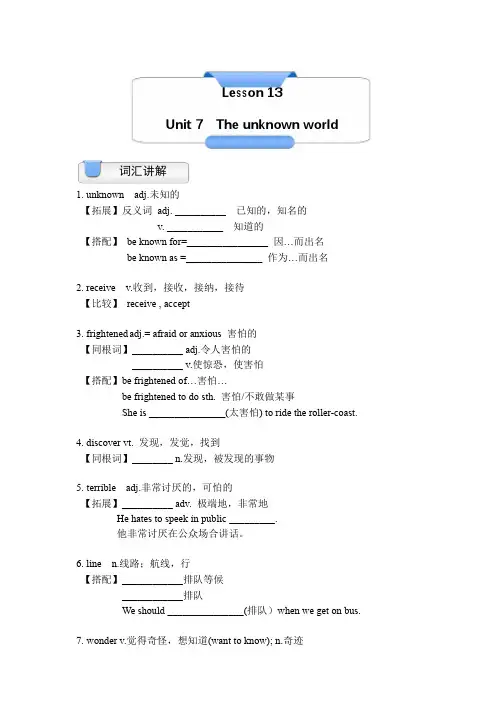
Lesson 13Unit 7 The unknown world词汇讲解1. unknown adj.未知的【拓展】反义词adj. __________ 已知的,知名的v. ___________ 知道的【搭配】be known for=________________ 因…而出名be known as =_______________ 作为…而出名2. receive v.收到,接收,接纳,接待【比较】receive , accept3. frightened adj.= afraid or anxious 害怕的【同根词】__________ adj.令人害怕的__________ v.使惊恐,使害怕【搭配】be frightened of…害怕…be frightened to do sth. 害怕/不敢做某事She is _______________(太害怕) to ride the roller-coast.4. discover vt. 发现,发觉,找到【同根词】________ n.发现,被发现的事物5.terrible adj.非常讨厌的,可怕的【拓展】__________ adv. 极端地,非常地He hates to speek in public _________.他非常讨厌在公众场合讲话。
6. line n.线路;航线,行【搭配】____________排队等候____________排队We should _______________(排队)when we get on bus.7.wonder v.觉得奇怪,想知道(want to know); n.奇迹【拓展】___________adj;___________adv.【搭配】wonder +what to do . / how to do sthI wonder ______ to solve the problem perfectly.我想知道如何完美的解决这个问题。
牛津深圳版英语八年级下册Unit7Theunknown第1课时Reading教学设计

4.课堂教学环节设计:
a.导入:通过展示神秘事件图片,激发学生的学习兴趣,引入本节课的话题。
b.阅读前:引导学生预测文章内容,培养学生的预测能力和阅读兴趣。
c.阅读中:采用任务型教学法,让学生在阅读过程中完成相应的任务,提高阅读效率。
d.阅读后:进行巩固练习,如填空、翻译等,检测学生对文章内容的理解程度。
2.学生分享自己的观点,教师总结:Today, we are going to explore some unknown mysteries in the reading passage. Let's see what interesting things we can learn from it.
a.摘抄文章中的核心词汇和短语,学会正确运用。
b.分析文章中的时态运用,特别是一般过去时。
c.概括文章大意,并用自己的话进行简要介绍。
2.写作任务:请学生以“An Unknown Mystery I Know”为题,编写一篇关于神秘事件的短文。要求如下:
a.运用本节课所学词汇和短语。
b.使用一般过去时描述神秘事件的发生。
在本章节的学习中,学生对神秘事件、未解之谜等话题表现出浓厚的兴趣,这为教学提供了良好的情感基础。然而,由于词汇量和阅读策略的限制,学生在面对较长、较复杂的文章时,可能会出现理解困难。因此,在教学过程中,教师应关注学生的个体差异,采用分层教学,针对不同水平的学生进行有针对性的指导。
此外,八年级的学生正处于青春期,他们的思维活跃,求知欲强,但同时也容易产生焦虑和挫败感。因此,在教学过程中,教师应注重激发学生的学习兴趣,鼓励他们积极参与课堂活动,培养他们的自信心和自主学习能力。通过本章节的学习,帮助学生拓展知识视野,提高英语综合运用能力,为今后的学习打下坚实基础。
八年级英语下册 Chapter 7 Family lives教案 牛津深圳版

Chapter 7 Family livesTeaching Aims:1.Learn to use these words : pocket money, teenager, spend, seldom, latest,disturb, responsibility, whole, useful, expect, last, family tree, bunch, play, perform, washing machine, receive, afford, therefore, electrical2.Learn to use the following phrases: after all, at the bottom of, make it, makethe decisions, aged 14, a generous amount of, the latest fashions,look after, expect things for nothing,3. Be able to skillfully report what people say and what we read.4.Read and comprehend the two short articles in Chapter Seven to improve thestudents’ reading ability.5.Encourage the students to interview some people they livearound them about the family life and try to establish afriendly family relationship.Important and difficult points:1)Report what people say and what we read2)Reading comprehensionTeaching Methods:1) Listening, speaking and writing.2)Watch and say3)Pair / group workTeaching aids: Multi-media, a tape recorderTeaching Periods: 8The First PeriodVocabulary StudyMain Points :1 Pronounce the words correctly..2. Memorize the word spelling3. Use the words and phrases to make the sentences.Teaching ProceduresStep 1 Greetings and revision1.Teacher greets the class in the usual way.2.Check the assignment for the last lesson.3.Get the students to read the new words of Chapter7 at Page 102Step 2 Learn to pronounce the words correctly.Step 3 Help to explain the words in English and memorize the spellingStep 4 Use the words and phrases to make the sentences in groups1) pocket money, teenager, spend, seldom, latest, disturb, responsibility, whole, useful, expect, last, perform, afford, therefore,2)after all, at the bottom of, make itStep 5 Let’s play a game.A memory testing game to review the new words in Chapter SevenStep 6 Today’s homework1.Finish the exercise in Workbook Vocabulary Page 77.2.Preview the reading of Chapter 7.Periods 2 & 3ReadingMain Points: Read and comprehend the two short articles in Chapter Seven to improve the students’ reading abilityTeaching ProceduresStep1 Greetings and revision1. Teacher greets the class in the usual way.2.Check the assignment for the last lesson.3. Review the new words we have learnedStep 2 Pre-taskWhat do you know about:Ask the Ss to discuss about the following questions before reading the articles.1.How much pocket money do you get?2.Who does the housework in your home?3.Do you often get presents from your parents? If so, what kind of presents arethey?4.Who makes the decisions in your family?5.What are the rules about watching TV in your home?Step 3 While-task1. Go through the articles and try to fill in the blanks at Page86.Tiny David1 pocket money2 housework a generous amounta _____ ____ ____b It is the job ____ ___________ ______a does it _____ ____b It is the _____ ____3 presents4 parents saying no5 TV watching _____.gets ____ ___ _________________ ____each week_____ ____ _____.gets them _______._____________ ____ each week2. Listen and then answer the T(True) or F(False) questions.3. Fill in the blanks with the words and phrases learntTina’s family lifeTina’s parents give her ________ _______ _____ of pocket money every month. If she ____ it before the _____ of the month, they complain _____ _____, but they always give her _____.She _____ do housework. Sometimes her mot her asks her to _____ her room if she’s very _____, but she always gives her _____ or a _____ for helping her. Tina thinks ______ is the job of the parents.She gets lots of presents. She also has lots of nice ______. Her parents buy her all the _____ fashions. They _____ say ‘no’. They want her to have a happy _____. Tina has her own TV. She can watch it for _____, and no one _____ her. She watches TV for about _____ hours each week.David’s family lifeDavid gets ______ _____ pocket money every month. His parents says he has to learn to _____ _____ his money. So they ______ give him any more if he spends it too q uickly. But he think this is ______.He has to do the _____ for about ____ hour every day. He ______ dishes and clothes, _____the floors and sometimes _____ meals. His parents never ______ him for doing housework. He thinks doing housework is the ________ of the ______ family.His parents give him presents _______. They usually give him something ______. They only buy him ______ clothes. They only have _____ TV for the whole family and he watches it for about _____ hours each week.Step 4 Post-task: Writing.Write an article about your own family life. Try to use the words and phrases learnt as many as possible.Step 5 Today’s homework1.Listen to the tape recording of the reading and read aloud .2.Finish the textbook C.&D. at Page88-89.The Fourth PeriodMain Points: Encourage the students to interview some classmates about the family life to improve oral EnglishTeaching ProceduresStep 1 Greetings and revision1.Teacher greets the class in the usual way.2.Check the assignment for the last lesson.C1 1. latest 2. Teenagers 3. useful 4. disturbsC2. 1. responsibility 2. seldom 3. pocket money 4. expecting 5. spends D1 1. Opinion 2. Fact 3. FactStep 2 Find out the following words and phrases:1. 决策 2、数量不少的零用钱 3、花费 4、月底 5、很少抱怨6.毕竟 7、最时尚的衣服 8、度过一个快乐的童年9、打扰某人 10、照顾、保管 11、整个家庭的责任12、某些有用的东西 13、想要一些没用的东西Step 3 Try to find out the answers to the following questions:1.How much pocket money do Tina’s parents give her?2.If Tina spends the pocket money before the end of the month, what will happen to her?3.Does Tina often do housework? What’s her opinion to doing housework?4.Why do Tina’s parents give her so many presents?5.Ho w does David deal with his pocket money?6.Does he need to do hous ework? What’s his opinion to doing housework?7. What kind of presents do David’s parents usually give him?8.How often does David watch TV?Step 4 DiscussionWork in pairs and discuss which opinion to doing housework do you agree on? And why?Step 6 Compare you with your partnerAfter finishing the chart, please compare you with your partner according to the information you take down. And then report it to your classmates.Step 7 Today’s homework1.Memorize the words and phrases and get ready for tomorrow’s dictation.2.Finish the exercises in Workbook at Page 84-85.The Fifth PeriodListeningMain Points: Practice listening for information to improve listeningTeaching ProceduresStep1 Greetings and revision1.Teacher greets the class in the usual way.2.Check the assignment for the last lesson.3.Have a dictation.Step 2 Introduce the the listening materials we’ll listen to.1.We’ll listen to three dialogues. After eac h dialogue there is onequestion on the recording.2.Explain some of new words and phrases in it.1). laste.g. I hope our friendship will last forever.2). family tree3) at the bottom ofe.g. We found some words at the bottom of the vase.4) make ite.g. If you try your best, you’ll make it.Step 3 Listen to the tape recording and choose the right answers.Answers:1. a2. c3. aStep 4 Do Workbook Page82-83Step 5Today’s homeworkPreview the textbook at Page 91-93Prepare for the dictation.Periods 6 & 7LanguageMain Points: Be able to skillfully report what people say and what we read. Teaching Procedures:Step1 Greetings and revision1.Teacher greets the class in the usual way.2.Check the assignment for the last lesson.3. Have a dictation.Step 2 Learn to report what people say1.In this chapter, only very simple reported speech in the present tense isused. Students only need to worry about changing the pronouns and making sure that the verbs agree with the changed forms.2.Read the introductory text with students and carefully explain the changesin the tab le. Point out to them how pronouns do not have one fixed meaning, but vary according to the speaker, and that, as in Chinese, when we report what someone says, we must make the appropriate adjustments.3.Remind students that the pronunciation of says is /sez/.4.Tell the class to wtite out the answers to Exercise A1 and A2, which shouldbe done by students individually.Step 3 Do the exercises on the textbook and check the answers.A11.David says he gets a little pocket money.2.David says that they all do the housework in her home.3.David says that his parents only buy him simple clothes.4.David says that they only have one TV for the whole family.A21.She says she seldom does housework.2.She says no one disturbs her.3.He says his parents give him presents sometimes.4.She says sometimes her mother asks her to clean her room..5.He says his parents often say ‘no’ when he asks for things.6.She says her parents want her to have a happy childhood.7.She says her parents never pay him for doing housework.B11.--- Will the flower show start on the fifth of March?---- No. The advert says it will start on the eighth of March.2.--- Will the Lady of Iron be on at 9.20?---- No. The paper says it will be on at 7.25.3.---- Is Sunshine Apartments near the underground station?----Yes. The advert says it is just a short walk away.4.---- Is the woman in the picture d oing a fashion show?--- No. The picture shows she is showing the customers some new cars.5.---- Will it be fine all day today?---- No. The forecast says it will become cloudy with rain later.6.---- Can children go to see the film at the Shenzhen Film Studio?---- No. The advert says it is not suitable for children.Step 4 Today’s homeworkFinish Workbook at Page 79-81.The Eighth PeriodSpeakingMain Points: Learn to give yourself time to thinkTeaching Procedures:Step 1 Greetings and revision1.Teacher greets the class in the usual way.2.Check the assignment for the last lesson.Step 2 Lead-inAnswer the following questions:1.How many people are there in your family?2.Are you an only child?3.Have you ever done housework?4.Do you wash clothes by yourself of by washin g machine?Step 3 Teach the students to use some of the expressions to give yourself time to think.Well: 1) to express doubt and hesitation;Well, I’m not so sure about it.2) to continue a story;Well, the next day he bought a new car.3) to express surprise;Well, that’s good news.Oh well, if I must leave , I will.( Oh well is used to express acceptance of something rather unwelcome)Oh, I didn’t realize that.( Oh expresses slight surprise.)Er, I don’t really know.(Er expresses hesitation.)Um, I don’t know what to say.(Um means the speaker is thi nking.)Ah, I was going to tell you that I’ve lost the report.( Ah expresses surprise , sudden understanding or introduces a difficulty.)Step 4 Listen and read and finish ExerciseA1A11. Let’s go to the cinema this afternoon.2. Well, er… Um, ah… Yes, but you see, er…3. What rubbish!4. He thinks washing clothes is a job for girls.5. bStep 5 Practicing the conversation in pairsB. Speak upWork in small groups and discuss the questions at Page95.Step 6 Report your results to the class.The Ninth PeriodWritingMain Points: Learn to write a family charter to improve our writingTeaching Procedures:Step1 Greetings and revision1.Teacher greets the class in the usual way.2.Check the assignment for the l ast lesson.Step 2 Lead-inRules are important. At school, we have school rules. In every country, we have rules called laws. Rules and laws make people feel safe and happy because they know what they can or cannot doDo you think a family needs rules as well? In some families, a Family Chapter is used to give parents and teenagers some ideas on how to live together better. Step 3 Writing a Family Chapter at Page 96Step 4 More PracticeStep 5 Using EnglishStep 6 Today’s homeworkWrite a family charter of your own family.。
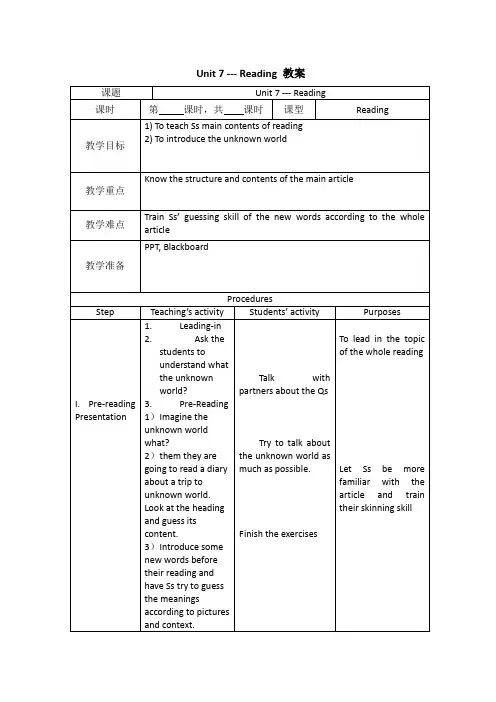
新牛津深圳版八年级英语下册Unit7 Reading教案
Discuss with classmates
Be more familiar with the whole passage
IV. Homework
1)学案Reading一张
2)英语周报一张
3)字帖一张
Reflection
3)Introduce some new words before their reading and have Ss try to guess the meanings according to pictures and context.
Talk with partners about the Qs
I. Pre-readingPrhe students to understand what the unknown world?
3.Pre-Reading
1)Imagine the unknown world what?
2)them they are going to read a diary about a trip to unknown world. Look at the heading and guess its content.
Try to talk about the unknown world as much as possible.
Finish the exercises
To lead in the topic of the whole reading
Let Ss be more familiar with the article and train their skinning skill
深圳牛津版英语八年级下册课件 U7 Reading comprehension 学案
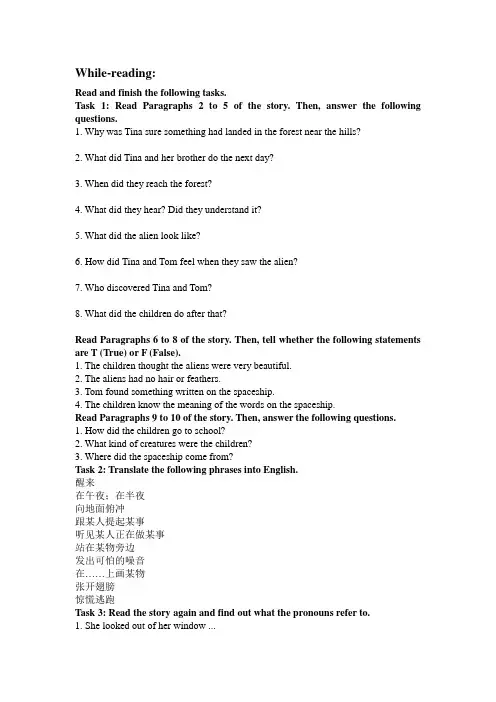
While-reading:Read and finish the following tasks.Task 1: Read Paragraphs 2 to 5 of the story. Then, answer the following questions.1. Why was Tina sure something had landed in the forest near the hills?2. What did Tina and her brother do the next day?3. When did they reach the forest?4. What did they hear? Did they understand it?5. What did the alien look like?6. How did Tina and Tom feel when they saw the alien?7. Who discovered Tina and Tom?8. What did the children do after that?Read Paragraphs 6 to 8 of the story. Then, tell whether the following statements are T (True) or F (False).1. The children thought the aliens were very beautiful.2. The aliens had no hair or feathers.3. Tom found something written on the spaceship.4. The children know the meaning of the words on the spaceship.Read Paragraphs 9 to 10 of the story. Then, answer the following questions.1. How did the children go to school?2. What kind of creatures were the children?3. Where did the spaceship come from?Task 2: Translate the following phrases into English.醒来在午夜;在半夜向地面俯冲跟某人提起某事听见某人正在做某事站在某物旁边发出可怕的噪音在……上画某物张开翅膀惊慌逃跑Task 3: Read the story again and find out what the pronouns refer to.1. She looked out of her window ...2. It suddenly dived into towards the ground.3. They heard some voices speak a strange language, ...4. It was standing next to a long spaceship.5. It discovered them and made a terrible noise.6. They were very ugly.7. It looks strange.8. “It looks strange,” he said, as he looked at the word “EARTH”.Post-reading:1.见课本100页C1。
深圳牛津版英语学案八年级下册Unit7
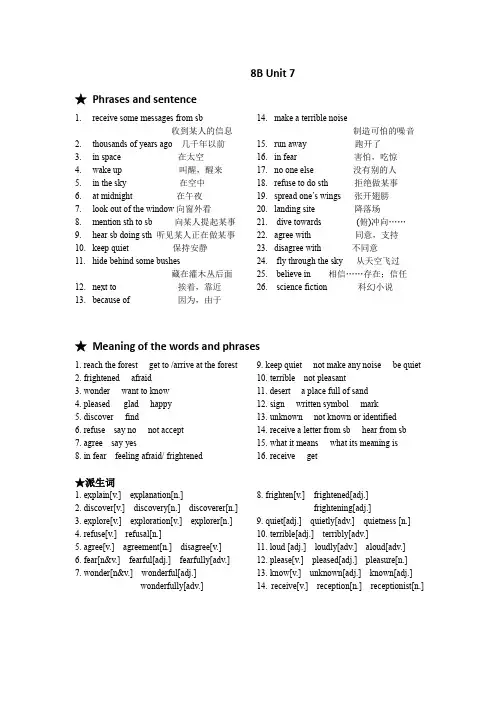
8B Unit 7 ★Phrases and sentence1. receive some messages from sb收到某人的信息2. thousands of years ago 几千年以前3. in space 在太空4. wake up 叫醒,醒来5. in the sky 在空中6. at midnight 在午夜7. look out of the window向窗外看8. mention sth to sb 向某人提起某事9. hear sb doing sth 听见某人正在做某事10. keep quiet 保持安静11. hide behind some bushes藏在灌木丛后面12. next to 挨着,靠近13. because of 因为,由于14. make a terrible noise制造可怕的噪音15. run away 跑开了16. in fear 害怕,吃惊17. no one else 没有别的人18. refuse to do sth 拒绝做某事19. spread one’s wings 张开翅膀20. landing site 降落场21. dive towards (俯)冲向……22. agree with 同意,支持23. disagree with 不同意24. fly through the sky 从天空飞过25. believe in 相信……存在;信任26. science fiction 科幻小说★Meaning of the words and phrases1. reach the forest----get to /arrive at the forest2. frightened----afraid3. wonder----want to know4. pleased---- glad----happy5. discover----find6. refuse---say no----not accept7. agree---say yes8. in fear---feeling afraid/ frightened 9. keep quiet----not make any noise----be quiet10. terrible---not pleasant11. desert ---a place full of sand12. sign----written symbol----mark13. unknown----not known or identified14. receive a letter from sb----hear from sb15. what it means----what its meaning is16. receive----get★派生词1. explain[v.]---explanation[n.]2. discover[v.]---discovery[n.]---discoverer[n.]3. explore[v.]---exploration[v.]---explorer[n.]4. refuse[v.]---refusal[n.]5. agree[v.]---agreement[n.]---disagree[v.]6. fear[n&v.]---fearful[adj.]---fearfully[adv.]7. wonder[n&v.]---wonderful[adj.]---wonderfully[adv.] 8. frighten[v.]---frightened[adj.]---frightening[adj.]9. quiet[adj.]---quietly[adv.]---quietness [n.]10. terrible[adj.]---terribly[adv.]11. loud [adj.]---loudly[adv.]---aloud[adv.]12. please[v.]---pleased[adj.]---pleasure[n.]13. know[v.]---unknown[adj.]---known[adj.]14. receive[v.]---reception[n.]---receptionist[n.]。
8B Unit7 More practice 2020-2021学年八年级英语牛津深圳版下册
★教材原文Many people say they have seen UFOs. Here is one famous story. It is called the Roswell Incident and it happened in the US in 1947.Person A (name not given): My wife and I were sitting outside because it was a warm night. Suddenly we saw something very bright flying through the sky.Person B (William Brazel, a farmer): I found some pieces of strange metal on my farm. I called the army. Major Marcel came and collected the pieces. He told me not to talk to anyone about this.Person C (Major Marcel): I went and collected the pieces. I gave them to an army expert. He said the pieces came from a weather balloon. However, since I have not seen this kind of metal before, I think this was a lie.Person D (name not given): My parents and I were in the countryside. Suddenly we saw a silver spaceship on the side of the hill. There were the bodies of three aliens lying on the grass. Then some soldiers came and told us to leave.So what is the truth?* Perhaps some or all of the people lied.* Perhaps a US rocket crashed and people thought it had come from space.* Perhaps an alien spaceship really crashed in Roswell.★巩固提升一、阅读下列短文,然后根据其内容回答问题。
牛津深圳版英语八下Unit 7《The unknown world》单元教学设计
牛津深圳版英语八下Unit 7《The unknown world》单元教学设计一. 教材分析牛津深圳版英语八下Unit 7《The unknown world》以探索未知世界为主题,引导学生了解和思考未知世界的奥秘。
本单元主要包括两部分内容:一是关于未知世界的科普知识,如黑洞、暗物质等;二是关于探索未知世界的方法和态度,如勇于探索、保持好奇心等。
通过本单元的学习,学生能够提高自身的科学素养,培养探索精神和批判性思维。
二. 学情分析八年级的学生已具备一定的英语基础,对未知世界充满好奇。
但在科普知识方面,学生了解不多,尤其是黑洞、暗物质等专业知识。
此外,部分学生可能对英语阅读产生抵触情绪,需要教师激发他们的学习兴趣。
三. 教学目标1.知识目标:学生能够掌握关于未知世界的相关词汇和表达,如blackhole、dark matter等;2.能力目标:学生能够运用所学知识进行阅读理解,提高获取信息的能力;3.情感目标:学生能够培养勇于探索、保持好奇心的态度,提高科学素养。
四. 教学重难点1.重点:学生能够熟练运用本单元词汇和表达进行阅读理解;2.难点:学生能够理解黑洞、暗物质等专业知识,并运用英语进行描述。
五. 教学方法1.任务型教学法:通过完成各种任务,激发学生的学习兴趣,提高学生的参与度;2.情境教学法:创设真实情境,让学生在实践中运用所学知识;3.合作学习法:培养学生团队合作精神,提高交际能力。
六. 教学准备1.教材:牛津深圳版英语八下Unit 7《The unknown world》;2.课件:制作与本单元主题相关的课件,辅助教学;3.视频资料:关于黑洞、暗物质等未知世界的科普视频;4.练习题:针对本单元内容设计的阅读理解练习题。
七. 教学过程1.导入(5分钟)利用课件展示未知世界的图片,如黑洞、暗物质等,引导学生思考:What do you want to know about the unknown world? 激发学生的好奇心,为本单元学习做好铺垫。
最新2019-2020学年牛津深圳版英语八下Unit 7《The unknown world》word单元教案
Unit 7 Memory一、教材分析本单元围绕着“未知的世界”的话题来展开听、说、读、写的训练。
教材一篇有关外星人的故事,鼓励学生对未知的世界和科学要善于探索和学习。
作为初二年级的学生,了解未来世界对于提高学生探索新知识有一定的帮助。
语法方面介绍由because引导的原因状语从句。
并培养学生在完成一篇有关遇见鸟的世界的人们的故事并尝试正确使用这个语态。
二、教学对象分析1.学生通过初一的学习,对工具书的使用有一定的了解,通过对百科全书的介绍和用法,提高学习的自学能力,有利于开展本单元的听、说、读、写任务。
2.学生在平时的学习就已经接触过了由because引导的原因状语从句的用法,本单元再通过系统地复习,在学习方式上引导学生学习归纳总结。
三、单元教学目标1.认知目标:1)通过谈论“未知世界”的相关话题,提高学生探索新知的意识。
2)结合课文的内容,引导学生对未来世界和科学的设想,鼓励学生拓展自己的视野,探索新知。
3. 能力发展目标:1)能够在听、说、读、写等语言综合实践活动中运用本单元的重点词汇、句型与语法。
2)在学习中提高交流和传递信息的能力,在写作中正确运用连词使文章更连贯和流畅。
3)通过指导学生在模拟交际中运用所学的知识,培养学生探究学习、合作学习、自主学习的能力。
四、单元教学重点1. 学生熟练掌握重点词语,词组及句型。
2.指导学生利用所学句型正确表达思想、进行交际活动。
3.指导学生归纳、总结原因状语从句的用法,并在实践运用中熟练运用。
五、单元教学难点状语从句的归纳整理及运用。
六、教学策略1. 引导学生积极主动的通过预习完成可以自己学会的部分,课堂学习完成学习的重难点,通过复习及归纳总结完善单元的学习。
2. 在教学中以旧带新,引导学生用正确的句子表达思想。
3. 适当补充与课文话题相关的内容,拓展学生的阅读视野。
七、学习策略1.初步接触略读(skimming)和找读(scanning)这两种阅读策略。
最新:广东省广州市牛津深圳版八年级英语下册Unit7 复习学案(无答案)-文档资料
广东省广州市七年级英语下U7系统复习【Part 1 8下Unit7系统复习】一.重点单词及短语Unit7二.重点语法U7原因状语从句原因状语从句:由because, for, as, since引导(1)because (因为)的用法:because通常表示直接的原因。
because引导的从句表示直接而明确的原因和理由,表示按因果关系的推断,语气很强,用来回答why的问题, 一般位于主句之后。
例:We couldn't go out because it was too cold. 因为天气太冷,我们不能外出。
.(2)for(因为)的用法:for是并列连词,引出的原因较间接,似乎是事后所想到的补充解释的理由,只陈述一般推断的理由,不一定表示产生结果的必然原因,主要放在两个并列句之间。
注意:下列情况下只能使用because: ①在回答why的问句时;②在用于强调句型时;③被not所否定时。
(3 )as和since(因为)的用法: 表示已经知道的原因时用as或since,即某种原因在说话人看来已经很明显,或已为听话人所熟悉。
since要比as正式一些,它们通常被置于语句之前。
Seeing all of the children already seated, he said,“Since everyone is here, let’s start.”(4)Because of and because because与because of的用法比较从词性上看because 是连词,其后接句子;because of 是复合介词,其后接名词、代词、动名词、what 从句等。
如:I didn’t buy it because it was too expensive. 我没有买是因为它太贵了。
He is here because of you (that). 他为你(那事)而来这里。
He lost his job because of his age. 由于年龄关系他失去了工作。