
六年级英语上册Module8Unit1教案外研版三起
2.Watch andanswer.
观看视频,回答问题。
1.Look and answer.
Hello, boys and girls. I’d like to show you something today. Do you know what these things are?
Do you like reading books?
4.Look, listen andanswer.
Look at the pictureand answer强调单词clean。
5.Look, listen andanswer.
Look at the pictureand answer the questions.
根据课文内容,填空。
3. Work in pairs and match.
学生两人一组,根据课文内容做连线练习。
1.Listen andrepeat.
Let’s listen andrepeat.
教师播放音频,学生听并跟读。
2. Let’s practice.
Let’s fill in the blanks with correct words.
新知呈现
1.Watchand answer.
学生观看视频,了解课文内容,获取信息:Amy和Lingling正在谈论几张照片?
2.Look, listen andanswer.
Look at the pictureand answer the question.
学生看第一张图片,并回答问题。
3. Look, listen andanswer.
强调重点句型“Do you often...?”并练习运用。
3.Look, listen andanswer.
Look at the pictureand answer the questions.
出示第二张图片,让学生根据内容回答问题。
Does Amy like reading books now?
2. Show.
学生两人一组进行展示。
1. Talk aboutphotos in pairs.
Now let’s talk aboutthe photos in pairs.
教师组织学生两人一组,运用本节课的重点句型进行对话。
2.Show.
Askthe students toshow their photos and make a dialogue.
Module8Unit 1Do you often play with dolls
科目版本
小学英语(三年级起点)外研版六年级上册
章节
Module8
课名
Module8 Unit1Do you often play with dolls?
学习目标
1. 能够听懂、会说,并初步运用词汇和词组:stop,clean,not really, camera, never, long ago, show。
2. 能够听懂、会说,并认读句型“Do you often...?”,并能在实际情境中灵活运用。
重难点
能够听懂、会说,并初步运用词汇和词组:stop,clean,not really, camera, never, long ago, show
教学环节/步骤
学生活动
教师活动
设计意图
热身进入
1.Look and answer.
Who has got a good camera?
出示第四张图片,让学生回答问题。
通过观看视频,引导学生回答问题,帮助学生理解对话内容,对本课重点句型“Do you often...?”进行学习和理解。
分步训练
1.Listen and repeat.
学生听录音并跟读。
2.Let’s practice.
请学生进行展示。
能在实际情境中运用所学的句型。
作业布置
学生记录作业
Talk about a photo with family or friends.
课堂内容小结
Look at the pictureand answer the questions.
学生看第二张图片,并回答问题。
4.Look, listen andanswer.
Look at the pictureand answer the questions.
学生看第三张图片,并回答问题。
5.Look, listen andanswer.
Look at the pictureand answer the questions.
学生看第四张图片,并回答问题。
1.Watchand answer.
Amy and Lingling are talking about some old photos.
How many photos are they talking about?
教师引导学生根据课文内容,填空。
3. Work in pairs and match.
教师出示连线题,让学生两人一组完成练习。
通过练习,检验学生对课文的理解程度,以及对重点句型的掌握和运用。
尝试应用
1. Talk aboutphotos in pairs.
学生两人一组,运用今天的重点句型讨论准备好的照片。
给学生展示相册中的老照片,询问学生是否知道这是什么。
2.Watch andanswer.
Watch the video and answer my questions.
播放视频并让学生回答问题。
通过老照片,引导学生回答问题,为课文导入做铺垫。导入情境:Amy和Lingling在一起看老照片,并互相询问对方的生活习惯。
Let’swatch the videoand find it.
引导学生听录音,了解课文内容,获取信息:Amy和Lingling正在谈论几张照片?
2.Look, listen andanswer.
Askstudents tolook at the picture.
出示第一张图片,让学生来说一说,Lingling问了Amy什么问题,Amy是如何回答的。
外研版小学六年级英语上册Module 8教案
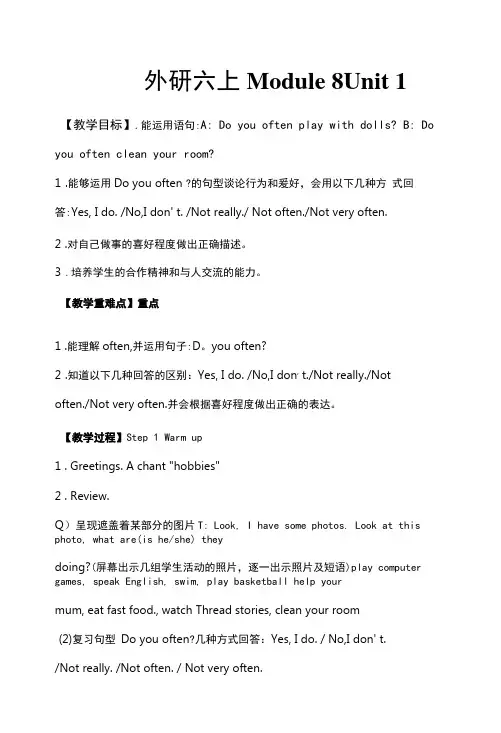
外研六上Module 8Unit 1【教学目标】.能运用语句:A: Do you often play with dolls? B: Do you often clean your room?1.能够运用Do you often ?的句型谈论行为和爰好,会用以下几种方式回答:Yes, I do. /No,I don' t. /Not really./ Not often./Not very often.2.对自己做事的喜好程度做出正确描述。
3.培养学生的合作精神和与人交流的能力。
【教学重难点】重点1.能理解often,并运用句子:D。
you often?2.知道以下几种回答的区别:Yes, I do. /No,I don, t./Not really./Not often./Not very often.并会根据喜好程度做出正确的表达。
【教学过程】Step 1 Warm up1. Greetings. A chant "hobbies"2. Review.Q)呈现遮盖着某部分的图片T: Look, I have some photos. Look at this photo, what are(is he/she) theydoing?(屏幕出示几组学生活动的照片,逐一出示照片及短语)play computer games, speak English, swim, play basketball help yourmum, eat fast food., watch Thread stories, clean your room(2)复习句型Do you often?几种方式回答:Yes, I do. / No,I don' t./Not really. /Not often. / Not very often.(设计意图:回忆已学词组,巩固旧知,为新授做好铺垫)Step 2Presentation1.出示课题:Module 8 Unitl Looking at photos.).看图回答:a. Who are they?b. What are they doing?过渡:T:Do you want to see Amy' s photo?Ss: Yes.T:You can say "Yes, I' d love to."3.带着问题听读第一遍课文a.How many photos are they talking about?b.What can you see in them?课件呈现三幅图片并让学生描述图片。
小学英语六年级上册(外研版三起)Module 8 Unit 1 Do you often play with dolls 公开课课件
The boy is playing with dogs
Do you often play with dogs?
They are playing basketball. Do you often play basketball?
The girl is playing the zither. Do you often play the zither ?
Do you often …? Yes, I do./Yes,of course. I often…. No, I don’t./Not really./Not very often.
clean your room read stories play computer games
watch films
Does Amy often play with dolls? Does Amy like reading books ? Does Amy often clean her room? Does Lingling often clean her room?
Does Amy often play with dolls? Not really. Does Amy like reading books ? Yes, she does. Does Amy often clean her room? Not very often.
Does Lingling often clean her room? Yes, she does.
Amy: Do you want to see my _________? photos love ______. to Lingling :Yes, I’d _____ at Amy :Look ____this photo. Lingling: You’re ________with dolls. Do you often playing play _____dolls? with really I_________ ago Amy:Not_______. stopped a long time _______. in Amy: There’s a picture book ____this photo. I loved picture books. reading Ling: Do you like _________books now? course I often read_______? Amy: Yes, of ______. stories
六年级英语上册Module8Unit1Doyouoftenplaywithdolls第1课时教学案外研版(三起)
②?
释
难
解
疑
学习过程中学生对于“带来”,学生容易迷惑,如:,,。教师通过解释词义,举例子让同学区分开三个词的区别。
拓
展
训
练
区分一般现在时和过去时的不同
:?
:?
作业设计
背诵第八模块的单词并会背活动一的内容
板书设计
很久以前’我很乐意不全是
?
主备教师
审核教师
课题
?
课型
新授课
课时
教学目标
知识与技能
会读、会写本单元的单词和句子
过程与方法
能用一般现在时的句子讲述自己的行为习惯和爱好
情感态度价值观
能正确使用现在进行时的句子来谈论正在进行的动作
教材分析
教学重点
பைடு நூலகம்一般现在时的用法
教学难点
现在进行时的肯定句
学具
挂图、录音机
教学过程
环节
教师活动
学生活动
效果反思
导
入
新
课
出示提前收集到的各种玩具娃娃的图片,板书课题?
学生看图片讨论玩具娃娃的习惯和爱好
自
主
学
习
听录音,在老师的指导下学习第八模块的单词
学生认真学习新单词
小
组
合
作
学生讨论新单词学习中的问题,并和教师合作学习活动一的内容。’ ?讨论,,的用法,并让小组讨论试着造句。
展
示
反
馈
学生们会用造句,例如:.
六年级上册英语教学设计-Module 8 Unit 1 Do you often play with
六年级上册英语教学设计-Module 8 Unit 1 Do you often playwith dolls|外研社(三起)一、教学背景本教学设计针对的是六年级的英语教学,教学内容为外研社(三起)六年级上册英语教材Module 8 Unit 1 “Do you often play with dolls?”。
二、教学目标1. 知识目标1.熟练掌握表示频率的词汇及句型。
2.了解和运用新词汇:act, often, instrument, collection。
2. 能力目标1.能够描述他人的日常活动。
2.能够跟他人就自己的日常活动进行交流。
3. 情感目标1.培养学生对英语学习的兴趣和积极性。
2.培养学生的沟通能力和合作精神。
三、教学重点和难点1. 教学重点1.学习表示频率的词汇及句型。
2.运用新词汇:act, often, instrument, collection。
2. 教学难点1.怎样运用频率词汇进行描述。
2.怎样运用新词汇进行表达。
四、教学内容与步骤1. 教学内容本节课的教学内容为Module 8 Unit 1 “Do you often play with dolls?”,主要内容包括:1.掌握描述他人日常活动的常用表达。
2.学习并掌握频率的表达方式。
3.学习并掌握新单词act, often, instrument, collection。
2. 教学步骤步骤一:导入通过教师自我介绍的形式,引导学生认识表示频率的词汇,如sometimes, often, always等。
步骤二:学习新词汇教师呈现新词汇act, often, instrument, collection,并通过图片和语音示范让学生学习和掌握这些单词的发音和意思。
步骤三:学习并掌握频率的表达方式教师采用举例的方式,引导学生学习频率的表达方式。
如:•100% → always•80% → often•50% → sometimes•20% → rarely•0% → never步骤四:描述他人的日常活动教师通过举例的方式,引导学生学习描述他人日常活动的常用表达方式。
六年级上册英语教案-Module8Unit1Doyouoftenplaywithdolls外研三起

六年级上册英语教案 Module 8 Unit 1 Do you often play withdolls 外研三起教学内容本课为外研三起六年级上册英语第8模块第1单元,主题为“Do you often play with dolls”。
教学内容包括日常活动词汇,如“play with dolls”,“watch TV”,“play football”等,以及一般现在时态的问答句型。
教学目标1. 学生能够理解并运用一般现在时态询问和描述日常活动。
2. 学生能够正确使用本课所学的日常活动词汇。
3. 学生能够通过听、说、读、写的活动,提高英语语言运用能力。
教学难点1. 学生对一般现在时态的问答句型的掌握。
2. 学生对日常活动词汇的记忆和应用。
教具学具准备1. 课本。
2. 多媒体设备。
3. 词汇卡片。
4. 小组活动手册。
教学过程导入利用图片或实物,引导学生复习之前学过的日常活动词汇。
通过问答游戏,激发学生对本课主题的兴趣。
新课展示通过PPT或实物展示,教授本课的新词汇。
利用问答句型,展示一般现在时态的用法。
小组活动学生分组,用本课的词汇和句型进行问答练习。
教师巡回指导,纠正发音和语法错误。
课堂练习学生完成课本上的练习题。
教师选取部分学生的答案进行讲解和点评。
学生用自己的话复述本课的重点内容。
板书设计1. Module 8 Unit 1 Do you often play with dolls2. 词汇列表:play with dolls, watch TV, play football,3. 句型展示:Do you often ? Yes, I do./No, I don't.作业设计1. 完成课本练习题。
2. 用本课的词汇和句型编写一段对话。
3. 收集并整理其他日常活动的词汇。
课后反思教师应关注学生对新词汇的记忆和应用情况。
通过课后作业和课堂练习,教师可以了解学生对本课内容的掌握程度。
教师应根据学生的反馈,调整教学方法和进度,以提高教学效果。
六年级上册英语教案-Module 8 Unit 1外研版三起

Period 2本课时为第八模块第一单元的第二课时,主要学习教材第46页的内容。
本课时为一节复习课,活动3通过对话的形式呈现上一课时的重点词汇stop、clean、not really和重点句型“Do you often+动词原形(+其他)?”,让学生进一步复习所学词汇和句型。
活动4再次对句型“Do you often+动词原形(+其他)?”进行反复操练。
知识目标能够用句型“Do you often+动词原形(+其他)?”询问对方的行为习惯并作答。
能力目标能够在实际情景中运用核心词汇和句型询问对方的行为习惯和爱好。
情感目标通过小组合作增加学生之间的了解,帮助学生建立更加深厚的友谊。
教学重难点能灵活运用句型“Do you often+动词原形(+其他)?”。
教师让学生反复朗读对话,熟悉该句型。
然后教师通过一些日常活动的图片,让学生与同桌之间用图片所表达的短语进行关键词替换,反复操练句型。
多媒体课件、录音机、图片、磁钉、小红花。
Step 1:Warm-up师生进行日常对话,如:T:Do you often play with dolls?S1:Yes,I like dolls.T:Do you often read books?S2:Yes,I like reading stories.T:Do you often clean your room?S3:Not very often.T:Do you often take photos?S4:Yes,I love taking photos.通过师生日常对话,复习上一课时所学重点词汇和句型,同时为新课的学习做准备。
Step 2:Presentation1.Activity 3·教材意图本部分是为复习句型“Do you often+动词原形(+其他)?”而设计的对话活动。
·教学建议(1)教师让学生观察活动3中的两幅图片,预测对话内容。
Module8Unit1Doyouoftenplaywithdolls(教学设计)外研版英语六年级上
Module 8 Unit1 Do you often play with dolls教学设计一、教材分析:本节课是外研版小学英语六年级上册的第八模块的第一单元。
本单元主要围绕着“Do you often play with dolls?”这一话题展开,通过学习询问和回答关于玩具的频率的问题,培养学生的听、说、读、写的能力,同时也帮助学生扩展词汇量和提高语言表达能力。
二、教学目标:1. 学会运用频率副词询问和回答关于玩具的频率。
2. 能够用简单的句子描述自己和他人的玩具使用频率。
3. 通过对话和练习,提高学生的听、说、读、写的能力。
4. 培养学生的合作意识和团队合作能力。
三、教学重点和教学难点:教学重点:1. 学会使用频率副词询问和回答关于玩具的频率。
2. 提高学生的听、说、读、写的能力。
教学难点:1. 运用频率副词正确询问和回答关于玩具的频率。
2. 提高学生的语言表达能力和口语交际能力。
四、学情分析:学生是小学六年级的学生,他们已经具备一定的英语基础,能够简单地进行英语对话和阅读。
他们对玩具这一话题感兴趣,但在表达自己的意见和观点时可能存在一定的困难。
因此,本节课需要通过多种形式的练习和活动激发学生的学习兴趣,提高他们的参与度。
五、教学过程:Step 1: WarmupGreet the students and review the previous lesson briefly.Show some pictures of different toys and ask the students if they like playing with these toys. Encourage them to express their preferences using sentences like "I like playing with dolls" or "I don't like playing with toy cars."Step 2: PresentationIntroduce the target sentence: "Do you often play with dolls?" Write it on the board and explain the meaning to the students.Teach the frequency adverbs: always, usually, often, sometimes, rarely, never. Write them on the board and explain their meanings and usage.Use examples to demonstrate how to form questions and answers using the target sentence and frequency adverbs. For example:Teacher: Do you often play with dolls?Student: Yes, I often play with dolls.Practice the target sentence and frequency adverbs with the whole class. Ask individual students questions using the target sentence and encourage them to answer using the frequency adverbs. For example:Teacher: Do you always play with toy cars?Student: No, I rarely play with toy cars.Step 3: PracticeDivide the class into pairs or small groups.Give each group a set of picture cards depicting different toys.Instruct the students to take turns asking and answering questions about the frequency of playing with each toy. For example:Student A: Do you often play with toy cars?Student B: No, I sometimes play with toy cars.Monitor the students' conversations and provide assistance if needed.After the practice, ask some groups to share their findings with the whole class. For example, ask a student from each group to report on the toy they oftenplay with and the toy they rarely play with.Step 4: ConsolidationPlay a game called "Toy Survey." Give each student a survey sheet with questions about toy preferences and frequency of playing with different toys.Instruct the students to walk around the classroom and ask their classmates the survey questions. They should record their classmates' answers on the survey sheet. After the survey, ask some students to share their findings with the whole class. For example, ask a few students to share the toy that is most popular among their classmates and the toy that is least popular. Step 5: WrapupReview the target sentence and frequency adverbs with the whole class. Ask some students to provide examples using the target sentence and frequency adverbs.Summarize the main points of the lesson and provide feedback on the students' performance. Praise their efforts and improvements.Assign relevant exercises from the textbook or workbook for homework.例子:Warmup: Show pictures of different toys, such as dolls, toy cars, action figures, and stuffed animals. Ask the students, "Do you like playing with dolls?" Encourage them to answer using plete sentences, such as "Yes, I like playing with dolls" or "No, I don't like playing with dolls because I prefer toy cars."Presentation: Write the target sentence "Do you often play with dolls?" on the board. Explain its meaning and emphasize the use of the frequency adverb "often." Give an example dialogue:Teacher: Do you often play with dolls?Student: Yes, I often play with dolls.Practice: Divide the class into pairs. Give each pair a set of picture cards depicting different toys. Instruct the students to ask and answer questions about the frequency of playing with each toy. For example: Student A: Do you usually play with toy cars?Student B: No, I rarely play with toy cars.Consolidation: Play the "Toy Survey" game. Give each student a survey sheet with questions about toy preferences and frequency of playing with different toys. Instruct the students to walk around theclassroom and ask their classmates the survey questions. Afterward, ask some students to share their findings with the whole class. For example:Student: According to the survey, most of my classmates often play with stuffed animals, and very few of them never play with action figures.Wrapup: Review the target sentence and frequency adverbs. Ask the students to create their own sentences using the target sentence and frequency adverbs. For example, "Do you always play with toy cars?" or "I sometimes play with dolls, but I usually play with action figures."六、板书设计:Do you often play with dolls?always usually often sometimes rarely never七、教学反思:本节课通过引入频率副词,教授了有关玩具频率的表达方式。
Module8(课件)英语六年级上册
(B ) 2. _____ you often play with _____
A. Do; doll B. Do; dolls C. Does; dolls (B ) 3. I _____ a long time ago.
A (
)
A. stoped 4. There’s
a
B. stopped picture book
Let’s learn.
Presentatio n
频度副词 always usually often
sometimes never
词义 总是 通常 经常 有时候 从不
发生频率 100% 80% 60% 30% 0
Practic
Fill in the blanks withe“never, sometimes, often, always”.
Presentation
Lingling: Do you often take photos
Amy: Yes, I love taking photos. Do you
Lingling: No. But Daming has got a good camera. He often takes photos of me. Did he show you his photos in China
Presentatio Listen and chantn.
I’m always here. I never go. You’re sometimes here. You often go.
Presentatio Read the sentencens
Simon
I always ride my bike to school. I never go by bus.
(外研版)六年级英语上册教案 Module8 Unit1(2)
外研版六年级英语上册教案Module 8 Unit 1 Looking at Photos教学内容:U nit one Looking at Photos学习任务:Do you often play with dolls?功能:谈论行为习惯和喜好教学程序:1.WarmerHave the students look at activity 1. They should number the pictures1, 2,and 3 respectively. Make sure they do this very lightly in pencil so that they can erase it later.Now tell the students that you are you are going to say things about the story and they have to say which pictures you are talking about.2. Listen, point and find ‘often”.Have the students close their books.Tell the students that you are going to play the tape and stop after each utterance. The students have to tell you who the speaker was: Lingling or Amy.Now play the tape a second time and tell the students to call out ‘stop’ each time they hear the word ‘often’.3. Ask and answer.Get two pieces of large paper.On one piece write ‘very often’ and on the other piece write ‘not very often’.Put the pieces of paper on the walls around the classroom.Now tell the students that you are going to ask them questions and they have to point to the relevant responses.Example: T: do you often go to see films?Ss:(point to the response that is relevant for them)T: do you often play computer games?Ss (point to the response that is relevant for them)4. homework: read the text板书设计:Unit one Looking at PhotosDo you often play with dolls?Do you often go to see films?Do you often play computer games?教学札记:。
六年级上册英语教案-Module 8 Unit 1 Do you often play with d
六年级上册英语教案-Module 8 Unit 1 Do you often play
with dolls|外研社(三起)
教学目标
1.学生能够听懂、会说、会读本课时单词和短语
2.学生能够用英语描述自己经常做的事情
3.学生能够用英语询问别人的兴趣爱好并进行简单的交流
教学重难点
1.教学重点:学生能够用英语描述自己经常做的事情
2.教学难点:学生能够和他人进行英语交流,了解别人的兴趣爱好,并将所学到的语言应用于生活中
教学准备
1.大型画纸和笔
2.单词卡片和图片
3.包含学生照片和幼儿园玩具照片的 PowerPoint 演示文稿
4.声音 CD
教学过程
Step 1 引入
•教师向学生展示 PowerPoint 演示文稿,其中包含着幼儿园玩具和学生自己的照片。
•教师问学生:“你经常玩什么玩具?”并鼓励学生回答。
•教师提供单词卡片和图片,并向学生展示并讲解每个单词的含义,例如dolls,cars,balls,trains 等。
Step 2 学生自我介绍
•学生自我介绍并展示自己的照片。
例如,。