
牛津译林版英语八年级下册第五单元综合提优测评卷含答案
第五单元综合提优测评卷(时间:90分钟总分:100分)I.听力部分(15分)第一部分听对话,回答问题。
本部分共有5道小题,每小题你将听到一段对话。
在听每段对话前,你将有5秒钟的时间阅读题目;听完后,你还有5秒钟的时间选出你认为最合适的备选答案。
听两遍。
1. What does the girl want to be in the future?2. What does the girl like doing best in the free time?3. Which did Jim's father take away from him4. Which film star does Katty like best?A. Liu Yifei.B. Audrey Hepburn.C. Tom Hanks5. How long did Mike stay in Canada?A. A week.B. Three days.C. A month.第二部分听对话和短文,回答问题。
听下面一段材料,回答第6-7题。
听两遍。
6. What does Lin Lin order?A. Cabbage and fried rice.B. Fried rice and fish.C. Fish and cabbage.7. When does Lin Lin make the telephone call?A. In the morning.B. At noon.C. At midnight.听第一篇短文,回答第8—10题。
请根据短文内容,选择正确答案,完成信息记录表。
8. A. English B. Chinese C. Physics9. A. say B. donate C. send10. A hobbies B. sports C. lessons听第二篇短文,回答第11-15题。
听两遍。
11. Why was Mr. Lee afraid of taking a plane?A. He had an accident before.B. He read a lot about accidents.C. His last trip by plane wasn't good.12. Who wanted to take Mr. Lee for a ride?A. His father.B. His boss.C. His friend.13. How was the weather when Mr. Lee got on the plane?A. It was sunny.B. It was cloudy.C. It was cold.14. How did Mr. Lee feel when the plane started to move?A. He was excited.B. He was relaxed.C. He was scared.15. What did Mr. Lee see out of the window?A. Some trees.B. Some ants.C. Some people.Ⅱ.单项选择(15分)16. There is a big stone my way my way home yesterday.A. at; byB. in; byC. on; inD. in; on17. He had to speak in aloud because of the of the party in the next room.A. noise; noiseB. voice; soundC. voice; noiseD. sound; voice18. Hard work can bring you , but if you are lazy, you won't become .A. success; successfulB. successful; successfulC. successful; successD. success; success19. Sailing on a snowy day means in the seaA. to risk losing lifeB. risking losing lifeC. to risk to lose lifeD. risking to lose life20. 一He's already been back from Australia, ?一. He is on a visit to Shanghai.A. Isn't he; NoB. Hasn't he; YesC. Isn't he; YesD. Hasn't he; No21. This exercise is difficult .A. so; that few of us can doB. so; that many of us can doC. too; for any one of us to do22. 一Where is your mother?一She Shanghai. She won't come back next week.A. has gone to; untilB. has been to; untilC. has been to; afterD. has gone to; after23. The woman all of her money to charities the poor.A. gave; helpB. gave; to helpingC. donated; to helpD. donated; help24. Mike is learning a computer.A. what to useB. how to useC. how he useD. how to using25. Anna dances , if not better than, Lily.A. so wellB. as well asC, so well as D. as well26. Tom's mother is too busy housework him with his homework.A. doing; to helpB. to do; to helpC, doing; helping D. to do; helping27. The book isn't mine. can it be?A. What elseB. Who elseC. Which else'sD. Who else's28. The tent is for a family of three .A. big enough; to liveB. enough big; to live in itC. big enough; to live inD. enough big; live in29. 一Ann plays the piano so well.一Yes, but I she could play it.A. didn't knowB. don't knowC haven't know D. won't know30. 一How did you find your visit to Qingdao, Joanna?一.A. Oh, wonderful indeedB. I went there aloneC First by train and then by shipD. A guide showed me the wayⅢ.完形填空(10分)Jim is interested in reading. One day, he wants to borrow a book from the 31 . He goes there 32 Jack. They can't see 33 assistants there, only some robots standing there. Then Jim says to one of 34 "Hey, give me a book.” But the robot 35 work.."What's wrong 36 the robot" He asks Jack. Jack tells him, "When you want 37 something from somebody, you must 38 …please‟first.”So Jim says, “Please 39 me a book, Mr. Robot.”Then the robot brings him the book. But again, Jim can't take the book out of the robot's hands.Jack says, "You must say `Thank you' before you take the book.”40 Jim says "Oh, thank you very much, Mr. Robot.” Then he gets the book he wants from the robot's hands.31. A. office B. shop C. library D. hospital32. A. to B. with C. from D. at33. A. a B. some C. the D. any34. A. a robot B. robots C. the robots D. robot35. A. isn't B. don't C. not D. doesn't36. A. at B. with C. to D. about37. A. to borrow B. borrows C. borrowing D. to borrowing38. A. to say B. say C. says D. saying39. A. give B. gives C. to give D. giving40. A. But B. And C. So D. OrⅣ.阅读理解(20分)AIn many English homes people eat four meals a day: breakfast, lunch, tea and dinner. People have breakfast at any time from seven to nine in the morning. They eat porridge, eggs or bread. English people drink tea or coffee at breakfast. Lunch comes at one o'clock. Afternoon tea is from four to five in the afternoon and dinner is about half past seven. First they have soups, and then they have meat or fish with vegetables. After that they eat some other things, like bananas, apples or oranges. But not all English people eat like that. Some of them have their dinner in the middle of the day. Their meals are breakfast, dinner, tea and supper and all these meals are very necessary.41. Many English people have meals a day.A. twoB. threeC. fourD. three or four42. People may have for their breakfast.A. tea and eggsB. porridge, eggs, bread, tea or coffeeC. tea and coffeeD. bread and eggs43. People have lunch at .A. any timeB. nineC. fiveD. one44. People don't have for their dinner.A. porridgeB. bananas and applesC. some soup and meatD. meat and fish45. In many English homes dinner comes .A. at one o'clockB. about half past sevenC. at noonD. at nightBLiving in a foreign country can be exciting, but it can also be confusing(令人迷惑的).A group of Americans who taught English in other countries recently discussed their experiences. They decided that miscommunications were always possible, even over something as simple as "yes" and "no".On her first day in Micronesia, an island in the Pacific, Lisa thought people weren't paying any attention to her. The day was hot. She went into a store and asked, "Do you have cold drinks?" The woman there didn't say anything. Lisa repeated the question. Still the woman said nothing. She later learned that the woman had answered her: She had raised her eyebrows (眉毛),which in Micronesia means "yes".Jan remembered an experience she had in Bulgaria, a country in Europe. She went to a restaurant that was known for its cabbage. She asked the waiter, "Do you have cabbage today?" He nodded his head. Jan waited, but the cabbage never came. In that country, a nod means "no".Tom had a similar problem when he arrived in India. After explaining something in class, he asked his students if they understood. They answered with many different nods and shakes of the head. He thought some students had not understood, so he explained again. When he askedagain, they did the same thing. He soon found out that his students d记understand. In India, people nod and shake their heads in different ways depending on where they come from. You have to know where a person is from to understand whether they mean "yes" or "no".46. These Americans teaching English in other countries found that they .A. should go abroad for vacationsB. needed to learn foreign languagesC. should often discuss their experiencesD. had problems with communications47. People in Micronesia show "yes" by .A. nodding headsB. raising eyebrowsC. shaking headsD. saying "no"48. Tom misunderstood his class at first because .A. he did not know much about Indian cultureB. he didn't explain everything clearly enoughC. some students didn't understand his questionsD. he didn't know where the students came from49. Which of the following is TRUE according to this passage?A. In Bulgaria, nodding heads means "no".B. Jan taught English on a Pacific island.C. Lisa was trying to buy some cabbage.D. In India, only shaking heads means "yes".50. The passage is mainly about .A. body language in foreign restaurantsB. class discussion in Indian schoolsC. miscommunication in different culturesD. English teaching in other countriesV.词汇运用(10分)A.根据句意、首字母或汉语意思完成单词。
牛津译林版八年级英语下册Unit5单元检测卷(含答案)
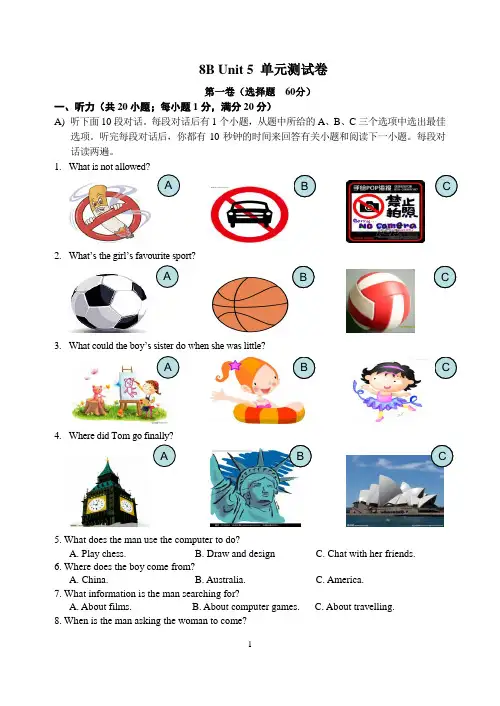
8B Unit 5 单元测试卷第一卷(选择题60分)一、听力(共20小题;每小题1分,满分20分)A) 听下面10段对话。
每段对话后有1个小题,从题中所给的A、B、C三个选项中选出最佳选项。
听完每段对话后,你都有10秒钟的时间来回答有关小题和阅读下一小题。
每段对话读两遍。
1. What is not allowed?A B C2. What’s the girl’s favourite sport?A B C3. What could th e boy’s sister do when she was little?A B C4. Where did Tom go finally?A B C5. What does the man use the computer to do?A. Play chess.B. Draw and designC. Chat with her friends.6. Where does the boy come from?A. China.B. Australia.C. America.7. What information is the man searching for?A. About films.B. About computer games.C. About travelling.8. When is the man asking the woman to come?A. On Friday morning.B. On Saturday afternoon.C. On Friday night.9. Where are they most probably talking?A. At a bus stop.B. At a theatre.C. At a railway station.10. Whose computer did the girl use?A. Her brother's.B. Her father's.C. John's.第二部分:你将听到一段对话和两篇短文。
新版牛津译林英语八年级下册unit5单元测试卷(有听力原文及参考答案)
新版译林八年级下英语第五单元测试卷(8B第五单元,卷面总分:120分)一、听力部分(每小题1分,满分20分)第一部分听对话,回答问题本部分共有10个小题,每小题你将听到一段对话,每段对话读两遍。
在听每段对话前,你将有5秒钟的时间阅读题目;听完后,你仍有5秒钟的答题时间。
1. What’s Tom going to make?A. Fried rice.B. Dumplings.C. Hamburgers.2. When will the boy and the girl go hiking?A. On Friday.B. On Saturday.C. On Sunday.3. What does the woman want to buy?A. A volleyball.B. A birthday cake.C. A basketball.4. What did Alice do last night?A. She went to the movies.B. She watched TV.C. She did her homework.5. What does the man hope?A. The weather is fine.B. The weather is hot.C. The bus will come soon.6. What’s Alice’s hobby?A. Playing computer games.B. Playing the piano.C. Playing the guitar.7. What does Lucy’s mother do?A. A doctor.B. A nurse.C. A teacher.8. Where are the two speakers now?A. In a bookstore.B. In a clothing store.C. In a fruit store.9. What does the girl want to drink?A. Some water.B. Orange juice.C. Apple juice.10. What does the woman want to do?A. She wants to know the time.B. She wants to take a seat.C. She wants to buy a bag. 第二部分听短文,回答问题你将听到两篇短文,各听两遍。
牛津译林版八年级英语下册 Unit 5 综合检测卷含答案
Unit 5综合能力检测卷一、单项填空(每小题1分,共10分)1.—What does the sign mean?—It means "".A. No litteringB. No photosC. No parkingD. No fishing2.No words could fully my happy feelings when I opened the gift box. In it was a model ship made by my son himself.A. excuseB. explainC. expressD. exercise3.A couple of boys at the head of the queue. This made us angry.A. handed inB. pushed inC. gave inD. brought in4.Grandma is rather deaf, so you must speak clearly and to her.A. quietlyB. loudlyC. noisilyD. softly5. The headmaster warns us the school rules, or we'll be punished.A. to breakB. don't breakC. breakingD. not to break6.—Nowadays lots of products from China are very popular in the world.—Yeah! Many people can hardly avoid products made in China.A. to buyB. buyingC. boughtD. buy7.—Who can help me carry the heavy box?—I think Ted is to do it. But the door is for him to go through.A. too strong; too narrowB. so strong; narrow enoughC. enough strong; narrow enoughD. strong enough; too narrow8.—Nantong is a beautiful city. Would you like to visit it?—Yes. Maybe next spring.A. some timeB. sometimeC. sometimesD. some times9.,is there a restaurant in the neighbourhood?A. SorryB. Forget itC. Excuse meD. Pardon me10. " " is used for saying that what you do is more important than what you say you will do.A. Every dog has its day.B. Practice makes perfect.C. Many hands make light work.D. Actions speak louder than words.二、完形填空(每小题1分,共10分)Before graduating from college, Jackie began to look for a job. She aimed at a famous company, but the 11for such jobs was very strong. The company Jackie chose planned to employ(雇用) only one person, but more than twenty people applied for the job. 12, Jackie was one of the three people invited for the final interview. The interview was very 13. The interviewer asked just a few questions and it was allover in less than 10 minutes. Then the interviewer said to them, "All of you are very good. Please go home and 14our response."Three days later, Jackie received a message saying she would not be 15the job. She felt deeply disappointed. That evening, however, she received another 16. This time it said that she got the job.Jackie later found out that the first message sent to her phone was part of the interview — a 17to see if she was suitable for the job. All the three people received the 18text, but only Jackie's reply 19the company. Of the three, one did not reply. The other said "goodbye" and Jackie said "thank you". This reply showed that Jackie was a(n) 20person, so the company offered her the job.11.A. exam B. work C. competition D. plan12.A. Thankfully B. Unluckily C. Hopefully D. Immediately13.A. long B. strict C. interesting D. easy14.A. pick up B. wait for C. deal with D. think of15.A. offered B. returned C. refused D. shown16.A. letter B. e-mail C. call D. message17.A. guide B. conversation C. test D. lesson18.A. same B. other C. second D. whole19.A. reached B. satisfied C. helped D. surprised20.A. brave B. clever C. polite D. honest三、阅读理解(每小题2分,共30分)A21.What time do Western people usually have dinner?A. About midday.B. At 5:00 in the afternoon.C. Around 7 p.m. or even later.D. Before 7:00 in the afternoon.22.Most food in the West is eaten with .A. spoonsB. chopsticksC. fingersD. knives and forks23.What will a host probably say to a guest at the start of a meal?A. "Can I help you?"B. "Eat slowly!"C. "Help yourself!"D. "Could you serve me?"24.When might people want to say, "I'm sorry, I can't eat this."?A. If they've been given something they don't like.B. If they are full.C. If the hosts keep offering a lot of food to them.D. If they are unhappy.25.Which of the following is helpful when you're in the West according to the poster?A. You can leave as soon as you've finished eating.B. You can't eat chicken legs with your fingers.C. The fork is held in your right hand and the knife in your left.D. If you don't know what to do, just watch the others and do as they do.BPlease help the museum protect works of art on show in the galleries(美术馆) by following the rules listed below. We hope you can keep the art safe so that it may be enjoyed by more people!Do not touch works of art. Your touch, even the slightest touch, can damage(损坏) the surface of a painting.Use only pencils. If an accident happens, a pencil mark is easier to be removed than a pen mark. We are happy to provide a pencil if you would like to write or draw during your museum visit.No leaning on walls or cases. That helps keep works of art hung on the walls or displayed in cases safe. Feel free to sit on the benches or the floor as you talk, write or draw.No food or drink. Both of them aren't allowed in the galleries. The art in the museum will provide plenty of food for your thoughts as well as your eyes!Photography is allowed only after you fill out a photo release form at the Visitor Services Desk. Only works of art owned by Dartmouth College can be photographed. No flash photography is allowed because the light damages the art.Thank you for following these rules to help keep the art safe!26.Which of the following signs isn't mentioned in the passage?A. B. C. D.27.You can have a rest if you are tired.A. by leaning on the wallsB. on the benches or the floorC. by sitting in a restaurantD. by leaning on the cases28.The underlined word "flash" here means "" in Chinese.A. 带电B. 闪光C. 彩色D. 数码29.Which of the following is TRUE according to the passage?A. You'd better mark something with a pencil if necessary.B. You can only eat the food like the bread in the museum.C. You can't take any kind of cameras to the museum.D. You can't visit the works of art from Dartmouth College.30.The passage is mainly about .A. the works in the museumB. the ways to keep museums safeC. the time to visit the museumD. the rules in the museumCImagine you're enjoying dinner with your friends in a nice restaurant. You're having a great time when suddenly you hear a phone ringing at the table next to you. A man takes out his phone and starts talking for almost ten minutes! How will you feel? Maybe you'll feel uncomfortable, but you can do nothing about it.This happens all the time, not only in a restaurant, but also on a bus, at a cinema, everywhere!Cell phones are useful in our daily lives. But be careful not to be a noisy user and disturb others. You are supposed to control your own behavior. Here are a few rules.Follow the rules! When you're in public places and see a sign that says"Turn off cell phones", don't use your phone. If you are allowed, speak softly for a short time and try to keep away from other people.Phone off! Never make calls in a theater, when you are watching a movie or enjoying a concert.Pay attention! Talking on a cell phone while driving is dangerous. And watch out where you're going when you're walking down the street and talking on the phone.As more people use cell phones, things are going to get worse. So, the next time you're getting ready to make a call, stop and consider the people around you.31.In Paragraph 1, the writer mainly tells us .A. an example of bad mannersB. how bad phones can be to peopleC. why using phones is not allowed in a restaurantD. what the man talks about on the phone with his friend32.What does the underlined word "disturb" mean in the passage in Chinese?A. 帮助B. 支持C. 打扰D. 利用33.According to the passage, we are expected to turn off our cell phones while .A. eating in a restaurantB. watching TV at homeC. enjoying a concertD. seeing a doctor34.When you have to talk on the phone in public, you should follow the following rules EXCEPT .A. using earphonesB. making short talksC. talking in a low voiceD. keeping away from people35.We can learn that from the passage.A. public manners are important in our livesB. cell phones lead to people's bad relationshipC. people ought to turn off cell phones in public placesD. cell phones have become the most useful tool in our lives四、任务型阅读(每小题1分,共10分)Today's students are often online, both in and out of school. Here are some good manners for you to keep in mind while you're online.Don't be rude to others. The first rule is to be kind. Show respect (尊重) for the opinions of others, even if you don't agree. Don't say anything bad about others.Double-check before you click "send". It is always a good idea to reread anything you type before clicking the "send" icon. If you have time, step away for a few minutes and come back to it with fresh eyes. If not, at least check your spelling, grammar, and tone (语气) of the message.Don't give away your personal (个人的) information. Since anything you post on the Internet is out there for all to see, avoid adding anything personal. This includes your name, address, phone number and other information.Don't post long messages. Most people use the Internet to save time, so avoid long messages. If you have more to say, you can talk on the phone or when you see each other.Don't forget the golden rule. Treat others as you would like to be treated. If you wouldn't say something to someone's face , don't say it online.36. 37. 38. 39. 40.41. 42. 43. 44. 45.五、词汇运用(每小题1分,共10分)(A)根据句意及汉语提示写出单词46.John admires his father very much because he is a (成功的) businessman.47.It's bad manners to shout loudly in (公共的) places.48.Let's have a (讨论) about the wonders of the world.49.Tom has a (谈话) with his teacher about his study problem.50.I will do a lot of (练习) to improve my English.(B)用所给单词的适当形式填空51.The sign means "No (smoke)".52.Our manager greeted the guests (polite) with a smile at the entrance.53.We Chinese often greet each other by (shake) hands.54.He (risk) losing his life to save the little girl and everyone clapped for him.55.The mother was angry with her naughty son, for he (litter) the ground.六、根据短文内容及首字母提示补全短文(每小题1分,共10分)Are you going to have dinner at your Western friend's home? Then be c56with your table manners. Good manners will make you a nice g57.You may find Western table manners are d58from Chinese manners. Here is some good a59for you.When you are r60to eat, sit up straight on the chair. Usually, don't put your elbows on the table. First p61your napkin (餐巾) up and put it on your lap. You can use it to clean your hands or mouth, but not your face. When you finish eating, put it back on the table.Don't make any n62when you eat the soup. It's not good to speak when your mouth is f63. If you do that, people will see the food in your mouth.If you want to get some food but you can't r64it, ask others to pass the dish to you. Put bones on the edge of the plate. And remember, take bread with your h65, instead of a fork.56. 57. 58. 59. 60.61. 62. 63. 64. 65.七、书面表达(20分)践行文明礼仪从我做起。
牛津译林版八年级英语第二学期8B U5单元提优卷(含答案)
八年级英语第二学期U5单元提优卷一、单项选择(每小题1分,满分15分)( )1.—Would you please not speak so loudly in public?—Sorry. I will remember to speak in lower voice.A. the; aB./;aC. the;theD. /;/( )2.—Is there anything serious with my leg, doctor?—No. You are to see the doctor at once.A. lucky enoughB. enough luckyC. luck enoughD. enough luck ( )3. The headmaster warns us the school rules, or we'll be punished.A. to breakB.not to breakC. breakingD. don't break ( )4. The train travelled fast for us to see much outside the window.A. quiteB. veryC. tooD. so( )5.不敷出Tom as well as his parents TV at home at eight last night.A.were watchingB.watchedC.was watchingD. has watched ( )6. Don't be so shy. Learning to ourselves properly can help us make more friends.A.excuseB.expressC. explainD. experience ( )7. I like using WeChat. It makes easier for friends to contact with each other.A. itB. thatC. thisD. them( )8.—I play football for every day. What about playing football together now?—Sorry, I can't. I'm too busy with my homework. What about next week?A. some times;sometimeB. some time;sometimeC. sometime;sometimesD. some time; sometimes( )9.—Why did his father buy that phone watch for him?—Because the GPS in the watch can help him to avoid the way.A. to loseB. loseC. losesD. losing( )10.He is hard-working and. I hope he will have more at his business.A. success; successfulB. successful;successC. successfully; successfulD. successful;successful( )11.Don't others while they are talking. It's not polite.A. cut inB. cut outC. cut intoD. cut in on ( )12.—Where is your mother?—She Shanghai. She won't come back next week.A. has gone to;untilB. has been to;untilC. has been in;tillD. has gone to;after( )13.We should save energy by the lights when we leave a room.A. getting offB. showing offC. taking offD. turning off ( )14. If you are , they won't touch you or push past you.A. in your wayB. on your wayC. on their wayD. in their way ( )15.—Do you think it will rain tomorrow?—. Because farmers need rain very much.A. I think soB. I hope soC. I'm afraid soD. I'm afraid not二、完形填空(每小题1分,满分10分)As the saying goes, "Friends are treasure in our lives." I remember when I was growing up,my mom always 1 , "Half the fun of doing anything is sharing it with others." It's true. Friends make 2 enjoy the taste of our success and joys and comfort us in our challenging moments. They provide a mirror for us to learn more about ourselves. I've always looked at friends as family 3 . They enrich(丰富)our lives. As a famous writer said, "A friend is a present which you give 4 ."To be a good friend, it's important to be a good listener. Hear what your friend says first rather than making conclusions(结论)quickly.Sometimes 5 is useful to repeat their words back to them. It can help them realize whether their words were what they wanted to say.Patience(耐心)is an important part of being a good friend, 6 . You know the old golden rule, "Care 7 others the way you would like them to care for you." The support of a friend during a difficult time can make a difference between success 8 failure. Encouragement and confidence are the 9 gifts that can change a person's life.We should choose our friends carefully, because they can have a great influence on our lives. As 10 told me, "The attitudes(态度)of your friends are like the buttons(按钮)on a lift. They will either take you up or down."( )1.A. said B. told C. talked D. spoke( )2.A. us B. me C. her D. them( )3.A. friends B. children C. members D. enemies( )4.A. herself B. yourself C. himself D. myself( )5.A. this B. that C. these D. it( )6.A. never B. either C. too D. also( )7.A. of B. with C. for D. in( )8.A. but B. so C. and D. or( )9.A. best B. better C. worse D. worst( )10.A. anyone B. someone C. everyone D. no one三、阅读理解(每小题2分,满分24分)AAn old man went to live with his son, his daughter-in-law, and his four-year-old grandson. The old man's hands trembled, his eyesight was very poor, and he couldn't walk steadily(平稳地).The family ate together nightly at the dinner table. But the elderly grandfather's shaky hands and failing sight made eating rather difficult. Rice often dropped on the floor.The son and the daughter-in-law became angry with the old man, so they put a small table in the corner. There,the grandfather ate alone,while the rest of the family enjoyed dinner at the table. Since the grandfather had broken a dish or two, his food was served in a wooden bowl.The four-year-old child watched it all in silence. One evening before supper, the father noticed his son playing with a piece of wood on the floor. He asked the child sweetly, "What are you making?" The boy answered, "Oh, I am making a little bowl for you and mama to eat your food when I grow up." The four-year-old boy smiled and went back to work. The words struck the parents so they were in silence. Then tears started to stream down their cheeks(脸颊).Though no word was spoken, they both knew what must be done. That evening the husband took his father's hand gently and led him back to the family table.( )1. The word "struck" in Paragraph 3 refers to .A. annoyedB. worriedC. scaredD. shocked( )2. Why did the husband lead the old man back to the family table?A. Because he realized his mistakes.B. Because the old man didn't drop rice on the floor any more.C. Because the old man was served in a wooden bowl.D. Because a gentleman led him back to the family table.BI was once hired(雇用)by an American bank. I received a letter from the head. And when I read the sentence "Dear John, I am quite pleased that you have decided to join us." I felt a bit sad because of that "quite". I thought he was saying "we're kind of(有点)pleased you decided to join us although(虽然)I wish we could hire someone else." Then I found that in American English "quite" sometimes means "very", while in British English it is another way of saying "kind of".So the first lesson about working in other countries is to learn the language. I don't just mean the words people speak. It is body language, dress, manners, ideas and so on. The way people do things highlights many of the differences we see between cultures.Some of these differences may be only on the surface(表面)-dress, food-while others may be deeper and take longer to deal with(处理).Mostly, it is just a question of getting used to the differences and accepting them.Some of the differences may be an improvement. However, other differences can be troubling,like being on time. If you invite people to a party at 7 o'clock, your guests will think it polite to turn up exactly on time in Germany, five minutes early in the American Midwest,an hour early in Japan, 15 minutes afterwards in the UK, up to an hour afterwards in Italy and some time in the evening in Greece. I do not want to use the word "late" because there is nothing wrong with the times people arrive. It is simply the accepted thing to do in their own country.( )1.The author was unhappy when he received a letter from the bank because he thought .A. the American bank didn't think much of himB. the American bank might hire another personC. it was difficult to get used to American cultureD. it was hard to understand Americans( )2 .What does the writer think we should do with most cultural differences?A. Ask the native people for help.B. Understand and accept them.C. Do things in your own way.D. Do everything like native people.( )3. Which of the following statements(陈述)is NOT TRUE?A. The writer thinks "language" is more than the words people say.B. The writer thinks it may be OK for some people to be late for a party.C. The writer didn't understand the letter he received correctly at first.D. The writer thinks the differences between cultures are mostly on the surface.CToday, an increasing number of people are alwayslooking at their mobile phones with their heads down.These people are called the "Heads-down Tribe(低头族)".Are you a heads-down tribe member? Heads-down tribemembers now can be seen everywhere.More and more traffic accidents are happening because more drivers use mobile phones when they are driving. In order to make drivers pay more attention to driving,some new traffic rules have been made. For example, people who use mobile phones while driving in Taiwan will be fined(罚款).Car drivers and motorcyclists who break the traffic rule will be fined NT$ 3,000 and NT$ 1,000 respectively(分别地).As we can see above, using mobile phones may cause accidents and even cost a lot of money. Also, more and more interesting and strange facts happen to the "Heads-down Tribe". Let's have a look at an interesting TV report. A man in America kept using his mobile phone on his way home. As a result, he knocked into a big lost bear. When he lifted his eyes from the phone, he was so afraid that he turned around and ran away quickly. Another fact is that we can often see people in the restaurant eating face to face but looking at their own mobile phones. It's strange that they don't talk to the ones who sit opposite to them during the meal. Some of them even have fun communicating with others on the phone.Mobile phones are helpful and necessary tools for modern life. Are mobile phones good or bad? It depends on how people use them. Let's be "healthy" users and try to be the“Heads-up Tribe".( )1.A heads-down tribe member .A. is good at using the InternetB. is a dangerous driverC. is always looking at his or her mobile phoneD. is always looking for his or her mobile phone( )2.The underlined word "motorcyclists" in Paragraph 2 means in Chinese.A.摩托车手B.手机使用者C.低头族D.机动车司机( )3.How does the writer develop(阐述)his idea in Paragraph 3?A. By giving examples.B. By talking about something important.C. By comparing two ideas.D. By referring to a social phenomenon(现象).DShe is a cute, quiet girl. As a daughter, she has no secrets from her mother, who is very pleased with her. But recently she has become rather mysterious(神秘的), not so open as her. What if she falls in love, which is too early of her age? After all, she is reaching the "dangerous time". These thoughts have caused trouble in the mother's mind.One weekend the girl came to tell her mother that she was going to the cinema with her schoolmate and would return late. This was the first time the mother agreed, but she couldn't help worrying because her daughter had never been away at night before. The mother waited till nine and decided to go out to meet her daughter. Just at that time the noise of a car pulling up drew her to the window and-there was her daughter, waving goodbye to a boy. Her heart missed a beat. When the girl came in,the mother was watching TV, pretending(假装)nothing had happened. "Mum. I'm back.""Yeah.""Sorry to be late. Still sitting up?""Yes. Oh,that... Who's that boy?"The daughter was stunned(发愣)for some time. "Ah. It's mymonitor. He gave me a lift on his way home. Mum, I'm going to bed.""All right. Go to sleep early."Next morning when the mother went to the daughter's room to do some tidying, she found her diary, left at her pillow(枕头).After a few minutes' hesitation(犹豫), she finally opened it to the entry of the night before. It read:Mum, it's love that made you ask, but it would show your understanding of me if you hadn't.( )1.Which is the correct order according to the story?a. The girl took a lift back in her monitor's car.b. The girl went to see a film with her classmate.c. The girl wrote a diary.d. Her mother pretended to be watching TV.e. Her mother worried about her daughter's returning late.A. b, e, a, d, cB. e, b, a, d, cC.b, a, e, d, cD. b, e, a, c, d ( )2.Which of the following is TRUE according to the story?A. The girl knew her mother would ask her the question about the boy.B. What the daughter did these days worried her mother.C. The mother was eager(渴望)to read her daughter's diary the next day.D. The girl's diary was always unlocked.( )3.From the diary, we can see the girl .A. thanked her mother for asking herB. thought her mother cared about her very muchC. thought it was her mother's duty to ask herD. thought understanding is better than simple love( )4. The main purpose of this article is to show that parents should .A.talk with their children about their early loveB.not give much freedom to their childrenC. care about what their children really think and feelD. keep silent about their children's secrets四、词汇检测(每小题1分,满分10分)根据所给汉语注释或通过上下文写出单词。
牛津译林版英语八年级下册(初二下学期)Unit5单元测试题含答案(可编辑修改word版)

八下Unit 5 单元测试题第Ⅰ卷选择题(共65 分)Ⅰ. 单项选择(每小题1 分,共15 分)从各题后所给的A、B、C、D 四个选项中选出最佳答案。
( )1. —do people start a conversation in China?—They often say “Nihao” first.A. WhatB. HowC. WhenD. Which( )2. Please run ,Linda, or you will miss the new film.A. quickB. slowC. quicklyD. slowly( )3. Peter is careless to the word correctly.A. too; spellingB. so; spellingC. too; spellD. so; spell( )4. Some Westerners like to greet people a kiss.A. byB. withC. ofD. without( )5. Everyone in my class went to the mountains Maria. She was ill in hospital.A. besidesB. withC. exceptD. including( )6. Please keep and don’t eat anything in the library.A. noisilyB. quietC. quietlyD. noisy( )7. It’s not the time to ask her to the party, because her mother is badly ill.A. usefulB. interestingC. properD. special( )8. The English guest could speak Chinese, so she managed to talk with us.A. a fewB. a littleC. fewD. little( )9. I found it very useful a good book.A. readB. readingC. of readingD. to read( )10. Peter is to get the award of “Best Student”.A. enough excellentB. excellent enoughC. too excellentD. excellent too( )11. —Would you like to collect with us in the park this Saturday?—Yes, I’d love to. Let’s make it clean.A. waterB. treesC. booksD. rubbish( )12. —Can I my car in the park?—I’m afraid not. T here are so many people in the park.A. stopB. parkC. buyD. move( )13. Miss Wang is going to visit the Great Wall next week.A. some timeB. sometimesC. some timesD. sometime( )14. —Please help yourself to some meat.—, but I’m full now.A. You’re kiddingB. I’m sorry to hear thatC. Sorry, I can’tD. Thanks a lot( )15. —Mum, Tony broke my pen again.—Forget it. , he’s only two years old.A. After allB. All the timeC. Not at allD. First of allⅡ. 完形填空(每小题1 分,共10 分)根据材料内容,从各题后所给的A、B、C、D 四个选项中选出最佳答案。
牛津译林版英语八年级下册Unit5单元检测卷(含答案)

牛津译林版英语八年级下册Unit5单元检测卷(含答案)8B Unit 5 单元测试卷第一卷(选择题60分)一、听力(共20小题;每小题1分,满分20分)A) 听下面10段对话。
每段对话后有1个小题,从题中所给的A、B、C三个选项中选出最佳选项。
听完每段对话后,你都有10秒钟的时间来回答有关小题和阅读下一小题。
每段对话读两遍。
1. What is not allowed?A B C2. What’s the girl’s favourite sport?A B C3. What could th e boy’s sister do when she was little?A B C4. Where did Tom go finally?A B C5. What does the man use the computer to do?A. Play chess.B. Draw and designC. Chat with her friends.6. Where does the boy come from?A. China.B. Australia.C. America.7. What information is the man searching for?A. About films.B. About computer games.C. About travelling.8. When is the man asking the woman to come?A. On Friday morning.B. On Saturday afternoon.C. On Friday night.9. Where are they most probably talking?A. At a bus stop.B. At a theatre.C. At a railway station.10. Whose computer did the girl use?A. Her brother's.B. Her father's.C. John's.第二部分:你将听到一段对话和两篇短文。
Units5-7 单元综合提优练习(含答案)牛津译林版八年级下册
牛津英语8B Unit5-7单元综合提优测试卷一、单项选择1. --Have you ever worked as______ volunteer during the COVID-19 pandemic.--Yes. It was _______ unforgettable experience for me.A.an; anB.an; aC.a; anD.a; a2.In the Name of People is_____that lots of people can’t wait ______the book.A. such a great work;to readB.quite a great work;to readC.so great work;readingD.too great a work;reading3.The famous artist came _______ and stopped to look at the painting _______.A. close; closelyB. closely; closeC. close; closeD. closely; closely4. --What is the ______of the sign on the bottle? --It______“ this side up”.A.means, meaningB.meaningful,meaningC.meaning, meansD.means,mean5. The visitors find is kind the local people to answer all the questions.A. it; forB. that; forC. that; ofD. it; of6. 一Mr Li, I have some difficulty the article.一Remember it three or four times at least.A. to understand; readingB. understanding; readingC. understanding; to readD. to understand; to read7. The Olympics_________ every four years. And Tokyo ___________ the 32nd Olympics in 2021.A. takes place; heldB. take place; will heldC. take place; will holdD. took place; hold8.— Who can help me carry the heavy box?— I think Ted is ____ to do it. But the door is ___ for him to go through.A. too strong; too narrowB. so strong; narrow enoughC. enough strong; narrow enoughD. strong enough; too narrow9.---He is so crazy about reading books. As a result, we all call him a bookworm!---So he is! If he is not reading, he is to the school library.A. in this wayB. by the wayC. in the wayD. on the way10. --My father’s new cellphone can be used ____ e-mails.---Is he used ___ on such a small screen?A. to send; to writeB. for sending; to writeC. to send; to writingD. to sending; to writing11. We students can _______ food and old clothes to the homeless people, and the teachers can ______ learning skills for the poor children.A. provide; giveB. provide; offerC. offer; giveD. give; provide12. ---When did you leave work yesterday? ---________.A. Until I finished my workB. Not until I finished my workC. Until I will finish my workD. Not until I will finish my work13.He is ___ enough to give a speech, I hope he will have more ____ when he speaks.A. confidence; confidenceB. confident; confidentC. confident; confidenceD. confidence; confident14.You always think what other people have seems better than your own, just as the saying goes ____.A. many hands makes light workB. put all your eggs in one basketC. every dog has its dayD. the grass is always greener on the other side.15. —Would you like________ the environment?—I don’t know. What can I do?A. help saveB. helping saveC. to help savingD. to help save二.完形填空When I woke up, I was surprised to discover that I was in in my own room. Somebody had put me there when I was 1 . The same had happened to Ned and Conseil. Capital Nemo did not 2 until about tw o o’clock. When he came out in front of us, he didn’t explain anything.“Are you a doctor?” he asked me. 3 had studied medicine in Paris. When I told him that, he asked me to help one of his men. I followed him to another 4 .“He is going to die soon,” I said. “ 5 can save him.” Tears filled Capital Nemo’s eyes, and he asked me to leave the room first.The next day, he 6 me to go with him for another walk under the water. I agreed, and my 7 friends decided to come, too. We went out and found that we were not on sand but on coral(珊瑚).We used our lights to go 8 into the ocean. Some of the crew had come with us. Four of them 9 the coffin(棺材) of the man who had died. We walked for two hours and stopped 10 we reached 300 meters. This is where coral begins to 11 . Some of the crew had brought tools with them, and they dug a hole in the coral. They placed the coffin in it. Then, they 12 the coffin with rocks. I could see that there had been other burials(埋葬) here 13 . We returned to the Nautilus. “Your 14 friend is safe from sharks,” I said to Capital Nemo.“And from men!” he added 15 .I began to think that Nemo was not just keeping away from humans in his Nautilus. He was planning revenge(复仇).1. A. asleep B. awake C. hungry D. thirsty2. A. attack B. attend C. act D. appear3. A. He B. They C. I D. We4. A. boat B. room C. hole D. ocean5. A. Something B. Everything C. Nothing D. Anything6. A. allowed B. ordered C. invited D. refused7. A. two B. three C. four D. five8. A. slower and slower B. faster and fasterC. higher and higherD. deeper and deeper9. A. took B. moved C. carried D. brought10. A. while B. when C. since D. until11. A. begin B. build C. find D. form12. A. filled B. covered C. hid D. built13. A. at present B. so far C. in the past D. in the future14. A. living B. dead C. lively D. dying15. A. happily B. sadly C. angrily D. calmly三、阅读理解(A)It would be hard for a family to live on 300 yuan a month, wouldn’t it? that is how much Li Hua’s family have to live on for a whole year. The world is now trying to help people like Li Hua live better.From Tuesday until today, about 2,000 government leaders and scientists met in Shanghai to talk about stopping poverty (贫穷) around the world.According to the United Nations (UN联合国), the p oorest people in the world live on less than 8.5 yuan a day.Most of those people live in African countries like Sierra Leone and Somalia. These countries often have wars and lots of diseases. Now, more than one billion people in the world live in poverty. The U N said that by 2015, the number should be cut (削减) in half.To help people in China, the World Bank has given more than 37 billion yuan to help China build railways and schools and stop river pollution and deserts.Many places in China’s countryside, like Li Hua’s hom e in Chongqing, are very poor. Li Hua, 13, lives with her mother, two grandparents and a 16-year-old brother in Chongqing. Her father is dead. The families make their lives by planting crops. They have no TV, no electr ic fan or telephone.( ) 1.How much do Li Hua’s family to live on for a whole year?A. ¥300.B. ¥600.C. ¥1,500.D. ¥2,000( ) 2.How many people will live in poverty by the year 2015?A. About half a billion.B. Over one billion.C. All the African people.D. About one billion.( ) 3.The meeting in Shanghai is to talk about stopping poverty _______.A. in ChinaB. in Serra LeoneC. on EarthD. in Somalia( ) 4.Why did the World Bank give more than 37 billion yuan to China?A. To build airports.B. To build museums.C. To buy much food for poor people.D. To help China’s poor people.( ) 5.Which is the best title for the passage?A.Li Hua’s familyB. Still too many poor peopleC. What is povertyD. How to stop poverty(B)Come to Austria(奥地利)Soll is a village in the mountains in western Austria. And the Post Hotel is clean and not expensive. It is opened by a local family. From the hotel you can see the whole village, the forests and the mountains. Temperatures in summer are usually 20 to 25 in the daytime, but much cooler by evening.Enjoy Thailand!When you visit Bangkok in Thail and, don't miss the early morning river boat trip to the Floating Market just outside the city. There you will find-many kinds of fruit and vegetables. And you can pay for them when you sit in your boat. Don't forget your hat: the sun can-be strong and it may be as hot as 40 at noon.Visit Hawaii!Maybe the most beautiful place in Hawaii is Kauai. You can visit its long, sandy beaches in the south and west of the island, and mountains and forests in the north, but don't be surprised if it rains in the centre of the island. Daytime temperatures there are usually around 24 to 26 by the sea, and only a little cooler by late evening.( ) 1. The advertisements above are about _______.A. shoppingB. foodC. travelD. hotels( )2. If you go to Bangkok, you can_______.A.climb mountainsB. enjoy the scenery(景色)of the forestsC.live in the Post HotelD. buy fruit while sitting in your boat( )3. _______ is one way to prevent the strong sunshine in Bangkok.A. Going to the sandy beachesB. Wearing a hatC. Climbing up the mountainsD. Staying in the forests( ) 4. Which place will you choose if you wan-t to visit both mountains and beaches?A. Soll in Austria.B. Bangkok in Thailand.C. The Floating Market.D. Kauai in Hawaii.( )5. According to(根据)the advertisements, we know that _______.A. the hottest travel place is SollB. maybe it often rains in the centre of KauaiC. the Floating Market is in the middle of BangkokD. the temperature isn't very high in these places(C)In films, spies(间谍) are lucky people. They are smart and adventurous. But a real spy’s life is not that exciting. They must live a life of lies. Their work is dangerous and they may have to pay for it with their lives. American spy Nathan Hale (1755-1776) was one of these people.Why does someone want to be a spy? Some do it for their country. Some for money. Some just love it. Nathan Hale became a spy for the first reason. He lived during the American Revolution (革命). He and his people fought the British army.In 1774, Hale joined the American army. Before that, he was a school teacher. Two years later, he chose to be a spy. He had to get information from the British army. He went to the city where the British army was staying. He told them that he was a school teacher and wanted to find a new job. As a young spy, Hale didn’t have enough experience. He had told his secret to somebody else. But that person sold him out to the British army. He tried to get information for the American army.Hale finally got something important and decided to go back. He hid some papers in his boots. He went to the river bank and waited for a boat to pick him up. However, British soldiers caught Hale at the river bank and found the papers in his boots.Hale died on Sept 22, 1776. His final words were: “I only regret(后悔) I have but one life to lose for my country.” He died at the age of 21.1. Why did Nathan Hale become a spy?A. For fun.B. For money.C. For himself.D. For his country.2. What does the underlined word “adventurous” in Paragraph 1mean?A. 爱撒谎的B. 爱冒险的C. 爱冲动的D. 爱幻想的3. According to the article, which of the following is TRUE?A. Nathan Hale was a spy for the British army.B. Nathan Hale joined the army at the age of 19 years old.C. Nathan Hale worked as a teacher for 2 years.D. Nathan Hale had rich experience as a spy.4. What was the correct order in which these events happened?①Hale joined the American army.①Hale got information for the American army.①British soldiers caught Hale.①Hale became a school teacher.①Hale told his secret to somebody else.A. ①①①①①B. ①①①①①C. ①①①①①D. ①①①①①5. What do Nathan Hale’s final words mean?A. He regretted that he had to die for his country.B. He felt scared to die at such a young age.C. He wished to continue working for his country.D. It’s unfair that his country didn’t bring him a reward.四.词汇运用1. Take the _______________ (药) and have lots of water, and you’ll be better soon.2. We are quite _______________ (骄傲) that he has made such great progress this term.3. This plan will win the support of many people, _______________ (尤其) in today’s China.4. Thousands of people in Asia died in World _______________ (战争)①?5. UNICEF works to prevent some serious diseases from ______________ (传播).6. Ten people, ___________ (包括) a baby, were hurt in the crash.7. We want to know more about different (慈善机构) in the world.8.B_______ politely can make you liked by others.9.---Jim,it’s your t____to clean the blackboard today! ---OK,Mrs Fang.10.The children are talking and laughing ________(大声地) in the hall.五.根据句意用括号内所给单词的适当形式填空1.With the __________(develop) of economy, China is stronger and stronger.2.The doctors had a problem with the __________(operate).3.Enough exercise can prevent you _______ (get) illness.4.People _________________ (encourage) to help the international charity.5.Eighty students have entered the writing competition since it __________. (hold)6.After a hard day’s work, they _______(success) completed the task.7.The doctor warned him _______( not drink) any more.8.Mr Smith had a pleasant ________(discuss) with us about the film the other day.9.---What’s the purpose of the activity? ----______(make) the children know the importance of protecting the environment.六.任务型阅读The Internet has changed our life a lot. Can old people keep up with the times? Let’s enjoy the following stories.Xing Yuxi, 12, ChongqingThe Internet has influenced (影响) the old people in my family a lot. My grandfather is a “nerd” now. He asked me to teach him how to play the popular video game King of Glory (《王者荣耀》). I’msurprised that he shows a great interest in this! He talks to family members on WeChat every day. He tries to learn other new things as well. So, as we can see, the Internet can help elderly people.Sun Zhenyao, 13, AnhuiMy grandmother has been using a mobile phone designed for old people for a long time. She thinks that the Internet is useful. She can see mobile navigation (导航) to find her way. She wants to get a smartphone so she can learn more. Still, she doesn’t trust cashless payment (无现金支付) apps like Alipay. While I enjoy shopping online and paying for things with Alipay, my grandmother still prefers to use cash and buys everything in the supermarket.Wen Jiayi, 13, SichuanSmartphones have made a big difference in my grandma’s life. In the past, newspapers and TV programmes were her only way to get information. But now, she can listen to the news through all kinds of apps on her mobile phone. Sometimes, she even plays mobile games for fun. Thanks to theWe are going to hold a talk on good table manners this afternoon. The p___1___of the talk is to teach students r___2___for eating. It will take place at 10 a.m. on 12 May at the school hall. There will be a lot of a__3____on table manners .We hope you will find them u___4__. Above all ,when you are sitting at the table ,you should not start e__5____until everyone is ready, and it is i___6___ to make too much noise while eating or drinking. You should not talk or eat w__7___food in your mouth. A lso ,don’t reach over someone’s plate for something. Before you leave , wait for everyone to f____8___.These ways are important b___9___we should make sure that both guests and hosts are c__10____at the table.八、书面表达暑假就快来了!假如你是李平,参加了学校开展的“我的暑假计划”的调查活动,请根据表中显示的调查结果用英语给校报编辑写一篇短文,并在最后总结你的想法。
牛津译林版八年级下册第五单元Good manners综合测试卷(有答案)
一、根据句意和汉语提示,在空白处填入一个适当的单词。
1.Just when I was ready to leave the __________ (停车)place, another car crashed into mine.2.To _________ (避免)the heavy traffic,he goes to work early and drives home late.3.Do you know the saying "Practice makes _________ (完美的)"?4.There is ________ (垃圾)everywhere; you should do some cleaning.5.-Come on,Sandy.Everybody will be lucky or ________ (成功的)sometime in his life.-Thanks. I'll try again.6.The boy wants to choose one of his favourite __________ (话题)to talk about.7.The boy!s mother always uses a morning _________ (亲吻)to wake him up.8.Please make everything in its _________ (适当的)place.9.He lighted a _________ (蜡烛)and walked into the dark room.10.My mum was very _________ (亲密的)to Judy's. I heard they used to be classmates.11.The man has good manners, and he is waiting at the gate __________ (礼貌土也)。
2024-2025学年译林版八年级英语下册 Unit 5 综合素质评价卷 (含答案)
Unit 5 综合素质评价(限时:120 分钟满分:100 分) 一、单项选择(共15 小题;每小题1 分, 满分15 分)从A、B、C、D 四个选项中, 选出可以填入空白处的最佳选项。
( )1. —Would you please lower your voice in _________ public?—Sorry. I will remember to speak in _________ low voice.A. a; theB. /; aC. the; theD. /; / ( )2. The wonderful programmes on Children’s Day have caused a hot ________ online.A. discussionB. conversationC. competitionD. communication( )3. Checking your answers before handing in your paper can help you _______ mistakes.A. makeB. provideC. avoidD. advise ( )4. —Why didn’t Sally play the violin at the concert last night?—She said that her hand hurt, but that was only a(n) _________. I saw her play tennis just now.A. matterB. excuseC. resultD. expression( )5. I was too busy _________ for the exam _________ the match yesterday.A. preparing; to watchB. to prepare; to watchC. preparing; watchingD. to prepare; watching( )6. —I’m sorry to _______ on you, but there’s something I can’t understand.—It doesn’t matter.A. cut downB. cut inC. cut outD. cut off ( )7. I find it _________ to work out the problem. You needn’t go to the teacher.A. enough easyB. easily enoughC. easy enoughD. very easily( )8. Hard work can bring you _________, but if you are lazy, you won’tbecome _________.A. success; successB. successful; successC. success; successfulD. successful; successful( )9. —Excuse me, madam. But you’re _________ my way.—Sorry. I _________ notice you were here.A. b y; didn’tB. in; didn’tC. on; don’tD. by; don’t( )10. If she _________ the English exam, she will go on a picnic with her parents.A. passB. passedC. passesD. will pass ( )11. —Did it take you a lot of time _________ English last weekend?—No. I went to the countryside to see my grandfather.A. practicing speakingB. practicing spokenC. to practice speakingD. practice spoken( )12. The Chinese Dream is a great way to gather people together and ________ the fast development of our own country.A. try out forB. cheer forC. fit forD. push for ( )13. —It’s impolite to speak loudly _________.—I think so.A. in factB. in timeC. in publicD. in danger ( )14. —How did the traffic accident happen? The woman seems to be seriously hurt.—It’s not the right time to discuss that. _________, we should send her to hospital.A. Above allB. In allC. At allD. After all ( )15. This famous saying “When I walk along with two others, they may serve me as my teachers” tells us _________.A. how we should treat peopleB. who we can learn fromC. what we should say in publicD. why we need teachers二、完形填空(共15 小题;每小题1 分, 满分15 分)阅读下面短文, 从短文后每题所给的A、B、C、D 四个选项中, 选出可以填入空白处的最佳选项。
牛津译林版英语八年级下册Unit5单元测试卷(包含答案)
牛津译林版英语八年级下册Unit5单元测试卷(包含答案)8B U5单元测试卷一、听力部分(共计20分)本部分共有10小题,每小题你将听到一段对话,每段对话听两遍,在听每段对话前,你将有5秒钟的时间阅读题目,听完后你将有5秒钟的时间选择最合适的备选、( ) 1. Where does Mr. Robin live now?( ) 2. What does the girl need to change?( ) 3. What did Simon do in the winter holiday?( ) 4. Which book is Peter reading these days?( ) 5.When will the plane take off?A. 7:15.B. 7:00.C. 7:30.( ) 6. What kind of weather doesn’t the man like?A. Cloudy days.B. Hot days.C. Rainy days.( ) 7. Why is the boy still in the library?A. Because the book is interesting.B. Because he forgets the time.C. Because the bad weather prevents him from leaving. ( ) 8. How long has the woman been here?A. For 5 minutes.B. For 20 minutes.C. For 15 minutes.( ) 9. Why are they having a party?A. Because one of them was just married.B. Because they don’t want to go to sleep early.C. Because it was New Year’s Eve.( ) 10. What does the man think of the film?A. Wonderful.B. Boring.C. Interesting.B.听对话和短文回答问题听第1段材料,回答第11--12题。