
九年级外研衔接版module9 Great inventions unit3
P77
5
Listen and find out where the speaker is. a) In a school library. b) In the British Library.
c) In the British Museum.
P77
6 Listen again and answer the questions. 1. Why were so few books produced in ancient times? Because they were written by hand. 2. Why were many old books copied onto a computer? They are too valuable to be picked up and held in the hand. 3. How has the computer helped people read old books in the British Library? Old books were copied onto a computer a few years ago for people to be able to read them without touching them.
常用结构:
(1) 主语 + will be + 动词过去分词 (+by+动作执行者)
(2)主语 + am/is/are going to be + 动词 过去分词(+ by+动作执行者) 例如: Some trees will be planted this spring. 今年春天将要种些树。 Will you be asked to study English? 会不会要你们去学英语呢?
常用结构:
主语 +情态动词+ be + 动词过去分词 (+ by + 动作执行者) 例如: The man must be sent to hospital. 这个人必须被送往医院。
各类句式:
1. 肯定句形式: 主语+情态动词+be+done 2. 否定句形式: 主语+情态动词 not+be+done 3. 一般疑问句形式: 情态动词+主语+be+done? 4. 特殊疑问句形式: 特殊疑问词+情态动词+主语+ be + done?
Will the problem _______________ be talked about 4. _______ (talk about) at the meeting tomorrow?
5. Who will ____________ be invited (invite) to give a report about great inventions next Friday?
P77
4 Complete the sentences with the words in
the box. direction introduction spread trade
introduction of printing, few 1. Before the ___________ people could read. 2. There were more books to sell, so the trade in books grew. __________ 3. Because more people could read, ideas spread __________ quickly. direction will printing take in the 4. What _________ future?
P78 7 Read the passage and choose the best title. a) The history of the Internet
b) The World Wide Wed
c) The Internet and the Web d) The future of the Internet
Module 9 Great inventions
Unit 3 Language in use
Objectives
1. To summarise the use of future simple passive 2. To summarise new words
Observe the following sentences carefully. And pay attention to the words in red. 1. They’ll be put up on the school website. 2. Will computers be used more than books in the future? 3. Will books be replaced by the Internet? 4. And they can be seen on the Internet by other classes, even people living in other countries.
computers in the future? 2. My bike is broken. It ____________ will be fixed (fix) tomorrow. 3. — Dad, can I use the Internet this evening? — Yes, but the computer is not on yet. The will not/ won’t be connected electricity __________________________ (not connect) until nine o’clock.
Now complete the chart.
The World Wide Web was invented. Scientists and businesspeople wanted to use the Internet to send and receive messages. More and more people started to use the Internet to send various types of files.
各类句式:
1. 肯定句形式: 主语+will/be (am/is/are) going to+be+done 2. 否定句形式: 主语+will not/be (am/is/are) not going to + be +done 3. 一般疑问句形式: Will+主语+be+done? Be (am/is/are) +主语+going to+be done? 4. 特殊疑问句形式: 特殊疑问词+will+主语+be+done? 特殊疑问词+be (am/is/are) +主语+going to+be done?
P76
1 Complete the sentences and
conversations with the correct form of the words and expressions in brackets. 1. ______ __________ Will books be replaced (replace) by
go Ready?
5. Paper _____ was first _______ created (create) about 2,000 years ago in China. 6. In those days, books ______ was only produced ________ (produce) one at a time by hand. 7. Printing _______ was invented _______ (invent) in China during the Sui and Tang Dynasties. 8. A much larger amount of information can ______ ______ be stored (store) in more varied forms on the Internet than in books.
根据时态变化的规则,将一般现在时、 一般过去时、一般将来时和含有情态 动词的主动语态和被动语态的结构总 结如下: (以do为例)
时态
一般现在 时 一般过去 时 一般将来 时
主动语态
do/does
被动语态
/is/are+ done
did
was/were+ done
will/ be(am/is/are) will/ be(am/is/are) going to do going to + be + done 情态动词 can/could/must… can/could/must… do +be +done
A new classroom will be built.
Possible answers: A new floor will be built. New furniture / desks/ chairs will be bought. A new blackboard will be bought. A new interactive whiteboard will be bought. The windows and the door will be changed. The teacher’s desk will be painted. The lights will be changed. The colour of the walls will be changed. The walls will be fixed.
九年级英语上Module9GreatinventionsUnit3Languageinuse课件外研
13. How far is it from the Moon to the Earth?(不超过10个词) ___O__v_e_r_3_8_0_,__0_0_0__k_il_o_m__e_te_r_s_. ___________________
C. would be given
D. would give
7.【 2021·安徽合肥庐阳期末】—It’s reported that a
Hanfu show ___A___ in the San Guo Park next week.
—What good news! I’m a big fan of Hanfu.
一眼睛看到纸的背面。2022年4月16日星期六2022/4/162022/4/162022/4/16 书籍是屹立在时间的汪洋大海中的灯塔。2022年4月2022/4/162022/4/162022/4/164/16/2022 正确的略读可使人用很少的时间接触大量的文献,并挑选出有意义的部分。2022/4/162022/4/16April 16, 2022 书籍是屹立在时间的汪洋大海中的灯塔。
B. has kept
C. keeps
D. will be kept
10.【2020·四川泸州】Our plan to have a graduation ceremony
___D___ in the next class meeting.
A. was discussed
外研版九年级上册英语《Module9GreatinventionsUnit3》集体备课说课稿

外研版九年级上册英语《Module 9 Great inventions Unit 3》集体备课说课稿一. 教材分析《Module 9 Great inventions Unit 3》主要介绍了四大发明——造纸术、印刷术、指南针和火药。
本课通过讲述这些发明的历史背景、发明过程以及对世界的影响,使学生了解中国古代的科技成就,培养学生的民族自豪感。
同时,本课还涉及一些与发明相关的英语表达和语法知识。
二. 学情分析九年级的学生已经具备了一定的历史知识,对四大发明有一定的了解。
但在英语表达方面,学生可能存在一定的困难。
此外,学生可能对英语课文中的一些细节内容感兴趣,需要教师引导关注。
三. 说教学目标1.知识目标:学生能够掌握与四大发明相关的英语表达,正确运用一般过去时描述历史事件。
2.能力目标:学生能够通过阅读、听力等方式获取文本信息,提高阅读理解能力。
3.情感目标:学生能够了解中国古代的科技成就,培养民族自豪感。
四. 说教学重难点1.教学重点:学生能够掌握与四大发明相关的英语表达和语法知识。
2.教学难点:学生能够运用英语描述四大发明的历史背景和影响。
五. 说教学方法与手段1.教学方法:采用任务型教学法,引导学生通过阅读、讨论等方式主动获取知识。
2.教学手段:利用多媒体课件、图片等辅助教学,提高学生的兴趣和参与度。
六. 说教学过程1.导入:教师通过展示四大发明的图片,引导学生回顾已学过的历史知识,激发学生的兴趣。
2.阅读理解:学生阅读课文,回答相关问题,了解四大发明的历史背景和影响。
3.小组讨论:学生分组讨论,用自己的语言总结四大发明的英语表达。
4.课堂展示:各小组代表进行课堂展示,分享自己的总结成果。
5.语法讲解:教师针对课文中出现的语法知识进行讲解,引导学生正确运用一般过去时。
6.课后作业:学生完成课后练习,巩固所学知识。
七. 说板书设计板书设计如下:Module 9 Great inventions1.Papermaking2.Printingpass4.Gunpowder八. 说教学评价1.课堂参与度:观察学生在课堂上的积极参与情况,包括发言、讨论等。
外研版 九年级上 Module 9 Great inventions Unit 3 Language in use 课件完美版

3 Work in pairs. Ask and answer questions about these great inventions.
a
•1875
•America
•Alexander Graham Bell
b
•1903 •America •Wright Brothers
c
•1924 •Britain •John Logie Baird
direction introduction spread trade
1 Before the _in__tr_o_d_u_c_t_io_n__ of printing, few people could read.
2 There were more books to sell, so the __tr_a_d_e__ in books grew.
6 — When _w__il_l_ the work __b_e_f_in_i_s_h_e_d__ (finish)?
— In two days.
2 Look at the pictures and describe the new classroom that will be built. Use the words in the box to help you. build buy change
3 How has the computer helped people read old books in the British Library? Old books were copied onto a computer a few years ago for people to be able to read them without touching them.
九年级英语Module9GreatinventionsUnit3Languageinuse素材(新版)外研版

Module 9 Great inventions
Step 1观察探究
带领学生回顾对话和短文,归纳他们找出的句子,观察——探究——总结一般将来时的被动语态。
Step 2实战演练
让学生根据掌握的语法知识,浏览Activities 1, 2, 3。
其中Activity 2要引导学生尽可能多地说出句子。
如:
New desks and chairs will be bought.
A new interactive whiteboard will be bought.
The windows and the door will be changed.
The colour of the walls will be changed.
Activity 3:要求学生模仿例句进行问答,可以进行适当拓展。
Step 3强化记忆
要求学生识记本模块单词,并快速完成Activity 4。
Step 4阅读理解
Activity 7:阅读材料介绍了因特网的历史和现状,内容与本模块相符。
要求学生快速阅读短文,并为短文选择一个最佳题目;然后再精读短文,寻找细节信息,完成图表。
Step 5Around the world
要求学生阅读短文,了解电子书的作用。
让学生找出短文中不理解的地方,教师统一讲解。
外研版九年级上册英语精品教学课件 Module 9 Great inventions Unit 3
1.Why were so few books produced in ancient times? Because they were written by hand.
2.Why were many old books copied onto a computer? They are too valuable to be picked up and held in the hand.
school composition competition?
build, buy, change A new classroom will be built.
A new floor will be built. New furniture (desk/ chairs) will be bought. A new blackboard will be bought. A new interactive whiteboard will be bought. The windows and the door will be changed. The teacher’s desk will be painted. The lights will be changed. The colour of the walls will be changed. The walls will be fixed.
Module 9 Great inventions
Unit 3 Language in use
Teaching Objectives
1. Get the students to be able to use the new words and expressions they learnt in this module. 2. To summarize and consolidate the
新外研版九上M9 Great inventionsUnit3 Language in 2
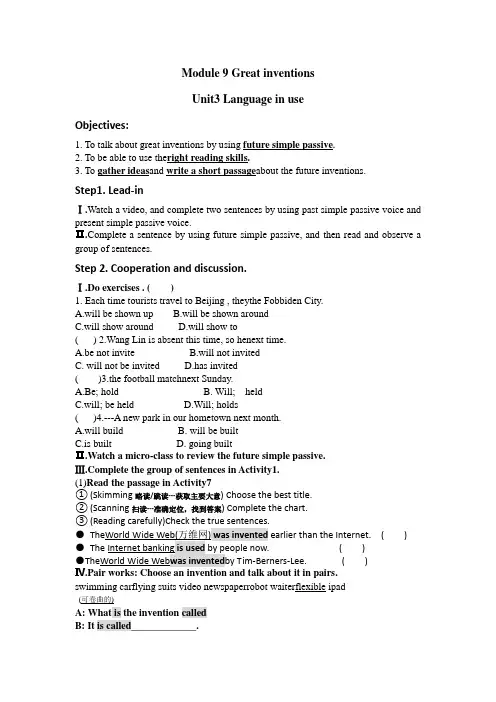
Module 9 Great inventionsUnit3 Language in useObjectives:1. To talk about great inventions by using future simple passive.2. To be able to use the right reading skills.3. To gather ideas and write a short passage about the future inventions.Step1. Lead-inⅠ.Watch a video, and complete two sentences by using past simple passive voice and present simple passive voice.Ⅱ.Complete a sentence by using future simple passive, and then read and observe a group of sentences.Step 2. Cooperation and discussion.Ⅰ.Do exercises . ( )1. Each time tourists travel to Beijing , theythe Fobbiden City.A.will be shown upB.will be shown aroundC.will show aroundD.will show to( ) 2.Wang Lin is absent this time, so henext time.A.be not inviteB.will not invitedC. will not be invitedD.has invited( )3.the football matchnext Sunday.A.Be; holdB. Will; heldC.will; be heldD.Will; holds( )4.---A new park in our hometown next month.A.will buildB. will be builtC.is builtD. going builtⅡ.Watch a micro-class to review the future simple passive.Ⅲ.Complete the group of sentences in Activity1.(1)Read the passage in Activity7①(Skimming略读/跳读---获取主要大意) Choose the best title.②(Scanning扫读---准确定位,找到答案) Complete the chart.③●( )●( )●( )Ⅳswimming carflying suits video newspaperrobot waiterflexible ipad(可卷曲的)A: What is the invention calledB: It is called_____________.A: What will _______be used to do/Where will_____be used/Who will_____be used byB: It will be used _________.A: What are the advantages of the inventionB: It will ______________________.A: When will it be inventedB:I’m not sure, but I hope it will be created as soon as possible./ It will be invented in …Step3 Teaching and explanationpositive sentence form:(肯定句式):negative sentence form:(否认句式)interrogative sentence form:(一般疑问句式)Wh- interrogative sentence form:(特殊疑问句式)Step4. Consolidation and ImprovementsGroup work: Work in groups and design your own inventions or make anStep 5 Self-generation What you have learned in this class Homework:1.Make a poster of your imaginative invention☆Write the instructions of your amazing invention.2.Do the exercises in workbook.Module 3HeroesUnit 1She trained hard, so she became a great player laterⅠ. Teaching modelListening and speakingⅡ.Teaching methodCommunicative approachⅢ. Teaching aimsa. Key words:including, medal, attend, abroad, doctor, degree, whatever, amazing, will, victory, simplyb. Key Phrases:once again, give up, attend university, a very strong willc. Everyday English:1. She started playing table tennis when she was five.2.She trained hard, so she became a great player later.3. Her English wasn’t good enough when she began.4. Whatever she does, she never gives up.5. I think she’s a good student as well as a good player.6. She’s simply the best.Ⅳ.Teaching aidsTape recorder, OHP, ppt.Ⅴ.Teaching StepsStep1 Warming-up and listening1. Look at the pictures and talk something about heroes.2. Say something about Deng Yaping.3. Listen and check the correct answers in Activity 2.Step 2 Listen and read1. Listen to the tape carefully.2. Ask the students to read through the conversation individually.3. Deal with the exercises in Activity III and IV.4. Play the tape and have them read and follow.5. Act it out.5.Deal with the important sentences in the dialogue.Step 3 Do ExerciseComplete the passage in Activity 5.Step 5 Explain the important and difficult points1. She trained hard, so she became a great player later. so引导的结果状语从句。
外研版九年级英语上册Module9 Unit3课件
In the past
Today
Inventions today
What kind of phone/plane/TV is invented today? .... is invented today.
mobile phone 5G
UVA(無人機)=Unmanned Aerial Vehicle
Let's learn grammar Robot teachers will solve homework problems
Passive voice
Homework problems __w_il_l_ b_e__ solved
______(solve) by teacher robots.
WWea_wlk_iil_nl_g _sb_ceh_o_oc_la_br_rai_ge_sd_wห้องสมุดไป่ตู้illccaarrrryy)usbytoscshchoooolbl ags to school.
Let's learn grammar
Passive voice
Nowdays Ipaid is used for learning
Our ways of reading _ar_e__ c_h_an_g_ed__ (change) by e-books now.
Past
am/is/are done
THANK YOU
Twhheaintfuvitteunruetseioidsntnsoevbeer.
Homework
1.Finish the reading part in activity 7. 2.Write a short passage to introduce your favourite invention .
九年级英语上册 Module 9 Great inventions Unit 3 Language
九年级英语上册Module 9 Great inventions Unit 3 Language in use自行车的发明素材(新版)外研版编辑整理:尊敬的读者朋友们:这里是精品文档编辑中心,本文档内容是由我和我的同事精心编辑整理后发布的,发布之前我们对文中内容进行仔细校对,但是难免会有疏漏的地方,但是任然希望(九年级英语上册Module 9 Great inventions Unit 3 Language in use自行车的发明素材(新版)外研版)的内容能够给您的工作和学习带来便利。
同时也真诚的希望收到您的建议和反馈,这将是我们进步的源泉,前进的动力。
本文可编辑可修改,如果觉得对您有帮助请收藏以便随时查阅,最后祝您生活愉快业绩进步,以下为九年级英语上册Module 9 Great inventions Unit 3 Language in use自行车的发明素材(新版)外研版的全部内容。
自行车的发明德莱斯(1785—1851)德莱斯原是一个看林人,每天都要从一片林子走到另一片林子,多年走路的辛苦,激起了他想发明一种交通工具的欲望。
他想:如果人能坐在轮子上,那不就走得更快了吗!就这样,德莱斯开始设计和制造自行车。
他用两个木轮、一个鞍座、一个安在前轮上起控制作用的车把,制成了一辆轮车.人坐在车上,用双脚蹬地驱动木轮运动。
就这样,世界上第一辆自行车问世了。
1817年,德莱斯第一次骑自行车旅游,一路上受尽人闪的讥笑,……他决心用事实来回答这种讥笑。
一次比赛,他骑车4小时通过的距离,马拉车却用了15个小时。
尽管如此,仍然没有一家厂商愿意生产、出售这种自行车.1839年,苏各兰人马克米廉发明了脚蹬,装在自行车前轮上,使自行车技术大大提高了一步。
此后几十年中,涌现出了各种各样的自行车,如风帆自行车、水上踏车、冰上自行车、五轮自行车,自行车逐渐成为大众化的交通工具。
以后随着充气轮胎、链条等的出现,自行车的结构越来越完善。
Module9GreatinventionsUnit3Languageinuse训练课件英语九年级上
10. With the _d__ev_e_l_o_p_m__e_n_t_ (develop) of the high-speed train, it’s convenient for people to go wherever they want.
If she sat 4. ___C____ , she felt lonely. 4. A. on time B. in a hurry C. by herself D. in public
【解析】考查介词短语辨析。on time 准时; in a hurry 匆忙地;by herself 独自;in public 在公共场合。由句中 “she felt lonely”可知, 应该是sit by herself“独坐”。故选C。
But if she asked to join someone and was 5. ___B____, she felt embarrassed. 5. A. called B. refused C. discussed D. believed
【解析】考查动词辨析。called 称呼;refused 拒绝; discussed 谈 论 ; believed 相 信 。 句 中 “she felt embarrassed” 描述的是被拒绝后的感受。故选B。
13. Do you know what you should pay attention to __to__f_o_r_m__ (form) a good study habit?
【解析】句意:你知道要养成一个良好的学习习惯 应该注意什么吗? form“培养,形成”,动词。 what you should pay attention to 作动词know 的宾语, 此处指为了养成一个良好的学习习惯应该注意什么, 应用动词不定式表目的。故填to form。
外研版英语九上Module 9《Great inventions》(Unit 3)word学案
特殊疑问词will+主语+be+done/
特殊疑问词be(am/is/are)+主语+going to+be+done
Practice
1. ____ books ________ (replace) by computers in the future?
2. My bike is broken. It _________ (fix) tomorrow.
Look at the pictures and describe the new classroom that will be built. Use the words in the box to help you.
build, buy, change
A new classroom will be built.
3. —Dad, can I use the Internet this evening?
—Yes, but the computer is not on yet. The electricity ___________ (not connect) until nine o’clock.
4. _____ the problem _____________ (talk about) at the meeting tomorrow?
Keys:A new floor will be built.
New furniture (desk/ chairs) will be bought.
A new blackboard will be bought.
A new interactive whiteboard will be bought.