
外研版高中英语必修五Module6《AnimalsinDanger》-Reading课件
and killed .when his f_r_o_z_e_n_ body was found hours later,he was still holding his gun. He had _g_i_v_e_n_ his life to _sa__v_e__ the Tibetan antelopes .
quickly .he shout _t_o_ the poachers top_u__t_d_o_w_n__ their guns . Although _s_u_r_p__r_is_e_d___,the poachers had an _a_d_v_a_n_t_a_g_e_ ---there were more of them.
Suonangdajie found what he was looking for --- a
group ofp_o_a_c_h_e_r_s who were killing the _e_n_d_a_n_g_e_r_e_d Tibetan antelope . Jiesang knew he had to move
by the 1990s about 50,000
the wool the most expensive soft , light and warm
a shawl five thousand dollars
for poachers
the profits
the poachers
shoot
the antelopes
skinned
the shawls
138 shawls
about 1,000
since 1975
in January 1994
3000 ; 300
since 1997
There has been a ban on the illegal trade since 1975 .
On a _f_r_e_e_z_in__g_ cold day in Januarቤተ መጻሕፍቲ ባይዱ 1994,Jiesang
Part II : paragraph 2-3
The poachers shoot lots of antelopes because their wool can bring them huge profits .So the antelopes are in danger .
Part III : paragraph 4-5
the Chinese government begin to protect
about 3,000 poachers
caught
The volunteers
help the officials
Police
get tough with
international co-operation strengthen
The Chinese government began to take actions to protect the antelopes in the 1990s and the antelope population is on the increase .
at the beginning of 20th millions of antelopes
What should we do to protect the wildlife and our own earth ?
高中英语课件
(金戈铁骑 整理制作)
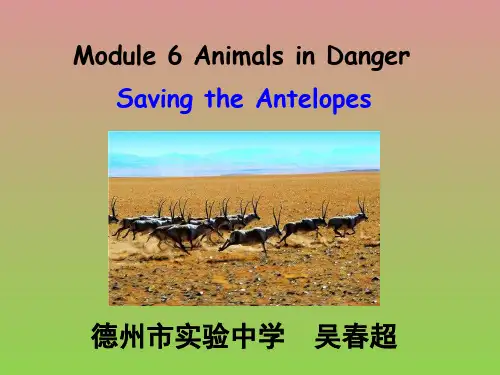
Saving the Antelopes
Why are the Tibetan antelopes in danger ? The poachers killed them for their wool
Part I : paragraph 1
Jiesang gave his life to save the Tibetan antelope.
外研版必修五精品课件Module6AnimalsinDanger(共20张PPT)
Summary
Say what the numbers and dates refer to
1. 50,000 2. $5,000 3. 1975 4. 138
Antelopes are endangered because of poachers killing them for their wool to earn money. Think of more reasons why animals are endangered.
Find out the reasons for the antelope being chosen as mascot.
5. 1,000 6. 3,000 7. 300 8. 1997
B
A
C
Tasks
F
D
E
Homework
Write a letter of apology to the antelopes.
wuchunchao@
Suppose a poacher is standing in front of you. Try to persuade him to protect antelopes.
Para 1
A. The illegal business of antelope wool
Para 2 Para 3 Para 4 Para 5
B. Progress in protecting the antelopes. C. Antelopes were killed for their wool. D. Jiesang Suonandajie E. The Chinese government protect
外研版必修五Module6AnimalsinDanger课件

8.__la_y_____ vt. 产卵;下蛋 9._b_r_a_n_c_h__ n. 分支机构;办事处 10._fo_c_u__s___ n. 焦点;集中点 11._w_a_s_t_e___ vt. 浪费
用准用活
单词拼写/单句语法填空 1.[2019·浙江卷]We left our mother outside to _b_a_tt_l_e___ (战斗) with
(三)精彩写句式 背原句
明句式
学仿写
1.Although surprised, the poachers had an advantage — there were more of them.
although 引 导让步状语
1. 尽 管 老 教 授 反 对 我 的 观 点,但他又提不出个人的看 法。
7.The tiger _e_n_d_a_n_g_e_re_d_ the safety of the deer, but the e_n_d_a_n_g_e_r_e_d
deer dealt with the d_a_n_g_e_r_o_u_s situation smartly. Now it is out of __d_a_n_g_e_r _.(danger)
高中英语必修5(外研版)Unit 6 Animals in Danger 知识点总结
高中英语必修5(外研版)Unit 6 Animals in Danger知识点总结一、重点词汇endanger·原文再现But the Siberian tiger is not the only endangered species.但是,西伯利亚虎并不是唯一一种濒危动物。
·基本用法endanger vt. 危及;使遭到危险Overworking can endanger your health.工作过度可能会危害你的健康。
He will endanger his freedom and even his life.他将断送自己的自由,以至生命。
·知识拓展相关单词endangered adj. 濒临灭绝的;有危险的We should do our best to save endangered species.我们应该竭尽全力挽救濒于灭绝的生物。
词义辨析:dangerous/ in danger/ endanger1. dangerous是形容词,指“危险的”,即句子主语给别人造成危害。
These are dangerous animals.这些是危险动物。
2. in danger 是介词短语,指自身处于危险的状态中。
反义词为out of danger。
He is in danger. We should go to save him.他处于险境;我们应该去救他。
3. endanger 是动词,指“危及;使…暴露于危险中”。
This kind of disease will endanger your life.这种疾病会危及你的生命。
reserve·原文再现The Chinese and Russian governments have created the reserve to help save the tiger’s natural habitat.中俄两国政府已设立了保护区来保护老虎的自然栖息地。
高中英语 Module6 Animals in Danger教案 外研版必修5
Module 6 Animals in DangerPeriod OneTeaching aims and demands:1. Knowledge and Skills(1) Ss will learn some information about the present situation of the wild animals and theeffort made to protect the wild animals.(2) Ss will learn to recognize the important reasons to protect the animals in danger andhelp them to realize that saving the wild animals is saving human beings.(3) Help Ss to consolidate their reading skills like skimming and scanning for details.2. Process and methodology(1) Communicative approach(2) Task-based strategy(3) Cognitive strategy3. Emotion, attitude and value(1) Help Ss to sense the importance of saving the animals in danger and the necessity ofprotecting the earth.(2) Help Ss learn how to realize the dream, how to call on more people to realize theimportance of saving the animals in danger.Difficult points:1. Enable the Ss to talk about the current situation of wild animals.2. Guide the Ss to summarize the main idea of each paragraph as well as the main idea of the text.3. Help Ss learn what effort has been made to change the serious situation and what else should be done.Teaching methods:1. Task-based activities and fast reading skills for main ideas and details.2. Discussions to improve Ss' reading comprehension of the passage.3. Individual,pair or group work to make every student work in class.Teaching aids:Computer, tape recorder, and blackboard and papers.Teaching procedures:Step 1. Greetings. Greet the whole class as usual.Step 2. Warming up.Begin with several pictures of dinosaurs, which will help the Ss to realize the topic of this module. And talk about several pictures with 2 questions:1.What do the giant panda and Siberian tiger have in common?2.What can we do to help them in their struggle for survival?Step 3. PresentationWith the help of several pictures and a flash, let the students predict the text.Step 4. Reading.1. Fast reading: help the Ss get some general information of the passage.A. Who is Jiesang Suonandajie?B. Why do the poachers kill the antelopes?2. Careful reading: Summarize the general idea of the whole passage.Para. 1 Jiesang Suonandajie died when protecting antelopes.Para. 2 The reason for the trade.Para. 3 The process of the trade.Para. 4 The result of the battle.Para. 5 The present situation and the future of the battle.3. Listen to the tape to catch specific information of the passage and ask the Ss to fillin the blanks.The general idea of the text:The reading gives a brief description of the current situation of antelopes. Realize the importance and urgency of protecting the wild animals. The struggle of protecting antelopes will last a long time and will call on more and more people to take part in it.Step 5. Reading for details and comprehension.Complete the table2. Finish exercise2 on Page 52.Step 6. Discussions:let the Ss realize the purpose of learning this passage, the importance of saving antelopes and the necessity of taking immediate measures. (a flash 藏羚羊的心愿 will help the Ss fully understand the topic.)1. What do you learn from the text?2. Why do we have to prevent the animals from dying out?3. In your opinion, what should we Chinese people do to save the endangered Tibetan antelope? Step 7. Collecting answers and making a summaryStep 8. HomeworkRead the text and underline the difficult sentences.Finish exercise 4 on Page53.Period TwoStep 1. Language points in introduction:1. Thanks to scientists’ hard work, the number of the pandas living in the wild has increasedto about 1,590.thanks to 多亏,由于 because of, as a result of,e.g. Thanks to the firefighters, people were saved in the fire.2. Every year thousands of wild animals and plants become extinct.extinct adj. (生物等)已灭绝,已绝种的This kind of elephant has been extinct for a long time.3. …More than 12,000 animal species are now in danger.in danger 在危险中,濒危e.g. This kind of tiger is in danger.He is in great danger of failing the entrance examination.Step 2. Language points in reading:4. On a freezing cold day in January 1994,…freezing adj. 极冷的, 冷淡的frozen adj. 被冰冻的, 结冰的,冷漠的freezing point, a freezing machine,frozen food, in frozen silence5. Although surprised, the poachers had an advantage—they were more of them.although surprised—although they were surprised at the shout6. He had given his life to save the Tibetan antelope.g ive one’ life to…为……献身, 把一生献给……7. The animals are skinned on the spot and the wool taken to India…on the spot当场,在现场, 立刻e.g. Anyone breaking the rules will be asked to leave on the spot.When the fighting started, policemen and reporters were soon on the spot. 8. But in the 1990s the shawls came into fashion among rich people.come into fashion 成为时尚9. The small group of officials who work in the reserve are helped by volunteers who comefrom all over the country, and who are ready for the difficult conditions of life at 5,000 metres.此句包含了三个由who 引导的定语从句(让学生体会定语从句在高考中的考察)10. Meanwhile, in those countries where the shawls are sold, police are getting tough with the dealers.get/ be tough with sb. 对某人强硬起来, 对某人毫不妥协e.g. The government will get tough with the people who avoid paying taxes.11. be / feel concerned about/ for / over sth. 关心, 担心某事,对某事关注12. important phrases:keep an eye on 照看go for someone 向某人进攻on the brink of … 在……边缘stand for 代表have an effect on 对……有影响Step 3. Homework1. Review what we have learnt.2. Remember the new words and expressions.3. Finish exercises on P53.Period ThreeStep1. Grammar –1. Presentation.Look at the underlined clauses and find the function of the clauses.Step2. Grammar –2. Practice. (15m)Do exercises 2,3,4 and 5 in the textbook.Step3. Grammar –3. Conclusion (15m)Ask Ss to make a conclusion of the use of attributive clauses. Two kinds of the attributive clause:1. 限制性定语从句restrictive attributive clause(无逗号)2. 非限制性定语从句non- restrictive attributive clause(有逗号)He doesn’t like to wear clothes which/that made him very strange.He doesn’t like to wear clothes ,which made him very strange.Xi hua who I met across in the street a few days ago has gone abroad.Xi hua ,who I met across in the street a few days ago has gone abroad.Attributive clause:定语从句被修饰的词:先行词引导定语从句的词:关系词关系词分为关系代词和关系副词两类,指代被修饰的词(先行词),并且在从句中充当成分.They have three houses. + The three houses are built of stone.===They have three houses which/that are built of stone.He is not a true man. + He doesn’t reach the Great Wall ====He who doesn’t reach the Great Wall is not a true man.Step 4. Function – 1. PresentationGive some facts and show your concern.✧Today there are only about 1,000 Siberian tigers left.✧It is reported that there are only 200-300 Northern bald ibises left.✧It is said that 12,000 animal species are now in danger.What do you feel when you read this?Step 5. Function – 2. PracticePoint out the expressions of concern.It is really upsetting.I’m very worried about…I’m concerned about…We really should do more for…Make more sentences to show your concern to the animals in danger.Step 6. Homework - Task of the lesson1.Have a revision of the grammar—the attributive clauses .2.Finish the exercises of workbook on page97Period FourTeaching aims:1. Target languagea. 重点词汇和短语 bird, insect, mammal, reptile, reserveb. 重点句子It’s a pity I didn’t have my camera! P562. Ability aimsGet the Ss to tell apart birds, insects, mammals and reptiles.3. Learning abilityGet the Ss to learn how to get the main information by writing down “key words”. Important & difficult points:Get the Ss to learn how to get the main information by writ ing down “key words”. Teaching methods:Practising, sorting and listening.Teaching aids:A computer, a projector and a tape-recorder.Teaching procedures:Step 1. Greeting and revisionT: There are more than ten English teachers attending to our class. Let’s welcome them.OK, class begins. Good morning!Ss: Good morning!Go through the teaching procedures, then make a revision by practicing the language focuses.T: Last lesson, we have practiced how to get main information by “key words” on rea ding.Here are four short passages at the bottom of page 55. Please read them as quickly as you can, then match the description with the photos.Half a minute later, check the answers and summary the means of getting main information by key words.Step 2. VocabularyGuide the Ss to do Activities 1 and 3. Get them to guess the animals on the screen and sort them.T: But who can tell us the differences between birds, insects, mammals and reptiles? Show the exercises of Activity 1 on the screen and ask individual to do the answers. S1: A bird has warm blood and lays eggs.S2: An insect is a small animal with six legs. Some have wings.S3: A reptiles has cold blood and lays eggs.S4: A mammal is an animal which drinks its mother’s milk when it is you ng.T: You are completely right! Now, please turn to Page 56 and do Activity 3 according tothe instruction. I will show you some photos of animals. You should tell me their names and fill in the table.Show some photos of animals on the screen and check whether the Ss tell their names rightly. Then, show one student’s answers on the screen to check with the whole class.Step 3. ListeningT: Now, please look at the picture on the screen. What is the continent?Ss: Africa.T: Yes. Pay attention to the south. There is a nature reserve. What’s its name?Ss: Tembe Elephant Reserve.T: Well, just now, we have talked about some animals. If you were a volunteer there, which animals would you talk about? Why?Ss: Elephant. Because the name of the reserve tells us. And the elephant is the most famous and useful animal in South Africa.T: You are quite right. Now go through the questions on the screen. Try you best to get the useful information for listening, at the same time, you should focus on what information you have to get while listening. I’ll give you two minutes.1.What was William Norris?2.Where was he work in?3.How long was he there?4.How many elephants are there in the reserve?5.Which animals did he work with?6.How often did he see them?7.Does William think people can help animals in danger?Two minutes later, Get the Ss to listen to the tape carefully and try to write down the “key words” for answering the questions.T: Are you ready?Ss: Yes.T: Now, listen to the tape carefully and try to write down the “key words” for answering the questions.Ss: OK.T: Have you got the answers?Ss: Yes.T: Good! Who wants to tell us your answers?S1: He was a volunteer.S2: On the Theme Nature Reserve in South Africa.S3: Only three months.S4: About 250.S5: Lions.S6: Almost every night.S7: Yes, he does.T: Well done! Now listen again and complete the page from William’s diary in Activity6.Then check the answers and summery the skills of listening.Step 4. HomeworkDo pair works to describe an animal in Activity 3 after class. One describes an animal and the other tries to guess what it is. Then make a change.Period FiveStep 1. Read the form and find out what animals they are.Step 2. Read the form and ask and answer.Talk about these animals and find more information.Ss may do like this:A: What kind of animal is the Siberian tiger?B: It is the largest member of cat family.A: Where can Siberian tigers be found?B: It can be found in Siberia of Russia and parts of Northeast China.… …Step 3. Cultural Corner – Prediction Look at the title and the pictures and predict the answers.1. What does WWF stand for?2. What kind of work does WWF do?Step 4. Read the passage and answer the questions.1. What’s the aim of the WWF when it was founded?2. Does the organization always have the same focus of attention?3. When did the WWF set up an office in Beijing?Step 5. Read again and decide the following statements are True or False.1. The WWF was founded in Switzerland in the year 1961.2. Peter Scott was both a painter and a naturalist.3. At present the organization has branches in 130 countries.4. The WWF only pays attention to protecting wild animals in danger.5. It was Dr George Shaller who set up an office of WWF in Beijing.6. Saving the panda is one of the projects that the WWF is carrying out in China. (Answers: 1—6 FTFFFT)Step 6. Ask Ss to do the role-play and give an interview.Four Ss a group to have an interview, talking about how to save the endangered animals. A: an official working for the branch of the WWF in ChinaB: a volunteer working for the WWFC: a reporter from CRID: a reporter from CCTVStep 7. Language points in cultural cornerStep 8. HomeworkWrite a passage of a certain kind of endangered animal, its description, habitat, numbers left and the way to save it must be included.。
外研版高中英语必修5教学课件:Module 6 Animals in Danger
of
into
antelopes 5._f_a_s_h_io_n____ among rich people. In
has fallen order to get the huge profits, greatly. poachers shot whole 6._h__er_d_s___ of
antelopes, and skinned the animals on the 7._s_p_o_t____.
Title: Saving the Antelopes
The wool of the antelope is soft,
light, and warm. A shawl made from
The the wool of the antelope is 4._w__o_rt_h__
number much. In the 1990s the shawls came
3.The Chinese government began to take an active part in protecting the antelopes.( T ) 4.Little progress has been made in protecting the antelopes.( F )
高中英语 Module 6 Animals in Danger课件 外研版必修
• David’s deer
• Chinese scientists find it hard to explain how the population of David’s deer,known as Milu deer among Chinese,bounced back after dying out in China.The Dafeng Nature Reserve in Jiangsu Province introduced 64 David’s deer in 1993 and 1994, and the population has grown to 450 today.
• Rhinos • There are five species of rhinos,two African species and
three Asian species.The African species are the white and black rhinos.Both species have two n rhinos each have one horn.Rhinos rank among the most endangered species on Earth.Valued for their horns,they face a serious threat from poaching.
• White elephant
• Today white elephants are very rare.The white elephant is a native of Southeast Asia—Laos,Cambodia,Vietnam and Thailand.The last white elephant in Burma was seen in 1961.
外研版高中英语必修5课件:Module 6 Animals in Danger
3.Which of the following statements is TRUE according to the passage? A.The aim of the poachers is to catch the baby antelopes. B.Police are getting tough with the dealers who deal with the wool shawls. C.The wool is made into shawls in developed countries, and then the shawls are exported to India. D.Some rich people’s preference for wool shawls has little connection with the decrease of the number of the antelopes. 答案 1.C 2.B 3.B
Ⅲ.句型搜索 1. Although surprised, the poachers had an advantage— there were more of them. [信息提取] 状语从句的省略 [例句仿写] 你应呆在你现在的地方不动,除非叫你动。 You should stay where you are,unless_(_y_o_u_a_r_e_) _a_sk_e_d__to_____ _l_e_a_ve___.
【比较网站】 endanger/in danger/dangerous
危及,危害,及物动词,后面接 endanger
宾语。 介词短语,指受到外来的威胁, in danger 自身处于危险之中。 adj.危险的,指给别人造成危害 dangerous 或危险,对别人构成威胁。
外研版必修5Module6AnimalsinDangerreading教学课件
other measures to save the animals.
• We can join some Animal Conservation Organizations to help to protect them.
D. The wool of the Tibetan antelope is very expensive in the world.
3. Arrange the following statements in the order of time ( C )
a. The antelope population slightly began to grow.
Para.1 Suonandajie’s death
__O_n_ a _f_re_e_z_in_g__cold day , Jiesang Suonandajie found a group of _p_o_a_c_h_er_s__ killing the _en_d_a_n_g_e_r_e_d__ Tibetan antelope. He asked them to _p_u_t _d_o_w_n_ their guns. But the poachers had an _a_d_v_a_n_ta_g_e_-- there were more of them. As a result, Jiesang was shot and killed. He had _g_iv_e_n_h_i_s_li_fe_ to save the Tibetan antelope.
• We try to call on people not to buy goods made from animals.
外研版必修五Module6AnimalsinDanger课件
以外,但他仍去
导的让步状
上课。
语从句的省 _A__lt_h_o_u_g_h__l_iv_i_n_g_ 略。其后省 _m__il_e_s_a_w_a_y__, he
略了they attended the
were。
course.
返回
原句背诵
句式解构 佳句仿写
随着社会的发展,
2.But today the
be involved in it.(involve) 5.The old man is still full of energy and his wife is even more
_e_n_e_r_g_e_t_ic_.(energy)
返回
6.This article is well worth reading, but it is not worthy of being translated. So I feel that all your effort isn't w__o_r_th__w_h_i_le_.(worth)
返回
[语境活用]
1.Many animals are already extinct , or are close to _e_x_ti_n_c_t_io_n_.(extinct)
2.We should have a specific aim in life. Living an aimless life
→ worthwhile adj.值得花时间/金钱/精力的
返回
6.dealer n.(尤指买卖贵重商品的)商人→ deal n.交易 7.aim n.目标;目的→ aimless adj.没有目标的 8.involve vt.涉及;包括→ involved adj.有关的 9.wonder n.奇迹→ wonderful adj.精彩的 10.energy n.能量;精力;能源→ energetic adj.精力充沛的
高中英语外研版 必修5 Module 6 Animals in Danger
——处于危险中的动物核心词汇.(没收)..(突击搜查) ..(理想的) .. (栖息地) ..(灭绝的) ..(斗争) ..(保护) ..’(涉及) .. .()., .();;;高频短语.处于危险中.记下;放下.献出生命,捐躯.一次;每次.当场;在现场.流行起来,开始风行.以强硬的方式惩罚.想得到;适用于;选择.关心某事;担心某事.(动物)以……为食.代表,象征;支持.建立;开创.从事于;忙于’ .重点句式.,— .尽管很吃惊,偷猎者有一个优势——他们人多。
. .截止到世纪年代,藏羚羊的数目下降到了大约万头。
.,,, .那些偷猎者常常是夜里出动,一次就捕杀掉整群的藏羚羊,只留下那些毛不那么值钱的幼崽。
., .这些被捕杀的藏羚羊被就地剥皮,羊毛被运送到印度,在那里被织成披肩。
. .但是现在政府好像正要赢得这场战斗。
;;;知识详解.保护(回归课本) —, .世纪年代,中国政府开始积极开展在可可西里自然保护区的保护藏羚羊的工作——可可西里自然保护区是一个位于青藏高原的大型国家公园,是藏羚羊的主要栖息地。
【归纳总结】【例句探源】① .他戴上太阳镜以保护眼睛免受日光的强烈照射。
② .保护朋友不受敌人伤害是他们的责任。
③, .然而,人们制定了法律保护狼免遭打猎人以及为了得到它们的皮而捕杀它们的人的伤害。
④ .那件外套太薄了,根本无法御寒。
【注意】 .阻止某人做某事阻止某事发生。
主动句中...中的可省略,在被动句中不可省略,且...中的也不能省略。
【易混辨析】,二者都有“保护;使安全”之意,有时可以互换使用,区别如下:指“保卫;防御”,应用范围很广,对象可以是具体的,也可以是抽象的;而指“保护……以免遭受危险或伤害等”。
① .② .【即境活用】.—,?—’ .....解析:选。
.= .阻止某人做某事;从……中把某人拯救出来,使某人免遭危险;使……免于……。
由语境知项符合。
.....解析:选。
句意:我们花园里的花木被保护以免遭冷空气危害。