
海员英语面试164条(船长、大副、二副、三副适用)
Occupation职务篇
26、Who is responsible for the vessel?
Master (Captain)is responsible for the vessel.That is,the master is responsible for the seaworthiness and safe, efficient and economical operation of the vessel and management of crew,cargo and ship borne equipment.
22、Who takes charge of fire fighting appliance in the engine room? What does it include?
Second Engineer takes charge of it. It includes fire mains, dry power, and so on.
8、How often will you have a life drill or fire fighting drill?
One month interval.
9、What does flag signal "Oscar" stand for?
It stands for man overboard.人员落水时应挂字母“O”旗,放三长声号笛,并转向。目视跟踪落水者,向落水人附近抛救生圈等。
23、How often will you perform a fire-fighting drill? Who control on the spot?Once a month. The Chief Officer takes charge of the drill on the spot. If the drill occurs in the engine room, Chief Engineer takes charge of the drill on the spot.
OK. It includes motor, warping drum gypsy, brake, clutch, hand wheel of clutch, hand ahead of brake.
注:
电动锚机由于在前甲板,其使用由甲板部,修理归轮机部,属于共性的问题。
15、Could you list different lines which ships use?
My pleasure,sir!For example:
5、Who takes care of documents on board?
Captain, or a senior officer nominated by the captain.
6、Who keeps the Master key?
7、Who takes care of medicine?
29、What does ILO talk about?
ILO stands for the International Labour Organization. ILO is an organization on crew agreement.It represents labour interests.Master takes responsibility for the ship.Master should adjust the relationship between shipowner and crew by generous and efficient measures taken in the interests of shipowner.
2、What is NCR in ISM code?
3、Where is Good Hope Cape located?
It is located in the southeast coast of South Africa. The ship will meet it to transit from the Indian Ocean to the Atlantic Ocean and vice versa.
24、How long is the lifeboat launched into water? Is it allowed to launch lifeboat in the harbour?
Within 3months.If you want to launch the lifeboat in the harbour,you may enquire the local Harbour Superintendency Administration before launching.
12、Could you list different kinds of ship's surveys?
Yes,sir.For example:ቤተ መጻሕፍቲ ባይዱ
Annual Surveys,Docking surveys,Special surveys,Immediate Surveys,Surveys for renew certificates, and so on.
10、Could you list different mooring equipment on board?
Yes, sir. For example:
open chock, cleat, closed chock, bitts, open roller chock, padeye, bullnose,dolphin, and so on.
海员英语面试164条(船长、大副、二副、三副适用)
1、What is DPA in ISM code?
DPA stands for Designated Person(s)Ashore.His responsibility includes monitoring safety,pollution prevention aspects on the behalf of shipowner.
21、If one of crew on board was seriously ill, whom will you contact with?Many methods. One of the methods is to contact with the shipowner, and obtain the instructions from the shipowner,or you can ask the agent from the nearest harbour to arrange hospital admission.船员生病的费用一般由两部分承担。船东互保协会承担一个固定数量,其余由船东承担,因此发生费用由船东承担这一事实就迫使在船工作的人员注意一旦船上有病号应及时地与船东联系,一般由船东安排,同时船上还要采取一定地有助于保持病员生命的措施。
13、Could you list the parts of a stockless anchor?
OK. It includes shackle, shank, crown, fuke, hinge bolt, tripping palm.锚卸扣、锚干、锚冠、锚爪、横销、突角。
14、Could you list the parts of an electric windless?
19、Could you tell particulars of the ship?
My pleasure.LOA (LBP),width (beam),freeboard,draft.They are included three kinds:
the maximum particulars related to maneuverability, the registered particulars related to certificates,and the type particulars related to stability calculation, and so on.通常按性质分类:
18、What are main reasons caused cargo damage?
Many reasons.Such as damages in inappropriate shifting or handling,damages due to false stowage,damages in poor ventilation or cargo hold conditions,damages in transshipment,damages due to the characteristics of the cargo themselves.
28、How many maritime publications are available for your vessel? Who takes care of them?
Many publications are available for our vessel. Such as Port to Entry, Admiralty Sailing Directions,Admiralty List of Light,Admiralty List of Radio Signals,Admiralty Tide Tables,Annual Summary of Admiralty Notice to Mariners.The second officer takes care of them.In addition,Chief Engineer keeps equipment specifications and publications for Engineer Department.
二副三副面试内容
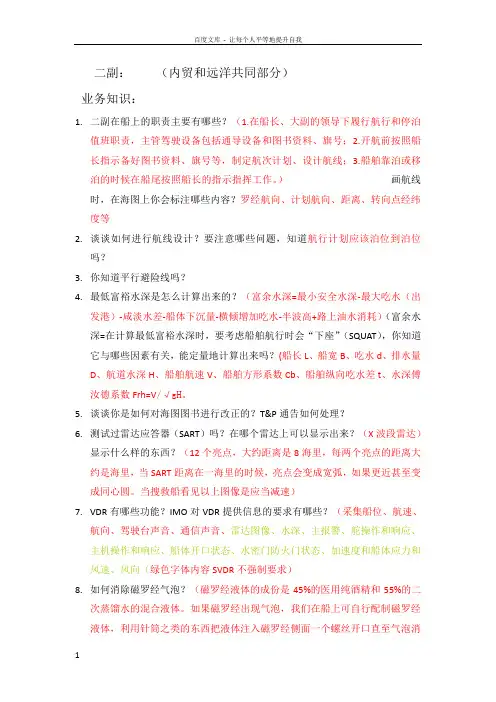
二副:(内贸和远洋共同部分)业务知识:1.二副在船上的职责主要有哪些?(1.在船长、大副的领导下履行航行和停泊值班职责,主管驾驶设备包括通导设备和图书资料、旗号;2.开航前按照船长指示备好图书资料、旗号等,制定航次计划、设计航线;3.船舶靠泊或移泊的时候在船尾按照船长的指示指挥工作。
)画航线时,在海图上你会标注哪些内容?罗经航向、计划航向、距离、转向点经纬度等2.谈谈如何进行航线设计?要注意哪些问题,知道航行计划应该泊位到泊位吗?3.你知道平行避险线吗?4.最低富裕水深是怎么计算出来的?(富余水深=最小安全水深-最大吃水(出发港)-咸淡水差-船体下沉量-横倾增加吃水-半波高+路上油水消耗)(富余水深=在计算最低富裕水深时,要考虑船舶航行时会“下座”(SQUAT),你知道它与哪些因素有关,能定量地计算出来吗?(船长L、船宽B、吃水d、排水量D、航道水深H、船舶航速V、船舶方形系数Cb、船舶纵向吃水差t、水深傅汝德系数Frh=V/√gH。
5.谈谈你是如何对海图图书进行改正的?T&P通告如何处理?6.测试过雷达应答器(SART)吗?在哪个雷达上可以显示出来?(X波段雷达)显示什么样的东西?(12个亮点,大约距离是8海里,每两个亮点的距离大约是海里,当SART距离在一海里的时候,亮点会变成宽弧,如果更近甚至变成同心圆。
当搜救船看见以上图像是应当减速)7.VDR有哪些功能?IMO对VDR提供信息的要求有哪些?(采集船位、航速、航向、驾驶台声音、通信声音、雷达图像、水深、主报警、舵操作和响应、主机操作和响应、船体开口状态、水密门防火门状态、加速度和船体应力和风速、风向(绿色字体内容SVDR不强制要求)8.如何消除磁罗经气泡?(磁罗经液体的成份是45%的医用纯酒精和55%的二次蒸馏水的混合液体。
如果磁罗经出现气泡,我们在船上可自行配制磁罗经液体,利用针筒之类的东西把液体注入磁罗经侧面一个螺丝开口直至气泡消除为止)。
船员英语英文面试-三副

船员英语英文面试-三副1. Could you give me a brief description of yourself?你可以做一个简短的自我介绍吗?My name is Hexi. I am 32 years old. I'm married and have a child.(I am single) I come from Dalian, a beautiful city near the sea. I like reading and playing football.I am a third officer now. I have experience in managing bulk carriers, oil tankers, and container ship.我的名字叫何西,今年32岁,我已经结婚了,并且有一个孩子(我是单身)。
我来自大连,一个美丽的海滨城市。
我喜欢阅读和踢足球。
我目前是一名三副,我有散货船、油轮和集装箱船的工作经验。
2 .Please tell us about a favorite port where your ship has called.请谈一下你船曾经挂靠过的最喜欢的港口。
Shanghai Port is my favorite port.We called at there in 2018. The port is very big and the city is beautiful. Shanghai is famous in China and in the world. It has more than 80 berths in the port. Many container ships call at this port. Shanghai is famous for seafood and tall buildings. Many foreigners live in Shanghai. It is a modern port.上海港是我最喜欢的港口,2018年我们挂靠在那儿。
海员英语面试164条(船长、大副、二副、三副适用)

Within 3months.If you want to launch the lifeboat in the harbour,you may enquire the local Harbour Superintendency Administration before launching.
29、What does ILO talk about?
ILO stands for the International Labour Organization. ILO is an organization on crew agreement.It represents labour interests.Master takes responsibility for the ship.Master should adjust the relationship between shipowner and crew by generous and efficient measures taken in the interests of shipowner.
My pleasure,sir!For example:
5、Who takes care of documents on board?
Captain, or a senior officer nominated by the captain.
6、Who keeps the Master key?
7、Who takes care of medicine?
大副(船员面试英语)

大副面试问题及参考答案第1页大副面试问题及参考答案大副是甲板上仅次于船长的“第二把手”。
大副的好坏直接关系到船舶、货物和人身安全。
经验表明,船东在面试大副时也是相当严格和认真的。
主要集中在货物的配载、装卸货、货物的保管、货物单据、管理能力、协调能力等方面。
而对于特种船来说,对有关货物装卸货的有关规定等也要熟知。
此外,有关ISM/SMS及其他公约、PSC检查以及船东内外审时的提问也是一个非常重要的部分。
下面整理了一部分面试试题,供参考。
我们建议,大副不但要准备下面的一些问题,也应该看看有关船长及二副和三副的有关问题,这样才能达到融会贯通的目的。
1. Can you tell me about your educational background and working experience?A reference answer:I graduated from Jimei Navigation College in 1992. I studied there for three years. I have worked as a seamen on eight ships for nearly ten years. I have the experience of Chief Officer for two ships. I have worked both Chinese and foreign shipowners in the past ten years.2. Can you tell me the responsibilities of the Chief Officer?Under the leadership of the Master, the Chief Officer shall carry out the daily management of the deck department, and he is also responsible for cargo handling. The specific duties include:(1) watch-keeping from 0400-0800 hours and 1600-2000 hours;(2) safety of the ship and work place, safety equipment;(3) daily safety and sanitary inspection;(4) store and spare parts inventory management;(5) maintenance on de ck;(6) stowage plan making;(7) supervision of the loading and unloading process;(8) cargo caring on board;(9) some other work and duties designated by the master of the vessel.3. Can you talk about the previous ve ssels (last ve ssel) you worked on board?It was an ocean-going ship, but it mainly loaded cargoes in Asia and discharged in Europe. It was an old ship about 14 years old. But the general condition of the ship was quite good because we did very good maintenance work ob board.4. What types of cargoes have ever been carried on board your last vessel?I have worked on bulk carriers and general cargo vessels and I have experienced a lot of cargo handling.这是一个很重要的问题,因为大副的一个很重要职务便是货物管理。
航海大副二副三副船舶避让英语
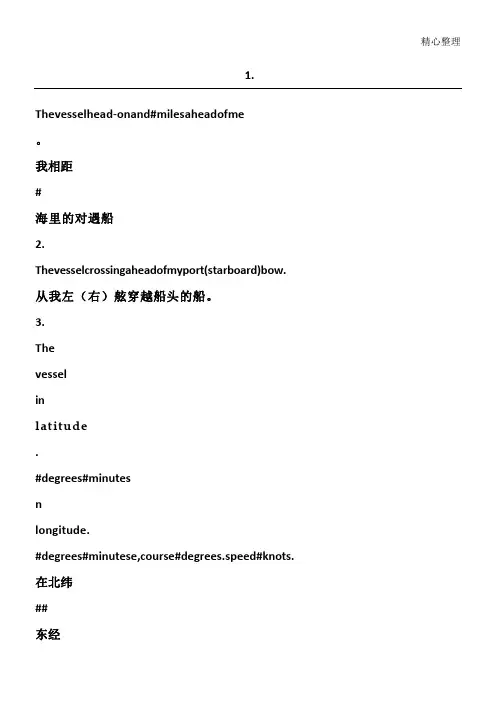
精心整理1.Thevesselhead-onand#milesaheadofme。
我相距#海里的对遇船2.Thevesselcrossingaheadofmyport(starboard)bow.从我左(右)舷穿越船头的船。
3.Thevesselinlatitude.#degrees#minutesnlongitude.#degrees#minutese,course#degrees.speed#knots.在北纬##东经##处,船向###度,航速##节的船。
4.Incoming(inward)/outgoing(outward)vessel. 进口/出口船5.Thevesselintendingtoovertake/cross/turn. 打算追越/横交/掉头的船。
6.Whatisyourintention?你的意图是什么?7.Iintend(want)to##.我打算###8.Iintendtoaltercourse,newcourse###degree. 我准备转向,新航向##度。
9.Altercoursetoport(starboard)/reducespeed/keepcourseandspeed/stopengine.向左(右)转向/减速/保向和保速/停车10.Adviceyoumark(steer)course###degrees.建议你走航向###度。
11.Pleasekeepwellclearofme/givemeawideberth. 请宽让我12.Keepoutofthewayofme/givewaytome.给我让路13.Donotpassahead/asternofme.不要过我船头/船尾。
14.Iwillovertakeonyourport(starboard)side.我将从你的左(右)舷追越。
15.Youshouldnavigatewithcaution.你应小心航行。
船舶修理轮机英语
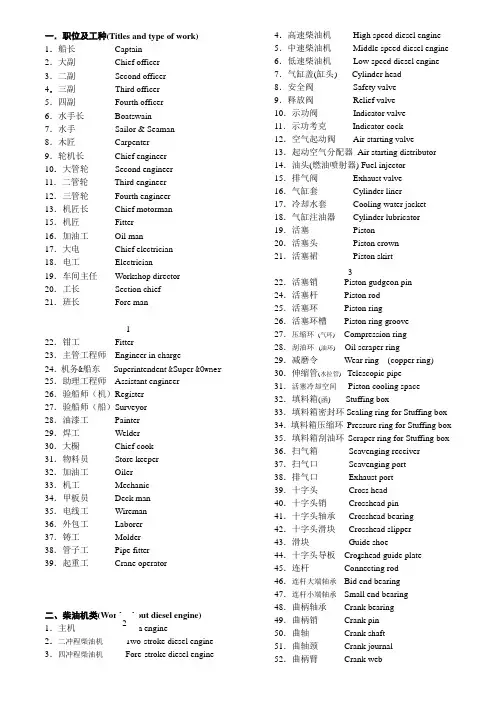
一.职位及工种(Titles and type of work) 1.船长 Captain 2.大副 Chief officer 3.二副 Second officer 4.三副 Third officer 5.四副 Fourth officer 6.水手长 Boatswain 7.水手 Sailor & Seaman 8.木匠 Carpenter 9.轮机长 Chief engineer 10.大管轮 Second engineer 11.二管轮 Third engineer 12.三管轮 Fourth engineer 13.机匠长 Chief motorman 15.机匠 Fitter 16.加油工 Oil man 17.大电 Chief electrician 18.电工 Electrician 19.车间主任 Workshop director 20.工长 Section chief 21.班长 Fore man22.钳工 23.主管工程师 Engineer in charge24.机务&船东 Superintendent &Super &Owner 25.助理工程师 Assistant engineer 26.验船师(机)Register 27.验船师(船)Surveyor 28.油漆工 Painter 29.焊工 Welder 30.大橱 Chief cook 31.物料员 Store keeper 32.加油工 Oiler33.机工 Mechanic 34.甲板员 Deck man 35.电线工 Wireman 36.外包工 Laborer 37.铸工 Molder 38.管子工 Pipe fitter 39.起重工 Crane operator二、柴油机类1.主机 2.二冲程柴油机 3.四冲程柴油机 Fore-stroke diesel engine4.高速柴油机 High speed diesel engine 5.中速柴油机 Middle speed diesel engine 6.低速柴油机 Low speed diesel engine 7.气缸盖(缸头) Cylinder head 8.安全阀 Safety valve 9.释放阀 Relief valve 10.示功阀 Indicator valve 11.示功考克 Indicator cock 12.空气起动阀 Air starting valve13.起动空气分配器 Air starting distributor 14.油头(燃油喷射器) Fuel injector 15.排气阀 Exhaust valve 16.气缸套 Cylinder liner17.冷却水套 Cooling water jacket 18.气缸注油器 Cylinder lubricator 19.活塞 Piston20.活塞头 Piston crown 21.活塞裙 22.活塞销 24.活塞杆 25.活塞环 Piston ring26.活塞环槽 Piston ring groove 27.压缩环 (气环) Compression ring 28.刮油环 (油环) Oil scraper ring29.减磨令 Wear ring (copper ring) 30.伸缩管(水拉管) Telescopic pipe31.活塞冷却空间 Piston cooling space 32.填料箱(函) Stuffing box33.填料箱密封环Sealing ring for Stuffing box 34.填料箱压缩环 Pressure ring for Stuffing box 35.填料箱刮油环 Scraper ring for Stuffing box 36.扫气箱 Scavenging receiver 37.扫气口 Scavenging port 38.排气口 Exhaust port 39.十字头 Cross head 40.十字头销 Crosshead pin 41.十字头轴承 Crosshead bearing 42.十字头滑块 Crosshead slipper 43.滑块 44.十字头导板 45.连杆 46.连杆大端轴承 47.连杆小端轴承 Small end bearing 48.曲柄轴承 Crank bearing 49.曲柄销 Crank pin 50.曲轴 Crank shaft 51.曲轴颈 Crank journal 52.曲柄臂 Crank web53.拐档差Crank deflection54.主轴承Main bearing55.主轴颈Main journal56.轴承瓦Bearing bush57.上轴瓦Upper bearing bush58.上轴瓦Upper half59.下轴瓦Lower bearing bush60.下轴瓦Lower half61.推力轴承Thrust bearing62.推力块Thrust pad63.推力盘Thrust disc64.推力轴Thrust shaft65.底座Bed plate66.机架67.曲柄箱68.曲柄箱导门69.曲柄箱防爆门Explosion-proof Crank case.70.定时齿轮Timing gear71.飞轮Flying wheel72.凸轮Cam73.凸轮轴Cam shaft74.喷油凸轮Fuel injection cam75.链条Chain76.链条轮Chain wheel77.链条箱Chain box78.推杆Push rod79.摇臂Rocker arm80.排气阀Exhaust valve81.吸气阀Suction valve82.排气总管Exhaust manifold83.进气总管Air inlet manifold84.高压燃油管High pressure fuel pipe85.活塞冷却水管Piston cooling water pipe86.法兰Flange87.贯穿螺栓Tie bolt (tie rod)88.端盖89.滑油泵90.燃油泵91.滑油泵齿轮Gear for lubricating oil pump92.燃油泵齿轮Gear for fuel oil pump93.叶轮Impeller94.柱塞Plunger95.导杆Guide rod96.导套Sleeve97.滚动轴承Ball bearing98.滑动轴承Sliding bearing99.推力滚动轴承Thrust ball bearing100.推力面Thrust surface (thrust side)101.盘车机Turning gear102.增压器Turbocharger103.涡轮机(透平)Turbine104.涡轮Turbine wheel105.涡轮叶片Turbine blade106.喷嘴Nozzle107.废气叶轮Exhaust impeller108.废气叶轮片Exhaust blade109.废气端Exhaust side110.透平端111.转子轴112.油泵113.换向装置Reversing device114.换向伺服期Reversing servomotor115.压气机(鼓风机) Blower116.膨胀接Expansion joint117.调速器governor118.飞重Flying weight119.补偿阀Compensate valve120.针阀Needle valve121.开口销Cotter pin122.轴封Shaft seal123.机械密封Machinery seal124.配电盘Switchboard125.应急配电盘Emergency switchboard126.应急发电机Emergency generator127.滤器Filter128.细滤器Filter129.粗滤器Strainer130.滑油滤器L.O. filter131.燃油滤器 F.O. filter132132.空气滤器133.空气瓶134.分油机Separator135.油水分离器Water-oil separator136.净油机Purifier137.燃油净化器 F.O. purifier138.二氧化碳CO2139.二氧化碳瓶CO2 bottle140.正时齿轮Timing gear141.导向棒装置Guide bar142.注油器驱动Lubricator driver143.链条张紧装置Chain tightener144.凸轮轴传动轮Chain wheel on cam shaft145.中间链链传动轮Intermediate chain wheel146.注油器驱动装置Lubricator drive147.链条张紧装置Chain tightener148.滚筒导座Roller guide housing149.应急操纵台Emergency console150.力矩平衡器151.主启动阀152153.喷油器Fuel valve154.扫气系统Scavenge air system155.安全帽Safety cap156.机座Bed plate157.轴向振动减振器Axial vibration damper158.贯穿螺栓Arrangement of stay bolt159.示功器驱动装置Indicator driver160.端罩End shields161.气缸架Cylinder frame162.气阀传动装置Valve operating device163.摇臂润滑油泵Rocker arm lubricating oilpump164.摇臂润滑油柜Rocker arm lubricating tank165.摇臂润滑滤器Rocker arm lubricating filter三、船舶机械类1.船用锅炉2.废气锅炉3.辅锅炉Donkey boiler4.组合式锅炉Combined boiler5.火管Fire tube6.给水管Feed pipe7.炉膛Furnace8.炉墙Furnace wall9.火侧Fire side10.水侧Water side11.燃烧器Oil burner12.安全阀Safety valve13.上排污Upper drain14.下排污Lower drain15.锅炉皮阀Mounting valve16.水位计Water level gauge17.压力表Pressure gauge18.主汽门Main steam valve19.玻璃管Glass tube20.空调装置Air-conditioning plant21.制冷装置Refrigerating plant22.冰机Fridge. Machine23.空气压缩机Air compressor24.造水机Fresh water generator25.板式冷却器Plate type cooler26.机舱天车Engine room crane27.天车导轨Crane rail28.电磁阀Solenoid valve29.舵机Steering gear30.舵承Rudder bearing carrier31.液压缸Hydraulic cylinder32.废气涡轮增压器Exhaust gas turbocharger33.弹簧阀Spring loaded valve34.冷凝器Condenser35.分油器Oil separator36.轴带发电机Shaft generator37.焚烧炉Oil burner38.分油机Separator39.分离筒Separator bowl40.配水盘装置Paring disc device41.转数计Revolution counter42.控制阀Control valve43.辅机44.制冷装置45.海水淡化装置Sea water desalting plant46.热交换器Heat exchanger47.船用气瓶Marine air bottle48.冷风机Cooler unit49.防水风门Fire damper50.气密挡板Gas tight damper51.排气风机Exhaust fan52.舱室通风机Cabin fan53.机舱通风机Engine room fan54.应急鼓风机Emergency blower四、阀门1.吸气阀2.排气阀Exhaust valve3.控制阀Control valve4.导阀Pilot valve5.单向阀Non-return valve6.口琴阀Flap valve7.调节阀Regulating valve8.液压阀Hydraulic valve9.膨胀阀Expansion valve10.给水阀Feed valve11.排水阀Discharge valve12.截止阀Stop valve13.吹泄阀Blow-off valve14.空气阀Air valve15.泄放阀Drain valve16.止回阀Check valve17.海底阀Sea valve18.回流阀Retune valve19.节流阀Throttle valve20.进气阀Inlet valve21.出气阀Outlet valve22.热力阀23.中央阀24.单向阀25.二通阀Two way valve26.三通阀Triple valve27.旁通阀By-pass valve28.换向阀Change-over valve29.减压阀Pressure-reducing valve30.溢流阀Overflow valve31.自闭阀Self-locking valve32.针阀Needle valve33.平衡阀Balance valve34.循环阀Circulation valve35.主阀Main valve36.滑阀Slide valve37.蝶阀Butter-fly valve38.截止阀Shut-off valve39.闸板阀Gate valve40.通海阀Sea suction valve41.吹除阀Sea chest cleaning valve42.防浪阀Storm valve43.舱壁阀Bulkhead valve44.快关阀Emergency shut off valve45.呼吸阀Breather valve五、泵类1.电动泵2.柱塞泵3.叶片泵Vane pump4.回转泵Rotary pump5.齿轮泵Gear pump6.往复泵Reciprocating pump7.离心泵Centrifugal pump1.电动泵Motor-driven pump2.柱塞泵Plunger pump3.叶片泵Vane pump4.回转泵Rotary pump5.齿轮泵Gear pump6.往复泵Reciprocating pump7.离心泵Centrifugal pump8.真空泵Vacuum pump9.螺杆泵Screw pump10.喷射泵Ejector pump11.冷却泵Cooling pump12.淡水泵Fresh water pump13.海水泵Sea water pump14.给水泵Feed water pump15.循环泵Circulating pump16.锅炉给水泵Boiler feed pump1718.压载泵19.舱底泵20.污水泵21.燃油泵Fuel pump22.高压油泵High pressure pump23.底压油泵Low pressure pump24.驳运泵Transfer pump25.增压泵Booster pump26.消防泵Fire pump27.通用泵G.S. pump28.旋涡泵Regenerative29.蜗壳泵V olute pump30.导叶泵Diffuser pump31.单联泵Simplex pump32.双联泵Duplex pump33.多联泵Multiplex pump34.活塞泵Piston pump35.减摇泵Anti-roll pump36.总用泵General service pump37.应急消防泵Emergency fire pump38.扫舱泵Stripping pump39.货油泵Cargo oil pump40.滑油泵Lubricating oil pump)1.锚机2.锚机轴Windlass shaft3.刹车带Brake lining4.离合器Clutch5.锚链轮Anchor Chain wheel6.轴承瓦Bearing bush7.轴承盖Bearing cover8.绞揽机Capstan9.系揽绞车Mooring winch10.卷缆车Reel11.钢丝绳Wire rope12.卡环Shackle13.缆绳Mooring rope14.滑轮Block15.刹车装置Brake device16.制链器Anchor chain stopper17.舱盖滚轮Hatch cover wheel18.舱盖铰链Hatch cover hinge19.液压油缸Hydraulic jack20.起货机Cargo winch21.可令吊Crane22.生活吊23.吊杆24.桅杆Mast25.救生艇Lifeboat26.艇架Davit27.艇机Lifeboat capstan28.救生筏Life raft29.救生衣Life jacket1.车床2.刨床3.钻床Drill machine4.砂轮机Grinding machine5.磨床Grinder6.铣床Milling machine7.镗床Boring machine8.手锤Engineer’s hammer9.冲击板手Impact wrench10.板手Spanner11.活络板手Screw spanner12.梅花板手Ring spanner13.呆扳手Open spanner15.套筒板手Socket spanner16.管子钳Pipe spanner17.螺丝刀Screw driver18.钢丝钳Wire pliers19.尖嘴钳Long nose pliers20.钢锯Hack saw21.剪刀Scissors22.手电筒Torch23.扁铲(凿子)24.锉刀File25.丝攻26.板牙Thread die27.绞刀Reamer28.刮刀Scraper29.油石Oil stone30.拔子(拉马) Puller31.沙布Emery cloth32.破布Rag33.卷尺Measuring tape34.空心冲Hole punch35.样冲Joint punch36.油壶Oil gun37.牛油枪Grease gun38.手电钻Handle drill39.钻头Drill40.液压千斤Hydraulic jack.41.塞尺Feeler gauge42.游标卡尺Vernier caliper43.外卡尺Outside calipers44.内卡尺Inside calipers4546.桥规47.电焊机48.气焊机Gas welding machine49.电焊钳Electric welding pliers50.气割枪Cutting touch51.电焊条Electric soldering iron52.电工刀Electrician knife53.电笔Test pen54.剥线钳Wire stripping pliers55.圆规Compass56.量表Gauge57.拐档表Crank deflection gauge58.深度规Depth gauge59.千分表Micrometer gauge60.台虎钳Table vice61.柴油Diesel oil62.滑油Lubricating oil63.液压油Hydraulic oil64.重油Heavy oil65.燃油Fuel oil66.黄油Grease67.螺栓Bolt68.螺帽Nut69.垫片Washer70.研磨沙 Grinding sand 71.研磨膏 Grinding paste 72.石棉板 Asbestos plate 73.青壳纸 Fish paper 74.盘根 Packing75.细钢丝 Thin steel wire 76.密封圈 Rubber seal ring 77.塑料管 Plastic pipe 78.胶皮管 Rubber hose 79.电灯泡 Electric bulb 80.工作灯 Working lamp 81.插头 Electric plug 82.插座 Electric socket.93. 喷砂机 Sand blaster outfit 94. 空气马达 Air motor95.油柜清洁器 Tank cleaning machine 96.高压冲水机 High pressure hose for hydraulic 97.真空泵 Vacuum pump 98.套筒扳手组 Socket wrench set 99. 深头套筒100.套筒扳手101.单开口扳手 102.双开口扳手 Double open end wrench 103.转矩扳手 Torque wrench 104.电动机扳手 Motor wrench 105.侧剪钳 Slide cutting plier 106.活节钳 Combination plier 107.可调快速扳手Speed wrench 108.螺丝起子 Screwdriver 109.偏向螺丝起子Offset screw110.六角螺帽起子组Hexagon nut drivers set 111.手摇钻 Straight hand drill 112.手工锯 Hacksaw frame 113.锯片 Hacksaw blade 114.砂纸 Silicon paper 115.手拉葫芦 Chain block116.高压管 High pressure hose 117.液压千金顶 Hydraulic jack 118.锤子 Hammer 119.平錾 Cold chisel120.活动扳手 Adjustable wrench 121.螺丝刀122.侧剪铗123.螺栓剪 124.敲击管钳 Rap wrench 125.砂轮 Grinding wheel 126.老虎钳 Utility vise 127.直梯 Straight ladder 128.踏梯 Step ladder 129.平台推车 Platform trunk130.搬平车 Gas cylinder carrier 131.给油机 Grease lubricator132.强力油泵 Heavy duty pump oiler 133.油壶 Oil jag 134.麻花钻 Twist drill 135.绞刀 Pin reamer 136.旋转中心钻Rolling center137.外径测微计Outside micrometer with counter 138.六折式尺 Six-folding rule 139.弹性带尺 Convex rule140.不锈钢直尺 Stainless steel straight rule 141.平面规 Surface gauge142.平行直角定规Precision flat try square 143.温度计 Thermometer八、常用物料1.阀研磨剂 2.电焊条 steel electrode 3.气焊条 Steel welding wire 4.细钢丝绳 Seizing wire 5.刚焊条 Steel welding rod 6.紫铜管 Copper tube7.乙炔气瓶 Acetylene cylinder 8.木屑 Saw dust 9.水泥 Cement 10.石灰 Lime11.帆布手套 Canvas glove 12.垫片 Gasket.13.氧气瓶 Oxygen cylinder 14.抹布 Rag 15.垫隙片 Shim 16.电线 Wire17.电缆 Electric cylinder 18.电池 Rag 19.灯泡 Bulb20.胶布 Insulating tape 21.插头 Plug 22.插座 Socket 23.保险丝 Fuse24.不锈钢 25.铸铁 26.黄铜 27.青铜 Bronze28.铝合金 Aluminium alloy 29.橡胶 Rubber 30.石棉 Asbestus 31.低碳钢 Soft steel32.高碳钢 High-carbon steel 33.合金钢 Alloy steel 34.木材 Wood 35.塑料 Plastic36.球墨铸铁 Nodular iron九、常用紧固件in commonuse)1.螺栓Bolt2.螺丝Screw3.螺母Nut4.方头螺栓Sq head bolt5.埋头螺栓Counter sunk head screw6.套筒螺栓Socket head bolt7.定位螺栓Set screw8.十字接头Cross9.锥形销Taper pin10.锁紧螺母Lock nut11.六角头螺栓Hex head bolt十、常用油类(Oil in common use)1.汽油Gas oil2.煤油Kerosene3.润滑油Lubricating oil4.汽缸油Cylinder oil5.压缩机油Compressor oil6.齿轮油Gear oil7.机油Motor oil8.凡士林Vaseline9.燃油Fuel oil10.油脂Grease11.柴油十一、常用量词1.件,只,个2.条,张,片Sheet3.双Pair4.套,组,副Set.5.盒Box6.箱Case7.瓶Bottle8.米Meter9.厘米Centimeter10.毫米Millimeter11.公斤Kilogram12.克Gram13.公升Liter14.平方Square15.袋Bag16.码Yard17.吨Ton18.磅Pound19.加仑Gallon20.立方Cubic十二、国家名称1.中国China2.美国3.日本Japan4.英国Britain5.法国France6.德国German7.韩国South Korea8.希腊Greece9.泰国Thailand10.印度India11.挪威Norway12.俄罗斯Russia13.新加坡Singapore14.澳大利亚Australia15.伊朗Iran16.丹麦Denmark17.加拿大Canada18.丹麦Denmark19.芬兰Finland20.巴基斯坦Pakistan21.意大利Italy1M/E2A/E3.阀V/V4.泵P/P5.备车St/by6.完车 F.W.E.7.前进三FAHD8.微速后退 D.S.Ast9.前进二H.Ahd10.高压H.P.11.低压L.P.12.重油/柴油H.O./D.O.13.前后F/A14.左舷P: port15.无人机舱UMS16.自动Auto17.气缸Cyl18.燃油柜 19.滑油柜20.沉淀柜.21.排出Disc22.吸入Suct23.柴油柜 1.停靠2.接近3.停泊Berth4.浮筒Buoy5.码头Pier6.港口Port7.移泊Shift8.航次V oyage9.试验Try10.值班Watch11.航行Sail1.调整2.压载Ballast3.转换Change over4.清洁Clean5.联接Connect6.排放压载Deballast7.放残水Drain8.卸载Off9.油漆Paint10.接通Put on11.吹灰Soot blown12.开始Start13.顶端Top14.洗Wash15.吹Blow16.检查Check17.铲Chip18.断开Cut out19.排放Discharge20.除垢Descale21Examine22On(load)23Pump out24.调整Set25.停止Stop26.调驳Transfer27.加满Top up十六、故障常用单词1.失常的2.烧坏Burn3.堵塞Clog4.裂缝Crack5.变形Deform6.毁坏Destroy7.磨损Wear8.出故障In trouble9.敲击Knock10.松开Loose11.不对中Misalign12.不足的Insufficient13.失灵Out of order14.过载Overload15.过度磨损Over-worn16.尺寸过大Oversized17.尺寸过小Under-sized18.振动Vibrate19.不平的Uneven20.不准确Inaccurate21.全船断电Black out22.出故障23.关掉24.弯曲25.停车Break drown26.腐蚀Corrode27.腐蚀的Corrosive28.损坏Damage29.有毛病的Faulty30.有缺陷的 Defective 31.破裂 Fracture 32.卡住 Jam 33.漏泄 Leak 34.漏泄的 Leaky 35.融化 Melt 36.噪声 Noise 37.过热 Overheat 38.咬住 Seize 39.紧的 Tight 40.松的 Loosen 41.发现 Find 42.停止 Stop43.脏的 Dirty 44.油污的 45.失效的 46.椭圆形的 47.点不着火 misfire 48.接错 misjoin49.放错 misplace 50.老化 perish 51.麻点 pit 52.凸起 ridge53.划伤 score 54.拉痕 scuff1.卡死 Blind2.用卡钳量 Caliper 3.关闭 Close 4.解体 Disassemble 5.安装 Fix 6.组装 Box up 7.检验 Check 8.拆卸 Dismantle 9.装配 Fit 10.紧固 Fasten 11.测量 Gauge12.安装 Install 13.测量 Measure 14.打开 Open 15.上油漆 Paint 16.换新 Renew 17.上紧 Tighten 18.洗 Wash 19.涂油脂 Grease 20.松开 Loosen 21.加油 22.检修23.重新组装 Reassemble 24.测取读数 Take reading 25.拧开螺栓 Unbolt 26.抽出 Withdraw十八、常用数字一 One 二 Two三 Three 四 Four 五 Five 六 Six 七 Seven 八 Eight 九 Nine 十 Ten 十一 Eleven 十二 Twelve 十三 Thirteen 十四 Fourteen 十五 Fifteen 十六 Sixteen 十七 Seventeen 十八 Eighteen十九Nineteen二十Twenty三十Thirty四十Forty五十Fifty六十Sixty七十Seventy八十Eighty九十Ninety百Hundred千Thousand万Ten thousand百万Million第一First第二Second第三Third第四Fourth第五Fifth第六Sixth第七Seventh第八Eighth第九Ninth第十Tenth第十一Eleventh第十二Twelfth第二十Twentieth(Time、1.星期一Monday2.星期二Tuesday3.星期三Wednesday4.星期四Thursday5.星期五Friday6.星期六Saturday7.星期日Sunday8.春季Spring9.夏季Summer10.秋季Autumn11.冬季Winter12.一月January13.二月February14.三月March15.四月April16.五月May17.六月June18.七月July19.八月August20.九月September21.十月22.十一月November23.十二月December24.小时Hour25.分钟Minute26.秒Second27.月Month28.天Day29.夜Night30.周Week31.早晨、上午Morning32.下午Afternoon33.傍晚Evening34.正午Noon35.今天Today36.昨天Yesterday37.明天Tomorrow38.前天The day before yesterday39.后天The day after tomorrow40.本周This week41.上周Last week42.下周Next week43.九月十日44.去年45.明年Next year46.上周二Last Tuesday47.下周一Next Monday48.东East49.西West50.南South51.北North52.西北Northwest53.东北Northeast54.东南Southeast55.西南Southwest56.世纪Century)1found beyond repair2.发现尺寸过大found over-sized3.发现反应缓慢found slow function4.发现不正常found out of order5.发现不合标准found not up to standard6.发现不准确 found inaccurate 7.发现失去作用 found out of function 8.发现轧住 found seized 9.发现过热 found overheated 10.发现过度磨损 found excessive wear 11.发现过度磨掉 found worn out12.发现有一点倾斜 found a little bit inclined 13.发现不正常 found abnormal14. 发现因过热而损坏found destroyed byoverheating15.发现龟裂 found chapped 16.发现塌陷 found collapsed17.发现运转失灵 found out of operation 18.发现呈椭圆形 found oval 19.发现拉痕 found scored 20.发现拉毛 found scuffed 21.发现变形 22.发现松动 23.发现油污 found greasy 24.发现肮脏 found dirty 25.发现咬住 found stuck 26.发现挤压 found squeezed 27.发现弯曲 found bent 28.发现故障 found faulty 29.发现损坏 found damaged30.发现破碎成片 found broken to pieces 31.发现部分剥离 found partly detached 32.发现部分堵塞 found partly choked 33.发现剧烈震动 found violent vibration 34.发现烧坏 found burnt 35.发现断裂 found fractured 36.发现接地 found earthed 37.发现敲缸 found knocking 38.发现溶化 found melted away 39.发现泄漏 found leaking (found leaky) 40.发现冻结 found stuck fast by icing 41.发现锈蚀 found rusty 42.发现失效 found ineffective 43.发现故障 found out of order 44.发现结霜 found frosted 45.发现丢失 found lost46.发现出故障 found in trouble 47.发现失灵 found out of order 48.发现失灵 found out of action 49.发现不一致 found out of operation 50.发现错位 found out of place1.借 borrow我要向你借这份图纸I want to borrow the drawing from you. 我可以向你借这个手锤吗?May I borrow the hammer from you? 2.裂 break 阀杆断裂了The valve spindle is broken. 滚动轴承断裂成碎片了The ball bearing are broken to pieces. 3.加强 build up 叶轮应该堆焊The impeller should be built up by welding. 4. 烧 burn电动机烧了 The motor is burnt. 5. 进行 carry out 应进行负载试验The load test should be carried out. 6.吹blow管子必须用压缩空气吹清The pipe should be blown with compressed air.7.铸 cast按原样铸造一个8.引起 cause损坏是有剧烈振动引起的The damage was caused by violent vibration. 9.倒角 chamfer油槽须倒角 Oil groove is to be chamfered. 法兰切削后须倒角The flange should be chamfered after being machined.10.换掉 change把它们换掉,否则我拒绝验收Have them changed, otherwise I refuse to accept them.11.龟裂 chap轴瓦上的白合金龟裂了The white metal on the bearing bush is chapped. 12.核查 check用桥规核查主轴承Check the main bearing with bridge gauge.修理前后要核查拐档差Check the crankshaft deflection before andafter repair.13.清洁clean装前须清洁14.阻塞clog燃油滤器阻塞了The fuel filter is clogged.15.涂漆coat用红丹涂管子Coat the pipe with red lead.泵壳里涂防护漆The pump casing is to be coated with anti-fouling.16.完成complete finish你什么时候能完成修理工作?When can you complete (finish) the repair job?17.连接connect把电动机和淡水泵连接起来Connect the motor with the fresh water pump18.腐蚀corrode泵壳和叶轮均有腐蚀The pump casing and impeller are corroded.19.盖cover请把所有卸下的部件盖起来Please cover all the removed parts.20.裂No.2 cylinder head is cracked.21.吊crane把液压马达吊上岸去修理Crane the hydraulic motor ashore for repair.22.割cut把底座割掉Cut off the bedplate.23.损坏damage滚动轴承严重损坏The ball bearings are seriously damaged.24.脱落detach白合金部分脱落了The white metal is partly detached.25.查看detect查看氟里昂系统有无泄漏Detect the Freon system for leakage.26.解体disassemble解体,清洁并检查高压油泵Disassemble, clean and check the H.P. fuel pump.27.脱开disconnect把起动空气管脱开Disconnect the starting air pipe.28.讨论discuss我要和你讨论一下关于主轴承的问题。
大副面试英语
大副面试英语1.can you tell me about your educational backgroud and workingexperience?A reference answer:I graduated from Nantong navigation college in 1987. I studied therefor two and half years. I have worked as a seamen on ten ships for seventeen years. I have the experience of chief officer on two ships for twelve months. One ship is J.TONG, which registered port is HONGKONG. The another ship is J.KING, which registered port is Kingstown. Up to now, I have worked for Jiangsu ocean shipping company in the past seventeen years. JOSCO now changed his name to Jiangsu ocean shipping limited company. I just ceased contract with them. I want to work for freign shipowner for next ten years. This is my first face-to-face interview. I will try my best. Thank you.2.can you tell me the responsibilities of the chief officer?Under the leadership of the master, the chief officer shall carry out the daily management of the deck department, and he is also responsible for cargo handling. The specific duties include:1) watch-keeping from 0400-0800 hours and 1600-2000 hourswhen underway or at anchor;2) safety of the ship and work place, safety equipment;3)daily safety and sanitary inspection;4)store and spare parts inventory management;5)maintenance on deck;6)stowage plan making;7)supervision of the loading and unloading process;8)cargo caring on board;9)some other work and duties designated by the master of the vessel 3.can you talk about the previous vessel you worked on board.It was an ocean-going ship, but is mainly loaded and discharging cargoes in Asia. It was an old ship built at 1994. But the general condition of the ship was quite good because we did very good maintenance work on board.4.what types of cargoes have ever been carried on board your lastvessel?I have worked on container and general cargo vessels and I haveexperienced a lot of cargo handling.5.where was your last vessel’s trading (plying , sailing) area?It was an ocean-going ship, but it mainly loaded and discharged cargoes in Asia . She has ever been to many countries such as China, Japan , Korea, Thailand , Philippines, Singapore, Malaysia and so on..6.did you have the experience of working with foreign crews? Whatwere their nationalities?No, I never worked with foreign crews. But I have experiences of goodcooperation with foreigner as a ship’s officer. I respect foreigner and dare to control them on board as a chief officer according to company’s SMS.Or: But The last two vessels I worked on had crew from several countries. The masters were from Indian, the chief engineers were from Hong Kong and Philippine and other seamen were from china, Indian, Burma and Vietnam.7.can you tell me how to make a stowage plan?Based on the capacity of the hold, the stowage factors, types of cargo, loading and discharging ports rotation, I shall calculate the volume of the cargo that is to be loaded into different holds. Then I shall calculate the draft of the vessel and trimming, shear force , bending moment and GoM to meet the requirements of the ship. At last, stowage plan is made based on these factors.8.what does a stowage factor of mean?how many cubic meters is needed to stow one metric ton of certain goods, it is the meaning of stowage factor. Stowage factors should include allowance for dunnage, irregular size of certain goods, pallets and something else. Even the most carefully determined stowage factor is not absolute and it should be used only as a guide while planning cargo disposition.9.if there happens stevedore damage to cargo, equipment of ship’sstructure in the loading or discharging ports, what should you do?If damage happens, I must record it first and then report it in an appropriate written form to the master and other parties concerned.The report must be signed by the liable parties admitting they have (or have not) responsibility for the damage. The damage report shall be carefully worded and shall be supported with photos and other evidence, if any. The damage report should also include the following contents: ship’s name, voyage number, date, geographical location, name of the person who took the photos and his signature, location where the photo was taken, and what is intended to show.10.w hat precautions do you have to take before cargo operation is carriedout?I shall check the pre-cargo operation check lists to make sure that noitem is missing. The following procedures are to be adopted:1)the chief officer shall make a cargo operation plan, in which thefollowing factors shall be considered: the cargo must be stowed insuch way that the stability, trim, shearing forces and bendingmoments are within the limits as laid down by the stability manual;excessive weight on tank tops , tweendecks and hatch covers mustbe avoided; and cargo must be stowed and secured in such way asto avoid damage—which can result in possible loss of life orproperty.2)Pre-operation conference with all ship’s personnel to be involvedin the cargo operation should be held to discuss such matters as cargo disposition, numbers of gangs and working hours, usual and special safety requirements, ballasting and de-ballasting information, special requirements regarding cargo operation , damage prevention and control, personnel organization, cargo watch etc. the chief officer must ensure that all relevant personnel have fully understood the intended cargo and all usual and special safety operational requirements.11.w hat will you do if cargo damage is found or suspected before loadingor during loading?I shall report to the master first and foremost. The master shoulddecide whether to replace the damaged cargo. For the full-set machines and high-valued products I must ask for the replacement in the loading port if damages are found. If the damaged cargoes cannot be replaced, the chief mate shall make remarks on the mate’s receipt.If disputes happen on the quantity and quality of the cargoes, I shall, at the discretion of the master, ask the cargo surveyor to do the survey. If necessary, under the endorsement of the ship owner, I shall write a letter of protest(based on the format provided by the company) to prove the innocence of the seamen on board.During the voyage, if a very small amount of cargo is damaged, withthe permission of the master, I shall throw it away into the sea to avoid any disputes with any third party.12.w hat are the differences between the bill of lading and the mate’sreceipt?A tally sheet is the basis of the mate’s receipt. The mate’s receipt is thebasis of the B/L. the condition of the cargo is clearly shown on the mate’s receipt. It is very important to make sure that the cargo condition on the bill of lading is the same as that on the mate’s receipt.The mate’s receipt is the legal evidence of the cargo received and the B/L is the legal evidence of the cargo ownership. If the consigner wants the master to issue a clean B/L on the basis of unclean mate’s receipt, the master firstly must ask for permission from the company.If the company agrees, the consigner must issue reliable letter of indemnity or letter of guarantee.13.i f the draft survey proves a shortage of cargo after loading incompleted, what will you do apart from reporting to the master? Will you make any remarks on the mate’s receipt?In the case, I shall report the problem to the master first. With the permission of the master, I shall ask the third party surveyor to do the survey. If the survey shows there is shortage or damage of the cargo, I shall write remarks on the mate’s receipt showing the loss or damage or shortage.The third party is to be invited to make the objective report on the real quantity of the volume of the cargo. If the cargo is proved to be in shortage, I shall write remarks on the mate’s receipt.14.w hat do you know about the ISM code and SMS? How many chaptersare there in the ISM code(as amended)? What are these chapters?The ISM code is the International Safety Management Code. The purpose of this code is to provide an internatioal standard for the safe management and operation of ships and for pollution prevention. The objectives of the code are to ensure safety at sea, prevention of human injury or loss of life, and avoidance of damage to the environment, in particular to the marine environment and to property.The 16 chapters of ISM Code are :general, safety and environment protection policy, company responsibilities and authority, designated person(s), master’s responsibilities and authority, resources and personnel, development of plans for shipboard operation, emergency preparedness , reports and analysis of non-conformity, accidents and hazardous occurrences, maintenance of the ship and equipment, documentation, company control, certification and periodical verification, verification, interim certification, and forms of certificates, the last four chapters are newly added in the new version of ISM code.SMS means safety management system, and this system is mad basedon the 16 elements of ISM Code, which is a compulsory part SOLAS74. the shipowner of manager cannot get document of compliance(DOC) and SMC without audited Safety Management Certificate (SMC) by Class designated by the flag registry country administration. Every company should develop, implement and maintain a safety management system(SMS).15.w hat do observation, non-conformity and major non-conformity meanrespectively?Observation means a statement of fact made during a safety management audit and substantiated by objective evidence.Non-conformity means an observed situation where objective evidence indicates the non-fulfillment of a specified requirement.Major non-conformity means an identifiable deviation that poses a serious threat to the safety of personnel or the ship or a serious risk to the environment that requires immediate corrective action and includes the lack of effective and systematic implementation of a requirement of this code.16.h ave you experienced any on-board internal audit before?The onboard internal audit is carried out at the discretion of the designated person of the owner. When the auditors come on board, the seamen should give full support to them. If observation or non-conformity items are found in the audit, these items should betreated with due diligence and rectified on time.As the chief officer, I should be very familiar with the operation and calibration of the gas detector and the loading computer.17.w hat is garbage management plan?The MARPOL 73/78 requires that a garbage management plan should be developed in accordance with the IMO guidelines on board almost all ships. The plan includes the procedures for garbage collection, separation, processing and disposal, as well as the management and requirements of garbage processing equipment, implementation of the plan and crew responsibilities. All processing work should be recorded in the garbage book.18.h ow do you carry out the deck machinery maintenance/on board the last vessel, I often ordered my bosun to organize the deck crew to maintain such equipment as windlass, steering engine, derrick, crane, wires, meters and winch. Chipping and greasing are also among their daily routines as per the PMS(planned maintenance system).All maintenance plans for the machines in the deck department shall be made by the chief officer.19.a s the chief officer, what precautions do you have to take to preparefor the PSC inspection?The chief officer should arrange for the checks of the following items: LSA and FFE equipment, garbage disposal records, gangway safety,ballasting system, sanitary condition, especially in the accommodation area, the galley, provision stores, cargo operation safety and documents. Besides, the chief officer should follow the master’s instructions in organizing the emergency drill.20.w hat precaution do you have to take before entering an enclosedspace?I shall nominate the standby personnel and prepare the ventilation,breathing tool, connecting signals, oxygen, air and poisonous gases testing equipment, and other necessary equipment according to the checklist. I shall then get the master’s signature on the checklist.21.w hat checks do you have made before any hot work is permitted?I must make sure of the following:There is no gas leakage on cargo deck or pump room area;The nearby places shall be free of inflammable materials or gases and portable extinguishers are available;The area where the hot work is done is not piles with solvents of any kind, including diesel oil, kerosene, paint , cleaners and thinners;Gas testing is also important to make sure no flammable or toxic gas is present at the work site and that the oxygen content is 21% by volume;Ventilation condition should also be checked before any hot work is done.The master’s approval must be obtained under all circumstances.While in port22.o n board your previous vessels, how often did you conduct afire-fighting drill?I carried out a fire fighting drill at least once every month.23.w hat are the chief officer’s responsibilities with regards to cargooperation?The chief officer is in charge of safe handling of all cargo operation.He must submit all cargo plans to the master for approval and discuss any critical stage of cargo operation with the master, he is responsible for making cargo records, time sheets, port logs and other paperwork related to cargo operation. He must also prepare cargo operation order and get all duty officers to read and understand it.24.w hat are the chief officer’s responsibilities with regard to deckmaintenance?The chief officer should prepare the deck maintenance schedule—both the long-term and short-term ones—and discuss the schedule with the master. He is in charge of the deck department personnel and should oversee their maintenance work. He should also write the monthly maintenance report.25.w hen the charted depth of anchorage is 40 meters, usually how do youdrop the anchor?Before dropping the anchor, I should make sure that the windlass andthe brakes are in good condition and there is good holding ground. I should also study the water depth, weather and sea conditions and take into account the duration of the anchorage action.During the anchoring, I should lower the anchor until it touches ground, then disengage and slack the chain cable until the length is paid out. Main engine should be used to stretch the cable. I should not use excessive weight for the cable.The length of the cable must be decided by the master in advance.No matter how deep the water is , at least two shackles should remain on board.26.i f water depth is more than 80 meters, is it possible for you to drop theanchor?Except in an extreme emergency situation, dropping anchor in this depth of water is very dangerous. So, if the anchor has to be dropped, the geographical condition(sea bed and adjacent area), weather condition must be carefully studied beforehand. If possible, you should have a discussion or meeting with relevant crew before the work is done.27.h ow do you keep proper ventilation during the voyage? Your ship isloaded with steel coil at constantsa in December and the cargo is to be discharged in Singapore.In order to prevent rust formation on the surface of the cargo, I mustmake sure the temperature in holds is higher than the dew point at any times. Ventilation is to be made on the condition of dew point and try to lower the dew point.Under the above situation, no ventilation is needed because the ship sails from a cold place to a hot place.28.h ow do you maintain the minimum under keel clearance (UKC) whenthe vessel during passage /in fairways/inside ports?Refer to master’s answer.29.i n case of cargo damage (for example, before the vessel arrives at thedischarging port, when opening the hatch, you find the quality of the surface cargo has changed), how do you handle it?Well, I have to know the quantity of the cargo whose quality has changed. If the cargo is a small quantity, I shall dispose it myself. If it is a large quantity, I shall ask for decision from the master.30.w hat are sensitive cargoes as defined by the P&I club/the cargoes that are particularly susceptible to moisture and damage are called sensitive cargoes. For the sensitive cargoes, special attention shall be required. The P&I CLUB defines the following cargoes as sensitive cargoes: cement, grain, and sugar.31.h ow do you judge whether the cargo holds are fitted for loading?According to the requirements of the voyage instructions or the charter party, I shall first see if it meets the charterer’s demands. ThenI will make my own judgment . if the holds are not suitable for loadingany type of cargo, I shall report this to the master and ask him to decide on this.32.c an you please briefly explain the general requirements for grain cargocarriage?1)hold preparationthe hold should be very clean and free from scale and odor. All bilges should be clean and dry. The tank top should be clean, stainless and dry. The front and rear sides of the brackets and beams, piping etc. should be completely washed and clear of all residues and dust from the previous cargo. And if the ship carried grain in the previous voyages and insects are found in the hold, the holds should be fumigated with insecticide.2)ventilationgrain can self heat, condense and absorb moisture. Without good ventilation, the cargo can easily deteriorate. In case of bulk grain, air is to be blown to the surface of the grain continuously on a daily basis in order to remove the air from the cargo. The temperature of the cargo shall be tested by thermometer on a daily basis and be recorded in the logbook.3)for detailed answer, please refer to the IMO grain rule.(IMORESOLUTION A.714 CODE OF SAFE PRACTICE FORCARGO STOW AGE AND SECURING.)33.h ow to conduct ventilation for hygroscopic cargo from warm to coldarea voyage, and from cold to warm voyage? How about the non-hygroscopic cargo?In case of carrying hygroscopic cargoes from a warm place to a cold place, ventilation is very critical. It should be as strong as possible in the beginning so that eventually the outside dew point will be too low.This is a very difficult voyage situation in which to arrange satisfactory ventilation. From cold to warm voyage, the ventilation is not necessary.In case of carrying non-hygroscopic cargoes from a cold place to a warm place, no ventilation is needed, and cargo sweat would occur on the surface of the stow if relative warmer moisture laden air was admitted. From the warm to the cold voyage, no ventilation is needed because ship sweat is inevitable but cargo will be unaffected unless condensation drips back on the stow.34.h ow to prevent cargo from being damaged by rain or seawater?Before the voyage, I will check the hatch cover to see if it is properly closed that tight water condition is in good order. To make sure suction boxes and manholes are properly closed; to check the bulkhead of adjacent ballast tank.35.w hat preparations should you make before the pilot comes on board?Preparation should be made in the following steps:First, the duty officer is to contact the pilot station to confirm the availability the pilot;Second, the master is to contact the coming pilot and discuss with him the vessel’s heading position and speed at the time of his boarding;Third, the duty officer should supervise the embarkation and disembarkation of the pilot to ensure his identity and safety;Fourth, the pilot ladder must meet the standards of the USCG and the IMO;Fifth, the deck crew is to prepare the ladder well and hoist the G flag; Last, when the pilot is on board, H flag should be hoisted.36.w hen you pass through the PANAMA canal, what should you payattention to? Why?The turn of bilge radius should be made known to the pilot. According to the regulations, the turn of bilge radius of the vessel cannot be over12.04 meters in the fresh water area. No bilge water is allowed to bepumped.As a precaution, we should check with the MR notice and apply for correction if on time. We should also prepare for the safety inspections by the boarding officers.Seven days before the ship’s estimated time of passing by the canal, we should report to the canal authority on the vessel condition.37.w hat material and information do you need when you make thepassage plan?The passage plan shall contain all the charts required and shall locate all the information concerning the intended area. The information needed for the passage plan shall be found from the sailing direction, list of lights, tide tables, tidal stream table, guide to port entry, deep draft vessel planning guide, the IMO ship route guide, guide to tanker port, various ports’ information booklets, government and port regulations, navigational warnings, pilot charts, notice to mariners, weather information, and so on.38.do you often change the ballast water? What should you pay attention to when changing the ballast water?Yes. The ballast water change is required by most port authorities in the world.Ballasting and de-ballasting on time is very important to keep the stress of the vessel in good condition. Under heavy weather conditions, it is necessary to test the ballasting and bilge water more often to make sure of the stability of the vessel.39.what should you pay attention to when the vessel is loaded with coal? Trimming is very important to make sure that the cargo is evenly loaded. Since coal is liable to get fire, you have to make sure that the deck is free from any source of fire. Fire-fighting equipment should beavailable at any time. Air in the cargo space should be regularly checked. Bilge water should be tested systematically to see whether there is any water leakage.Ventilation is not allowed during the voyage. Reasonable ventilation is to be carried out when the cargo temperature is above 55 degrees centigrade or the methane concentration is abnormal.Also, you have to measure the cargo temperature at least once every day . if the temperature and methane are abnormal, I will report to the owner for instruction.40. what are the function of a B/L? what is a clean B/L and what is unclean B/L?A B/L has three important functions. It constitutes evidence of the terms of the contract of carriage—a promise to carry and deliver the cargo. It constitutes the apparent order, condition, and quantity or weight of goods at the time of shipment. It is also a document of title(property) of the cargo.A clean B/L is one on which there is not any remark of cargo loss, shortage or damage. An unclean B/L is also called claused B/L, which carries some remarks of cargo damage, quantity shortage and so on.41.what is back dated or anti-dated B/L? what is advanced B/L?A back dated B/L is a B/L whose issuing date is earlier than the virtual loading completion date. An advanced B/L means a B/L that is signedand issued by the carrier before the completion of loading. Both backdated and advanced B/Ls will bring some dangers and liabilities to the shipowner and charterer.42.what anti-stowaway precautions should you take before the vessel sails from a port?Before departure from any port, stowaway search has to be carried out. The following spaces shall be searched thoroughly: void space, chain lockers , funnel, and other places where the stowaways can hide themselves.If stowaways are discovered before the ship sails, arrangement has to be made for his immediate disembarkation. Records have to be made in the ship’s logs and the company should be notified. Necessary steps should be taken to prevent any further reoccurrence.43.who should not be allowed to have the shore leave at the same time? Refer to master’s answer.44.what is the maximum book alcohol concentration (BAC) rate on board?Refer to master’s answer.45.what kind of garbage cannot be thrown into incinerator?The following garbage cannot be thrown into the incinerator:.any containers that once contained gases under pressure, or aerosol cans; .the materials that may produce harmful gases or ashes;.the materials that may produce high temperature and prolonged incineration of such materials that may cause damage to the incinerator. 46.what should a muster list include? What kind of muster lists did you have on the last vessel?Refer to master’s answer?47.what is heavy weather condition? Under heavy weather conditions, what preparations should you make before sailing?I think heavy weather means weather conditions of wind force of 8 or above on the Beaufort scale and wave height of greater than 5 meters. Refer to master’s answer no. 5348.the same as 47.49.if the stevedores damage the crane, derrick or any other equipment on board, what should you do?Firstly, I shall ask the duty officer have a careful supervision when the stevedores are loading and unloading cargo and ask the duty officers to report to me any incident or any damage the workers have done to the vessel equipment.If equipment damages occur, usually, I will see how serious the damage is, if the damage is serious, I shall report to the master immediately. If the damage is not very serious, I shall ask the stevedore company to make repair . at least, I shall ask the stevedores to acknowledge their liabilities. But anyway, I shall not allow the stevedore workers to leave the vesseluntil the damage is settled properly.50.before and during dry-docking for the vessel , what should a chief officer do?The chief officer shall prepare a detailed repair list for the approval of the master and the company, adjust the proper trim as per the dock’s requirements and make out a safety procedure before drydocking. The chief officer should also make an assignment plan for the deck officers and crew during drydocking. When the repair work is being done, the chief officer should have a good supervision on the jobs and ensure safety of the workers and the seamen.51.how do you balance the interests between the ship owner and the charterer?Sometimes , the crew are heavily pressured in the circumstances: the charterer just pushes the master to catch time, but there will be no time for the maintenance and repairs for the vessel. But I know that the charterer is very important to the ship owner, so good relation with the charterer is very important to both the master and the ship owner.52.what do you know about BC Code?The BC Code refers to the IMO Bulk Cargo Code. In this code, bulk cargo operation procedures are stated. This is a very important manual and the chief officer must study it with care and follow the instructions in the Code at work, especially when he makes the stowage plan.53.how should you deal with the garbage on board the ship?See the master’s answer no.61.54.what should a turnover/handover of watch be deferred or postponed? Usually, under the following situations, the turnover can be deferred or ever postponed: 1)if the officer on watch has reason to believe that the relieving officer is obviously not able to carry out his duties effectively;2)when bridge maneuver is taking place, turnover of watch must be deferred until the action is completed and the ship is in a safe condition for the relief of the watch to take place.55.under what situations should you as the officer on watch reduce the ship’s speed? Can you give some examples?The OOW should not hesitate to use engine to reduce the speed for safety. Some examples are:1)when the ship meets restricted visibility; 2)when the ship is in heavy traffic area; 3)when the ship is in a close quarter situation.56.what actions should be taken when restricted visibility is encountered or expected?The following actions should be taken: 1) call or notify the master;2)stand by engine and sail at safe speed; 3) switch on the navigational lights; 4)switch on and sound fog signals; 5)switch on ARPA and radar; 6) shift to manual steering for maneuver; 7)post additional lookout.57.what precautions should be taken 12 hours before arrival at or。
二副英文面试资料
二副面试问题及参考答案二副面前前主要应准备关于职责范围内的问题,如画海图(电子海图)、如何修正海图、地理常识、海事专业出版物及船上图书馆的管理、制定航路计划、船上药品管理、装卸货值班、正常海上值班、垃圾处理、其他所负责的设备的维护和保养等问题。
当然职位的船员的英文水平和业务水平越来越好。
对于没有外派经历的二副,建议抓紧时间补习英文,特别是专业英语。
下面收集了一部分问题,可供参考。
1. Can you tell me about your educational background and working experience as a seaman?I graduated from Dalian Maritime University in July 1999. Since April, 1999, I began my seamen career. I have worked on two ships. On the fist ship, I worked as a deck cadet for 10 months.On the second ship. I worked as a 3/O for nearly a year.2. Can you tell me about your last vessel?My last ship was a general cargo sailing globally, but mainly from European ports to the USAND Canada port. I worked on that vessel for 13 months as third officer.4. When do you call the Master to the Bridge?If the master were not in the bridge room, I would call the master to the bridge under the following circumstances:When the officers do not know the correct actions to take.When the giving away vessel does not give away as a rule and cannot get into contact with it. navigational equipment fails.When receiving the distress call.When navigational marks are missing or in the expected time, and did not see the marks.When the depth sounding do not have expected result.When entry into heavy traffic, low visibility areas.When main engine speed decreases or breakdown.When approaching the poor visibility areas.And when the vessel is in danger.Questions for 2/O二副面试前主要应该准备关于职责范围内的问题,如如何画海图、如何修正海图、制定航路计划、值班时所要注意的问题等等。
三副面试英语
二副:Can you name some publications on board the ship? 下面列举一些海事出版物,供参考。
Standard library on board (applicable for all ships)Additional for Bulk carrierAdditional for tankersAdditional publications for Chemical Tankers三副面试问题及参考答案就船上的值班和所承担的任务分工来看,三副也是甲板部非常重要的职位。
但是,考虑到三副毕竟在船上的工作时间不会很长,经验也不会很多,所以考官对三副的问题一般不会很复杂,主要是集中在职位范围内的一些问题,如救生、消防设备的维护和保管、吃水的测量、应急反应、值班时应注意的问题等等。
也可能会问及《国际安全管理规则》(ISM)以及《公司安全管理体系》方面的知识和问题。
有些公司的三副可能还要承担一些二副的工作职责,所以,三副也应该参考一下二副的问题。
1. Can you tell me about your educational(教育)background(经历)and working experience(经验,体验)as a seaman?For example: I graduated from Weifang Maritime University in July 2007. Since April, 2007, I began my seamen career. I have worked on two ships. On the first ship, I worked as a deck cadet for 14 months. On the second ship, I worked as a 3/O for nearly a year.2. Can you tell me about your last vessel?My last ship was a general cargo sailing globally, but mainly from European(欧洲)ports to the US and Canada port.I worked on that vessel for 13 months as third officer.3. What are your responsibilities as a Third Officer?(1) To perform(指挥)sea watches and cargo watch, from 0800~1200 and 2000~2400 hours(2) To assist the Chief Officer in supervising(监督。
三副
三副面试问题及参考答案1. Can you tell me about your educational background and working experience as a seaman?For example: I graduated from Dalian Maritime University in July 1999. Since April, 1999, I began my seamen career. I have worked on two ships. On the fist ship, I worked as a deck cadet for 10 months. On the second ship, I worked as a 3/0 for nearly a year.2. Can you tell me about your last vessel?My last ship was a general cargo sailing globally, but mainly from European ports to theUS and Canada port. I worked on that vessel for 13 months as third officer.3. What are your responsibilities as a Third Officer?(1)To perform sea watches and cargo watch, from 0800-1200 and 2000-2400 hours;(2) To assist the Chief Officer in supervising cargo handling operation(3) To measure the draft at the discretion of the Chief Officer or the Master;(4) To assist the Master on the bridge with anchoring and mooring and unmooring operation isunderway;(5) To inspect communication systems and important items related to the navigational systemand other department before leaving port or shifting anchorage;(6) To maintain the life-saving appliances and fire fighting equipment and make records in themaintenance log and inventory book;(7) To do some paper work and other jobs assigned by the Master4. When do you call the Master to the Bridge?If the master were not in the bridge room, according to some rules and my experience, Iwould call the master to the bridge under the following circumstances:When I do not know the correct actions to take;When the giving away vessel does not give away as a rule and cannot get into contactwith it;When navigational equipment fails to respond;When receiving the distress call;When navigational marks are missing or in the expected time, and did not see the marks;When the depth sounding do not have expected result;When entry into heavy traffic, low visibility areas;When main engine speed decreases or breakdown;When approaching the poor visibility areas;And when the vessel is in danger and I am not sure how to react.5. Who is responsible for the LSA and FFE equipment on board a ship?LSA means Life Saving Apparatus; FFE means Fire Fighting Equipment. The ThirdOfficer is responsible for the maintenance of all these apparatus. The maintenance records should be logged.6. How often and what do you inspect the lifeboats?Usually I inspect and test the important parts of the lifeboat on a weekly basis. Mychecking points include attachment to the hull, life-line, handrail, the condition of rudder, fuel oil tanks, fresh water, food and so on. After checking, I make records in the maintenance book and log book.7. What actions should you take while you find fire in the cabin?I should sound the fire alarm first, and then inform the bridge, the engine room and theMaster immediately. And I will use the portable fire extinguisher to put out the fire the soonest possible if the fire is not that serious. At the same time, I shall watch the fire carefully and wait for the fire-fighting team assistance. When the fire fighting team is in their respective position,I will come to my position on the Fire Muster List.8. What do you know about the ISM code? What are DOC and SMC?For answer to the first question, please refer to the Questions and Reference Answers for the Master.DOC means Document of Compliance. It is issued to a shipping company by a classification society or a maritime administration. SMC means Safety ManagementCertificate. It is issued to a ship by a classification society or a maritime administration.9. Why must you check the compass error between the gyro and magnetic during the watch?The duty officer should check the difference between the two compasses at least everyhour. If significant error between magnetic and gyro-compass is found, compasses must be adjusted and corrected immediately. If there the gyro-compass breaks down, I shallimmediately report it to the Master.10. How do you check the ship’s position when you keep the anchor watch and which way is thebest?I can use three ways i.e. Radar fixing, GPS fixing, landmark fixing to get the vessel’sposition and define the anchor position. But I think the best way is radar fixing because it is more precise and reliable. For the sake of safety, instead of using only one means, all the other ways available should be used. At the same time, lockout is still very important.11. What preparations should you make in anticipation of the PSC inspection on board the ship?I should check very carefully the FFE and LSA to make sure they function well. I shouldalso make sure that all the logs and records of the FFE and LSA and the drills are available for inspection.12. How do you check the CO2 System?The CO2 system is the fixed fire fighting system. I do the checks according to the checklist.First, the date of last service, CO2 pipelines and bottles should be checked. The air blow test should be carried out to make sure that the system works well enough. Certificates also need to be checked to make sure they are up-to-date. The weight of the CO2 in the bottles should be tested at regular interval.13. During cargo watch, what should the Third Officer on duty do?According to the cargo stowage plan, the Third Officer must ensure the safety of thepersonnel, the cargo and the ship. He should watch and supervise the loading operation and cargo stowing, and report the accident and abnormalities, if any, to the Chief Officer. The Third Officer should keep watch on the weather, the mooring conditions, sea and vicinity con dition, and check the draft regularly. All records should be made in the logbook.14. What is the maximum blood alcohol concentration (BAC) rate on board?According to some rules and regulations, the BAC shall not be more than 0.04% by weight of the blood any time when being tested. But watch-keepers are not allowed to drink any alcoholic beverage 4 hours before their watch. Anyway, I shall refer to the SMS manual of the company to get some more detailed regulation in this regard.15. When RADAR, ARPAR and other positioning systems are in use, does the use of theseapparatus relieve your duty of look-out as a watch-keeper?No, the working of these apparatus does not relieve the watch officer of his duty tomaintain a proper look-out at all time. You can not depend on the machines too much. Lock out(deck watch) is always very important, especially in some passages, inside the port and in some dangerous sailing areas. Delayed actions will possibly give rise to big accidents. 16. When the vessel departs the port, what preparation shall the Master do?(1) He shall make various principal calculations such as the ride, current and the time ofsun-rise and sun-set that are necessary for securing safety during port entry or departure.(2) Check to see that the disembarkation of the visitors and the embarkation or disembarkations of supernumeraries in accordance with the safety management records. (3) Check to see tha t the deck crew are on board. (4) Prepare and check signal flags, make sure that the Port Clearance and other formalities are well prepared. (5) make sure that the pilotage and tug service are prepared.17. How often do you check and correct the chronometer(天文钟)?I shall check and correct it on daily basis. The record of each correction shall be put intothe record book. Besides, the chronometer shall be sent ashore for cleaning during eachshipyard repair period.18. When working on the bridge, when do you call the engine room for information?(1) Whenever necessary to ascertain that engine room and bridge clocks are synchronized;(2) At least one hour before starting or ending a sea passage;(3) As soon as it appears that engine operation maneuvers may be required, with onehour's notice if possible;(4) Whenever the ship machinery operation may be affected by weather or other conditionchanges, such as shallow water approach, concentration of marine life or seaweed, ice in water, or change of trim or draft due to ballasting shifting;(5) One hour before inert gas system operation is required (for tanker);(6) One hour before steam is required on deck;(7) Whenever the temperature falls to 2 degree centigrade to prevent damage to equipment;(8) At least one hour before the standby generator is required;(9) As soon as an excessive some is to be turned;(10) Whenever the cargo pumps are used;(11) One hour prior to getting underway.19. When you join a vessel, what should you do first?First, I shall report to the master and familiarize myself with the Emergency Card in the cabin and the Muster Lists, and the crewmen including the master and other officers and seamen on board the vessel. Second, with accompaniment of the relieved the 3/O, I shall have an inspection of those items the 3/Ois responsible for. I shall discuss immediately with the master on any unsatisfactory conditions, including equipment malfunctions. I shall also take over all the documents the 2/O shall take care of. Lastly, I shall prepare for getting under way. I shall test the draft of the vessel and report the result to the C/O.A good handover with the relieved 3/O is the very important thing for me.20. Please tell some parts of a lifeboat in English.For instance, manrope, oars, ration, securing gears, launch tracks, slip gear, sea anchor,sea plug davit, roll, harbor pin, canvas roof, fresh water fishing gear, medicine, axe,provisions, sail makers lather palm, sail makers needle, grommet, serving boards, serving mal lets, round mallets, wood hand fids, hatch wedge, rat guards, lifejackets, lifejacket lights, life buoys, thermal protector, radar reflector, bailer, hatchets, sponges, lifeboat oil lamps, inflatable life jacket, immersion suit, matches, life-saving signal, survival manual, waterproof electrictorch, boathooks, and so on.以上词汇供参考,并不是要求大家把所有的词汇都能记下来。