
高中英语必修一 教案
Unit 1 FriendshipPart One: Teaching DesignPeriod 1: A sample lesson plan for reading(ANNE’S BEST FRIEND)AimsTo talk about friendshipTo read about friendshipProceduresI. Warming up1. Warming up by assessingA lot of people have only few possibilities of getting feedback about their own personality. In this exercise you will have the opportunity to get some feedback and to discuss it with a partner. While comparing your mutual judgements, certain prejudices or misunderstandings may appear, as people often do not know each other thoroughly enough to judge others correctly. Try to be honest!Self assessmentOf the following characteristics choose 5 that are particularly applicable to you personally.Partner assessmentNow choose 5 characteristic features which you think are especially applicable to your partner.2. Warming up by describingHave the students get into groups of four to describe their own ideal friend. Individual students must decide on TOP 5 character adjectives that could be used to describe the ideal friend and insist they have good reasons for their choice. Then let the group leader give the class a description of their ideal friend.3. Further applyingYou may also have the students do the survey in the textbook, following the steps below.1.Get the students to make a list of three qualities a good friend should have.2.Have the students get into groups of four to find out what each has listed.3.Have a member of each group report on what their lists have in common and list them onthe board.4.Ask the class whether or not they agree with all the qualities listed.5.Then have the students do the survey in the textbook.6.Have the students score their survey according to the scoring sheet on page 8.7.The teacher ask some students how many points they got for the survey and assess theirvalues of friendship:★4~7 points: You are not a good friend. You either neglect your friend’s needs or just do what he/she wants you to do. You should think more about what a good friend needs to do.★8~12 points: You are a good friend but you sometimes let your friendship become too important, or you fail to show enough concern for your friend’s needs and feelings. Try to strike a balance between your friend’s needs and your own responsibilities.★13+ points: You are an excellent friend who recognizes that to be a good friend you need balance your needs and your friend’s. Well done.(You may also show your students the results above and let themselves self-reflect upon their own values of friendship)II. Pre-readingTo focus the Students’ attention on the main topic of the reading passage.To activate their previous knowledge on the topic.III. Talking and sharingWork in groups of four. Tell your group mates how you reflect on these questions.1.Why do you need friends Make a list of reasons why friends are important to you.2.What do you think a good friend should be like List what a good friend should do and sharethe list with your partners.3.Does a friend always have to be a person What else can be a friend4.Do you think a diary can become your friend Why or why notInstructions: The teacher can give each group one of these questions above to talk about. Then let the class share their ideas. It’s better to stimulate the students to challenge their classmates’opinions about these questions.IV. Reading1. Looking and guessingWork in pairs. Look at the pictures and the heading and guess what the text might be about. 1). Imagine what it might be like if you had to stay in your bedroom for a whole year. You could not leave it even to go to the WC or to get a cup of tea. How would you feel2). What would you choose if you are only allowed to have five things with you in the hiding place because there is very little room2. Reading to summarise the main idea of each paragraph.Skim the text and summarise the main idea of each paragraph in one sentence.3. Language focusNext you are to read and underline all the useful expressions or collocations in the passage. Copy them to your notebook after class as homework.V. Closing downClosing down by doing exercisesTo end the lesson you are to do the comprehending Exercises 1 and 2.Closing down by discussion of ideasWork in groups of four. Discuss the ideas put forward in the reading passage. It does not matter whether you agree or disagree. What is important is that you should have a reason for what you say. Also you can put forward your own ideas, either criticising the text or using it as a support: ★What would you do if your family were going to be killed just because they did something the Emperor did not like★Where would you plan to hide★How would you arrange to get food given to you every dayWhat would you do to pass the timePeriod 2: A sample lesson plan for Learning about Language (Direct & Indirect Speech(Ⅰ) statements & questions)AimsTo discover useful words and expressionsTo discover useful structuresProceduresI. Warming upWarming up by discovering useful words and expressionsTurn to page 4 and do Exercises 1, 2, 3 and 4 first. Then check your answers with your class partner.II. Learning about grammar: Direct and Indirect SpeechSpeechIn direct speech, the original speaker's exact words are given and are indicated by quotation marks.★“I don’t know what to do,” said Dean.In some grammar books, ‘said Dean’ is referred to as a reporting clause. “I don't know what to do,” is referred to as the reported claus e.2. Indirect SpeechIn indirect speech, the exact meaning of the speaker’s words is given, but the exact words are not directly quoted.★Dean said that he didn’t know what to do.To convert direct speech into indirect speech:If the main verb is past tense, present tense verbs in ‘that clause’ must also be changed to past tense.Dean said that he didn’t know what to do.First and second person pronouns must be changed to third person pronouns.Dean said that he didn’t know what to do.(The word ‘that’ can often be left out: Dean said he didn’t know what to do.)3. Indirect QuestionsThe same rules apply to indirect questions as to indirect statements. The difference is that a wh- clause is used instead of a that clause.In telling a story or recounting events, a speaker using direct speech has all the resources of intonation to produce a lively account. Because indirect speech is always speech reported by someone else, the account is more reserved and restrained.The ability to change direct speech into indirect speech is a useful skill for those engaged in taking the minutes of a meeting or reporting on events.III. Discovering words and expressionsDo exercises 1, 2, 3 and 4 on page 4 and 5. Check your work with your partner’s.IV. Discovering structuresDo exercise 1 and 2. Check your work with your partner’s.Period 3: A sample lesson plan for Using Language(A letter from a student to the editor of The 21st Century)AimsTo listen to a letter about friendshipTo speak about a questionnaire about friendshipTo write advice about friendshipTo write a few lines describing a friendProceduresI. Warming up1. Read the letter to Miss Wang and find out what was upsetting Lisa.2. Listen to what Miss Wang says, and then answer the questions in Exercise 2.3. Listen to the tape again and try to spell out the missing words in Ex 3.II. Talking about designing a questionnaireWork in groups of four. Design a questionnaire to find out what kind of friends your classmates are. Ask the Students to use the quiz in the Warming Up as an example.Note: The students should be talking while they are doing the task. This provides the students with the opportunity to practise expressing thought and concern in matters of immediate concern and interest. Tell the students to follow these steps:Step1: In your group, come up with four situations among friends. Design four questions accordingly with three possible answers.Step2: Put the four questions together and form a questionnaire.Step3: Check the questionnaire through and try it out on your own group.Step4:Share your questionnaire with another group and try each other’s questionnaires.III. Guided writing1.Read the letter to the editor from Xiaodong and make sure you know what problemXiaodong has.2.Discuss in groups of four. Think what advice you can give Xiaodong.3.Write your advice to Xiaodong as an editor individually.IV. Writing assessment1. Can you give Xiaodong some good advice2. I s your letter well developed3. Are your ideas well organized to the point4.Do you have a good choice of words and idioms in your writing5.Do you get a good mastery of complex structures of language6.What kind of mistakes have you made in your writing What can you do to avoid suchmistakesV. Further ApplyingHere are some proverbs about friends and friendship. Read them carefully and pay attention to the sentence stress and intonation. Then write a passage. Choose some you agree and explain why. Then choose some you disagree and explain why.■You may also have the students complete the task as homework after class.Part Two: Teaching ResourcesSection 1: Background reading on friendshipFriendship QuotesI. Questions about friendshipis the main problem in friendship (leaving someone out)do you keep a friend (treat someone like you want to be treated)is a good friend (somebody whom you can depend on)if your friend said they wouldn’t be your friendif you were another person’s friend(That “friend” would not mind if she were really your friend.)II. Tips on being a good friend※Treat your friends the way you want to be treated.※Keep secrets that are told to you.※Pay attention when your friend is talking.※Keep your promises.※Share things with your friend.※Tell your friend the truth.※Stick up for your friend.III. What kind of friend are you1. If your friend tells you a secret that isn’t bad but you promi sed not to tell anyone, you will________.A. tell everyoneB. keep the promise2. If you know your friend is planning to cheat on a test, you will________.A. tell your teacherB. let your friend cheatC. help your friend study for the test so she won't feel she needs to cheat3. If your friend tells you a secret and it may cause his or her death, you will________.A. tell a trusted adultB. keep it a secretC. tell your friendsYou may print this sheet and answer the questions. Then discuss the answers with your friends.IV. Self-reflection upon friendshipRead the following statements and then tick Yes (√) or No( ×) to show your opinions upon friendship.1. Friendship is very important to me.2. I have a lot of friends.3. There can be true friendship between a schoolboy and a schoolgirl.4. I am very kind to my friends.5.I think everyone should have friends.6.Friends must have the same character.7.I keep a diary and think it is my close friend.8.When my friend is in trouble, I am always ready to help.9.I don’t like to talk to others very much. I like to be alone.。
人教版高中英语必修1教案5篇
人教版高中英语必修1教案5篇人教版高中英语必修1教案篇1Where’s your pen pal from?一、单元教材分析本单元的中心话题是pen pals。
主要语言功能项目是talk about countries, cities and languages。
语法结构为 Where…from; Where…live and whatlanguage…speak。
先以Activity1复习语言与国家的配对练习入手,Activity2a, 2b一个综合的听力训练来展示学生的听力能力,并以听力内容为基础,通过人教版高中英语必修1教案篇2教学目标知识与技能(1)熟练掌握下列词汇:rules, arrive, late, hall, dinning hall, listen, , fight, sorry outside,wear, important, bring, uniform, quiet(2)熟练掌握下列短语:dining hall, arrive late for school, (be) on time, listen to music break the rules, in class, be/ keep quiet, a lot of, bring …to…,weara hat, have to, music players(3)掌握下列句型:1. Dont eat in class.2. You must be on time.3. Eat in the dining hall.4. 正确使用情态动词can, can’t——Can we wear a hat in school?——Yes, we can./No, we can’t.5. 能正确使用have to 和 must 谈论规章制度We must be on time/ We also have to be quiet in the library. 教学重难点重点:1) 肯定祈使句是省略掉主语的原形动词开头;2) 否定祈使句则是在肯定祈使句前加上“don’t”。
英语人教版高中必修一(新课标)教案Unit1 Reading for Writing 教案

Unit 1 Teenage LifePeriod 5 Reading for Writing教材分析该板块设计了读写结合的活动,活动主题是“写一封建议信”(Write a letter of advice)。
阅读文本是一封青少年咨询师Susan Luo写给一位因朋友沉迷于电脑游戏和网络而担忧的青少年的建议信。
青少年思想活跃,渴望独立,在“幼稚”与“成熟”之间徘徊,所以在这个年龄段会面临各种问题。
该板块引导学生思考网瘾、早恋、孤独、与父母之间的代沟等问题,并讨论解决的方法,最终落实到一封建议信的书写。
旨在让学生能够体会到互相沟通、真诚相助的重要性,并能对照反思自己的行为,解决现实生活中出现的问题。
教学目标1. 能正确理解使用下列词汇:behaviour, generation, attract, focus, addict, adult。
2. 了解中外青少年在学习生活、课外活动和成长中可能面临的身心问题。
3. 熟悉并掌握建议信的常见结构,掌握提建议的常用表达方式。
4. 能够写一封针对解决青少年问题的建议信。
5. 能够客观、理性地分析青少年学习生活中的问题,并提出解决方案。
教学重难点【教学重点】帮助学生掌握建议信的常见结构和语言特征,并能写出一封语义连贯、结构清晰的建议信。
【教学难点】掌握建议信的语言特征并能够写出一封语义连贯、结构清晰的建议信。
教学过程Task Writing a letter of adviceStep 1 Reading1. Read the letter. Then answer the following questions:(1) What is Worried Friend’s problem?(2) What suggestions does Susan Luo give to Worried Friend?(3) Besides suggestions, what else does Susan Luo say in her letter?Step 2 Pre-writing2. Work on Activity 1. Students discuss the last 2 questions in groups.3. Work on Activity 2. Study the organisation and language features. Then summarize the expressions used to make suggestions.设计意图:该环节属于语言输入阶段,活动一关注阅读文本内容,活动二关注文本结构和语言特点。
人教版高中英语必修一unit1教案最终版

人教版高中英语必修一unit1教案最终版人教版高中英语必修一unit1教案最终版一、课程介绍本单元为人教版高中英语必修一的第一单元,主题为“问候与介绍”。
通过本单元的学习,学生能够掌握基本的英语问候与介绍用语,提高口语表达能力。
二、教学目标1、学生能够准确、流利地使用英语进行问候与自我介绍。
2、学生能够理解并运用基本的问候与介绍用语。
3、学生能够根据情境进行角色扮演,提高口语表达能力。
4、通过学习,学生能够增强自信心,主动与他人交流。
三、教学内容1、课文阅读:本单元提供了一篇关于问候与介绍的短文,学生需要理解并掌握其中的重点词汇和语法结构。
2、听力练习:通过听一段对话,学生能够理解并掌握日常问候与介绍的用语。
3、口语表达:学生需要进行多次口语练习,包括个人介绍、两人对话、小组讨论等,提高口语表达能力。
4、写作训练:学生需要写一篇关于自己或他人的介绍文章,巩固所学知识。
四、教学步骤1、导入新课:通过简单的问候,引导学生进入本单元的主题。
2、讲解新词:学习本单元的新单词,包括生词、词组和习惯用法。
3、课文阅读:阅读本单元提供的短文,并回答相关问题。
4、听力练习:听一段对话,并回答相关问题。
5、口语表达:进行多次口语练习,包括个人介绍、两人对话、小组讨论等。
6、写作训练:写一篇关于自己或他人的介绍文章。
7、复习巩固:回顾本单元所学内容,加深印象。
五、教学评价1、课堂提问:通过提问,检测学生对本单元重点内容的掌握情况。
2、小测验:进行小测验,检测学生对本单元重点词汇、语法和习惯用法的掌握情况。
3、课后作业:布置课后作业,让学生巩固本单元所学内容。
六、教学反思1、成功之处:通过多种教学方法的运用,本节课取得了良好的教学效果,学生积极参与,课堂氛围热烈。
2、不足之处:部分学生的口语表达能力还有待提高,需要加强针对性的训练。
3、改进措施:针对学生的不足,制定个性化的教学方案,加强针对性的训练,提高学生的口语表达能力。
英语人教版高中必修一(新课标)教案Unit2 Listening and Speaking 教案
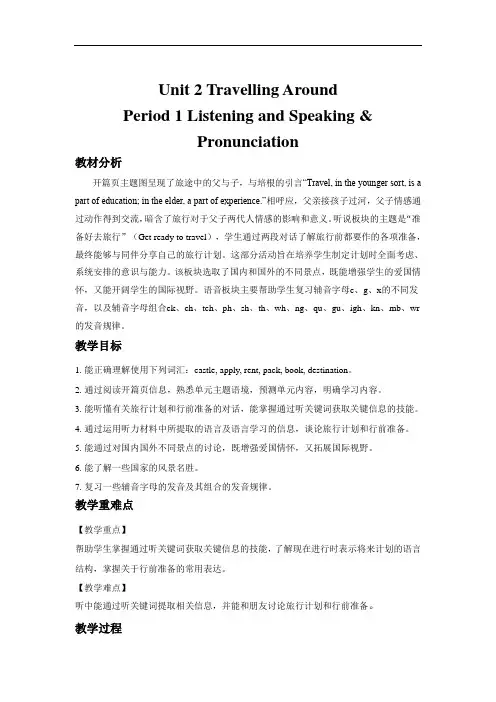
Unit 2 Travelling AroundPeriod 1 Listening and Speaking &Pronunciation教材分析开篇页主题图呈现了旅途中的父与子,与培根的引言“Travel, in the younger sort, is a part of education; in the elder, a part of experience.”相呼应,父亲接孩子过河,父子情感通过动作得到交流,暗含了旅行对于父子两代人情感的影响和意义。
听说板块的主题是“准备好去旅行”(Get ready to travel),学生通过两段对话了解旅行前都要作的各项准备,最终能够与同伴分享自己的旅行计划。
这部分活动旨在培养学生制定计划时全面考虑、系统安排的意识与能力。
该板块选取了国内和国外的不同景点,既能增强学生的爱国情怀,又能开阔学生的国际视野。
语音板块主要帮助学生复习辅音字母c、g、x的不同发音,以及辅音字母组合ck、ch、tch、ph、sh、th、wh、ng、qu、gu、igh、kn、mb、wr 的发音规律。
教学目标1.能正确理解使用下列词汇:castle, apply, rent, pack, book, destination。
2.通过阅读开篇页信息,熟悉单元主题语境,预测单元内容,明确学习内容。
3.能听懂有关旅行计划和行前准备的对话,能掌握通过听关键词获取关键信息的技能。
4.通过运用听力材料中所提取的语言及语言学习的信息,谈论旅行计划和行前准备。
5.能通过对国内国外不同景点的讨论,既增强爱国情怀,又拓展国际视野。
6.能了解一些国家的风景名胜。
7.复习一些辅音字母的发音及其组合的发音规律。
教学重难点【教学重点】帮助学生掌握通过听关键词获取关键信息的技能,了解现在进行时表示将来计划的语言结构,掌握关于行前准备的常用表达。
【教学难点】听中能通过听关键词提取相关信息,并能和朋友讨论旅行计划和行前准备。
高中英语外研版高中必修1(新课标)UNIT1Anewstart-教案设计说明
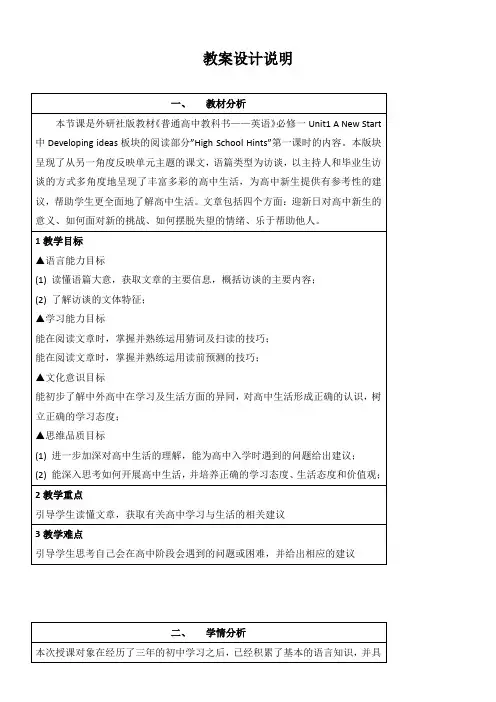
(二)读前活动
教师引导学生根据词云、图片预测文章的主要内容,并通过阅读文章第一段猜测标题中”hints”的意思。
【设计意图】运用词云中的关键词引导学生积极思考;通过阅读文章内容,训练学生的猜词技能;
(三)读中活动
教师引导学生扫读课文,通过关键词定位信息,找到问题的答案。
【设计意图】教师可以检验学生对课文结构、主要内容和阅读策略的理解情况,并有意识地培养学生在阅读中的扫读技能。
本次授课对象在经历了三年的初中学习之后,已经积累了基本的语言知识,并具备了一定的阅读经验,但其缺乏运用阅读技巧的能力。因此,本课引导学生运用扫读、猜词,培养其一定的阅读技能;此外,还引导学生联系自己的生活与学习,深入思考会在高中入学时会遇到哪些问题或困难,以及解决该问题的建议,从而发展学生的逻辑思维、批判性思维及创新思维。
(五)语言技能:(1)理解性技能:从语篇中提取主要观点和信息,理解语篇要义;理解书面语篇中标题、小标题的含义;辨认关键字词和概念以迅速查找目标信息;根据语篇标题预测语篇的主题和内容;把握语篇的结构以及语言特征;将语篇的内容与自身的经历联系起来;(2)表达性技能:根据表达目的选择适当的语篇类型;根据表达的需要选择词汇和语法结构;在口头表达中运用目光、表情、手势、姿势、动作等非语言手段表达意义;
高中英语必修一单词拼写教案

高中英语必修一单词拼写教案概述:单词拼写是英语学习的基本功,对于高中英语必修一的学习来说尤为重要。
本教案旨在帮助学生提高单词拼写能力,加深对必修一单词的理解,并通过多种练习形式巩固拼写技能。
教案内容:一、教学目标:1. 学习并掌握必修一中的重要单词拼写;2. 熟练掌握这些单词的拼写规则和发音;3. 培养良好的拼写习惯,提高英语写作和阅读的能力。
二、教学重点:1. 必修一中的重要单词拼写;2. 拼写规则和发音。
三、教学难点:1. 部分单词拼写规则的掌握;2. 拼写错误的纠正。
四、教学方法:1. 讲授法:通过课堂讲解介绍单词拼写规则和发音规律;2. 练习法:通过拼写练习巩固所学内容;3. 游戏法:通过游戏形式激发学生的学习兴趣。
五、教学过程:1. 学习单词拼写规则和发音规律:首先,通过单词卡片的形式展示必修一中的重要单词,引导学生注意每个单词的拼写和发音;其次,根据拼写规则,向学生进行讲解和示范,例如说清楚辅音字母的发音和重音的位置等。
2. 进行单词拼写练习:随堂练习:在课堂上设计一些拼写练习题,包括填空、连线和词组拼写等,要求学生在规定的时间内完成,然后互相检查答案并纠正错误。
课后作业:布置一些书面作业,要求学生自主完成并提交,教师批改后及时反馈,帮助学生纠正错误。
3. 游戏活动:设置一些单词拼写的小游戏,例如拼写比赛、口头拼写挑战等,以增加学生的参与度和学习兴趣,同时加深对单词拼写的记忆。
4. 错误分析和纠正:分析学生在拼写练习中出现的常见错误,并进行讲解、反思和帮助纠正,引导学生形成正确的拼写意识和习惯。
六、教学评价:评价学生的单词拼写能力主要通过平时的课堂表现和作业完成情况,包括练习的准确性、规范性和独立完成度等。
七、教学资源:1. 必修一教材及单词表;2. 单词卡片、黑板、白板等;3. 计算机或移动设备等电子工具。
八、教学反思:教学过程中需要注意引导学生进行积极的互动和合作,通过小组合作、角色扮演等方式培养学生的合作意识和表达能力。
高一英语必修一第一单元教案
高一英语必修一第一单元教案高一英语必修一第一单元教案精选5篇作为一无名无私奉献的教育工作者,往往需要进行教案编写工作。
下面是小编为你准备的高一英语必修一第一单元教案,快来借鉴一下并自己写一篇与我们分享吧!高一英语必修一第一单元教案【篇1】一、课程目标高中英语新课程的总目标是使学生在义务教育阶段英语学习的基础上,进一步明确英语学习的目的,发展自主学习和合作学习的能力;形成有效的英语学习策略;培养学习的综合语言运用能力。
综合语言运用能力的形成建立在语言技能、语言知识、情感态度、学习策略和文化意识等素养整合发展的基础上。
语言技能和语言知识是综合语言运用能力的基础。
情感态度是影响学生学习和发展的重要因素。
学习策略是提高学习效率、发展自主学习能力的先决条件。
文化意识则是得体运用语言的保障。
高一年级(课标六级)英语课程目标:1.进一步增强英语学习动机,有较强的自主学习意识。
2.能理解口头或书面材料中表达的观点,并且能简单发表自己的见解。
3.能有效地使用口头或书面语言描述个人经历。
4.能在教师的帮助下策划、组织和实施英语学习活动。
5.能主动利用多种教育资源进行学习。
6.能初步对学习过程和结果进行自我评价,调整自己学习目标和策略。
7.能体会交际中所使用语言的文化内涵和背景。
高一年级(课标七级)英语课程目标:1.有明确和持续的学习动机和自主学习意识。
2.能就熟悉的话题交流信息,提出问题并且陈述自己的意见和建议。
3.能读懂供高中学生阅读的英文原著简写本及英语报刊。
4.具有初步的实用写作能力,例如:事务通知和邀请信等。
5.能在教师的指导下,主动参与计划、组织和实施语言实践活动。
6.能主动扩展和利用学习资源,从多渠道获取信息,并能利用所获得的信息进行清楚和有条理的表达。
7.具有较强的自我评价和自我调控能力,基本形成适合自己的学习策略。
8.理解交际中的文化差异,初步形成跨文化交际意识。
二、课程内容完成牛津英语第三第四模块的全部内容。
高中英语必修一第二单元教案
高中英语必修一第二单元教案一、教学任务及对象1、教学任务本教案针对的是高中英语必修一第二单元的教学内容。
该单元的主题为“友谊”,旨在帮助学生掌握与友谊相关的词汇、语法、句型,培养学生在实际语境中运用英语进行交流的能力,同时加强学生的听说读写综合技能。
教学内容包括:词汇学习(如:friendship, loyal, trustworthy等)、语法点(如:一般现在时、一般过去时)、课文理解、听力训练、口语表达以及写作练习。
2、教学对象本教案的教学对象为高中一年级学生,他们在初中阶段已经具备了一定的英语基础,但在高中阶段需要进一步提高英语综合运用能力。
学生们的英语水平参差不齐,因此,在教学过程中需要关注每一个学生的学习需求,因材施教,使他们在原有的基础上得到提高。
在教学过程中,要注意激发学生的学习兴趣,培养他们自主、合作、探究的学习习惯,帮助他们树立正确的学习观念,使他们在轻松愉快的氛围中学习英语,提高英语素养。
同时,要关注学生的情感需求,营造一个和谐、友善的课堂氛围,让他们在友谊的陪伴下共同成长。
(1)掌握与友谊相关的词汇、语法、句型;(2)运用所学知识进行听说读写实践活动;(3)理解课文内容,提高阅读理解能力;(4)培养良好的学习习惯,提高英语综合运用能力;(5)树立正确的友谊观,懂得珍惜友谊。
在此基础上,教师应运用多种教学策略,关注每一个学生的成长,使他们在英语学习中获得全面发展。
二、教学目标1、知识与技能(1)词汇:学生能够掌握本单元的基本词汇,如friendship, loyal, trustworthy, support, communicate等,并能够在实际语境中正确运用。
(2)语法:学生能够理解并掌握一般现在时和一般过去时的用法,能够运用这两个时态进行句子构建和文章写作。
(3)听力:学生能够听懂与友谊相关的对话和短文,提高听力理解能力,并能够抓住关键信息进行答题。
(4)口语:学生能够在日常生活中使用英语进行与友谊话题相关的交流,表达自己的观点和感受,提高口语表达能力。
高一英语学习教案七篇
高一英语学习教案七篇高一英语学习教案七篇高一英语学习教案都有哪些?教学场所和实习场所应当在数量和功能上满足教学需要,并配备专职人员对教学设施进行日常管理和维护。
下面是小编为大家带来的高一英语学习教案七篇,希望大家能够喜欢!高一英语学习教案篇1高一上学期是高中教育的起始阶段,教育就显得尤为重要,为了使学生圆满完成新课标要求的各项学习任务,尽快适应新的环境,在各方面能够健康发展,把英语教学搞的有声有色,必须有一个切实可行的教学计划。
特制定英语教学计划如下:一、教材分析教材是“课标”的具体表现,是学生学习的“蓝本”。
现在使用的人教版英语教材每一个单元都围绕一个主要话题开展听说读写活动,共九个部分,即热身,阅读,理解,语言学习,语言运用,小结,学习建议和趣味阅读。
语言知识和技能的呈现与训练,以及语法和句型等重点循序渐进,循环反复,符合学生的认知规律,有利于学生构建知识系统。
新教材打破了传统的体系,用新的理念、新的方式、新的体系呈现出来。
我们应当以积极的态度去学习新教材,研究新教材,理解新教材各个栏目的编写意图,限度地发挥各个栏目的作用。
一方面我们要努力去理解新教材、适应新教材、用好新教材,一方面我们又要努力站在新教材之上使用新教材,要根据教学目标和学生实际对其进行大胆的取舍和重组,是教材为我所用,而不是被教材牵着鼻子走。
二、教学目标1、使学生明确学习英语的目的性,发展自主学习的能力和合作精神。
2、做好初高中的教学衔接工作,让学生了解和适应高中的英语学习。
3、在培养学生的语言知识、语言技能、情感态度、学习策略和文化意识等素养的基础上发展学生综合运用语言的能力,培养学生在获取信息,处理信息,分析问题解决问题的能力,以及运用英语进行思维和表达的能力。
4、优化学生的英语学习方法,使他们能通过观察、体验、探究等主动学习的方法,充分发挥自己的学习潜能,形成有效的学习策略,提高自主学习的`能力。
三、学生现状分析针对我所带的班级高一5、6班学生生员构成复杂,大部分来自农村,远到王坟,庙子,城区学生少,普遍英语底子差,基础薄,英语水平参差不齐,发音不标准的实际情况,打算在高一起始阶段的英语教学中,本着低起点,爬坡走,抓习惯的原则,长期不懈地抓好学生的学习英语的的兴趣和习惯养成。
人教版高中英语必修一全套教案
Unit 2 English Around the WorldI Teaching aims1.Knowledge aim2.Master the words and phrases and get a view of the road to modern English.3.Ability aim4.Train students’ reading skill.5.Emotion aim6.Let students know more about English and inspire students to study English hard. IITeaching important pointsThe understanding and comprehension of the passage.III Teaching difficult pointHow to get to master the useful words and expressions.How to improve students’ ability to read an article.IV Teaching ProceduresV Teaching TimeSeven Periods.Period 1 Warming up and ReadingStep1. Warming up1. Lead in: Show Ss a map of the world, and ask them the following questions:1) How many languages are there in the world?2) How many English-speaking counties are there in the world?3) How are you ever heard some differences between American English and BritishEnglish?Step2. Reading(1)SkimmingRead the passage quickly and find out the answers of the questions in comprehension.(2)Scanning(3)Listen to the tape and tell the meaning of each paragraph.1. Para1: Brief introduction of the change in English.2. Para.2: An example of different kinds of English.3. Para3: The development of English.Para4: English spoken in some other countries.(4)Post readingStep3. DiscussionSome people say that Chinese is a much more elegant language, so it is more important for us to master it and it is not so necessary to master foreign language. Do you agree with this opinion and why?Period 2 Language pointsLanguage points:1. Do you know that there is more than one kind of English in the world?你知道世界上英语的种类并不止一种吗?more than one +名词单数,后面的谓语动词用单数例如:More than one student wants to go to swim.2.In some important ways they are very different form one another.在某些重要的方面,它们彼此有些差异。