
【强烈推荐】闽教版小学英语五年级下册知识点
闽教版小学英语五年级下册知识点Unit 1重点句型与语法How was your winter vacation? 你的寒假过得如何?It was wonderful. I visited the Great Wall. 好极了,我参观了长城。
was 是is 的过去式。
动词的过去式分规则和不规则动词规则动词一般在动词原形末尾直接加上-ed。
如:look-- looked, visit--visited, watch--watched以不发音的字母e结尾的动词,只需加-d。
如:live--lived。
末尾只有一个辅音字母的重读闭音节,先双写这个辅音字母,再加-ed。
如:stop--stopped。
末尾是辅音字母+y 结尾的动词,先改y为i,然后再加上-ed。
如:study--studied。
How about you ? Were you in China?你呢?你在中国吗?No, I wasn’t. I went to Australia. 不,我不在中国。
我去了澳大利亚。
How was the weather there? 那里的天气如何?It was hot. It was summer there. 那里天气很热,是夏天。
I went to Taiwan with my parents. 我和父母一起去了台湾。
with 介词,意思是和,跟,随着Is it your hometown? 台湾是你的故乡吗?Yes, it is. 是的,是我的故乡。
it 指代前面提过的台湾。
I took a boat tour of Sun Moon Lake. 我乘船游览了日月潭。
Unit2重点句型与语法Look, there is a map over there. 瞧那边有一幅地图。
there be 句型表示的是“某处有(存在)某人或某物”,其结构为There be +名词+地点状语(地点状语也可以放在句首)。
主语是单数名词或不可数名词时用there is ,主语是名词的复数形式时用there are 如:There is a baby elephant in the zoo. 动物园里有一只小象。
There are some bears under tree. 树下有几只熊。
There are some elephants behind the hill. 小山后面有几只大象。
Let me take a photo of it. 让我来给它拍一张照片。
There are some tigers next to the lions. 紧挨着狮子园有几只老虎。
Next to 紧挨着What animals did you see, children? 你们看到了什么动物?We saw pandas, tigers, monkeys……我们看到了熊猫,老虎,猴子特殊疑问句,用助动词do,did来提问,谓语动词用原形。
Did you give bananas to the monkeys? 你们喂猴子吃香蕉了吗?No, we didn’t. 不,我们没有。
一般疑问句及其否定回答。
We are hungry. We ate the bananas. 我们很饿,我们吃了香蕉。
Unit3重点句型与语法What are you going to do, Mom? 妈妈,你准备做什么?I’m going to make some Easter Eggs. 我准备做一些复活节彩蛋。
be going to do sth 将要去做某事;打算,计划做某事they look beautiful. 它们看起来很漂亮。
look 系动词。
I’m going to hide them in the garden. 我准备把它们藏在花园里。
They’re looking for Easter eggs. 他们在寻找复活节彩蛋。
Kate is picking up an egg. 凯特正在捡鸡蛋。
Did you have a good time? 你们玩得快乐吗?Yes, we did.是的,我们玩得很快乐。
Unit 4重点句型与语法We are going for a spring outing. 我们将要去春游。
We’re going to climb a mountain.我们打算去爬一座山。
What’re you going to take with you? 你准备带什么去?I’m going to take some water with me. 我打算带点水。
take……with somebody 是随身携带的意思。
Are you going to wear sports shoes?你准备穿运动鞋吗?Now they are climbing the mountain. 现在他们正在爬山。
climb the tree 爬树climb 意思是向上爬Now they are at the top of the mountain. 他们现在在山顶。
at the foot of the mountain 在山脚They got to the foot of the mountain by bus. 他们乘坐公交车到达山脚。
get to 到达get to the train station 到达火车站get home 到家,getthere 到那里Unit 5重点句型与语法Who will run 100 meters? 谁愿意参加100米短跑比赛?I will. 我愿意。
will 用来表达意愿,一般将来时Great! You can run very fast. 好极了!你跑得很快。
fast 的反义词是slow, 在四年级上册第4单元的A部分学过He is very slow. I can have a sleep.Who will do long jump? How about you, Julia? 谁愿意跳远?茱莉亚,你来跳远好吗?How about you? 用来征求意见I will try. 我来试试吧。
try 是“尝试”的意思。
如:Who will try? 谁愿意来试一试?Let me try. 让我来试一试。
Miss Gao is very proud of Peter. 高老师为彼得感到骄傲。
be proud of 是“为……感动骄傲/自豪”的意思。
如:We are proud of China. 我们为中国感到自豪。
He is falling down. 他掉下来了。
She is trying to do well. 她正努力跳好。
Unit 6句型与语法Who is the winner of 100-meter race? 谁是百米赛跑的获胜者?100-meter 是由数词+名词(单数)组成复合形容词。
a 500-word report 一份500字的报告a ten-pound note 一张10英镑的钞票my four-year-old son 我4岁的儿子Look. Peter is the first. Wang Ming is the second. And Li Hua is the third. 瞧,彼得获得第一名,王明第二名,李华第三名。
序数词前要用theYou’re the winner of 100-meter race. 你是百米赛跑的获胜者。
of 是个介词,有很多含义,在本句表示从属关系,可以解释为……的,也就是“百米赛跑”Are you thirsty? Drink some water. 你渴吗? 喝点水吧。
He looks tired. 他看起来很疲惫。
look 为看起来的意思,I didn’t do well in the high jump. 我跳高没跳好。
do well in 指具体的某件事,be good at 擅长,具备的能力Oh, cheer up! 振作起来I’m only the fourth in the high jump. 我在跳高比赛中仅名列第四。
Not all can be the first. 并非所有的人都能获得第一名。
Unit 7重点句型与语法Look. I live in that tall building. 瞧,我住在那栋高楼。
tall 和high 都表示“高”。
但是在使用上有以下区别:(1)tall 常指高度远超过宽度的细长形的东西,常用来指人或动物,其反义词是short, 如:a tall man, a tall tree。
(2)high 主要强调高于地面上的垂直高度或借喻性的高,如高山,高温,高速等,其反义词是low,如:a high mountain, a high speed, ahigh school等。
(3)建筑物的“高”,可用tall,也可用high, 主要取决于建筑物的形状,如果建筑物的高度超过宽度,用a tall building,如果建筑物的宽度超过高度,用a high building.(4)指某人社会地位高,只能用high, 如:Then the Emperor arrived with all his high officials. 皇帝带着他的高官们到达了。
Which floor do you live on? 你住在哪一层楼?On the twelfth floor. 住在第12层楼。
We’d love to. 我们很想参观。
would 所带的问句常用来提出邀请,We’d 是We would的缩写形式,We’d love to. 是简单的回答,完整的回答是We’d love to go for a visit. 更多的例子:Would you like to change a seat? 你要不要换个座位?Would you like some fish? 您要不要吃点鱼?I can see the bridge from the window. 我可以从窗户看到大桥。
Look. A ship! It’s g oing under the bridge. 瞧,一艘轮船。
它正从桥下驶过。
There are many cars on the bridge.桥上有很多汽车。
There be 句型Mr. Wang also lives in this building. 王老师也住在这一楼。
also 和too 都有也的意思,一般都是用于肯定句中,但是用法有所不同:also 用句中,靠近动词I also went to see the film. 我也去看了电影。
too 用于句末,语气较轻,通常位于句末,前加逗号。
闽教版小学英语五年级下册知识点讲课教案

闽教版小学英语五年级下册知识点闽教版小学英语五年级下册知识点Unit 1重点句型与语法How was your winter vacation? 你的寒假过得如何?It was wonderful. I visited the Great Wall. 好极了,我参观了长城。
was 是is 的过去式。
动词的过去式分规则和不规则动词规则动词一般在动词原形末尾直接加上-ed。
如:look-- looked, visit--visited, watch--watched以不发音的字母e结尾的动词,只需加-d。
如:live--lived。
末尾只有一个辅音字母的重读闭音节,先双写这个辅音字母,再加-ed。
如:stop--stopped。
末尾是辅音字母+y 结尾的动词,先改y为i,然后再加上-ed。
如:study--studied。
不规则动词的过去式需要记忆。
如:am/is--was, are--were, go--went,come--came,take--took,have(has)--had.How about you ? Were you in China?你呢?你在中国吗?No, I wasn’t. I went to Australia. 不,我不在中国。
我去了澳大利亚。
How was the weather there? 那里的天气如何?It was hot. It was summer there. 那里天气很热,是夏天。
I went to Taiwan with my parents. 我和父母一起去了台湾。
with 介词,意思是和,跟,随着Is it your hometown? 台湾是你的故乡吗?Yes, it is. 是的,是我的故乡。
it 指代前面提过的台湾。
I took a boat tour of Sun Moon Lake. 我乘船游览了日月潭。
Unit2重点句型与语法Look, there is a map over there. 瞧那边有一幅地图。
闽教版小学英语五下Unit 1 单元知识点梳理
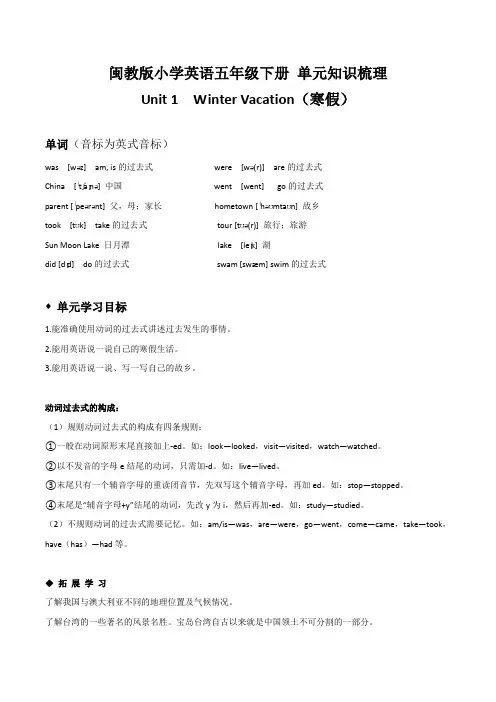
闽教版小学英语五年级下册单元知识梳理Unit 1 Winter Vacation(寒假)单词(音标为英式音标)was [wəz] am, is的过去式were [wə(r)] are的过去式China [ˈtʃaɪnə] 中国went [went] go的过去式parent [ˈpeərənt] 父,母;家长hometown [ˈhəʊmtaʊn] 故乡took [tʊk] take的过去式tour [tʊə(r)] 旅行;旅游Sun Moon Lake 日月潭lake [leɪk] 湖did [dɪd] do的过去式swam [swæm] swim的过去式◆单元学习目标1.能准确使用动词的过去式讲述过去发生的事情。
2.能用英语说一说自己的寒假生活。
3.能用英语说一说、写一写自己的故乡。
动词过去式的构成:(1)规则动词过去式的构成有四条规则:①一般在动词原形末尾直接加上-ed。
如:look—looked,visit—visited,watch—watched。
②以不发音的字母e结尾的动词,只需加-d。
如:live—lived。
③末尾只有一个辅音字母的重读闭音节,先双写这个辅音字母,再加ed。
如:stop—stopped。
④末尾是“辅音字母+y”结尾的动词,先改y为i,然后再加-ed。
如:study—studied。
(2)不规则动词的过去式需要记忆。
如:am/is—was,are—were,go—went,come—came,take—took,have(has)—had等。
◆拓展学习了解我国与澳大利亚不同的地理位置及气候情况。
了解台湾的一些著名的风景名胜。
宝岛台湾自古以来就是中国领土不可分割的一部分。
Part A重点句型及词组(1)How was your winter vacation?你的寒假过得怎么样?-- It was wonderful. I visited the Great Wall.很精彩。
新版闽教版五下英语单元重点归纳
新版闽教版五下英语单元重点归纳全文共四篇示例,供读者参考第一篇示例:五年级下册英语主要围绕着日常生活和环保这两个主题展开教学。
在整个学习过程中,学生们将学会如何用英语描述自己的日常生活和周围环境,并且学会保护环境,关爱地球。
下面我将对五年级下册英语的重点内容进行详细归纳,让大家更好地了解这个学习阶段的内容。
一、Unit 1 Friends这个单元主要围绕着“朋友”这个主题展开。
学生们将学会如何用英语介绍自己的朋友和与朋友们一起做某些事情。
还会学习一些有关家庭成员的单词和短语,以及日常用语和礼貌用语。
重点词汇和短语包括:family members(家庭成员)、friend(朋友)、classmate (同学)、together(一起)、go to the park(去公园)等。
二、Unit 2 We are the same三、Unit 3 How tall are you?在学习五年级下册英语的过程中,希望同学们能够通过这些单元的学习,提高自己的英语口语和写作能力,同时也培养对于环境保护的意识,为建设美丽的地球尽一份力量。
希望大家都能在英语学习的路上越走越顺,不断提升自己的能力,成为优秀的英语学习者!第二篇示例:新版闽教版五下英语单元重点归纳五年级下册是学生英语学习的一个重要阶段,也是一个承上启下的阶段。
在这一阶段,学生们需要巩固和扩展他们在前几年所学到的英语知识,并且学习一些新的知识。
新版闽教版五下英语单元内容丰富多样,涵盖了生活中的各个方面,使学生在学习英语的也能够了解更多有关世界的知识。
第一单元:世界体育运动在这个单元里,学生们将学习到有关体育运动的词汇和句型,向同学们介绍自己喜欢的运动项目,并且了解一些世界知名的体育运动项目,比如篮球、足球和田径等。
在学习这个单元的过程中,学生们能够了解到不同国家的文化和传统,同时也可以锻炼他们的口语表达能力。
第二单元:家庭与亲情这个单元主要围绕家庭与亲情展开,学生们将学习到有关家庭成员的词汇和句型,表达对家人的爱和关心,学会与家人交流和沟通。
闽教版小学英语五年级下册知识点 (2)
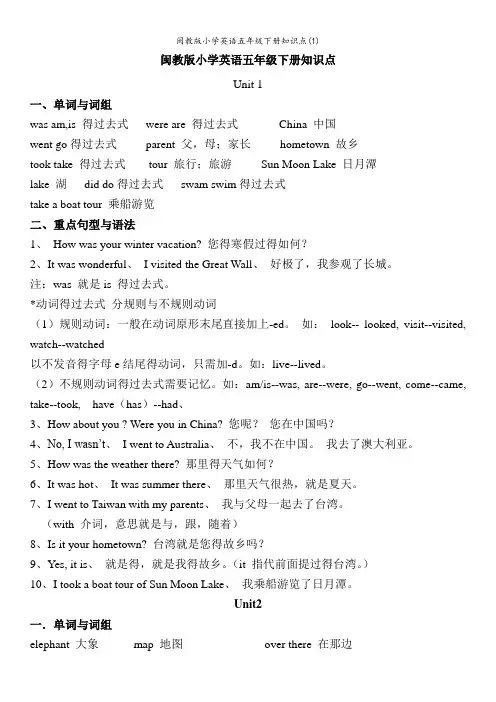
闽教版小学英语五年级下册知识点Unit 1一、单词与词组was am,is 得过去式were are 得过去式China 中国went go得过去式parent 父,母;家长hometown 故乡took take 得过去式tour 旅行;旅游Sun Moon Lake 日月潭lake 湖did do得过去式swam swim得过去式take a boat tour 乘船游览二、重点句型与语法1、How was your winter vacation? 您得寒假过得如何?2、It was wonderful、I visited the Great Wall、好极了,我参观了长城。
注:was 就是is 得过去式。
*动词得过去式分规则与不规则动词(1)规则动词:一般在动词原形末尾直接加上-ed。
如:look-- looked, visit--visited, watch--watched以不发音得字母e结尾得动词,只需加-d。
如:live--lived。
(2)不规则动词得过去式需要记忆。
如:am/is--was, are--were, go--went, come--came, take--took, have(has)--had、3、How about you ? Were you in China? 您呢?您在中国吗?4、No, I wasn’t、I went to Australia、不,我不在中国。
我去了澳大利亚。
5、How was the weather there? 那里得天气如何?6、It was hot、It was summer there、那里天气很热,就是夏天。
7、I went to Taiwan with my parents、我与父母一起去了台湾。
(with 介词,意思就是与,跟,随着)8、Is it your hometown? 台湾就是您得故乡吗?9、Yes, it is、就是得,就是我得故乡。
闽教版小学英语五年级下册知识点(1)
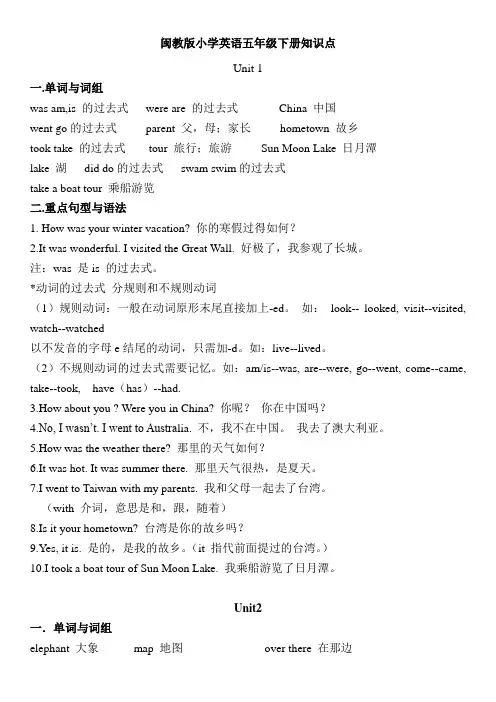
闽教版小学英语五年级下册知识点Unit 1一.单词与词组was am,is 的过去式were are 的过去式China 中国went go的过去式parent 父,母;家长hometown 故乡took take 的过去式tour 旅行;旅游Sun Moon Lake 日月潭lake 湖did do的过去式swam swim的过去式take a boat tour 乘船游览二.重点句型与语法1. How was your winter vacation? 你的寒假过得如何?2.It was wonderful. I visited the Great Wall. 好极了,我参观了长城。
注:was 是is 的过去式。
*动词的过去式分规则和不规则动词(1)规则动词:一般在动词原形末尾直接加上-ed。
如:look-- looked, visit--visited, watch--watched以不发音的字母e结尾的动词,只需加-d。
如:live--lived。
(2)不规则动词的过去式需要记忆。
如:am/is--was, are--were, go--went, come--came, take--took, have(has)--had.3.How about you ? Were you in China? 你呢?你在中国吗?4.No, I wasn’t. I went to Austra lia. 不,我不在中国。
我去了澳大利亚。
5.How was the weather there? 那里的天气如何?6.It was hot. It was summer there. 那里天气很热,是夏天。
7.I went to Taiwan with my parents. 我和父母一起去了台湾。
(with 介词,意思是和,跟,随着)8.Is it your hometown? 台湾是你的故乡吗?9.Yes, it is. 是的,是我的故乡。
闽教版五年级英语下册每单元知识要点
闽教版五年级英语下册每单元知识要点delete this paragraph重点句型与语法XXX?你最喜欢的动物是什么?XXX.我最喜欢的动物是大象。
was是is的过去式,were是are的过去式。
动词的过去式分规则和不规则动词规则动词一般在动词原形末尾直接加上-ed。
如:look-- looked。
visit--visited。
watch--watched以不发音的字母e结尾的动词,只需加-d。
如:live--lived。
末尾只有一个辅音字母的重读闭音节,先双写这个辅音字母,再加-ed。
如:ped。
末尾是辅音字母+y结尾的动词,先改y为i,然后再加上-ed。
如:study--studied。
不规则动词的过去式需要记忆。
如:am/is--was,are--were,go--went,come--came,take--took,have(has)--had.Can you show me on the map?你能在地图上给我指出来吗?Sure。
Here it is.当然可以,它在这里。
I went to the zoo last weekend.我上周末去了动物园。
There XXX.那里有很多动物。
I saw a XXX and a giraffe.我看到了一只狮子和一只长颈鹿。
XXX was fierce.狮子很凶猛。
XXX XXX.长颈鹿很高。
Look。
there is a map on the wall。
Let's take a look at it。
The "there be" structure is used to XXX place。
It is formed by "there + be + noun + n adverbial" (the XXX)。
When the subject is a XXX。
"there is" is used。
2021年闽教版小学英语五年级下册知识点
闽教版小学英语五年级下册知识点Unit 1单词与词组was am,is 过去式were are 过去式China 中华人民共和国went go过去式parent 父,母;家长hometown 故乡took take 过去式tour 旅行;旅游Sun Moon Lake 日月潭lake 湖did do过去式swam swim过去式take a boat tour 乘船游览重点句型与语法How was your winter vacation?你寒假过得如何?It was wonderful. I visited the Great Wall. 好极了,我参观了长城。
was 是is 过去式。
动词过去式分规则和不规则动词规则动词普通在动词原形末尾直接加上-ed。
如: look-- looked,visit--visited,watch--watched以不发音字母e结尾动词,只需加-d。
如:live--lived。
末尾只有一种辅音字母重读闭音节,先双写这个辅音字母,再加-ed。
如:stop--stopped。
末尾是辅音字母+y 结尾动词,先改y为i,然后再加上-ed。
如:study--studied。
不规则动词过去式需要记忆。
如:am/is--was,are--were,go--went,come--came,take--took,have(has)--had.How about you ?Were you in China?你呢?你在中华人民共和国吗?No,I wasn’t. I went to Australia. 不,我不在中华人民共和国。
我去了澳大利亚。
How was the weather there?那里天气如何?It was hot. It was summer there. 那里天气很热,是夏天。
I went to Taiwan with my parents. 我和父母一起去了台湾。
闽教版小学英语五年级下册各单元语法知识点总复习
闽教版小学英语五年级下册各单元语法知识点总复习Unit 1: Daily Routines- Present Simple Tense: I/You/We/They + base verb; He/She/It + base verb + 's'- Adverbs of Frequency: always, usually, often, sometimes, seldom, neverUnit 2: Hobbies- Present Continuous Tense: Subject + am/is/are + present participle (-ing form)- Action Verbs: play, read, swim, sing, dance, drawUnit 3: Animals- Superlatives: adjective + -est (e.g., biggest, fastest)Unit 4: Weather- Weather Conditions: sunny, windy, cloudy, rainy, snowy- Season Words: spring, summer, autumn/fall, winterUnit 5: Food and Drinks- Countable and Uncountable Nouns: use 'a/an' with countable nouns and 'some' with uncountable nouns- Quantifiers: a/an, some, a lot of, any, much, manyUnit 6: Places- Prepositions of Place: in, on, under, next to, between- Locative Adverbs: here, thereUnit 7: Festivals- Present Continuous Tense with Future Time: am/is/are + going to + present participle- Celebrations: Christmas, Thanksgiving, Chinese New YearUnit 8: Travel- Past Simple Tense: regular verbs - base verb + 'ed'; irregular verbs - verb changes- Time Expressions: yesterday, last week/month/year, agoUnit 9: Jobs- Job Vocabulary: doctor, teacher, firefighter, police officer, musician, chef- Verb + Infinitive: want to, need to, have to, like toUnit 10: Health- Verb + Object + Infinitive: can, can't, could, couldn't- Expressions for Giving Advice: You should/shouldn't, You ought to, You'd betterUnit 11: Nature- Imperative Sentences: base verb (e.g., Listen! Look! Open!)- Action Verbs: plant, water, pick, feed, take care ofUnit 12: Daily Life- Adjectives to Describe People: tall, short, thin, fat, old, young- Possessive Pronouns: my, your, his, her, its以上为闽教版小学英语五年级下册各单元的语法知识点总复。
闽教版五下英语闽教版五下英语闽教版五年级下册复习知识点梳理公开课教案课件
闽教版五年级下册英语复习资料词组teachers’ office 教师的办公室want to想要want to be想要成为ride a bike骑自行车get in (the boat)上船get on (the bus)上车jump into跳入in the garden在花园里climb the mountain爬山take…w ith…随身带…take some pictures拍照paint the eggs漆蛋hide the eggs藏蛋look for寻找look at看an Easter card一张复活节卡片how clever多聪明啊how beautiful多漂亮啊do high jump跳高do long jump 跳远on Sports Day在运动会上run 100 meters跑100米good luck祝你好运come on加油,快点fly a kite放风筝climb the Great Wall登长城help people帮助人们in the day在白天at night在晚上far away from 离…很远play chess 下棋play basketball打篮球句型1.-Where is your classroom? / Where are the teachers’ offices? 在哪里-On the third floor.(地点)2.-When is your birthday? 你的生日在什么时候?-August 2.(时间)3. I have a new doll for my birthday.4. I am happy/sad/cared/tired/proud/angry.5. A dog is coming.一只狗来了。
6. -May I go with you? 我能跟你去吗?–Yes.7. The first season is spring. 第一个季节是春天。
闽教版小学英语五年级下册各单元语法知识点
闽教版小学英语总复习基础语法四年级下册Unit 1 Winter Vacation(寒假)Hi, Lily. How was your winter vacation? 你好,莉莉。
你的寒假过得怎么样?It was wonderful. I visited the Great Wall. 很精彩。
我参观了长城。
How about you? Were you in China? 你呢?你寒假有在中国吗?No, I wasn’t. I went to Australia. 不,没有。
我去了澳大利亚。
How was the weather there? 那的天气怎么样?It was hot. It was summer there. 很热。
那里是夏天。
Hi, boys and girls! 嗨,孩子们!Hi, Miss Gao. 嗨,高老师。
How was your winter vacation? 你们的寒假过得怎么样?I went to Taiwan with my parents. 我和父母去了台湾。
Is it your hometown?那里是你的故乡吗?Yes, it is. 是的,台湾是我的故乡。
I took a boat tour of Sun Moon Lake. 我乘船游览了日月潭。
How about you, Yang Ming? 你呢,杨明?I played chess with my father. 我和爸爸下了棋。
Who was the winner? 谁赢了?Very often my dad was the winner. 经常是我的爸爸赢。
I did my homework. 我做了家庭作业。
P5短文:讲述自己的家乡Taiwan is Wang Tao’s hometown. In winter vacation he went there with his parents. He wanted to see his aunt and uncle. He was at their home for the Spring Festival. They went to see Sun Moon Lake by boat. The tour of the lake was wonderful.台湾是王涛的家乡,在寒假他会和父母回台湾。