
高一英语上册期中考试知识点总结
高一英语必修一第一单元复习要点Unit One Friendship一、重点短语1.go through 经历,经受get through 通过;完成;接通电话2. set down 记下,放下3. a series of 一系列4. on purpose 有目的的5. in order to 为了6. at dusk 傍晚,黄昏时刻7. face to face 面对面8. fall in love 爱上9. join in 参加(某个活动);take part in 参加(活动)join 加入(组织,团队,并成为其中一员)10. calm down 冷静下来11. suffer from 遭受12. be/get tired of…对…感到厌倦13. be concerned about 关心14. get on/along well with 与…相处融洽15. be good at/do well in 擅长于…16. find it + adj. to do sth. 发现做某事是…17. no longer / not …any longer 不再…18. too much 太多(后接不可数n.)much too 太…(后接adj.)19. not…until 直到…才20. it’s no pleasure doing sth 做…并不开心21. make sb. sth. 使某人成为…make sb. do sth. 使某人做某事二、语法----直接引语和间接引语概念:直接引语:直接引述别人的原话。
一般前后要加引号。
间接引语:用自己的话转述别人的话。
间接引语在多数情况下可构成宾语从句且不要加引号。
例:Mr. Black said, “I’m busy.”Mr. Black said that he was busy.变化规则(一)陈述句的变化规则直接引语如果是陈述句,变为间接引语时,用连词that(可省略)引导,从句中的人称、时态、指示代词、时间状语、地点状语都要发生相应的变化。
人称的变化——人称的变化主要是要理解句子的意思例:1. He said, “I like it very much.”→He said that he liked it very much.2. He said to me, “I’v left my book in your room.”→He told me that he had left his book in my room.时态的变化直接引语间接引语一般现在时一般过去时现在进行时过去进行时现在完成时过去完成时一般过去时过去完成时一般将来时过去将来时过去完成时过去完成时例:“I don’t want to set down a series of facts in a diary,”said Anne.→Anne said that she didn’t want to set down a series of facts in a diary.The boy said, “I’m using a knife.”→The boy said that he was using a knife.▲注意:如果直接引语是客观真理,变为间接引语时,时态不变,如:He said, “Light travels much faster than sound.”He said that light travels much faster than sound.Unit two English around the world一、重点短语1. be different from 与…不同be the same as 与…一样2. one another 相互,彼此(=each other)3. official language 官方语言4. at the end of 在…结束时5. because of 因为(后接名词或名词性短语)because 因为(后接句子)6. native speakers 说母语的人7. be based on 根据,依据8. at present 目前;当今9. especially 特别,尤其specially 专门地10. make use of 利用…make the best of 充分利用…11. a large number of 大量的,很多(作主语,谓语动词用复数) the number of …的数量(作主语,谓语动词用单数)12. in fact = actually= as a matter of fact 事实上13. believe it or not 信不信由你14. there is no such thing as…没有这样的事…15. be expected to …被期待做某事16. play a part/role in …在…起作用17. make lists of…列清单18. included 包括(前面接包括的对象)Including包括(后接包括的对象)19. command sb. to do sth. 命令某人去做某事command + that 从句(从句用should+V原)20. request sb. to do sth. 要求某人做某事request + that 从句(从句用should+V原)二、语法----英语中的命令(command)语气和请求(request)语气命令语气:表示直接命令某人做某事,语气比较重,不怎么礼貌,一般用于上级对下级例:1. “Look at the example”, the teacher said to us.2. Open the window!请求语气:表示请求某人做某事,语气比较缓和,非常礼貌例:1. “Would you like to see my flat?”She asked.2. Would you please open the window?高一英语复习要点之Unit 3 Unit 3 Travel journal一、重点短语1. travel----泛指旅行journey----指长时间长距离的陆上旅行voyage----指长距离的水上旅行,也可以指乘飞机旅行trip----常指短时间短距离的旅行tour----指周游,巡回旅游,2. prefer to 更加喜欢,宁愿prefer A to B 比起B,更喜欢Aprefer doing to doing 比起做…,宁愿做…prefer to do rather than do 与其做…, 不如…3. flow through 流过,流经4. ever since 自从5. persuade sb. to do sth. 说服某人做某事6. be fond of 喜欢7. insist on doing 坚持做某事insist + that 从句(用should+ V原)8. care about 关心9. change one’s mind 改变想法10. altitude 高度attitude 态度,看法11. make up one’s mind to do下定决心做某事= decide to do = make a decision to do 12. give in 让步,屈服give up 放弃13. be surprised to …对…感到惊奇to one’s surprise 令某人惊讶的是…14. at last = finally = in the end 最终15. stop to do 停下来去做某事stop doing 停止做某事16. as usual 像往常一样17. so…that 如此…以至于…So + adj + a/an + n. + thatSuch + a/an +adj. + n. + that18. be familiar with 对…熟悉(人作主语)be familiar to 为…所熟悉(物作主语)二、语法:现在进行时表将来现在进行时表将来,表示最近按计划或安排要进行的动作,常见的现在进行时表将来的动词有:come/ go / leave/ arrive / travel / take / stay/ do等.例:1. I’m coming. 我就来2. what are you doing next Sunday ? 你下个星期天做什么?3. I hear that you are travelling along Mekong River. 我听说你将沿湄公河旅行4. Where are you staying at night? 你们晚上待在哪里/高一年级上册英语知识点:unit4【单元导航】Moved by mother’s great loveShe had died when the rescuers found her.She was buried by the crushed house.Through gaps of those ruins,we can see her last posture(姿态).Being on her knees,the upper part of the body was prostrate (趴着的) forward,with her hands on the ground to support her body.That was something like an ancient who was kowtowing.The rescuers confirmed her death by touching her through the gaps of ruins.They shouted at the ruins again and again,knocked the bricks using the crowbar(铁棍),but no response inside.Then the rescuing team went to next building,suddenly the leader ran back,calling “come here”.He came to the body,stretched his hands under the woman,feeling and touching,then shouted loudly “there is someone,a baby,still living”.Through some efforts,rescuers cleaned up the ruins carefully which blocked her.Under her body lay her baby,who was wrapped in a small red quilt with yellow flowers scattered in red.He was about 3 or 4 months’old.Since well protected by mother’s body,he was totally safe.He was sleeping on both ears when the rescuer carried him out,and his lovely and peaceful face warmed everyone around him.The doctor along with the rescuing team unfastened the quilt to check if the baby was all right,and he found there was a mobile phone filled in the quilt.The doctor looked at the screen subliminally,a written message was already there: “My dear baby,if you could live,don’t forget how much I love you”.As a doctor,he experienced too much of parting forever;but at this moment,he wept.The mobile was passed,every person who saw this message shaded tears.Section OneWarming Up and ReadingⅠ.Leadin1.Who can remember what happened in Yushu,in Qinghai Province in the year 2010?A terrible earthquake broke out there on April 14th.More than 2,200 people were killed.2.Do you know any other natural disasters?tornadoes;typhoons/hurricanes;volcanoeruption;drought;floods;etc.3.Can you tell some famous land earthquakes?(1)Pakistan Earthquake:On October 8th,2005,a terrible earthquake which measured 7.6 onthe Richter scale happened in Pakistan,Afghanistan and India.And Pakistan was the mostseriousaffected country,in which 38,000 people died,62,000 people injured and 25,000 peoplewere homeless.(2)San Francisco:On October 17,1989,an earthquake measuring 7.1 on theRichter scale struck San Francisco.(3)The Wenchuan Earthquake in 2008.4.Do you know why an earthquake happens?The plates are moving constantly.Sometimes these two plates stop and do not move foryears.Then suddenly,they jump and an earthquake happens.As a result of the movementof these plates,west America near the sea has always been a bad place for earthquakes.5.What do you think may happen before an earthquake?Mice ran out of the fields looking for places to hide.Fish jumped out of bowls and ponds.Thechickens and even pigs were too nervous to eat.Thedog barked loudly again and again.Peoplecould see bright lights in the sky.Ⅱ.速读课文,回答下列问题1.What happened?2.Where did it happen?3.How long did it last?4.Who helped to rescue the trapped people?Ⅲ.精读课文,回答下列问题1.概括每一部分的大意Part 1(Para.1):Before the earthquake,strange things began to happen but no onetook any notice of them.Part 2(Paras.2~3):The earthquake destroyed the city of Tangshan and shocked thepeople very much.Part 3(Para.4):The army came to help the survivors,bringing hope for a new life.2.True or false?(1)People in Tangshan were warned of the earthquake and didn’t go to bed that night.(F)(2)People in Beijing also felt the earthquake.(T)(3)More than 400,000 people were killed in the earthquake.(F)(4)Many rescue workers and doctors were trapped under the ruins during the aftershock.(T)(5)People tried to get fresh water from under the ground in Tangshan.(F)英语高一必修一Unit5知识点详解:Nelson Mandela -amodern hero【短语归纳】lose heart 丧失勇气lose one’s heart to sb/sth 爱上,喜欢上be worried about 担心(状态)in trouble 处于不幸中be sentenced to 被判处be out of work = lose one’s job 失业be equal to 相等的,平等的be proud of / take pride in 以……而自豪invite sb to do sth 邀请某人做某事invite sb for/ to sththink highly of 对……评价高give out 发出(气味等);分发;耗尽as a matter of fact = in fact = actually 事实上blow up 充气爆炸beg for 乞讨set up 建立,创立;设置,竖起send up 发射,使上涨set about 着手做某事(set about doing sth)go up 上升,增长;被兴建set off 出发,动身set up 设立,建立;设置,竖起set out 陈列,摆出;开始be active in = take an active part in 积极参与,在……活跃keep sb from doing sth阻止某人做某事die for 为……而死die from 死于(外因)die of 死于(内因如:饥饿,寒冷,疾病等)be proud of / take pride in 以……而自豪invite sb to do sth 邀请某人做某事think highly of 对…评价高give out 发出(气味等);分发;耗尽put sb in prison= throw sb into prison= send sb to prison 把……投入监狱advise sb to do sth 建议某人做某事(advice 不可数,a piece of advice)advise doing sth fight for 为争取……而斗争advise sb on sthfight against 为反对……而斗争advise that (should)+ v原fight with 同……并肩作战/ 同……斗争have problems/ difficulty/ trouble with sthwork out 算出break the law 违反法律be willing to do sth 乐于做某事realize one’s dream of 实现……的梦想answer violence with violence 以暴制暴come to power 当权,上台social activities 社会活动【重点句子】1. Only then did we decide to answer violence with violence.only 放在句首且后接状语时(作状语:副词;介词短语;状语从句),要使用部分倒装------才用一般疑问句语序。
高一必修一期中知识点
高一必修一期中知识点高一必修一是学生们进入高中阶段的第一门英语课程,本期中考试将覆盖所学习的知识点。
以下是本期中知识点的详细介绍。
一、语法知识点1. 一般现在时:用于表达经常发生的动作或现实真理,主语为第三人称单数时要加-s。
2. 一般过去时:用于表达过去发生的事情,动词需要用过去式。
3. 现在进行时:用于表达现在正在进行的动作,构成为“be动词+动词的ing形式”。
4. 现在完成时:表示过去发生的动作对现在造成的影响,构成为“have/has + 过去分词”。
5. 句型:疑问句、否定句、祈使句等基本句型的构成和用法。
二、词汇知识点1. 名词:可数名词和不可数名词的区分,单数名词和复数名词的变化规则。
2. 冠词:不定冠词(a/an)和定冠词(the)的用法。
3. 代词:人称代词、物主代词、指示代词、不定代词等的使用。
4. 动词:不同动词形式(及物动词、不及物动词、系动词)的用法和意义。
5. 介词:常见的介词及其用法。
6. 形容词和副词:形容词和副词的比较级和最高级形式,以及其用法。
三、阅读理解1. 阅读短文:理解短文的主旨、细节和推理能力。
2. 词汇理解:根据上下文推测单词的意思。
3. 段落理解:理解短文的段落结构和上下文关系。
四、写作能力1. 书信写作:了解书信的格式和常用句式,能够按要求书写不同类型的书信。
2. 日记写作:熟悉日记的写作风格和用词,能够描述和记录日常生活中的事情。
3. 句子写作:练习使用各种语法结构,正确地拼写和使用单词。
五、口语交际能力1. 日常对话:学会用英语进行简单的问候、交流和表达意见。
2. 场景交际:在各种情境中练习使用正确的语言表达方式。
以上是高一必修一期中考试的知识点总结,希望同学们认真复习,并且进行充分的练习,为期中考试做好准备。
祝大家取得好成绩!。
高一上册期中英语知识点

高一上册期中英语知识点1. 词汇知识点:
- 单词拼写和词义辨析
- 同义词和反义词
- 词形变化和词根词缀
2. 语法知识点:
- 句子成分和句型结构
- 时态和语态的正确运用
- 物主代词、反身代词和疑问代词的使用
3. 语篇理解:
- 阅读理解
- 完形填空
4. 口语交际:
- 日常对话中常用的口语表达
- 角色扮演和情景对话
5. 写作技巧:
- 段落写作和行文逻辑
- 作文结构和语言表达
6. 阅读技巧:
- 阅读速度和阅读技巧
- 标题、主题和段落大意的判断能力
7. 听力技巧:
- 听力材料的理解和笔记记忆
- 听力技巧和常见题型分析
8. 面试技巧:
- 面试中的自我介绍和自信表达
- 面试对话和回答问题的技巧
以上是高一上册英语期中考试的主要知识点,每个知识点对于学生来说都很重要。
在备考期中考试时,同学们可以根据这些知识点进行有针对性的复习和练习。
通过对词汇、语法、阅读、口语、写作、听力和面试技巧的全面提升,可以在英语考试中获得更好的成绩。
希望同学们能够认真复习,积极备考,取得好的成绩。
加油!。
新高一英语期中考试知识点
新高一英语期中考试知识点一、词汇与表达考试中常涉及的词汇及表达方式包括但不限于以下几个方面:1. 同义词替换:经常在阅读理解和填空题中出现,为了考察学生对词汇的理解和运用能力,注意识别并替换同义词,例如:happy - joyful,beautiful - attractive等。
2. 合成词与派生词:英语中有很多词是通过合成或者派生生成的,对于这类词汇的掌握十分重要,例如:photograph - photography,teacher - teaching等。
3. 短语与习惯用法:短语在英语中具有重要的地位,熟练掌握各类短语及其搭配用法对于写作和阅读理解具有积极的影响,例如:take place - 发生,as a result - 结果等。
4. 形近词汇辨析:英语中存在很多形态相近但含义不同的词汇,区分这些词汇对于理解句子和翻译句子具有重要的帮助,例如:accept - except,compliment - complement等。
二、语法知识点英语语法是英语学习的重要组成部分,理解和掌握相关的语法知识对于提高阅读、写作和翻译的水平都十分关键。
以下是一些常见的考试知识点:1. 时态:包括一般现在时、过去时、将来时等,理解这些时态的用法及其在句子中的作用是解答题目的基础。
2. 语态:主动语态和被动语态是英语中的重要语法现象,了解它们的用法和变化规律对于解析句子有很大的帮助。
3. 从句:宾语从句、定语从句和状语从句是考试中常见的复合句结构,掌握它们的引导词和连接词在句子中的作用是理解和分析句子的基础。
4. 并列与复合句:了解并列句和复合句的结构和用法,对于写作和解析句子具有积极的影响,注意句子成分之间的关系及结构的合理性。
三、阅读理解阅读理解是英语考试中常见的题型之一,可以通过以下几个方面提高解答阅读理解题目的能力:1. 阅读策略:选择正确的阅读策略是提高解答正确率的关键,不同的题型需要不同的策略,如预测题、细节题、主旨题等。
高一英语期中考试知识点
高一英语期中考试知识点一、词汇与短语 (Vocabulary and Phrases)1. 英语常用动词短语 (Common English Verb Phrases)动词短语在英语中起到了非常重要的作用,掌握这些常用的动词短语是提高英语水平的关键。
2. 高频词汇 (High-frequency Words)在英语学习中,高频词汇是我们必须要掌握的,它们出现的频率较高,也是理解英语文章的基础。
3. 词根词缀 (Roots and Affixes)了解词根词缀的含义和用法,可以帮助我们更好地理解单词的含义和构成。
4. 句子和短语转换 (Sentence and Phrase Transformation)句子和短语的转换是英语学习的重要内容,不仅有助于培养语感,还能提高我们的语言表达能力。
二、语法 (Grammar)1. 时态与语态 (Tenses and Voice)英语的时态和语态是我们在句子构成中必须要掌握的,了解它们的用法可以帮助我们正确地表达自己的意思。
2. 名词与代词 (Nouns and Pronouns)名词和代词在英语中具有重要的地位,掌握它们的用法可以帮助我们更好地理解和运用英语。
3. 形容词与副词 (Adjectives and Adverbs)形容词和副词是修饰其他词汇的重要手段,掌握它们的用法可以使我们的表达更加生动、准确。
4. 从句与复合句 (Clauses and Complex Sentences)了解从句与复合句的构成和用法,可以帮助我们在写作和阅读中更好地理解和使用复杂的句子结构。
三、阅读理解 (Reading Comprehension)1. 主旨大意题 (Main Idea and Summary Questions)主旨大意题是英语阅读理解中常考的题型,通过掌握阅读技巧和理解文章的结构,可以更准确地回答这类问题。
2. 推理判断题 (Inference and Deduction Questions)在阅读理解中,推理判断题要求我们通过对文章的细节和线索进行分析,进行推理和判断。
高一英语必修一期中知识点
高一英语必修一期中知识点1. Listening SkillsIn the first part of the semester, high school freshmen typically focus on enhancing their listening skills in English. This involves developing the ability to understand spoken English in various contexts, such as classroom instructions, conversations, news broadcasts, and interviews. Students learn to identify main ideas, supporting details, and draw inferences from what they hear. Practice activities include listening to audio recordings and engaging in listening comprehension exercises.2. Reading ComprehensionAnother essential knowledge point covered in the first semester of Grade 10 English is reading comprehension. Students work on improving their ability to understand and analyze written texts of different genres, including short stories, articles, essays, and poems. They learn techniques to identify main ideas, key details, author's purpose, and literary devices employed in the text. Practice activities include reading passages, answering questions, and participating in class discussions.3. Vocabulary ExpansionExpanding vocabulary is a crucial aspect of English language learning. During the first semester, students are introduced to new words and idiomatic expressions. They learn strategies to decipher the meaning of unfamiliar words through context clues, word formation, and the use of dictionaries. Regular vocabulary quizzes and exercises help reinforce their understanding and retention of the new vocabulary.4. Grammar and Sentence StructureMastery of grammar and sentence structure is essential in developing effective communication skills in English. Freshmen study various grammatical topics, including tenses, parts of speech, sentence types, subject-verb agreement, and sentence structure. They practice applying these rules in both written and spoken English to ensure grammatical accuracy and coherence.5. Writing SkillsThe first semester of Grade 10 English also focuses on improving writing skills. Students learn to write different types of compositions, such as narratives, descriptive essays, expository essays, and argumentative essays. They are taught how to organize their ideas, write cohesive paragraphs, use appropriate vocabulary, and maintain coherence and cohesion throughout their writing. Regular writingassignments and peer revision sessions contribute to their development as competent writers.6. Speaking and Presentation SkillsOral communication skills are emphasized in Grade 10 English to develop students' ability to express themselves confidently and effectively. Students practice speaking in various situations, including giving presentations, participating in debates, and engaging in discussions. They learn strategies for structuring their speech, using appropriate body language, and expressing their opinions clearly and persuasively. Peer evaluations and feedback from the teacher help them improve their speaking skills.7. Cultural AwarenessIn addition to language skills, the first semester also introduces students to different aspects of English-speaking cultures. They explore literature, customs, traditions, and current events to foster a deeper understanding of English-speaking communities worldwide. Through reading, discussion, and multimedia resources, students gain insights into cultural diversity and develop cross-cultural awareness.ConclusionThe first semester of Grade 10 English covers a wide range of knowledge points, including listening skills, reading comprehension, vocabulary expansion, grammar and sentence structure, writing skills, speaking and presentation skills, and cultural awareness. By focusing on these areas, students gain the necessary foundation to advance their English language proficiency throughout high school and beyond.。
高一期中英语考试知识点
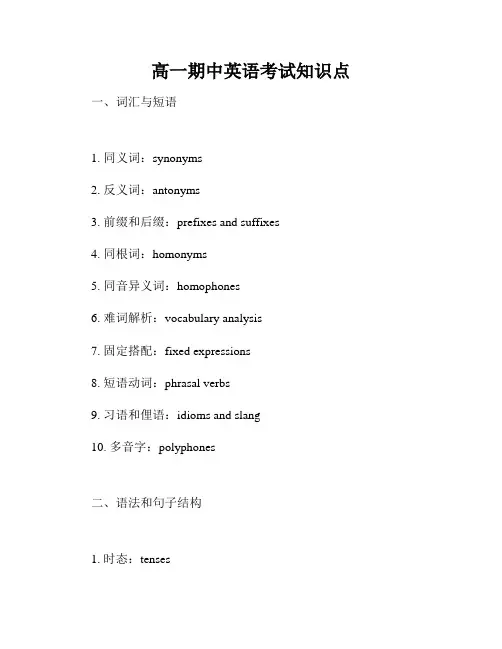
高一期中英语考试知识点一、词汇与短语1. 同义词:synonyms2. 反义词:antonyms3. 前缀和后缀:prefixes and suffixes4. 同根词:homonyms5. 同音异义词:homophones6. 难词解析:vocabulary analysis7. 固定搭配:fixed expressions8. 短语动词:phrasal verbs9. 习语和俚语:idioms and slang10. 多音字:polyphones二、语法和句子结构1. 时态:tenses2. 语态:voice3. 主谓一致:subject-verb agreement4. 并列句和复合句:compound and complex sentences5. 名词性从句:noun clauses6. 定语从句:adjective clauses7. 状语从句:adverbial clauses8. 直接引语和间接引语:direct and indirect speech9. 倒装句:inverted sentences10. 并列连词和从属连词:coordinating and subordinating conjunctions三、阅读理解1. 主旨大意:main idea2. 细节题:detail questions3. 推理题:inference questions4. 词义猜测:vocabulary inference5. 段落标题:paragraph headings6. 标题归纳:summary7. 判断正误:true/false8. 阅读速度和理解:reading speed and comprehension9. 阅读技巧:reading strategies10. 综合阅读:integrated reading四、写作技巧1. 写作结构和组织:writing structure and organization2. 书信写作:letter writing3. 应用文写作:functional writing4. 议论文写作:argumentative essay writing5. 图表描述:chart description6. 句型转换:sentence transformation7. 写作连贯性:coherence in writing8. 篇章结构:paragraph structure9. 文体特点和语言风格:writing style and language features10. 写作修辞技巧:rhetorical devices in writing五、听力技巧1. 理解主旨大意:grasping main ideas2. 获取细节信息:getting specific details3. 辨别态度和观点:identifying attitudes and opinions4. 判断正误:true/false5. 多种题型训练:practice with various question types6. 高频词汇辨析:differentiating commonly confused words7. 短对话和长对话:short and long conversations8. 讲座和演讲:lectures and speeches9. 笔记做记号:taking notes while listening10. 模拟听力测试:simulated listening tests以上是高一期中英语考试的知识点总结,包括词汇与短语、语法和句子结构、阅读理解、写作技巧和听力技巧等方面。
高一英语上期中考试知识点
高一英语上期中考试知识点一、词汇与短语1. 名词:指物的名称,如book(书)、computer(计算机)等。
2. 动词:表示动作或状态的词,如run(跑)、study(学习)等。
3. 形容词:描述名词的特征,如beautiful(美丽的)、happy(快乐的)等。
4. 副词:修饰动词、形容词或其他副词,如slowly(慢慢地)、well(好地)等。
5. 代词:代替名词的词,如he(他)、she(她)等。
6. 介词:表达位置、方向等关系的词,如in(在……里面)、on(在……上面)等。
7. 连词:连接词语、短语或句子的词,如and(和)、but(但是)等。
二、语法1. 时态:表示动作发生的时间,如一般现在时、一般过去时、一般将来时等。
2. 语态:表示句子的主语是动作的执行者还是承受者,如主动语态、被动语态等。
3. 句型:不同类型的句子结构,如陈述句、疑问句、祈使句等。
4. 定冠词与不定冠词:用于限定名词的冠词,如a、an、the等。
5. 数词:表示数量的词,如one、two、first、second等。
6. 比较级与最高级:形容词和副词的比较形式,如big(大)-bigger(更大)-biggest(最大)。
7. 名词性从句:在句子中充当名词的从句,如主语从句、宾语从句等。
8. 定语从句:修饰名词的从句,用来限定或补充名词的内容。
三、阅读理解1. 主旨大意:把握文章的中心思想和主题。
2. 细节理解:从文章中找出具体的细节信息。
3. 推理判断:根据已有信息进行推断或判断。
4. 词义猜测:通过上下文推测词语的意思。
5. 表达意图:理解作者写作的目的和意图。
四、写作技巧1. 书信写作:包括信头、称呼、内容组织等要素。
2. 日记写作:记录个人的思考、感受、经历等。
3. 简要写作:对某一事件或情况进行简要描述。
4. 图表描述:针对某一图表进行数据解读和说明。
五、听力技巧1. 抓关键词:在听力材料中抓住关键词,帮助理解。
高一英语上册期中知识点总结
高一英语上册期中知识点总结高一英语上册期中知识点重点句型1. What should a friend be like? 询问对方的看法2. I think he / she should be…表示个人观点的词语3. I enjoy reading / I'm fond of singing / I like playing computer games. 等表示喜好的词语4. Chuck is on a flight when suddenly his plane crashes.“when"作并列连词的用法5. What / Who / When / Where is it that...? 强调句的特殊疑问句结构6. With so many people communicating in English everyday,... “with+宾语+宾补”的结构做状语7. Can you tell me how to pronounce...? 带连接副词(或代词)的不定式做宾补的用法重点词汇1. especially v. 特别地2. imagine v. 想像3. alone adv. / adj. 单独,孤独的4. interest n. 兴趣5. everyday adj. 每天的,日常的6. deserted adj. 抛弃的7. hunt v. 搜寻8. share v. 分享9. care v. 在乎,关心10. total n. 总数11. majority n. 大多数12. survive v. 生存,活下来13. adventure n. 冒险14. scared adj. 吓坏的15. admit v. 承认16. while conj. 但是,而17. boring adj. 令人厌烦的18. except prep. 除……之外19. quality n. 质量20. favourite adj. 最喜爱的重点短语1. be fond of爱好2. treat…as…把……看作为……3. make friends with 与……交朋友4. argue with sb. about / over sth. 与某人争论某事5. hunt for寻找6. in order to为了7. share…with与……分享8. bring in引进;赚钱9. a great / good many许多…高一英语上册必修知识点介词in, on, under等+名词构成介词短语表被动意义表示方位的介词与含动作意义的名词合用,含被动之义,其意义相当于该名词相应动词的被动形式,名词前一般不用冠词。
高一英语期中考知识点总结
高一英语期中考知识点总结高一的英语学习是理解英语的基础知识并逐步提高英语表达能力的重要阶段。
期中考试是对学生所学知识的一个总结和检验。
本文将总结高一英语期中考试重点知识点,希望对同学们的备考有所帮助。
一、语法知识1. 时态:a. 一般现在时:表示习惯、经常性动作以及客观事实。
b. 现在进行时:表示正在进行或发生的动作。
c. 现在完成时:表示过去某一时刻开始,一直持续到现在的动作或状态。
d. 一般过去时:表示过去某个时间发生的动作或状态。
e. 过去进行时:表示过去某一段时间内正在进行的动作。
f. 过去完成时:表示过去某一时间或动作发生之前已经完成的动作。
2. 名词性从句:a. 主语从句:在句子中作主语。
b. 宾语从句:在句子中作宾语。
c. 表语从句:在句子中作表语。
d. 定语从句:在句子中修饰名词或代词。
3. 倒装句:a. 完全倒装:把谓语动词的全部提到主语之前。
b. 部分倒装:把助动词、情态动词或带有否定意义的副词提到主语之前。
4. 虚拟语气:a. 虚拟条件句:表示与现实相反的假设或愿望。
b. 虚拟语气的动词形式:使用 "would/should/could/might/had + 动词原形"。
二、阅读理解1. 标题推断:根据文章的段落和细节判断出文章的主题。
2. 细节理解:根据文章中的具体信息回答问题,并找出对应的关键词。
3. 推理判断:根据文章中的暗示或推理得出结论。
4. 词义推测:根据上下文寻找线索,猜测生词的意思。
三、写作技巧1. 作文结构:引出话题,明确立场,论证观点,总结全文。
2. 逻辑连接词:使用适当的连接词使文章结构紧密、逻辑流畅。
3. 多样化表达:使用多种句式和词汇,避免重复和单调。
四、词汇积累1. 动词短语:根据不同的语境,运用各种动词短语来丰富词汇。
2. 固定搭配:通过文本阅读和写作积累常见的固定搭配,运用到实际中。
3. 同义词与反义词:通过学习常见的同义词与反义词,拓展词汇量。
英语高一期中知识点总结
英语高一期中知识点总结英语是一门重要的国际语言,在学习过程中,我们需要熟练掌握一些基础知识点。
下面将对高一英语期中考试所涉及的知识点进行总结。
一、词汇和短语1. 基础词汇:我们应该牢固掌握一些基础词汇,如时间、数字、颜色、家庭成员等常用词汇。
2. 常见短语:在日常交流中,我们需要掌握一些常见的英语短语,如“thank you”、“how are you”、“see you later”等。
二、语法知识1. 时态:我们需要掌握一些基本的时态用法,如一般现在时、一般过去时、一般将来时等。
2. 语态:我们应该理解并正确运用被动语态,特别是与及物动词的使用有关的被动语态。
3. 从句:了解主从复合句的构造和连接词的使用情况,如定语从句、宾语从句和状语从句。
4. 名词性从句:了解它们在复合句中的作用,如主语从句、宾语从句和表语从句等。
5. 倒装句:了解倒装句的用法,如完全倒装、部分倒装等。
三、阅读理解1. 短文理解:我们需要通过阅读短文来获取相关信息,了解文章的大意、主旨和细节。
2. 阅读策略:学会使用一些阅读策略,如扫读、略读、定位、推测和总结等,以提高阅读效率。
四、写作技巧1. 写作结构:学会使用适当的段落结构和过渡词,使文章结构清晰,衔接自然。
2. 词汇运用:运用适当的词汇丰富文章,注意使用同义词、近义词和词组,以提升文章的表达能力。
3. 句型多样化:尝试使用多样的句型结构,如倒装句、强调句和介词短语等,使文章更具吸引力。
五、听力技巧1. 主旨理解:听力中要抓住信息的主旨,注意关注关键词和上下文给出的线索。
2. 注意转折:听力中经常出现转折词,我们要注意这些词以及它们带来的语境变化。
3. 笔记能力:学会在听力过程中做好笔记,可以帮助我们更好地理解和记忆所听到的内容。
综上所述,以上是英语高一期中考试所需要掌握的知识点总结。
通过对这些知识点的掌握,我们将能够更好地应对考试,提升英语学习能力,为以后的学习打下坚实的基础。