
PEP小学六年级英语下册知识点S
PEP小学英语六年级下册知识点Unit 1 How tall are you?一、词汇tall ----- taller 高的----更高的than 比short ----- shorter 矮的/短的----更矮的/更短的cm 厘米long ------ longer 长的----更长的meter 米形容词strong------ stronger 强壮的----更强壮的ton 吨adj. old ------ older 老的/旧的----更老的/更旧的size 号码young------ younger 年轻的-----更年轻的feet 脚small------ smaller 小的----更小的think 想wear 穿辅+元+辅--------双写最后一个辅音字母+er others even 甚至big-----bigger 大的-----更大的tail 尾巴thin-----thinner 瘦的-----更瘦的little 小的fat-----fatter 胖的------更胖的lobster 龙虾shark 鲨鱼辅音字母+y -----改y为i +er deep 深的happy-----happier 开心的-----更开心的seal 海豹heavy-----heavier 重的------更重的squid 鱿鱼funny-----funnier 滑稽的------更滑稽的sperm whale抹香鲸killer whale虎鲸二、重点句型⑴问年龄,身高,体重等How old are you? How tall are you? How heavy are you?---- I’m _______ (years old). ------ I’m ______ cm tall. ------- I’m ______ kg .⑵问物品的情况:①How large is your room? 你的房间有多大?It’s __________ m2 (square meters.) 有_______ 平方米。
②How long is your bed? 你的床有多长?It’s _________cm long. 有______厘米长。
③How big are your feet? 你的脚有多长?I wear size ______. 我穿_______码的鞋。
⑶形容谁比谁更……am①… be is ( even/much ) …er than …aree.g. I am taller than you. 我比你高。
I am 4 cm taller than your brother. 我比你弟弟高4cm .I am taller and stronger than your brother.我比你的弟弟更高更壮。
Jack is even stronger than his father. Jack 甚至比他爸爸还壮。
Zhang Peng and John are much younger than Mr.Green.张鹏和John 比Mr. Green 要年轻多了。
有用的句型:1.Which monkey do you like? 你喜欢哪一只猴子?I like the yellow one. 我喜欢黄色的那只。
2.I think the little monkey is only 40 cm tall. 我想那只小猴只有40cm 高。
3.Its tail is about 38 cm long. 它的尾巴约有38cm.4. A sperm whale is ____________ than a killer whale in its length.Unit 2 What’s the matter, Mike?一、词汇:have a fever (发烧)tired (疲劳的)have a cold (感冒)excited(兴奋得)have a sore throat (喉咙痛)angry(生气的)表示身体have a toothache (牙痛)表示情绪sad (悲伤的)不适的have a headache (头痛)心情happy (高兴得)hurt (疼痛)bored (无聊的)sore (疼得)其他:feel(感觉)sick(有病的)nose(鼻子)know(知道)worry (担心)medicine (药)drink (喝)stay (在,逗留)better(更好的)soon (立刻,不久)trip(旅行)fail (失败)pass(传递)二、句型:1.A:What’s the matter? 你怎么啦?B: I have a toothache. 我牙痛。
2.A: How do you feel ? 你感觉怎样?B:I feel sick. 我觉得不舒服。
3.A:How does she/he feel? 她/他感觉如何?B:She/ He is tired. 她/他累了。
4.You look so happy. 你看起来如此高兴。
5.A:I failed the math test. 我数学考试失败了。
B:I’m sorry to hear that. 听到这个消息我很难过。
6.How are you ? You look so excited. 你怎么了?你看起来很兴奋。
7.If you have a fever ,you might have athe flu.如果你发烧,你可能得了流感。
8.Don’t worry! If you are sick,see the doctor.不要担心!如果你病了,去看医生。
9.Take some medicine and drink hot drinks.吃些药和热饮料。
10 Stay in bed for a few days. You will feel better soon.卧床休息几天,你很快就会好起来。
Unit 3 Last Weekend一词汇watch ( watched ) 看wash ( washed) 洗clean ( cleaned ) 打扫play (played ) 玩visit (visited)看望do(did )助动词/做cook (cooked ) 做饭go( went ) 去go swimming ( went swimming ) 去游泳read ( read ) 阅读go fishing ( went fishing )去钓鱼go hiking ( went hiking ) 去郊游study ( studied ) 学习fly ( flew ) 飞return ( returned) 送回,归还swim (swam) 游泳last 上一个weekend 周末to 朝,向park 公园yesterday ( 昨天) 二句型1 询问在过去的某一个时间做了什么,借助助动词did●特殊疑问句——What did you do yesterday/last weekend ?——I did my homework .●一般疑问句,把did提前——Did you help your parents clean the room ? ( 当句子变为一般疑问句,动词应还原)——Yes , I did ./No, I didn’t .●标牌警示语No fishing here !此处禁止钓鱼!No swimming here ! 此处禁止游泳!No dogs pooing here! 此处禁止狗大便!No dogs peeing here! 此处禁止狗小便!三语法当一个动作是在过去的某一个时间发生时,动词则要用过去式,如句子中有yesterday, last week , last weekend , last yesterday , last Sunday 等这样表示过去时间的词时,就要用一般过去时态。
动词的过去式构成规则:1 一般动词在词尾加上ed 。
如:work — worked , wash — washed play --- played2 以e 结尾的动词在词尾加上e . 如:use --- used live --- lived3 以辅音字母和y结尾的动词改y为i ,再加上ed . 如:study --- studied , empty--- emptied4 末尾只有一个辅音字母的重读闭音节词,双写最后的辅音字母,再加ed 如:stop –stopped5 不规则变化。
(注:除去不规则变化动词,其他动词都是规则变化)swim --- swam 游泳fly --- flew 飞run --- run 跑eat --- ate 吃sleep --- slept 睡觉have --- had 有buy --- bought买take --- took 拿teach ---taught 教go---went去sing --- sang唱歌do --- did 做read ---read 读书sweep ---swept 打扫make ---made制作set ---set do --- did做get --- get得到,到达draw --- drew画画drink --- drank喝write --- wrote写ride --- rode 骑put --- put 放tell ---told告诉send --- sent发送feel --- felt感觉think --- thought想meet --- met 见面fall --- fell落下wake --- woke 醒来Unit 4 My holiday不规则动词过去式:sing sang 唱eat ate 吃go went 去take took 拍(照)have had 有;吃leave left 离开buy bought 买see saw 看见get got 到达learn / learned Chinese学中文take /took pictures 拍照climb/climbed a mountain 爬山sing and dance /sang and danced 唱歌跳舞buy/bought presents 买礼物row/rowed a boat 划船see/saw elephants 看大象go/went skiing 去滑雪go/went ice-skating 去滑冰cousin 堂兄弟;堂姐妹工作I’ll= I will miss想念relax放松prepare准备二、句型:问过去发生的动作要借助动词did,特殊疑问句为句型是:疑问词+did+主语+V原形+其它?Where did you go on your holiday? 假期你去了哪里?I went to Xinjiang. 我去了新疆.What did you do on your holiday?你假期干了什么?I sang and danced. 我即唱了歌又跳了舞.How did you go there? 你怎样去的?I went by train. 我坐火车去的.When did you go? 你什么时候去的?I went last Monday. 我上周一去的.It was a long holiday. 这是一个长的假期.For the last day of the holiday, we relaxed and prepared to go back to work or school.Recycle 2 A Farewell Party一.重点短语:have a ferewell party 开毕业告别会sing songs 唱歌play the piano 弹钢琴play the erhu 拉二胡do Chinese kung fu 表演中国功夫say hello/goodbye to sb. 向某人问好/告别invite sb. to …邀请某人…二.重点句子:1.It is the end of the school year. 这是学期末。
PEP小学六年级英语下册复习语法知识及配套习题
小学英语语法及习题一、名词复数规则1.一般情况下,直接加-s,如:book-books, bag-bags, cat-cats, bed-beds2.以s. x. sh. ch结尾,加-es,如:bus-buses, box-boxes, brush-brushes, watch-watches3.以“辅音字母+y”结尾,变y为i, 再加-es,如:family-families, strawberry-strawberries4.以“f或fe”结尾,变f或fe为v, 再加-es,如:knife-knives5.不规则名词复数:man-men, woman-women, policeman-policemen, policewoman-policewomen, mouse-micechild-childrenfoot-feet,.tooth-teethfish-fish, people-people, Chinese-Chinese, Japanese-Japanese写出下列各词的复数I _________him _________this ___________her哇库资源网______watch _______child _______photo ________diary ______day________ foot________ book_______ dress________tooth_______ sheep ______box_______ strawberry _____thief _______yo-yo ______ peach______ sandwich ______man______ woman_______paper_______ juice___________ water________ milk________ rice__________tea__________二、一般现在时一般现在时基本用法介绍【No. 1】一般现在时的功能1.表示事物或人物的特征、状态。
英语六年级下第三单元
英语六年级下第三单元
以下是英语六年级下册第三单元的知识点总结,供你参考:
一、词汇
1.描述情绪和感觉的词汇:happy, sad, angry, worried, excited, tired, etc.
2.身体部位及相关疾病的词汇:headache, stomachache, toothache, fever, cold, etc.
3.其他词汇:medicine, rest, magazine, newspaper, etc.
二、语法
1.一般过去时:讲述过去发生的事情,如I went to the park yesterday.
2.情态动词should 和shouldn't 的用法:给出建议或劝告,如You should drink more water.
3.形容词比较级和最高级的用法:比较不同程度的形容词,如She is taller than me.
三、句型
1.How are you feeling? 询问他人的情绪和身体状况。
2.What's the matter? 用于询问他人的问题或困扰。
3.I'm sorry to hear that. 表达对他人困扰的同情和关心。
四、阅读理解
1.理解故事和文章中的主要情节和人物情感。
2.提取关键信息,回答问题。
五、写作
1.描述自己或他人的情绪和身体状况。
2.写关于健康生活方式的建议。
以上是第三单元的主要知识点总结,但请注意不同教材版本可能会有所差异。
pep六年级英语下册知识点总结
六年级下册英语知识点总结第一单元(Unit1 How tall are you?)单词: tall—taller更高的short—shorter 更矮的strong—strong更强壮的old—older年龄更大的young—younger 更年轻的big—bigger更大的heavy—heavier 更重的long—longer 更长的thin—thinner更瘦的small—smaller 更小的 dinosaur恐龙 hall大厅 metre,meter 米kilo meter千米than比 both A and B两个都 kilo gram千克,公斤 countryside乡村 country乡村,国家low—lower更低的shadow阴影,影子 smart—smarter更聪明的 become开始变得,变成-became-become句子: 1、That's the tallest dinosaur in this hall.那是这个厅里最高的恐龙。
2、You’re older than me. 你比我大。
3、How tall are you ?你有多高? I’m 1.65 metres.我身高1.65米。
point点4、What size are your shoes ?你穿多大号的鞋?5、My shoes are size 37. 我穿37号的鞋。
6 、Your feet are bigger than mine .你的脚比我的大。
名词性物主代词=形容词性物主代词+名词7、How heavy are you ?你有多重? I’m 48 kilograms .我体重48公斤。
8、It’s taller than both of us together .它比我们俩加在一起还高。
应该掌握的知识点:1、形容词变为比较级的变化规则:(1)一般情况下,在形容词的词尾直接加er。
如: tall—taller short—shorter.(2)以字母e结尾的形容词,在词尾直接加r,如:nice—nicer. late—later(3)以重读闭音节结尾(辅+元+辅),且结尾只有一个辅音字母的词,先双写这个辅音字母,再加er.如:big—bigger thin—thinner fat—fatter(4)以辅音字母加y结尾的双音节形容词,先变y为i , 再加er。
人教PEP版英语六年级下册Unit 1-4知识点总结(期末复习)
Unit1How tall are you?一、核心词汇互为反义词的比较级:shorter更矮的/更短的—taller更高的/longer更长的older更年长的—younger更年轻的thinner更瘦的—stronger更强壮的/heavier更重的bigger更大的—smaller更小的拓展词汇——形容词比较级:1.形容词比较级一般情况下直接在原级词尾加-er。
如:clean—cleaner;2.以不发音的e结尾的单词直接加-r。
如:large—larger nice—nicer;3.以“辅音字母+y”结尾的单词变y为i,再加-er。
如:easy—easier busy—busier happy—happier funny—funnier;4.以重读闭音节结尾的单词,要先双写词尾的辅音字母,再加-er。
如:red—redder fat—fatter sad—sadder;5.不规则变化。
如:good—better bad—worse many—more little —less6.多音节词和部分双音节词则在词前加more。
如:beautiful—more beautiful exciting—more exciting二、了解词汇dinosaur恐龙hall大厅metre米(美式英语:meter)than比both两个都kilogram千克;公斤countryside乡村lower(low的比较级)更低地shadow阴影;影子smarter(smart的比较级)更聪明的become开始变得;变成三、核心句型1.—How tall are you?你有多高?—I’m1.64metres.我身高1.64米。
2.—What size are your shoes,Mike?迈克,你穿多大号的鞋?—Size7.7号。
3.—How heavy are you?你体重多少?—I’m48kilograms.我体重48公斤。
(完整版)PEP小学英语六年级下册词汇句子汇总
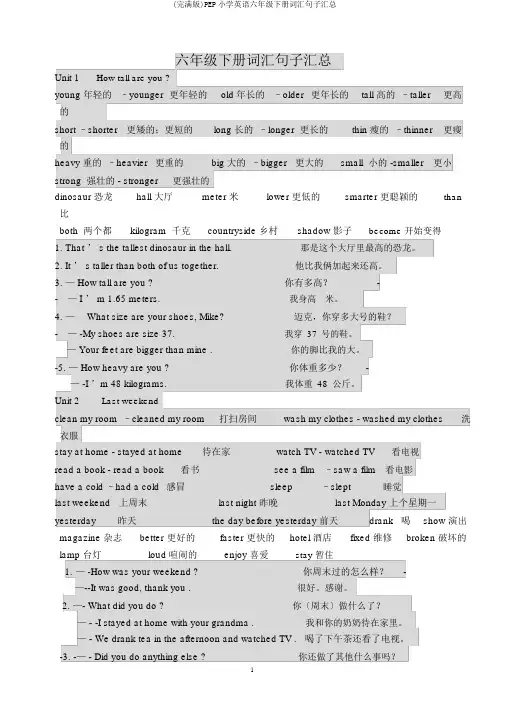
六年级下册词汇句子汇总Unit 1How tall are you ?young 年轻的–younger更年轻的old 年长的–older更年长的tall 高的–taller更高的short –shorter更矮的;更短的long 长的–longer 更长的thin 瘦的–thinner更瘦的heavy 重的–heavier更重的big 大的–bigger更大的small 小的 -smaller更小strong 强壮的 - stronger更强壮的dinosaur 恐龙hall 大厅meter 米lower 更低的smarter 更聪颖的than 比both 两个都kilogram 千克countryside 乡村shadow 影子become 开始变得1. That ’ s the tallest dinosaur in the hall.那是这个大厅里最高的恐龙。
2. It ’ s taller than both of us together.他比我俩加起来还高。
3. — How tall are you ?你有多高?-- — I ’ m 1.65 meters.我身高米。
4. —What size are your shoes, Mike?迈克,你穿多大号的鞋?- — -My shoes are size 37.我穿37号的鞋。
— Your feet are bigger than mine .你的脚比我的大。
-5. — How heavy are you ?你体重多少?-— -I ’m 48 kilograms.我体重48公斤。
Unit 2Last weekendclean my room –cleaned my room打扫房间wash my clothes - washed my clothes洗衣服stay at home - stayed at home待在家watch TV - watched TV看电视read a book - read a book看书see a film–saw a film看电影have a cold –had a cold感冒sleep–slept睡觉last weekend上周末last night 昨晚last Monday 上个星期一yesterday昨天the day before yesterday 前天drank喝show 演出magazine 杂志better 更好的faster 更快的hotel 酒店fixed 维修broken 破坏的lamp 台灯loud 喧闹的enjoy 喜爱stay 暂住1. — -How was your weekend ?你周末过的怎么样?-—--It was good, thank you .很好。
小学英语PEP六年级下册三四单元知识点归纳复习
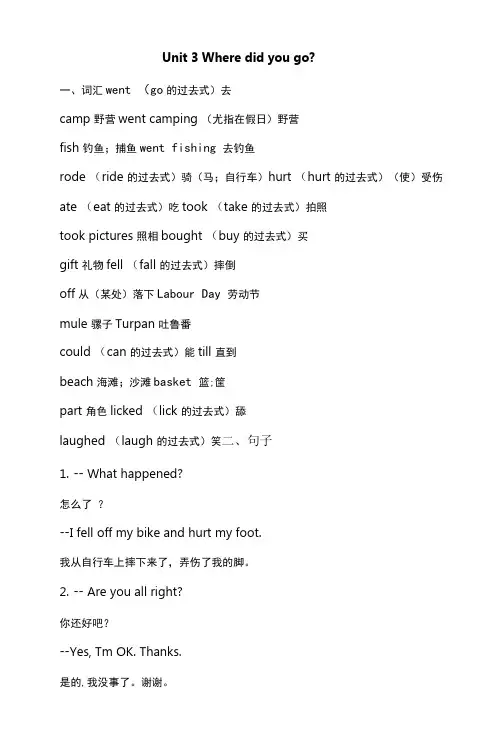
Unit 3 Where did you go?一、词汇went (go的过去式)去camp 野营went camping (尤指在假日)野营fish钓鱼;捕鱼went fishing 去钓鱼rode (ride的过去式)骑(马;自行车)hurt (hurt的过去式)(使)受伤ate (eat的过去式)吃took (take的过去式)拍照took pictures 照相bought (buy的过去式)买gift礼物fell (fall的过去式)摔倒off从(某处)落下Labour Day 劳动节mule 骡子Turpan 吐鲁番could (can的过去式)能till 直到beach海滩;沙滩basket 篮;筐part 角色licked (lick的过去式)舔laughed (laugh的过去式)笑二、句子1.-- What happened?怎么了?--I fell off my bike and hurt my foot.我从自行车上摔下来了,弄伤了我的脚。
2.-- Are you all right?你还好吧?--Yes, Tm OK. Thanks.是的,我没事了。
谢谢。
3.Oh dear!哦,天啊!4.-- Did you go to Turpan?你去吐鲁番了吗?--Yes, I did.是的,我去了。
5.-- Who did you go with?你和谁一起去的?--My parents and my uncle.我父母和我叔叔。
6.That's too bad!那太糟糕了!e and look at my photos from the Labour Day holiday. 来看我劳动节假期的照片吧。
8.-- Where did you go?你去哪了?--Mt. Tianshan, Xinjiang. I rode a horse.新疆的天山。
我骑马了。
9.-- Where did you go over the winter holiday?在寒假期间你去了哪里?--My family and I went to Sanya.我和我的家人去了三亚。
PEP新版小学英语六年级下册单词表(带音标)
PEP新版小学英语六年级下册单词表(带音标)Unit1tall—taller ['tɔ:lə] 更高的short—shorter ['ʃɔ:tə] 更矮的strong—stronger ['strɔŋgə] 更强壮的old—older ['əuldə] 年龄更大的young—younger ['jʌŋɡə] 更年轻的cm(centimeter) ['senti,mi:tə]n. 厘米;公分than [ðæn] 与…相比较funnier ['fʌniə] 更滑稽的big—bigger [bɪɡə] 更大的heavy—heavier ['heviə] 更重的long—longer['lɒŋɡə(r)] 更长的thin—thinner ['θɪnə(r)] 更瘦的small—smaller [s'mɔ:lər] (体型)更小feet ['fi:t,fi:t] 脚(复数)size [saiz] 号码;尺码wear [wεə] 穿meter [mi:tə] 米ton [tʌn,tuŋ]吨each [i:tʃ] 各自;每个squid [skwid] 鱿鱼lobster ['lɔbstə] 龙虾shark [ʃɑ:k] 鲨鱼deep [di:p] 深的seal [si:l] 海豹sperm whale [spə:m][hweil] 抹香鲸killer whale ['kilə][hweil] 虎鲸even ['i:vən] 甚至dinosaur ['daɪnəsɔː]恐龙hall [hɔːl]大厅both [bəʊθ]两个都kilogram [ˈkɪləɡræm] 千克、公斤countryside ['kʌntrɪsaɪd] 乡下lower ['ləʊə] 更低的shadow [ˈʃædəʊ]影子smarter ['smɑ:tə] 更聪明的become [bɪ'kʌm] 变成Unit2have a fever ['fi:və] 发烧have a sore throat [sɔ:][θrəut] 喉咙疼have a cold [kəuld] 感冒have a toothache ['tu:θeik] 牙疼have a headache ['hedeik] 头疼matter ['mætə] 事情,麻烦sore [sɔ:] 疼的sick [sik] 不舒服的;有病的hurt [hə:t] 疼痛nose [nəuz] 鼻子people ['pi:pl] 人们flu [flu:] 流感know [nəu] 知道might [mait] 可以;能worry ['wʌri,'wə:ri] 烦恼;担忧medicine ['medisin] 药drink [driŋk]饮料stay [stei] 在;逗留better ['betə(r)] 更好的soon [su:n] 立刻;不久tired ['taiəd] 疲劳的,累的excited [ik'saitid] 兴奋的angry ['æŋɡri] 生气的happy ['hæpi] 高兴的bored [bɔ:d] 无聊的,烦人的sad [sæd] 忧伤的,悲伤的trip [trip] 旅行fail [feil] 不及格;失败test [test] 测试hear [hiə] 听见match [mætʃ] 比赛between [bi'twi:n] 在…之间pass [pɑ:s,pæs] 传递kick [kik] 踢alittle ['lɪtl] 有些goal [ɡəul] 得分bounce [bauns] 反弹off [ɔf] 距;离;离开another [ə'nʌðə] 另一个guess [ɡes] 猜测win [win] (过去式won[wʌn])赢game [ɡeim] 比赛laugh at [lɑ:f, æt] 因…而发笑cleaned[kli:nd]打扫[kli:nd] 打扫clean过去式stayed [steɪd] 待、停留stay的过去式washed [wɔʃt] 洗,洗涤(wash的过去watched(watch的过去式[wɒtʃt]看的过去式had(have的过去式) [hæd] 患病、有、吃、喝、上课had a cold [hæd] 感冒slept(sleep的过去式) [slept] 睡觉(sleep的过去式read [red] 读书过去式saw [sɔː]s ee的过去式看last [lɑːst]上一个、最后的yesterday [ˈjestədɪ;-deɪ] 昨天before [bɪˈfɔ:(r)] 之前drank(drink的过去式)[dræŋk]喝show [ʃəʊ] 表演magazine [mægə'ziːn杂志better(good,well的比较级) ['betə]更好的faster [fɑ:stə(r)] 更快的hotel [həʊˈtel] 旅馆、酒店fixed(fix的过去式) [fɪkst] 修理broken ['brəʊk(ə)n] 破的,坏的lamp [læmp] 灯、台灯loud [laʊd] 大声的enjoy [ɪnˈdʒɔɪ] 喜爱、享受stay [steɪ] 待、停留Unit3watch—watched [wɒtʃt] 看wash—washed [wɔʃt] 洗play—played [pleɪd] 玩visit—visited ['vɪzɪtid] 看望do—did [did] 做lastweekend [lɑ:st]['wi:kend] 上一个周末go—went [went] 去go to a park—went to a park 去公园go swimming—went swimming ['swɪmɪŋ]去游泳go fishing—went fishing ['fɪʃɪŋ]去钓鱼read—read [ri:d] 读go hiking—went hiking [haɪkɪŋ]去郊游study(过去式studied)['stʌdi] 学习tongue twister [tʌŋ]['twistə] 绕口令fiy [flai] 飞flew [flu:] 飞(过去式)return [ri'tə:n]] 送回;归还swim [swim] 游泳swam [swæm] 游泳(过去式)went [went] 去(过去式)camp [kæmp] 野营went camping [went][kæmpɪŋ]去野营(过去式)fish [fɪʃ] 钓鱼、鱼、鱼肉went fishing [went][fɪʃɪŋ]去钓鱼(过去式)rode [rəʊd] 骑(过去式)ride [raɪd] 骑hurt [hɜːt]伤害ate [et; eit] 吃(过去式)took [tu:k] 拍照(过去式)take [teɪk] 拍照took pictures [tu:k]['pɪktʃəz] 照相bought [bɔːt]买buy [baɪ] 买gift [gɪft] 礼物fell [fel] 跌倒fall [fɔːl]跌倒off [ɒf] 脱落、离开Labour Day ['leɪbə][deɪ] 劳动节mule [mjuːl]骡子Turpan ['tuə'pɑ:n] 吐鲁番could [kəd; kʊd] 可以;能;可能;can的过去式till [tɪl] 直到…时beach [biːtʃ] 海滩;海滨basket ['bɑːskɪt] 篮;一篮part [pɑːt]角色;部位lick [lɪk] 舔licked [lɪkt] 舔laugh [lɑːf]笑;嘲笑luaghed [lɑːft]笑;嘲笑Unit4learn Chinese [lə:n][tʃaɪniːz]学汉语learned Chinese [lə:nd][tʃaɪniːz]学汉语sing and dance [siŋ][dɑ:ns,dæns]唱歌和跳舞sang and danced [sæŋ][dɑ:nst]唱歌和跳舞eat good food [i:t] 吃好吃的食物ate good food [et,eit] 吃好吃的食物climb /klaim/ 爬climbed /klaimd/ 爬have [hæv] 有,吃,喝,上…课had [hæd] 有,吃,喝,上…课buy presents [bai][pri'zents] 买礼物bought presents [bɔ:t][pri'zents] 买礼物row a boat [rəu][bəut] 划船rowed a boat [rəud][bəut] 划船see elephant [si:]['elifənt] 看大象saw elephant [sɔ:]['elifənt] 看大象go skiing—[gəʊ]['ski:ɪŋ]去滑雪went skiing ['ski:ɪŋ]去滑雪go ice-skating [gəʊ]['skeɪtɪŋ]去滑冰went ice-skating ['skeɪtɪŋ]去滑冰how [haʊ] 怎么,如何get [ɡet] 到达got [ɡɒt] 到达last [lɑ:st] 上一个的,仅余的cousin ['kʌzn] 堂(表)兄弟、姐妹relax [ri'læks] 放松prepare [pri'pεə] 准备dining hall [daɪnɪŋ][hɔːl]饭厅grass [grɑːs]草;草地gym [dʒɪm] 体育馆ago [ə'gəʊ] 以前;过去的cycling ['saɪklɪŋ]骑自行车go cycling [gəʊ]['saɪklɪŋ]骑自行车ice-skate [aɪs][skeɪt] 滑冰badminton ['bædmɪnt(ə)n 羽毛球运动star [stɑː]星;明星easy ['iːzɪ] 容易的;舒适的look up [luk ʌp] 查找Internet ['ɪntənet] 因特网different [ˈdɪfrənt] 不同的active ['æktɪv] 积极的;活跃的race [reɪs] 比赛nothing ['nʌθɪŋ]没什么;毫不think [θɪŋk]想;思索thought [θɔːt]思想;思考felt [felt] 感觉feel的过去式cheetah ['tʃiːtə] 非洲猎豹trip [trɪp] 旅行;绊倒woke [wəʊk] 唤醒;激发wake [weɪk] 醒来;唤醒dream [driːm]梦想;做梦。
人教版PEP六年级英语下册小升初重点单词及短语复习资料
Unit1g e t up起床have breakfast吃早餐go t o school去上学School begins.开始上课have lunch吃午饭School is over放学go home回家have dinner吃晚饭watch TV看电视go t o bed睡觉breakfast早餐lunch午餐dinner晚餐cook breakfast做早餐teach English教英语take a walk散步read stories读故事walk走;步行every每一个morning早晨六年级上册单词表afternoon下午evening晚上;傍晚see a film看电影play the piano弹钢琴clean the window擦窗户clean the door擦门clean the floor擦地板often时常easy容易difficult困难Unit2collect toy cars搜集玩具汽车collect stamps搜集邮票collect maps搜集地图collect picture cards搜集图片open开;打开hobby爱好map地图box盒子colour颜色go fishing去钓鱼plant flowers种花cook meals做饭dad爸爸mum妈妈plant植物;种植flower花drink喝tea茶play computer games玩电脑游戏mak e dolls tak e pho t os照相photo照片kid小孩baby婴儿hungry饿的cry哭Unit3invite your friends t o your party 邀请朋友参加聚会celebrate your birthday with your friends与朋友庆祝生日time时间after在......后then那时me我(I的宾格)bye再见star-shaped cake星形蛋糕jelly果冻fruit pie水果派;水果馅饼kind种类chocolate巧克力ice cream冰激凌candy糖果sure当然light the candles点蜡烛sing the birthday so ng唱生日歌mak e a wish许愿blow out the candles吹蜡烛cut the cake切蛋糕eat the cake吃蛋糕here在这里for给;为了light点燃Unit4the first month of the year 一年里的第一个月the second month of the year 一年里的第二个月New Y ear's Day元旦Spring Festival春节January一月February二月back回原处;后面their他(她,它)们的the third month of the year 一年里的第三个月the fourth month of the year 一年里的第四个月T ree Planting Day植树节Easter复活节March三月April四月tree树;树木grass草;草地st op(使)停egg蛋;卵the fifth month of the year一年里的第五个月the sixth month of the year一年里的第六个月Labour Day劳动节May五月June六月M other’s Day母亲节Children’s Day儿童节Father’s Day父亲节hear d-shaped cake心形蛋糕give a birthday card t o your friend向朋友赠送生日礼Unit5the seventh month of the year一年里的第七个月the eighth month of the year一年里的第八个月the Party’s birthday党的生日Army Day建军节July七月August八月month月Dayyear 年the ninth month of the year 一年里的第九个月the tenth month of the year 一年里的第十个月 National Day 国庆节 September 九月 October 十月the eleventh month of the year 一年里的第十一个月the twelfth month of the year一年里的第十二个月Thanksgiving 感恩节 Christmas 圣诞节 November 十一月December 十二月Teacher’s 教师节Unit 6farm the land 种地;种田go on spring outgoings 去春游 fly kites 放风筝season 季节spring 春天little 一点green 绿色(的) bird 鸟 fly 飞go on a trip 去旅游go t o a summer camp 去夏令营 have summer holidays 过暑假 begin 开始 close 关;关闭 summer 夏天 weather 天气 heavy 重的 rain 雨;下雨 pick apples 摘苹果 cut rice 割稻子mak e a snowman 堆雪人 sweep the snow aut umn 秋天yellow 黄色(的)brown 棕色(的) white 白色(的) winter 冬天snowman 雪人六年级上册短语总结Unit11.be from/come from来自于20.have dinner吃晚餐2.Primary Six第六小学21.watch TV看电视3.Grade Six六年级22.for30minutes30分钟4.let sb do sth让某人做某事5.tell sb abo ut sth告诉某人关于某事6.tell sb t o do sth告诉某人做某事7.daily life日常生活8.ge t up起床9.in the morning在早上10.have breakfast吃早饭11.at six在六点钟at abo ut six在六点钟12.go t o school去学校13.School begins开始上课14.have seven subjects有七门课15.have lunch吃午餐16.at school在学校17.School is over放学18.in the afternoon在下午19.go home回家23.do some reading阅读24.go t o bed去睡觉25.How abo ut=w hat abo ut怎么样26.best wishes最好的祝愿27.be happy t o do sth高兴做某事28.get your email收到你的邮件29.in Grade Six在六年级30.an English teacher一位英语老师31.every morning每天早上32.cook breakfast做早饭33.go t o school去上学34.have four lessons a day一天有四节课35.learn English学英语36.by doing sth通过做某事37.play games玩游戏38.like sth very much非常喜欢某事39.cook dinner做晚餐40.after dinner晚饭 2.have a look看一看41.take a walk散步 3.open the box and see打开盒子看一看42.read sth t o sb读某东西给某人 4.What a super car!多棒的一辆小车啊!43.On Saturday每周六 5.collect stamps收集邮票44.see a film看电影 6.1)How abo u t you?你呢?45.have piano lessons上钢琴课46.It is adj t o do sth做某事是怎么样的47.help sb(to)do sth帮助某人做某事48.help sb with sth帮助某人某事49.practice doing sth练习做某事50.enjoy doing sth喜欢做某事51.at home在家52.do the housework做家务53.learn from sb向某人学习54.should do sth应该做某事55.teach English教英语56.read stories读故事57.clean the window擦窗户58.clean the door擦门59.clean the floor擦地板Unit21.a new toy car一辆新的小汽车2)How abo ut doing sth?做...怎么样?7.collect maps收集地图8.collect picture cards收集图片9.so colourful and beautiful如此多彩漂亮10.want t o do sth想要做某事11.look at看一看12.my family pho t o s我的全家福13.plant flowers种花14.drink Chinese tea喝中国茶15.That’s great那太棒了!16.That’s interesting那太有趣了!17.That’s wonderful那太棒了!18.look at this photo看这个照片19.in this photo在这个照片里20.at her birthday party在她的生日派对21.make a doll=mak e dolls做布娃娃22.be interested in sth对某事感兴趣d23.be interested in doing sth对做某事感兴趣much. 非常感谢5.would like t o do sth. = want t o do sth.24.play computer games 玩电脑游戏想要做某事25.take pho t o s 拍照片 6.my birthday party 我的生日聚会 26.two phot o s 两张照片 7.I ’ l ove to. 我愿意。
小学英语时态总复习(课件)度人教版PEP版英语六年级下册
When did you clean the classroom?
yesterday
给对应的时态找到时间伙伴
用动词的正确形式填空 1. she __d_o_e_s_ (do) her homework every evening. 2. We ___f_l_y__ (fly) kites in the park on Sundays. 3. My mother __c_le_a_n_e_d_ (clean) our room last Sunday. 4. Tom __p__la_y_s_(play) the piano every Saturday. Now he_i_s_p_la_y_ing(play). 5. She __l_ik_e_s__(like) swimming. She i_s g_o_in_g_to__sw_im_(swim) next weekend. 6. Usually my mother _w_a_s_h_e_s_ (wash) the dishes after lunch. But my grandma_w_a_s_h_e_d_ (wash) yesterday. 7. Look at the man! He __is_r_e_a_d_i_n_g__ (read) a magazine. 8. _D__id_ (do)you__d_o(do)homework last weekend?
习惯性的 动作
爱好
Tip
经常发生
现在进行时态 表示正在发生的动作, 常与表示现在的时间 now, listen, look 连用
结构:
问:What+be动词+主语+doing? 答:主语+be动词+动词ing形式。 如:——What are you doing?
PEP人教版小学英语六年级下册单元知识梳理总结(全册)
六年级下册单元知识点第一单元四会单词:tall—taller更高的short—shorter 更矮的strong—stronger更强壮的old—older 年龄更大的young—younger 更年轻的big—bigger更大的heavy—heavier 更重的long—longer 更长的thin—thinner 更瘦的small—smaller (体型)更小的四会句型: How tall are you? 你有多高?I’m 164 cm tall. 我164 厘米高。
You’re shorter than me. 你比我矮。
You’re 4 cm taller than me.你比我高4厘米。
How heavy are you? 你有多重?I’m 48 kg. 我48千克。
应该掌握的知识点:1、表示两者之间有所比较时,句子中的形容词要用比较级形式。
形容词变为比较级的变化规则:(1)一般情况下,在形容词的词尾直接加er。
如: tall—taller short—shorter.(2)以字母e结尾的形容词,在词尾直接加r,如:nice—nicer. late—later (3)以重读闭音节结尾,且结尾只有一个辅音字母的词,先双写这个辅音字母,再加er.如:big—bigger thin—thinner fat—fatter (4)以辅音字母加y结尾的双音节形容词,先变y为i , 再加er。
如:easy—easier heavy—heavier funny—funnier.形容词比较级的变化口诀:原级变为比较级,通常er加上去。
若是结尾辅元辅,辅音双写要牢记。
辅音加y结尾时,把y变i 是必须。
原级若以e结尾,直接加r不后悔。
2、部分形容词比较级的不规则变化:good—better well—better bad—worse badly—worse many—more much—more little—less far—farther3、同义句:How tall are you?==What’s your height?How heavy are you?==What’s your weight?4、以How开头的问句(仅限小学阶段):How are you? 问身体状况。