
人教版(2019)必修二Unit4 History and traditionsVideoTime
tower. __5__ F. is a traditional place for public
meetings. __4__ G. contains a great art collection.
Before you watch
Match the place names below with the photos from the video.
A Big Ben B Buckingham Palace C Houses of Parliament D Tower of London E National Gallery F Trafalgar Square G Tower Bridge H Westminster Abbey
• To learn about places in London by watching a video.
• To talk about the historic places in your local city.
Big Ben
Westminster Bridge
The palace of Westminster, the home of the UK government
2. What historic places in your local city would visitors probably like to see most? What could you tell visitors about those places and the traditions of your local city?
An introduction to historic London
London sits upon the River Thames in the southeast of England. It is the capital of the United Kingdom, and—with almost nine million people—Europe's largest city.
2. Answer the questions using information from the video. What did Samuel Johnson say about London? Samuel Johnson said that when one is tired of London, one is tired of life. What makes London a great city to walk in?
Do you know these buildings? Which country do they belong to?
We are going Байду номын сангаасo watch a video about London. What do you expect to see in the video? Why?
It is a great city to walk in because there are no hills and many things to see.
After you watch
Discuss the questions in groups.
1. What historic places in London would you like to visit? Why? I would like to take a walk around Trafalgar Square to explore the area. I would also like to visit Westminster Abbey and pay my respects to the famous people who lie buried there.
H
G
D
B
E
F
A
C
While you watch
While you watch
1. Complete the sentences below by writing 1-7 on the lines.
1. The Tower Bridge 2. Westminster Abbey 3. Buckingham Palace 4. The National Gallery 5. Trafalgar Square 6. The Houses of Parliament 7. Big Ben
Search online more information about the historic places in your local city and then try to write a passage to describe one of them.
Visitors to Henan Province would probably like to visit the Gaocheng Astronomical Observatory and the ancient ruins of Yin. The former is the site of the oldest observatory in China where astronomy has traditionally been studied. The latter was the last capital of the Shang Dynasty and is the largest archaeological site in China today.
__1__ A. is a symbol of the city of London. __6__ B. is also called the Palace of Westminster. __3__ C. is where the king or queen lives. __2__ D. is where all royal funerals and most
Unit 4 History and Traditions高中英语人教版(2019)必修第二册
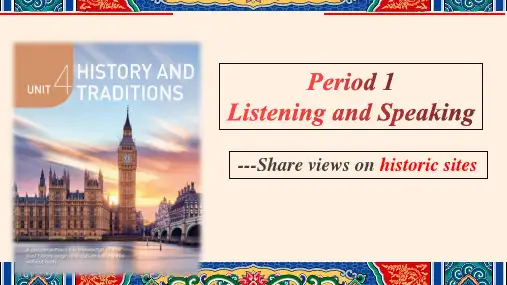
Located (locate )to the east of the Temple of Confucius, this was the historical home of the descendants of Confucius where they managed sites and ceremonies in Qufu. Kong Family Mansion Today it is a museum.
other building in the city can be taller than it.
WX::AOWnha,iittd,hyaioot’usmmreesipasnecwat.hnTehreeatxS’sphaarkleietstslpesebiaoritenlwikawesmfhryoicmhoh?mWmethoeawtana–ncSsotirnsactofiodmredn-ecuetp–honCi-noAngvfoudnc.iiufsfaenrdent frSohamkestpheaere,m5._e_a_tw_n_oi_no_fg_t_h_oe_gf_r_eta_ht_ee_st_im_n_i_nd_di_sv_in_id_h_ius_t_aor_ly_w_! oI rredalsly. wSaontmtoeviisdit itohemUKs– I’m
3. He lived _o_ve_r__20_0_0__ye_a_r_s__ago.
Xiao Kong
1. Confucius has _o_v_e_r_3__m_i_ll_io_n__descendants. 2. He was a great _ed_u_c_a_t_o_r and had many ideas about_e_d_u_c_a_ti_o_n____. 3. He was _on_e__o_f _th_e__gr_e_a_t_es_t_m__in_d_s__in history.
UNIT4 History and Traditions课件-高一英语(人教版2019必修第二册)
as there were so many people around. have/get/make/keep/leave sb./sth. done
5. She had a copy of the painting boxed to ensure that it was delivered safely.
to use some special cases concerning the past participle used as attributive and objective complement flexibly
to strengthen students’ great interest and comprehension in grammar learning
-ed form
used as non-verb
4 attribute
5 adverbial
6 object
complement
Learning objectives
to review the basic usages of the past participle used as attributive and objective complement
attribute
1
Most people just use the shortened name: “the United Kingdom” or “the UK”. (教材P40)
attribute
2 They use the same flag, known as the Union Jack, … (教材P40)
Summarizing the usage
When we use past participle as the object complement, they are usually appear in the following structures:
Unit+4+History+and+traditions+Words+人教版(2019)必修第二册
crowd /kraʊd/ n.人群 v.挤满
Wales /weɪlz/威尔士(英国) Scotland /skɒtlənd/苏格兰(英国) Northern Ireland /ˈnɔːðənˈaɪələnd/北爱尔兰(英国) Anglo-Saxon /æŋɡləʊ ˈsæksn/盎格鲁-撒克逊人 Viking /vaɪkɪŋ/ n.维京人;北欧海盗 Normans /nɔ:məns/ adj.诺曼式的;诺曼人
honey /ˈhʌni/ n.蜂蜜 ancestor /ˈænsestə(r)/ n.祖宗;祖先 position /pəˈzɪʃn/ n.位置;姿态;职位 courtyard /ˈkɔːtjɑːd/ n.庭院;院子 snack /snæk/ n.点心;小吃 poet /ˈpəʊɪt/ n.诗人
03 belong /bɪˈlɒŋ/ vi.应在(某处);适应 belong to 属于
佳 句 列 举 No matter what happens, Taiwan belongs to China.
要点必记
belongings n. (pl.)所有物;财产,财物 • personal belongings 个人财物,私人用品
custom /ˈkʌstəm/ n.风俗;习俗;习惯
sensory /ˈsensəri/ adj.感觉的;感官的
sense v.感知
sensitive adj.敏感的
striking /ˈstraɪkɪŋ/ adj.引人注目的;显著的 strike v.罢工;击打
transition /trænˈzɪʃ(ə)n/ n.过渡;转变;变迁
surround /səˈraʊnd/ v.围绕;包围 be surrounded by/with sorrounding adj.周围的 surroundings n.环境
Unit 4 History And Traditions高中英语人教版(2019)必修第二册

5 Role Play
B: Welcome to our school! A: Thank you! I’m so happy to be here. Oh, what’s that over there? It looks like a statue of an ancient man. Who is he? …… A: Thank you for your explanations. I am looking forward to studying with you guys under Confucius’ guidance! B: Let me show you our classroom.
3 Listening for the second time
Decide whether these statements are true, false, or not mentioned.
① Confucius said that learning without understanding leads to
一个不了解自己历史、起源、和文化的民族,就如同一颗无根之树。
1 Lead-in
How can we learn more about history and traditions?
1. Read books 2. Watch documentaries 3. Visit websites 4. Read travel journals 5. Visit historical sites 6. Attend cultural festivals
recorded in the family tree.
T F NM
④ Dacheng Hall is the tallest building in Qufu.
人教版(2019)必修 第二册Unit 4 History and traditions Disc

Period 3 Discovering Useful Structures
Learning aims
To learn the past participles as the attribute and the object complement.
past participle as the attrib_u_t_e___①______②______________________
past participle as the object complemen_t___③_________________
3. Fill in the blanks.
as the object complement
✓ The United Kingdom, Great Britain, England— many people are confused by... as the attribute
✓ They conquered England after the well-known Battle of Hastings in the 11th century. as the attribute
宾语和宾语补足语之间为被动关系,为动宾关系
3.表示"希望"、"要求"意义的动词,如∶ would like,order,want, wish等; I would like this matter settled at once. 我希望此事立刻得到解决。 I wish my homework finished before five o'clock. 我希望 5 点前完成我 的作业。
人教版(2019)必修第二册Unit 4 History and Traditions List教案

2019新人教高中英语必修二Unit 4 Listening and Speaking公开课教案Analysis of the materials:Theme Group: History,Society and CultureThis unit focuses on history and traditions covering the long history and cultural traditions of China,Britain,Russia,Ireland,Brazil,Greece,Egypt and other countries.It's of great significance for students to understand the English language,the historical and cultural connotation of the world's important civilization and the way of thinking contained in these history and traditions.In this unit,you will read about history and traditions of the UK;and listen to people talk about historic places and share your own experiences;and write about a place by describing different senses;and learnmore about different tea cultures,etc.The Target Teaching Text Analysis(目标文本分析)(What)Theme:With the section purpose of sharing views on historic sites under the guidance of the unit theme history and traditions,the listening script is a dialogue between a Chinese student and a British tourist on their way to Confucius Temple.It'll help Ss learn about Confucius in Qufu and Shakespeare in the UK as well as their profound influence on Chinese and British history and traditions respectively,which need all human's protection and inheritance(保护和传承)and lay a good foundation for the following Reading and Thinking section.(How)Feature:Evidently,it is a conversation with Shakespeare and Confucius mentioned together and some idioms as well as historic sites at home and abroad presented, aiming to make Ss learn more about Confucius and be open with colorful cultures and traditions.(Why)Purpose:It's mainly meant to help Ss understand it is human beings,history and traditions that make historic sites truly alive and meaningful, andreflect on the profound influence of Confucius and his thoughts on Chinese history and traditions,after which Ss will share some views on two questions,enhancing their international perspective,strengthening national identity and cultural confidence and learning to present China stories well(增强国际视野,坚定民族认同与文化自信,讲好中国故事).Analysis of the students:Students involved are from Pearl Class 2,Senior 1,most of whom are active, energetic and quick-minded with relatively creative thinking,and have mastered some good learning methods.In a way,they are generally hard-working and eager to improve their overall English abilities.Luckily, they know about Confucius and Shakespeare,and are very familiar with Confucius's thoughts as well as some basic information about Shakespeare. (Wonder)H owever,they complain that they have much trouble in listening and speaking,forgetting what they've heard quickly.And they have a strong desire to have more to say rather than 1 or 2 words. (To learn)Thus,listening strategies with three steps will be presented ahead of time.Then Ss may find it relatively relaxing to share views on historic sites to practice listening and speaking,the purpose of which is to strengthen their national identity and cultural confidence.Teaching aims:1.Enable students to get familiar with the vocabulary of“Confucius,Temple ofConfucius,Confucius' descendants,Confucius 'educational thoughts”.2.Guide students to understand some English idioms and their related cultural allusions.3.Help students to talk about Confucius 'ideas on education and introduce the historyand importance of a historic site.Teaching key and difficult points:1.To help students to get familiar with the vocabulary of“Confucius,Temple ofConfucius,Confucius' descendants,Confucius' educational thoughts".2.To enable students to understand English idioms and the related cultural allusions.3.To lead students to talk about Confucius' educational thoughts.Teaching procedures:Step I Lead-inLook at the Opening Page and have a discussion.1.How do you understand the quote“A people without the knowledge of their past history,origin and culture is like a tree without roots"by Marcus Garvey?2.Why is it important to protect historic buildings and cultural traditions?Suggested answers:1.In this quote,Garvey is emphasizing the importance of knowledge about the history of yourcountry and people.He uses“people”in the countable form to refer to all the persons who live in a particular place or belong to a particular country,race,or other groups.In Garvey's case,race is especially important.A tree is a good metaphor for a group of people.For example,we talk about“family trees”,which detail our relatives across time.A tree without roots would easily fall down and die.The roots also feed the tree.The roots of a tree cannot usually be seen,but they often spread deep and wide.In this way,a people's history also has deep roots that spread far and wide.If people do not know about their history,they will not learn from the past and will not be able to develop and progress well into the future. 2.It is important to protect historic buildings and cultural traditions because they are a recordof our shared history and tell us a lot about who we are as a country and people.Step ⅡListeningActivity 1 Warming upLook at some photos ofQufu.What can you say about these places?Suggested answers:Activity 11.Temple of Confucius:The most famous and largest temple honoring the great sage.It is also aUNESCO World Heritage Site.It covers 16,000 square meters and has 460 rooms.The main part consists of nine courtyards with several gates.Dacheng Hall stands at the centre and isthe principal place for offering sacrifices to Confucius.2.Kong Family Mansion:Located to the east of the Temple of Confucius,this was the historicalhome of the descendants of Confucius from where they managed sites and ceremonies in Qufu.Today it is a museum.3.Cemetery of Confucius:This is where Confucius and his descendants are buried.There are morethan 10,000 of them,buried here over 2,000 years.The cemetery has had many renovations and extensions in its history.Activity 2 PredictionPredict what the listening text is about by looking at Activity 2 on page 38.Suggested answer:The listening text is probably about the introduction of a great educator—Confucius.Activity 3 First listeningListen to a conversation between a British tourist and a Chinese student in Qufu,and then write down what they say about Confucius.(红色为学生作答)Activity 4 Second listening1.Listen again and decide whether these statements are true(T),false(F),or not mentioned(NM).(1)Confucius said that learning without understanding leads to confusion.( )(2)Xiao Kong is doing a research project on Confucius philosophy.( )(3)As one of Confucius' descendants,Xiao Kong's name is recorded in the family tree.((4)Dacheng Hall is the tallest building in Qufu.( )2.Answer the question:Why do you think William said his hometown was similar to Qufu?A.There are famous halls in his hometown.B.There are no tall buildings in his hometown.C.Both places have a famous person who was born there.D.His hometown doesn't allow other buildings to be more noticeable than the historic buildings. Suggested answers:1.(1)F(2)F(3)NM(4)T 2.DActivity 5 Third listeningWrite down the English idioms that are used in the conversation.Explaintheir meanings and think about some Chinese equivalents.(红色为学生作答部分)SteplIISpeakingActivity 1 Draw a mind map to sort out the information about Confucius in this class and listActivity 2 Think about a historic site that you have visited,work in groups and give anintroduction to its historyand importance.and statues.They were constructed over many dynasties and are an important record of tradition and belief in China during that time.StepIV Homework1.Must:Explorative assignment(探究性作业):Output a n essay with requirements below.(30′)假如你是来自21世纪的李华,有幸穿越时空遇见孔子,你想对他说些什么?要点如下:(1)孔子及其弟子的言行和思想汇聚成《论语》,在全世界广为传播,并举例说明;(2)结合日常学习生活阐述孔子的“温故而知新”对你的影响;Key words:The Analects of Confucius《论语》;Review the old and learn the new 温故而知新注意:可适当增加细节,恰当描述你对孔子想说的话。
人教版(2019)必修第二册Unit 4 History and Tradit课文讲解课件(共30页
people: 1) [pl.] 人,人们 2) [C] 民族,种族 the 56 peoples of China
Big Ben (大本钟)
Houses of Parliament (国会大厦)
Buckingham Palace(白金汉宫)
Tower Bridge(塔桥)
Activity 3
when? 1st century 5th century 8th century
11th century
16th century
What happened?
What changed?
Romans arrived
towns and roads
language and way Anglo-Saxons came houses were built
联合王国的人被称为“英国人”,这意味着联合 王国也经常被称为英国或大不列颠。
Para.3
The four countries that belong to the United Kingdom work together in some areas.
last country was Ireland, but later the southern half didn't want
to be __jo_i_n_e_d__to________ the United Kingdom.
A: I remember now! The southern part _b_r_o_k_e__a_w_a_y___ from
Wales was joined to Kingdom of England
When?
What happened?
Unit 4 History and Traditions课件-高中英语人教版(2019)必修第二册
What towns and changed? roads
2024/10/17
language, the way people
built houses
vocabulary, names of locations
had castles built, legal system, French words
the four countries of the UK D. Introduction of the topic. E. The four groups of people in the history of the UK and their influence
13
Para.1: Introduction of the topic
What will be talked about next?
time ? space ? logic?
14
2024/10/17
14
Para.2: The four names of the country How did UK come into being?
单击此处编辑母版标题样 式
单击此处编辑母版副标题样式
be surrounded by take over at different times
式 被……所环绕 在不同时期掌权
include building towns and 单ro击ad此s 处编辑母版副标题包样括式建造城镇和马路 introduce the beginnings of the English language 引入了英语的雏形
United Kingdom. Studying the history of the country will make your visit much more enjoyable. Th单e击ca此pi处ta编l c辑ity母L版o副nd标on题i样s a式great place to start, as it is an ancient port city that has a history dating all the way back to Roman times. There are countless historic sites to explore, and lots of museums with ancient relics from all over the UK. The UK is a fascinating mix of history and modern culture, with both new and old traditions...
Unit 4 History and Traditions高一英语(人教版2019必修第二册)
教学中学生基本适应了主题探究,语言应用和交流分享的教学 方法,表现出了很强的学习和表达的兴趣和愿望,能积极参与阅 读任务获取信息,理解表达回答问题,提取文本中的关键功能句, 并用于自己的思维表达中,通过学生的表现,我们对新教材的读 思教学编写思路有了信心,今后的教学中只要坚持,就一定还会 有成绩;但同时也暴露出了学生们对理解和表达一体学习方式的 准备不足, 对新的英语方式还没有完全适应,导致课堂不知如 何应用。今后一段时间需坚持理解和表达一体的课堂学习方式的 探索。 通过在理解中学习构思和语言,在表达中应用语言,在 完成任务中提升能力的课堂学习方式,落实学科核心素养的培养 目标。
教学反思
1)Reading and Thinking部分获取梳理文本信息,耗时长且乏 味,如何改进教学设计,使课堂形成有趣的教学过程?
2)就本单元小单元2,涉及很多背景知识,课堂时间有限,不 能留出足够的活动时间,请问学生应从哪些方面进行单元学习前 的预习工作?
无论历史和传统,都是很大的概念,本单元主要通过旅行感受 历史遗迹,感觉把历史的范畴狭窄化了,请问如何通过有意引导 来避免知识的诅咒?
语篇内容
主题意义
从一个旅行者的角度 描述自己熟悉的、有 描述爱尔兰乡村的美 趣的、令人惊讶的地 丽景色和风土人情。 点,挖掘其历史文化
传统,并表达感受和 情感。
全面细致地介绍了伦 深度介绍伦敦历史景
敦的概况和历史文化 点,更好地了解英国
景点。
社会文化及英语语言
的文化背景。
单元大观念 本单元以历史与传统为话题,围绕中国、英国和爱尔兰等国家的 悠久历史和文化传统展开,内容涉及历史遗迹和国家历史概况,通 过景物描写表达的深层含义和作者情感,以及分享观光旅游的经历 ,引领青少年了解中国、英国、爱尔兰、墨西哥等多个国家的悠久 历史和文化传统,积极思考历史文化与传统的重要性及现实意义。 旨在让青少年能够结合自己的生活和学习需要及相关历史文化知识 等,观察和分析语言和文化现象,了解相关国家悠久历史和特色传 统的文化内涵和现实意义,思考历史与现实的辩证关系。
Unit4 History and Traditions教学设计高中英语人教版(2019)必修第二册
人教统编版必修二Unit4 History and Traditions period 5 Reading for writing一、教学文本分析本单元的话题以历史和传统为主题展开,涉及中国、英国、俄罗斯、爱尔兰、巴西、希腊、埃及等多个国家的悠久历史和传统文化等内容,这些国家在悠久的历史文化长河中,孕育了一些独特的文化传统和风俗习惯。
了解这些历史和传统对学生理解英语语言,世界重要文明的内涵及其蕴含的思维方式,具有重要意义。
本节课选取的则是有关爱尔兰这个国家文章。
本文是一篇景物描写,作者从旅行者的角度将爱尔兰乡村的景致、自身感受与当地风土人情融为一体,内容丰富,语言优美,短小精悍。
作者生动地描述了乡村美景和风土人情在视觉、嗅觉、味觉、听觉和触觉等方面给人们带来的直观感受。
如“The peaceful landscape of the Emerald Isle and its many green counties is atrue feast for eyes, with its rolling green hills dotted with sheep and cattle.” “And down by the sea, the roar of the ocean waves and cries of the seabirds make up the music of the coast.” “On a quiet morning in the mountains, feel the sun on the skin, and breathe in a sweet scent of fresh flowers...”,分别从视觉、听觉、触觉和嗅觉的角度,对丘陵、大海、群山进行了惟妙惟肖地描写。
作者运用这些丰富细腻的手法,将爱尔兰乡村清新浓郁的文化气息描绘得栩栩如生。
同时,字里行间流露出对爱尔兰乡村的喜爱之情。