
过去进行时、一般过去时方案
他们老是吵架。
4. 动词be的过去进行时也可表示过去一时的 表现或暂时的状态。 比较:
He was friendly. 他很友好。 (指过去长期如此) He was being friendly. 他当时显得很友好。(指当时一时的表现)
一般过去时与过去进行时的区别
以when, while及as引导的时间状语从句 延续性动词:指动作可以延续一段时间, 而不是瞬间结束。 如:work、study、drink、eat等。
非延续性动词:指动作极为短暂,瞬间 结束。 如:start、begin、jump、knock等。
• 1. 当从句中的谓语动词是 持续性的动作时, 用while, when或as 引导。
用动词的适当形式填空(一般现在时、过去时、将来时、 现在进行时、过去进行时)
1. She __w_a_s_d_o_i_n_g_ (do) her homework this time yesterday.
2. The teacher _i_s_h_e_l_p_in_g_ (help) his students with their lessons now.
these days.
7.They _w_i_ll_v_i_s_it__ (visit) the science museum next Monday. 8.Look, they _a_r_e_p_l_a_y_in_g_ (play) video games. 9.We _w_e_r_e_d_o_i_n_g_ (do) some cleaning at that time. 10.__D_o___ the students _l_ik__e_ (like) learning English? 11._D_i_d__ you _h_a_v_e__ (have) a good time last Sunday?
•
swim - swimming
•
show - showing
• 4) 以字母y结尾的单词,直接加ing。 • 如carrying、playing、studying。
• 5) 以字母ie结尾的动词,变ie为y,再加ing。
• die→dying
lie→lying
用法
1. 过去进行时的基本用法主要表示过去某一 时间正在进行的动作。 如: He fell asleep when he was reading. 他看书时睡着了。
I was talking to Tom the other day. 那天我跟汤姆聊天来着。
典型的例子
1) Mary ___ a dress when she cut her finger. A. made B. is making C. was making D. makes
答案C. 割伤手指是已发生的事情,应用过去时。 同时,when表时间的同时性,"玛丽在做衣服时" 提供事情发生的背景,因此用过去进行时。
2、一般过去时表示只做一次动作,而过去 进行时却表示动作反复地进行。 如:
She waved to me. 她朝我挥了挥手。
She was waving to me. 她一直朝我挥手。
3、句中有a moment ago, this morning, the whole morning, all day yesterday, from nine to ten last evening, when, while , at that time, just now之类的短语一般用一般过去时。过去进 行时可以用来代替一般过去时,表示更为偶然 而非预定的动作
1、一般过时往往表示某一动作已经完成, 而过去进行时却表示动作在持续或未完成。 比较: She wrote a letter to her friend last night. 她昨晚给朋友写了封信。 (信写完了) She was writing a letter to her friend last night. 她昨晚一直在给朋友写信。 (信不一定写完)
• 2) 以不发音字母e结尾的动词,先去掉e,再 加-ing。
• come - coming • make-making • write - writing
• 3) 以重读闭音节结尾的动词,如果末尾以
一个辅音字母结尾,应先双写这个字母,再
加ing, x和w结尾的除外。
• 如: get - getting
A. had seen, was picking B. saw, picked
C. had seen, picked
D. saw, was picking
4.I don’t think Jim saw me; he ___ into space.
A. just stared
B. was just staring
当他抓住球的时候,有一种撕裂的声音。
注意:在上述所列的动词中,个别的也能用 进行时态,但其词义发生了转变.
I hear the girl singing. We are hearing a talk on the history of America. I have a computer. I am having lunch.
2. 过去进行时表示现在主要是为了使语气委 婉、客气。
如:
I was wondering if you could give me a lift. 我不知你能否让我搭一下车
【注】一般过去时也有类似用法,但比较而 言,用过去进行时显得更客气,更不肯定。 能否让我搭一下车。
3. 过去进行时表示感情色彩与现在进行时相 似,过去进行时也可表示满意、称赞、惊 讶、厌恶等感情色彩,也通常与 always, forever, continually等副词连用。 如:
• 如果谈论两个长动作,最常用的是while。
Eg:While John was sitting biting his nails,I was working out a plan to get us home.
如果表示两个短动作或事件 同时发生,常用as或just as, 也可用when。
Just as he caught the ball, there was a tearing sound
3.What _w_e_r_e_ you _r_ea_d_i_n_g
(read) last night?
4.His mother r_e_t_u_r_ne_d_ (return) while he _w__as__d_o_in_g_ (do) his homework. 5.My father _w_a_s_w_a_t_c_h_in_g_ (watch) TV while my mother _w_a_s_c_o_o_k_in_g (cook).
3. He __m__a_k_e_s___ (make) progress every day. 4. She __w_a_s_r_e_a_d_i_n_g__ (read) a story-book at seven
yesterday evening. 5. It __is__r_a_in_i_n_g___ (rain) hard now. 6. The students a_r_e__g_e_tt_in__g (get) ready for the picnic
2. Tom ___ into the house when no one ___. A. slipped, was looking B. had slipped, looked C. slipped, had looked D. was slipping, looked
3.The last time I __ Jane she ___ cotton in the fields.
C. has just stared D. had just stared
5.I first met Lisa three years ago. She ___ at a radio shop at the time.
A. has worked
B. was working
C. had been working D. had worked
结 构
一般疑问句:Be (Was, Were)+主语+现在分词+其 他?
特殊疑问句: 疑问句 1.疑问词+be(was , were)+现在分词+其他?(疑
问词做主语) 2.疑问词+be(was , were)+主语+现在分词+其他?
• 现在分词的构成
• 1) 一般动词在词尾加- ing, 读[iη], • 如go – going,do – doing, drink – drinking
基本概念:表示在过去某一时刻或某一段时 间内进行或发生的动作。
主语+be(was, were)+现在分词+其他。 肯定句 如:My son was learning English in US last year.
否定句
主语+be (was, were) not+现在分词+其他。 如:It was not raining then.
单项选择题
1. My brother ___ while he ___ his bicycle and hurt himself. A. fell, was riding B. fell, were riding C. had fallen, rode D. had fallen, was riding
Exercises
1.He w_a_s_n_'t__w_o_r_ki_n_g_ (not work)
英语过去进行时的知识点归纳

英语过去进行时的知识点归纳
一、过去进行时的构成
1、一般过去时:主语+ was/were + 动词的-ing 形式
2、句式:(1)主语+ was/were + 动词-ing
例句:I was working in the garden yesterday afternoon.
(2)主语+ was/were +not+动词-ing
例句:She wasn’t doing anything at that time.
(3)主语+was/were+动词-ing+when/while
例句:He was watching TV when the lights went out.
二、过去进行时的用法
1、表示过去某一时间正在进行的动作
用于已经安排或计划好的将来活动
例句:My friend was taking a shower when I called her.
2、表示过去的某一时刻正在进行的持续性动作
例句:I was studying English at 7 o'clock yesterday.
3、表示过去某时发生的突发事件
例句:My father was reading the newspaper when the phone rang.
4、表示过去某个时间段内,一直在进行的动作
例句:I was doing my homework all afternoon.。
- 1 -。
(完整版)英语一般过去时和过去进行时
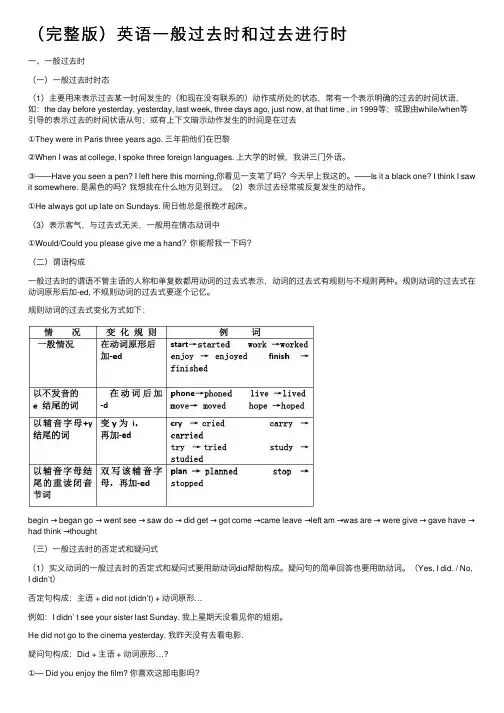
(完整版)英语⼀般过去时和过去进⾏时⼀、⼀般过去时(⼀)⼀般过去时时态(1)主要⽤来表⽰过去某⼀时间发⽣的(和现在没有联系的)动作或所处的状态,常有⼀个表⽰明确的过去的时间状语,如:the day before yesterday, yesterday, last week, three days ago, just now, at that time , in 1999等;或跟由while/when等引导的表⽰过去的时间状语从句;或有上下⽂暗⽰动作发⽣的时间是在过去①They were in Paris three years ago. 三年前他们在巴黎②When I was at college, I spoke three foreign languages. 上⼤学的时候,我讲三门外语。
③——Have you seen a pen? I left here this morning,你看见⼀⽀笔了吗?今天早上我这的。
——Is it a black one? I think I saw it somewhere. 是⿊⾊的吗?我想我在什么地⽅见到过。
(2)表⽰过去经常或反复发⽣的动作。
①He always got up late on Sundays. 周⽇他总是很晚才起床。
(3)表⽰客⽓,与过去式⽆关,⼀般⽤在情态动词中①Would/Could you please give me a hand?你能帮我⼀下吗?(⼆)谓语构成⼀般过去时的谓语不管主语的⼈称和单复数都⽤动词的过去式表⽰,动词的过去式有规则与不规则两种。
规则动词的过去式在动词原形后加-ed, 不规则动词的过去式要逐个记忆。
规则动词的过去式变化⽅式如下:begin → began go → went see → saw do → did get → got come →came leave →left am →was are → were give → gave have →had think →thought(三)⼀般过去时的否定式和疑问式(1)实义动词的⼀般过去时的否定式和疑问式要⽤助动词did帮助构成。
一般过去时 过去进行时课件

I didn't play video games.
学习交流PPT
20
3. 一般疑问句 did + 主语 +行为动词原形 was / were + 主语 +其他成分 eg. - Did you go shopping yesterday? -Yes, I did. / No, I didn’t. -Was she 15 years old last year?
4. 表示过去所发生的一系列的动作。
Miss Liu got up at seven o’clock this morning, dressed, had breakfast, and went to work.
学习交流PPT
10
一般过去时的构成
•I played tennis last weekend.
1.与ago 连用:
a moment
two minutes
three hours
five days one week
ago
six months
four years
学习交流PPT
6
2.与last 连用
last
3.与yesterday 连用:
time night week month term Monday
Whwo efinntd it just now ? _____
could
see
waited
found
学习交流PPT
29
根据要求改写下列句子。
1. They had a meeting yesterday. (改为一般疑问句)
Did they have a meeting yesterday? 2. Mrs Black does some cleaning every Sunday. (
初中英语一般过去时和过去进行时教案

一般过去时和过去进行时教案一般过去时一般过去时概念表示过去某一时间内发生的动作或存在的状态以及过去习惯性、反复性的动作。
谓语动词要用动词的过去式,常和表示过去的时间状语连用,如yesterday,the day before yesterday , last + 时间, just now( 刚才),时间+ ago , a moment ago( 刚才) , in + 过去的时间等。
一般过去时用法1) 表示过去发生的动作或存在的状态,常与表示过去时间的副词yesterday, the other day, last week (year, night, month …), in 1989, two hours ago, just now等连用如:Julia caught a bad cold yesterday.I sold computers last night.He knew Mary in 1989.We moved here five years ago.2) 表示过去一段时间经常或反复发生的动作。
这时可与频度副词often, usually, always等连用如When I was a child we often went to the seaside in August.The children often swam in this river before the factory was built here.3) 情态动词的过去式,如could, would, should, might等可用于现在或将来,表示一种委婉的语气Would you like a glass of beer?想要一杯啤酒吗?Should I call him tonight?我应该今晚给他打电话吗?动词过去式的规则变化(1)、一般动词在词尾直接加― ed ‖如:work---worked ,visit---visited(2)、以― e ‖结尾的动词,只在词尾加― d ‖如:live---lived(3)、以―辅音字母+ y ‖结尾的动词,将"y" 变为"i" ,再加― ed ‖study---studied cry---cried try---tried fly---flied(4)、以重读闭音节(即辅音+元音+辅音)结尾,末尾只有一个辅音字母,先双写该辅音字母,再加― ed ‖。
一般过去式和过去进行时-有答案解析

一般过去式与过去进行时1.常见形式1)一般过去时“主+was/were”或者“主+动词过去式”①I was very surprised when the Alien went into a toy shop.②The Alien was so cute!③We were on the playground when the UFO landed.④When the police arrived, the Alien disappeared suddenly.注:be动词在一般过去时中表示“是”、“在”,有意义2)过去进行时“主 + was/were + 过去分词”①We were playing football when the UFO landed?②I was eating an apple when the UFO landed?③I was reading a book when the UFO landed?注:be动词在过去进行时中只是一个符号,无意义2.用法1)一般过去时(1)表示过去某个时间发生的动作或存在的状态。
①He was at home yesterday.②I got up at six thirty yesterday morning.③I visited my aunt last weekend.(2)表示过去经常或反复发生的动作。
①My father often went to work by bus last year.②When I was a child, I often listened to music.③He always carried an umbrella.(3)常与一般过去时态连用的时间有①yesterday, yesterday morning, the day before yesterday②last night last week, last month, last year…③two days ago, three years ago…④ a moment ago=just now(刚才)⑤in 1990, (in 1998…)⑥this morning, this Monday⑦When I was 5 years old2)过去进行时(1)过去进行时常表示过去某一时刻或过去某一阶段内正在进行的动作。
过去进行时与一般过去时教案

一般过去时:句中有Ago, two hours ago, yesterday, the day before yesterday, last week, last year, last night, just now, once upon a time(很久以前) 等时间状语结构:肯定句:动词用过去式He watched TV last night.I was in Hongkong a year ago.否定句:didn't + 动原was/were not …He didn’t watch TV last night.I wasn’t in Hongkong a year ago.一般疑问句:Did+动原Was/ Were …Did he watch TV last night?Were you in Hongkong a year ago?特殊疑问句:疑问词 + 一般疑问句What did he do last night?Where were you a year ago?过去进行时:过去进行时表示在过去某一时刻或某一段时间内进行或发生的动作。
其形式为was /were + V-ing。
常与表示过去的时间状语连用,如:last night, last Saturday等;或者与when, while, as引导的过去时间状语连用。
常用的时间状语:this morning, the whole morning, all day ,yesterday, from nine to ten last evening, when, while ,at that time, just now,a moment agoMy brother fell while he was riding his bicycle and hurt himself. It was raining when they left the station.I was walking in the street when someone called me.补充:when 和while的用法区别①when是at or during the time that, 既指时间点,也可指一段时间; while是during the time that,只指一段时间,因此when引导的时间状语从句中的动词可以是终止性动词,也可以是延续性动词,而while 从句中的动词必须是延续性动词。
(完整版)英语一般过去时和过去进行时
一、一般过去时(一)一般过去时时态(1)主要用来表示过去某一时间发生的(和现在没有联系的)动作或所处的状态,常有一个表示明确的过去的时间状语,如:the day before yesterday, yesterday, last week, three days ago, just now, at that time , in 1999等;或跟由while/when等引导的表示过去的时间状语从句;或有上下文暗示动作发生的时间是在过去①They were in Paris three years ago. 三年前他们在巴黎②When I was at college, I spoke three foreign languages. 上大学的时候,我讲三门外语。
③——Have you seen a pen? I left here this morning,你看见一支笔了吗?今天早上我这的。
——Is it a black one? I think I saw it somewhere. 是黑色的吗?我想我在什么地方见到过。
(2)表示过去经常或反复发生的动作。
①He always got up late on Sundays. 周日他总是很晚才起床。
(3)表示客气,与过去式无关,一般用在情态动词中①Would/Could you please give me a hand?你能帮我一下吗?(二)谓语构成一般过去时的谓语不管主语的人称和单复数都用动词的过去式表示,动词的过去式有规则与不规则两种。
规则动词的过去式在动词原形后加-ed, 不规则动词的过去式要逐个记忆。
规则动词的过去式变化方式如下:begin → began go → went see → saw do → did get → got come →came leave →left am →was are → were give → gave have → had think →thought(三)一般过去时的否定式和疑问式(1)实义动词的一般过去时的否定式和疑问式要用助动词did帮助构成。
一般过去时过去进行时被动语态
一般过去时过去进行时被动语态一般过去时一、一般过去时的基本构成1、be动词的一般现在时形式:was , were2、其他动词用过去式的形式二、一般过去时的基本用法1、在确定的过去时间里所发生的动作或存在的状态。
例如:时间状语有:yesterday, last week, an hour ago, the other day, in 1982等。
Eg ① He didn't finish his homework yesterday.② We visited the factory last week.2、表示在过去一段时间内,经常性或习惯性的动作。
因此在这类句子中,经常使用always,often,once a month等表示事情发生频度的时间状语。
① When I was a child, I often played football in the street.② Whenever the Browns went during thei r visit, they were given a warm welcome.那时,布朗一家无论什么时候去,都受到热烈欢迎。
**表示过去经常性的、习惯性的动作也可以用used to do 来表示。
(强调现在已经不这样了)Eg I used to get up early in the morning.3、有些句子,虽然没有表示过去确定时间的状语,但实际上是指过去发生的动作或存在的状态的话,也要用过去时。
Eg I didn’t know you were in Paris. 我不知道你在巴黎。
(因为在说话时,我已经知道你在巴黎了。
这句话指的是说话之前,所以只能用过去时表示。
实际上,这句话暗指:But now I know you are here.)I thought you were ill. 我以为你病了呢。
(这句话应是在说话之前,我以为你病了。
一般过去时、过去进行时、过去完成时ppt课件
6.---Hey, look where you are going! ---Oh, I’m terribly sorry.________.
A. I’m not noticing
B. I wasn’t noticing
C. I haven’t noticed
D. I didn’t notice
19
2. Tom ___ into the house when no one ___.
A. slipped, was looking B. had slipped, looked
C. slipped, had looked looked
D. was slipping,
17
3.The last time I __ Jane she ___ cotton in the fields.
12
2、一般过去时表示只做一次动作,而过 去进行时却表示动作反复地进行。
如: She waved to me. 她朝我挥了挥手。 She was waving to me. 她一直朝我挥手。
13
3、句中有a moment ago之类的短语一般 用一般过去时。 4、句中有at this time last Sunday, from 8 to 9 yesterday 之类的状语一般用过去进 行时。过去进行时可以用来代替一般过去 时,表示更为偶然而非预定的动作: I was talking to Tom the other day. 那天我跟汤姆聊天来着。
14
典型的例子
1) Mary ___ a dress when she cut her finger. A. made B. is making C. was making D. makes
一般过去时和过去进行时
一、时间状语不同一般过去时的时间状语主要有:yesterday (morning, afternoon, evening), last night (week, month, year), ago, the day before yesterday, in 2003, just now, long long ago, one day等;过去进行时的时间状语有:at this / that time yesterday, the whole evening, all day yesterday等。
试比较:He introduced Tom to us just now. 刚才他向我们介绍了汤姆。
She was doing some washing all day yesterday. 昨天她洗了一整天的衣服。
二、强调动作的角度不同一般过去时强调动作的发生或状态的存在;而过去进行时强调动作正在进行的延续性。
试比较:I got up at five the day before yesterday. 前天我是五点起床的。
He was painting the lab the whole day yesterday. 昨天他一整天都在粉刷实验室。
三、动词的特点不同1. 行为动词在这两种时态中均可使用。
例如:We planted trees two days ago. 两天前我们植树了。
We were planting trees this time last Friday. 上周五这时候我们在植树。
2. 有些动词只用于一般过去时,而不能用于过去进行时。
例如:1) 表示感观的动词:feel, hear, know, see, smell, taste等。
2) 表示状态、感情的动词:be, dislike, have, hate, love, like, want, wish等。
3) 表示心理活动的动词:forget, realize, recognize, remember, understand等。