
牛津译林版英语九下Unit1 Asia Period 2 (Reading I)
九年级下册Unit1 Asia Period 2 (Reading I)命题人:审核人:班级________姓名_______学号_________(友情提醒:请家长督促孩子在复习完当天课堂所讲内容后,闭卷完成下列作业)【家长反馈】是否复习后独立完成作业(是、否)是否完成课前预习(是、否)作业完成时间_____________( 分钟) 家长签字_________________【自主学习】一、跟读磁带,背诵今天所学的单词和课文15分钟,听读情况:______________二、背诵P8-9四会单词、重要句型后,默写下列短语,并用红笔批改订正。
1. 明朝和清朝的皇帝们2. 变成一个博物馆_____________3. 世界上最大的城市广场4. 值得参观____5. 一大清早聚集在那里6. 看升国旗7. 坐落在自然风景地8. 另一个著名的景点9. 每几百米设有瞭望塔_____________________________10. 世界奇迹之一________________________ 【基础训练】一、根据所给中文提示完成单词。
(每空一词)1. The Great Wall is one of the _____________(奇迹) of the world.2. The Summer Palace was set in a natural ________________(风景、地形).3. Through his efforts, the man of ___________(中间的)age became one of the wealthiest person in his city.4. Look! The children are all waving the __________(旗帜)to welcome the foreigners .5. The daughter of an ____________(皇帝)does not worry about finding a husband.二、根据句意,用所给词的适当形式填空。
1. Her favourite _____________(attract) are the Forbidden City and Tian’anmen Square.2. Do you know what we should do to celebrate _____________(nation) Day?3. The stamp is not worth ______________(collect).4. The balloon _________(rise) up quickly and soon disappeared in the air.5. People _________(gather) round, curious to know what was happening.三、单项选择。
( ) 1. The Great Wall is a long wall which _____ for over 6,000 kilometres ______northern China to protect the northern border of the country.A. runs; throughB. runs; acrossC. lies; throughD. stands; through( ) 2. Great changes have taken place in my home town. This place has been ________a big supermarket, so people can go shopping easily.A. turn up B turned into C turned off D turned down( ) 3. The boy _____ his hand and asked if the sun ______ in the east every day.A. rose, risesB. raised, raisedC. raised, risesD. rises, raised( ) 4. There is ________water in the glass, is there?A. a lot ofB. fewC. a littleD. little( ) 5. The Yellow River ________flood(v.淹灭) large areas in the past, but now the waters of it are used to _________energy.A. was used to; producing B used to ; producingC was used to; producingD used to; produce四、翻译句子。
1. 里面有精彩的建筑和艺术珍宝,故宫很值得一游。
______________________________________________________________________2. 很多游客喜欢一大清早聚集在那里观看升国旗。
______________________________________________________________________3. 明朝和清朝的皇帝们过去常常住在紫禁城。
______________________________________________________________________4. 长城绵延6000多公里,横穿中国北部,每隔几百米就设有烽火台。
______________________________________________________________________5. 北京的西北是颐和园——一个坐落在自然风景地的大的中国园林。
______________________________________________________________________【能力提高】一.完形填空Once a seeker(寻找者) wanted very much to know what truth was. After many years of 1 , the seeker was told to go to a cav e, in which he would find a well. “Ask the well,” he was 2, “and it will tell you what is truth.”After he had found the well, the seeker asked the most 3 question. From the depth came the answer, “Go to the village crossroad and you shall find what you are seeking.”Full of 4 , the man ran to the crossroad to find only three 5 shops. One shop was selling pieces of metal, another sold wood, and thin wires were for sale in the 6 . Nothing and no one at the crossroad seemed to have much to do with 7 . Disappointed(失望地), the seeker returned to the well to ask for an explanation, 8 he was told only, “You will understand in the future.”Although he was angry for being made a fool of, the seeker 9 his search for truth. As years went by, the memory of his experience at the well was gradually disappearing until one 10 , while he was walking in the moonlight, the sound of sitar (印度的西塔琴) music 11 his attention.Deeply moved by the wonderful music, the truth seeker walked towards the player. He looked at the 12 dancing over the strings. He became aware of(意识到) the sitar itself. And then suddenly he came to realize in a cry of 13 recognition(认出): the sitar was made out of wires and pieces of metal and wood just like those he had once seen in the three shops and had thought to be without any particular 14 .At last he understood the message of the well: we have already been 15everything we need. Our task is to gather them together and use them in the proper way. Nothing is meaningful if we look at it as separate fragments (零碎的东西).()1. A. advising B. searching C. walking D. looking()2. A. ordered B. asked C. advised D. puzzled()3. A. troubling B. happy C. disappointing D. important()4. A. worry B. hope C. anger D. disappointment()5. A. attractive B. wonderful C. uninteresting D. beautiful()6. A. first B. second C. third D. fourth()7. A. truth B. metal C. wires D. wood()8. A. however B. but C. though D. besides()9. A. continued B. stopped C. prevented D. started()10. A. day B. noon C. morning D. night()11. A. paid B. had C. caught D. gave()12. A. arms B. legs C. fingers D. feet()13. A. angry B. sad C. puzzling D. happy()14. A. meaning B. price C. explanation D. purpose()15. A. shown B. informed C. given D. helped二.首字母填空The London Eye is a t__1____ attraction in London,the UK. There you can get into a capsule(密封舱)to enjoy a great view of the city of London.I visited the London Eye last summer with a friend. My friend didn't know where we were going. I just told him we would go s__2____ very special. As we arrived at Waterloo Station, he had worked out where we were going. He s 3 happily. When we r__4____ the London Eye, there was a very long waiting line, so in order to s 5 time, he stayed in the line while I went to buy the t 6 .The capsule doesn't completely stop when people get on, so you have to get into it quickly. Then the door of the capsule s__7___. The view was wonderful. We took many photos of the view and of o 8 . It took about half an hour for the capsule to go around.If you are interested in going there, I'd like to give you some advice. To enjoy the view, go in the d 9 . There are night rides, but you won’t see a lot. Sometimes the top of the wheel can be quite cool even t10 it's sunny. So ladies, don’t forget to take a scarf.1.______________2.____________3.____________4.____________5._____________6._______________7._____________8.____________9.____________ 10.____________预习Reading II九年级下册Unit1 Asia Period 2 (Reading I)命题人:审核人:班级________姓名_______学号_________(友情提醒:请家长督促孩子在复习完当天课堂所讲内容后,闭卷完成下列作业)【家长反馈】是否复习后独立完成作业(是、否)是否完成课前预习(是、否)作业完成时间_____________( 分钟) 家长签字_________________【自主学习】一、跟读磁带,背诵今天所学的单词和课文15分钟,听读情况:______________二、背诵P8-9四会单词、重要句型后,默写下列短语,并用红笔批改订正。
【最新】牛津译林版九年级英语下册Unit 1 Asia Reading精品课件

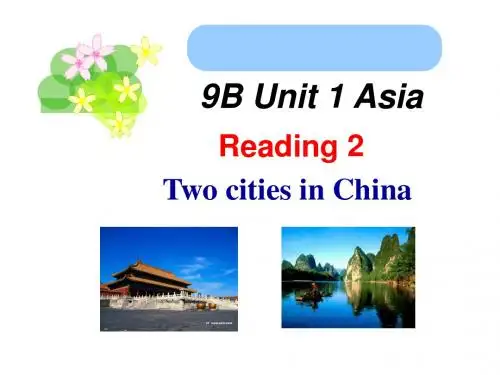
Tian’anmen Square
Welcome to Beijing
the Summer Palace
the Great Wall
Task two: Guess:
We can gather there early in the morning to watch Tian’ an men Square the raising of the national flag.
2.Who used to live there? The emperors of the Ming and Qing dynasties. —————————— 3. What is it used for now? It is now used as a museum. _____________________ 4. Why is it well worth a visit?
Where would you like to go?
Beijing
Guilin
Pre-reading
Task one: Let’s visit places of interest , see what they are.
L
the Summer Palace
the Palace Museum
1. Is it the biggest square in the world?
Yes, it is. _______________
2. What can we see there?
We can watch the raising of the national flag. _________________________
Because it has wonderful buildings and art treasures inside. _________________________________
【学生】2017牛津译林版九年级下册Unit1Asia2
【关键字】学生Unit 1 AsiaIntegrated skillsI. Teaching aims and learning objectivesBy the end of the lesson, students should be able to:1. extract information by reading and listening;2. arrange and describe a trip to somewhere;3. talk about different Asian countries.II. Teaching contents1. New words: Japanese, state2. New structures: We are going to visit an ancient city called and learn about Japanese cultures.Most people can speak both English and Chinese.III. Focus of the lesson and predicted area of difficulty1. Develop the abilities of reading and listening through exercises in Part A.2. Learn to arrange and describe a trip to somewhere.IV. Teaching proceduresA A trip toStep 1 An impression of JapanT: Today we’ll talk about . What do you think of when you talk about it?S: is famous for , sushi, geisha, sakura and so on.T: Then what places of interest in do you know?S: Mount Fuji, Disneyland, , and so on.T: Wow, you know a lot about . It’s really a nice place to visit. The exchange students are going to after visiting .【设计意图:直接由日本旅游宣传片导入新课,激发学生的学习兴趣,同时引导学生用英语描述自己印象中的日本,为下文的听读做好铺垫。
牛津译林版英语九下Unit1 Asia Period 2 (Reading I)
初中英语学习材料madeofjingetieji Unit1 Asia Period 2 (Reading I)命题人: 审核人: 班级________姓名_______学号_________(友情提醒:请家长督促孩子在复习完当天课堂所讲内容后,闭卷完成下列作业)【家长反馈】是否复习后独立完成作业(是、否) 是否完成课前预习(是、否)作业完成时间_____________( 分钟 ) 家长签字_________________【自主学习】一、跟读磁带,背诵今天所学的单词和课文15分钟,听读情况:______________二、背诵P8-9四会单词、重要句型后,默写下列短语,并用红笔批改订正。
1. 明朝和清朝的皇帝们2. 变成一个博物馆 _____________3. 世界上最大的城市广场4. 值得参观 ____5. 一大清早聚集在那里6. 看升国旗7. 坐落在自然风景地 8. 另一个著名的景点9. 每几百米设有瞭望塔_____________________________10. 世界奇迹之一________________________【基础训练】一、根据所给中文提示完成单词。
(每空一词)1. The Great Wall is one of the _____________(奇迹) of the world.2. The Summer Palace was set in a natural ________________(风景、地形).3. Through his efforts, the man of ___________(中间的)age became one of the wealthiest person in his city.4. Look! The children are all waving the __________(旗帜)to welcome the foreigners .5. The daughter of an ____________(皇帝)does not worry about finding a husband.二、根据句意,用所给词的适当形式填空。
九下Unit1AsiaPeriod2Reading牛津译林
A Two cities in China Millie wants to help the exchange students learn more about different cities in China. She has found two articles written by two students. Here are the articles.
dynasties gather museum palace
raising
summer wonders
Kevin: What about the Great Wall? Have you ever been there? Daniel: Sure. As an old saying goes, “He who has never been to
Guilin Location: on the two sides of the (9) ___Li_ji_a_n_g_R_i_v_e_r____ What to
see: (10) ___m__o_u_n_ta_i_n_s____ stand in different shapes; the Reed Flute Cave, an (11) __u_n_d_e_r_g_ro_u_n_d____ cave with (12) ___(_m__a_n_y_)_r_o_c_k_s___ in unusual shapes What to do: take a (13) ___b_o_a_t_t_ri_p____along the Lijiang River;
B2. Kevin is asking Daniel about Beijing. Complete their conversation with the words in the box.
牛津译林九年级下学期英语Unit1 Know yourself Reading2
4. What might be the most attractive things to us?
We might be attracted by the beautiful buildings, the clothes and the furniture used in the past. _________________________________
Listen & Read the text for details:
Listen to the first part “Welcome to Beijing” and try to match the
name with the correct information.
The Forbidden City
4. The Reed Flute Cave is in eastern Guilin. F 5. You can find man-made lakes inside the Reed Flute Cave. F 6. We can take a boat trip along Li River. T
Tiananmen Square
The Summer Palace
The Great Wall
It was used to protect the northern border of China in the past. Back
Read the first part carefully again and try to get more detailed information.
Forbidden City
1.Where is the Forbidden City? The Forbidden City is at the centre of Beijing. ____________________
最新译林版英语九年级下Unit1 Asia Reading2课件(共27张PPT)
Revision
1) Who once lived in the Forbidden City? The emperors of the Ming and Qing dynasties. 2) Why do many tourists go to Tian’anmen Square early in the morning every day? They gather there to watch the raising of the national flag. 3) Where is the Summer Palace? It’s in the north-west of Beijing. 4) What is Wei Ke’s favorite attraction? The Great Wall.
national flag
5.在自然景观中 in a natural landscape every few hundred metres 6.每隔几百米 one of the wonders 7.奇迹之一
Useful Phrases
8.位于…的两边 lie on the two sides of .. 9.以不同形状耸立着 stand in different shapes 10.向下悬垂(倒挂) hang down be praised as 11.被赞为 12.沿着…乘船旅行 take a boat trip along... turn into 13.变成 be worth a visit 14.值得参观 15.在...西北 in the north-west of 16.在中国北部 in the north of point upwards 17.向上指着
B2 Kevin is asking Daniel about Beijing. Complete their conversation with the words in the box.
牛津译林版英语九下Unit 1《Asia》(Reading2)ppt课件
Language points:
4. With wonderful buildings and art treasures inside, it is well worth a visit.
它(故宫)里面有宏伟的建筑和艺术珍宝, 非常值得一游。 【1】介词with短语,在句中常用作状语, 表示原因、条件、时间、伴随、方式等。 e.g. With the development of modern medicine, more and more diseases can be cured.随着现代医学的发展,越来越多的疾 病能够被治愈。
Language points:
(2)called意为“被叫做,被称作”。例如: The boy called Daniel is a member of the Reading Club. 那个叫丹尼尔的男孩是读书兴趣小组的一员。
3. The emperors of the Ming and Qing dynasties used to live there.
明朝和清朝的皇帝曾住在那儿。 used to do sth.表示“过去常常做某事,而现在不 做了”。例如:My father used to sleep very late. 我父亲以前睡觉很晚。
Language points:
【辨析】 used to do sth 和 be/get used to sth./doing sth. 翻译 过去他经常晚起,现在他习惯早起了。 He used to get up late, but now he is/gets used to getting up early. 【总结】 be/get used to doing sth.表示习惯于做某事或习惯 于某事,to是介词,后面要跟名词、代词或动名 词。而used to do sth.则表示过去常常,to后跟原 形动词。
牛津译林版九年级下册 Unit 1 Asia 阶段复习二(含答案)
牛津译林版九年级下册Unit 1 Asia 阶段复习二(含答案)一、根据所给首字母或中文提示,完成下列句子。
1. What is your English ____________ (水平) ? Can you answer my questions in English?2. They have done much more for the _________ (国家) than we have.3. My father has givena lifetime of ____________ (服务) to athletics.4. We need to think about the fact that half the p________ of the world live on one or two dollarsa day.二、用所给单词的适当形式填空。
1. Heilongjiang is a __________ (north-east) city in China.2. Although it is a small island country, there are about two_______ (million) people there.3. He isn't from Japan, but he speaks__________ (Japan) very well.4. The Summer Palace is one of the __________ (beautiful) places of interest in China.三、单项选择。
( ) 1. -- Your coat looks very good. Where did you buy ___________ ?-- In the nearby clothes shop. You can also buy after work.A. one; oneB. it; oneC. one; itD. it; it( )2. -- What are you doing, Jack?-- I am moving the desk to the downstairs because it____________ too much space.A. takes inB. takes onC. takes offD. takes up( )3. -- When can I go to see you, today or tomorrow?-- I am busy these days.A. BothB. EitherC. NeitherD. None( )4. Mr Smith, unusual man, will have second baby next month.A. a; theB. an; theC. the; aD. an; a( )5.-- There'll be a film tonight.-- ___________. Let's go to the cinema together.A. Take it easy.B. What a shame!C. With pleasure.D. Wonderful!四、翻译句子。
牛津译林版英语九下Unit 1《Asia》(Integrated skills)说课稿
牛津译林版英语九下Unit 1《Asia》(Integrated skills)说课稿一. 教材分析牛津译林版英语九下Unit 1《Asia》主要介绍了亚洲的自然地理、人文地理以及亚洲各国的主要城市。
本课以亚洲为主题,通过学习亚洲的自然地理特点、人文地理特点以及亚洲各国的文化、历史、名胜古迹等内容,让学生了解亚洲的风土人情,提高学生的跨文化交际能力。
教材内容丰富,贴近学生生活,有利于激发学生的学习兴趣。
二. 学情分析九年级的学生已经具备了一定的英语基础,对地理、文化等方面的知识也有一定的了解。
但部分学生对英语的学习仍存在恐惧心理,英语表达能力较弱。
因此,在教学过程中,需要关注学生的个体差异,充分调动学生的积极性,提高他们的英语表达能力。
三. 说教学目标1.知识目标:让学生掌握亚洲的自然地理、人文地理的基本知识,了解亚洲各国的主要城市。
2.能力目标:培养学生运用英语进行跨文化交际的能力,提高学生的英语听说读写能力。
3.情感目标:激发学生对亚洲文化的兴趣,培养学生的爱国情怀和国际视野。
四. 说教学重难点1.重点:亚洲的自然地理、人文地理的基本知识,亚洲各国的主要城市。
2.难点:运用英语描述亚洲的自然地理、人文地理特点,进行跨文化交际。
五. 说教学方法与手段1.交际式教学法:通过小组讨论、角色扮演等形式,让学生在实际语境中运用英语进行交际。
2.情境教学法:创设生动、直观的情境,让学生在真实的环境中感受和体验亚洲的文化。
3.多媒体教学手段:利用多媒体课件、地图、图片等教学资源,丰富教学内容,提高学生的学习兴趣。
六. 说教学过程1.导入:以一幅亚洲地图为切入点,引导学生谈论自己对亚洲的了解,激发学生的学习兴趣。
2.新课呈现:通过多媒体课件,展示亚洲的自然地理、人文地理特点,让学生直观地感受亚洲的风土人情。
3.课堂活动:分组讨论亚洲各国的主要城市,让学生用英语介绍自己所在小组的城市,培养学生的交际能力。
4.实践环节:让学生结合地图,找出自己喜欢的亚洲城市,用英语介绍该城市的历史、文化、名胜古迹等,提高学生的英语表达能力。
2020年牛津译林版初三英语下册Unit 1 Asia Reading 课件
F
spend the wsuimntmerer.
The Great Wall runs for_o_v_e_r__6_,0_0__0_k_i_lo__m_e__te_r_s___,
across n_o_r_t_h_e_Hr_neChwinha.oThheares anrevw_e_a_rt_c_h_t_o_w_e__rs_ every _f_e_w_____h_u__n_bd_re_ee_d_n_tmoethrees.GThreewaatllWwaasllfirst built more than _2_,_0_0_0_ yeisarns oagtoa. trua.ewmanat nto.know something
It is famous for its landscape,especially the trees and rocks. [ˈlæ ndskeɪp]
风景;地形
Nanjing Museum
There are many art treasures inside.
′[ treʒə(r)]
珍宝
These treasures are in different dynasties.
Summer Palace
Para.4
1. The Summer Palace is in thennoortrhth-w-eeassttof Beijing. F
2. It is a large Chinese garden set in a natural
T
landscape.
3. It was once a nice place for the emperors to
Para.2
1. What is the Palace Museum also called?