
home alone 九年级英语M4 Unit 1
讲解来自《点拨》
eg:He shut his eyes. 他闭上了眼睛。 Mike was shut in the bedroom. 迈克被关在卧室里。 典例 用所给词的适当形式填空。 shut The white cat was ________(shut) in the room by John.
讲解来自《点拨》
知识点
考向
1
So am I. 我也是(很遗憾)。 so的用法。
句式意义 区别关 键
句式结构
表示前面所述肯定情况同 so+be动词/ 样适用于后者,“…… 前后两 助动词/情态动 也……”。在口语交际中, 句为不同 词+主语 可转化为“宾格代词+ 主语。 too”。
讲解来自《点拨》
Betty: Yes, Mum. I can look after myself, although it won't be easy for me. Mum: Well, make sure you eat plenty of fresh fruit and vegetables. And I've left lots of your favourite biscuits. Betty:Don't worry.❹ I can cook simple meals. Dad: There won't be anybody❺ to wake you up in the morning. Betty: I'll be fine. My clock rings so loudly that it will certainly wake me up. Mum: I'm sure I've forgotten something, but I don't know what it is!
典例
写出下列画线单词的词性及汉语意思。 1.My pen is missing. I want to buy a new one. ________ 形容词 ________ 丢失的 2.The boy missed his parents a lot. ________ 动词 ________ 想念
(Announcement: We advise❻ all passengers for Train T27 to Lhasa to go immediately to Platform 2.Your train is about to leave. ❼) Betty: That's your train! Goodbye Mum, goodbye Dad. Mum: I know! I haven't given you our address in Lhasa! Betty: Send me a text message. Have a good trip! Mum: Bye, my dear! Betty: Bye! See you in a couple❽ of weeks!
【点拨】题用句意理解法解答。根据句意“________知道
这个问题的答案吗?”“我。”可排除A和D两项;又因为 这是一个一般疑问句,故排除 C。 discussion
讲解来自《点拨》
考向二 anybody作主语时,谓语动词用单数形式;若 用代词代替,用单数he, him, his (正式)或复数
they, them, their (非正式)均可。
Everyday English · Now,... · I'm sorry... · So am I. · Have a good trip!
Now complete the sentences. There may be more than one answer. Lhasa for a meeting . 1. Betty's parents are going to __________________
未出席;没见到;遗漏”。 eg: The batter missed the ball. 击球员未击中球。 She got up late. That's why she missed the early bus. 她起床晚了。那就是她错过早班车的原因。
讲解来自《点拨》
拓展
missing作形容词,意为“丢失的;失踪的”。 eg:The police are looking for the missing girl. 警察正在寻找失踪的女孩。
3. Betty can look after herself/cook simple meals... .
4. Betty's parents usually________________________. wake her up in the morning 5. Betty's mum has not given her their address in Lhasa .
判断第二句应用助动词have。
讲解来自《点拨》
知识点 2 miss /mɪs/ v. 未出席,未出现
eg: The teacher was very angry because I missed three days of school this week. 老师很生气因为我本周缺了三天的课。
考向 miss作动词,意为“想念;错过;未击中;
when you get home.
4
Listen and read.
Mum: Now, what's our train number? Dad: T27 to Lhasa. It's leaving from Platform 2.
Mum: The meeting in Lhasa is very important for us,
2. Betty's mum tells her to be _______________________ careful with the door/look after herself/eat plenty of fresh fruit and vegetables... ____________________________________________.
so+主语+
表示对前面所述情况加
前后两
句为相 同主语。
be动词/助动 以确认,“……的确如 词/情态动词 此”。 温馨 提示
表示与上文所述否定情况相同时,应该用句型 “Neither+be/助动词/情态动词+主语.”结 构。例如:Mary isn't outgoing. Neither am I.
玛丽不外向,我也不(外向)。
eg:If anybody comes, ask him to wait. 如果有人来,让他等着。
考向三
辨析:somebody, anybody, nobody和everybody
讲解来自《点拨》
单词 somebody
意义 某人;有人
用法 一般用在肯定句中 一般用于否定句和疑问句 中 定意义,相当 not...anybody
讲解来自《点拨》
知识点
4 承上启下法
此句是一个祈使句,在文中起到了承上启下
的作用。作者通过此句很自然地引出贝蒂独 自在家时可以做一些简单的饭菜,不用父母 担心,使文章的上下文衔接自然。
讲解来自《点拨》
知识点 5
anybody /'eniˌbɒdi/ pron. 任何人 任何人都能理解这个故事。
eg: Anybody can understand this story. 考向一 anybody用于否定句、疑问句或条件句中, 相当于anyone,表示“任何人”。anybody 用于肯定句中,表示“随便哪一个人”。 eg: Did anybody/anyone hear of such a thing? 有谁听说过这样的事吗?
Module 4 Home alone
Unit 1 I can look after myself, although it won't be easy for me.
Module 1 Unit 1
课 堂 导 入
1Leabharlann 2…结 对 活 动
课 堂 小 结
课 堂 练 习
课 后 作 业
课文 呈现
知识 讲解
„„
but I'm sorry you can't come with us, Betty. Betty: So am I❶, but I can't miss ❷ two weeks of school. Mum: Will you remember everything I've told you? Be especially careful with the door. Shut❸ it when you're in and lock it when you go out.
讲解来自《点拨》
知识点 3 shut /ʃʌt/ v. 关上;合上 eg: Shut the door, please.
请关上门。
考向 shut 表示“关闭”,通常情况下可以和 close互换,不包含“不让进入”的意思。 其过去式和过去分词为shut,可以作形容
词,但不能放在名词前。“shut up”常用
讲解来自《点拨》
典例 —I have changed my job.
B —________ .(贵州黔西南州)
A.So do I C.So I do B.So have I D.So I have
【点拨】此题用题眼法解答。由选项中的“题眼”I 可知第 二句与第一句不是指同一个人,又根据题眼have changed可
Betty: Yes, I will.
初中-英语-外研版-九年级上册 Module 4 Home alone Unit 1-课件

although it won’t be easy for me.
What do you usually do to look after yourself when you are at home alone?
platform n. (供上下火车用的)月台; 站台
1. Betty’s parents are going to _L_h_a_s_a__. 2. Her parents tell her to _b_e_c_a_r_e_fu__l _w_i_th_…__/_
_e_a_t_f_re_s_h__fr_u_i_t_…___. 3. Betty can _lo_o_k__a_f_te_r__h_e_rs_e_l_f_. 4. Betty’s parents usually _w_a_k__e_h_e_r_u_p___
What are they doing there?
The girl should be seeing off her parents.
1. Where are Betty and her parents? The railway station.
2. Is Betty travelling with her parents? No, she isn’t.
2. 我妈妈每天早晨六点钟把我叫醒。 My mother _w_a_k_e_ me _u_p__ at six every morning.
3. 昨天谁给他发了一条短信? Who sent him a _te_x_t_ _m__e_ss_a_g_e_ yesterday?
4. 你出去时要特别当心那条狗。 Please _b_e_ _e_s_p_e_ci_a_l_ly_ _c_a_r_e_fu_l__ _w_i_th__ that dog when you go out.
Module 4 Home alone Unit 1课件+音频 (共35张)外研版九年级上册
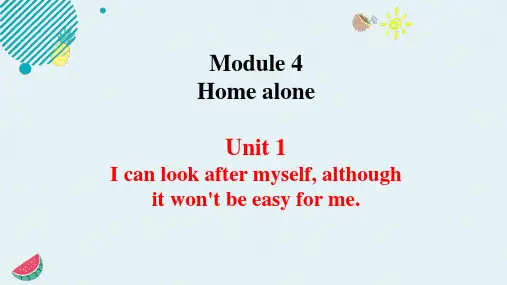
7.Work in pairs. Imagine you are staying at home by yourself. Ask and answer.
1. Can you look after yourself? 2. How will you make sure you wake up in the morning? 3. What will you eat?
Example: Can you look after yourself?
How will you …?
Yes, I can. / No, I can’t.
I’ll …
拓展提升
Language points
1.so引导的倒装句的用法
So am I, but I can't miss two weeks of school. So am I: 我也是。 so+be动词/情态动词/助动词+主语: 表示“某人也是..........”
Answer the following questions.
1. Who will take the train? Mum and Dad. 2. What's their train number? T27 to Lhasa. 3. Where is their train leaving from? It's leaving from Platform 2.
Betty: So am I, but I can't miss two weeks of school. Mum: Will you remember everything I’ve told you? Be especially careful
Module4Home alone unit1 教案2023-2024学年外研版英语九年级上册
Module4Home alone unit1 教案2023-2024学年外研版英语九年级上册外研版九年级上册Module 4 unit1 I can look after myself, although it won't be easy for me.教案Objectives:To introduce and discuss the concept of independence and self-care skills. To develop students’ reading, listening, and speaking skills through comprehension and discussion activities.To enhance students’ vocabulary related to self-care and daily life skills. To encourage students to analyze challenges and develop strategies for self-care.Materials:Textbook: New Standard English (Foreign Language Teaching and Research Press) - Grade 9, Module 4, Unit 1.Whiteboard or blackboard and appropriate markers/chalk.Handouts with reading passages and comprehension questions. Pictures or visuals illustrating self-care activities.Procedure:Warm-upBegin the class by having a brief discussion on the concept of independence and self-care.Ask students to share examples of self-care activities they do on a daily basis.Engage the students in a short conversation about the challenges they might face in taking care of themselves.Vocabulary BuildingIntroduce key vocabulary words related to self-care and daily life skills, such as “responsibility,” “hygiene,” “nutrition,” “time management,” and “problem-solving.”Provide definitions, example sentences, and encourage students to use the words in context.Engage the class in a discussion about the importance of these skills in maintaining a healthy and independent lifestyle.Reading Activity - Personal ChallengesProvide each student with a reading passage about personal challenges faced by individuals in taking care of themselves.Instruct students to read the passage silently and underline any unfamiliar words or phrases.Discuss the passage as a class, clarifying the meaning of the underlined words and confirming comprehension.Listening Activity - Strategies for Self-CarePlay an audio recording or read out a short passage about strategies individuals can adopt to overcome challenges in self-care.Instruct students to listen carefully and take notes on key information. Conduct a class discussion based on the listening activity, prompting students to share their thoughts on effective strategies for self-care. Comprehension QuestionsProvide each student with a handout containing comprehension questions based on the reading and listening activities.Instruct students to answer the questions individually or in pairs. Discuss the answers as a class, allowing students to share and compare their responses.Group Discussion - Personal Challenges and SolutionsDivide the class into small groups.Instruct each group to discuss personal challenges they face in self-care and brainstorm possible solutions or strategies.Encourage students to share their experiences and support each other in finding practical solutions.Facilitate a whole-class discussion summarizing the main challenges and solutions raised by each group.Writing Activity - Personal Action PlanInstruct each student to write a personal action plan for improving their self-care skills.Encourage students to identify specific areas they want to work on and outline steps they can take to enhance their independence andwell-being.Collect and review the students’ action plans, providing feedback and guidance.Conclusion and Wrap-upSummarize the main points covered in the lesson, emphasizing the importance of self-care skills for personal well-being and independence. Address any remaining questions or concerns from the students. Assign the following homework: Write a reflection paragraph on their progress in practicing self-care skills and any challenges they encountered.。
外研版九年级上册 Module 4 Home Alone Unit 1(共29张PPT)
1. Betty’s parents are going to _____________. Lhasa
2. Betty’s mum tells her to _________________ be careful with
_____________________________________ the door / shut and lock the door when she goes out / eat plenty of _____________________________________ fresh fruit and vegetables _______________.
6.be in=be at home 7.be out=get out外出 8.look after=take care of 9.be easy for sb. 10.make sure确保 11.eat plenty of fresh fruit and vegetables吃大量的新鲜水果和蔬菜
__________________________. in the morning
5. Betty’s mum has not _______________ given Betty
_____________________. their address in Lhasa
1.miss sb.想念某人 2. miss two weeks off school缺课 两周 3.remember everything 4. be especially careful with sth.特别小心某事 5. Shut the door when you’re in and lock it when you go out.
外研版九年级英语上册教案 Module 4 Home alone Unit 1

Module4 HomealoneUnit1 Icanlookaftermyself,althoughitwon’tbeeasyforme.◇目标导航◇◇教学过程◇预习指导一、方法指导1.在Activity 4的对话中画出although和so...that引导的状语从句。
2.找出本单元生词和短语所在的句子,体会它们的用法。
二、预习检测Ⅰ.英汉互译1.两个 a couple of2.小心/谨慎地对待be careful with3.照顾;照料look after4.出去go out5.make sure 确保6.plenty of 许多7.wake up 唤醒,叫醒8.be about to do sth. 正准备要做某事Ⅱ.根据汉语意思完成句子,每空一词1.特别小心门。
Be especially careful with the door.2.我会照顾我自己,尽管对于我来说不容易。
I can look after myself, though/although it won’t be easyfor me.3.确保你吃大量的新鲜水果和蔬菜。
Make sure you eat plenty of fresh fruit and vegetables.4.我的闹钟声音那么响,它肯定会叫醒我的。
My clock rings so loudly that it will certainly wake me up.5.您的火车马上就要开了。
Your train is about to leave .课堂教学Step1 情景导入Teacher: Good morning,boys and girls!Have you ever stayed at home alone?If your answer is yes,what did you do?Let’s have a free talk.Step2听力处理1.听录音,回答Activity 2中的问题。
最新外研新版九年级上module4 home alone unit1知识分享
Patterns: My clock rings so loudly that it will certainly wake me up. I can look after myself, although is won’t be easy for me.
Don’t answer the door to strangers. Don’t touch dangerous things.
Let’s look through the Home alone
rules for American
children.
Objectives:
1. To get specific information from the conversation
When he was at home alone, two bad men were planning to steal from his house. He used many funny ways to catch them.
Let’s enjoy a piece of video about it.
接龙
幻灯片上单词或短语出现时,同 学应迅速读出并说出中文意思。
每人一词,按行/列依次接龙,3秒 内说不出,此行/列同学即失去此 答题机会,下一行/列同学接续。
ts
P26 1 Work in pairs. Talk about the picture.
The girl’s parents are going to take the train T27 to Lhasa. Her father is carrying a big luggage. …
2022年外研版九年级上册英语Module 4 Home alone Unit 1
Module 4Home aloneUnit 1Ⅰ. 核心词汇名词:1. (供上下火车用的)月台; 站台n. platform2. 会议; 集会n. meeting3. 钟; 时钟n. clock4. 乘客; 旅客n. passenger5. 地址n. address6. 文本; 正文n. text7. 一对; 两个n. couple动词:8. 关上; 合上v. shut9. 锁; 锁住v. lock10. 鸣响; 发出铃声v. ring形容词:11. 简单的; 容易的adj. simple代词:12. 任何人pron. anybody短语:13. 短信t ext message14. 两个a couple ofⅡ. 重点句式1. ——贝蒂, 你不能和我们一起去, 真遗憾。
——我也是(很遗憾), 但是我不能两周不上课。
—I’m sorry you can’t come with us, Betty.—So am I, but I can’t miss two weeks of school.2. 要保证你吃大量的新鲜水果和蔬菜。
Make sure you eat plenty of fresh fruit and vegetables.3. 我的闹钟铃声那么响, 它一定会叫醒我的。
My clock rings so loudly that it will certainly wake me up.4. 所有乘坐T27次列车前往拉萨的旅客, 请马上到2号站台。
We advise all passengers for Train T27 to Lhasa to go immediately to Platform 2. 5. 您的火车要开了。
Your train is about to leave.【考点释疑】考点1miss v. 未出席; 未出现(1)miss作动词时, 意为“未出席, 未出现”, 其后接名词、代词或动名词作宾语。
外研版九年级英语上册课件Module4HomealoneUnit1(共47张PPT)
Enjoy a song Be What You Wanna Be.
Have you had the experience of being at home alone for a few days?
How did you spend the time?
Could you look after yourself?
3. What things does her mother ask her to do at home? Take care of everything at home and keep the flat tidy.
Listen again and complete the sentences.
Where are they? What are they doing?
Listen and answer the questions.
1.Where Betty and her parents? They are at the station.
2. Is Betty travelling with her parents? No, she isn’t.
2. Why can’t Betty go to Lhasa with them?
Because she can’t miss two weeks of school.
3. Can Betty cook? Yes. She can cook simple meals.
4. Does Betty know her parents’ address in Lhasa? No, she doesn’t.
Complete the sentences according to the reading.
Module 4 Home Alone Unit 1课件 外研版(2024)英语九年级上册
APP
PRC
No.
UFO
Apr.
VIP
No. PRC UFO Apr. APP VIP
No. stands for Number.
April application Number Unidentified Flying Object Very Important Person the People’s Republic of China
Listen and Mark T or F.
( T ) 1. HAS stands for Haidian All Stars. ( F ) 2. HAS beat BIG because Daming was chosen for the team last time. ( T ) 3. Tony has played three matches against HAS this year.
— Sorry, but _th_a_t_’s_n_o__e_x_c_u_se__. Here’s your ticket (罚单). 4. You will __g_et_n_o__c_h_a_n_c_e__ of winning if you don’t practice this season. 5. — Have you finished the task?
Listen and decide which words are weak and which words are strong.
1. Yes, I’m training for the big match next week. 2. It’s next Saturday at noon, but if you want good seats,
外研版九年级上册 Module 4 Home alone Unit 1大单元教学设计
外研版九年级上册Modu1e4Homea1one大单元教学设计在今后的学习、生活中能够自我认识,培养学生自我认识、自我管理的意识。
第三单元是把前两个单元出现的知识点和重点句型进行概括性的归纳和总结,使学生在学习时有了方向,能更好的掌握知识,明确学习目标。
本单元语篇主要围绕“独自在家”这一主题开展,分别通过对话、阅读等形式来完成学习,掌握文中的日常交际用语,同时学习让步和结果状语从句。
学生在完成课本里包含的活动外,还通过学习引入了状语从句,通过阅读培养了学生对语篇的理解能力、简述个人经历的写作能力。
在学的过程中培养学生的语言综合运用能力,发展其思维能力。
同时,使学生初步形成“自我认识、自我管理”的意识,并鼓励他们在生活中实践。
核心语言知识分析:本模块主要语法为状语从句的用法,主要学习让步和结果状语从句的用法,使学生能够准确表达,达到自如运用的程度。
知识储备:1.学生对“独自在家”话题应该很感兴趣,但是词汇量及相应的知识储备可能不足,让学生自己尝试表达的话,应该会有一定的难度。
本模块主要通过Betty 和ZhengChengyU 独自自家的经历及影片《小鬼当家》来进行学习。
学生通过听、说、读、写等环节来学习独自在家的一些注意事项、独自自家是不是很美好等来引导学生进行一个自我的认识。
内容比较丰富、有趣,所以学生对话题会比较感兴趣,也很容易进行讨论。
模块内容分析(Ana1ysisof the1earning materia1s)学情分析(Ana1ysisof thestudents)3.完成相应的练习、学习重点知识点。
7.学生对课文、分角色朗读课文。
8 .对对话内容进行总结、概括。
复述本对话的内容。
观察学生是否能准 确、流利地朗读课文。
概括能力。
引导学生将对话形式的内容进行复述,培养他们总结、概括及提取信息的能力。
作业设计(Homework):1 .Readandrecitetheconversation.2 .Finishofftheexerciseintheexercisebook.1≡fa⅛f板书设计(BoardP1an):Unit11canIOOkaftermyse1f»a1thoughitwon'tbeeasyforme.p1entyofBetty,sdad Wakeup Betty“oksimp 1emea1s 1ookaftermyse1fso...that...becarefu1with Betty'smum makesure。